Mostrando entradas con la etiqueta Phytoplankton. Mostrar todas las entradas

domingo, 23 de octubre de 2016

NSF : Researchers track effects of changing ocean temperature on phytoplankton .- Los investigadores rastrean los efectos de los cambios en la temperatura del fitoplancton en el océano.....

https://www.nsf.gov/news/news_summ.jsp?cntn_id=190021&WT.mc_id=USNSF_51&WT.mc_ev=click

New study shows changes could have major effects on global marine ecosystems
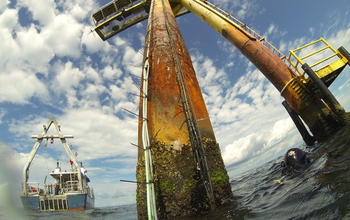
Research vessel Tioga waits for divers; they're under the Martha's Vineyard Coastal Observatory.

Research vessel Tioga waits for divers. They're under the Martha's Vineyard Coastal Observatory.
Credit and Larger Version

October 20, 2016
Changes in ocean temperature affect a key species of phytoplankton, according to scientists at the Woods Hole Oceanographic Institution (WHOI) funded by the National Science Foundation (NSF).
Their study, published in this week's issue of the journal Science, tracked levels of Synechococcus -- a tiny bacterium common in marine ecosystems -- near the coast of Massachusetts over a 13-year period.
"Synechococcus and other phytoplankton are sentinels," says WHOI biologist Heidi Sosik, who initiated the study. "They tell us how an ecosystem is responding to shifts in climate."
As ocean temperatures increased during the study period, annual blooms of Synechococcus occurred up to four weeks earlier, researchers found, because cells divide faster in warmer waters. Such shifts could have major effects on marine ecosystems worldwide, according to Sosik.
If ocean temperatures continue warming over the next century, some ecosystems could become dominated by small phytoplankton, eventually leading to changes that could affect larger species like fish, whales and birds, Sosik says.
That growth in smaller phytoplankton isn't a sure thing, however.
"Now that we have the appropriate technology to study phytoplankton on time scales of hours to weeks, we're gaining a much better understanding of what controls phytoplankton populations in coastal ocean ecosystems," says David Garrison, program director in NSF's Division of Ocean Sciences, which funded the research.
Although Sosik and colleagues saw that Synechococcus cells reproduced faster than usual as conditions warmed, the overall size of the phytoplankton bloom didn't increase much during the course of the study.
As the bacteria grew more quickly, tiny protozoa, viruses and other single-celled organisms that prey on Synechococcus consumed them more quickly.
"That was a surprise to us," says Sosik. "We didn't expect such a tight lockstep among Synechococcus and its consumers as the spring bloom changed. It shows that the consumers are able to keep up."
This balance of bacteria and consumers leads to a similar bloom cycle year after year, but with a shift in timing earlier or later as the water temperature changes, Sosik says.
"The question is: How stable is that balance?" asks Kristen Hunter-Cervera, lead author of the paper and a graduate of the MIT-WHOI Joint Program in Oceanography. "In the future, will consumer species be able to keep up? A mismatch is a huge concern. If the bloom expands, or moves earlier in the year, higher-level organisms that feed on those consumers at a certain time of year might miss them entirely."
The team was able to determine division rates of Synechococcus by using an automated sensor called "FlowCytobot," developed by Sosik and WHOI colleague Rob Olson. FlowCytobot continually sampled seawater for 13 years.
The device looks for the physical characteristics of Synechococcus cells, which are roughly one micrometer in diameter and contain compounds that glow orange and red under laser light.
Using this method to tally cells has allowed the researchers to home in on just one species of phytoplankton among thousands in seawater -- the first time such a long-term experiment has been able to do so.
"Looking at physiology at the species level is a holy grail in marine ecology," Sosik says. "Each species interacts with its environment in a different way, so to understand the effects of something like temperature, it's critical to be able to study a single species. Doing that every hour, every day, every year gave us a very high-resolution picture. There's nothing like this out there."
The Gordon and Betty Moore Foundation, NASA, a National Defense Science and Engineering graduate fellowship from the U.S. Department of Defense, and WHOI also supported the work.
-NSF-
Media Contacts Cheryl Dybas, NSF, (703) 292-7734,
cdybas@nsf.gov
Stephanie Murphy, WHOI, (508) 566-3055,
Related WebsitesNSF Grant: MRI Development: Imaging FlowCytobot on Autonomous Vehicles for Plankton Research and Harmful Algal Bloom Mitigation:


The National Science Foundation (NSF) is an independent federal agency that supports fundamental research and education across all fields of science and engineering. In fiscal year (FY) 2016, its budget is $7.5 billion. NSF funds reach all 50 states through grants to nearly 2,000 colleges, universities and other institutions. Each year, NSF receives more than 48,000 competitive proposals for funding and makes about 12,000 new funding awards. NSF also awards about $626 million in professional and service contracts yearly.
Useful NSF Web Sites:
NSF Home Page:
 https://www.nsf.gov
NSF News:
https://www.nsf.gov/news/
For the News Media:
 https://www.nsf.gov/news/newsroom.jsp
Science and Engineering Statistics:
 https://www.nsf.gov/statistics/
Awards Searches:
 https://www.nsf.gov/awardsearch/
Researcher Bennett Lambert assists with FlowCytobot at the Martha's Vineyard Coastal Observatory.
Credit and Larger Version
Divers from the Martha's Vineyard Coastal Observatory operations team return topside to the Tioga.
Credit and Larger Version
Diver's view of shipboard operations as scientist Rob Olson reaches to recover a float.
Credit and Larger Version
Researcher Kristen Hunter-Cevera uses low-tech bucket-sampling to collect seawater for analysis.
Credit and Larger Version
Scientists Rob Olson and Heidi Sosik work on the FlowCytobot automated submersible plankton sensor.
Credit and Larger Version
The National Science Foundation (NSF)
Guillermo Gonzalo Sánchez Achutegui
ayabaca@gmail.com
ayabaca@Hotmail.com
ayabaca@yahoo.com
Inscríbete en el Foro del blog y participa : A Vuelo De Un Quinde - El Foro!

domingo, 8 de noviembre de 2015

NASA : NASA to Fly, Sail North to Study Plankton-Climate Change Connection .- NASA volará, Vela del Norte para estudiar la conexión del cambio climático y el Plancton........

Hola amigos: A VUELO DE UN QUINDE EL BLOG., NASA comienza un estudio de cinco años este mes del ciclo anual del fitoplancton y el impacto que las pequeñas partículas en el aire emitidas por el océano tienen sobre el Atlántico Norte sensibles al clima.
The agency's North Atlantic Aerosols and Marine Ecosystems Study (NAAMES);  recogerá datos durante las campañas de medición de los buques y aeronaves y combinar esos datos con lecturas de satélites y sensores océano continuas. La primera de las cuatro misiones de investigación de temporada comienza 06 de noviembre y continúa hasta principios de diciembre.
More information....

NASA’s C-130H Hercules airborne laboratory begins research flights over the North Atlantic Nov. 12 from St. John’s, Newfoundland
NASA’s C-130H Hercules airborne laboratory begins research flights over the North Atlantic Nov. 12 from St. John’s, Newfoundland, Canada, the agency's North Atlantic Aerosols and Marine Ecosystems Study (NAAMES).
Credits: NASA
Woods Hole Oceanographic Institution's research vessel Atlantis
The research vessel Atlantis, operated by the Woods Hole Oceanographic Institution, will provide detailed ship-based measurements of plankton in the North Atlantic as part of the North Atlantic Aerosols and Marine Ecosystems Study (NAAMES).
Credits: Woods Hole Oceanographic Institution
 
NASA begins a five-year study this month of the annual cycle of phytoplankton and the impact that small airborne particles emitted from the ocean have on the climate-sensitive North Atlantic.

The North Atlantic Aerosols and Marine Ecosystems Study (NAAMES) will collect data during ship and aircraft measurement campaigns and combine that data with continuous satellite and ocean sensor readings. The first of four seasonal research missions begins Nov. 6 and continues through early December.

NASA’s C-130H Hercules airborne laboratory will begin research flights Nov. 12 from St. John’s International Airport in St. John’s, Newfoundland. The flights will be coordinated with the research vessel (R/V) Atlantis, operated by the Woods Hole Oceanographic Institution in Woods Hole, Massachusetts. Atlantis will provide detailed ship-based measurements of plankton in the North Atlantic.

“We will be studying an ocean region that every year exhibits one of the largest natural phytoplankton blooms on Earth,” said Mike Behrenfeld, NAAMES principal investigator from Oregon State University in Corvallis. “These plankton are also known to release organic compounds into the atmosphere that can be measured as far away as Ireland. That makes the North Atlantic an ideal place to study how plankton blooms are recreated each year by ecological and physical processes, and how ocean biology is involved in the sea-air exchange of organic aerosols and trace gases that may influence clouds and climate.”

The C-130H will fly eastward to rendezvous with and overfly the global-class, floating laboratory-ship Atlantis during its approximately 26-day research cruise. By combining ship, airborne, computer modeling, sustained satellite and autonomous sensor data, scientists hope to improve their predictions of ecosystem and aerosol changes in a warming ocean.

Plankton ecosystems in the ocean are strongly interconnected with climate and life on Earth. Plankton production, responding to a warming climate, results in environmental impacts such as changes in fisheries production, uptake of atmospheric carbon dioxide, and ocean emissions of climate-regulating aerosols. The ability to predict the consequences of a warming ocean depends on resolving conflicting theories about what controls plankton ecosystems and their aerosol emissions.

NASA’s Langley Research Center in Hampton, Virginia, has science and project management responsibilities for NAAMES and science instruments onboard the C-130H. The agency’s Goddard Space Flight Center in Greenbelt, Maryland, leads project data management. The NAAMES ship and airborne science-instrument teams involve more than 20 different research facilities and academic institutions. NASA’s Wallops Flight Facility Aircraft Office in Virginia operates the C-130H research aircraft to support airborne scientific research activities.

The NASA C-130H and the R/V Atlantis supporting the NAAMES mission will be available to the media at two different events this month. On Wednesday, Nov. 4 from 10 to 11:30 a.m. EST, media can tour the Atlantis at Woods Hole, located at 86 Water St. The C-130H will be available on Tuesday, Nov. 10 from 10 to 11:30 a.m. Newfoundland Time Zone, in Hangar #4 of St. John’s International Airport, located at RCAF Road in St. John’s.

NAAMES is part of NASA’s second series of Earth Venture suborbital investigations that provide an innovative approach to regularly address Earth science research that accommodates evolving scientific priorities. Earth Venture investigations are part of NASA's Earth System Science Pathfinder Program, managed at Langley for NASA’s Science Mission Directorate in Washington.

NASA researchers collect and study data from space, air, land and sea to tackle challenges facing the world today, including improved environmental prediction and natural hazard and climate change preparedness. NASA develops new ways to observe and study Earth's interconnected natural systems with long-term data records. The agency freely shares this unique knowledge and works with institutions around the world to gain new insights into how our planet is changing.

For more information about NAAMES, go to:


For more information about NASA’s Earth science activities, visit:


- end -
Steve Cole
Headquarters, Washington
202-358-0918
stephen.e.cole@nasa.gov

Chris Rink
Langley Research Center, Hampton, Va.
757-864-6786
chris.rink@nasa.gov
Last Updated: Nov. 4, 2015
Editor: Karen Northon
Tags:  Climate,
NASA
Guillermo Gonzalo Sánchez Achutegui
Inscríbete en el Foro del blog y participa : A Vuelo De Un Quinde - El Foro!

domingo, 11 de enero de 2015

NASA : Coloring the Sea Around the Pribilof Islands.- Un coloreado Mar alrededor de las islas Pribilof

Hola amigos: A VUELO DE UN QUINDE EL BLOG., hemos recibido información de la Fundación Nacional de Ciencia, de Los Estados Unidos; acerca det trabajo de investigación de : El Operativo Land Imager (OLI) en Landsat 8 capturó esta vista de un florecimiento de fitoplancton cerca de las islas Pribilof de Alaska el 22 de septiembre de 2014. Los Pribilofs están rodeados de aguas ricas en nutrientes en el mar de Bering. El sombreado azul verde y luz lechosa del agua indica la presencia de grandes poblaciones de fitoplancton microscópico-en su mayoría cocolitóforos, que tienen escalas de calcita que aparecen en blanco en las imágenes de satélite. Tal fitoplancton forman la base de un hábitat tremendamente productivo para peces y aves...."
Coloring the Sea Around the Pribilof Islands
The Operational Land Imager (OLI) on Landsat 8 captured this view of a phytoplankton bloom near Alaska’s Pribilof Islands on Sept. 22, 2014. The Pribilofs are surrounded by nutrient-rich waters in the Bering Sea. The milky green and light blue shading of the water indicates the presence of vast populations of microscopic phytoplankton—mostly coccolithophores, which have calcite scales that appear white in satellite images. Such phytoplankton form the foundation of a tremendously productive habitat for fish and birds.
Blooms in the Bering Sea increase significantly in springtime, after winter ice cover retreats and nutrients and freshened water are abundant near the ocean surface. Phytoplankton populations plummet in summertime as the water warms, surface nutrients are depleted by blooms, and the plant-like organisms are depleted by grazing fish, zooplankton, and other marine life. By autumn, storms can stir nutrients back to the surface and cooler waters make better bloom conditions.
Image Credit: NASA/Landsat 8
NASA
Guillermo Gonzalo Sánchez Achutegui
ayabaca@gmail.com
ayabaca@yahoo.com
ayabaca@hotmail.com
Inscríbete en el Foro del blog y participa : A Vuelo De Un Quinde - El Foro!

Mi lista de blogs