 Credit and Larger Version |
New research results suggest that magma sitting 4-5 kilometers beneath the surface of Oregon's Mount Hood has been stored in near-solid conditions for thousands of years.
The time it takes to liquefy and potentially erupt, however, is surprisingly short--perhaps as little as a couple of months.
The key to an eruption, geoscientists say, is to elevate the temperature of the rock to more than 750 degrees Celsius, which can happen when hot magma from deep within the Earth's crust rises to the surface.
It was the mixing of hot liquid lava with cooler solid magma that triggered Mount Hood's last two eruptions about 220 and 1,500 years ago, said Adam Kent, an Oregon State University (OSU) geologist and co-author of a paper reporting the new findings.
Results of the research, which was funded by the National Science Foundation (NSF), are in this week's journal Nature.
"These scientists have used a clever new approach to timing the inner workings of Mount Hood, an important step in assessing volcanic hazards in the Cascades," said Sonia Esperanca, a program director in NSF's Division of Earth Sciences.
"If the temperature of the rock is too cold, the magma is like peanut butter in a refrigerator," Kent said. "It isn't very mobile.
"For Mount Hood, the threshold seems to be about 750 degrees (C)--if it warms up just 50 to 75 degrees above that, it greatly decreases the viscosity of the magma and makes it easier to mobilize."
The scientists are interested in the temperature at which magma resides in the crust, since it's likely to have important influence over the timing and types of eruptions that could occur.
The hotter magma from deeper down warms the cooler magma stored at a 4-5 kilometer depth, making it possible for both magmas to mix and be transported to the surface to produce an eruption.
The good news, Kent said, is that Mount Hood's eruptions are not particularly violent. Instead of exploding, the magma tends to ooze out the top of the peak.
A previous study by Kent and OSU researcher Alison Koleszar found that the mixing of the two magma sources, which have different compositions, is both a trigger to an eruption and a constraining factor on how violent it can be.
"What happens when they mix is what happens when you squeeze a tube of toothpaste in the middle," said Kent. "Some comes out the top, but in the case of Mount Hood it doesn't blow the mountain to pieces."
The study involved scientists at OSU and the University of California, Davis. The results are important, they say, because little was known about the physical conditions of magma storage and what it takes to mobilize that magma.
Kent and UC-Davis colleague Kari Cooper, also a co-author of the Nature paper, set out to discover whether they could determine how long Mount Hood's magma chamber has been there, and in what condition.
When Mount Hood's magma first rose up through the crust into its present-day chamber, it cooled and formed crystals.
The researchers were able to document the age of the crystals by the rate of decay of naturally occurring radioactive elements. However, the growth of the crystals is also dictated by temperature: if the rock is too cold, they don't grow as fast.
The combination of the crystals' age and apparent growth rate provides a geologic fingerprint for determining the approximate threshold for making the near-solid rock viscous enough to cause an eruption.
"What we found was that the magma has been stored beneath Mount Hood for at least 20,000 years--and probably more like 100,000 years," Kent said.
"During the time it's been there, it's been in cold storage--like peanut butter in the fridge--a minimum of 88 percent of the time, and likely more than 99 percent of the time."
Although hot magma from below can quickly mobilize the magma chamber at 4-5 kilometers below the surface, most of the time magma is held under conditions that make it difficult for it to erupt.
"What's encouraging is that modern technology should be able to detect when the magma is beginning to liquefy or mobilize," Kent said, "and that may give us warning of a potential eruption.
"Monitoring gases and seismic waves, and studying ground deformation through GPS, are a few of the techniques that could tell us that things are warming."
The researchers hope to apply these techniques to other, larger volcanoes to see if they can determine the potential for shifting from cold storage to potential eruption--a development that might bring scientists a step closer to being able to forecast volcanic activity.
-NSF-

Media Contacts Cheryl Dybas, NSF, (703) 292-7734, cdybas@nsf.gov
Mark Floyd, OSU, (541) 737-0788, mark.floyd@oregonstate.edu
Andy Fell, UC-Davis, (530) 752-4533, ahfell@ucdavis.edu
Mark Floyd, OSU, (541) 737-0788, mark.floyd@oregonstate.edu
Andy Fell, UC-Davis, (530) 752-4533, ahfell@ucdavis.edu
Related WebsitesNSF Award: Collaborative Research: Tectonic Links, Magma Fluxes, and Single Mineral Geochemistry in Plutonic Systems From 5-30 km Depth, Cascades Core, Washington:
http://www.nsf.gov/awardsearch/showAward?AWD_ID=0948616&HistoricalAwards=false
NSF News: Triggers of Volcanic Eruptions in Oregon's Mount Hood Investigated:
NSF News: Triggers of Volcanic Eruptions in Oregon's Mount Hood Investigated:
The National Science Foundation (NSF) is an independent federal agency that supports fundamental research and education across all fields of science and engineering. In fiscal year (FY) 2014, its budget is $7.2 billion. NSF funds reach all 50 states through grants to nearly 2,000 colleges, universities and other institutions. Each year, NSF receives about 50,000 competitive requests for funding, and makes about 11,500 new funding awards. NSF also awards about $593 million in professional and service contracts yearly.

Useful NSF Web Sites:
NSF Home Page: http://www.nsf.gov
NSF News: http://www.nsf.gov/news/
For the News Media: http://www.nsf.gov/news/newsroom.jsp
Science and Engineering Statistics: http://www.nsf.gov/statistics/
Awards Searches: http://www.nsf.gov/awardsearch/
NSF Home Page: http://www.nsf.gov
NSF News: http://www.nsf.gov/news/
For the News Media: http://www.nsf.gov/news/newsroom.jsp
Science and Engineering Statistics: http://www.nsf.gov/statistics/
Awards Searches: http://www.nsf.gov/awardsearch/

Geoscientist Adam Kent considers results of studies of magma beneath Oregon's Mount Hood.
Credit and Larger Version

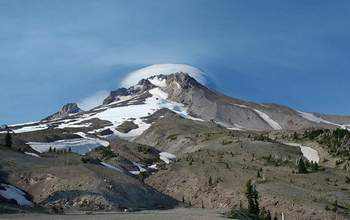
Gray volcanic deposits form ridges along the southeast and southwest flanks of Mount Hood.
Credit and Larger Version

All appears quiet today on Mount Hood.
Credit and Larger Version

New studies indicate that magma beneath Mount Hood, other volcanoes, could liquefy in a short time.
Credit and Larger Version

Mount Hood mirrored in a placid lake below. Will it always be this tranquil?
Credit and Larger Version
Guillermo Gonzalo Sánchez Achutegui
ayabaca@gmail.com
ayabaca@hotmail.com
ayabaca@yahoo.com
Inscríbete en el Foro del blog y participa : A Vuelo De Un Quinde - El Foro!