Mostrando entradas con la etiqueta Science. Mostrar todas las entradas

jueves, 18 de noviembre de 2021

Física : ¿Está a la vista el final del famoso reclamo de materia oscura? Nuevos datos arrojan más dudas sobre el controvertido resultado del experimento DAMA y surge una explicación alternativa

Hola amigos: A VUELO DE UN QUINDE EL BLOG., El drama del reclamo de materia oscura más controvertido del mundo puede haber llegado a su último acto, si no a su escena final. Durante dos décadas, los físicos con un experimento llamado DAMA han afirmado que las partículas de materia oscura, la materia invisible cuya gravedad parece unir nuestra galaxia, chocan con núcleos atómicos en su detector de partículas subterráneas, incluso cuando otras búsquedas de materia oscura quedan vacías. Ahora, los físicos con un detector llamado COSINE-100, diseñado para imitar a DAMA, presentan la refutación más directa hasta ahora de los hallazgos. Y en 2020, los teóricos identificaron una forma en la que la señal DAMA podría haber surgido inadvertidamente en el análisis del equipo.....  ....siga leyendo..............


Las partículas de materia oscura deberían generar destellos de luz en los cristales de yoduro de sodio del experimento COSINE. Su objetivo es probar la afirmación de materia oscura de un experimento similar. CHANG HYON HA

El drama del reclamo de materia oscura más controvertido del mundo puede haber llegado a su último acto, si no a su escena final. Durante dos décadas, los físicos con un experimento llamado DAMA han afirmado que las partículas de materia oscura, la materia invisible cuya gravedad parece unir nuestra galaxia, chocan con núcleos atómicos en su detector de partículas subterráneas, incluso cuando otras búsquedas de materia oscura quedan vacías. Ahora, los físicos con un detector llamado COSINE-100, diseñado para imitar a DAMA, presentan la refutación más directa hasta ahora de los hallazgos. Y en 2020, los teóricos identificaron una forma en la que la señal DAMA podría haber surgido inadvertidamente en el análisis del equipo.

El equipo de DAMA rechaza ambas afirmaciones. Rita Bernabei, física de la Universidad de Roma Tor Vergata y líder de DAMA, se negó a ser entrevistada. Pero descartó la nueva explicación en un correo electrónico: "Ya hemos demostrado que las suposiciones allí reportadas son insostenibles y las conclusiones no valen nada".

Se cree que la Vía Láctea gira dentro de una vasta nube de materia oscura, que podría consistir en hipotéticas partículas masivas de interacción débil (WIMP) . A medida que el Sistema Solar orbita el centro galáctico a 225 kilómetros por segundo, la Tierra presumiblemente choca con un viento de WIMP. Debido a que nuestro planeta también orbita alrededor del Sol a 30 kilómetros por segundo, el viento debería fortalecerse levemente cuando la Tierra se mueve en la misma dirección que el Sol, en junio, y disminuir cuando se mueve en la dirección opuesta, en diciembre.

Los físicos de DAMA han afirmado durante mucho tiempo ver este ciclo anual en su detector, que ahora contiene 25 cristales de 10 kilogramos de yoduro de sodio dopado con talio. Cada cristal produce un destello de luz cuando una partícula golpea un núcleo. El equipo de DAMA dice que, en un rango de baja energía que corresponde a los WIMP, el número de colisiones ha aumentado y disminuido cada año desde que comenzaron las observaciones en 1995.

Otros detectores no ven tal cosa. Pero esos experimentos utilizan diferentes materiales objetivo. Entonces, los grupos han construido detectores de yoduro de sodio que pueden probar el resultado de DAMA en una comparación de manzanas con manzanas. Uno es COSINE, que comprende ocho cristales por un total de 100 kilogramos y ha estado tomando datos desde 2016 en el laboratorio subterráneo Yangyang de Corea del Sur. Desde 2018, COSINE ha mejorado su sensibilidad 100 veces, dice Hyun Su Lee, co-portavoz del equipo y físico de partículas en el Instituto de Ciencias Básicas de Corea del Sur. Pero en 1.7 años de datos, no ven signos de WIMP , informan los investigadores hoy en Science Advances .

Hay una salvedad. El nuevo análisis COSINE no busca el ciclo anual en la tasa de eventos, sino simplemente un número excesivo de eventos de baja energía. Esa pequeña señal aparecería sobre un fondo mucho mayor de eventos causados ​​por la radiación de partículas ordinarias de fuentes tanto dentro como fuera de los cristales. Entonces, el análisis depende de la capacidad de los investigadores para modelar los detalles sutiles de esos antecedentes, señala Bernabei.

Sin embargo, COSINE no es el único experimento que prueba el resultado de DAMA. El detector ANAIS-112 contiene nueve cristales de yoduro de sodio con una masa total de 112 kilogramos y ha estado tomando datos en el laboratorio subterráneo de Canfranc de España desde 2017. Tres años de datos no muestran un ciclo anual en eventos de baja energía, informaron investigadores de ANAIS el 27 de mayo. en Physical Review D . Sin embargo, las incertidumbres eran un poco demasiado altas para descartar la señal DAMA, dice María Luisa Sarsa, física de la Universidad de Zaragoza y colíder de ANAIS.

Si la señal DAMA no es real, "el campo de la física de partículas se debe a sí mismo para descubrir lo que está viendo DAMA", dice Reina Maruyama, física de partículas nucleares de la Universidad de Yale y co-portavoz de COSINE. Y el año pasado, Dario Buttazzo, teórico de la sección de Pisa del Instituto Nacional de Física Nuclear de Italia, y sus colegas identificaron una forma en la que el equipo de DAMA podría haber creado inadvertidamente el ciclo anual.

Los investigadores de DAMA recopilan datos en carreras de un año. Para resaltar la variación en cada ejecución, restan la tasa promedio durante el año de la tasa de eventos medida cada día. Pero si la tasa de eventos aumenta o cae constantemente año tras año, la resta puede convertir una tendencia constante en una oscilación, dice Buttazzo. Por ejemplo, si la tasa aumentara un 1% cada año, el método de DAMA produciría una señal que comienza cada ejecución en –0,5% y finaliza cada ejecución en + 0,5%.

"Si haces el análisis como lo estaba haciendo DAMA, y si el fondo tiene una característica particular, entonces podrías tener ese efecto", dice Buttazzo, cuyo grupo informó su análisis en el Journal of High Energy Physics el 21 de abril de 2020. Pero advierte que debido a que DAMA no ha publicado sus datos, "no podemos saber si este efecto está realmente ahí o no".

Aún así, los documentos de COSINE y ANAIS sugieren que el tema podría ser importante. La tasa total de eventos del detector ANAIS está disminuyendo constantemente a medida que los núcleos radiactivos de corta duración de los cristales se desintegran, dice María Lucía Martínez Pérez, física de la Universidad de Zaragoza y colíder del equipo. COSINE ve una disminución constante similar, dice Lee.

El cierre podría llegar pronto. En semanas, COSINE lanzará un análisis de ciclo anual de 3 años, dice Lee. Sarsa de ANAIS dice que para el próximo verano, "Esperamos tener una publicación de alto impacto con la tasa promedio medida durante el año con los 5 años de datos". Eso puede ser suficiente información, dice, para bajar el telón de la afirmación de DAMA.

doi: 10.1126 / science.acx9619

SCIENCE

domingo, 2 de octubre de 2016

ESA : Ambition – Epilogue .- La ambición - Epílogo

http://www.esa.int/spaceinvideos/Videos/2016/09/Ambition_Epilogue
About JW Player 6.11.4923 (Premium edition)

Ambition – Epilogue


DOWNLOADMP4(18.48 MB)SOURCEMP4(844.86 MB)

Details

Open/Close
  • Title Ambition – Epilogue
  • Released: 28/09/2016
  • Length 00:02:12
  • Language English
  • Footage Type Music Clip
  • Copyright ESA/Platige Image
  • Description After her long, arduous training, our young Apprentice is now a fully fledged Master of cosmic origins, exploring an alien planet rich with water and life. But something familiar crosses her mind. Memories from her training, and Rosetta’s historic journey to catch a comet. She returns to the archives.
    Once again, ESA and Fish Ladder / Platige Image blur the lines between science fiction and science fact in this epilogue to their award-winning 2014 short film, Ambition, which portrayed the scientific questions and technical challenges, and above all, the human determination that make exploration of the Universe such a compelling theme.
    The epilogue is directed by Maciej Jackiewicz and stars Aisling Franciosi (The Fall, Game of Thrones).


TAGS

Open/Close
ESA
Guillermo Gonzalo Sánchez Achutegui
ayabaca@gmail.com
ayabaca@hotmail.com
ayabaca@yahoo.com
Inscríbete en el Foro del blog y participa : A Vuelo De Un Quinde - El Foro!

sábado, 1 de octubre de 2016

The National Science Foundation (NSF): NSF awards $94 million to create four new Science and Technology Centers .- NSF con premios de $ 94 millones de dólares para crear cuatro nuevos Centros de Ciencia y Tecnología...............

https://www.nsf.gov/news/news_summ.jsp?cntn_id=189782&WT.mc_id=USNSF_51&WT.mc_ev=click

Centers support long-term research at the forefront of innovation

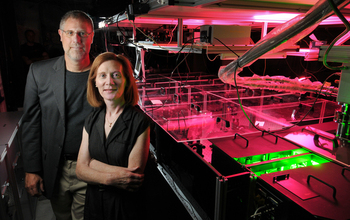
Margaret Murnane

Margaret Murnane is a physicist at the University of Colorado at Boulder.
Credit and Larger Version

September 26, 2016
Ambitious, complex research that leads to breakthrough discoveries requires large-scale, long-term investments. Today, the National Science Foundation (NSF) announces $94 million in funding to support four new Science and Technology Centers (STCs), partnerships that lay the foundations for advances in fields ranging from cell biology and mechanobiology to particle physics and materials science.
Each awardee will receive up to $24 million over a five-year period, with the possibility of a continuation for five additional years. In addition to these latest awards, NSF supports eight active STCs across the U.S.
Created in 1987, the STC Integrative Partnerships program supports collaborative, world-class research in areas of national importance. STCs address grand challenges at the intersection of scientific disciplines as well as focusing on new approaches to science and engineering within disciplines. Each STC involves partnerships across universities, federal labs, industry and other organizations.
"From deepening our understanding of intelligence, to developing energy-efficient electronics and next-generation polymers, NSF's Science and Technology Centers have stood at the forefront of discovery and innovation," said Suzi Iacono, head of the NSF Office of Integrative Activities. "The program's history sets high expectations for these newly awarded partnerships, and I'm pleased to see recipients poised to continue that legacy."
In addition to performing innovative research, STCs provide rich environments for training scientists and engineers. They actively integrate research and education, treating inquiry, discovery and creativity as inherent parts of the learning process. NSF also expects the centers to recruit, retain and mentor participants from groups traditionally underrepresented in science, technology, engineering and mathematics (STEM).
This year's four newly awarded STCs, principal investigators and their co-principal investigators and their sponsor institutions are:

Center for Bright Beams, J. Ritchie Patterson, Georg H. Hoffstaetter, Cornell University

Accelerators are important scientific tools that use beams of charged particles to investigate particle physics. This center's overarching research goal is to decrease the cost of key accelerator technologies while simultaneously increasing the intensity ("brightness") of charged particle beams by two orders of magnitude (roughly 100 times more intense). This STC will contribute to scientific advances in many disciplines, ranging from physics, to chemistry, to biology, by enhancing accelerator capabilities. The center will partner Cornell University with the University of Chicago; Chicago State University; the University of California, Los Angeles; the University of Florida; the University of Maryland; Brigham Young University; Morehouse College; Clark Atlanta University; the University of Toronto; the Fermi National Accelerator Laboratory; the Lawrence Berkeley National Laboratory; and TRIUMF (Canada's national laboratory for particle and nuclear physics and accelerator-based science).

Center for Cellular Construction, Wallace Marshall, Zev J. Gartner, Wendell Lim, University of California, San Francisco

Cell biology is a rapidly expanding field of science that explores the structure and properties of cells, yielding revolutionary discoveries in biology. This center's goal is to transform cell biology into a discipline that uses tools from engineering, and the physical and computer sciences to generate a greater understanding of the rules that govern cell behavior, while also enabling the design of cells that have useful functions. The center will develop tools to predict, design and test the impact on cellular function of changes to their internal organization. It will also create tools for building multicellular and multi-organism structures and develop living "bioreactors" that will generate products of commercial value. This STC will partner the University of California, San Francisco with University of California, Berkeley; San Francisco State University; Stanford University; the IBM Almaden Research Center; and the Exploratorium.

Science and Technology Center for Engineering MechanoBiology, Yale E. Goldman, Vivek B. Shenoy, Rebecca G. Wells, University of Pennsylvania; Guy Genin, Ram V. Dixit, Washington University in St. Louis; Christopher Chen, Boston University

Mechanobiology is a field that focuses on how forces influence plant and animal systems. This center's mission is to discover the principles that govern how biological systems communicate using molecular and cellular methods. The center will provide the intellectual foundations and materials for engineering new and powerful cell-based devices, and for training students in the foundations of mechanobiology. The center will bring together leading researchers from a diverse group of disciplines and institutions at the intersection of biology, mechanics and engineering. This STC will partner the University of Pennsylvania with Washington University in St. Louis; the University of Maryland; the New Jersey Institute of Technology; Bryn Mawr College; Alabama State University; and Boston University.
 
Science and Technology Center on Real-Time Functional Imaging, Margaret Murnane, Rafael Piestun, Markus B. Raschke, University of Colorado at Boulder; Naomi S. Ginsberg, University of California, Berkeley; Jianwei Miao, University of California, Los Angeles

As discoveries in science and technology proliferate at the nanometer and atomic scales, real-time functional imaging, which gives researchers the ability to detect what's happening at those tiny scales, becomes increasingly important. This center aims to advance real-time functional imaging by moving away from the current approach of using microscopes that employ a single imaging method -- optical, X-ray, nano-probe or electron microscopy, for example -- by combining and improving those techniques. Ultimately, the center seeks to enhance the research community's understanding of the structure and functionality of various types of matter as they change over time. This STC will partner the University of Colorado at Boulder with Fort Lewis College; Florida International University; the University of California, Berkeley; the University of California, Irvine and the University of California, Los Angeles.
-NSF-

Media Contacts Robert J. Margetta, NSF, (703) 292-2663,
rmargett@nsf.gov


The National Science Foundation (NSF) is an independent federal agency that supports fundamental research and education across all fields of science and engineering. In fiscal year (FY) 2016, its budget is $7.5 billion. NSF funds reach all 50 states through grants to nearly 2,000 colleges, universities and other institutions. Each year, NSF receives more than 48,000 competitive proposals for funding and makes about 12,000 new funding awards. NSF also awards about $626 million in professional and service contracts yearly.
 Get News Updates by Email 
Useful NSF Web Sites:
NSF Home Page:
https://www.nsf.gov
NSF News:
 https://www.nsf.gov/news/
For the News Media:
https://www.nsf.gov/news/newsroom.jsp
Science and Engineering Statistics:
https://www.nsf.gov/statistics/
Awards Searches:
 https://www.nsf.gov/awardsearch/

Wallace Marshall is a biochemistry professor at the University of California, San Francisco.
Credit and Larger Version
Yale E. Goldman is a professor of physiology at the University of Pennsylvania.
Credit and Larger Version
J. Ritchie Patterson is a physics professor at Cornell University.
Credit and Larger Version
The National Science Foundation (NSF)
Guillermo Gonzalo Sánchez Achutegui
ayabaca@gmail.com
ayabaca@hotmail.com
ayabaca@yahoo.com
Inscríbete en el Foro del blog y participa : A Vuelo De Un Quinde - El Foro!

domingo, 4 de septiembre de 2016

ESA : Comet dust flyover .- Paso elevado de polvo de cometa

http://www.esa.int/spaceinvideos/Videos/2016/08/Comet_dust_flyover

About JW Player 6.11.4923 (Premium edition)


ESA in your country > Spain

Sobevolando el polvo del cometa. Créditos: ESA/Rosetta/IWF para el equipo de MIDAS IWF/EA/LATMOS/Universiteit Leiden/Universität Wien.
Access the video

Imágenes en 3D del polvo del cometa

1 septiembre 2016
Rosetta ha procesado con MIDAS, el sistema de microimágenes para el análisis de polvo, los granos de polvo más pequeños nunca vistos del cometa 67P/Churyumov-Gerasimenko.
MIDAS recopila y escanea las partículas mediante un microscopio de fuerza atómica. Para ello utiliza una punta ultrafina, similar a la aguja utilizada en los tocadiscos, que pasa por cada partícula. La deflexión de la punta y, con ella, la altura de la muestra se miden para generar una imagen 3D. De esta forma, los científicos pueden determinar la estructura de la partícula, obteniendo así datos de cómo pudo formarse.
 
MIDAS partículas A, B y C. Créditos: ESA/Rosetta/IWF para el equipo de MIDAS IWF/ESA/LATMOS/Universiteit Leiden/Universität Wien.

Los resultados más recientes, publicados en la revista Nature, demuestran que las partículas de polvo siguen siendo agregados con un tamaño por debajo del umbral ya indicado por el instrumento COSIMA. Esto quiere decir que incluso a escalas minúsculas, de varias decenas de micras a varios cientos de nanómetros, los granos de polvo analizados por MIDAS parecen estar formado por la acumulación de numerosos granos aún más pequeños.
“Para entender cómo se forman los cometas, tenemos que conocer la estructura de los granos más pequeños y comprender cómo se forman”, reconoce Mark Bentley, del Instituto de investigación espacial de la Academia austriaca de ciencia en Graz (Austria), investigador principal de MIDAS y autor principal del artículo.
“Lo que está demostrando MIDAS es que todo está formado por agregados de materiales cada vez más pequeños; es algo parecido a lo que ve el instrumento COSIMA, pero a escalas cada vez menores”.
 
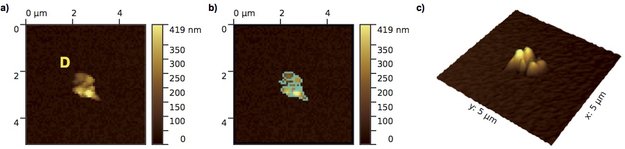
MIDAS partícula D. Créditos: ESA/Rosetta/IWF para el equipo de MIDAS IWF/ESA/LATMOS/Universiteit Leiden/Universität Wien.

MIDAS detectó tanto granos pequeños y ‘compactos’ como granos de mayor tamaño, ‘esponjosos’, porosos y con el material más suelto. Los granos del cometa también parecen estar elongados, ya que son varias veces más largos en una dirección que en las restantes, algo que también coincide con las observaciones de polvo en el medio interestelar.
 
MIDAS partícula E - una Créditos: ESA/Rosetta/IWF para el equipo de MIDAS IWF/ESA/LATMOS/Universiteit Leiden/Universität Wien.
 
Las figuras que ilustran esta entrada muestran ejemplos de los distintos tipos de granos recogidos por MIDAS entre mediados de noviembre de 2014 y febrero de 2015.
Un grano poroso y especialmente grande, procedente de 67P/C-G, presenta unas propiedades parecidas a las de las llamadas ‘partículas de polvo interplanetarias’ (IDP), agregados de granos esferoidales más pequeños que se podrían haber compactado durante las fases tempranas de formación de nuestro Sistema Solar.
Los nuevos resultados de MIDAS respaldan la teoría que vincula los IDP con el polvo de cometa. La estructura de tipo “agregado de agregados” de las partículas da cuenta de su mecanismo de formación y de cómo tales partículas podrían haber formado una capa débilmente adherida a la superficie del núcleo del cometa.
El artículo “Aggregate dust particles at comet 67P/Churyumov-Gerasimenko”, de M. S. Bentley et al., está publicado en Nature.


Comet dust flyover


Details

Open/Close
  • Title Comet dust flyover
  • Released: 31/08/2016
  • Length 00:02:00
  • Language English
  • Footage Type Animation
  • Copyright ESA/Rosetta/IWF for the MIDAS team IWF/ESA/LATMOS/Universiteit Leiden/Universität Wien
  • Description Rosetta has imaged the smallest grains of Comet 67P/Churyumov-Gerasimenko’s dust yet, with its Micro-Imaging Dust Analysis System, MIDAS. The three-dimensional nature of five representative dust particles is visualised in this animation. It shows the complexity of the shapes of the dust particles, which are in turn made up of smaller and smaller dust grains.
    In general, the particles are either classified as small, tightly packed ‘compact’ grains or larger more porous, loosely arranged ‘fluffy’ grains.
    But, even though it may appear like we are flying over of a mountain range in this animation, these particles are extremely small: they range from a few tens of micrometres down to just a few hundred nanometres.
    Find out more: Imaging tiny comet dust in 3D

ESA
Guillermo Gonzalo Sánchez Achutegui
ayabaca@gmail.com
ayabaca@hotmail.com
ayabaca@yahoo.com
Inscríbete en el Foro del blog y participa : A Vuelo De Un Quinde - El Foro!

viernes, 4 de marzo de 2016

NSF: Celebrating women in science and engineering ..- Celebración de las mujeres en la ciencia y la ingeniería

http://www.nsf.gov/discoveries/disc_summ.jsp?cntn_id=137862&WT.mc_id=USNSF_51&WT.mc_ev=click

NSF Director shares her thoughts on Women's History Month
France Cordova and Gabriela Gonzalez at LIGO
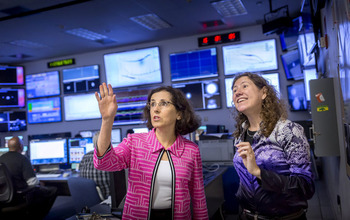
NSF Director France Córdova and LIGO Spokesperson Gabriela Gonzalez at LIGO.
Credit and Larger Version
March 3, 2016
The following is a post from Notes from the Field, the blog of NSF Director France Córdova.
This month we recognize and honor the many achievements of women scientists and engineers in celebration of Women's History Month. The National Science Foundation (NSF) was founded in the aftermath of a world war, one that brought women into the workplace in far greater numbers than ever before. They helped win the war even as they broke a cultural barrier, demonstrating women could succeed and prosper in a workforce previously dominated by men.
 
We've come a long way since those Rosie the Riveter days, especially in science, technology, engineering and mathematics (STEM). Women have earned about 50 percent of all science and engineering bachelor's degrees since the late 1990s. Women's share of full-time, full professorships has more than doubled since 1993. NSF programs like ADVANCE -- which works at an institutional level to support women in STEM careers -- have helped spark large-scale comprehensive change and institutional transformation.
 
Despite advances in overall STEM degrees, women are still vastly underrepresented in fields like physics and engineering; the number of women receiving a bachelor's degree in computer science has actually declined since 2002. This spills over into disparities in employment and even salary: In 2013, median salaries were highest for those with doctorates in computer and information sciences and engineering, fields in which men outnumber women substantially.
 
To close these gaps, we must promote gender diversity in STEM education, and support women every step along their path to a science or engineering career. And we must get more girls excited about STEM. Every child has a moment when their imagination is sparked by science and engineering. Watching Neil Armstrong and Buzz Aldrin step onto the Moon was that moment for me -- it was a reminder of my early, innate interest in science and space.
 
Imagine if we could keep that spark alive and nurture it. We would have a new generation of scientists and engineers, a new STEM-savvy generation. NSF funds many great programs that target young women and girls, from after-school robot programming classes to award-winning television shows. A new NSF initiative, called INCLUDES, will help expand work like this, bringing more girls, women, minorities and other underrepresented groups into STEM.
 
This month, we'll be sharing stories of women in STEM on NSF platforms. I want to thank the countless women who work tirelessly in science and engineering, who take risks and make discoveries and inspire others. I often give similar advice to students and young scientists across the U.S.: Be confident in your journey. In my career, I've had to take some calculated risks and depart from the path of others to remain true to my own scientific vision. It's important to understand the work of people who came before you, but also dare to write history for those who will follow.
-- Jessica Arriens, (703) 292-2243 jarriens@nsf.gov
border=0/


The National Science Foundation (NSF)
Guillermo Gonzalo Sánchez Achutegui
Inscríbete en el Foro del blog y participa : A Vuelo De Un Quinde - El Foro!

viernes, 2 de mayo de 2014

nsf.gov - National Science Foundation - Study suggests survival isn't always about competition

New research findings contradict one of Darwin's hypotheses, which encourages prioritizing species for conservation based on evolutionary or genetic uniqueness
researchers in a lab
Researchers' experiments ultimately challenged one of Darwin's hypotheses related to competition.
Credit and Larger Version
May 1, 2014
One of Charles Darwin's hypotheses posits that closely related species will compete for food and other resources more strongly with one another than with distant relatives, because they occupy similar ecological niches. Most biologists have long accepted this to be true.
Thus, three researchers were more than a little shaken to find that their experiments on fresh-water green algae failed to support Darwin's hypothesis.
"It was completely unexpected," says Bradley Cardinale, an associate professor in the University of Michigan's school of natural resources and environment. "We sat there banging our heads against the wall. Darwin's hypothesis has been with us for so long, how can it not be right?"
The researchers--who also included Charles Delwiche, a professor of cell biology and molecular genetics at the University of Maryland, and Todd Oakley, a professor in the department of ecology, evolution and marine biology at the University of California, Santa Barbara--were so uncomfortable with their results that they spent the next several months trying to disprove their own work. But the research held up.
"The hypothesis is so intuitive that it was hard for us to give it up. But we are becoming more and more convinced that he wasn't right about the organisms we've been studying," Cardinale says. "It doesn't mean the hypothesis won't hold for other organisms, but it's enough that we want to get biologists to rethink the generality of Darwin's hypothesis."
 
Preserving species
The assumptions underlying Darwin's hypothesis are important for conservation policy, since they essentially encourage decision-makers to prioritize species preservation based on how evolutionarily or genetically unique they are. "We don't have enough time, people or resources to save everything," Cardinale says. "A large number of species will go extinct and we have to prioritize which ones we will save.
"Many biologists have argued that we should prioritize for conservation those species that are genetically unique, and focus less on those species that are genetically more similar," he adds. "The thinking is that you might be able to tolerate the loss of species that are redundant. In other words, if you lost a redundant species, you might not see a change."
But if scientists ultimately prove Darwin wrong on a larger scale, "then we need to stop using his hypothesis as a basis for conservation decisions," Cardinale says. "We risk conserving things that are the least important, and losing things that are the most important. This does bring up the question: How do we prioritize?"
The scientists did not set out to disprove Darwin, but, in fact, to learn more about the genetic and ecological uniqueness of fresh-water green algae so they could provide conservationists with useful data for decision-making. "We went into it assuming Darwin to be right, and expecting to come up with some real numbers for conservationists," Cardinale says. "When we started coming up with numbers that showed he wasn't right, we were completely baffled."
The National Science Foundation is supporting the work with $2 million over five years, awarded in 2010.
 
Experiments with green algae
The researchers sequenced 60 species of algae most common in North America and can describe with a high certainty their evolutionary relationships. "We know which ones are ancient and have become genetically unique, and which are new and recently diverged," he says.
Their experiments involved taking closely related species and putting them into competition, and taking evolutionarily ancient distantly related species and similarly pitting them against each other.
They also sent graduate students into natural lakes to gather samples, including one lake with "the most spectacular group of green algae," as well as something else, prompting the nickname "Leech Lake."
When the students stood in the water to collect their samples, "the entire bottom of the lake would start moving toward them," Cardinale says. "They would congregate on their boots, and start crawling up their legs. The challenge was to get the samples before the leeches got into their waders."
Samples obtained, they put species that have different evolutionary histories into bottles and measured how strongly they competed for essential resources such as nitrogen, phosphorus and light.
"If Darwin had been right, the older, more genetically unique species should have unique niches, and should compete less strongly, while the ones closely related should be ecologically similar and compete much more strongly – but that's not what happened," Cardinale says. "We didn't see any evidence of that at all.” They found this to be so in field experiments, lab experiments and surveys in 1,200 lakes in North America.
"If Darwin was right, we should've seen species that are genetically different and ecologically unique, doing unique things and not competing with other species," he adds. "But we didn't."
 
Traits and the quality of competition
Certain traits determine whether a species is a successful competitor or a poor competitor, he says. "Evolution does not appear to predict which species have good traits and bad traits," he says. "We should be able to look at the Tree of Life, and evolution should make it clear who will win in competition and who will lose. But the traits that regulate competition can't be predicted from the Tree of Life."
The scientists have a few ideas of what may be going on, and why Darwin's hypothesis is incorrect, at least for this group of organisms.
"Organisms like algae can be plastic. Maybe they all have the same genes that do the same things and can turn them off and on at different times," he says. "Maybe they sometimes can flip a switch for nitrogen on or off, or all at the same time. If we are correct, and they are not diverging in the genes that control competition, maybe they are diverging in other genes."
Darwin "was obsessed with competition," Cardinale says. "He assumed the whole world was composed of species competing with each other, but we found that one-third of the species of algae we studied actually like each other. They don't grow as well unless you put them with another species. It may be that nature has a heck of a lot more mutualisms than we ever expected.
"Maybe species are co-evolving," he adds. "Maybe they are evolving together so they are more productive as a team than they are individually. We found that more than one-third of the time, that they like to be together. Maybe Darwin's presumption that the world may be dominated by competition is wrong."
Cardinale's broad research goal is to gain a better understanding of how human alteration of the environment affects the biotic diversity of communities and, in turn, the impact of this loss on fluxes of energy and matter required to sustain life. "I focus on this because I believe that global loss of biodiversity ranks among the most important and dramatic environmental problems in modern history," he says.
Editor's Note: This Behind the Scenes article was first provided to LiveScience in partnership with the National Science Foundation.
-- Marlene Cimons, National Science Foundation
Investigators Todd Oakley
Xiaoxia Lin
Phillip Savage
Bradley Cardinale
Related Institutions/Organizations University of Michigan Ann Arbor
Total Grants $2,770,718

Researcher Bradley Cardinale stands in front of 180 algal chemostats used for experiments.
Credit and Larger Version
Two women in a lab with algal samples
Undergraduate and postdoc take samples during competition experiments.
Credit and Larger Version
students in a lab working on samples
Experiments on fresh-water green algae failed to support one of Darwin's hypothesis.
Credit and Larger Version
The National Science Foundation (NSF)
Guillermo Gonzalo Sánchez Achutegui

nsf.gov - Discovery - Clarity for lake researchers' water quality questions

Studies of trends in Midwestern lakes benefit from help of local residents
Sign on a lake with algae reads for swimmers health please don't feed the ducks
The discovery is the first report of a virus carrying genes for sulfur oxidation.
Credit and Larger Version
May 1, 2014
Scientists engaged in a study of long-term water quality trends in Midwestern lakes found some good news: little change in water clarity in more than 3,000 lakes.
Look deeper, and the research becomes something more: a chronicle of a new source of data for scientists, data from residents of towns and villages surrounding the lakes.
The results are published this week in a paper in the journal PLOS ONE.
The paper co-authors analyzed almost a quarter of a million observations taken over seven decades on 3,251 lakes in eight Midwestern states.
 
Enter local residents
But the researchers didn't collect those data. The observations came from lakefront homeowners, boaters, anglers and other interested members of the public wanting to know more about what's going on in "their" lakes.
Noah Lottig, a co-author of the paper and a scientist at the University of Wisconsin-Madison's Center for Limnology, says that ecologists are looking at big-picture issues--such as how changes in land use or climate affect ecosystems--at state, national and continental scales.
This time, the help of local residents was key to the findings.
"This study highlights research opportunities using data collected by citizens making important environmental measurements," says Elizabeth Blood, program director in the National Science Foundation's (NSF) Directorate for Biological Sciences, which funded the work through its MacroSystems Biology Program. "Their efforts provide scientists with data at space and time scales often not available by other means."
 
Water clarity from a Secchi disk reading--or tens of thousands of them
Lottig and freshwater scientists from across the United States combed through state agency records and online databases. The water clarity measurements they sought were taken by non-scientists using a circular, plate-sized instrument called a Secchi disk.
Used in the aquatic sciences since the mid-1800s, Secchi disks hang from a rope and are lowered into the water until their distinct black-and-white pattern disappears from view, a distance that marks the "Secchi depth."
Lake associations and other groups have used the disks for decades to document conditions in their respective waters.
Previous studies have shown that local residents' Secchi readings are nearly as accurate as scientists' measurements, says Lottig.
With a dataset covering more than 3,000 lakes and stretching back to the late 1930s, the team decided to ask questions about long-term change.
 
Before and after the Clean Water Act
The Clean Water Act provided a useful frame of reference. Signed into law in 1972, the act set water quality goals for all U.S. waters.
Thanks to the data collected by residents, Lottig's team had access to water clarity measurements for decades before and after the act came into effect.
Somewhere in that data, the researchers reasoned, they might detect a landscape-scale shift over time to clearer (often an indicator of cleaner) water.
While there was a slight one percent yearly increase in water clarity for the lakes, Lottig says, "most of the lakes are just chugging along, not changing much through time."
While some lakes improved, others did not. Taken as a whole, there was no major change in clarity at the landscape scale.
Lottig is part of the "Cross-Scale Interaction" or "CSI Limnology" project, an effort to collect global data on water chemistry and aquatic biology that will add needed context.
 
Townspeople weigh in
For Ken Fiske, collecting data has been well worth the effort.
In 1985, Fiske saw an announcement for volunteers for a new Wisconsin lake monitoring program. Fiske had been coming to northern Wisconsin from his home in Illinois for years and had recently bought property on the shoreline of Lake Adelaide.
"My interest was in finding out what the quality of water in Lake Adelaide was and seeing what we could do to maintain it," he says.
For the next several years, Fiske went on a monthly five-hour drive to Lake Adelaide to take measurements. Eventually, he found some neighbors to help. Some 30 years later, the group is still going strong.
"We've been doing it long enough that it makes the results meaningful," Fiske says.
Scientists are harnessing efforts like Fiske's to try to answer questions about not just one lake, but 3,251--or more--of them.
-- Cheryl Dybas, NSF (703) 292-7734
  cdybas@nsf.gov
-- Adam Hinterthuer, University of Wisconsin - Madison (608) 890-2187
  hinterthuer@wisc.edu
Investigators Noah Lottig
Emily Stanley
Related Institutions/Organizations University of Wisconsin-Madison
Total Grants $591,461
Reflection of boat on the water to see transparency in Lake Mendota, Wisconsin.
Scientists measure the water's transparency in Lake Mendota, Wisc.
Credit and Larger Version
Underwater view of a Secchi disk, used to measure water clarity, dropping through the water column.
Credit and Larger Version
Image showing people on a boat on a lake
Scientist teaching area residents the best ways to monitor water quality in lakes.
Credit and Larger Version
Children looking at a Secchi disk being lowered into the water to measure transparency
Children learn how to measure water quality with a Secchi disk.
Credit and Larger Version
Aerial view showing algae blooms in Wisconsin's Lake Mendota
Algae blooms in Wisconsin's Lake Mendota are being monitored from the air and from the ground.
Credit and Larger Version
The National Science Foundation (NSF)
Guillermo Gonzalo Sánchez Achutegui

lunes, 13 de enero de 2014

nsf.gov - The National Science Foundation (NSF) - There's more to biofuel production than yield

Focusing solely on yield comes at a high price
mixed prairie in the U.S. Midwest.
Early morning in a big bluestem-dominated mixed prairie in the U.S. Midwest.
Credit and Larger Version
January 13, 2014
When it comes to biofuels, corn leads the all-important category of biomass yield. However, focusing solely on yield comes at a high price, scientists say.
In this week's issue of the journal Proceedings of the National Academy of Sciences (PNAS), the researchers show that looking at the big picture allows other biofuel crops, such as native perennial grasses, to score higher as viable alternatives.
"We believe our findings have major implications for bioenergy research and policy," said Doug Landis, a biologist at Michigan State University (MSU) and one of the paper's lead authors.
"Biomass yield is obviously a key goal, but it appears to come at the expense of many other environmental benefits that society may desire from rural landscapes."
Landis and a team of researchers from the Great Lakes Bioenergy Research Center and the National Science Foundation (NSF) Kellogg Biological Station Long-Term Ecological Research (LTER) site compared three potential biofuel crops: corn, switchgrass and mixes of native prairie grasses and flowering plants.
Kellogg Biological Station is one of 26 such NSF LTER sites in ecosystems from grasslands to coral reefs, deserts to mountains around the world.
"Sustainability, food security, biodiversity, biofuel production--all are important to an increasing human population," says Saran Twombly, program director in NSF's Division of Environmental Biology, which funded the research through the LTER Program. "This is a superb example of how fundamental ecological research can assist human well-being."
The scientists measured the diversity of plants, pests and beneficial insects, birds and microbes that consume methane, a greenhouse gas that contributes to climate change.
Methane consumption, pest suppression, pollination and bird populations were higher in perennial grasslands.
In addition, the team found that the grass crops' ability to harbor such increased biodiversity is strongly linked to the fields' location relative to other habitats.
For example, pest suppression, which is already higher in perennial grass crops, increased by an additional 30 percent when fields were located near other perennial grass habitats.
That suggests that to enhance pest suppression and other critical ecosystem services, coordinated land use should play a key role in agricultural policy and planning, Landis said.
"With supportive policies, we envision the ability to design agricultural landscapes to maximize multiple benefits," he said.
However, rising corn and other commodity prices tempt farmers to till and plant as much of their available land as possible.
"Corn prices are currently attractive to farmers, but with the exception of biomass yield, all other services were greater in the perennial grass crops," Landis said.
"If high commodity prices continue to drive conversion of these marginal lands to annual crop production, it will reduce the flexibility we have in the future to promote other critical services like pollination, pest suppression and reduction of greenhouse gases."
Additional MSU researchers involved in the study include Ben Werling, Timothy Dickson, Rufus Isaacs, Katherine Gross, Carolyn Malmstrom, Leilei Ruan, Philip Robertson, Thomas Schmidt, Tracy Teal and Julianna Wilson.
Scientists from the University of Wisconsin, University of Nebraska, Bard College and Trinity Christian College were part of the research.
The work was also funded by the U.S. Department of Energy and MSU AgBioResearch.
-NSF-
Media Contacts Cheryl Dybas, NSF, (703) 292-7734, cdybas@nsf.gov
Layne Cameron, MSU, (517) 353-8819, layne.cameron@cabs.msu.edu
Related WebsitesNSF Kellogg Biological Station LTER Site:
 http://lter.kbs.msu.edu/
The KBS LTER Project: Long-term Ecological Research in Row-crop Agriculture:
 http://www.lternet.edu
Landscape Change Leads to Increased Insecticide Use in U.S. Midwest:
 http://www.nsf.gov/news/news_summ.jsp?cntn_id=120928
Scientists Develop New Carbon Accounting Method to Reduce Farmers' Use of Nitrogen Fertilizer: http://www.nsf.gov/news/news_summ.jsp?cntn_id=123848
The National Science Foundation (NSF) is an independent federal agency that supports fundamental research and education across all fields of science and engineering. In fiscal year (FY) 2012, its budget was $7.0 billion. NSF funds reach all 50 states through grants to nearly 2,000 colleges, universities and other institutions. Each year, NSF receives about 50,000 competitive requests for funding, and makes about 11,500 new funding awards. NSF also awards about $593 million in professional and service contracts yearly.
Useful NSF Web Sites:
NSF Home Page: http://www.nsf.gov
NSF News: http://www.nsf.gov/news/
For the News Media: http://www.nsf.gov/news/newsroom.jsp
Science and Engineering Statistics: http://www.nsf.gov/statistics/
Awards Searches: http://www.nsf.gov/awardsearch/

Switchgrass harvest for research at NSF's Kellogg Biological Station LTER site in Michigan.
Credit and Larger Version
Three students collecting plant biomass samples in the field
Collecting plant biomass samples at the NSF KBS LTER mixed prairie research site.
Credit and Larger Version
Ecologists empty bee bowls used to sample for pollinators in the field
Ecologists empty bee bowls used to sample for pollinators.
Credit and Larger Version
Field researcher checks insect sticky traps for insects
Field researcher checks insect "sticky traps."
Credit and Larger Version
Scientist collecting insect samples at the KBS LTER site.
Scientists collect insect samples at the KBS LTER site.
Credit and Larger Version
 
The National Science Foundation (NSF)
Guillermo Gonzalo Sánchez Achutegui

Mi lista de blogs