Mostrando entradas con la etiqueta The Atlantic Ocean. Mostrar todas las entradas

miércoles, 1 de marzo de 2017

NASA : Glaciers Ebb on South Georgia Island .-Glaciares de Ebb en la isla de Georgia del Sur

https://www.nasa.gov/image-feature/glaciers-ebb-on-south-georgia-island
Georgia Island
closeup satellite image of sub-Antarctic island with glaciers
Frequent cloud cover in the southern Atlantic Ocean often obscures satellite images of South Georgia and the South Sandwich Islands. But occasionally the clouds give way. On September 14, 2016, the Operational Land Imager (OLI) on Landsat 8 captured natural-color images of South Georgia Island, where several glaciers are in retreat.

The image above, a closer crop of a Landsat scene, shows Neumayer Glacier. In the past 16 years, Neumayer has retreated more than 4 kilometers (2.5 miles). Like other large glaciers on the island, Neumayer is a tidewater glacier—that is, it flows down into the ocean. Roughly 30 kilometers (20 miles) to the southeast of Neumayer, on the same side of the island, Hindle Glacier has also retreated markedly since 2000—more than 3 kilometers (2 miles). Like Neumayer, Hindle used to merge with another glacier (Ross).
Image Credit: NASA Earth Observatory images by Joshua Stevens, using Landsat data from the U.S. Geological Survey
Caption: Pola Lem
Last Updated: Feb. 28, 2017
Editor: Sarah Loff
NASA
Guillermo Gonzalo Sánchez Achutegui
ayabaca@gmail.com
ayabaca@hotmail.com
ayabaca@yahoo.com
Inscríbete en el Foro del blog y participa : A Vuelo De Un Quinde - El Foro!

miércoles, 27 de julio de 2016

NASA : Aquanauts Splash Down, Beginning NEEMO 21 Research Mission .- A partir de la misión de investigación NEEMO 21: Acuanautas realizan amerizaje....

http://www.nasa.gov/image-feature/aquanauts-splash-down-beginning-neemo-21-research-misión

Aquanauts in dive suits pose for photo outside undersea habitat
The NASA Extreme Environment Mission Operations (NEEMO) 21 mission began on July 21, 2016, as an international crew of aquanauts splashed down to the undersea Aquarius Reef Base, located 62 feet below the surface of the Atlantic Ocean in the Florida Keys National Marine Sanctuary. The NEEMO 21 crew will perform research both inside and outside the habitat during a 16-day simulated space mission. During simulated spacewalks carried out underwater, they will evaluate tools and mission operation techniques that could be used in future space missions. Inside the habitat, the crew's objectives include testing a DNA sequencer, a medical telemetry device, and HoloLens operational performance for human spaceflight cargo transfer.
 
Pictured at the end of Mission Day 1 are the NEEMO 21 aquanauts, clockwise from top: Matthias Maurer (ESA), Marc O Griofa (Teloregen/VEGA/AirDocs), NASA astronaut Megan McArthur, NASA astronaut Reid Wiseman, Dawn Kernagis (Institute for Human & Machine Cognition), and Noel Du Toit (Naval Postgraduate School). Inside the Aquarius habitat are Florida International University Habitat Technicians Hank Stark (left) and Sean Moore (right).
Image Credit: NASA/Karl Shreeves
Last Updated: July 22, 2016
Editor: Sarah Loff
NASA
GuillermoGonzalo Sánchez Achutegui
ayabaca@gmail.com
ayabaca@hotmail.com
ayabaca@yahoo.com
Inscríbete en el Foro del blog y participa : A Vuelo De Un Quinde - El Foro!

lunes, 29 de julio de 2013

nsf.gov - National Science Foundation - Sick Sea Fans: Undersea "Doctors" to the Rescue

Scientists discover genes involved in immunity of sea fans to coral diseases.-
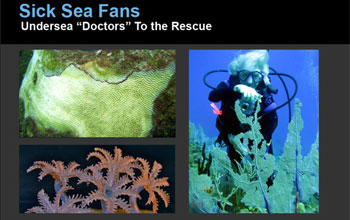
collage of various pictures showing researchers, seafans and corals
In sea fans, scientists discover new immunity genes. See photo gallery for sea fan 'Message in a Bottle.'
Credit: NSF

Credit and Larger Version
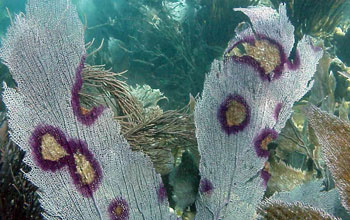
A sea fan  with dark purple inflammation.
A sea fan fights back against disease; its response is marked by dark purple inflammation.
Credit: E. Weil
Download the high-resolution JPG version of the image. (804 KB)

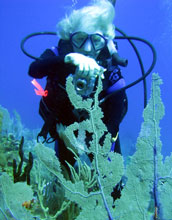
Scientist Drew Harvell examines sea fansunder water
Scientist Drew Harvell examines sea fans in Puerto Rico for signs of recovery.
Credit: E. Weil
Download the high-resolution JPG version of the image. (668 KB)

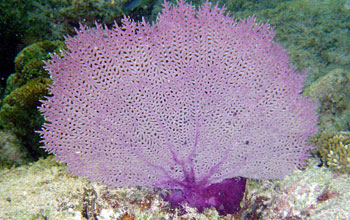
A purple sea fan under water
Beautiful and healthy now, the purple sea fan may fall ill from a host of infectious diseases.
Credit: Wikimedia Commons
Download the high-resolution JPG version of the image. (246 KB)

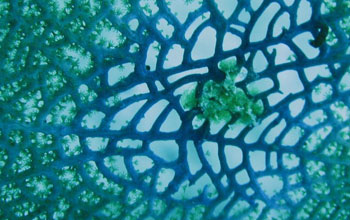
Close-up of a sea fan recovering nicely from ocean diseases.
Close-up of formerly sick sea fan that's recovering nicely from ocean diseases.
Credit: D. Harvell
Download the high-resolution JPG version of the image. (129 KB)

Marine ecologist Ernesto Weil diving to look at a sick sea fan
Marine ecologist Ernesto Weil looks at a sick sea fan; he's studying sea fan immune systems.
Credit: D. Harvell
Download the high-resolution JPG version of the image. (506 KB)
The following is part five in a series on the NSF-NIH Ecology and Evolution of Infectious Diseases (EEID) Program. For part one, see Cool Cat in a Hot Zone. For part two:
Like all of us, corals get sick. They respond to pathogens (disease-causing microbes) and recover or die. But unlike us, they can't call a doctor for treatment.
Instead, help has arrived in the form of scientists who study the causes of the corals' disease, and the immune factors that might be important in their response and resistance.
With support from the National Science Foundation (NSF), scientists Drew Harvell and Colleen Burge of Cornell University and their colleagues have developed a catalog of genes that, the researchers say, will allow us to better understand the immune systems of corals called sea fans.
The marine ecologists have trained their undersea eyes on a particular sea fan species, Gorgonia ventalina, or the purple sea fan, found in the western Atlantic Ocean and the Caribbean Sea.
The team has monitored sea fan health in the Florida Keys, Mexican Yucatan and Puerto Rico for the past 15 years. The most recent research, in collaboration with Ernesto Weil of the University of Puerto Rico, is underway on reefs at La Parguera, Puerto Rico.
Gorgonia ventalina is a fan-shaped coral with several main branches and a latticework of smaller branches. Its skeleton is composed of calcite and gorgonian, a collagen-like compound. Purple sea fans often have smaller, accessory fans growing sideways out of their main fans.
These large sea fans fare best near shore in shallow waters with strong waves and on deeper outer reefs with strong currents, down to a depth of about 50 feet. Small polyps on the graceful fans catch plankton drifting by on fast-flowing currents.
Turning (more) purple
Life as a purple sea fan isn't always easy. The coral may be attacked by the fungus Aspergillus sydowii, which causes the disease aspergillosis.
It results in damaged patches on the fan, extreme purpling of tissues and sometimes death. Several outbreaks of aspergillosis have occurred in the Caribbean; corals in stressful conditions such as warming waters may be especially susceptible.
"Diseases and climate change are very tightly linked," says Mike Lesser, program director in NSF's Division of Ocean Sciences, which funds the research along with the joint NSF-National Institutes of Health Evolution and Ecology of Infectious Diseases (EEID) Program.
"The role of climate change in diseases is important," Lesser says, "for understanding the spread of infectious diseases in every corner of the globe, including the oceans."
Adds Sam Scheiner, NSF EEID program director, "Human-induced climate change is having profound effects on many parts of the world. As this research shows, coral reefs are being decimated by the combination of climate change and infectious diseases."
Undersea "doctors" come to sea fans' aid
Harvell agrees.
In a paper published earlier this year in The Annual Review of Marine Science, Harvell, Burge and other scientists reviewed climate change influences on marine infectious diseases.
Now the scientists are using the purple sea fan as a model for studying ocean diseases. "We're looking at microbial infection, pathways of defense and the health of this sea fan in the face of warming waters and climate change," says Harvell.
"All animals on Earth--from humans to fish to corals--are susceptible to infection by pathogens that cause illness," she says. "What we hope to answer is: How widespread are these infections? Why do they happen? And, what can we do about them?"
Coral reefs are declining worldwide. Even very old coral colonies in remote locations are dying. "Disease-related deaths are caused in part by pathogens alone and in part by interactions between pathogens and climate change," says Burge.
Many of these pathogens are unidentified, leaving sea fans and their coral relatives at high risk.
But the mystery is slowly being solved.
The scientists have discovered two pathogens in purple sea fans. The microbes are being cultured and used to examine how sea fans' immune systems work.
Past is prologue?
A look back a decade or more may provide clues to the present--and the future--for sea fans.
From 1996 through 2004, thousands of sea fans in the Caribbean died of aspergillosis. Many survived, however, and appear resistant to further attack.
But they're far from home free.
Purple sea fans are now being infected by a new pathogen, called Aplanochytrium. Burge was the first to isolate and culture the microbe from a sick sea fan.
Aplanochytrium is a member of an order of lethal microbes known as Labyrinthulomycetes. It grows faster at warmer temperatures, leaving sea fans in "hot water."
Corals don't have "immune memory," such as the T cells and antibodies found in humans. Instead they have an ancient defense system called the innate immune system.
Studying sea fans' immunity through their genes is an important step in protecting them, says Burge.
"We used molecular biology and bioinformatics--a combination of biology, computer science and information technology--to make a set of the genes' messages, called transcripts," she says. "Then we characterized these messages, which are known collectively as a transcriptome."
The results, reported this month in a paper in the journal Frontiers in Physiology, are the first to show which genes are activated in response to pathogens in sea fans. Co-authors of the paper are Burge, Harvell and Morgan Mouchka of Cornell, and Steven Roberts of the University of Washington.
Message in a (genetic) bottle
The purple sea fan may hold messages for the oceans, and for us, but the messages come in a genetic bottle.
The scientists studied what's called messenger RNA, which transfers genetic messages, in sea fans exposed to Aplanochytrium, comparing it with that of unexposed sea fans.
They found that the sea fans' genes hold clues to questions such as how the fans recognize and kill pathogens, and how they repair injured tissues.
The scientists are increasing the sea fan genetic "catalog" by adding genes expressed, or turned on, in response to record-breaking Caribbean Sea temperatures in 2010.
The researchers, working in Puerto Rico with Weil and Laura Mydlarz of the University of Texas at Arlington, assessed the effect of the 2010 Caribbean coral bleaching event, as it's known, on sea fans' genes and immune function.
The study compared immune system genes in a heat-sensitive coral species, Orbicella annularis, the boulder star coral, with that of Gorgonia ventalina.
The purple sea fan was thought to be resilient to the stresses of warming waters. But Gorgonia ventalina, the scientists found, is also susceptible to the double whammy of disease and warming.
-- Cheryl Dybas, NSF (703) 292-7734 cdybas@nsf.gov
Related WebsitesNSF Special Report: The Ecology and Evolution of Infectious Diseases:
 http://www.nsf.gov/news/special_reports/ecoinf/index.jsp
NSF Award: EEID: Evaluating the Effects of a Changing Ocean on Management and Ecology of Infectious Marine Disease:
 http://www.nsf.gov/awardsearch/showAward?AWD_ID=1215977
NSF Award: Effect of the 2010 Caribbean Coral Bleaching Event:
 http://www.nsf.gov/awardsearch/showAward?AWD_ID=1105201&HistoricalAwards=false
NSF News: Controlling the Spread of Diseases Among Humans, Other Animals and the Environment:
Guillermo Gonzalo Sánchez Achutegui

martes, 18 de junio de 2013

NASA - Cassini Probe to Take Photo of Earth From Deep Space

 Cassini is Going to Compose a Special Portrait of Saturn … and You!
By Linda Spilker
June 18, 2013
One of the most exciting Cassini events in 2013 will be the unusual opportunity on July 19 to image the whole Saturn system as it is backlit by the sun. With Saturn covering the harsh light of the sun, we will be gathering unique ring science and also catching a glimpse of our very own home planet.
A computer simulated  view of Saturn from Cassini on July 19.
This simulated view from NASA's Cassini spacecraft shows the expected positions of Saturn and Earth on July 19, 2013, around the time Cassini will take Earth's picture. Cassini will be about 898 million miles (1.44 billion kilometers) away from Earth at the time. That distance is nearly 10 times the distance from the sun to Earth. Image credit: NASA/JPL-Caltech
 
The main science goal for the mosaic we are making of the Saturn system is to look at the more diffuse rings that encircle Saturn and check for change over time. A previous mosaic of the Saturn system Cassini made in 2006 revealed that the dusty E ring, which is fed by the water-ice plume of the moon Enceladus, had unexpectedly large variations in brightness and color around its orbit. We'll want to see how that looks seven Earth years and a Saturnian season later, giving us clues to the forces at work in the Saturn system. We'll do this analysis by collecting data from our visual and infrared mapping spectrometer, composite infrared mapping spectrometer and ultraviolet imaging spectrograph in addition to the imaging cameras.
But one of the best parts of the mosaic we're making on July 19 is that we'll be able to take a picture of Earth – and all of you -- from about 898 million miles (1.44 billion kilometers) away. The Earth will appear to be just a pixel, but you can see in this simulated close-up what parts of it will be illuminated.
A computer simulated,  close-up view of Earth from Cassini on July 19.
North America and part of the Atlantic Ocean are expected to be illuminated when NASA's Cassini spacecraft takes a snapshot of Earth on July 19, 2013. This view is a close-up simulation. Image credit: NASA/JPL-Caltech
 
Opportunities to image Earth from the outer solar system are few and far between and special care must be taken so we don't blind our cameras by looking in the direction of the sun, where Earth is. There have been only two images of Earth from the outer solar system in all the time humankind has been venturing out into space. The first and most distant was one was taken 23 years ago by NASA's Voyager 1 spacecraft from 4 billion miles (6 billion kilometers away), showing Earth as a pale blue dot . The other opportunity was Cassini's image in 2006 from 926 million miles (1.49 billion kilometers).
We think Cassini's July image is a special opportunity for Earthlings to wave at our photographer in the Saturn system and learn more about my favorite planet, its rings and moons. We hope you'll go outside, look in the direction of Saturn and send us pictures of yourselves waving. You can share your pictures by joining our Flickr group Wave at Saturn, adding them to our Wave at Saturn Facebook event page or tagging pictures on Twitter #waveatsaturn. We hope to make a special collage of all these images if we get enough of them.
The Cassini portrait session of Earth will last about 15 minutes from 2:27 to 2:42 p.m. PDT (21:27 to 21:42 UTC) Another blog post by Jane Houston Jones, will provide more information about where to look in the sky.
We've dedicated a special section of the Cassini website to this campaign and we hope you'll keep checking back at http://saturn.jpl.nasa.gov/waveatsaturn as the event approaches!

Linda Spilker is the Cassini project scientist, based at NASA's Jet Propulsion Laboratory, Pasadena, Calif.
NASA
Guillermo Gonzalo Sánchez  Achutgui
ayabaca@gmail.com
ayabaca@hotmail.com

miércoles, 25 de julio de 2012

Discovery: Where North Meets South in the Sea

Hi My Friends: A VUELO DE UN QUINDE EL BLOG., If it's a small fish known as the Atlantic silverside (Menidia menidia), it can.
The east coast of North America has one of the fastest water temperature changes, which scientists call a thermal gradient, of any ocean or sea. It plummets one degree Celsius for each degree of latitude.
Marine scientist David Conover with embryos from wild Atlantic silversides.
Credit: Keith Dunton
Download the high-resolution JPG version of the image. (117 KB)
Scientists Lyndie Hice and Glenn Wagner seine for Atlantic silversides near Cape Hatteras.
Credit: Keith Dunton
Download the high-resolution JPG version of the image. (1.5 MB)
 Lyndie Hice checking water temperature and salinity before seining along the coast of Maine.
Credit: Tara Duffy
Download the high-resolution JPG version of the image. (1.9 MB)
 Lyndie Hice checking water temperature and salinity before seining along the coast of Maine.
Credit: Tara Duffy
Download the high-resolution JPG version of the image. (1.9 MB)
Researchers Tara Duffy and Lora Clarke prepare a net for seining off South Carolina.
Credit: Lyndie Hice
Download the high-resolution JPG version of the image. (963 KB)  Researchers Tara Duffy and Lora Clarke prepare a net for seining off South Carolina.
Credit: Lyndie Hice
Download the high-resolution JPG version of the image. (963 KB)
Where North Meets South in the Sea
Small fish adapt to cold, warm water temperatures along 2,000 miles of Atlantic Coast

July 24, 2012
The Atlantic Ocean off Nova Scotia ... and off Florida.
Along some 2,000 miles, its waters go from icy to steamy. Can a marine species live in both temperatures--and everywhere in between?
If it's a small fish known as the Atlantic silverside (Menidia menidia), it can.
The east coast of North America has one of the fastest water temperature changes, which scientists call a thermal gradient, of any ocean or sea. It plummets one degree Celsius for each degree of latitude.
What effect does this steep thermal gradient have on marine species that live along the Atlantic Seaboard? How do they adapt to the extreme differences?
A study by marine scientist David Conover, currently director of the National Science Foundation (NSF)'s Division of Ocean Sciences--along with Lyndie Hice and Tara Duffy of Stony Brook University in Stony Brook, N.Y., and Stephan Munch of NOAA's Southwest Fisheries Science Center in Santa Cruz, Calif.--shows that Atlantic silversides reflect the drop in water temperature in changes in their genetics.
Atlantic silversides range from the Gulf of St. Lawrence in Canada to northeastern Florida in the U.S. Walk along any east coast shoreline and you're likely to see one--or a school of them--flashing silver in the shallows.
The fish are often found swimming in brackish waters, such as near the mouths of rivers and streams that connect with the sea. They're among the most common piscine residents of the world's largest such estuary, Chesapeake Bay.
The small fish gather in salt marshes, which offer shelter for spawning and a haven from predators such as striped bass.
Atlantic silversides fuel coastal food webs from north to south. They're also a common subject of scientific research because of their sensitivity to environmental changes.
Conover and colleagues recently published the results of their study of these ubiquitous fish in the journal Ecology Letters. Hice is the lead author.
The study, she says, is the most comprehensive look at genetic variation across latitudes in a marine species.
"The Atlantic silverside is a fish that survives in a spectrum of water temperatures. There's also extensive mixing of its populations throughout its range. Scientists once assumed that all such populations would have similar traits, but we found otherwise."
Despite a blending of Atlantic silverside populations across latitudes, "the fish show remarkable genetic differences over very short distances," says Conover.
For example, the fish's maximum growth rate, and its number of vertebrae, are different in populations as little as 60 kilometers (37 miles) apart.
Conover and colleagues conducted experiments on Atlantic silversides from 39 locations along the fish's 3,000 kilometer (1,864 mile) range, mapping genetic variation in growth rate, number of vertebrae and sex determination.
They initially hypothesized that areas along the coastline where there are abrupt changes in climate, such as at North Carolina's Cape Hatteras, would be places where the traits of silversides would rapidly shift in concert.
Instead they found that each trait varied uniquely with latitude--and not necessarily where expected.
The growth rate of silversides, for example, is fastest in northernmost populations.
"These patterns tell us that natural selection appears to be acting independently on each trait," says Hice.
Relationships between environmental gradients and local populations within a single species, say the scientists, are more complex than anyone thought.
"Knowledge of the conditions that lead to local adaptations in growth rate and other traits," says Conover, "will improve management of marine species and fish stocks--and our understanding of the effects of a changing environment."
As water temperatures warm with climate change, what will happen to fish like Atlantic silversides?
"Understanding how marine species adapt to changes in climate with latitude," says Conover, tells us a lot about their capacity to weather climate change in the future.
As climate and water temperatures warm, Atlantic silversides may someday splash their way north as far as Newfoundland, Labrador--and well beyond.
--  Cheryl Dybas, NSF (703) 292-7734 cdybas@nsf.gov
Guillermo Gonzalo Sánchez Achutegui
ayabaca@gmail.com 
ayabaca@hotmail.com 
ayabaca@yahoo.com
 Inscríbete en el Foro del blog y participa : A Vuelo De Un Quinde - El Foro!

Mi lista de blogs