Mostrando entradas con la etiqueta the James Webb Space Telescope. Mostrar todas las entradas

domingo, 27 de noviembre de 2016

ESA : Centre of curvature .- Centro de curvatura

http://www.esa.int/spaceinimages/Images/2016/11/Inspecting_JWST_s_primary_mirror
http://www.esa.int/esl/ESA_in_your_country/Spain/Inspeccionando_el_espejo_primario_del_JWST
                               

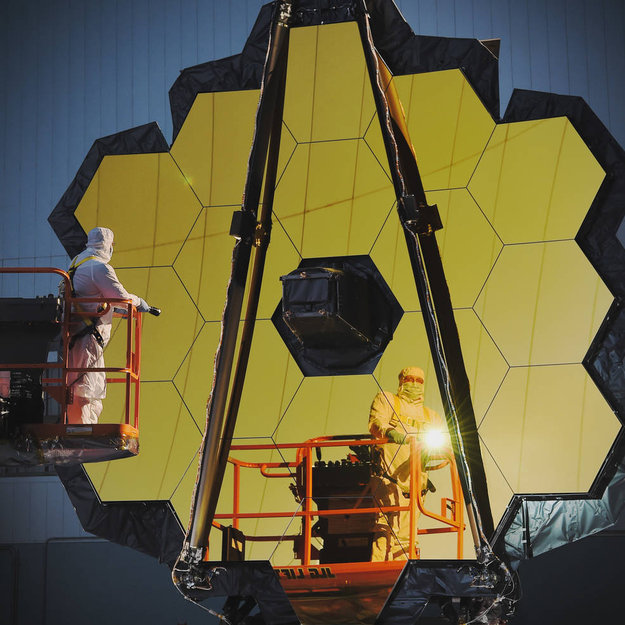
Inspeccionando el espejo primario del JWST

21 noviembre 2016
Antes de salir al espacio, las naves espaciales se someten a rigurosos ensayos para confirmar que podrán soportar las vibraciones y sonidos de gran violencia que se producen durante el lanzamiento.
En el caso del potente telescopio espacial James Webb (JWST), de 6,5 metros de diámetro, se efectúan mediciones antes y después del lanzamiento simulado, algo crucial para confirmar que sus sistemas ópticos no se verán afectados negativamente durante el lanzamiento real.
En un reciente ensayo ‘prelanzamiento’, los ingenieros llevaron a cabo una comprobación del centro de curvatura del espejo principal, tomando medidas muy precisas de su forma.
Así, para determinar con todo detalle la forma y la posición de los distintos segmentos del espejo, observaron cómo la luz se reflejaba en ellos. A continuación, compararon los datos obtenidos con una referencia que representaría las características ideales del espejo. Esta técnica permite identificar cualquier diferencia con una precisión asombrosa, lo que garantizara la perfecta alineación de los espejos.
Una vez que el telescopio ha experimentado las condiciones de lanzamiento simuladas, el ensayo se repetirá para confirmar que los sistemas ópticos serán capaces de soportar los rigores del lanzamiento.
El telescopio espacial James Webb es un proyecto conjunto de la NASA, la ESA y la agencia espacial canadiense CSA, y está previsto que sea lanzado a bordo de un cohete Ariane 5 desde el Puerto Espacial Europeo de Kourou, Guayana Francesa, en octubre de 2018.
Los distintos objetivos de este observatorio incluyen detectar las primeras galaxias del Universo y seguir su evolución a través del tiempo cósmico, presenciar el nacimiento de nuevas estrellas y sus sistemas planetarios, y estudiar los planetas de nuestro Sistema Solar y alrededor de otras estrellas.
El ensayo ha sido realizado por un equipo del Centro Goddard de la NASA, la empresa Ball Aerospace de Boulder, Colorado, y el Instituto de Ciencia sobre Telescopios Espaciales (STScI) en Baltimore, Maryland. Este pie de imagen se ha redactado a partir de la noticia de la NASA correspondiente, publicada el 2 de noviembre.

Inspecting JWST’s primary mirror

Details

Open/Close
  • Title Inspecting JWST’s primary mirror
  • Released 21/11/2016 10:46 am
  • Copyright NASA–C. Gunn
  • Description
    Before a spacecraft goes into space it must undergo rigorous testing to confirm it can withstand the violent vibrations and sounds during launch.
    For the powerful 6.5 m-diameter telescope of the James Webb Space Telescope, or JWST, making the same measurements both before and after a simulated launch is a vital part of confirming its optics will not be adversely affected by the real launch.
    In a recent ‘before’ test, engineers made highly precise measurements of the shape of the main mirror in a ‘centre of curvature’ test.
    They made detailed measurements of the mirror segments’ shape and position by looking how light is reflected from them. Then they compare it with a reference that represents what the mirrors ideally should be. The technique allows any differences to be determined with incredible precision, and to ensure the mirrors are perfectly aligned.
    After the telescope has experienced the simulated launch conditions, the test will be repeated to confirm that the optics will indeed survive the rigors of launch.
    JWST is a joint project of NASA, ESA and the Canadian Space Agency, and is scheduled for launch in October 2018 on an Ariane 5 rocket from Europe’s Spaceport in Kourou.
    The observatory’s broad goals include detecting the first galaxies in the Universe and following their evolution over cosmic time, witnessing the birth of new stars and their planetary systems, and studying planets in our Solar System and around other stars.
    The test was conducted by a team from NASA Goddard, Ball Aerospace of Boulder, Colorado, and the Space Telescope Science Institute in Baltimore Maryland. This caption is based on the related NASA news item featured on 2 November.
  • Id 369517

TAGS

Open/Close

TAGS

Open/Close

ESA
Guillermo Gonzalo Sánchez Achutegui
ayabaca@gmail.com
ayabaca@hotmail.com
ayabaca@yahoo.com
Inscríbete en el Foro del blog y participa : A Vuelo De Un Quinde - El Foro!

domingo, 1 de mayo de 2016

NASA : James Webb Space Telescope's Golden Mirror .- Espejo de oro del telescopio espacial James Webb

Hola amigos: A VUELO DE UN QUINDE EL BLOG., hemos recibido información de la Agencia Espacial NASA, el espejo del Telescopio James Weber, nos dice: "los espejos del telescopio están cubiertos por una capa de espesor microscópico de oro, que los optimiza para reflejar la luz infrarroja, que es la longitud de onda de la luz principal de este telescopio observará. Para garantizar el espejo es a la vez fuerte y ligero, el equipo hizo los espejos de berilio. Cada segmento de espejo es aproximadamente del tamaño de una mesa de café y pesa aproximadamente 20 kilogramos (46 libras). Una película muy fina de capas de oro vaporizados cada segmento para mejorar el reflejo del espejo de la luz infrarroja. El espejo totalmente montado es más grande que cualquier cohete, por lo que los dos lados de la misma se pliegan. Detrás de cada espejo son varios motores para que el equipo puede enfocar el telescopio en el espacio........."
More information....


Overhead view of Webb Telescope with hexagonal gold mirrors uncovered
Inside the clean room at NASA's Goddard Space Flight Center, the golden James Webb Space Telescope is viewed from overhead with its secondary mirror booms stowed. This is the position the secondary mirror will be in during launch. In the next few months, engineers will install other key elements, and take additional measurements to ensure the telescope is ready for space.
 
The telescope's mirrors are covered in a microscopically thin layer of gold, which optimizes them for reflecting infrared light, which is the primary wavelength of light this telescope will observe. To ensure the mirror is both strong and light, the team made the mirrors out of beryllium. Each mirror segment is about the size of a coffee table and weighs approximately 20 kilograms (46 pounds). A very fine film of vaporized gold coats each segment to improve the mirror's reflection of infrared light. The fully assembled mirror is larger than any rocket, so the two sides of it fold up. Behind each mirror are several motors so that the team can focus the telescope out in space.
 
The James Webb Space Telescope is the scientific successor to NASA's Hubble Space Telescope. It will be the most powerful space telescope ever built. Webb will study many phases in the history of our universe, including the formation of solar systems capable of supporting life on planets similar to Earth, as well as the evolution of our own solar system. It’s targeted to launch from French Guiana aboard an Ariane 5 rocket in 2018. Webb is an international project led by NASA with its partners, ESA (European Space Agency) and the Canadian Space Agency.
 
Image Credit: NASA/Chris Gunn
Last Updated: April 29, 2016
Editor: Sarah Loff
NASA
Guillermo Gonzalo Sánchez Achutegui
Inscríbete en el Foro del blog y participa : A Vuelo De Un Quinde - El Foro!

domingo, 7 de febrero de 2016

NASA : NASA's James Webb Space Telescope Primary Mirror Fully Assembled .- Espejo principal del telescopio espacial James Webb de la NASA montado completamente

Hola amigos: A VUELO DE UN QUINDE EL BLOG., Dentro de una habitación limpia masiva en el Centro de Vuelo Espacial Goddard de la NASA en Greenbelt, Maryland el equipo del telescopio espacial James Webb utilizó un am robótico para instalar el último de los 18 espejos del telescopio en la estructura del telescopio.
More information.......

Clean room at NASA Goddard
Inside a massive clean room at NASA's Goddard Space Flight Center in Greenbelt, Maryland the James Webb Space Telescope team used a robotic am to install the last of the telescope's 18 mirrors onto the telescope structure.
Credits: NASA/Chris Gunn
the 18 mirrors for the Webb Telescope
In this rare view, the James Webb Space Telescope's 18 mirrors are seen fully installed on the James Webb Space Telescope structure at NASA's Goddard Space Flight Center in Greenbelt, Maryland.
Credits: NASA/Chris Gunn
 
The 18th and final primary mirror segment is installed on what will be the biggest and most powerful space telescope ever launched. The final mirror installation Wednesday at NASA’s Goddard Space Flight Center in Greenbelt, Maryland marks an important milestone in the assembly of the agency’s James Webb Space Telescope.

“Scientists and engineers have been working tirelessly to install these incredible, nearly perfect mirrors that will focus light from previously hidden realms of planetary atmospheres, star forming regions and the very beginnings of the Universe,” said John Grunsfeld, associate administrator for NASA’s Science Mission Directorate in Washington. “With the mirrors finally complete, we are one step closer to the audacious observations that will unravel the mysteries of the Universe.”

Using a robotic arm reminiscent of a claw machine, the team meticulously installed all of Webb's primary mirror segments onto the telescope structure. Each of the hexagonal-shaped mirror segments measures just over 4.2 feet (1.3 meters) across -- about the size of a coffee table -- and weighs approximately 88 pounds (40 kilograms). Once in space and fully deployed, the 18 primary mirror segments will work together as one large 21.3-foot diameter (6.5-meter) mirror.

"Completing the assembly of the primary mirror is a very significant milestone and the culmination of over a decade of design, manufacturing, testing and now assembly of the primary mirror system," said Lee Feinberg, optical telescope element manager at Goddard. "There is a huge team across the country who contributed to this achievement."

While the primary mirror installation may be finished on the tennis court-sized infrared observatory, there still is much work to be done.

"Now that the mirror is complete, we look forward to installing the other optics and conducting tests on all the components to make sure the telescope can withstand a rocket launch," said Bill Ochs, James Webb Space Telescope project manager. "This is a great way to start 2016!"

The mirrors were built by Ball Aerospace & Technologies Corp., in Boulder, Colorado. Ball is the principal subcontractor to Northrop Grumman for the optical technology and optical system design. The installation of the mirrors onto the telescope structure is performed by Harris Corporation, a subcontractor to Northrop Grumman. Harris Corporation leads integration and testing for the telescope.

“The Harris team will be installing the aft optics assembly and the secondary mirror in order to finish the actual telescope,” said Gary Matthews, director of Universe Exploration at Harris Corporation. “The heart of the telescope, the Integrated Science Instrument Module, will then be integrated into the telescope. After acoustic, vibration, and other tests at Goddard, we will ship the system down to Johnson Space Center in Houston for an intensive cryogenic optical test to ensure everything is working properly.”

The James Webb Space Telescope is the scientific successor to NASA's Hubble Space Telescope. It will be the most powerful space telescope ever built. Webb will study many phases in the history of our universe, including the formation of solar systems capable of supporting life on planets similar to Earth, as well as the evolution of our own solar system. It’s targeted to launch from French Guiana aboard an Ariane 5 rocket in 2018. Webb is an international project led by NASA with its partners, ESA (European Space Agency) and the Canadian Space Agency.

To watch the Webb telescope being built at Goddard, visit the "Webb-cam" page at:


-end-
Felicia Chou
Headquarters, Washington
202-358-0257
felicia.chou@nasa.gov

Rob Gutro
Goddard Space Flight Center, Greenbelt Md.
301-286-4044
robert.j.gutro@nasa.gov
Last Updated: Feb. 4, 2016
Editor: Sarah Ramsey
NASA
Guillermo Gonzalo Sánchez Achutegui
Inscríbete en el Foro del blog y participa : A Vuelo De Un Quinde - El Foro!

domingo, 10 de mayo de 2015

NASA : Engineers Clean Mirror with Carbon Dioxide Snow.- Ingenieros limpian espejo con nieve de dióxido de carbono....

Hola amigos: A VUELO DE UN QUINDE EL BLOG., hemos recibido información de la Agencia Espacial NASA, sobre una actividad que ingenieros especialistas limpian una capa de nieve de dióxido de Carbono del espejo del:  the James Webb Space Telescope.
NASA, dice :  "Los cristales como de nieve (nieve de dióxido de carbono) golpean con  partículas y moléculas que  contaminan  al espejo", dijo Lee Feinberg, la NASA gestor de elementos telescopio óptico. Esta técnica sólo se utilizará si el espejo Espacial James Webb Telescope se contamina durante la integración y pruebas.

Two men in white lab suits shoot snow at a round, copper-colored mirror
Just like drivers sometimes use snow to clean their car mirrors in winter, two Exelis Inc. engineers are practicing "snow cleaning'" on a test telescope mirror for the James Webb Space Telescope at NASA's Goddard Space Flight Center in Greenbelt, Maryland. By shooting carbon dioxide snow at the surface, engineers are able to clean large telescope mirrors without scratching them. 
"The snow-like crystals (carbon dioxide snow) knock contaminate particulates and molecules off the mirror," said Lee Feinberg, NASA optical telescope element manager. This technique will only be used if the James Webb Space Telescope's mirror is contaminated during integration and testing.
The Webb telescope is the scientific successor to NASA's Hubble Space Telescope. It will be the most powerful space telescope ever built. With a mirror seven times as large as Hubble's and infrared capability, Webb will be capturing light from 13.5 billion light years away. To do this, its mirror must be kept super clean.
"Small dust particles or molecules can impact the science that can be done with the Webb," said Feinberg. "So cleanliness especially on the mirrors is critical."
Webb is an international project led by NASA with its partners, the European Space Agency and the Canadian Space Agency.
Image credit: NASA/Chris Gunn
Text credit: Laura BetzNASA's Goddard Space Flight Center, Greenbelt, Maryland
Last Updated: May 10, 2015
Editor: Ashley Morrow
NASA
Guillermo Gonzalo Sánchez Achutegui
Inscríbete en el Foro del blog y participa : A Vuelo De Un Quinde - El Foro!

jueves, 1 de enero de 2015

NASA : Space Simulation Chamber Prepared for Testing Webb Telescope .- Cámara Espacial de Simulación Preparando para Pruebas del telescopio Webb

Hola amigos: A VUELO DE UN QUINDE EL BLOG., hemos recibido la información de la Agencia Espacial NASA, sobre las pruebas que están preparando en simulación  del Telescopio Webb.
 
Esta foto fue captada desde fuera la enorme boca de la cámara gigante  de vacío térmico de la NASA llamado Sala A, en el Centro Espacial Johnson en Houston. Anteriormente utilizado para misiones de vuelos espaciales tripulados, esta cámara histórica ahora está lleno de ingenieros y técnicos que preparan un sistema de elevación que se utiliza para mantener el Telescopio Espacial James Webb durante la prueba.
El Telescopio Espacial James Webb es el sucesor científico del Telescopio Espacial Hubble de la NASA. Será el más poderoso telescopio espacial jamás construida. Webb es un proyecto internacional liderado por la NASA con sus socios, la Agencia Espacial Europea y la Agencia Espacial Canadiense.
Space Simulation Chamber Prepared for Testing Webb Telescope
This photo was captured from outside the enormous mouth of NASA's giant thermal vacuum chamber, called Chamber A, at Johnson Space Center in Houston. Previously used for manned spaceflight missions, this historic chamber is now filled with engineers and technicians preparing a lift system that will be used to hold the James Webb Space Telescope during testing.
The James Webb Space Telescope is the scientific successor to NASA's Hubble Space Telescope. It will be the most powerful space telescope ever built. Webb is an international project led by NASA with its partners, the European Space Agency and the Canadian Space Agency.
Image Credit: NASA/Chris Gunn
NASA
Guillermo Gonzalo Sánchez Achutegui
ayabaca@gmail.com
ayabaca@hotmail.com
ayabaca@yahoo.com
Inscríbete en el Foro del blog y participa : A Vuelo De Un Quinde - El Foro!

sábado, 6 de septiembre de 2014

NASA : NASA Engineers Conduct Low Light Test on New Technology for Webb Telescope


NASA Engineers Conduct Low Light Test on New Technology for Webb Telescope
NASA engineers inspect a new piece of technology developed for the James Webb Space Telescope, the micro shutter array, with a low light test at NASA's Goddard Space Flight Center in Greenbelt, Maryland. Developed at Goddard to allow Webb's Near Infrared Spectrograph to obtain spectra of more than 100 objects in the universe simultaneously, the micro shutter array uses thousands of tiny shutters to capture spectra from selected objects of interest in space and block out light from all other sources.
The James Webb Space Telescope is a large space telescope, optimized for infrared wavelengths. It is scheduled for launch later in this decade. Webb will find the first galaxies that formed in the early universe, connecting the Big Bang to our own Milky Way galaxy. Webb will peer through dusty clouds to see stars forming planetary systems, connecting the Milky Way to our own solar system.
Caption Credit: Laura Betz, NASA's Goddard Space Flight Center, Greenbelt, Maryland
Image Credit: NASA Goddard/Chris Gunn
NASA
Guillermo Gonzalo Sánchez Achutegui
ayabaca@gmail.com
ayabaca@hotmail.com
ayabaca@yahoo.com
Inscríbete en el Foro del blog y participa : A Vuelo De Un Quinde - El Foro!

lunes, 3 de febrero de 2014

NASA : NASA Administrator Bolden, Senator Mikulski View Progress on James Webb Space Telescope

Reflecting on Webb's Progress

As the James Webb Space Telescope scientists and engineers continue to move forward with the observatory's pre-launch testing and assembly, the NASA community is excited to see the outstanding work accomplished so far.
NASA's Goddard Space Flight Center in Greenbelt, Md., held an employee event on Feb. 3, 2014, to share this progress. The main auditorium filled to capacity with NASA employees, as well as top officials from Northrop Grumman, Ball Aerospace & Technologies, the Space Telescope Science Institute, the Association of Universities for Research in Astronomy, the Canadian Space Agency and others to hear the strides the Webb team has made.
Youtube Override:
NASA Administrator Charles Bolden and Sen. Barbara Mikulski, of Maryland, visited NASA's Goddard Space Flight Center in Greenbelt, Md., on Feb. 3, 2014, to discuss the status of the James Webb Space Telescope, the agency's flagship science project.
Image Credit: NASA
Goddard Center Director Chris Scolese welcomed everyone and acknowledged that, "Without their leadership, we wouldn’t be here today," he said. "They have taken Webb from the beginning to the really great state it is in today."
The two other esteemed guests who joined Scolese on stage were NASA Administrator Charles Bolden and Sen. Barbara Mikulski of Maryland. Bolden shared his excitement and admiration for the scientists and engineers working hard to keep Webb on-budget and on-target for the much-anticipated launch date, scheduled for no earlier than 2018.

Sen. Barbara Mikulski, Goddard Center Director Chris Scolese, NASA Administrator Charles Bolden chat, via video, with Webb telescope's Paul Geithner
Sen. Mikulski, Goddard Center Director Chris Scolese and Administrator Bolden chat, via video from a Goddard clean room, with Paul Geithner, the James Webb Space Telescope's technical deputy project manager as Goddard employees and other officials look on.
Image Credit: NASA Goddard/Rebecca Roth
Feature Link:
Sen. Barbara Mikulski, of Maryland, addresses employees at NASA Goddard as NASA Administrator Charles Bolden and Goddard Center Director Chris Scolese look on
Sen. Mikulski addresses Goddard employees and other guests.
Image Credit: NASA Goddard/Chris Gunn
"The recent completion of the critical design review for Webb, and the delivery of all its instruments to Goddard, mark significant progress for this mission," Bolden said.

Mikulski, a long-time NASA supporter, said she was proud and happy to see how far NASA has come with the telescope. In her role, Mikulski has helped secure funding for NASA so scientists and engineers can continue to push the envelope with their innovation and hard work. "My goal is to help you be you," she said. "May the force continue to be with you."
Guests also had the opportunity to see a live tour, through video feed, of the clean room that houses the hardware for Webb. They saw the 18 primary mirror segments that will soon be assembled on the Webb telescope. Paul Geithner, deputy project manager for Webb and tour guide explained the various parts of the telescope housed at Goddard.
Among the instruments was the University of Arizona's Near-Infrared Camera, which will be Webb's primary camera and collect images of some of the very first stars and galaxies that formed in our universe. Another instrument, European Space Agency’s Near-Infrared Spectrograph analyzes the composition of various astronomical objects. Next, Geithner showed the European Space Agency-provided Mid-Infrared Instrument. The instrument has both a camera and a spectrograph, which can see light in the mid-infrared, a portion of the electromagnetic spectrum that the human eye can’t see. The last instrument shown on the tour was the Canadian Space Agency's Fine Guidance Sensor and Near-infrared Imager and Slitless Spectrograph. This will allow Webb to point as precisely as possible at its targets to obtain the highest-quality images possible. It will also provide another method for investigating both the distant universe and closer, recently discovered exoplanets.
These components, once assembled and launched will contribute to the Webb telescope's discovery of amazing things. "This is the promise of JWST," Geithner said.
Talya Lerner
NASA's Goddard Space Flight Center, Greenbelt, Md.


NASA Administrator Charles Bolden and Senator Barbara Mikulski of Maryland congratulated the James Webb Space Telescope team Monday for the delivery of all flight instruments and primary mirrors to NASA's Goddard Space Flight Center in Greenbelt, Md.
Their comments came in a morning news conference at Goddard, where NASA's flagship science project will be assembled in preparation for launch in 2018.
”The Hubble Space Telescope has already rewritten the science books. Going from Hubble to the James Webb Space Telescope is like going from a biplane to the jet engine,” said Mikulski, Chairwoman of the Senate Appropriations Committee that funds NASA. "As Chairwoman, I’ve continued to fight for funds in the federal checkbook to keep the James Webb Space Telescope mission on track, supporting jobs today and jobs tomorrow at Goddard. NASA Goddard is home to leaders in Maryland’s space and innovation economies, making discoveries that not only win Nobel Prizes, but create new products and jobs. The James Webb Space Telescope will keep us in the lead for astronomy for decades to come, spurring the innovation and technology that keep America’s economy rolling."
NASA's James Webb Space Telescope will be the most powerful space telescope ever built, capable of observing the most distant objects in the universe, providing images of the first galaxies formed, and observing unexplored planets around distant stars. A joint project of NASA, the European Space Agency (ESA) and the Canadian Space Agency (CSA), Webb is the successor to the agency's Hubble Space Telescope.
All 18 of Webb's primary mirror segments are now housed in the Goddard clean room. Its 1.3 million cubic feet of dust-free space make the clean room one of the world's largest. All four of Webb's science instruments are within feet of the mirrors. The telescope’s mirror and instruments will capture images of the universe and break down the spectra of incoming light to analyze the properties of galaxies, stars, and the atmospheres of planets beyond our solar system.
"The recent completion of the critical design review for Webb, and the delivery of all its instruments to Goddard, mark significant progress for this mission," said Bolden. "The design, build, delivery and testing of these components took meticulous planning and action here at Goddard and with teams across the country, as well as with our international partners. It's very exciting to see it all coming together on schedule. And I want to thank our good friend Senator Barbara Mikulski for her support. We wouldn't be here today without her championing of this critical capability for NASA. I know she understands just how important it is to continue to push the boundaries of what we can do in space."
"This past year has been one of significant progress for the Webb telescope," said Goddard Director Chris Scolese during the news conference. "The NASA Goddard team is working tirelessly with our partners to keep the program on track as we develop this newest scientific tool to explore the universe."
The news conference featured a video presentation hosted by Webb's deputy project manager and technical engineer, Paul Geithner, from inside the clean room. He explained how the 18 mirror segments will be coupled to form the massive space telescope's 21-foot-wide main mirror. This work, and the assembly of the rest of the telescope, will begin once the telescope structure arrives at Goddard.
"Each of these instruments has a unique function to collect data about the universe," Geithner said, pointing to four science instruments that will be located inside the heart of the telescope.
One of these instruments, the University of Arizona's Near-Infrared Camera, will be Webb's primary camera and will take images of the first stars and galaxies to form in the universe, along with many other astronomical targets.
A second instrument, ESA's Near-Infrared Spectrograph (NIRSpec), will analyze the spectra and composition of as many as 100 objects at once. Airbus Defence and Space, formerly known as EADS/Astrium, built NIRSpec with components provided by Goddard.
A third instrument, ESA's Mid-Infrared Instrument, has both a camera and a spectrograph, which sees light in the mid-infrared region of the electromagnetic spectrum -- wavelengths longer than the human eye can see. This instrument was developed in collaboration with NASA's Jet Propulsion Laboratory in Pasadena, Calif.
A fourth instrument, CSA's Fine Guidance Sensor and Near-infrared Imager and Slitless Spectrograph, will allow Webb to point precisely at its target in order to obtain high-quality images, and also will provide other valuable science modes for investigating both the distant universe and nearby exoplanets.
Northrop Grumman Aerospace Systems is building Webb's sunshield. Once in space, the sunshield will act as an umbrella to keep heat radiating from the sun and Earth from reaching scientific instruments that must stay cold to function properly. The Webb telescope will be fully assembled by 2016 and then moved to a clean room at NASA's Johnson Space Center for additional testing.
For more information about the instruments and the Webb telescope, visit:
and
 
NASA
Guillermo Gonzalo Sánchez Achutegui
martes, 12 de marzo de 2013

NASA - James Webb Telescope Model at South by Southwest


 Full-scale model of the James Webb Space Telescope model on display at South by Southwest in Austin. Image Credit: NASA/Chris Gunn

Download Image

› Full Size

ames Webb Telescope Model at South by Southwest

As big as a tennis court and as tall as a four-story building, a full-scale model of the James Webb Space Telescope model was on display from March 8-10 at the South by Southwest Interactive Festival in Austin, Texas.

NASA's James Webb Space Telescope is the successor to Hubble and the largest space telescope to ever be built.

› Read more about the Webb Telescope

Image Credit: NASA/Chris Gunn
 
Webb Instruments
NASA engineer Ernie Wright looks on as the first six flight ready James Webb Space Telescope's primary mirror segments are prepped to begin final cryogenic testing at NASA's Marshall Space Flight Center in Huntsville, Ala. NASA engineer Ernie Wright looks on as the first six flight ready James Webb Space Telescope's primary mirror segments are prepped to begin final cryogenic testing at NASA's Marshall Space Flight Center in Huntsville, Ala.
Credit: NASA's Marshall Space Flight Center/David Higginbotham
› Larger image
American manufacturing is critical to the development of NASA’s scientific instruments, satellites and telescopes – specifically the James Webb Space Telescope. The telescope, often referred to as JWST, will be the premier observatory of the next decade, studying every phase in the history of our universe from the first luminous glows after the Big Bang, to the formation of solar systems capable of supporting life on planets like Earth, to the evolution of our own solar system.

In order to observe these cosmic wonders, numerous technologies have been developed here on Earth by American manufacturers.

The heart of the telescope is its primary imager, an infrared camera that will, among other things, detect light from the earliest stars and galaxies in the process of formation. The Near Infrared Camera (NIRCam) is equipped with coronagraphs, instruments that allow astronomers to take pictures of very faint objects around a central bright object, like stellar systems. Built by the University of Arizona and Lockheed Martin, NIRCam will allow astronomers to determine the characteristics of planets orbiting other stars.

JWST will house four primary instruments on board. ATK developed and manufactured the special lightweight, high-strength, cryo-capable composite structure that holds all those instruments.

The instruments on board the Webb telescope must be cooled to a temperature below 50 degrees Kelvin to allow them to see these faint infrared emissions from astronomical objects. The solution – large sunshields acting as an umbrella to block the heat of the Sun. Sheldahl, a Minnesota company that specializes in advanced coated films, developed manufacturing techniques to apply the coatings to large continuous rolls of Kapton, which make up the sunshade membranes. Those membranes are being built by another American company, NeXolve. The sunshield membranes must fold around the telescope before it deploys in space.

Perhaps the most impressive feature of the Webb telescope is its mirrors, which were manufactured entirely in America, from the raw material mined in Utah to the forming, machining and polishing in Ohio, Alabama and California. Ball Aerospace, Axsys, Brush Wellman, and Tinsley Laboratories developed new mirror manufacturing technology to create the most advanced space telescope mirrors ever produced. Each of the 18 primary mirror segments are made of beryllium, which was selected for its stiffness, light weight and stability at cryogenic temperatures. Bare beryllium is not very reflective of near-infrared light, so each mirror is coated with gold. The microscopic gold coating enables the mirrors to efficiently reflect infrared light (which is what the Webb telescope's cameras see). In the last part of 2012, the secondary mirror and three primary mirror segments were delivered by Ball Aerospace in a trailer truck to Goddard Space Flight Center for assembly with the rest of the telescope.

Not only will these manufacturing techniques allow NASA to deploy its most sophisticated telescope to date, but what we learn from developing these innovative processes benefit American manufacturers here on Earth.

To learn more about President Obama’s plan to make America a magnet for investing in manufacturing, visit here.
NASA
Guillermo Gonzalo Sánchez Achutegui
 ayabaca@gmail.com
ayabaca@hotmail.com
ayabaca@yahoo.com
Inscríbete en el Foro del blog y participa : A Vuelo De Un Quinde - El Foro!

Mi lista de blogs