Mostrando entradas con la etiqueta the White House. Mostrar todas las entradas

viernes, 25 de diciembre de 2015

NSF : President Obama honors nation's leading scientists and innovators .- El presidente Obama honra a los principales científicos e innovadores de la nación

Hola amigos: A VUELO DE UN QUINDE EL BLOG., La Casa Blanca anunció hoy los últimos beneficiarios de la Medalla Nacional de la Ciencia y la Medalla Nacional de Tecnología e Innovación - los más altos honores de la nación para el logro y el liderazgo en la promoción de los campos de la ciencia y la tecnología. Los nuevos galardonados recibirán sus medallas en una ceremonia en la Casa Blanca a principios del próximo año.
"La ciencia y la tecnología son fundamentales para resolver algunos de los desafíos más grandes de nuestra nación", dijo el presidente Obama. "El conocimiento producido por estos americanos hoy llevar legado de innovación de nuestro país hacia adelante y seguir ayudando a muchos otros en todo el mundo. Su trabajo es una prueba de ingenio americano."
More information.............

Barack Obama is the 44th President of the United States. His story is the American story -- values from the heartland, a middle-class upbringing in a strong family, hard work and education as the means of getting ahead, and the conviction that a life so blessed should be lived in service to others.
 
Barack Obama es el 44º presidente de los Estados Unidos. Su historia es la historia de América - valores del corazón, una educación de clase media en una familia fuerte, el trabajo duro y la educación como medio para salir adelante, y la convicción de que una vida tan bendecida debe ser vivida en el servicio a los demás.
 
With a father from Kenya and a mother from Kansas, President Obama was born in Hawaii on August 4, 1961. He was raised with help from his grandfather, who served in Patton's army, and his grandmother, who worked her way up from the secretarial pool to middle management at a bank.
 
Con un padre de Kenia y una madre de Kansas, el presidente Obama nació en Hawai el 4 de agosto de 1961. Se crió con la ayuda de su abuelo, que sirvió en el ejército de Patton, y su abuela, que trabajó su manera para arriba de la secretaría piscina para los mandos medios en un banco.

More information..........
https://search.usa.gov/search?affiliate=nsf&query=President+Obama&x=10&y=6

Nearly all awardees received NSF support during careers

medal
The National Medal of Science is the nation's highest scientific honor.
Credit and Larger Version
December 22, 2015
The White House today announced the latest recipients of the National Medal of Science and National Medal of Technology and Innovation -- the nation's highest honors for achievement and leadership in advancing the fields of science and technology. The new awardees will receive their medals at a White House ceremony early next year.
"Science and technology are fundamental to solving some of our Nation's biggest challenges," President Obama said. "The knowledge produced by these Americans today will carry our country's legacy of innovation forward and continue to help countless others around the world. Their work is a testament to American ingenuity."
The National Medal of Science was created by statute in 1959 and is administered for the White House by the National Science Foundation (NSF). Awarded annually, the Medal recognizes individuals who have made outstanding contributions to science and engineering. The President receives nominations from a committee of Presidential appointees based on their extraordinary knowledge in and contributions to chemistry, engineering, computing, mathematics, and the biological, behavioral/social and physical sciences.
Among this year's nine recipients of the National Medal of Science, seven received NSF support at some point in their research careers.
The National Medal of Technology and Innovation was created by statute in 1980 and is administered for the White House by the U.S. Department of Commerce's Patent and Trademark Office. The award recognizes those who have made lasting contributions to America's competitiveness and quality of life and helped strengthen the Nation's technological workforce. A distinguished independent committee representing the private and public sectors submits recommendations to the President.
Six of the eight National Medal of Technology and Innovation awardees have received NSF funding.
The new recipients are listed below.
National Medal of Science
National Medal of Technology and Innovation
  • Joseph DeSimone, University of North Carolina at Chapel Hill, North Carolina State University, and Carbon3D
  • Robert Fischell, University of Maryland at College Park
  • Arthur Gossard, University of California, Santa Barbara
  • Nancy Ho, Green Tech America Inc. and Purdue University
  • Chenming Hu, University of California, Berkeley
  • Mark Humayun, University of Southern California
  • Cato T. Laurencin, University of Connecticut
  • Jonathan Rothberg, 4catalyzer Corporation and Yale School of Medicine
-NSF-
Media Contacts Sarah Bates, NSF, (703) 292-7738,
Program Contacts Sherrie Green, NSF, (703) 292-8040,
Related WebsitesNSF National Medal of Science home:
 http://www.nsf.gov/od/nms/medal.jsp
National Medals of Science and Technology Foundation:
 http://nationalmedals.org/
Medal of Science fact sheet:
 http://www.nsf.gov/news/news_summ.jsp?cntn_id=100684
NSF National Medals of Science 50th Anniversary Website:
 http://www.nsf.gov/news/special_reports/medalofscience50/
President Obama to Honor Nation’s Leading Scientists and Innovators:
The National Science Foundation (NSF) is an independent federal agency that supports fundamental research and education across all fields of science and engineering. In fiscal year (FY) 2015, its budget is $7.3 billion. NSF funds reach all 50 states through grants to nearly 2,000 colleges, universities and other institutions. Each year, NSF receives about 48,000 competitive proposals for funding, and makes about 11,000 new funding awards. NSF also awards about $626 million in professional and service contracts yearly.
 Get News Updates by Email 
Useful NSF Web Sites:
NSF Home Page:
http://www.nsf.gov
NSF News:
http://www.nsf.gov/news/
For the News Media:
http://www.nsf.gov/news/newsroom.jsp
Science and Engineering Statistics:
http://www.nsf.gov/statistics/
Awards Searches:
http://www.nsf.gov/awardsearch/
The National Science Foundation (NSF)
Guillermo Gonzalo Sánchez Achutegui
ayabaca@gmail.com
ayabaca@hotmail.com
ayabaca@yahoo.com
Inscríbete en el Foro del blog y participa : A Vuelo De Un Quinde - El Foro!

miércoles, 23 de julio de 2014

NASA : President Obama Meets With Crew of Apollo 11

¡Extra! ¡Extra! ¡El hombre ha pisado la Luna!

Así recogió la prensa escrita los días previos y posteriores a la llegada a nuestro satélite la hazaña de la misión Apolo 11, y el momento histórico en el que los astronautas de la NASA aterrizaron en la Luna por primera vez

https://www.nationalgeographic.com.es/llegada-del-hombre-a-la-luna/extra-extra-el-hombre-ha-pisado-luna_14539/1


President Obama Meets With Crew of Apollo 11
President Barack Obama meets with Apollo 11 astronauts Michael Collins, seated left, Buzz Aldrin, Carol Armstrong, widow of Apollo 11 commander, Neil Armstrong, NASA Administrator Charles Bolden, and Patricia “Pat” Falcone, OSTP Associate Director for National Security and International Affairs, far right, Tuesday, July 22, 2014, in the Oval Office of the White House in Washington, during the 45th anniversary week of the Apollo 11 lunar landing.
Image Credit: NASA/Bill Ingalls
NASA
Guillermo Gonzalo Sánchez Achutegui
ayabaca@gmail.com
ayabaca@Hotmail.com
ayabaca@yahoo.com
Inscríbete en el Foro del blog y participa : A Vuelo De Un Quinde - El Foro!

viernes, 18 de abril de 2014

nsf.gov - National Science Foundation - Early Career Scientists and Engineers receive highest honor from the White House

Twenty NSF-funded scientists recognized for strengthening America's scientific enterprise
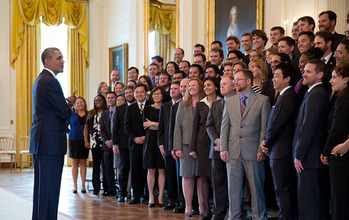
President Obama talks with PECASE recipients at the White House.
Credit and Larger Version
April 16, 2014
On Monday, 102 men and women received the United States government's highest honor for scientists and engineers in the early stages of their independent research careers--the Presidential Early Career Award for Scientists and Engineers (PECASE). The National Science Foundation (NSF) nominated 20 of the awardees.
They received their awards from NSF Director France Córdova at a morning ceremony presided over by John P. Holdren, assistant to the president for science and technology and director of the Office of Science and Technology Policy.
The awardees come from universities around the country and excel in research in a variety of scientific disciplines: biology, computer and information sciences, education and human resources, geosciences, the physical sciences including mathematics, chemistry, physics and materials research, engineering and social, behavioral and economic sciences.
"The PECASE awardees embody America's high priority of producing outstanding scientists and engineers to advance the nation's goals, tackle grand challenges and contribute to all sectors of the economy," said NSF Director France Córdova. "I salute the creativity, ingenuity, dedication and generosity of this year's PECASE winners. I commend them for shouldering the responsibilities to inspire and mentor the next generation and to help America sustain global leadership in science and technology."
All NSF PECASE awardees are from a pool of individuals whose research has been vetted by NSF's rigorous peer review process and have received five-year grants from the Faculty Early Career Development (CAREER) Program. CAREER awardees have proven themselves exemplary in integrating research and education within the context of the mission of their organization and selection is highly competitive: 20 percent or 525 of the nearly 2,600 CAREER award applicants were funded in 2012. Of those, just shy of 4 percent were PECASE winners, the cream of the crop.
The Office of Science and Technology Policy within the Executive Office of the President coordinated the awards, which were established by President Clinton in February 1996. Awardees are selected on the basis of two criteria: pursuit of innovative research at the frontiers of science and technology and a commitment to community service as demonstrated through scientific leadership, public education or community outreach.
This year's NSF recipients are:
 
Theodor Agapie, California Institute of Technology
For the creative design of model complexes for active sites that catalyze the formation and cleavage of O-O bonds relevant to alternative-energy and sustainability; exemplary teaching, mentoring and outreach activities; and a commitment to increase participation of underrepresented groups in science.
 
Javier Arce-Nazario, University of Puerto Rico, Cayey
For ambitious interdisciplinary research advancing the frontiers of sustainability science related to water issues in extreme climate conditions, and for direct involvement in bringing science into the homes of Puerto Rican people in rural areas of the La Plata watershed.
 
Sarah Bergbreiter, University of Maryland, College Park
For designing and fabricating ant-scale microrobots with the ability to navigate on rough terrain in order to deepen our understanding of insect biomechanics and locomotion, and for work to increase participation in this field of research.
 
Moises A. Carreon, Colorado School of Mines
For fundamental research aimed at developing a novel family of crystalline porous membranes for carbon dioxide capture, and for international collaboration and minority student recruitment.
Sigrid Close, Stanford University
 
For profound discoveries related to the effects of meteoroid impacts on the atmosphere and spacecraft, and for extraordinary informal science education and outreach efforts to bring space science to K-12 students and to the general public.
 
Raffaella De Vita, Virginia Polytechnic Institute & State University
For outstanding research into female pelvic floor disorders based on engineering-based knowledge on the structural and mechanical properties of associated supporting tissues.
 
Abigail Doyle, Princeton University
For the development of innovative approaches to incorporating fluorine into organic compounds, impacting synthetic and medicinal chemistry and chemi­cal biology, and for mentoring young scientists, broadening participation in STEM disciplines and engaging middle-school teachers and community college students.
 
Daniel I. Goldman, Georgia Institute of Technology
For dynamic, multi-disciplinary studies of the neuromechanics of locomotion on granular substrates, and for the creative use of robots to generate interest in and teach the principles of science to students, teachers and the public.
 
Joel Griffitts, Brigham Young University
For creative experimental approaches to studying the molecular negotiations between nitrogen-fixing bacteria and their plant hosts that allow productive symbiotic associations to arise, and for the Symbiosis Learning Consortium that brings undergraduates and high-school students into the research effort as key participants.
 
Samantha Hansen, University of Alabama
For innovative research that will provide critical constraints on the geodynamic evolution of the Antarctic continent as well as information to better constrain evolution of the Antarctic ice sheets, and for developing novel approaches to introduce underrepresented students to the geosciences.
 
Jeffrey D. Karpicke, Purdue University
For innovative contributions at the intersection of cognitive science and education to advance our understanding of learning and memory, for applying those insights to practical challenges in science classrooms and for ensuring that classroom teachers learn from these scientific findings. (Also nominated by the Department of Education.)
 
Rouslan Krechetnikov, University of California, Santa Barbara
For outstanding work combining applied mathematics, analytical mechanics and challenging experimental and theoretical fluid mechanics including geo­physics, micro-hydrodynamics and physics of complex interfaces.
 
Tamara J. Moore, Purdue University
For transformative research on how young students learn engineering concepts and how to integrate those practices into K-12 teacher development in order to have a transformative impact on underrepresented minority and underprivileged urban K-12 students.
 
Daniela A. Oliveira, Bowdoin College
For pioneering disruptive approaches to cybersecurity that are enabling transformative solutions to serious financial and economic threats, and for novel outreach activities that successfully encourage the participation of underrepresented groups in cybersecurity-related research issues.
 
Jonathan W. Pillow, The University of Texas at Austin
For foundational advances in probabilistic methods for understanding how populations of neurons encode and process information, and for leadership in education and broadening participation in computational neuroscience and related fields.
 
Benjamin Recht, University of California, Berkeley
For visionary research on scalable computational tools for large-scale data analysis and machine learning, and for initiating paradigm shifts in several related disciplines with enormous scientific and societal impact.
 
David Savitt, University of Arizona
For work on the p-adic Langlands program and generalizations of Serre's modularity conjecture, and for educational activities including organizing the high-school summer program Canada/USA Mathcam, running graduate workshops, and helping students from underrepresented groups reach their full potential.
 
Noah Snavely, Cornell University
For innovative research in developing new computer-vision algorithms for scalable 3-D reconstruction; camera location estimation from diverse unknown cameras; and innovations in STEM education.
 
Junqiao Wu, University of California, Berkeley
For leading-edge research on nanomaterials with phase transitions, and for creating a comprehensive program to educate students and the general public about science and nanotechnology.
 
Ahmet Yildiz, University of California, Berkeley
For developing state-of-the-art single-molecule approaches for visualization and quantitation of the behavior of molecular motors responsible for cellular traffic, and for outstanding outreach providing innovative educational and research activities to underrepresented groups at local charter high schools.
Note to regional reporters: For more information about, or interviews with, local winners of the Presidential Early Career Award for Scientists and Engineers, please contact the awardees' home institution or agency.
-NSF-
Media Contacts Lisa-Joy Zgorski, NSF, (703) 292-8311, lisajoy@nsf.gov
Program Contacts Mayra N. Montrose, NSF, (703) 292-4757, mmontros@nsf.gov
Related WebsitesCAREER and PECASE Information:
http://www.nsf.gov/funding/pgm_summ.jsp?pims_id=503214
Presidential Early Career Awards for Scientists and Engineers:
The National Science Foundation (NSF) is an independent federal agency that supports fundamental research and education across all fields of science and engineering. In fiscal year (FY) 2014, its budget is $7.2 billion. NSF funds reach all 50 states through grants to nearly 2,000 colleges, universities and other institutions. Each year, NSF receives about 50,000 competitive requests for funding, and makes about 11,500 new funding awards. NSF also awards about $593 million in professional and service contracts yearly.
Useful NSF Web Sites:
NSF Home Page:
 http://www.nsf.gov
NSF News:
http://www.nsf.gov/news/
For the News Media:
http://www.nsf.gov/news/newsroom.jsp
Science and Engineering Statistics:
NSF Director France Cordova and Deputy Director Cora Marrett met with 2014 PECASE awardees at NSF.
NSF Director France Córdova and Deputy Director Cora Marrett meet with 2014 PECASE awardees.
Credit and Larger Version
NSF Director France Cordova addresses 2014 PECASE awardees at a gathering at NSF.
NSF Director France Córdova addresses 2014 PECASE awardees at a gathering at NSF.
Credit and Larger Version
2014 PECASE awardee Jeffrey Karpicke meets with NSF's EHR Assistant Director Joan Ferrini-Mundy.
Credit and Larger Version
PECASE awardees with CISE's Farnam Jahanian and Suzi Iaconno
Several 2014 PECASE awardees received CAREER Awards from NSF's CISE Directorate.
Credit and Larger Version
The National Science Foundation (NSF)
Guillermo Gonzalo Sánchez Achutegui
ayabaca@gmail.com
ayabaca@hotmail.com
ayabaca@yahoo.com
Inscríbete en el Foro del blog y participa : A Vuelo De Un Quinde - El Foro!

sábado, 11 de enero de 2014

NASA : NASA, Obama Administration Highlight International Space Station Extension at Global Forum

President Obama Awards Presidential Medal of Freedom to Sally Ride

Tam O'Shaughnessy, Sally Ride's life partner and the chair of the board of directors of Sally Ride Science, is seen with President Barack Obama as she prepares to accept the Presidential Medal of Freedom on behalf of Dr. Ride, Wednesday, Nov. 20, 2013 at the White House in Washington.
Image Credit: NASA/Carla Cioffi
Image Token:
Speaking at a global space exploration forum Thursday, John P. Holdren, director of the White House Office of Science and Technology Policy, explained the importance of President Obama's decision to extend International Space Station (ISS) operations until at least 2024.
Holdren discussed the ISS extension plan at the International Space Exploration Forum (ISEF) in Washington, where leaders from more than 35 spacefaring nations gathered for the first ministerial-level meeting ever held to build political support for global cooperation in space exploration. The U.S. Department of State hosted the meeting.
"The exploration and utilization of space benefits all humankind," Secretary of State John Kerry said in a written statement. "They further promote innovation and economic development, foster scientific advancement, and inspire the next generation of explorers to pursue studies and careers in the fields of science, technology, engineering, and mathematics. Government-level involvement in and support for human and robotic space exploration are critical to realizing these benefits. The ISEF provides us with an opportunity to strengthen international cooperation through discussions of policy issues relevant to the exploration, long-term sustainability, development, and utilization of this important domain."
Holdren touted the benefits of continuing to operate the orbiting laboratory for at least another decade in his remarks.
"The ISS is a unique facility that offers enormous scientific and societal benefits," said Holdren. "The Obama Administration’s decision to extend its life until at least 2024 will allow us to maximize its potential, deliver critical benefits to our Nation and the world, and maintain American leadership in space."
NASA Administrator Charles Bolden emphasized in a keynote speech the importance of the role space exploration has played in scientific discovery in space and on Earth, and the ways exploration has led to new technologies.
"NASA is committed to the space station as a long-term platform to enable the utilization of space for global research and development," Bolden said. "We’re committed to implementing a unified strategy of deep space exploration, with robotic and human missions to destinations that include near-Earth asteroids, the moon and Mars. And we are committed to our international partnerships and the continued peaceful uses of outer space and unlocking the mysteries of our vast universe."
Deputy Secretary of State William Burns spoke at the forum on behalf of the Department of State.
“We all share a deep stake in extending humanity’s reach further into the solar system, advancing innovation further and faster, and extending the benefits of discovery to more people in more places," Burns said. "The question facing us today is whether we can muster the courage and political will to advance space exploration and ensure that cooperation continues to trump competition.”
After the meeting, the State Department issued a forum summary on behalf of the participating countries. The full text of the summary is at the bottom of this release.
For documents issued by the State Department for the International Space Exploration Forum, visit:
For the International Space Exploration Forum Fact Sheet, visit:
For remarks by Deputy Secretary of State Burns, visit:
For video of Holdren's remarks, visit:
For remarks from NASA Administrator Bolden, visit:
For more information about Holdren's and Bolden's announcement on extended use of the International Space Station, visit:
International Space Exploration Forum
Forum Summary
Representatives of nations from around the globe met in Washington, DC, on January 9, 2014, at the International Space Exploration Forum (ISEF) to further advance the exploration and utilization of space and to highlight their direct benefit to humankind. This ISEF meeting continued the dialogue initiated by the European Commission and the European Space Agency, and most recently held in Italy in November 2011, which underscored the importance of space exploration, and its benefit to all citizens of the world. As host of the ISEF, the United States expressed its strong commitment to advance space exploration and urged all nations to join together to extend humanity’s reach into the solar system.
ISEF participants noted that space exploration represents the ultimate challenge in our quest to explore new frontiers and expand our collective sense of humanity’s place in the universe. All participants confirmed that innovation and knowledge derived from space exploration directly contribute to economic growth and societal well-being.
Discussions highlighted that many of the spaceflight achievements of the past half-century would not have been possible without international cooperation. Competition-driven innovation at the industrial and scientific levels is also an important element for the evolution of space exploration. Currently, working together, nations are successfully leveraging their strengths and executing multiple robotic and human space missions with broad societal benefits. Nations are coordinating efforts to better understand our planet and to expand our reach to a variety of solar system destinations, including asteroids, the Moon, and Mars. Nations participating in the ISEF recognized that human and robotic space exploration generates benefits for people on Earth and will be most successful by building on accomplishments and expanding partnerships with the long-term goal of human exploration of Mars. ISEF participants also noted the importance of policy-level commitment for realization and sustainable implementation of international endeavors in space exploration.
ISEF participants supported the work of space agencies participating in the International Space Exploration Coordination Group (ISECG) in developing a strategic roadmap for human space exploration documented in the 2013 Global Exploration Roadmap released in August. They welcomed an expansion of efforts to increase synergies between human and robotic missions to maximize the unique contribution made by each and their collective contribution to common goals. They recognized the value of the stepwise approach to exploration, enabling nations to demonstrate advanced space exploration capabilities through cooperative international missions which allow individual national priorities to be met while achieving shared long-term goals. They encouraged broadened participation in ISECG from additional space agencies.
As part of this common vision for space exploration, ISEF participants recognized the importance of the International Space Station (ISS) as the largest, most complex international scientific and engineering project in history. In addition to the benefits of continuing research, technology demonstrations, and experimentation, the ISS partnership illustrates that nations can collaboratively design, fund and complete an expansive and complex project. In light of the research that has been conducted by more than 80 nations, the ISS partners encouraged expanded international access to this unprecedented facility, and noted its continuing value to future exploration endeavors. ISEF participants acknowledged the need to continue making concrete steps fostering international cooperation for additional space exploration projects, programs and activities.
ISEF participants recognized the growth in commercial spaceflight activities. Such private sector efforts expand economic growth, bring new vitality and ideas, and enhance space exploration. ISEF participants emphasized the importance of commercial spaceflight in exploration activities in accordance with existing national and international guidelines.
ISEF participants acknowledged that the United Nations Committee on the Peaceful Uses of Outer Space (COPUOS) is an important venue in which spacefaring and non-spacefaring nations alike can continue to discuss important issues regarding expanding humanity’s horizons in space and furthering the objectives of the 1967 Treaty on Principles Governing the Activities of States in the Exploration and Use of Outer Space. These globally important issues include the long-term sustainability of the space environment for all users, and protecting Earth from potentially hazardous objects. With the participation for the first time by a number of developing countries in space exploration, ISEF also recognized the value of space activities in promoting sustainable development. ISEF participants noted the need for discussion of international frameworks and common principles for collaboration on future space exploration, drawing on the experience of projects such as the ISS.
The ISEF participants welcomed an offer from Japan to host the next space exploration dialogue in 2016 or 2017 and agreed that policy level consultations should continue in the interim until the next meeting. They committed to convey the results of the ISEF to various stakeholders within their respective governments.
January 9, 2014
Washington, D.C.
NASA
Guillermo Gonzalo Sánchez Achutegui

domingo, 8 de septiembre de 2013

nsf.gov - National Science Foundation - Understanding the brain: the National Science Foundation and the BRAIN Initiative


Illustration of a head
A comprehensive understanding of the brain remains unknown.
Credit and Larger Version
September 3, 2013
On April 2, 2013, the White House announced an initiative called Brain Research through Advancing Innovative Neurotechnologies (BRAIN), which includes the participation of the National Science Foundation (NSF). You may wonder what this means.
Part of what it means is an opportunity to continue a national conversation about an important topic: the brain. To help with the dialogue, here are short answers to some basic questions.
What is the BRAIN Initiative?
The BRAIN Initiative is an effort by federal agencies and private partners to support and coordinate research to understand how the human brain works.
Why do we need to understand the brain?
Understanding the brain means knowing the fundamental principles underlying brain structure and function. The research required to do so will accelerate scientific discovery and innovation, promote advances in technology and bolster U.S. economic competitiveness.
New neuroscience discoveries will enable us to foster brain health; engineer solutions that enhance, replace or compensate for lost function; improve the effectiveness of formal and informal educational approaches; promote learning across the lifespan and build brain-inspired smarter technologies for improved quality of life.
What is NSF's role in brain research?
NSF has a long history of support for brain science that has produced breakthroughs in brain imaging, neurotechnologies, modeling and genomics, and is uniquely positioned to lead an innovative, multi-disciplinary effort by scientists and engineers to advance a comprehensive understanding of brain structure and function.
NSF invests in high-risk, high-reward exploratory and transformational scientific and engineering research with emphasis on integration across scales and disciplines.
Why now?
While our knowledge of brain anatomy and how brain cells use chemical and electrical signals to communicate with one another has grown considerably, we are only beginning to understand how those signals interact to give rise to thoughts, processes and behaviors.
Now is the time for a comprehensive approach that combines new discoveries from a variety of fields, including brain anatomy, imaging and function as well as cyberinfrastructure. Understanding the brain has been identified as one of five longstanding and fundamental questions, or "grand challenges," for future research.
What do we need to do this?
  • Continued cooperation among different fields of research: biology, engineering, chemistry, physics, math, computer science, social and behavioral science, and medicine. To integrate findings across scales of space and time, from molecular, physical, physiological and genetic to cognitive and behavioral.
  • Discoveries born out of curiosity-driven science that will ultimately help maintain a healthy brain.
  • Tools that can detect, measure and record all the connections and activity in a single brain of 100 billion neurons (today's technology is limited to a few thousand neurons).
  • Improved data management and storage for the large amounts of information that will be produced.
  • Time. This is a long-term investment.
How will the BRAIN Initiative affect programs at NSF?
NSF invests tens of millions of dollars in neuroscience and cognitive science research across many disciplines. NSF will continue to make major investments in fundamental science across disciplines and in innovative technologies to accelerate discovery that will revolutionize our understanding of the brain.
When can the scientific community expect to learn more about NSF's research goals for the BRAIN Initiative?
Information will be added to NSF.gov in coming months. Follow our social media accounts for #brain updates.
Have more questions? Email us at
-NSF-
Media Contacts Sarah Bates, NSF (703) 292-7738
 sabates@nsf.gov
Lily Whiteman, NSF (703) 292-8070
Related WebsitesPrying Open the Black Box of the Brain:
 http://www.nsf.gov/discoveries/disc_summ.jsp?cntn_id=128239
President Obama announces BRAIN Initiative:
The National Science Foundation (NSF) is an independent federal agency that supports fundamental research and education across all fields of science and engineering. In fiscal year (FY) 2012, its budget was $7.0 billion. NSF funds reach all 50 states through grants to nearly 2,000 colleges, universities and other institutions. Each year, NSF receives about 50,000 competitive requests for funding, and makes about 11,500 new funding awards. NSF also awards about $593 million in professional and service contracts yearly.
Useful NSF Web Sites:
NSF Home Page:
 http://www.nsf.gov
NSF News:
http://www.nsf.gov/news/
For the News Media:
 http://www.nsf.gov/news/newsroom.jsp
Science and Engineering Statistics:
 
The National Science Foundation (NSF)
Guillermo Gonzalo Sánchez Achutegui
Inscríbete en el Foro del blog y participa : A Vuelo De Un Quinde - El Foro!

Mi lista de blogs
