Mostrando entradas con la etiqueta Life. Mostrar todas las entradas

miércoles, 16 de septiembre de 2015

NSF : Life on Earth: National Science Foundation awards $23 million for studies of planet's biodiversity .- Vida en la Tierra: los premios de la Fundación Nacional de Ciencias de $ 23 millones para estudios de biodiversidad del planeta

Hola amigos: A VUELO DE UN QUINDE EL BLOG., hemos recibido información de la Fundación Nacional de Ciencia de Los Estados Unidos, sobre un premio de U$ 23, millones; que la institución otorga a los  trabajos de investigación sobre la vida en la Tierra.
More information...........

Research will fill in knowledge gaps, lead to advances in health, agriculture, energy and manufacturing

Field researcher in Alaska
A field researcher in Alaska places experimental chambers that warm air over tundra vegetation.
Credit and Larger Version
September 15, 2015
Rapid changes are happening in the Arctic: ice cover is shrinking, permafrost is thawing. But what's happening to ground-dwelling species such as mosses?
Mosses are critical parts of nutrient cycles in the far north, scientists say. For example, microbes that live on mosses are the major source of nitrogen for plant growth in boreal and tundra ecosystems. Yet many aspects of these plant communities are poorly understood.
Through a new National Science Foundation (NSF) Dimensions of Biodiversity grant, Stuart McDaniel of the University of Florida and colleagues will use moss-microbe interactions to understand how biodiversity shapes high-latitude ecosystems.
The project is one of 10 funded this year through NSF's Dimensions of Biodiversity Program.
A total of $23 million has been invested in the grants, with contributions from NSF's directorates for Biological Sciences and Geosciences, as well as the National Natural Science Foundation of China (NSFC) and the Sao Paulo Research Foundation of Brazil (FAPESP).
The Dimensions of Biodiversity Program is unique in its approach. In contrast to traditional biodiversity research that focuses on one taxonomic group or ecosystem, Dimensions of Biodiversity integrates multiple areas of study into research projects.
The program links functional, genetic and phylogenetic/taxonomic dimensions of biodiversity, offering opportunities to produce rapid advances in understanding the creation, maintenance and loss of biodiversity.
"This year's Dimensions of Biodiversity investigators join an international and multidisciplinary network of scientists who, through cutting-edge and integrative approaches, are transforming our understanding of biodiversity," says James Olds, assistant director for NSF's Biological Sciences directorate.
The research will fill in gaps in biodiversity knowledge, scientists say. It also has the potential to lead to significant progress in agriculture, fuel, manufacturing and health.
For example, plant and animal extinctions are detrimental to human health, scientists have found. Species losses in ecosystems such as forests and fields result in increases in pathogens, or disease-causing organisms. The species most likely to disappear as biodiversity declines are often those that buffer infectious disease transmission. Those that remain tend to be ones that magnify diseases such as West Nile virus and Lyme disease.
Economic sustainability also depends on the diversity of life on Earth. Many industrial materials, such as fibers and dyes, come from biological sources. In addition, biodiversity is important to such resources as water, food and pharmaceuticals.
To conserve Earth's biodiversity, scientists funded through the Dimensions of Biodiversity program are working to better understand interactions among species from microbes to mosses, lichens and marine life.
"Understanding the diversity of life on land and in the sea is critical as our environment changes," says Roger Wakimoto, assistant director for NSF's Geosciences directorate. "This year's Dimensions of Biodiversity projects include important but poorly known branches of animals and microorganisms in understudied regions of the oceans."
The new Dimensions of Biodiversity projects focus on topics including: the diversity of ctenophores, or comb jellies, in the deep sea; lichens in a global diversity hotspot; microbial communities living on suspended and sinking particles in marine oxygen-deficient zones; moss microbiomes in rapidly changing Alaskan ecosystems; and pollination in Penstemon, or beardtongues, a large genus of North American and East Asian flowering plants.
2015 Dimensions of Biodiversity Awards
Martha Condon, Cornell College:
Dimensions: Collaborative Research: Diversification Dynamics of Multitrophic Interactions in Tropical Communities
Peter Girguis, Harvard University:
Dimensions: The phylogenetic and functional diversity of extracellular electron transfer across all three domains of life
Steven Haddock, Monterey Bay Aquarium Research Institute:
 Dimensions: Life at extremes: Linking the phylogenetic and genomic diversity of ctenophores to ecophysiological adaptations in the deep sea
Lena Hileman, University of Kansas:
Dimensions: The evolution of pollination syndrome diversity in Penstemon
James Lendemer, New York Botanical Garden:
 Dimensions: Biodiversity Gradients in Obligate Symbiotic Organisms: A Case Study in Lichens in a Global Diversity Hotspot
Stuart McDaniel, University of Florida:
Dimensions: Collaborative Research: Community genomic drivers of moss microbiome assembly and function in rapidly changing Alaskan ecosystems
Matthew Olson, Texas Tech University:
Dimensions US-China: Allosomes and dioecy in plants as drivers of multi-level biodiversity
Tammi Richardson, University of South Carolina:
 Dimensions: Links Between Spectral Irradiance and Cryptophyte Biodiversity in Environments from Ponds to Oceans
Gabrielle Rocap, University of Washington:
 Dimensions: Diversity, assembly and function of microbial communities on suspended and sinking particles in a marine Oxygen Deficient Zone
Brett Tyler, Oregon State University:
Dimensions: Dynamical interactions between plant and oomycete biodiversity in a temperate forest
-NSF-

Media Contacts Cheryl Dybas, NSF, (703) 292-7734, cdybas@nsf.gov

Related WebsitesNSF News (2014 awards): Whither the diversity of life on Earth? NSF, partners award $23 million for studies of planet's biodiversity:
http://www.nsf.gov/news/news_summ.jsp?cntn_id=132506
NSF News (2013 awards):
In race against time, NSF grants fund research on Earth's threatened biodiversity: http://www.nsf.gov/news/news_summ.jsp?cntn_id=129242
NSF News (2012 awards):
 Stemming the Tide of Biodiversity Loss on Earth:
 http://www.nsf.gov/news/news_summ.jsp?cntn_id=125495&org=NSF&from=news
NSF Discovery: Staple of recipe favorites--the tomato--reveals processes that maintain biodiversity: http://nsf.gov/discoveries/disc_summ.jsp?cntn_id=129676
NSF Discovery: A Stream Is a Stream Is a Stream: Or Is It?: http://www.nsf.gov/discoveries/disc_summ.jsp?cntn_id=123855&org=NSF


The National Science Foundation (NSF) is an independent federal agency that supports fundamental research and education across all fields of science and engineering. In fiscal year (FY) 2015, its budget is $7.3 billion. NSF funds reach all 50 states through grants to nearly 2,000 colleges, universities and other institutions. Each year, NSF receives about 48,000 competitive proposals for funding, and makes about 11,000 new funding awards. NSF also awards about $626 million in professional and service contracts yearly.
 Get News Updates by Email 
Useful NSF Web Sites:
NSF Home Page: http://www.nsf.gov
NSF News: http://www.nsf.gov/news/
For the News Media: http://www.nsf.gov/news/newsroom.jsp
Science and Engineering Statistics: http://www.nsf.gov/statistics/
Awards Searches: http://www.nsf.gov/awardsearch/
Deep-sea ctenophore
This deep-sea ctenophore, or comb jelly, shows the dark red color typical of deep-sea species.
Credit and Larger Version
lichen on wood
This ecologically important lichen is indicative of high-quality habitats in eastern North America.
Credit and Larger Version
Parasitic wasp
A parasitic wasp stands on a plant with the common name rainforest cucumber (Gurania costaricensis).
Credit and Larger Version
Wind River Forest Dynamics Plot
The Wind River Forest Dynamics Plot in Oregon is a Dimensions of Biodiversity research site.
Credit and Larger Version
Beardtongue plant and a humingbird
The beardtongue plant's red flowers attract hummingbirds.
Credit and Larger Version
The National Science Foundation (NSF)
Guillermo Gonzalo Sánchez Achutegui
ayabaca@gmail.com
ayabaca@hotmail.com
ayabaca@yahoo.com
Inscríbete en el Foro del blog y participa : A Vuelo De Un Quinde - El Foro!

jueves, 24 de abril de 2014

nsf.gov - National Science Foundation - Earth Week: Whither Yellowstone's willows and the streams they shade?


Yellowstone's water table dropping below riverbank willow trees
Willow catkin with dew in Yellowstone.
Willow catkin with dew in Yellowstone. Willows there and elsewhere depend upon a supply of water.
Credit and Larger Version
April 22, 2014
This article is the eighth in a series on NSF's Long Term Research in Environmental Biology (LTREB) awards. Visit parts one, two, three, four, five, six, and seven.
Willows and streams. In Yellowstone, where there's one, the other isn't far behind.
On Earth Week, scientists are asking: How far do such connections reach?
New research on water-dependent willows shows that streams and willows may be conducting the music on Yellowstone's ecological dance floor.
Ecologists Tom Hobbs, Kristin Marshall and David Cooper published the results in a recent issue of the Journal of Ecology. Hobbs and Cooper are with Colorado State University (CSU) in Fort Collins, Marshall is at NOAA.
After wolves were extirpated from Yellowstone almost 100 years ago, elk multiplied, says Hobbs. The herbivores roamed across the landscape, nibbling willows to nubbins.
But the story doesn't end there.
With fewer willows to gnaw on, beavers began to decline. Crucially for willows, without the dams beavers build, which slow the flow of water, streams ran faster. Brooks soon became deeply carved into their banks from the force of rapidly-moving water.
Before long, the water table fell below the reach of streamside willows' roots.
Wolves and elk, beavers and willows: carefully choreographed parts
"All the possible interactions among plants and animals in nature are impossible to separately identify and measure," says Henry Gholz, program director in the National Science Foundation's (NSF) Division of Environmental Biology, which funds the Yellowstone willow research through its Long Term Research in Environmental Biology (LTREB) Program.
"Yet scientists know these links are critical to the maintenance of functional ecosystems."
Over a 30-year-period, Hobbs and colleagues studied riparian willow (Salix spp.) establishment and stem growth. In Yellowstone's northern range, the scientists reconstructed willows' history from tree rings. The three-decade time-frame covered the reintroduction of wolves in 1995.
"What happens to willows is shaped more by how high the water table is," says Hobbs, "than by any other factor."
The finding shows how complicated ecosystem links can be, says Gholz. "The effects of elk browsing on streamside willows in Yellowstone over the past 30 years are related more to variations in year-to-year climate, age of the willow trees, and changes in streams due to declining numbers of beavers."
The scientists used climate variables such as annual precipitation, stream flow and growing season length; the abundance of herbivores (elk); and landscape elevation and an index of "topographic wetness" (how soggy the ground is) to predict willow growth before and after the reintroduction of wolves.
"Explaining variability in [willow] establishment required models with stream flow, annual precipitation and elk abundance," write the ecologists in their paper.
"The results show that changes in the growth of willows after the reintroduction of wolves," says Marshall, "can't be understood without considering all the variables."
Life as a willow: water required
Picture a willow as it leans over a river or stream. Willows, sallows and osiers form the genus Salix, made up of some 400 species of deciduous trees and shrubs. All are found on moist soils in cold and temperate regions of the Northern Hemisphere.
Most are known as willows, but some narrow-leaved shrub species are called osiers, and broader-leaved species are referred to as sallows, from an Old English word derived from the Latin term salix.
Willows are the dominant riparian, or riverside, woody vegetation in Yellowstone and across the Rocky Mountains, according to Hobbs.
In Yellowstone, willows are found along rivers and streams, as well as near springs, seeps and anywhere water is available.
"As long as willows' roots can reach groundwater," says Hobbs, "the trees can survive--and withstand very high levels of browsing by elk. It all comes down to water."
On Earth Week and every week, the dance of life needs all the partners
Restoring an ecologically complete ecosystem in Yellowstone requires the return of willows--and with them, beavers, says Hobbs.
Once willows have returned, beavers will gnaw down a certain number of the trees to build dams. The dams will slow stream flow, allowing yet more willows to grow.
Willows, streams and beavers; wolves and elk. Willows and streams may have the first dance. But without them all, Yellowstone's ecological music will eventually fade away.
-- Cheryl Dybas, NSF (703) 292-7734 cdybas@nsf.gov
Investigators Fred Watson
David Cooper
Jennifer Hoeting
Matthew Kauffman
N. Thompson Hobbs
Related Institutions/Organizations Colorado State University
Total Grants $449,978
Related WebsitesNSF Discoveries in Long-Term Ecological Research:
 http://www.nsf.gov/pubs/2013/nsf13083/nsf13083.pdf
Earth Week: The Search for White Gold - Snowmelt:
 http://www.nsf.gov/discoveries/disc_summ.jsp?cntn_id=127580
Earth Day: Big Ecosystem Changes Viewed Through the Lens of Tiny Carnivorous Plants:
 http://www.nsf.gov/news/news_summ.jsp?cntn_id=127651
Earth Week: A Stream Is a Stream Is a Stream: Or Is It?:
 http://www.nsf.gov/discoveries/disc_summ.jsp?cntn_id=123855
On 'Earth Week,' World Is No Longer Our Oyster:
 http://www.nsf.gov/news/news_summ.jsp?cntn_id=116767
It's Earth Week. Just In Time, Thousands of Hectares of Tropical Forest Are Saved:
 http://www.nsf.gov/news/news_summ.jsp?cntn_id=119179
Earth Day in the future: What will it be like?:
 http://www.nsf.gov/discoveries/disc_summ.jsp?cntn_id=130998&org=NSF
Earth Week: Bark beetles change Rocky Mountain stream flows, affect water quality:
 http://www.nsf.gov/discoveries/disc_summ.jsp?cntn_id=130951&org=NSF
Elk browsing on willows in Yellowstone
Elk browsing on willows in Yellowstone; Do elk or does water limit the growth of willows?
Credit and Larger Version
old lake bed in Yellowstone covered with grass and willows growing along its wet edges.
An old lake bed in Yellowstone. Willows grow along its wet edges.
Credit and Larger Version
Two researchers with instruments working on Yellowstone's northern range clip willows
Researchers working on Yellowstone's northern range clip willows as part of the study.
Credit and Larger Version
profile of an elk
What is the true role of elk in Yellowstone's ecosystem?
Credit and Larger Version
An elk in a forest
At the center of Yellowstone: elk, willows, water, wolves--or all of them?
Credit and Larger Version
The National Science Foundation (NSF)
Guillermo Gonzalo Sánchez Achutegui

lunes, 29 de julio de 2013

nsf.gov - News - NSF Awards Third Round of Grants to Advance Digitization of Biodiversity Collections

Funding will shed light on "dark data," and integrate organismal, vocal, fossil, and ecological information.-

Credit and Larger Version

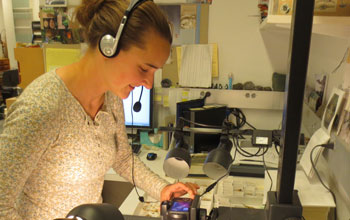
Aresearcher using the Rapid Image Processing with Voice Recognition
Rapid Image Processing with Voice Recognition aids steps in specimen processing.
Credit: Susan Butts, Yale Peabody Museum
Download the high-resolution JPG version of the image. (6.2 MB)

Fossilized damselfly from the 34-million-year-old Florissant Formation of Colorado.
Credit: University of Colorado Museum of Natural History
Download the high-resolution JPG version of the image. (227 KB)

Scientists Roy Tsuda and Varnelle Magoon study a red algae specimen in Hawaii.
Credit: Shelley James, Bishop Museum
Download the high-resolution JPG version of the image. (2.2 MB)

Curator Kathy Ann Miller looks at seaweed collected along the coast of Washington.
Credit: Sheraz Sadiq, KQED Science
Download the high-resolution JPG version of the image. (3.5 MB)

Fly specimen
NSF's ADBC Program will foster advances in digitizing biological specimen collections.
Credit: Santiago Ramirez, Museum of Comparative Zoology, Harvard University
Download the high-resolution JPG version of the image. (1.8 MB)

Researcher Clare Loughran takes a digital photo of a red seaweed using a special light box.
Credit: Sheraz Sadiq, KQED Science
Download the high-resolution JPG version of the image. (4.8 MB)

Over centuries of discovery, the diversity of life on Earth has been documented in numerous ways.
Records of that biodiversity are, however, often obscured in varied and distinct natural history collections, making accessing the information a difficult task.
The National Science Foundation (NSF), through its Advancing Digitization of Biodiversity Collections (ADBC) Program, is responding to the need for greater accessibility of biodiversity collections data by awarding major new grants.
The funding will expand the scope of the national resource of digital data documenting existing biodiversity collections.
The awards are part of the National Resource for Digitization of Biological Collections; all data resulting from the awards will be available through the national resource.
Biological diversity is critical to the future of planet Earth, say researchers. Incomplete information on species, their distributions and environmental and biological changes over time make it difficult, however, to assess the status of and changes in biodiversity.
Much of the relevant information exists in research collections, scientists say, but the majority isn't integrated and isn't readily available online.
It's "dark data"--inaccessible to most biologists, policy-makers and the general public.
"The ADBC program continues to grow in the breadth of its collections, including fossils, and in the depth of additional information about each specimen," says John Wingfield, NSF assistant director for Biological Sciences.
"The collections being digitized are unprecedented in their worth to research and education and hold huge potential for future development and integration with other biological data from genomes to phenomes," says Wingfield.
"With the diversity of information digitized, these projects are addressing issues of interoperability, access and analysis--'big data.' The benefits will be felt for many generations to come."
The program will result in more efficient and innovative ways of providing access to information in biological and paleontological research collections.
It will also help speed up the process of integrating diverse information on the genetic, ecological, organismal (including vocalizations), molecular biology and evolutionary history of specimens in collections.
"During the past 200 or more years, an abundance of fossil collections that are scientifically documented, biotically diverse and geologically distributed in time and space has been accessioned into non-federal museums across the U.S.," says Wendy Harrison, director of NSF's Division of Earth Sciences.
Such collections, she says, are the building blocks for paleontology, stratigraphy, paleogeography, paleoceanography and paleoecology.
"These scientific 'treasures' are of great importance to our search and production of fossil fuels and minerals, as well as to unraveling the history of the Earth and life itself," says Harrison.
"Having the vital statistics and visuals of these collections available on the Web will place these sciences on a new level of integration and understanding."
Standardized digital photos of specimens will be linked with, for example, sound recordings, pathogens found on the specimens, stratigraphic information for fossils, environmental variables at the collecting localities and electron micrographs.
"Insects, for example, have a long geologic history, providing a deep-time record of ecological and evolutionary responses to environmental changes," says H. Richard Lane, program director in NSF's Division of Earth Sciences.
"With current models of future climate change and the important role insects play in human society, the ability to access modern and fossil archived data to make predictions about future insect populations becomes urgent."
Training for future researchers on collections techniques, informatics technology and data integration is part of ADBC efforts.
The awards provide graduate and undergraduate training opportunities and outreach to K-12 educators, students and non-scientists.
Each of the three Thematic Collections Networks (TCN) focuses on "grand challenge," or major scientific, questions in biodiversity, and offers multiple research opportunities as data become widely available.
"The new fossil insect TCN, for example, promises to accelerate our understanding of the insect world--past, present and future," says Lane.
The awards include 65 institutions in 29 states and one territory.
In addition, five Partners to Existing Networks (PEN) were funded.
These efforts allow institutions that were not fully ready to participate in a TCN to add to their collections and fill in gaps.
Two PEN awards have been made that will increase the coverage of the Paleoniches TCN. The TCN is focused on critical specimens needed to identify organisms and environments from ages and localities not previously included.
A third PEN will expand the Southwest Arthropod Network, which also includes field guides for the Navajo reservation area; a fourth PEN will add central Midwest specimens to the InvertNet TCN; and a fifth will add two historically important collections to the lichen and bryophyte TCN.
2013 NSF ADBC Awards
Title: (TCN) Fossil Insect Collaborative: A Deep-Time Approach to Studying Diversification and Response to Environmental Change
PI (Principal Investigator):
Collaboratoring Award PIs: Sam Heads, University of Illinois Urbana-Champaign; David Grimaldi, American Museum of Natural History; Alton Dooley, Virginia Museum of Natural History; Michael Engle, University of Kansas; Brian Farrell, Harvard University; Susan Butts, Yale University.
Title: (TCN) Developing a Centralized Digital Archive of Vouchered Animal Communication Signals
PI (Principal Investigator):
Collaboratoring Award PIs: Rafe Brown, University of Kansas; David Kavanaugh, California Academy of Sciences; Travis LaDuc, University of Texas at Austin; Daniel Lane, Louisiana State University & Agricultural and Mechanical College.
Title: (TCN) The Macroalgal Herbarium Consortium: Accessing 150 Years of Specimen Data to Understand Changes in the Marine/Aquatic Environment
PI (Principal Investigator):
Collaboratoring Award PIs: Christopher Dick, University of Michigan, Ann Arbor; Brent Mishler, University of California Berkeley; David Giblin, University of Washington; Alan Weakley, University of North Carolina at Chapel Hill; Kenneth Karol, New York Botanical Garden.
The five PEN awards are:
Title: (PEN) Targeted Digitization to Expand and Enhance the PALEONICHES TCN
Title: (PEN) Increasing the Robustness of the Ordovician and Pennsylvanian Dataset of PALEONICHES-TCN
Title: (PEN) Facilitating a Shared Image Library and Occurrence Database for Ants of the Southwest as Part of the SCAN TCN
Title: (PEN) Digitizing the University of Iowa Museum of Natural History's Historic Invertebrate Collections through the InvertNet TCN
Title: (PEN) Digitization of two Important Medium-sized Collections to Join the North American Bryophytes and Lichens TCN
-NSF-

Media Contacts Cheryl Dybas, NSF (703) 292-7734

Related WebsitesNSF News: NSF Awards Second Round of Grants to Advance Digitization of Biological Collections: http://www.nsf.gov/news/news_summ.jsp?cntn_id=124031
NSF News: NSF Awards First Round of Grants to Advance Digitization of Biological Collections: http://www.nsf.gov/news/news_summ.jsp?cntn_id=121015&org=NSF&from=news

The National Science Foundation (NSF) is an independent federal agency that supports fundamental research and education across all fields of science and engineering. In fiscal year (FY) 2012, its budget was $7.0 billion. NSF funds reach all 50 states through grants to nearly 2,000 colleges, universities and other institutions. Each year, NSF receives about 50,000 competitive requests for funding, and makes about 11,500 new funding awards. NSF also awards about $593 million in professional and service contracts yearly.
Useful NSF Web Sites:
NSF Home Page:
http://www.nsf.gov
NSF News:
http://www.nsf.gov/news/
For the News Media:
 http://www.nsf.gov/news/newsroom.jsp
Science and Engineering Statistics:

The National Science Foundation (NSF).
Guillermo Gonzalo Sánchez Achutegui
ayabaca@gmail.com
ayabaca@hotmail.com
ayabaca@yahoo.com
Inscríbete en el Foro del blog y participa : A Vuelo De Un Quinde - El Foro!

domingo, 6 de enero de 2013

nsf.gov - National Science Foundation - Life in the Fast Lane: Racing to Identify Species as Biodiversity Shrinks

A conversation about conserving and naming species.-
 http://www.nsf.gov/news/mmg/media/images/ocean-h.jpg
Without significant changes, more than 50 percent of the world's marine species may be perched on the brink of extinction by 2100, according to UNESCO.
Credit: Dan Norton (for commercial use, contact photobank@coral.org)
Download the high-resolution JPG version of the image. (1.1 MB)
 http://www.nsf.gov/news/mmg/media/images/DAPHNE-h.jpg
 Daphne Fautin searches for new organisms while conducting a marine survey.
Credit: Rita Tan of www.wildsingapore.com
Download the high-resolution JPG version of the image. (272 KB)
 graphic with headphones and text audio only
Name that Species! A conversation about conserving, finding and naming species with NSF Program Manager Daphne Fautin
Credit: National Science Foundation
Download the high-resolution JPG version of the image. (8 KB)
A little more than 39 years ago, on December 28, 1973, the Endangered Species Act was enacted to conserve threatened and endangered species and their ecosystems. To honor this anniversary, Daphne Fautin of the National Science Foundation answered questions about biodiversity.
As a marine biologist, Fautin has literally gone to the ends of the Earth--from the poles to the tropics--to study marine life. She is currently a program manager at the National Science Foundation, a professor of ecology and evolutionary biology at the University of Kansas, and a commissioner with the International Commission on Zoological Nomenclature, which produces rules on giving scientific names to animals.
What is biodiversity?
Biodiversity--short for "biological diversity"--is the variety and abundance of plants, animals and other living things on Earth and in particular locations. Biodiversity is absolutely essential to ecosystem health. And human survival depends on the health of our planet's ecosystem.
Rain forests and coral reefs are known for their biodiversity. Why is so much biodiversity concentrated in these types of ecosystems?
More than 25 percent of the world's fish species and between nine and 12 percent of all of the world's fisheries are associated with coral reefs. More than half of the world's plant and animal species live in rainforests.
We don't know for sure why rain forests and coral reefs harbor so much biodiversity. One idea is that these ecosystems occur in tropical climates, and so they are quite climatically consistent year-round.
According to this idea, tropical organisms diverged because they don't have to deal with the climatic extremes that organisms at higher latitudes (and altitudes) do. A rabbit, for example, that lives in a non-tropical place must be able to eat certain plants in the summer and certain other plants in the winter. Therefore, it must remain a generalist to survive.
By contrast, a rabbit that lives in the tropics may specialize in eating certain plants that are available year-round; at the same time, other species of rabbits (or other organisms) may evolve that specialize in eating other plants. Such specialization promotes diversity.
But some evidence does refute this idea--such as the fact that not all groups of plants and animals demonstrate more diversity in the tropics than at higher latitudes. So, many other ideas have also been proposed to explain the extraordinary biodiversity of the tropics.
Insects account for a large proportion of the biodiversity on Earth. Why?
Many statistics bear out the biodiversity of insects. For example, more than 850,000 insect species have been named. And the total estimated weight of just ants in the Amazon is four times the estimated weight of all land vertebrates in the Amazon--including all mammals, birds, reptiles and amphibians!
We don't really know why insects account for so much of the Earth's biodiversity. That is one of the questions that is being studied by entomologists--the people who research insects.
One idea is that insects began to diversify when flowering plants evolved on Earth, and so insects evolved along with flowering plants because they are so important in the pollination of plants.
Insects tend to be small and specialized: So there may be a certain insect that sucks out the cell sap from the stems of a particular plant; other insects that eat that plant's leaves; other insects that feed on that plant's nectar; and other insects that feed on that plant's pollen and pollinate the plant in the process. So as flowers evolved, many insects evolved as well.
This idea about the evolutionary connections between flowering plants and insects is consistent with what we see in the oceans: Relatively few species of flowering plants live in the oceans, and relatively few species of insects live in the oceans.
(By the way, NSF recently issued a press release that identified some interesting reasons why humans need insects--even pesky ones.)
How many species have been described and named by scientists, so far?
The Encyclopedia of Life estimates that there are 1.9 million known eukaryotic organisms. (Eukaryotic organisms are those that are made of one or more cells with a nucleus; bacteria and viruses are not eukaryotic organisms.)
How many species exist on Earth?
Estimates range from 2 million species to 10 million species.
A recent estimate of 8.7 million species received a lot of press, in part, I suspect, because of its supposed accuracy and because it corresponds quite well to the often-bandied figure that 80 percent of the Earth's biodiversity has yet to be discovered/named. The Encyclopedia of Life states that "at least four times" the number of known species exist on Earth. Based on its own figures, this translates to around 8 million species.
A paper estimating the number of marine species (which I contributed to) was recently published. According to this paper, 226,000 species that live in the ocean have been named and described by scientists, and 72,000 additional species are in collections waiting to be named and described.
But who knows what hasn't been collected yet? And of course, as I previously mentioned, oceans have few insects, but insects account for the bulk of biodiversity.
How can scientists estimate the total number of species on Earth when it is obviously impossible to count what has not yet been counted. In other words, how can we know what we don't know?
People have used various creative methods to estimate the total number of organisms on Earth. For example, there was a very large estimate made years ago by a scientist who went to the jungles of Panama and used insecticide to spray a tree in the jungle. Then, lots of insects died and fell from the tree to the ground. And the scientist and his colleagues identified and counted as many of these fallen insects as they could, and the rest were counted as unknown. Then, the scientist extrapolated from the proportion of species in that one tree that were known vs. unknown to produce a global estimate of known vs. unknown species.
It was good first try. But a lot of people point to the fact that in many parts of the world, the proportion of known species to unkown species is higher than it is in Panama. So this fact would suggest that the estimate may be excessive.
In 2011, an NSF-funded researcher provided the first empirical evidence of what had been long suspected: That biodiversity promotes water quality. What are some of the other reasons why need biodiversity?
We need biodiversity to eat, we need to preserve species that we use as food, including fish from the sea. We also need to preserve those species that serve as food for the fish we eat, so that our food supply persists. And we also need to preserve all the species that create the habitat that enables all of these needed species to live, spawn, and raise their young.
So, there are all of these connections in the great "web of life" that we don't even know yet. And these connections support all of the species on Earth, including species that provide us with food and clothing.
Also, 50 percent of the oxygen we breathe is produced by microscopic plants that live in the ocean and the other 50 percent is produced by plants that live on land.
(If you want to learn more about the ways in which the various species of plants help humans survive, watch this dynamic, upbeat video produced by NSF.)
The planet's ecosystem is sometimes compared to an airplane. You can lose one rivet from an airplane, and the airplane will probably fly. You can lose two rivets for an airplane and the airplane will still probably fly. But eventually, if you lose too many rivets (how many?), the plane will crash.
The same principle applies to ecology: You can lose some species without major harm. But no one knows how many species can be lost before the planet's ecosystem will crash.
What does it mean to discover a new species?
A new species is one that hasn't yet been formally described and named according to scientific procedures--not one that is newly evolved.
People on the street or people in the jungle may have a name for it. But if we haven't followed the internationally recognized rules of nomenclature for describing and naming a species, it doesn't exist for certain scientific purposes.
When we have discovered a new species, it means we have finally found and gone through the procedures of formally describing it (distinguishing it from other species) and giving it a name following the rules of nomenclature.
How many new species are named each year?
Between 15,000 and 20,000 new species are named each year.
A species may be discovered and collected before it is described and named. But it isn't recognized as a new, distinct species until it is described and named.
How many species go extinct each year?
We don't know. The World Wildlife Fund's Web site says that experts have calculated that between .01 percent and .10 percent of all species on Earth go extinct each year.
But because we don't know how many species there are, we don't know how many species those percentages actually represent. And so, if the low estimate of the number of species on Earth is true--if there are around 2 million species on our planet--then between 200 and 2,000 extinctions occur each year.
But if, in fact, there really are 10 million species on Earth, then between 10,000 and 100,000 extinctions occur each year.
What would you say to naysayers who argue that newly discovered species offset species losses, and so there really is no extinction crisis?
"New" species are not newly evolved. They evolved a long time ago. They are simply being newly discovered by science. They may be very well known to the people living in the areas where they live. So they aren't new in that sense; they are only new to those of us who name them.
What does the process of naming a species involve?
It can be long, protracted and difficult process that can take many years. First, you want to be sure that the animal or plant hasn't been named before.
This can be difficult for a variety of reasons. For one thing, many descriptions that were prepared in the early days were very vague. And usually, only small groups of experts have the specialized expertise to know what has and hasn't been described before.
And in order to name a species, you also have to describe it. To do this, you have to know what kinds of features are used to identify species, and figure out what distinguishes the "new" species from known species. This is important, because at least according to the rules of zoological nomenclature, when you publish a description of a new species, you have to write out what makes it different from everything that is already known--including organisms that are not closely related to it, but that look like it anyway.
For example, suppose you have an organism that has a red spot; then you have to distinguish your "new" species from everything that is red-spotted, even if those other red-spotted species are not closely related to your species. That way, when somebody comes across your species, they can say, "AHA! This is another one of those red-spotted organisms that is covered by that new name; it's not another thing with red spots."
Other rules in the codes of nomenclature require you to name species in Latin or make them sound like Latin. You also have make sure a specimen of your species is deposited in a natural history collection (typically in a museum or herbarium). If the "new" species is an animal, you may also have to register the name in ZooBank.
And then you have to publish your description of the species in a scientific journal, so that other scientists can look at it and agree that it is correct.
It is interesting to note that names that are accepted are frequently later "sunk" for various reasons. For example, when the exhaustive homework that is required for describing and naming a "new" species is not conducted in a comprensive and thorough way, it may ultimately turn out that the "new" species has already been described and named.
Alternatively, a name for a "new" species may be sunk because the difference that was thought to distinguish it from others does not hold up. For example, I have a colleague who described several coral reef fish as "new"--only to ultimately discover that the "new" species was a member of a species for which only one sex had previously identified. So the "new" species was really just a female (or male) of a known species!
Do you have to be a professional taxonomist to identify and name new species?
About half of the species that are named each year are named by people who aren't employed as taxonomists--whose job isn't in a museum or university. In fact, some of the people with the most expertise and time to do this are not professionals in the field.
For example, I knew a dentist who is one of the world's foremost authorities on tiger beetles. He had earned a master's degree in entomology. And then he realized that if he had gone into academic entomology, he would be spending his time teaching, writing grant proposals and doing administrative work--but he wanted to catch tiger beetles.
And so he went into dentistry so that he could make enough money to take time off each year to catch tiger beetles. He probably thereby ended up being able to spend more time chasing tiger beetles as a dentist than he would have if he had become a professional entomologist.
A new species of frog was recently identified by an NSF-funded researcher right smack in New York City. Is that common for new species to be discovered in such populated places?
I think that it is quite common for new species to be found in populated areas.
In the summer of 2012, an NSF-funded researcher named a new coral reef crustacean after Bob Marley, the singer. Is that unusual for species to be named after celebrities?
It may be less common than it used to be.
Many years ago, it would be common for a patron to fund the travels of a scientist to exotic places, and then species that were found during those travels would be named for the patron.
Tell me about one of the big problems that is reducing biodiversity in the oceans?
We have depleted the oceans of many of the big fish that we eat.
Part of the reason we are able to overfish is due to technology. We have fish-finders: various types of tracking devices, including sonar equipment, and airplanes that are used to help find schools of fish. And we now know enough about marine biology to predict where fish and crustaceans will be under particular conditions. Fishing is no longer about a fisherman just saying, I'll drop a line here or there." Fishing has become very scientific and methodical.
When we trawl, we drag nets along the ocean floor. And whatever else gets swept by these nets in addition to the target fish is called "bycatch." This bycatch gets thrown back into the ocean because we are not licensed to take it or because it's not profitable to take.
But how many organisms can manage to survive after being caught in a big net, pulled up and then thrown back into the ocean? What's more, trawling destroys habitat; after the ocean floor has been trawled, it may no longer be a suitable home for what is thrown back.
The analogous situation on land would be if we flew an airplane that dragged a big net across the ground to catch grazing cattle. And we would draw up the net periodically--and keep the cattle, but toss back the dogs, trees and everything else that we happened to net in addition to the cattle. That is similar to what we do to the oceans.
Many people assume that it is necessarily better to consume farmed fish and shrimp than wild caught fish and shrimp. But many fish and shrimp farming practices are also harmful to the environment. Just because it is farmed doesn't mean that it is environmentally neutral or preferred over wild caught.
Can you cite any "good news" stories in biodiversity?
I read the other day that we have lost 97 percent of wild tigers in just over a century. Only about 3,200 tigers currently remain in the wild. We can infer that the populations of many smaller species are plummeting just like populations of many large species are plummeting.
But I am happy to say that a few species have come off the endangered species list, like the wolf and the bald eagle, because plans for their recovery were enacted.
Also, there are "good news" stories in the history of whales. Many of them were hunted to the brink of extinction, and then they were listed as endangered. It therefore became legally, socially and economically difficult to harvest whales, and so populations of many whale species have fortunately recovered.
These kinds of successes show that if we stop harvesting species, and if their habitat is conserved, life is resilient and endangered species may recover.
Additional Resources
To learn more about biodiversity and help promote conservation:
--  Lily Whiteman, National Science Foundation (703) 292-8310 lwhitema@nsf.gov
Investigators
Daphne Fautin 
Guillermo Gonzalo Sánchez Achutegui
ayabaca@gmail.com
ayabaca@hotmail.com
ayabaca@yahoo.com  
 Inscríbete en el Foro del blog y participa : A Vuelo De Un Quinde - El Foro!

lunes, 27 de agosto de 2012

CAVES: Astronauts searching for life – underground

Hi My Friends: A VUELO DE UN QUINDE EL BLOG., Astronauts dream of finding new life and for a select crew that dream might be within reach this week - albeit deep underground instead of in outer space.

Download:
 Astronauts exploring Sardinian caves.
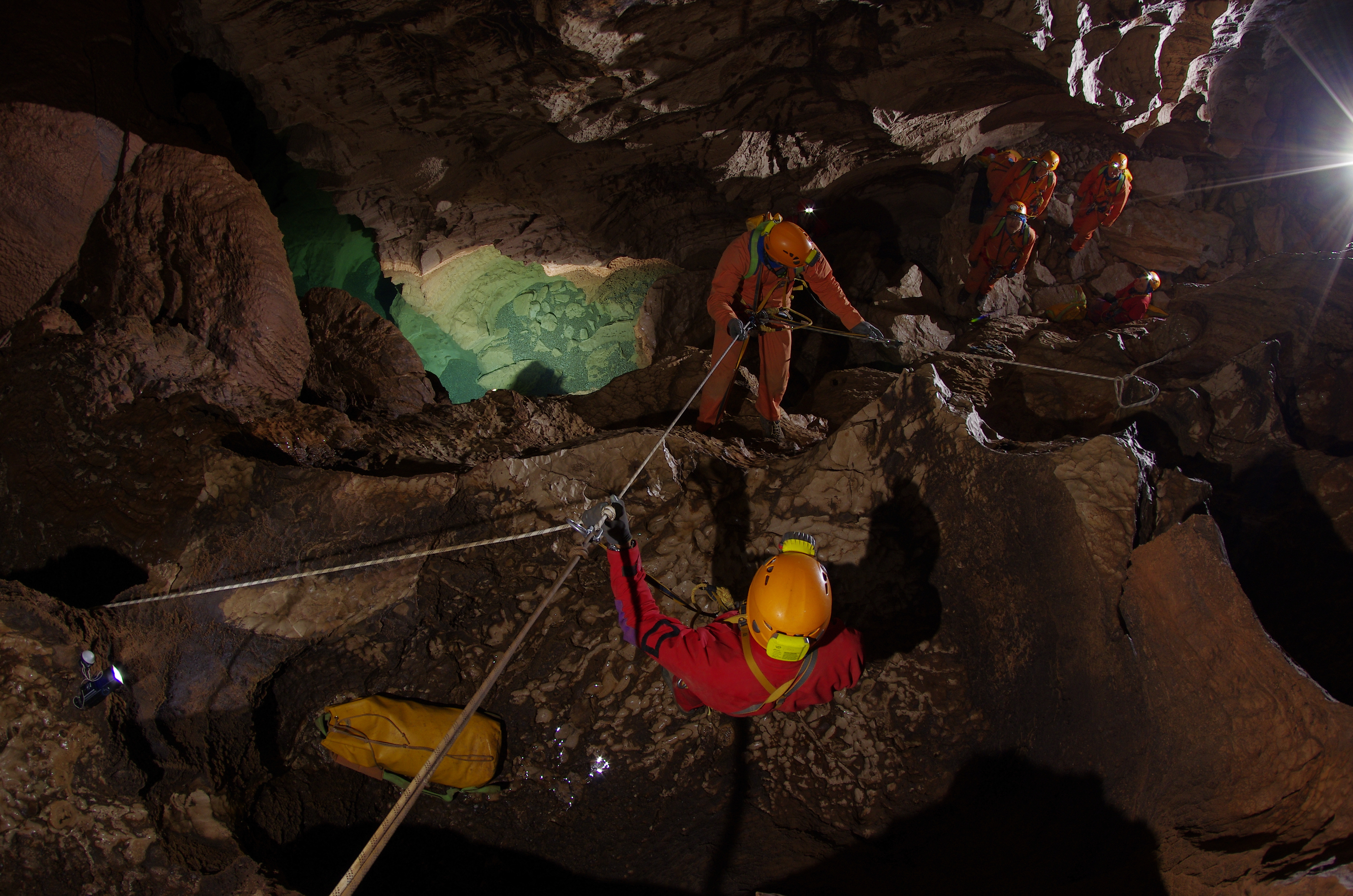
ESA’s cave training prepares astronauts to work as an international team in real exploration conditions. Sending astronauts underground to survive and explore Sardinian caves in Italy for almost a week is just one element of their long training.
The caves are isolated from the outside world. The astronauts need to get used to confined spaces, minimal privacy, technical challenges and limited equipment and supplies for hygiene and comfort – just as in space. Credits: ESA–R. Bresnik
 
An international crew of six astronauts will start training for a caving adventure designed to prepare them for spaceflight.
CAVES, an abbreviation of Cooperative Adventure for Valuing and Exercising human behaviour and performance Skills, prepares astronauts to work safely and effectively and solve problems as a multicultural team while exploring uncharted areas using space procedures.
The sunny island of Sardinia in Italy will welcome the astronauts from all the partners of the International Space Station. After a week spent learning the safety procedures and basics of exploring caves, the astronauts will venture underground on 7 September for six days.  
Download:
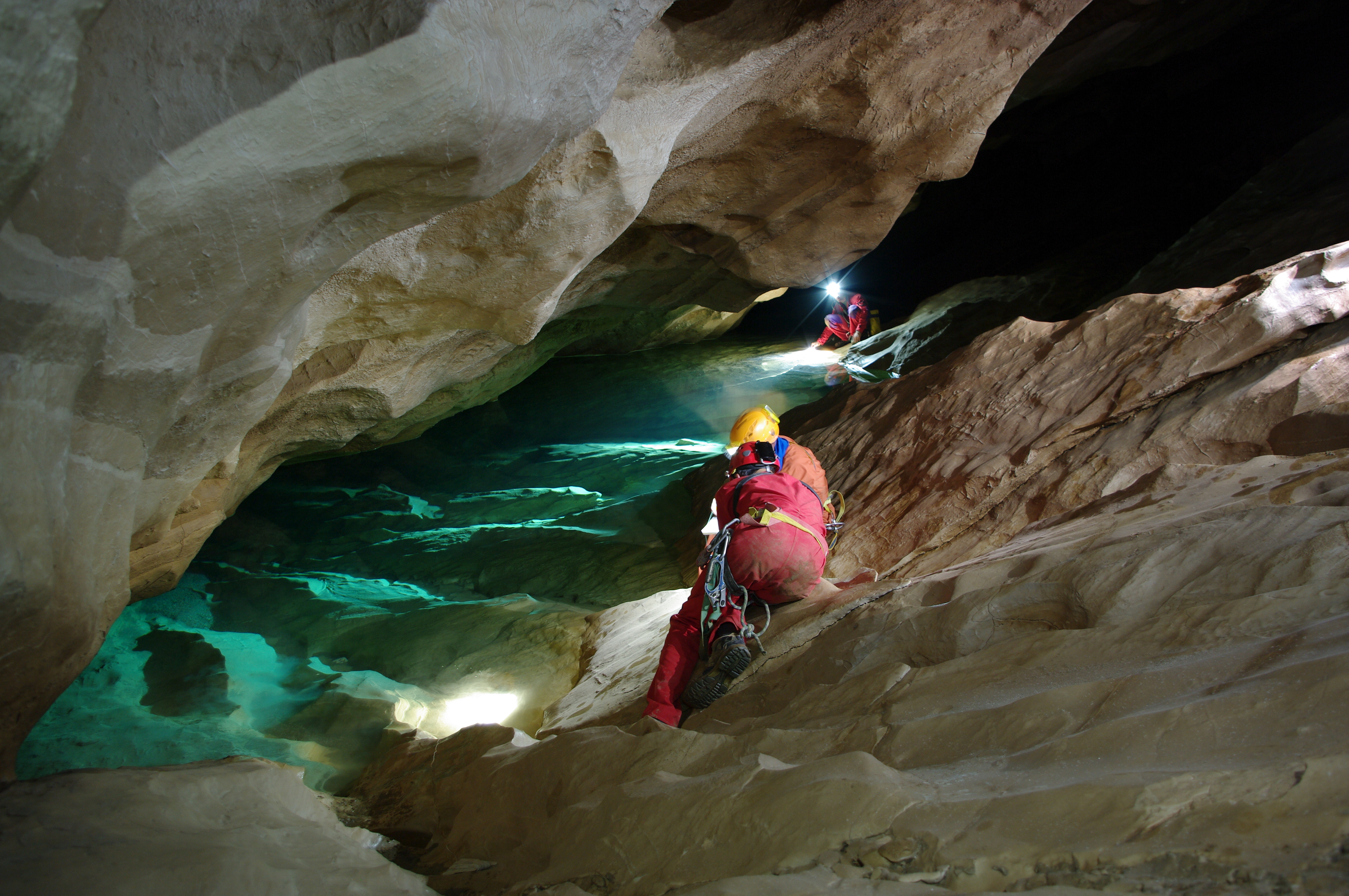
A ‘cavewalk’. Moving in a cave is similar to a spacewalk. It requires safety tethering, 3D orientation, with no-touch areas (speleothemes) and exclusion zones (dangerous paths). As in a spacewalk the view is stunning.
ESA’s cave training prepares astronauts to work as an international team in real exploration conditions. Sending astronauts underground to survive and explore Sardinian caves in Italy for almost a week is just one element of their long training.
The caves are isolated from the outside world. The astronauts need to get used to confined spaces, minimal privacy, technical challenges and limited equipment and supplies for hygiene and comfort – just like in space. 
Credits: ESA–V. Crobu
 Caves offer many similarities to space travel. Working in isolation from the outside world in confined spaces with minimal privacy as well as coping with technical challenges and limited supplies are conditions that astronauts have to live with in space – and underground.
The experience is designed to be as realistic as possible. A dedicated mission control will monitor the crew from a base station at the entrance of the cave. Briefings are held twice a day as they are on the International Space Station.
The crew is allowed only one shipment of supplies during their stay underground. They will have to choose the equipment carefully and give mission control at least 24 hours’ notice to prepare the cargo.
Orientation phase of CAVES 2011.
ESA’s cave training prepares astronauts to work as an international team in real exploration conditions. Sending astronauts underground to survive and explore Sardinian caves in Italy for almost a week is just one element of their long training.
The caves are isolated from the outside world. The astronauts need to get used to confined spaces, minimal privacy, technical challenges and limited equipment and supplies for hygiene and comfort – just like in space. Credits: ESA–V. Crobu
Looking for life

The opportunity to conduct research will not be lost. Just as in space, the astronauts have a busy schedule performing scientific work as well as testing new equipment and procedures.
A large part of the Sardinian caves are unexplored or uncharted. The ‘cavenauts’ will have to navigate safely through passages while deciding which areas to explore. They will draw detailed maps of their progress to ensure they make it back to base camp and to help future cave explorers.
This year the astronauts will be searching for life-forms as well. “Nobody has systematically looked for life in these caves,” says ESA astronaut trainer and CAVES course designer Loredana Bessone.


Life spotted in cave. ESA’s cave training prepares astronauts to work as an international team in real exploration conditions. Sending astronauts underground to survive and explore Sardinian caves in Italy for almost a week is just one element of their long training.
The Sardinian caves are isolated from the outside world. The astronauts need to get used to confined spaces, minimal privacy, technical challenges and limited equipment and supplies for hygiene and comfort – just like in space. 
Credits: ESA–F. Sauro
 “Finding life big and small is always good, so I am very excited we will be looking for exotic bacteria and cave dwellers such as anthropods.”
The astronauts will use the same safety protocols as used on spacewalks and they will also test a new communication system.
With support from their trainers, the astronauts will analyse their team-working skills and leadership qualities during the two-week course.
  ESA
G
 
Guillermo Gonzalo Sánchez Achutegui

 ayabaca@gmail.com
 ayabaca@hotmail.com
 ayabaca@yahoo.com
 Inscríbete en el Foro del blog y participa : A Vuelo De Un Quinde - El Foro!

lunes, 6 de agosto de 2012

Science: Scientists Define New Limits of Microbial Life in Undersea Volcanoes

Hi My Friends: A VUELO DE UN QUINDE EL BLOG., A third of Earth's organisms live in rocks and sediments, but their lives have been a mystery .
 Hydrothermal vent field at Axial Volcano seen through the porthole of the submersible Alvin.
Credit: Mark Spear/WHOI
Download the high-resolution JPG version of the image. (1.7 MB)
 Hydrothermal sulfide spire at Endeavor Segment, Juan de Fuca Ridge in the Pacific Ocean.
Credit: Bruce Strickrott/WHOI
Download the high-resolution JPG version of the image. (4.8 MB)
 Alvin extends its mechanical arm to a high-temperature black smoker at Endeavor Segment.
Credit: Bruce Strickrott/WHOI
Download the high-resolution JPG version of the image. (5.1 MB)
 Scientists James Holden (left), Helene Ver Eecke with Alvin pilot Bruce Strickrott in The Deep.
Credit: Bruce Strickrott/WHOI
Download the high-resolution JPG version of the image. (4.1 MB)
 Researcher Helene Ver Eecke with a hydrothermal vent sample, aboard the ship Atlantis.
Credit: James Holden/UMass-Amherst
Download the high-resolution JPG version of the image. (3.4 MB)

By some estimates, a third of Earth's organisms live in our planet's rocks and sediments, yet their lives are almost a complete mystery.
This week, the work of microbiologist James Holden of the University of Massachusetts-Amherst and colleagues shines a light into this dark world.
In the journal Proceedings of the National Academy of Sciences (PNAS), they report the first detailed data on methane-exhaling microbes that live deep in the cracks of hot undersea volcanoes.
"Evidence has built that there's an incredible amount of biomass in the Earth's subsurface, in the crust and marine sediments, perhaps as much as all the plants and animals on the surface," says Holden.
"We're interested in the microbes in the deep rock, and the best place to study them is at hydrothermal vents at undersea volcanoes. Warm water there brings the nutrient and energy sources these microbes need."
Just as biologists studied the habitats and life requirements of giraffes and penguins when they were new to science, Holden says, "for the first time we're studying these subsurface microorganisms, defining their habitat requirements and determining how they differ among species."
The result will advance scientists' comprehension of biogeochemical cycles in the deep ocean, he and co-authors believe.
"Studies such as this add greatly to our understanding of microbial processes in the still poorly-known deep biosphere," says David Garrison, program director in the National Science Foundation's Division of Ocean Sciences, which funded the research.
The project also addresses such questions as what metabolic processes may have looked like on Earth three billion years ago, and what alien microbial life might look like on other planets.
Because the study involves methanogens--microbes that inhale hydrogen and carbon dioxide to produce methane as waste--it may also shed light on natural gas formation on Earth.
One major goal was to test results of predictive computer models and to establish the first environmental hydrogen threshold for hyperthermophilic (super-heat-loving), methanogenic (methane-producing) microbes in hydrothermal vent fluids.
"Models have predicted the 'habitability' of the rocky environments we're most interested in, but we wanted to ground-truth these models and refine them," Holden says.
In a two-liter bioreactor at UMass Amherst where the scientists could control hydrogen levels, they grew pure cultures of hyperthermophilic methanogens from their study site alongside a commercially available hyperthermophilic methanogen species.
The researchers found that growth measurements for the organisms were about the same. All grew at the same rate when given equal amounts of hydrogen and had the same minimum growth requirements.
Holden and Helene Ver Eecke at UMass Amherst used culturing techniques to look for organisms in nature and then study their growth in the lab.
Co-investigators Julie Huber at the Marine Biological Laboratory on Cape Cod provided molecular analyses of the microbes, while David Butterfield and Marvin Lilley at the University of Washington contributed geochemical fluid analyses.
Using the research submarine Alvin, they collected samples of hydrothermal fluids flowing from black smokers up to 350 degrees C (662 degrees F), and from ocean floor cracks with lower temperatures.
Samples were taken from Axial Volcano and the Endeavour Segment, both long-term observatory sites along an undersea mountain range about 200 miles off the coast of Washington and Oregon and more than a mile below the ocean's surface.
"We used specialized sampling instruments to measure both the chemical and microbial composition of hydrothermal fluids," says Butterfield.
"This was an effort to understand the biological and chemical factors that determine microbial community structure and growth rates."
A happy twist awaited the researchers as they pieced together a picture of how the methanogens live and work.
At the low-hydrogen Endeavour site, they found that a few hyperthermophilic methanogens eke out a living by feeding on the hydrogen waste produced by other hyperthermophiles.
"This was extremely exciting," says Holden. "We've described a methanogen ecosystem that includes a symbiotic relationship between microbes."
The research was also supported by the NASA Astrobiology Institute and the National Oceanic and Atmospheric Administration.
-NSF-


 Guillermo Gonzalo Sánchez Achutegui
ayabaca@gmail.com
ayabaca@hotmail.com
ayabaca@yahoo.com
 Inscríbete en el Foro del blog y participa : A Vuelo De Un Quinde - El Foro!

Mi lista de blogs