Mostrando entradas con la etiqueta Mato Grosso. Mostrar todas las entradas

jueves, 29 de marzo de 2018

SELVA AMAZÓNICA : CIENCIA .- ARQUEOLOGÍA .- BBC Mundo Noticias .- El sorprendente hallazgo de un grupo de aldeas en el Amazonas que replantea la historia de la selva más grande del mundo

Hola amigos: A VUELO DE UN QUINDE EL BLOG., la Agencia de Noticias BBC Mundo Noticias, nos informa sobre el descubrimiento de un grupo de 81, que según lo cálculos, fueron habitadas por  unos 500,000 o un millón de personas. entre los años de 1,200 a 1,450: el hallazgo fue efectuado por  un grupo de arqueólogos de la Universidad de Exeter, en Reino Unido,.
Lo destacable de este hallazgo arqueológico es que las poblaciones estuvieron ubicadas muy lejos de los  ríos principales, lo cual cuestiona la idea, que las mayores poblaciones  pre colombinas. solo se ubicaban alrededor de las grandes fuentes de agua.                , 
un geoglifo
Image captionLos geoglifos son figuras geométricas talladas en la tierra. Foto: Universidad de Exeter.
La deforestación amenaza con destruir la Amazonía, pero en esta ocasión fue la clave de un descubrimiento arqueológico que replantea la historia de la selva más grande del mundo.
Gracias a imágenes aéreas de unas áreas en las que prácticamente no quedan árboles, un grupo de arqueólogos de la Universidad de Exeter, en Reino Unido, descubrieron 81 aldeas que, según sus cálculos, fueron habitadas por entre 500.000 y un millón de personas, entre los años 1.200 y 1.450.
El hallazgo, revelado esta semana, tuvo lugar en el sur de la Amazonía, en el estado brasilero de Mato Grosso.
Lo interesante del descubrimiento es que estos asentamientos están lejos de los principales ríos, lo cual cuestiona la idea de que las mayores poblaciones precolombinas de esta región solo se ubicaban alrededor de las grandes fuentes de agua.
un geoglifo
Image captionCon la deforestación quedaron al descubierto los restos de los asentamientos. Foto: Universidad de Exeter.
Hasta hace unos años se estimaba que antes de la colonización, en los 5,5 millones de kilómetros cuadrados de la Amazonía vivían unos 8 millones de personas.
Este hallazgo, sin embargo, sugiere que en solo 2.000 kilómetros cuadrados vivieron un promedio de 750.000 personas.
"Esta es solo una pieza más en el rompecabezas del Amazonas", le dice a BBC Mundo el arqueólogo Jonas Gregorio de Souza, líder de la investigación.
"Hay regiones de la Amazonía de la que no se sabe prácticamente nada, así que estos hallazgos nos ayudan a entender mejor las poblaciones que vivían ahí y cómo se relacionaban con el paisaje".
Según su conocimiento, probablemente estas culturas combinaban la agricultura a pequeña escala con el manejo de árboles fructíferos, como el de castañas y variedades de palmas.

Círculos, cuadrados y hexágonos

Desde el aire, lo que llamó la atención de los investigadores fueron los geoglifos, que son zanjas talladas en la tierra en forma de figuras geométricas como círculos, cuadrados y hexágonos.
un geoglifo
Image captionLos investigadores estiman que en las aldeas descubiertas vivían entre 500.000 y un millón de personas. Foto: Universidad de Exeter.
Se cree que estos trazos se utilizaban para demarcar las villas fortificadas y como centros ceremoniales.
Ya en el terreno, los investigadores encontraron lo que conocen como terra preta(tierra negra), un tipo de suelo muy fértil que se forma en lugares donde los humanos se han asentado durante mucho tiempo.
Al excavar, encontraron restos de cerámica y objetos como hachas fabricadas con piedra tallada.
Antes, ya se habían encontrado asentamientos similares cientos de kilómetros al este y al oeste de estas aldeas. Además, algunos relatos históricos mencionaban que esta zona estaba poblada, lo cual hace pensar a los expertos que no se trataban de pueblos aislados, sino de un corredor habitado de manera continua por varias culturas.
Para de Souza estos asentamientos abre el camino para muchas lecciones.
"Seguir investigando a estas culturas nos permitirá aprender la forma de mantener poblaciones grandes de manera sostenible con el paisaje", dice.
Además de seguir investigando, de Souza también espera que en un futuro no sea a causa de la deforestación que logren estos descubrimientos.
línea
Ahora puedes recibir notificaciones de BBC Mundo. Descarga la nueva versión de nuestra app y actívalas para no perderte nuestro mejor contenido.


Contenido relacionado

BBC Mundo Noticias
Guillermo Gonzalo Sánchez Achutegui
ayabaca@gmail.com
ayabaca@hotmail.com
ayabaca@yahoo.com
Inscríbete en el Foro del blog y participa : A Vuelo De Un Quinde - El Foro!
martes, 15 de abril de 2014

nsf.gov - National Science Foundation - Drought and fire in the Amazon lead to sharp increases in forest tree mortality

Deforestation and fragmentation of forests help create tinderbox conditions
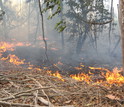
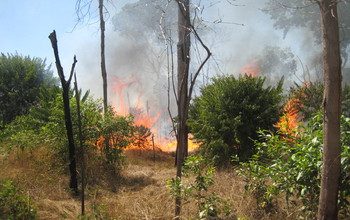
Grasses on fire in Mato Grosso, Brazil
Grasses in Mato Grosso, Brazil, catch fire regularly near the edges of forests and croplands.
Credit and Larger Version
April 14, 2014
Ongoing deforestation and fragmentation of forests in the Amazon help create tinderbox conditions for wildfires, contributing to rapid and widespread forest loss during drought years, according to a team of researchers.
Their findings show that forests in the Amazon could reach a "tipping point" when severe droughts coupled with forest fires lead to large-scale loss of trees, making recovery more difficult, said Jennifer Balch, a geographer at Penn State University.
"We documented one of the highest tree mortality rates witnessed in Amazon forests," Balch said. "Over the course of our experiment, 60 percent of the trees died with combined drought and repeated fire.
"Our results suggest that a perfect firestorm, caused by drought conditions and previous fire disturbance, crossed a threshold in forest resistance."
The researchers conclude in today's issue of the journal Proceedings of the National Academy of Sciences (PNAS) that "efforts to end deforestation in the Amazon must be accompanied by programs and policies that reduce the accidental spread of land management fires into neighboring forests--and effectively control forest fires when started."
Balch noted that climate change is expected to warm the air in the Amazon region by several degrees and substantially reduce regional precipitation, making understanding the interactions between droughts and fires even more important.
"However, before any prediction of Amazon climate warming occurs, our study demonstrates that drought and fire are already driving forest dieback," she said.
The eight-year study is the largest and longest-running fire experiment in tropical forests. The researchers burned 50-hectare forest plots in the Southeastern Amazon, a region prone to the effects of climate change.
"If drought and wildfires happen in the same time-frame, there are far-reaching consequences for the health of Amazon forests," said Henry Gholz, a program director in the National Science Foundation Division of Environmental Biology, which funded the research. "When climate change becomes part of the mix, questions for these forests loom yet larger."
The plots were burned every year, every three years, or not at all. The timeframe for the study included 2007, a year of severe drought.
By comparing the tree deaths for the plots each year, the researchers could assess the effect of drought on fire intensity and tree deaths.
"Drought causes more intense and widespread fires," said lead PNAS paper author Paulo Brando of the Instituto de Pesquisa Ambiental da Amazônia, Carnegie Institution for Science, and Woods Hole Research Center.
"Four times more adult trees were killed by fire during a drought year, which means that there was also more carbon dioxide released to the atmosphere, more tree species loss and a greater likelihood of grasses invading the forest."
The researchers found that fragmented forests are more susceptible to the effects of drought and fire, and that drought leads to an increase in fuel such as leaves and branches.
The findings are key, in part, because most climate change models have not included the effects of fires on Amazon forests.
"Basically, none of the models used to evaluate future Amazon forest health includes fire, so most of these predictions underestimate the amount of tree death and overestimate overall forest health," said Michael Coe, a scientist at the Woods Hole Research Center.
Fire as a forest management tool can contribute to an increase in severe fires because the resulting thinner canopy leads to drier forest conditions.
This lack of humidity does not dampen fires but does encourage airflow between fields and forests. Fragmented forests also have more edge space, which is susceptible to both fire and invasive grasses, another potential fuel.
"These forests are tough and can take a lot, but if drought reaches a certain level, big trees begin to die," said Daniel Nepstad of the Earth Innovation Institute, who also co-led the project. "We now know that severe drought makes fires more intense, creating a second tree mortality threshold."
The results are important because large portions of the Amazon forest already experience droughts and are susceptible to fire--they are broken into smaller blocks by agriculture and are close to human settlements, the predominant source of fire in the Amazon.
The researchers analyzed NASA satellite data to provide regional context for results from the experimental burns.
"In 2007, fires in Southeast Amazonia burned 10 times more forest than in an average climate year -- an area equivalent to a million soccer fields," said scientist Douglas Morton of NASA.
"These smaller forest fragments have more edges than large blocks of forest, which expose them to the hotter, drier conditions in the surrounding landscape and make them more vulnerable to escaped fires," said researcher Marcia Macedo of the Woods Hole Research Center.
By 2011, about eight percent of Southeast Amazonia's forests were less than 328 feet from an agricultural or pasture clearing. This lattice-like network of degraded forest edges is now very susceptible to future fires.
The research was also funded by the Packard Foundation, NASA and the Max Planck Institute for Biogeochemistry.
-NSF-
Media Contacts Cheryl Dybas, NSF, (703) 292-7734, cdybas@nsf.gov
Eunice Yeomans, WHRC, (508) 444-1509, eyoumans@whrc.org
Anne Danahy, PSU, (814) 865-4504, acd2@psu.edu
The National Science Foundation (NSF) is an independent federal agency that supports fundamental research and education across all fields of science and engineering. In fiscal year (FY) 2014, its budget is $7.2 billion. NSF funds reach all 50 states through grants to nearly 2,000 colleges, universities and other institutions. Each year, NSF receives about 50,000 competitive requests for funding, and makes about 11,500 new funding awards. NSF also awards about $593 million in professional and service contracts yearly.
Useful NSF Web Sites:
NSF Home Page: http://www.nsf.gov
NSF News: http://www.nsf.gov/news/
For the News Media: http://www.nsf.gov/news/newsroom.jsp
Science and Engineering Statistics: http://www.nsf.gov/statistics/
Awards Searches: http://www.nsf.gov/awardsearch/

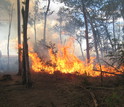
Experimental fire burning the understory of a forest between Cerrado and Amazonia, Brazil.
Credit and Larger Version
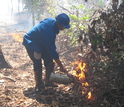
Scientist advancing  a fire line in an experimental fire plot in Mato Grosso, Brazil.
Advancing fire line in an experimental fire plot in Mato Grosso, Brazil.
Credit and Larger Version
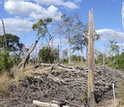
Forest with bare land degraded by experimental fires in Mato Grosso, Brazil.
Forest degraded by experimental fires in Mato Grosso, Brazil.
Credit and Larger Version
An experimental fire in the Brazilian forest
Igniting an experimental fire in the Brazilian forest, using a drip torch.
Credit and Larger Version
Fire experiment in Mato Grasso, Brazil with tinderbox grasses along the forest
Fire experiment in Mato Grasso, Brazil; tinderbox grasses lie along forests and croplands.
Credit and Larger Version
 
The National Science Foundation (NSF)
Guillermo Gonzalo Sánchez Achutegui

Mi lista de blogs