Mostrando entradas con la etiqueta NASA’s Orion spacecraft. Mostrar todas las entradas

viernes, 2 de septiembre de 2016

ESA : Imágenes Semanales de ESA

http://www.esa.int/spaceinimages/Images/2016/08/Stellar_shrapnel">http://www.esa.int/spaceinimages/Images/2016/08/Stellar_shrapnel
http://esaintouch.net/
http://www.esa.int/spaceinimages/Images/2016/08/Ariane_5_liftoff_VA232
https://soundcloud.com/esa
http://www.esa.int/Highlights/Week_In_Images_22_26_August_2016
http://www.esa.int/Our_Activities/Telecommunications_Integrated_Applications/First_satellite-based_wildlife_monitoring_tool_for_airports

Stellar shrapnel

Details

Open/Close
  • Title Stellar shrapnel
  • Released 19/08/2016 12:41 pm
  • Copyright ESA/Hubble & NASA, Y. Chu
  • Description
    Several thousand years ago, a star some 160 000 light-years away from us exploded, scattering stellar shrapnel across the sky. The aftermath of this energetic detonation is shown here in this striking image from the NASA/ESA Hubble Space Telescope’s Wide Field Camera 3.
    The exploding star was a white dwarf located in the Large Magellanic Cloud, one of our nearest neighbouring galaxies. Around 97% of stars within the Milky Way that are between a tenth and eight times the mass of the Sun are expected to end up as white dwarfs. These stars can face a number of different fates, one of which is to explode as supernovae, some of the brightest events ever observed in the Universe. If a white dwarf is part of a binary star system, it can siphon material from a close companion. After gobbling up more than it can handle — and swelling to approximately one and a half times the size of the Sun — the star becomes unstable and ignites as a Type Ia supernova.
    This was the case for the supernova remnant pictured here, which is known as DEM L71. It formed when a white dwarf reached the end of its life and ripped itself apart, ejecting a superheated cloud of debris in the process. Slamming into the surrounding interstellar gas, this stellar shrapnel gradually diffused into the separate fiery filaments of material seen scattered across this skyscape.
  • Id 364183

TAGS

Open/Close

The real thing

Details

Open/Close
  • Title The real thing
  • Released 24/08/2016 12:16 pm
  • Copyright Airbus DS
  • Description
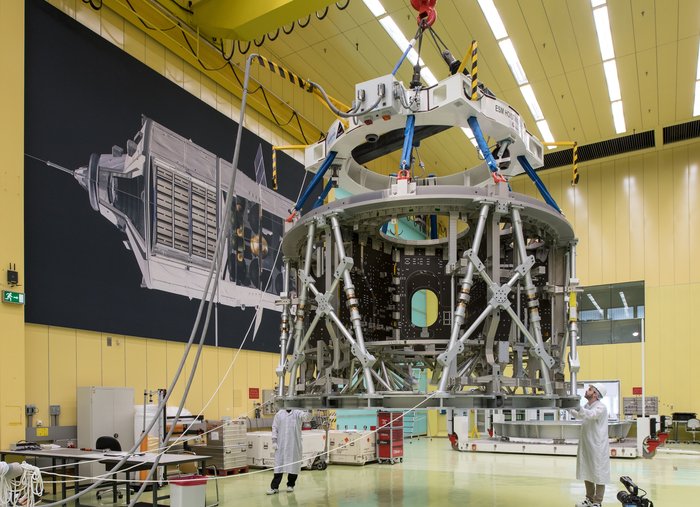
    The European Service Module that will power NASA’s Orion spacecraft to the Moon and beyond is taking shape in the assembly hall at Airbus Defence and Space,  Bremen, Germany. The spacecraft module will provide propulsion, electricity, water, oxygen and nitrogen and thermal control.
    Seen here is the primary structure that provides rigidity to the European Service Module much like the chassis of a car. It absorbs the vibrations and energy from launch while a secondary structure protects the module from micrometeoroids and space debris.
    Assembly of the thousands of components needed to build the advanced spacecraft started on 19 May with the arrival of the primary structure that was shipped from Turin, Italy, by Thales Alenia Space. In 2018 this structure will be an element of the European Service Module that will be launched into space, as part of the Orion spacecraft, on its first mission to fly more than 64 000 km beyond the Moon and back.
    In the background is a poster of ESA’s Automated Transfer Vehicle (ATV) that was also assembled in this hall in Bremen. Five ATVs flew to the International Space Station to deliver supplies and raise its orbit.  Developing ATV provided the experience necessary to develop the European Service Module in Europe.
  • Id 364275

TAGS

Open/Close

Ariane 5 liftoff VA232

Details

Open/Close
  • Title Ariane 5 liftoff VA232
  • Released 25/08/2016 12:16 am
  • Copyright ESA
  • Description On 24 August 2016, Ariane 5 flight VA232 lifted off from Europe’s Spaceport in French Guiana and delivered two satellites, Intelsat-33e and Intelsat-36, into their planned orbits.
  • Id 364290

TAGS

Open/Close
  • Click on the tags to find the matching images.
  • Activity Launchers
  • Mission Ariane

Proba-V views Great Salt Lake

Details

Open/Close
  • Title Proba-V views Great Salt Lake
  • Released 26/08/2016 9:14 am
  • Copyright ESA/Belspo – produced by VITO
  • Description Great Salt Lake, the largest salt lake in the western hemisphere, captured by ESA's Proba-V satellite last June.
    Launched on 7 May 2013, Proba-V is a miniaturised ESA satellite – less than a cubic metre – tasked with a full-scale mission: to map land cover and vegetation growth across the entire planet every two days.
    Its main camera’s continent-spanning 2250 km swath width collects light in the blue, red, near-infrared and mid-infrared wavebands at 300 m resolution and down to 100 m resolution in its central field of view.
    VITO Remote Sensing in Belgium processes and then distributes Proba-V data to users worldwide. An online image gallery highlights some of the mission’s most striking images so far, including views of storms, fires and deforestation.
  • Id 364330

TAGS

Open/Close

Italy earthquake displacement

Details

Open/Close
  • Title Italy earthquake displacement
  • Released 26/08/2016 5:31 pm
  • Copyright Contains modified Copernicus Sentinel data (2016)/ESA/ CNR-IREA
  • Description
    Combining two Sentinel-1 radar scans from 20 August (Sentinel-1B) and 26 August 2016 (Sentinel-1A), this interferogram shows changes that occurred during the 24 August earthquake that struck central Italy.
    The seven interferometric ‘fringes’ correspond to about 20 cm of surface deformation in the radar sensor line of sight.  Each fringe (which is associated to a colour cycle) corresponds to approximately 2.8 cm of displacement.
    Although Sentinel-1 has a swath width of 250 km over land surfaces, its pass over Italy on 26 August did not cover the entire area affected. Another acquisition planned for 27 August will cover the entire earthquake zone.
  • Id 364362

TAGS

Open/Close


Ascend - the wildlife management solution for airports

First satellite-based wildlife monitoring tool for airports

29 August 2016
Wildlife habitats close to airports pose a serious risk to safety at takeoff and landing. Thanks to ESA, a new service lets airports use satellites to identify and manage these areas.
Developed by Ascend XYZ in Denmark with ESA’s help, the service uses free images and data from Earth observation satellites combined with smart software.
Several airports in Denmark have tested the Ascend software and found it far easier to use than existing complicated standalone systems.
Focusing on risk sites has increased their efficiency and reduced costs and enabled them to comply with the legal requirement to monitor within a 13 km radius.
 
 
Detecting water via satellite
 
"Using Earth observation data is more efficient than on-ground monitoring, requiring fewer man-hours and lowering demands on resources which cuts costs while increasing flight safety,” commented Peter Hemmingsen, CEO at Ascend.
“This is especially valuable to smaller airports with fewer resources to meet the same safety standards as large airports.
“Free data from the latest Copernicus Sentinel satellites make this an affordable solution for airports.”
Two airports have already signed up to the service.
Several international airports from Germany, England and North America also plan to adopt it.
 
Registering a lake in Ascend
 
In the software, users can identify risk sites such as lakes, golf courses, rubbish dumps, seasonal crops and other areas that attract wildlife – birds in particular. This provides a full overview of all the sites around the airport.
Satellite pictures are updated weekly, so changes in the water levels of lakes and flooded fields can be monitored and the site visited. All actions can be documented in the software.
The software can also generate alerts such as reminders to visit a site, monitor it via the satellite images, or contact the authorities if changes occur.
Sites can be marked on maps and field personnel can visit specific areas guided by satellite navigation data from Ascend.
 
Field personnel locate sites through satnav
 
Reports and images generated in Ascend can also be used for auditing purposes and to create a wildlife management report. Without the Ascend solution, airports require a costly team of specialists to do this.
The cloud- and browser-based management system allows the information to be shared online between airport operators, ground staff, civil aviation authorities, the wildlife management team and others involved in airport operations.
Early next year, Ascend intends to extend their service to identify objects that exceed height restrictions in restricted areas.
“ESA’s ARTES Applications programme merges big space data with smart ideas,” noted Arnaud Runge, Ascend Project Manager at the Agency.
“Ascend is an excellent example of how space can increase efficiency, cuts costs, solve problems and, in this case, make our skies safer.”
ESA
Guillermo Gonzalo Sánchez Achutegui
ayabaca@gmail.com
ayabaca@hotmail.com
ayabaca@yahoo.com
Inscríbete en el Foro del blog y participa : A Vuelo De Un Quinde - El Foro!

domingo, 7 de febrero de 2016

NASA : Engineers Mark Completion of Orion’s Pressure Vessel .- Los ingenieros marcan la finalización de los recipientes a presión de Orión

Hola amigos: A VUELO DE UN QUINDE EL BLOG., Soldadura de aluminio siete piezas grandes de Orión, que comenzó en septiembre de 2015, aparejado un proceso meticuloso. Ingenieros preparados y equipados cada elemento con medidores de deformación y el cableado para controlar el metal durante el proceso. Las piezas se unen utilizando un proceso llamado soldadura por fricción-agitación del estado de la técnica, que produce lazos muy fuertes mediante la transformación de metales a partir de un sólido a un estado parecido al plástico, y luego usando una herramienta pivote giratorio para ablandar, remover y forjar un vínculo entre los dos componentes de metal para formar una unión soldada uniforme, un requisito vital de equipo espacial de próxima generación.
More information....
 

Orion spacecraft structure inside large room with engineer standing at right
NASA’s Orion spacecraft is another step closer to launching on its first mission to deep space atop the agency’s Space Launch System (SLS) rocket. On Jan. 13, 2016, technicians at Michoud Assembly Facility in New Orleans finished welding together the primary structure of the Orion spacecraft destined for deep space, marking another important step on the journey to Mars.
 
Welding Orion’s seven large aluminum pieces, which began in September 2015, involved a meticulous process. Engineers prepared and outfitted each element with strain gauges and wiring to monitor the metal during the process. The pieces were joined using a state-of-the-art process called friction-stir welding, which produces incredibly strong bonds by transforming metals from a solid into a plastic-like state, and then using a rotating pin tool to soften, stir and forge a bond between two metal components to form a uniform welded joint, a vital requirement of next-generation space hardware.
Image Credit: NASA
Last Updated: Jan. 27, 2016
Editor: Sarah Loff

NASA to Announce Science, Technology Missions for First Flight of Space Launch System

NASA Television will air the announcement of the selection of a fleet of small satellites to launch on the inaugural flight of the agency’s Space Launch System (SLS). The event, which is at 11 a.m. EST (10 a.m. CST) Tuesday, Feb. 2, from NASA’s Marshall Space Flight Center in Huntsville, Alabama, will announce the CubeSats that will fly as secondary payloads and deploy to conduct science and technology demonstrations in deep space.

Following the event, which media are invited to participate in, NASA TV will air a demonstration of the Near-Earth Asteroid Scout (NEA Scout), a CubeSat that uses solar sail propulsion for low-cost exploration and reconnaissance of an asteroid.

The participants for both the announcement and demonstration are:
  • NASA Deputy Administrator Dava Newman
  • Todd May, Marshall Space Flight Center director (acting)
  • Bill Hill, deputy associate administrator of Exploration Systems Development at NASA Headquarters in Washington
  • Michael Seablom, chief technologist for NASA’s Science Mission Directorate at NASA Headquarters
  • Jim Cockrell, Cube Quest program administrator in NASA’s Space Technology Mission Directorate at NASA’s Ames Research Center in Moffett Field, California
  • Jitendra Joshi, technology integration lead for the Advanced Exploration Systems Division at NASA Headquarters
  • Chris Crumbly, manager of the Space Launch System Spacecraft and Payload Integration/Evolution Office at Marshall
  • Leslie McNutt, NEA Scout project manager at Marshall
  • Les Johnson, NEA Scout solar sail principal investigator at Marshall

The event will include a brief question-and-answer session with media attending in person or by phone. To participate by phone, media must contact Kim Newton at 256-544-0371, 256-653-5173 or kimberly.d.newton@nasa.gov by 1 p.m. (noon CST) on Monday, Feb. 1. During the broadcast, viewers can ask questions on social media using #AskNASA.

The primary goal of the first integrated launch of NASA’s SLS and Orion spacecraft is to demonstrate the agency’s new capability to launch future crewed, deep space missions, which include missions to an asteroid and Mars. As a bonus, SLS will carry 13 CubeSats on its first flight as secondary payloads. These small satellites will perform various in-space experiments and demonstrations to advance the technological capabilities needed to take humans farther into space than ever before. The secondary payloads were selected through a series of announcements of flight opportunities, a public contest, and negotiations with NASA’s international partners.

For NASA TV downlink information and schedules, and to view the news briefing, visit:


-end-
Kathryn Hambleton
Headquarters, Washington
202-358-1409
kathryn.hambleton@nasa.gov

Kim Newton / Shannon Ridinger
Marshall Space Flight Center, Huntsville, Ala.
256-544-0371 / 256-544-3774
kimberly.d.newton@nasa.gov / shannon.j.ridinger@nasa.gov
Last Updated: Jan. 28, 2016
Editor: Allard Beutel
NASA

Super Guppy Ready to Transport the Orion Spacecraft


NASA's Super Guppy airplane ready to transport Orion spacecraft to Kennedy Space Center.      
NASA's Super Guppy aircraft readies to transport the Orion spacecraft pressure vessel for Exploration Mission-1 from the Michoud Assembly Facility in Louisiana to Kennedy Space Center in Florida. The pressure vessel will fly on the first integrated launch of Orion and NASA's powerful new rocket, the Space Launch System. The test flight, which will fly without crew, will demonstrate the agency’s new capability to launch future deep space missions, which include missions to an asteroid and Mars.
The Super Guppy has a cargo compartment that is 25 feet tall, 25 feet wide and 111 feet long and can carry more than 26 tons. The aircraft has unique hinged nose that can open more than 200 degrees, allowing large pieces of cargo to be loaded and unloaded from the front.
Image Credit: NASA
Last Updated: Feb. 1, 2016
Editor: Steve Fox
NASA
 

Todd May Named Marshall Space Flight Center Director

toddmay.jpg
Todd May, director of NASA's Marshall Space Flight Center in Huntsville, Alabama.
Credits: NASA

NASA Administrator Charles Bolden has named Todd May director of the agency’s Marshall Space Flight Center in Huntsville, Alabama. May was appointed Marshall deputy director in August 2015 and has been serving as acting director since the Nov. 13, 2015 retirement of Patrick Scheuermann.

As director, May will lead one of NASA's largest field installations, with almost 6,000 civil service and contractor employees, an annual budget of approximately $2.5 billion and a broad spectrum of human spaceflight, science and technology development missions.

"Todd’s experience and leadership have been invaluable to the agency, especially as we have embarked on designing, building and testing the Space Launch System, a critical part of NASA’s journey to Mars," said Bolden. "He brings his expert program management and leadership skills and sense of mission to this new role, and I look forward to having him at the helm of Marshall."

Since its inception in 2011, May led the Space Launch System (SLS) program through a series of milestones, including a successful in-depth critical design review. SLS, now under development, is the most powerful rocket ever built, able to carry astronauts in NASA's Orion spacecraft on deep space missions, including to an asteroid and ultimately on a journey to Mars.

May's NASA career began in 1991 in the Materials and Processes Laboratory at Marshall. He was deputy program manager of the Russian Integration Office in the International Space Station Program at NASA's Johnson Space Center in Houston in 1994. May managed the successful integration, launch and commissioning of the station's Quest airlock in 1998. He also joined the team that launched the Gravity Probe B mission to test Einstein's general theory of relativity.

In 2004, May assumed management of the Discovery and New Frontiers Programs, created to explore the solar system with frequent unmanned spacecraft missions. He moved to NASA Headquarters in Washington in 2007 as a deputy associate administrator in the Science Mission Directorate. Returning to Marshall in June 2008, May was named Marshall's associate director, technical, a post he held until being named SLS program manager.

May earned a bachelor's degree in materials engineering from Auburn University in Auburn, Alabama, in 1990. His many awards include NASA’s Exceptional Achievement Medal, the Presidential Rank Award of Meritorious Executive, NASA’s Outstanding Leadership Medal and the John W. Hager Award for professionalism in materials engineering. He has been named a Distinguished Engineer by Auburn. In 2014, he received Aviation Week's Program Excellence Award, as well as the Rotary National Award for Space Achievement Foundation’s Stellar Award in recognition of the SLS team’s many accomplishments.

A native of Fairhope, Alabama, May and his wife, Kelly, have four children and live in Huntsville.

For more information about NASA's Marshall Space Flight Center, visit:


-end-
David Weaver
Headquarters, Washington
202-358-1600
david.s.weaver@nasa.gov

Jennifer Stanfield
Marshall Space Flight Center, Huntsville, Ala.
256-544-0034
jennifer.stanfield@nasa.gov
Last Updated: Feb. 1, 2016
Editor: Karen Northon
NASA
Guillermo Gonzalo Sánchez Achutegui
Inscríbete en el Foro del blog y participa : A Vuelo De Un Quinde - El Foro!

domingo, 29 de noviembre de 2015

NASA : NASA TV to Air Event Marking Arrival of Test Orion Powerhouse .- NASA TV para eventos Aire Marcado Llegada de prueba Orion Casa de Máquinas

Hola amigos: A VUELO DE UN QUINDE EL BLOG., El artículo de prueba estructural del módulo de servicio europeo de Orion está siendo ensamblado en Airbus Defensa y Espacio. Airbus está construyendo el módulo, que abastecerá de energía de la nave espacial, propulsión en el espacio y el aire y el agua para la tripulación, en nombre de la ESA (Agencia Espacial Europea) para Orión. El STA está siendo transportado a la estación de Plum Brook Glenn Research Center para la prueba.
More information.......

Orion service module
The structural test article of the European service module for Orion is being assembled at Airbus Defence and Space. Airbus is building the module, which will supply the spacecraft’s power, in-space propulsion and air and water for the crew, on behalf of ESA (European Space Agency) for Orion. The STA is being transported to Glenn Research Center's Plum Brook station for testing.
Credits: NASA
 
NASA Television will broadcast an event marking the arrival of a full-size test version of the service module provided by the European Space Agency (ESA) for NASA’s Orion spacecraft at 12:30 p.m. EST on Monday, Nov. 30 at the agency’s Plum Brook Station in Sandusky, Ohio.

Orion spacecraft
NASA’s Orion spacecraft will be the exploration vehicle that will carry humans farther into space than ever before, provide emergency abort capability, sustain the crew during the space travel, and provide safe re-entry from deep space return velocities.
Credits: NASA
 
Event participants will be:
  • Jim Free, director of NASA’s Glenn Research Center in Cleveland
  • Greg Williams, deputy associate administrator for Human Exploration and Operations at NASA Headquarters in Washington
  • Mark Kirasich, manager for the Orion Program at the agency’s Johnson Space Center in Houston
  • Mike Hawes, program manager for Orion at Lockheed Martin
  • Nico Dettmann, development department head at ESA
  • Oliver Juckenhoefel, vice president and head of the European Service Module program at Airbus Defence and Space

A brief question-and-answer session will take place during the event with media on site and by phone. Media that wish to ask questions on the phone must email their name, media affiliation and phone number to Jan Wittry at jan.m.wittry-1@nasa.gov by noon EST on Fri., Nov. 27. The public also can ask questions during the briefing on social media using #AskNASA.
The Orion spacecraft is being developed to help send astronauts to deep space destinations, such as an asteroid placed in lunar orbit and Mars. It will launch on the agency’s Space Launch System rocket. ESA, along with its contractor Airbus Defence and Space, is providing the service module for Orion’s next mission, a partnership that will bring international cooperation to the journey to Mars. The service module will supply power and propulsion to the Orion spacecraft for Exploration Mission-1.

ESA and Airbus also provided the structural representation of the service module so that NASA may conduct rigorous tests to ensure the module can withstand the trip to space. The multi-month test campaign will take place at Plum Brook’s Space Power Facility. Plum Brook is home to some of the largest testing structures in the world, including one of the world’s largest vacuum chamber, the world's most powerful spacecraft acoustic test chamber, and the world's highest capacity and most powerful spacecraft vibration table.

For NASA TV downlink information and schedules, and to view the news briefing, visit:


-end-
Kathryn Hambleton
Headquarters, Washington
202-358-1100
kathryn.hambleton@nasa.gov

Jan Wittry
Glenn Research Center, Cleveland
216-433-5466
jan.m.wittry-1@nasa.gov
Last Updated: Nov. 24, 2015
Editor: Sarah Ramsey
NASA
Guillermo Gonzalo Sánchez Achutegui
Inscríbete en el Foro del blog y participa : A Vuelo De Un Quinde - El Foro!

domingo, 15 de marzo de 2015

NASA : NASA's Space Launch System Booster Passes Major Ground Test.- Lanzamiento Espacial de la NASA System Booster Pasa la prueba de tierra Major

Hola amigos: A VUELO DE UN QUINDE EL BLOG., hemos recibido de la Agencia Espacial NASA, la información que su:  NASA System Booster, pasó la prueba en efectuada en "Tierra Mayor".
NASA, nos dice: "El más grande, más poderoso cohete jamás construido encendió miércoles para una prueba de tierra; constituyendo un  importante hito en la preparación para futuras misiones para ayudar a impulsar el cohete de la NASA Espacial Launch System (SLS) y la nave espacial Orion a destinos del espacio profundo, incluyendo un asteroide y Marte fue todo un  éxito.

For more information read below attached ....

Space Launch System rocket booster test
At the Orbital ATK test facility, the booster for NASA’s Space Launch System rocket was fired for a two minute test on March 11. The test is one of two that will qualify the booster for flight before SLS begins carrying NASA’s Orion spacecraft and other potential payloads to deep space destinations.
Image Credit: 
NASA
The largest, most powerful rocket booster ever built successfully fired up Wednesday for a major-milestone ground test in preparation for future missions to help propel NASA’s Space Launch System (SLS) rocket and Orion spacecraft to deep space destinations, including an asteroid and Mars.
The booster fired for two minutes, the same amount of time it will fire when it lifts the SLS off the launch pad, and produced about 3.6 million pounds of thrust. The test was conducted at the Promontory, Utah test facility of commercial partner Orbital ATK, and is one of two tests planned to qualify the booster for flight. Once qualified, the flight booster hardware will be ready for shipment to NASA’s Kennedy Space Center in Florida for the first SLS flight.
"The work being done around the country today to build SLS is laying a solid foundation for future exploration missions, and these missions will enable us to pioneer far into the solar system," said William Gerstenmaier, NASA’s associate administrator for human exploration and operations. "The teams are doing tremendous work to develop what will be a national asset for human exploration and potential science missions."
It took months to heat the 1.6 million pound booster to 90 degrees Fahrenheit to verify its performance at the highest end of the booster’s accepted propellant temperature range. A cold-temperature test, at a target of 40 degrees Fahrenheit, the low end of the propellant temperature range, is planned for early 2016. These two tests will provide a full range of data for analytical models that inform how the booster performs. During the test, temperatures inside the booster reached more than 5,600 degrees.
"This test is a significant milestone for SLS and follows years of development," said Todd May, SLS program manager. "Our partnership with Orbital ATK and more than 500 suppliers across the country is keeping us on the path to building the most powerful rocket in the world."
During the test, more than 531 instrumentation channels on the booster were measured to help assess some 102 design objectives. The test also demonstrated the booster meets applicable ballistic performance requirements, such as thrust and pressure. Other objectives included data gathering on vital motor upgrades, such as the new internal motor insulation and liner and an improved nozzle design.
When completed, two five-segment boosters and four RS-25 main engines will power the SLS on deep space missions. The 177-feet-long solid rocket boosters operate in parallel with the main engines for the first two minutes of flight. They provide more than 75 percent of the thrust needed for the rocket to escape the gravitational pull of the Earth.
The first flight test of SLS will be configured for a 70-metric-ton (77-ton) lift capacity and carry an uncrewed Orion spacecraft beyond low-Earth orbit to test the performance of the integrated system. The SLS will later be configured to provide an unprecedented lift capability of 130 metric tons (143 tons) to enable missions farther into our solar system.
For more information on SLS, visit:
 

  • Test Firing of Booster for NASA's New Rocket
    The largest, most powerful rocket booster ever built successfully fired up Wednesday for a major-milestone ground test in preparation for future missions to help propel NASA’s Space Launch System (SLS) rocket and Orion spacecraft to deep space destinations, including an asteroid and Mars.
    The booster fired for two minutes, the same amount of time it will fire when it lifts the SLS off the launch pad, and produced about 3.6 million pounds of thrust. The test was conducted at the Promontory, Utah test facility of commercial partner Orbital ATK, and is one of two tests planned to qualify the booster for flight. Once qualified, the flight booster hardware will be ready for shipment to NASA’s Kennedy Space Center in Florida for the first SLS flight.
    Image Credit: Orbital ATK
     
    NASA
    Guillermo Gonzalo Sánchez Achutegui
    Inscríbete en el Foro del blog y participa : A Vuelo De Un Quinde - El Foro!

    sábado, 6 de diciembre de 2014

    NASA : NASA’s New Orion Spacecraft Completes First Spaceflight Test

    Hola amigos: A VUELO DE UN QUINDE EL BLOG., la Agencia Espacial NASA, nos alcanza la información que logró cumplir todos los propósito empeñados en la Nave Orión, que según sus planes son ensayos como se podría hacer a futuro en el próximo viaje Marte.
    NASA nos dice " NASA marcó un hito importante el viernes en su viaje a Marte como la nave espacial Orion completó su primer viaje al espacio, viajando más lejos que cualquier nave espacial diseñada para los astronautas ha estado en más de 40 años......"
    NASA.. agrega " "Hoy es la prueba de vuelo de Orión es un gran paso para la NASA y una parte muy importante de nuestro trabajo pionero en el espacio profundo en nuestro Viaje a Marte", dijo el administrador de la NASA Charles Bolden. "Los equipos hicieron un gran trabajo poniendo Orion través de sus pasos en el entorno real que perdurará en nuestro empeño de los límites de la exploración humana en los próximos años."
    Major Milestone on Agency's Journey to Mars
    Following a perfect launch and more than four hours in Earth's orbit, NASA's Orion spacecraft is seen from an unpiloted aircraft descending under three massive red and white main parachutes, and shortly after its bullseye splashdown in the Pacific Ocean, 600 miles southwest of San Diego. During the uncrewed test, Orion traveled twice through the Van Allen belt, where it experienced periods of intense radiation, and reached an altitude of 3,600 miles above Earth. The spacecraft hit speeds of 20,000 mph and w
    Después de un lanzamiento perfecto y más de cuatro horas en la órbita de la Tierra, la nave espacial Orion de la NASA se ve desde un avión no tripulado descendiendo bajo tres paracaídas principales rojas y blancas masivas y poco después de su amerizaje diana en el Océano Pacífico, a 600 km al suroeste de San Diego. Durante la prueba sin tripulación, Orion viajó dos veces a través del cinturón de Van Allen, donde experimentó períodos de intensa radiación, y alcanzó una altitud de 3.600 kilómetros sobre la Tierra. La nave alcanzó una velocidad de 20,000 mph y resistido temperaturas cercanas a 4.000 grados Fahrenheit, ya que entró en la atmósfera de la Tierra.
    Following a perfect launch and more than four hours in Earth's orbit, NASA's Orion spacecraft is seen from an unpiloted aircraft descending under three massive red and white main parachutes and then shortly after its bullseye splashdown in the Pacific Ocean, 600 miles southwest of San Diego. During the uncrewed test, Orion traveled twice through the Van Allen belt, where it experienced periods of intense radiation, and reached an altitude of 3,600 miles above Earth. The spacecraft hit speeds of 20,000 mph and weathered temperatures approaching 4,000 degrees Fahrenheit as it entered Earth’s atmosphere.
    Image Credit: 
    NASA
    NASA marked a major milestone Friday on its journey to Mars as the Orion spacecraft completed its first voyage to space, traveling farther than any spacecraft designed for astronauts has been in more than 40 years.
    “Today’s flight test of Orion is a huge step for NASA and a really critical part of our work to pioneer deep space on our Journey to Mars,” said NASA Administrator Charles Bolden. “The teams did a tremendous job putting Orion through its paces in the real environment it will endure as we push the boundary of human exploration in the coming years.”
    The United Launch Alliance Delta IV Heavy rocket with NASA’s Orion spacecraft mounted atop, lifts off from Cape Canaveral Air Force Station's Space Launch Complex 37 at at 7:05 a.m. EST, Friday, Dec. 5, 2014, in Florida.
    El cohete pesado llamado:  United Launch Alliance Delta IV con la nave espacial Orion de la NASA montado encima, quita de Lanzamiento Espacial de Estación de la Fuerza Aérea de Cabo Cañaveral Complejo 37 en a las 7:05 am EST, Viernes, 05 de diciembre 2014, en la Florida.
     
    The United Launch Alliance Delta IV Heavy rocket with NASA’s Orion spacecraft mounted atop, lifts off from Cape Canaveral Air Force Station's Space Launch Complex 37 at at 7:05 a.m. EST, Friday, Dec. 5, 2014, in Florida.
    Image Credit: 
    NASA/Bill Ingalls
    Orion blazed into the morning sky at 7:05 a.m. EST, lifting off from Space Launch Complex 37 at Cape Canaveral Air Force Station in Florida on a United Launch Alliance Delta IV Heavy rocket. The Orion crew module splashed down approximately 4.5 hours later in the Pacific Ocean, 600 miles southwest of San Diego.
    During the uncrewed test, Orion traveled twice through the Van Allen belt where it experienced high periods of radiation, and reached an altitude of 3,600 miles above Earth. Orion also hit speeds of 20,000 mph and weathered temperatures approaching 4,000 degrees Fahrenheit as it entered Earth’s atmosphere.
    Orion will open the space between Earth and Mars for exploration by astronauts. This proving ground will be invaluable for testing capabilities future human Mars missions will need. The spacecraft was tested in space to allow engineers to collect critical data to evaluate its performance and improve its design. The flight tested Orion’s heat shield, avionics, parachutes, computers and key spacecraft separation events, exercising many of the systems critical to the safety of astronauts who will travel in Orion.
    NASA Administrator Charles Bolden and William Gerstenmaier, Associate Administrator for NASA's Human Exploration and Operations Directorate, and others in Building AE at Cape Canaveral Air Force Station in Florida monitor the Orion spacecraft as it returns to Earth and splashes down in the Pacific Ocean.
    NASA Administrator Charles Bolden and William Gerstenmaier, Associate Administrator for NASA's Human Exploration and Operations Directorate, and others in Building AE at Cape Canaveral Air Force Station in Florida monitor the Orion spacecraft as it returns to Earth and splashes down in the Pacific Ocean.
    Image Credit: 
    NASA/Bill Ingalls
    On future missions, Orion will launch on NASA’s Space Launch System (SLS) heavy-lift rocket currently being developed at the agency’s Marshall Space Flight Center in Huntsville, Alabama. A 70 metric-ton (77 ton) SLS will send Orion to a distant retrograde orbit around the moon on Exploration Mission-1 in the first test of the fully integrated Orion and SLS system.
    “We really pushed Orion as much as we could to give us real data that we can use to improve Orion’s design going forward,” said Mark Geyer, Orion Program manager. “In the coming weeks and months we’ll be taking a look at that invaluable information and applying lessons learned to the next Orion spacecraft already in production for the first mission atop the Space Launch System rocket.”
    A team of NASA, U.S. Navy and Lockheed Martin personnel aboard the USS Anchorage are in the process of recovering Orion and will return it to U.S. Naval Base San Diego in the coming days. Orion will then be delivered to NASA’s Kennedy Space Center in Florida, where it will be processed. The crew module will be refurbished for use in Ascent Abort-2 in 2018, a test of Orion’s launch abort system.
    Lockheed Martin, NASA’s prime contractor for Orion, began manufacturing the Orion crew module in 2011 and delivered it in July 2012 to the Neil Armstrong Operations & Checkout Facility at Kennedy where final assembly, integration and testing were completed. More than 1,000 companies across the country manufactured or contributed elements to Orion.
    For more information about Orion, its flight test and the Journey to Mars, visit:
    and
    NASA
    Guillermo Gonzalo Sánchez Achutegui
    Inscríbete en el Foro del blog y participa : A Vuelo De Un Quinde - El Foro!

    martes, 16 de septiembre de 2014

    NASA : NASA’s Orion Spacecraft Nears Completion, Ready for Fueling


    NASA's Orion crew module
    The Orion crew module, stacked atop its service module, moved out of the Neil Armstrong Operations and Checkout Building at NASA’s Kennedy Space Center in Florida on Sept 11. Orion was transported to the Payload Hazardous Servicing Facility at Kennedy where it will be fueled ahead of its December flight test. During the flight, Orion will travel 3,600 miles into space to test the spacecraft systems before humans begin traveling in Orion on future missions.
    Image Credit: 
    NASA/Dan Casper
    NASA is making steady progress on its Orion spacecraft, completing several milestones this week at NASA's Kennedy Space Center in Florida in preparation for the capsule's first trip to space in December.
    Engineers finished building the Orion crew module, attached it and the already-completed service module to the adapter that will join Orion to its rocket and transported the spacecraft to a new facility for fueling.
     
    The Orion crew and service module stack
    The Orion crew and service module stack made a 20 minute trip from the Neil Armstrong Operations and Checkout Building at NASA’s Kennedy Space Center in Florida on Sept. 11, 2014, to the Payload Hazardous Servicing Facility.
    Image Credit: 
    NASA/Dan Casper
     
    "Nothing about building the first of a brand new space transportation system is easy," said Mark Geyer, Orion Program manager. "But the crew module is undoubtedly the most complex component that will fly in December. The pressure vessel, the heat shield, parachute system, avionics -- piecing all of that together into a working spacecraft is an accomplishment. Seeing it fly in three months is going to be amazing."
    Finishing the Orion crew module marks the completion of all major components of the spacecraft. The other two major elements -- the inert service module and the launch abort system -- were completed in January and December, respectively. The crew module was attached to the service module in June to allow for testing before the finishing touches were put on the crew module.
    The adapter that will connect Orion to the United Launch Alliance (ULA) Delta IV Heavy rocket was built by NASA's Marshall Space Flight Center in Huntsville, Alabama. It is being tested for use on the agency's Space Launch System rocket for future deep space missions.
    NASA, Orion's prime contractor Lockheed Martin, and ULA managers oversaw the move of the spacecraft Thursday from the Neil Armstrong Operations and Checkout Building to the Payload Hazardous Servicing Facility at Kennedy, where it will be fueled with ammonia and hyper-propellants for its flight test. Once fueling is complete, the launch abort system will be attached. At that point, the spacecraft will be complete and ready to stack on the Delta IV Heavy.
    Orion is being built to send humans farther than ever before, including to an asteroid and Mars. Although the spacecraft will be uncrewed during its December flight test, the crew module will be used to transport astronauts safely to and from space on future missions. Orion will provide living quarters for up to 21 days, while longer missions will incorporate an additional habitat to provide extra space. Many of Orion's critical safety systems will be evaluated during December's mission, designated Exploration Flight Test-1, when the spacecraft travels about 3,600 miles into space.
    Youtube Override: 
     
    For more information on Orion, visit:
     

    NASA
    Guillermo Gonzalo Sánchez Achutegui
    ayabaca@gmail.com
    ayabaca@hotmail.com
    ayabaca@yahoo.com
    Inscríbete en el Foro del blog y participa : A Vuelo De Un Quinde - El Foro!

    viernes, 27 de junio de 2014

    NASA : Parachutes for NASA's Orion Spacecraft Hit No Snags in Most Difficult Test


    Parachute testing for NASA's Orion Spacecraft
    A test version of NASA’s Orion spacecraft descends under its three main parachutes above the U.S. Army Proving Ground in Arizona in the agency’s most difficult test of the parachutes system’s performance. NASA is preparing Orion for its first trip to space in December, a two-hour, four-orbit flight that will send an uncrewed spacecraft more than 3,600 miles into space before returning it to Earth to test the performance of many of the spacecraft’s critical systems needed to carry crew to deep space destinations in the future.
    Image Credit: NASA/Rad Sinyak
     
    NASA completed the most complex and flight-like test of the parachute system for the agency's Orion spacecraft on Wednesday.
    A test version of Orion touched down safely in the Arizona desert after being pulled out of a C-17 aircraft, 35,000 feet above the U.S. Army's Yuma Proving Ground. It was the first time some parachutes in the system had been tested at such a high altitude. Engineers also put additional stresses on the parachutes by allowing the test version of Orion to free fall for 10 seconds, which increased the vehicle's speed and aerodynamic pressure.
    "We've put the parachutes through their paces in ground and airdrop testing in just about every conceivable way before we begin sending them into space on Exploration Flight Test (EFT)-1 before the year's done," said Orion Program Manager Mark Geyer. "The series of tests has proven the system and will help ensure crew and mission safety for our astronauts in the future."
    After Orion's free fall, its forward bay cover parachutes deployed, pulling away the spacecraft's forward bay cover, which is critical to the rest of the system performing as needed. The forward bay cover is a protective shell that stays on the spacecraft until it has reentered Earth's atmosphere. The parachutes that slow Orion to a safe landing speed are located under the cover, so the cover must be jettisoned before they can be unfurled.
    Engineers also rigged one of the main parachutes to skip the second phase of a three-phase process of unfurling each parachute, called reefing. This tested whether one of the main parachutes could go directly from opening a little to being fully open without an intermediary step, proving the system can tolerate potential failures.
    The test also marked the last time the entire parachute sequence will be tested before Orion launches into space in December on its first space flight test, EFT-1. During the flight, an uncrewed Orion will travel 3,600 miles into space, farther than any spacecraft built to carry humans has been in more than 40 years. Orion will travel at the speed necessary to test many of the systems critical to NASA's ability to bring astronauts home safely from missions to deep space, including an asteroid and eventually Mars.
    During its return to Earth, Orion will reach a speed of up to 20,000 mph and experience temperatures near 4,000 degrees Fahrenheit. Once Orion has made it through the atmosphere, the parachute system, with two drogue parachutes and three massive main parachutes that together cover almost an entire football field will be responsible for slowing it down to just 20 mph for a safe splashdown in the Pacific Ocean.
    Orion's next parachute test is set for August and will test the combined failure of one drogue parachute and one main parachute, as well as new parachute design features. It is one of three remaining tests needed to demonstrate the system's capability for human missions, but does not need to be completed before Orion's first flight later this year.
    For more information about Orion, visit:
    NASA
    Guillermo Gonzalo Sánchez Achutegui
    Inscríbete en el Foro del blog y participa : A Vuelo De Un Quinde - El Foro!

    lunes, 16 de junio de 2014

    NASA : NASA's Orion Spacecraft Stacks Up for First Flight


    Orion crew module for Exploration Flight Test-1
    The Orion crew module for Exploration Flight Test-1 is shown in the Final Assembly and System Testing (FAST) Cell, positioned over the service module just prior to mating the two sections together. The FAST cell is where the integrated crew and service modules are put through their final system tests prior to rolling out of the Operations and Checkout Building at NASA's Kennedy Space Center in Florida for integration with its rocket. Technicians are in position to assist with the final alignment steps once the crew module is nearly in contact with the service module. In December, Orion will launch 3,600 miles into space in a four-hour flight to test the systems that will be critical for survival in future human missions to deep space.
    Image Credit: NASA/Rad Sinyak
     
    With just six months until its first trip to space, NASA’s Orion spacecraft continues taking shape at the agency's Kennedy Space Center in Florida.
    Engineers began stacking the crew module on top of the completed service module Monday, the first step in moving the three primary Orion elements –crew module, service module and launch abort system – into the correct configuration for launch.
    "Now that we're getting so close to launch, the spacecraft completion work is visible every day," said Mark Geyer, NASA's Orion Program manager. "Orion's flight test will provide us with important data that will help us test out systems and further refine the design so we can safely send humans far into the solar system to uncover new scientific discoveries on future missions."
    With the crew module now in place, the engineers will secure it and make the necessary power connections between to the service module over the course of the week. Once the bolts and fluid connector between the modules are in place, the stacked spacecraft will undergo electrical, avionic and radio frequency tests.
    The modules are being put together in the Final Assembly and System Testing (FAST) Cell in the Operations and Checkout Facility at Kennedy. Here, the integrated modules will be put through their final system tests prior to rolling out of the facility for integration with the United Launch Alliance Delta IV Heavy rocket that will send it on its misión.
    Orion is being prepared for its first launch later this year, an uncrewed flight that will take it 3,600 miles above Earth, in a 4.5 hour mission to test the systems critical for future human missions to deep space. After two orbits, Orion will reenter Earth’s atmosphere at almost 20,000 miles per hour before its parachute system deploys to slow the spacecraft for a splashdown in the Pacific Ocean.
    Orion's flight test also will provide important data for the agency’s Space Launch System (SLS) rocket and ocean recovery of Orion. Engineers at NASA’s Marshall Space Flight Center in Huntsville, Alabama, have built an advanced adapter to connect Orion to the Delta IV Heavy rocket that will launch the spacecraft during the December test. The adapter also will be used during future SLS missions. NASA’s Ground Systems Development and Operations Program, based at Kennedy, will recover the Orion crew module with the U.S. Navy after its splashdown in the Pacific Ocean.
    For more information on Orion, visit:
    NASA
    Guillermo Gonzalo Sánchez Achutegui

    Mi lista de blogs