Mostrando entradas con la etiqueta Ocean Acidification. Mostrar todas las entradas

martes, 27 de agosto de 2013

nsf.gov - Ocean acidification: Making new discoveries through National Science Foundation research grants

 Acidifying marine ecosystems of increasing concern
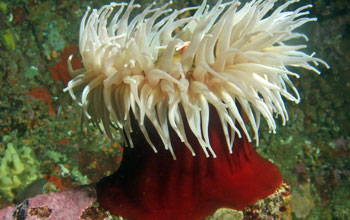
Photo of anemones and symbiotic algae.
NSF awardees will study how ocean acidification affects anemones and symbiotic algae.
Credit and Larger Version
August 26, 2013
With increasing levels of carbon dioxide accumulating in the atmosphere and moving into marine systems, the world's oceans are becoming more acidic.
The oceans may be acidifying faster today than at any time in the past 300 million years, scientists have found.
To address the concern for acidifying marine ecosystems, the National Science Foundation (NSF) has awarded new grants totaling $12 million in its Ocean Acidification Program.
The program is part of NSF's Science, Engineering and Education for Sustainability (SEES) investment.
The awards, the third round in this program, are supported by NSF's Directorates for Geosciences and Biological Sciences.
"These new awards will expand the scope of our knowledge about the types of marine organisms, populations, communities, and ecosystems that may be affected in unique ways by a more acidic ocean," says David Conover, director of NSF's Division of Ocean Sciences.
From tropical oceans to icy seas, the projects will foster research on the nature, extent and effects of ocean acidification on marine environments and organisms in the past, present and future.
"NSF is excited to add these high-quality research projects to our growing ocean acidification award portfolio," says David Garrison, program director in NSF's Directorate for Geosciences and chair of NSF's Ocean Acidification Working Group.
Ocean acidification affects marine ecosystems, organisms' life histories, ocean food webs and biogeochemical cycling, scientists have discovered.
Researchers believe there is a need to understand the chemistry of ocean acidification and its interplay with marine biochemical and physiological processes, before Earth's seas become inhospitable to life as we know it.
Animal species from pteropods--delicate, butterfly-like planktonic drifters--to hard corals are affected by ocean acidification. So, too, are the unseen microbes that fuel ocean productivity and influence the chemistry of ocean waters.
As the oceans become more acidic, the balance of molecules needed for shell-bearing organisms to manufacture shells and skeletons is altered.
The physiology of many marine species, from microbes to fish, may be affected. Myriad chemical reactions and cycles are influenced by the pH, or acidity, of the oceans.
The newly funded projects include studies of whether populations of animals have the genetic capacity to adapt to ocean acidification. The findings, scientists say, will yield new insights about how a future more acidic ocean will affect marine life.
"These awards will extend our understanding of the physiological abilities of organisms to adjust to acidifying oceans in the near-term, and the evolutionary capacities of populations to adapt to predicted ocean acidification in the next century," says William Zamer, program director in NSF's Directorate for Biological Sciences.
Has ocean life faced similar challenges in our planet's past?
"Earth system history informs our understanding of the effects of ocean acidification in the present and the future," says Garrison.
For a true comprehension of how acidification will change the oceans, he says, we need to integrate paleoecology with marine chemistry, physics, ecology and an understanding of the past environmental conditions on Earth.
NSF Ocean Acidification Program grantees will ask questions such as: Will regional differences in marine chemistry and physics increase acidification? Are there complex interactions, cascades and bottlenecks that will emerge as the oceans acidify, and what are their ecosystem implications? And if current trends continue, how far-reaching will the changes be?
NSF 2013 Ocean Acidification awardees, their institutions and projects are:
Additional Collaborators: Patricia Matrai and Peter Countway, Bigelow Laboratory for Ocean Sciences
Additional Collaborators: Christof Meile, William Fitt and Yongchen Wang, University of Georgia
Additional Collaborators: Steven Dudgeon, California State University
Additional Collaborators: Ann Tarrant and Amy Maas, Woods Hole Oceanographic Institution
Additional Collaborators: Richard Lenski, Michigan State University
Additional Collaborators: Nitin Baliga, Institute for Systems Biology
Additional Collaborators: Todd Martz, University of California, San Diego, Scripps Institution of Oceanography
Additional Collaborators: Adam Marsh, University of Delaware
-NSF-
Media Contacts Cheryl Dybas, NSF (703) 292-7734 cdybas@nsf.gov
Related WebsitesNSF News: Natural Underwater Springs Show How Coral Reefs Respond to Ocean Acidification:
 http://www.nsf.gov/news/news_summ.jsp?cntn_id=128243
NSF News: World Oceans Month Brings Mixed News for Oysters:
 http://www.nsf.gov/news/news_summ.jsp?cntn_id=128228
NSF News: Ocean Acidification Linked With Larval Oyster Failure in Hatcheries:
 http://www.nsf.gov/news/news_summ.jsp?cntn_id=123822
NSF Discovery: Trouble in Paradise: Ocean Acidification This Way Comes:
 http://www.nsf.gov/discoveries/disc_summ.jsp?cntn_id=122642
NSF News and Audioslideshow: On 'Earth Week,' World Is No Longer Our Oyster:
 http://www.nsf.gov/news/news_summ.jsp?cntn_id=116767
NSF Science, Engineering and Education for Sustainability Investments: http://www.nsf.gov/sees
NSF Publication: Discoveries in Sustainability:
The National Science Foundation (NSF) is an independent federal agency that supports fundamental research and education across all fields of science and engineering. In fiscal year (FY) 2012, its budget was $7.0 billion. NSF funds reach all 50 states through grants to nearly 2,000 colleges, universities and other institutions. Each year, NSF receives about 50,000 competitive requests for funding, and makes about 11,500 new funding awards. NSF also awards about $593 million in professional and service contracts yearly.
Useful NSF Web Sites:
NSF Home Page:
 http://www.nsf.gov/news/
For the News Media:
 http://www.nsf.gov/news/newsroom.jsp
Science and Engineering Statistics:
 
David Conover
View Video
NSF Ocean Sciences Division Director David Conover answers questions about ocean acidification.
Credit and Larger Version
Oceanus research vessel
View Video
Join scientists studying ocean acidification aboard the research vessel Oceanus.
Credit and Larger Version

Photo of coral reef and fish
Decreased ocean pH will affect coral reef habitats and the organisms that call them home.
Credit and Larger Version
Encrusting red algae
Encrusting red algae are likely to be affected by ocean acidification.
Credit and Larger Version
floating marine snail
Ocean acidification harms the shells of floating marine snails called pteropods.
Credit and Larger Version
Organisms in estuaries, where rivers meet the seas, are affected by ocean acidification.
Credit and Larger Version
diatoms, marine phytoplankton
Marine phytoplankton such as diatoms may evolve in acidified conditions.
Credit and Larger Version

The National Science Foundation (NSF)
Guillermo Gonzalo Sánchez Achutegui
ayabaca@gmail.com
ayabaca@hotmail.com
ayabaca@yahoo.com
Inscríbete en el Foro del blog y participa : A Vuelo De Un Quinde - El Foro!
martes, 18 de junio de 2013

nsf.gov - National Science Foundation - Natural Underwater Springs Show How Coral Reefs Respond to Ocean Acidification

Ocean acidification reduces the density of coral skeletons, making them more vulnerable.-
 
 Coral reef as seen underwater 
Researchers study how coral responds to ocean acidification at natural undersea springs.
Credit: Elizabeth Crook
 Download the high-resolution JPG version of the image. (960 KB)

 corals and fish at submarine springs along the Caribbean Coast of Mexico.
Vibrant coral community at submarine springs along the Caribbean Coast of Mexico.
Credit: Elizabeth Crook
Download the high-resolution JPG version of the image. (400 KB)
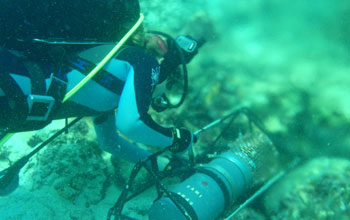
 Diver deploying a metal pH sensor near coral reef
Scientists deploy pH sensors to find out how acid the waters are near the springs.
Credit: Elizabeth Crook
Download the high-resolution JPG version of the image. (194 KB)
 Fish, plants and the coral reef
Submarine springs and the coral reefs that live near them sustain other species.
Credit: Elizabeth Crook
Download the high-resolution JPG version of the image. (1.6 MB)
 Denizens of the reefs near springs
Denizens of the reefs near the springs depend on healthy corals.
Credit: Elizabeth Crook
Download the high-resolution JPG version of the image. (2.3 MB)
 Eroded coral growing in more acidic conditions
Some corals grow in low pH (more acid) conditions, but are more easily eroded.
Credit: Elizabeth Crook
Download the high-resolution JPG version of the image. (2.4 MB)

Ocean acidification due to rising carbon dioxide levels reduces the density of coral skeletons, making coral reefs more vulnerable to disruption and erosion.
The results are from a study of corals growing where underwater springs naturally lower the pH of seawater. (The lower the pH, the more acidic.)
The findings are published today in the journal Proceedings of the National Academy of Sciences and are the first to show that corals are not able to fully acclimate to low pH conditions in nature.
"People have seen similar effects in laboratory experiments," said paper co-author Adina Paytan, a marine scientist at the University of California at Santa Cruz (UCSC).
"We looked in places where corals are exposed to low pH for their entire life span. The good news is that they don't just die. They are able to grow and calcify, but they are not producing robust structures."
With atmospheric carbon dioxide rising steadily, the oceans are absorbing more carbon dioxide, which lowers the pH of surface waters.
Ocean acidification refers to changes in seawater chemistry that move it closer to the acidic range of the pH scale, although seawater is not expected to become literally acidic.
"In our efforts to understand and predict ocean acidification and its long-term effects on marine chemistry and ecosystems, we must deal with a slow process that challenges our ability to detect change," said Don Rice, program director in the National Science Foundation's (NSF) Division of Ocean Sciences.
"This study shows that, with a little effort, we can find ocean sites where nature is already doing the experiments for us."
NSF funded the research through its Ocean Acidification Program, part of the agency's Science, Engineering and Education for Sustainability Investment.
The scientists studied coral reefs along the Caribbean coastline of Mexico's Yucatan Peninsula, where submarine springs lower the pH of the surrounding seawater in a natural setting.
The effect is similar to the widespread ocean acidification that's occurring as the oceans absorb increasing amounts of carbon dioxide from the atmosphere.
Led by first author Elizabeth Crook of UCSC, the researchers deployed instruments to monitor seawater chemistry around the springs and removed skeletal cores from colonies of Porites astreoides, an important Caribbean reef-building coral.
They performed CT scans of the cores in the lab of co-author Anne Cohen at the Woods Hole Oceanographic Institution in Woods Hole, Mass., to measure densities and determine annual calcification rates.
The results show that coral calcification rates decrease significantly along a natural gradient in seawater pH.
Ocean acidification lowers the concentration of carbonate ions in seawater, making it more difficult for corals to build their calcium carbonate skeletons.
"Carbonate ions are the building blocks corals need to grow skeletons," said Paytan.
"When the pH is lower, corals have to use more energy to accumulate these carbonate building blocks internally. As a result, the calcification rate is lower and they lay down less dense skeletons."
The reduced density of the coral skeletons makes them more vulnerable to mechanical erosion during storms, to organisms that bore into corals and to parrotfish, which sometimes feed on corals.
This could lead to a weakening of the reef framework and degradation of the coral reef ecosystem.
"There are likely to be major shifts in reef species and some loss of coral cover, but if ocean acidification is the only factor there won't be total destruction," Paytan said.
"We need to protect corals from other stressors, such as pollution and overfishing. If we can control those, the impact of ocean acidification might not be as bad."
In addition to Crook, Cohen and Paytan, co-authors of the paper include Mario Rebolledo-Vieyra and Laura Hernandez of the Centro de Investigacion Cientifica de Yucatan.
The research was also funded by UC-MEXUS.
-NSF-
Media Contacts Cheryl Dybas, NSF (703) 292-7734
 cdybas@nsf.gov
Tim Stephens, UCSC (831) 459-2495  
Related WebsitesNSF Science, Engineering and Education for Sustainability Programs:
 http://www.nsf.gov/sees
NSF Publication: Discoveries in Sustainability: 
http://www.nsf.gov/pubs/2012/disco12001/disco12001.pdf
NSF News Release: Ocean Acidification: Finding New Answers Through National Science Foundation Research Grants:
The National Science Foundation (NSF) is an independent federal agency that supports fundamental research and education across all fields of science and engineering. In fiscal year (FY) 2012, its budget was $7.0 billion. NSF funds reach all 50 states through grants to nearly 2,000 colleges, universities and other institutions. Each year, NSF receives about 50,000 competitive requests for funding, and makes about 11,500 new funding awards. NSF also awards about $593 million in professional and service contracts yearly.
Useful NSF Web Sites:
NSF Home Page:
 http://www.nsf.gov
NSF News:
 http://www.nsf.gov/news/
For the News Media:
 http://www.nsf.gov/news/newsroom.jsp
Science and Engineering Statistics:
 http://www.nsf.gov/statistics/
Awards Searches: 
 The National Science Foundation (NSF)

 Guillermo Gonzalo Sánchez Achutegui
ayabaca@gmail.com
ayabaca@hotmail.com
ayabaca@yahoo.com
Inscríbete en el Foro del blog y participa : A Vuelo De Un Quinde - El Foro!
miércoles, 26 de septiembre de 2012

Ocean Acidification: Finding New Answers Through National Science Foundation Research Grants


 A shell placed in seawater with increased acidity slowly dissolves over 45 days.
Credit: NOAA PMEL
From carbon emissions to the oceans: Land and sea interact in ocean acidification.
Credit: NOAA PMEL 
 NSF ocean acidification grantees are researching U.S. West Coast intertidal zonation.
Credit: Carol Blanchette
NSF awardees are studying ocean acidification and sea ice cover in the western Arctic Ocean.Credit: Jonathan Wynn 
Earth's oceans may be acidifying faster today than in the past 300 million years.
Credit: NOAA
 Coral reefs in the tropics and beyond are threatened by ocean acidification.
Credit: NOAA

With increasing levels of carbon dioxide accumulating in the atmosphere and moving into marine systems, the world's oceans are becoming more acidic.
The oceans may be acidifying faster today than at anytime in the past 300 million years, scientists have found.
To address the concern for acidifying marine ecosystems, the National Science Foundation (NSF) recently awarded new grants totaling $12 million in its Ocean Acidification program. 
The program is part of NSF's Science, Engineering and Education for Sustainability (SEES) investment.
The awards, the second round in this program, are supported by NSF's Directorates for Geosciences and Biological Sciences, and Office of Polar Programs.
From tropical oceans to icy seas, the projects will foster research on the nature, extent and effects of ocean acidification on marine environments and organisms in the past, present and future.
"With this round of awards, NSF has an increasingly diverse portfolio of research projects on ocean acidification," says David Garrison, program director in NSF's Directorate for Geosciences and chair of NSF's Ocean Acidification Working Group.
"These scientists will make major contributions to understanding this serious environmental threat," says Garrison.
"We look forward to building on this effort over the next few years, and expect that ocean acidification research will be a major contribution to SEES efforts at NSF."
Ocean acidification affects marine ecosystems, organisms' life histories, ocean food webs and biogeochemical cycling, scientists have discovered.
The researchers believe there is a need to understand the chemistry of ocean acidification and its interplay with marine biochemical and physiological processes before Earth's seas become inhospitable to life as it is known today.
Animal species from pteropods--delicate, butterfly-like planktonic drifters--to hard corals are affected by ocean acidification. So, too, are the unseen microbes that fuel ocean productivity and influence the chemical functioning of ocean waters.
As the oceans become more acidic, the balance of molecules needed for shell-bearing organisms to manufacture shells and skeletons is altered.
The physiology of many marine species, from microbes to fish, may be affected.  A myriad of chemical reactions and cycles are influenced by the pH, or acidity, of the oceans.
"The Ocean Acidification awards address how organisms detect carbon dioxide and levels of acidity, and regulate these variables in their cells and body fluids," says William Zamer, program director in NSF's Directorate for Biological Sciences.
"These projects include studies of whether populations of animals have the genetic capacity to adapt to ocean acidification. The findings will yield new insights about how a future more acidic ocean will affect marine life."
Has ocean life faced similar challenges in our planet's past?
Earth system history informs our understanding of the effects of ocean acidification in the present and the future, says Garrison. 
For a true comprehension of how acidification will change the oceans, he says, we must integrate paleoecology with marine chemistry, physics, ecology and an understanding of the past environmental conditions on Earth.
Overall, Ocean Acidification grantees will ask questions such as will regional differences in marine chemistry and physics increase acidification? Are there complex interactions, cascades and bottlenecks that will emerge as the oceans acidify, and what are their ecosystem implications? And if current trends continue, how far-reaching will the changes be?
NSF 2012 Ocean Acidification awardees, their institutions and projects are:
Jonathan Wynn, University of South Florida: Ocean acidification in the Canada Basin: Roles of sea ice
-NSF-
Media Contacts Cheryl Dybas, NSF (703) 292-7734 cdybas@nsf.gov
Related WebsitesNSF News Release: NSF Awards First Grants to Study Effects of Ocean Acidification: http://www.nsf.gov/news/news_summ.jsp?cntn_id=117823&org=NSF&from=news
NSF Discovery Article: Trouble in Paradise: Ocean Acidification This Way Comes: http://www.nsf.gov/discoveries/disc_summ.jsp?cntn_id=122642&org=NSF
NSF News Release: Oceans Acidifying Faster Today Than in Past 300 Million Years: http://www.nsf.gov/news/news_summ.jsp?cntn_id=123324
NSF SEES Discovery Articles Publication: http://www.nsf.gov/pubs/2012/disco12001/disco12001.pdf
NSF Science, Engineering and Education for Sustainability (SEES) Investment: http://www.nsf.gov/sees
With increasing levels of carbon dioxide accumulating in the atmosphere and moving into marine systems, the world's oceans are becoming more acidic.
The oceans may be acidifying faster today than at anytime in the past 300 million years, scientists have found.
To address the concern for acidifying marine ecosystems, the National Science Foundation (NSF) recently awarded new grants totaling $12 million in its Ocean Acidification program. 
The program is part of NSF's Science, Engineering and Education for Sustainability (SEES) investment.
The awards, the second round in this program, are supported by NSF's Directorates for Geosciences and Biological Sciences, and Office of Polar Programs.
From tropical oceans to icy seas, the projects will foster research on the nature, extent and effects of ocean acidification on marine environments and organisms in the past, present and future.
"With this round of awards, NSF has an increasingly diverse portfolio of research projects on ocean acidification," says David Garrison, program director in NSF's Directorate for Geosciences and chair of NSF's Ocean Acidification Working Group.
"These scientists will make major contributions to understanding this serious environmental threat," says Garrison.
"We look forward to building on this effort over the next few years, and expect that ocean acidification research will be a major contribution to SEES efforts at NSF."
Ocean acidification affects marine ecosystems, organisms' life histories, ocean food webs and biogeochemical cycling, scientists have discovered.
The researchers believe there is a need to understand the chemistry of ocean acidification and its interplay with marine biochemical and physiological processes before Earth's seas become inhospitable to life as it is known today.
Animal species from pteropods--delicate, butterfly-like planktonic drifters--to hard corals are affected by ocean acidification. So, too, are the unseen microbes that fuel ocean productivity and influence the chemical functioning of ocean waters.
As the oceans become more acidic, the balance of molecules needed for shell-bearing organisms to manufacture shells and skeletons is altered.
The physiology of many marine species, from microbes to fish, may be affected.  A myriad of chemical reactions and cycles are influenced by the pH, or acidity, of the oceans.
"The Ocean Acidification awards address how organisms detect carbon dioxide and levels of acidity, and regulate these variables in their cells and body fluids," says William Zamer, program director in NSF's Directorate for Biological Sciences.
"These projects include studies of whether populations of animals have the genetic capacity to adapt to ocean acidification. The findings will yield new insights about how a future more acidic ocean will affect marine life."
Has ocean life faced similar challenges in our planet's past?
Earth system history informs our understanding of the effects of ocean acidification in the present and the future, says Garrison. 
For a true comprehension of how acidification will change the oceans, he says, we must integrate paleoecology with marine chemistry, physics, ecology and an understanding of the past environmental conditions on Earth.
Overall, Ocean Acidification grantees will ask questions such as will regional differences in marine chemistry and physics increase acidification? Are there complex interactions, cascades and bottlenecks that will emerge as the oceans acidify, and what are their ecosystem implications? And if current trends continue, how far-reaching will the changes be?
NSF 2012 Ocean Acidification awardees, their institutions and projects are:
Jess Adkins, California Institute of Technology: Ocean acidification: Collaborative research: Measuring the kinetics of CaCO3 dissolution in seawater using novel isotope labeling, laboratory experiments, and in situ experiments
William Balch, Bigelow Laboratory for Ocean Sciences: Ocean acidification: Effects of ocean acidification on Emiliania huxleyi and Calanus finmarchicus; Insights into the oceanic alkalinity and biological carbon pumps
Joan Bernhard, Woods Hole Oceanographic Institution: Ocean acidification, hypoxia and warming: Experimental investigations into compounded effects of global change on benthic foraminifera
Robert Byrne, College of Marine Science, University of South Florida: Ocean acidification: Collaborative research: Investigation of seawater CO2 system thermodynamics under high pCO2 conditions
Anne Cohen, Woods Hole Oceanographic Institution: Toward predicting the impact of ocean acidification on net calcification by a broad range of coral reef ecosystems: Identifying patterns and underlying causes
Erik Cordes, Temple University: Ocean acidification: Physiological and genetic responses of the deep-water coral, Lophelia pertusa, to ongoing ocean acidification in the Gulf of Mexico
Robyn Hannigan, University of Massachusetts Boston: Ocean acidification: Effects on morphology and mineralogy in otoliths of larval reef fish
Donal Manahan, University of Southern California: Ocean acidification: Predicting "winners and losers" to ocean acidification--a physiological genomic study of genetically-determined variance during larval development
Figen Mekik, Grand Valley State University: Carbonate preservation in pelagic sediments: Developing a new aragonite preservation proxy
Bruce Menge, Oregon State University: Ocean acidification: Collaborative research: OMEGAS II - Linking ecological and organismal responses to the ocean acidification seascape in the California Current System
T. Aran Mooney, Woods Hole Oceanographic Institution: Ocean acidification: Examining impacts on squid paralarval development, behavior, and survival
M. Brady Olson, WWU Shannon Point Marine Lab: Collaborative research: Ocean acidification: Impacts on copepod populations mediated by changes in prey quality
Mak Saito, Woods Hole Oceanographic Institution: Ocean acidification: The influence of ocean acidification and rising temperature on phytoplankton proteome composition
Martin Tresguerres, UCSD Scripps Inst of Oceanography: Ocean acidification: Physiological mechanisms for CO2-sensing and related intracellular signaling pathways in corals
Jonathan Wynn, University of South Florida: Ocean acidification in the Canada Basin: Roles of sea ice
James Zachos, University of California-Santa Cruz: Ocean acidification: Collaborative research: Establishing the magnitude of sea-surface acidification during the Paleocene-Eocene Thermal Maximum
-NSF-
Media Contacts Cheryl Dybas, NSF (703) 292-7734 cdybas@nsf.gov

Related WebsitesNSF News Release: NSF Awards First Grants to Study Effects of Ocean Acidification: http://www.nsf.gov/news/news_summ.jsp?cntn_id=117823&org=NSF&from=news
NSF Discovery Article: Trouble in Paradise: Ocean Acidification This Way Comes: http://www.nsf.gov/discoveries/disc_summ.jsp?cntn_id=122642&org=NSF
NSF News Release: Oceans Acidifying Faster Today Than in Past 300 Million Years: http://www.nsf.gov/news/news_summ.jsp?cntn_id=123324
NSF SEES Discovery Articles Publication: http://www.nsf.gov/pubs/2012/disco12001/disco12001.pdf
NSF Science, Engineering and Education for Sustainability (SEES) Investment: http://www.nsf.gov/sees

The National Science Foundation (NSF) is an independent federal agency that supports fundamental research and education across all fields of science and engineering. In fiscal year (FY) 2012, its budget is $7.0 billion. NSF funds reach all 50 states through grants to nearly 2,000 colleges, universities and other institutions. Each year, NSF receives over 50,000 competitive requests for funding, and makes about 11,000 new funding awards. NSF also awards nearly $420 million in professional and service contracts yearly.
 Get News Updates by Email 
Useful NSF Web Sites:
NSF Home Page: http://www.nsf.gov
NSF News: http://www.nsf.gov/news/
For the News Media: http://www.nsf.gov/news/newsroom.jsp
Science and Engineering Statistics: http://www.nsf.gov/statistics/
Awards Searches: http://www.nsf.gov/awardsearch/
The National Science Foundation (NSF) is an independent federal agency that supports fundamental research and education across all fields of science and engineering. In fiscal year (FY) 2012, its budget is $7.0 billion. NSF funds reach all 50 states through grants to nearly 2,000 colleges, universities and other institutions. Each year, NSF receives over 50,000 competitive requests for funding, and makes about 11,000 new funding awards. NSF also awards nearly $420 million in professional and service contracts yearly.
Useful NSF Web Sites:
NSF Home Page: http://www.nsf.gov
NSF News: http://www.nsf.gov/news/
For the News Media: http://www.nsf.gov/news/newsroom.jsp
Science and Engineering Statistics: http://www.nsf.gov/statistics/
Awards Searches: http://www.nsf.gov/awardsearch/
The National Science Foundation (NSF).
Guillermo Gonzalo Sánchez Achutegui
ayabaca@gmail.com
ayabaca@hotmail.com
ayabaca@yahoo.com
 Inscríbete en el Foro del blog y participa : A Vuelo De Un Quinde - El Foro!

Mi lista de blogs