Mostrando entradas con la etiqueta The Mars Science Laboratory (MSL). Mostrar todas las entradas

sábado, 7 de diciembre de 2013

NASA : NASA Discusses Curiosity Radiation Findings


NASA Discusses Curiosity Radiation Findings
NASA will host a media teleconference at 1 p.m. EST Monday, Dec. 9, to discuss new findings from the Mars Science Laboratory (MSL) Radiation Assessment Detector (RAD) aboard the rover Curiosity.
Just prior to the teleconference, the findings will be presented at the American Geophysical Union Fall Meeting in San Francisco. The journal Science has embargoed details until noon Dec. 9.
The briefing participants are:
-- Jason Crusan, Advanced Exploration Systems Division director, NASA Headquarters, Washington
-- Dan Dumbacher, deputy associate administrator for exploration systems development, NASA Headquarters, Washington
-- Donald M. Hassler, RAD principal investigator and program director, Southwest Research Institute (SwRI), San Antonio
-- Rich Williams, chief health and medical officer, NASA Headquarters, Washington
For dial-in information, media representatives should e-mail their name, affiliation and telephone number to Rachel Kraft at rachel.h.kraft@nasa.gov by 11 a.m. Dec. 9.
SwRI and Christian Albrechts University in Kiel, Germany, built RAD with funding from NASA's Human Exploration and Operations Mission Directorate and Germany's national aerospace research center, Deutsches Zentrum für Luft- und Raumfahrt. NASA's Jet Propulsion Laboratory, a division of the California Institute of Technology in Pasadena, Calif., manages the MSL Project. NASA's Science Mission Directorate in Washington manages the Mars Exploration Program.
Audio of the teleconference will be streamed live on NASA's website at:
For more information about MSL, visit:
NASA
Guillermo Gonzalo Sánchez Achutegui
ayabaca@gmail.com
ayabaca@hotmail.com
ayabaca@yahoo.com
Inscríbete en el Foro del blog y participa : A Vuelo De Un Quinde - El Foro!

sábado, 4 de agosto de 2012

MARTE: Mars Express marca el lugar donde aterrizará Curiosity

Hola amigos: A VUELO DE UN QUINDE EL BLOG., Al igual que en el mapa de un tesoro, en el que la ‘X’ marca el lugar donde se esconde un cofre enterrado, el rover Curiosity de la NASA ha puesto rumbo hacia su propia ‘X’ en el interior del cráter Gale, donde tratará de encontrar indicios de la existencia de agua – y puede que de vida – en el pasado del Planeta Rojo.

Download:
Gale Crater is 154 km wide and is located at latitude 5.4 degrees south and longitude 137.9 degrees east. This image, taken by the High Resolution Stereo Camera (HRSC) of Mars Express, has a resolution of 100 metres per pixel. It is colour-coded based on a digital terrain model derived from stereo image data. 
Credits: ESA/DLR/FU Berlin (G. Neukum).
Al igual que en el mapa de un tesoro, en el que la ‘X’ marca el lugar donde se esconde un cofre enterrado, el rover Curiosity de la NASA ha puesto rumbo hacia su propia ‘X’ en el interior del cráter Gale, donde tratará de encontrar indicios de la existencia de agua – y puede que de vida – en el pasado del Planeta Rojo.

Mars Express jugará un papel muy importante durante los ‘siete minutos de terror’ que durará la maniobra de entrada, descenso y aterrizaje sobre la superficie de Marte de Curiosity, monitorizando la maniobra y registrando las señales de la nave. La sonda europea ha estado tomando imágenes del cráter Gale que han permitido afinar el lugar previsto para el aterrizaje de este rover del tamaño de un coche. 
Download:
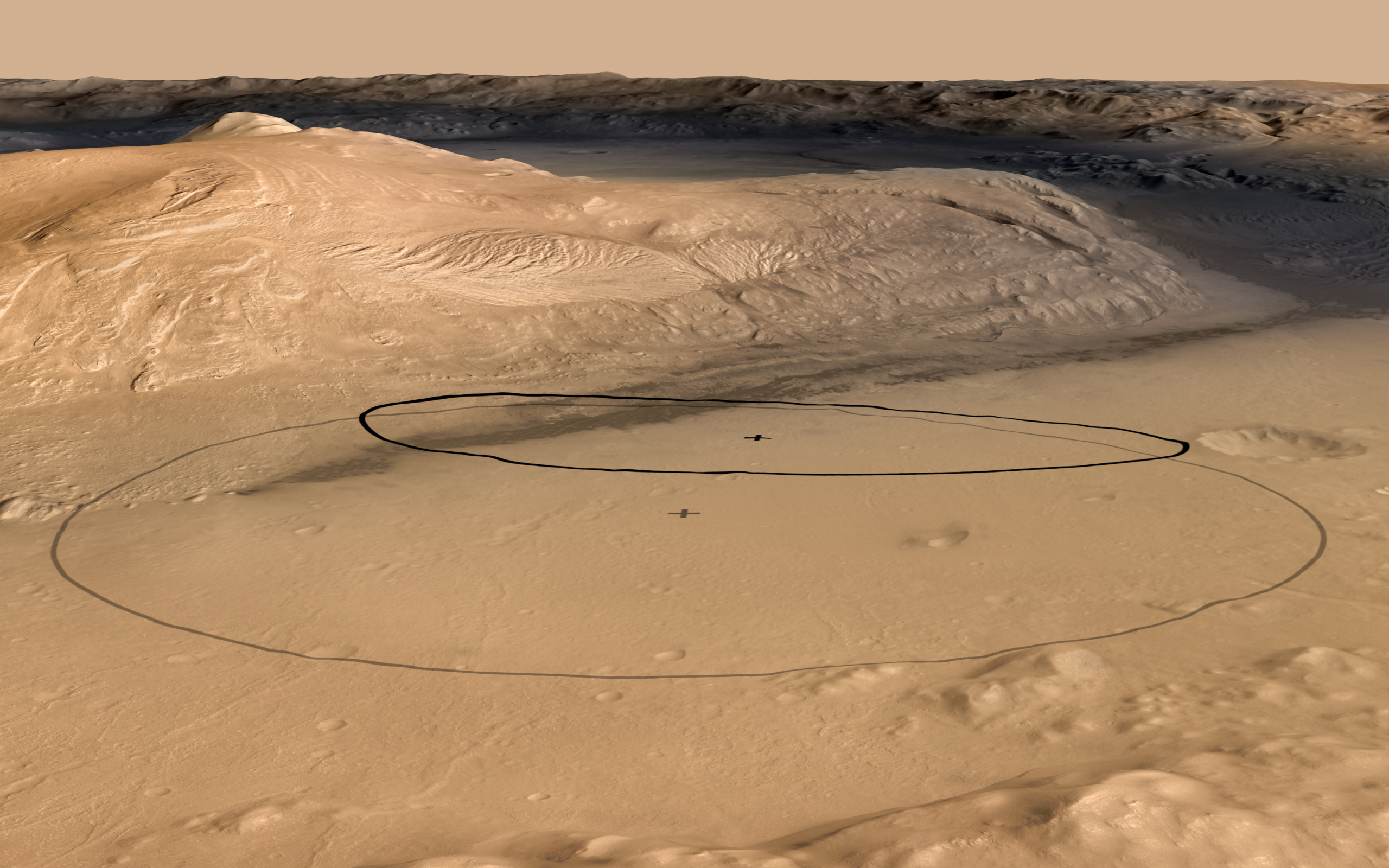
 Oblique view of Mount Sharp inside Gale Crater, with the original and revised landing ellipses marked. Credits: NASA/JPL-Caltech/ESA/DLR/FU Berlin/MSSS
 El rover Curiosity, parte de la misión MSL (Mars Science Laboratory) de la NASA, tenía previsto aterrizar en el interior de una elipse de 20 x 25 kilómetros, una diana bastante más pequeña que la de cualquiera de sus predecesores, gracias a los sofisticados sistemas de aterrizaje de precisión que incorpora MSL. Los datos de la elevación del terreno obtenidos gracias a la Cámara Estéreo de Alta Resolución (HRSC) de Mars Express, combinados con las imágenes de la Cámara Contextual del satélite MRO de la NASA y con las tomadas por las sondas Viking en los años setenta han permitido reducir el tamaño de la elipse a tan sólo 20 x 7 km.
 

Download:

This artist's concept depicts the moment that NASA's Curiosity rover touches down onto the Martian surface. The entry, descent, and landing (EDL) phase of the Mars Science Laboratory mission begins when the spacecraft reaches the Martian atmosphere, about 81 miles (131 kilometers) above the surface of the Gale crater landing area, and ends with the rover safe and sound on the surface of Mars.
Entry, descent, and landing for the Mars Science Laboratory mission will include a combination of technologies inherited from past NASA Mars missions, as well as exciting new technologies. Instead of the familiar airbag landing systems of the past Mars missions, Mars Science Laboratory will use a guided entry and a sky crane touchdown system to land the hyper-capable, massive rover.
The sheer size of the Mars Science Laboratory rover (over one ton, or 900 kilograms) would preclude it from taking advantage of an airbag-assisted landing. Instead, the Mars Science Laboratory will use the sky crane touchdown system, which will be capable of delivering a much larger rover onto the surface. It will place the rover on its wheels, ready to begin its mission after thorough post-landing checkouts.
The new entry, descent and landing architecture, with its use of guided entry, will allow for more precision. Where the Mars Exploration Rovers could have landed anywhere within their respective 93-mile by 12-mile (150 by 20 kilometer) landing ellipses, Mars Science Laboratory will land within a 12-mile (20-kilometer) ellipse! This high-precision delivery will open up more areas of Mars for exploration and potentially allow scientists to roam "virtually" where they have not been able to before.
In the depicted scene, Curiosity is touching down onto the surface, suspended on a bridle beneath the spacecraft's descent stage as that stage controls the rate of descent with four of its eight throttle-controllable rocket engines. The rover is connected to the descent stage by three nylon tethers and by an umbilical providing a power and communication connection. When touchdown is detected, the bridle will be cut at the rover end, and the descent stage flies off to stay clear of the landing site.
NASA's Jet Propulsion Laboratory, a division of the California Institute of Technology, Pasadena, Calif., manages the Mars Science Laboratory Project for the NASA Science Mission Directorate, Washington.
More information about Curiosity is at http://mars.jpl.nasa.gov/msl/.
Credits: NASA/JPL-Caltech
Curiosity aterrizará cerca de la montaña Gale

Este ajuste desplazó el centro de la elipse hacia la montaña que se encuentra en el centro del cráter Gale, de 154 kilómetros de diámetro.
El pico central de Gale – conocido coloquialmente como Monte Sharp – se eleva 5.5 km sobre el fondo del cráter, y es el principal objetivo de la misión de Curiosity.
Los satélites en órbita a Marte han identificado minerales arcillosos en esta región que parecen indicar que contuvo grandes cantidades de agua en algún momento de su pasado. Curiosity analizará muestras de estos materiales en su propio laboratorio de a bordo en busca de su propio tesoro: los componentes fundamentales de la vida.
ESA
Guillermo Gonzalo Sánchez Achutegui
ayabaca@gmail.com
ayabaca@hotmail.com
ayabaca@yahoo.com  
 Inscríbete en el Foro del blog y participa : A Vuelo De Un Quinde - El Foro!

martes, 17 de julio de 2012

Astronomy: NASA's Car-Sized Rover Nears Daring Landing on Mars

 
This artist's concept features NASA's Mars Science Laboratory Curiosity rover, a mobile robot for investigating Mars' past or present ability to sustain microbial life. Credit: NASA/JPL-Caltech

Read more at: http://phys.org/news/2012-06-curiosity-rover-track-early-august.html#jCp
This artist's concept features NASA's Mars Science Laboratory Curiosity rover, a mobile robot for investigating Mars' past or present ability to sustain microbial life. Credit: NASA/JPL-Caltech

Read more at: http://phys.org/news/2012-06-curiosity-rover-track-early-august.html#jCp
 
This artist's concept features NASA's Mars Science Laboratory Curiosity rover, a mobile robot for investigating Mars' past or present ability to sustain microbial life. Credit: NASA/JPL-Caltech

Read more at: http://phys.org/news/2012-06-curiosity-rover-track-early-august.html#jCp
This artist's concept features NASA's Mars Science Laboratory Curiosity rover, a mobile robot for investigating Mars' past or present ability to sustain microbial life. Credit: NASA/JPL-Caltech

Read more at: http://phys.org/news/2012-06-curiosity-rover-track-early-august.html#jCp
This artist's concept features NASA's Mars Science Laboratory Curiosity rover, a mobile robot for investigating Mars' past or present ability to sustain microbial life. Credit: NASA/JPL-Caltech

Read more at: http://phys.org/news/2012-06-curiosity-rover-track-early-august.html#jCp

NASA's Car-Sized Rover Nears Daring Landing on Mars
 
 
WASHINGTON -- NASA's most advanced planetary rover is on a precise course for an early August landing beside a Martian mountain to begin two years of unprecedented scientific detective work. However, getting the Curiosity rover to the surface of Mars will not be easy.

"The Curiosity landing is the hardest NASA mission ever attempted in the history of robotic planetary exploration," said John Grunsfeld, associate administrator for NASA's Science Mission Directorate, at NASA Headquarters in Washington. "While the challenge is great, the team's skill and determination give me high confidence in a successful landing."

The Mars Science Laboratory (MSL) mission is a precursor mission for future human mission to Mars. President Obama has set a challenge to reach the Red Planet in the 2030s.

To achieve the precision needed for landing safely inside Gale Crater, the spacecraft will fly like a wing in the upper atmosphere instead of dropping like a rock. To land the 1-ton rover, an air-bag method used on previous Mars rovers will not work. Mission engineers at NASA's Jet Propulsion Laboratory (JPL) in Pasadena, Calif., designed a "sky crane" method for the final several seconds of the flight. A backpack with retro-rockets controlling descent speed will lower the rover on three nylon cords just before touchdown.

During a critical period lasting only about seven minutes, the MSL spacecraft carrying Curiosity must decelerate from about 13,200 mph (about 5,900 meters per second) to allow the rover to land on the surface at about 1.7 mph (three-fourths of a meter per second). Curiosity is scheduled to land at approximately 1:31 a.m. EDT Aug. 6 (10:31 p.m. PDT Aug. 5).

"Those seven minutes are the most challenging part of this entire mission," said Pete Theisinger, JPL's MSL project manager. "For the landing to succeed, hundreds of events will need to go right, many with split-second timing and all controlled autonomously by the spacecraft. We've done all we can think of to succeed. We expect to get Curiosity safely onto the ground, but there is no guarantee. The risks are real."

During the initial weeks after the actual landing, JPL mission controllers will put the rover through a series of checkouts and activities to characterize its performance on Mars while gradually ramping up scientific investigations. Curiosity then will begin investigating whether an area with a wet history inside Mars' Gale Crater ever has offered an environment favorable for microbial life.

"Earlier missions have found that ancient Mars had wet environments," said Michael Meyer, lead scientist for NASA's Mars Program at NASA Headquarters. "Curiosity takes us the next logical step in understanding the potential for life on Mars."

Curiosity will use tools on a robotic arm to deliver samples from Martian rocks and soils into laboratory instruments inside the rover that can reveal chemical and mineral composition. A laser instrument will use its beam to induce a spark on a target and read the spark's spectrum of light to identify chemical elements in the target.

Other instruments on the car-sized rover will examine the surrounding environment from a distance or by direct touch with the arm. The rover will check for the basic chemical ingredients for life and for evidence about energy available for life. It also will assess factors that could be hazardous for life, such as the radiation environment.

"For its ambitious goals, this mission needs a great landing site and a big payload," said Doug McCuistion, director of the Mars Exploration Program at NASA Headquarters. "During the descent through the atmosphere, the mission will rely on bold techniques enabling use of a smaller target area and a heavier robot on the ground than were possible for any previous Mars mission. Those techniques also advance us toward human-crew Mars missions, which will need even more precise targeting and heavier landers."
The chosen landing site is beside a mountain informally called Mount Sharp. The mission's prime destination lies on the slope of the mountain. Driving there from the landing site may take many months.

"Be patient about the drive. It will be well worth the wait and we are apt to find some targets of interest on the way," said John Grotzinger, MSL project scientist at the California Institute of Technology in Pasadena. "When we get to the lower layers in Mount Sharp, we'll read them like chapters in a book about changing environmental conditions when Mars was wetter than it is today."

In collaboration with Microsoft Corp., a new outreach game was unveiled Monday to give the public a sense of the challenge and adventure of landing in a precise location on the surface. Called "Mars Rover Landing," the game is an immersive experience for the Xbox 360 home entertainment console that allows users to take control of their own spacecraft and face the extreme challenges of landing a rover on Mars.

"Technology is making it possible for the public to participate in exploration as it never has before," said Michelle Viotti, JPL's Mars public engagement manager. "Because Mars exploration is fundamentally a shared human endeavor, we want everyone around the globe to have the most immersive experience possible."

NASA has several other forthcoming experiences geared for inspiration and learning in science, technology, engineering and mathematics. Information about many ways to watch and participate in the Curiosity's landing and the mission on the surface of Mars is available at:

MSL is a project of NASA's Science Mission Directorate. The mission is managed by JPL. Curiosity was designed, developed and assembled at JPL.

Follow the mission on Facebook and on Twitter at:

and


For information about the mission and to use the new video game and other education-related tools, visit:

and

NASA
Guillermo Gonzalo Sánchez Achutegui
ayabaca@gmail.com
ayabaca@hotmail.com
ayabaca@yahoo.com
 Inscríbete en el Foro del blog y participa : A Vuelo De Un Quinde - El Foro!

martes, 13 de diciembre de 2011

ASTRONOMY: NASA Mars-Bound Rover Begins Research in Space

Hi My Friends: A VUELO DE UN QUINDE EL BLOG., NASA's car-sized Curiosity rover has begun monitoring space radiation during its 8-month trip from Earth to Mars. The research will aid in planning for future human missions to the Red Planet.Mars Science Laboratory Spacecraft During Cruise, Artist's Concept
This is an artist's concept of NASA's Mars Science Laboratory spacecraft during its cruise phase between launch and final approach to Mars. The spacecraft includes a disc-shaped cruise stage (on the left) attached to the aeroshell. The spacecraft's rover (Curiosity) and descent stage are tucked inside the aeroshell. Along the way to Mars, the cruise stage will perform several trajectory correction maneuvers to adjust the spacecraft's path toward its final, precise landing site on Mars. The Mars Science Laboratory spacecraft will use the stars to navigate. A star scanner on the cruise stage will help keep the spacecraft on track by constantly monitoring its position relative to stars in our Milky Way galaxy. The cruise stage will have its own miniature propulsion system, consisting of eight thrusters to be fired on command using hydrazine fuel in two titanium tanks. It will also have its own power system, consisting of a solar array for providing continuous power. The vehicle will maintain stability by spinning about its central axis at two revolutions per minute. The Mars Science Laboratory spacecraft is being prepared for launch during Nov. 25 to Dec. 18, 2011. Landing on Mars is in early August 2012. In a prime mission lasting one Martian year (nearly two Earth years) researchers will use the rover's tools to study whether the landing region has had environmental conditions favorable for supporting microbial life and for preserving clues about whether life existed. NASA's Jet Propulsion Laboratory, a division of the California Institute of Technology, Pasadena, Calif., manages the Mars Science Laboratory Project for the NASA Science Mission Directorate, Washington.

More information about Curiosity is at http://www.nasa.gov/msl and http://mars.jpl.nasa.gov/msl/ .

Image credit: NASA/JPL-Caltech

WASHINGTON -- NASA's car-sized Curiosity rover has begun monitoring space radiation during its 8-month trip from Earth to Mars. The research will aid in planning for future human missions to the Red Planet.

Curiosity launched on Nov. 26 from Cape Canaveral, Fla., aboard the Mars Science Laboratory (MSL). The rover carries an instrument called the Radiation Assessment Detector (RAD) that monitors high-energy atomic and subatomic particles from the sun, distant supernovas and other sources.

These particles constitute radiation that could be harmful to any microbes or astronauts in space or on Mars. The rover also will monitor radiation on the surface of Mars after its August 2012 landing.

"RAD is serving as a proxy for an astronaut inside a spacecraft on the way to Mars,” said Don Hassler, RAD's principal investigator from the Southwest Research Institute in Boulder, Colo.”The instrument is deep inside the spacecraft, the way an astronaut would be. Understanding the effects of the spacecraft on the radiation field will be valuable in designing craft for astronauts to travel to Mars."

Previous monitoring of energetic-particle radiation in space has used instruments at or near the surface of various spacecraft. The RAD instrument is on the rover inside the spacecraft and shielded by other components of MSL, including the aeroshell that will protect the rover during descent through the upper atmosphere of Mars.

Spacecraft structures, while providing shielding, also can contribute to secondary particles generated when high-energy particles strike the spacecraft. In some circumstances, secondary particles could be more hazardous than primary ones.

These first measurements mark the start of the science return from a mission that will use 10 instruments on Curiosity to assess whether Mars' Gale Crater could be or has been favorable for microbial life.

"While Curiosity will not look for signs of life on Mars, what it might find could be a game- changer about the origin and evolution of life on Earth and elsewhere in the universe,” said Doug McCuistion, director of the Mars Exploration Program at NASA Headquarters in Washington. “One thing is certain: the rover's discoveries will provide critical data that will impact human and robotic planning and research for decades.”

As of noon EST on Dec. 14, the spacecraft will have traveled 31.9 million miles (51.3 million kilometers) of its 352-million-mile (567-million-kilometer) flight to Mars. The first trajectory correction maneuver during the trip is being planned for mid-January.

Southwest Research Institute, together with Christian Albrechts University in Kiel, Germany, built RAD with funding from the Human Exploration and Operations Mission Directorate, NASA Headquarters, Washington, and Germany's national aerospace research center, Deutsches Zentrum für Luft- und Raumfahrt.

The mission is managed by NASA's Jet Propulsion Laboratory (JPL) for the agency's Science Mission Directorate in Washington. The mission's rover was designed, developed and assembled at JPL.

Information about the mission is available at:
http://www.nasa.gov/msl

You can follow the mission on Facebook and Twitter at:
http://www.facebook.com/marscuriosity
NASA.
Guillermo Gonzalo Sánchez Achutegui
ayabaca@gmail.com
ayabaca@yahoo.com
ayabaca@hotmail.com

domingo, 27 de noviembre de 2011

ASTRONOMY: NASA Launches Most Capable and Robust Rover to Explore Mars

Hi my Friends: A VUELO DE UN QUINDE EL BLOG., NASA began a historic voyage to Mars with the Nov. 26 launch of the Mars Science Laboratory.

NASA's Mars Science Laboratory soars through the sky aboard an Atlas V rocket. It will arrive at Mars on August 6, 2012, Universal Time.
Image credit: NASA/JPL-Caltech.

Latest Updates:

- Engineers have received data from NASA's Mars Science Laboratory showing that all systems are operating normally. The approximately eight-month journey to Mars is underway. - NASA's Mars Science Laboratory has separated from the rocket that boosted it toward Mars and has sent a signal to Earth. - NASA's Mars Science Laboratory and its rocket are coasting in orbit around Earth before heading to Mars. - NASA's Mars Science Laboratory and its Curiosity rover have blasted off on an Atlas V rocket from Cape Canaveral Air Force Station in Florida.

NASA's Mars Science Laboratory lifts off from Cape Canaveral Air Force Station, Fla.
Image credit: NASA/JPL-Caltech.

Mars Science Laboratory Launch Milestones - 11.23.11
PASADENA, Calif. -- NASA's Mars Science Laboratory is tucked inside its Atlas V rocket, ready for launch on Saturday, Nov. 26, 2011 from Cape Canaveral Air Force Station in Florida. The Nov. 26 launch window extends from 7:02 a.m. to 8:45 a.m. PST (10:02 a.m. to 11:45 a.m. EST). The launch period for the mission extends through Dec. 18.
The spacecraft, which will arrive at Mars in August 2012, is equipped with the most advanced rover ever to land on another planet. Named Curiosity, the rover will investigate whether the landing region has had environmental conditions favorable for supporting microbial life, and favorable for preserving clues about whether life existed.
On Nov. 26, NASA Television coverage of the launch will begin at 4:30 a.m. PST (7:30 a.m. EST). Live launch coverage will be carried on all NASA Television channels. For NASA Television downlink information, schedule information and streaming video, visit: http://www.nasa.gov/ntv .
 The launch coverage will also be streamed live on Ustream at http://www.ustream.tv/nasajpl .
If the spacecraft lifts off at the start of the launch window on Nov. 26, the following milestones are anticipated. Times would vary for other launch times and dates.
Launch
--The rocket's first-stage common core booster, and the four solid rocket boosters, will ignite before liftoff. Launch, or "T Zero", actually occurs before the rocket leaves the ground. The four solid rocket boosters jettison at launch plus one minute and 52 seconds.


Mars Science Laboratory on the Pad
A United Launch Alliance Atlas V rocket with NASA’s Mars Science Lab (MSL) rover Curiosity rolls out to its Space Launch Complex-41 launch pad arriving at 8:40 a.m. EST today. After landing on Mars in August 2012, MSL’s prime mission will last one Martian year (nearly two Earth years). Researchers will use the rover’s tools to study whether the landing region has environmental conditions favorable for supporting microbial life. The launch of the MSL mission is set for Saturday, Nov. 26 with the launch window opening at 10:02 a.m. EST. Photo by Pat Corkery, United Launch Alliance.

Fairing Separation
--The nose cone, or fairing, carrying Mars Science Laboratory will open like a clamshell and fall away at about three minutes and 25 seconds after launch. After this, the rocket's first stage will cut off and then drop into the Atlantic Ocean.
Parking Orbit
--The rocket's second stage, a Centaur engine, is started for the first time at about four minutes and 38 seconds after launch. After it completes its first burn of about 7 minutes, the rocket will be in a parking orbit around Earth at an altitude that varies from 102 miles (165 kilometers) to 201 miles (324 kilometers). It will remain there from 14 to 30 minutes, depending on the launch date and time. If launch occurs at the beginning of the launch Nov. 26 launch window, this stage will last about 21 minutes.
On the Way to Mars
-- The second Centaur burn, continuing for nearly 8 minutes (for a launch at the opening of the Nov. 26 launch window), lofts the spacecraft out of Earth orbit and sends it toward Mars.
Spacecraft Separation
--Mars Science Laboratory will separate from the rocket that boosted it toward Mars at about 44 minutes after launch, if launch occurs at the opening of the Nov. 26 window. Shortly after that, the separated Centaur performs its last task, an avoidance maneuver taking itself out of the spacecraft's flight path to avoid hitting either the spacecraft or Mars.
Sending a Message of Good Health
--Once the spacecraft is in its cruise stage toward Mars, it can begin communicating with Earth via an antenna station in Canberra, Australia, part of NASA's Deep Space Network. Engineers expect to hear first contact from the spacecraft at about 55 minutes after launch and assess the spacecraft's health during the subsequent 30 minutes. The spacecraft will arrive at the Red Planet Aug. 6, 2012, Universal Time (evening of Aug. 5, 2012, PDT).
NASA's Jet Propulsion Laboratory, Pasadena, Calif., a division of the California Institute of Technology, manages the Mars Science Laboratory mission. Launch management is the responsibility of NASA's Launch Services Program at the Kennedy Space Center in Florida. The Atlas V launch service is provided by United Launch Alliance, Denver.
Whitney Clavin 818-354-4673

Jet Propulsion Laboratory, Pasadena, Calif. whitney.clavin@jpl.nasa.gov

Curiosity at Work on Mars (Artist's Concept)
This artist's concept depicts the rover Curiosity, of NASA's Mars Science Laboratory mission, as it uses its Chemistry and Camera (ChemCam) instrument to investigate the composition of a rock surface. ChemCam fires laser pulses at a target and views the resulting spark with a telescope and spectrometers to identify chemical elements. The laser is actually in an invisible infrared wavelength, but is shown here as visible red light for purposes of illustration. NASA's Jet Propulsion Laboratory, a division of the California Institute of Technology, Pasadena, manages the Mars Science Laboratory Project for the NASA Science Mission Directorate, Washington, and designed and built Curiosity. More information about Curiosity is at http://mars.jpl.nasa.gov/msl/.

Image Credit: NASA/JPL-Caltech

NASA Launches Most Capable and Robust Rover to Explore Mars :
CAPE CANAVERAL, Fla. -- NASA began a historic voyage to Mars with the Nov. 26 launch of the Mars Science Laboratory (MSL), which carries a car-sized rover named Curiosity. Liftoff from Cape Canaveral Air Force Station aboard an Atlas V rocket occurred at 10:02 a.m. EST. "We are very excited about sending the world's most advanced scientific laboratory to Mars," NASA Administrator Charles Bolden said. "MSL will tell us critical things we need to know about Mars, and while it advances science, we'll be working on the capabilities for a human mission to the Red Planet and to other destinations where we've never been".

The mission will pioneer precision landing technology and a sky-crane touchdown to place Curiosity near the foot of a mountain inside Gale Crater on Aug. 6, 2012. During a nearly two-year prime mission after landing, the rover will investigate whether the region has ever offered conditions favorable for microbial life, including the chemical ingredients for life.

"The launch vehicle has given us a great injection into our trajectory, and we're on our way to Mars," said MSL Project Manager Peter Theisinger of NASA's Jet Propulsion Laboratory (JPL) in Pasadena, Calif. "The spacecraft is in communication, thermally stable and power positive".

The Atlas V initially lofted the spacecraft into Earth orbit and then, with a second burst from the vehicle's upper stage, pushed it out of Earth orbit into a 352-million-mile (567-million-kilometer) journey to Mars.

"Our first trajectory correction maneuver will be in about two weeks," Theisinger said. "We'll do instrument checkouts in the next several weeks and continue with thorough preparations for the landing on Mars and operations on the surface".

Curiosity's ambitious science goals are among the mission's many differences from earlier Mars rovers. It will use a drill and scoop at the end of its robotic arm to gather soil and powdered samples of rock interiors, then sieve and parcel out these samples into analytical laboratory instruments inside the rover. Curiosity carries 10 science instruments with a total mass 15 times as large as the science-instrument payloads on the Mars rovers Spirit and Opportunity. Some of the tools are the first of their kind on Mars, such as a laser-firing instrument for checking rocks' elemental composition from a distance, and an X-ray diffraction instrument for definitive identification of minerals in powdered samples.

To haul and wield its science payload, Curiosity is twice as long and five times as heavy as Spirit or Opportunity. Because of its one-ton mass, Curiosity is too heavy to employ airbags to cushion its landing as previous Mars rovers could. Part of the MSL spacecraft is a rocket-powered descent stage that will lower the rover on tethers as the rocket engines control the speed of descent.

The mission's landing site offers Curiosity access for driving to layers of the mountain inside Gale Crater. Observations from orbit have identified clay and sulfate minerals in the lower layers, indicating a wet history.

Precision landing maneuvers as the spacecraft flies through the Martian atmosphere before opening its parachute make Gale a safe target for the first time. This innovation shrinks the target area to less than one-fourth the size of earlier Mars landing targets. Without it, rough terrain at the edges of Curiosity's target would make the site unacceptably hazardous.

The innovations for landing a heavier spacecraft with greater precision are steps in technology development for human Mars missions. In addition, Curiosity carries an instrument for monitoring the natural radiation environment on Mars, important information for designing human Mars missions that protect astronauts' health.

The mission is managed by JPL for NASA's Science Mission Directorate in Washington. The rover was designed, developed and assembled at JPL. NASA's Launch Services Program at the Kennedy Space Center in Florida managed the launch. NASA's Space Network provided space communication services for the launch vehicle. NASA's Deep Space Network will provide spacecraft acquisition and mission communication. United Launch Alliance, Denver, Colo., provided the Atlas V launch vehicle.

For more information about the mission, visit:
http://www.nasa.gov/msl

For more information about the Deep Space Network, visit:
http://deepspace.jpl.nasa.gov/dsn
- end -
text-only version of this release
NASA.
Guillermo Gonzalo Sánchez Achutegui
ayabaca@gmail.com

Mi lista de blogs