lunes, 27 de agosto de 2012

MARS: NASA Rover Returns Voice and Telephoto Views from Martian Surface


Charles Bolden, 12th Administrator of NASA. Credit: NASA/Bill Ingalls
› Full Resolution Image


 NASA Rover Returns Voice and Telephoto Views from Martian Surface
 
 
PASADENA, Calif. -- NASA's Mars Curiosity has debuted the first recorded human voice that traveled from Earth to another planet and back.

In spoken words radioed to the rover on Mars and back to NASA's Deep Space Network (DSN) on Earth, NASA Administrator Charles Bolden noted the difficulty of landing a rover on Mars, congratulated NASA employees and the agency's commercial and government partners on the successful landing of Curiosity earlier this month, and said curiosity is what drives humans to explore.

"The knowledge we hope to gain from our observation and analysis of Gale Crater will tell us much about the possibility of life on Mars as well as the past and future possibilities for our own planet. Curiosity will bring benefits to Earth and inspire a new generation of scientists and explorers, as it prepares the way for a human mission in the not too distant future," Bolden said in the recorded message.

The voice playback was released along with new telephoto camera views of the varied Martian landscape during a news conference today at NASA's Jet Propulsion Laboratory (JPL), Pasadena, Calif.

"With this voice, another small step is taken in extending human presence beyond Earth, and the experience of exploring remote worlds is brought a little closer to us all," said Dave Lavery, NASA Curiosity program executive. "As Curiosity continues its mission, we hope these words will be an inspiration to someone alive today who will become the first to stand upon the surface of Mars. And like the great Neil Armstrong, they will speak aloud of that next giant leap in human exploration."

The telephoto images beamed back to Earth show a scene of eroded knobs and gulches on a mountainside, with geological layering clearly exposed. The new views were taken by the 100-millimeter telephoto lens and the 34-milllimeter wide angle lens of the Mast Camera (Mastcam) instrument. Mastcam has photographed the lower slope of the nearby mountain called Mount Sharp.

"This is an area on Mount Sharp where Curiosity will go," said Mastcam principal investigator Michael Malin, of Malin Space Science Systems in San Diego. "Those layers are our ultimate objective. The dark dune field is between us and those layers. In front of the dark sand you see redder sand, with a different composition suggested by its different color. The rocks in the foreground show diversity -- some rounded, some angular, with different histories. This is a very rich geological site to look at and eventually to drive through."

A drive early Monday placed Curiosity directly over a patch where one of the spacecraft's landing engines scoured away a few inches of gravelly soil and exposed underlying rock. Researchers plan to use a neutron-shooting instrument on the rover to check for water molecules bound into minerals at this partially excavated target.

During the news conference, the rover team reported the results of a test on Curiosity's Sample Analysis at Mars (SAM) instrument, which can measure the composition of samples of atmosphere, powdered rock or soil. The amount of air from Earth's atmosphere remaining in the instrument after Curiosity's launch was more than expected, so a difference in pressure on either side of tiny pumps led SAM operators to stop pumping out the remaining Earth air as a precaution. The pumps subsequently worked, and a chemical analysis was completed on a sample of Earth air.

"As a test of the instrument, the results are beautiful confirmation of the sensitivities for identifying the gases present," said SAM principal investigator Paul Mahaffy of NASA's Goddard Space Flight Center in Greenbelt, Md. "We're happy with this test and we're looking forward to the next run in a few days when we can get Mars data."

Curiosity already is returning more data from the Martian surface than have all of NASA's earlier rovers combined.

"We have an international network of telecommunications relay orbiters bringing data back from Curiosity," said JPL's Chad Edwards, chief telecommunications engineer for NASA's Mars Exploration Program. "Curiosity is boosting its data return by using a new capability for adjusting its transmission rate."

Curiosity is 3 weeks into a two-year prime mission on Mars. It will use 10 science instruments to assess whether the selected study area ever has offered environmental conditions favorable for microbial life.

JPL manages the mission for NASA's Science Mission Directorate in Washington. The rover was designed, developed and assembled at JPL. NASA's DSN is an international network of antennas that supports interplanetary spacecraft missions and radio and radar astronomy observations for the exploration of the solar system and the universe. The network also supports selected Earth-orbiting missions.
 
The full text of the administrator's message, as well as a video clip with his recorded voice, are available at:
First Recorded Voice from Mars
08.27.12
 

Members of NASA's Mars Science Laboratory mission listen to a voice message from NASA Administrator Charles Bolden in the mission support area at the Jet Propulsion Laboratory. The message, which had been sent to Mars and back, was played for the team on Aug. 27, 2012.     › Download video     › Latest images gallery    › Listen to audio file

Administrator Charles F. Bolden. Credit: NASA/Bill Ingalls Charles Bolden, 12th Administrator of NASA. Credit: NASA/Bill Ingalls
› Full Resolution Image
The following statement by NASA Administrator Charles Bolden was returned to Earth via the Mars Curiosity rover.
Hello. This is Charlie Bolden, NASA Administrator, speaking to you via the broadcast capabilities of the Curiosity Rover, which is now on the surface of Mars.
Since the beginning of time, humankind’s curiosity has led us to constantly seek new life…new possibilities just beyond the horizon. I want to congratulate the men and women of our NASA family as well as our commercial and government partners around the world, for taking us a step beyond to Mars.
This is an extraordinary achievement. Landing a rover on Mars is not easy – others have tried – only America has fully succeeded. The investment we are making…the knowledge we hope to gain from our observation and analysis of Gale Crater, will tell us much about the possibility of life on Mars as well as the past and future possibilities for our own planet. Curiosity will bring benefits to Earth and inspire a new generation of scientists and explorers, as it prepares the way for a human mission in the not too distant future.
Thank you.


To view the new images, and for more information about the Curiosity rover, visit:

and
http://mars.jpl.nasa.gov/msl
NASA
Guillermo Gonzalo Sánchez Achutegui
ayabaca@gmail.com
ayabaca@hotmail.com
ayabaca@yahoo.com 
Inscríbete en el Foro del blog y participa : A Vuelo De Un Quinde - El Foro!

CAVES: Astronauts searching for life – underground

Hi My Friends: A VUELO DE UN QUINDE EL BLOG., Astronauts dream of finding new life and for a select crew that dream might be within reach this week - albeit deep underground instead of in outer space.

Download:
 Astronauts exploring Sardinian caves.
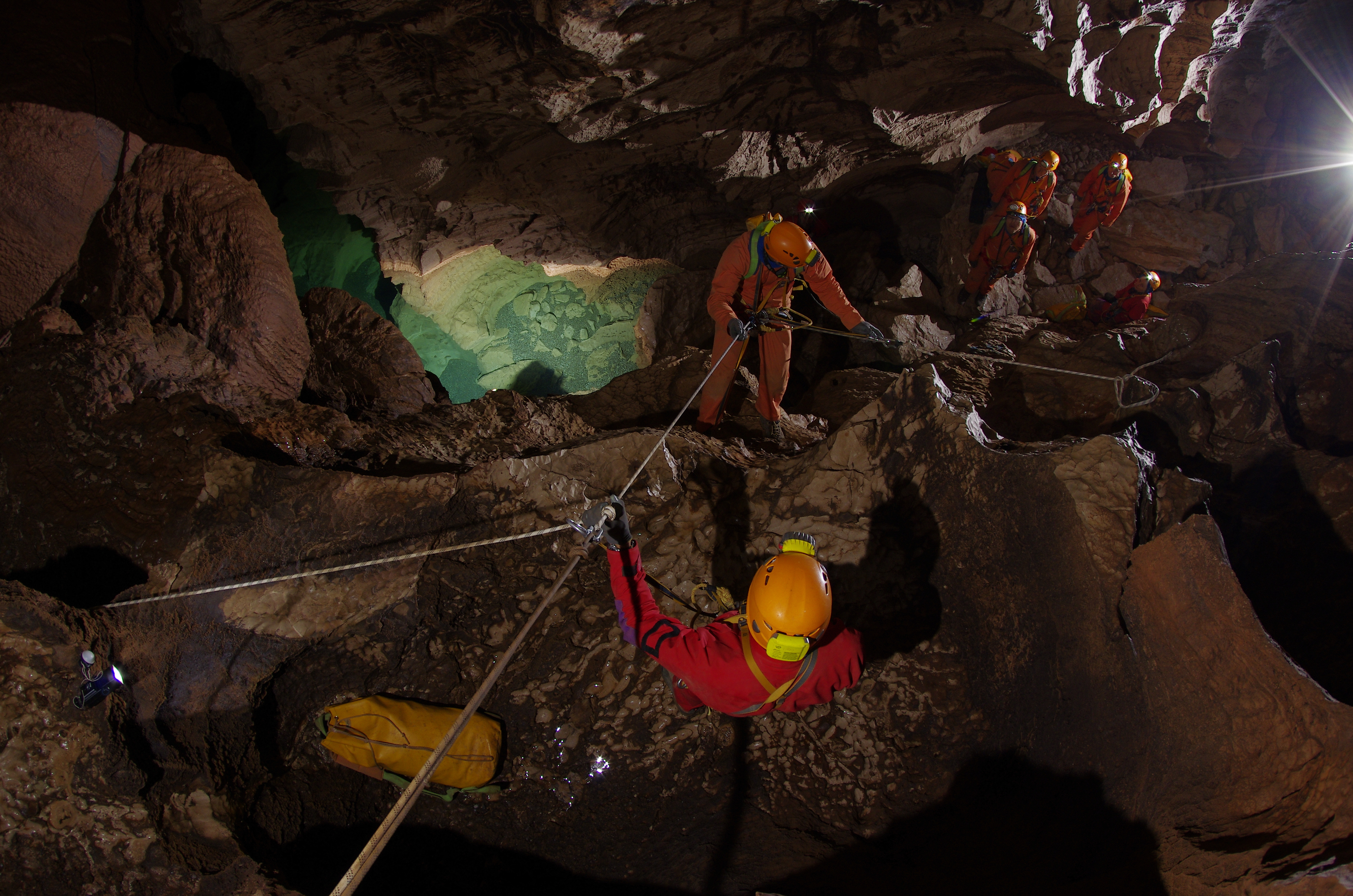
ESA’s cave training prepares astronauts to work as an international team in real exploration conditions. Sending astronauts underground to survive and explore Sardinian caves in Italy for almost a week is just one element of their long training.
The caves are isolated from the outside world. The astronauts need to get used to confined spaces, minimal privacy, technical challenges and limited equipment and supplies for hygiene and comfort – just as in space. Credits: ESA–R. Bresnik
 
An international crew of six astronauts will start training for a caving adventure designed to prepare them for spaceflight.
CAVES, an abbreviation of Cooperative Adventure for Valuing and Exercising human behaviour and performance Skills, prepares astronauts to work safely and effectively and solve problems as a multicultural team while exploring uncharted areas using space procedures.
The sunny island of Sardinia in Italy will welcome the astronauts from all the partners of the International Space Station. After a week spent learning the safety procedures and basics of exploring caves, the astronauts will venture underground on 7 September for six days.  
Download:
A ‘cavewalk’. Moving in a cave is similar to a spacewalk. It requires safety tethering, 3D orientation, with no-touch areas (speleothemes) and exclusion zones (dangerous paths). As in a spacewalk the view is stunning.
ESA’s cave training prepares astronauts to work as an international team in real exploration conditions. Sending astronauts underground to survive and explore Sardinian caves in Italy for almost a week is just one element of their long training.
The caves are isolated from the outside world. The astronauts need to get used to confined spaces, minimal privacy, technical challenges and limited equipment and supplies for hygiene and comfort – just like in space. 
Credits: ESA–V. Crobu
 Caves offer many similarities to space travel. Working in isolation from the outside world in confined spaces with minimal privacy as well as coping with technical challenges and limited supplies are conditions that astronauts have to live with in space – and underground.
The experience is designed to be as realistic as possible. A dedicated mission control will monitor the crew from a base station at the entrance of the cave. Briefings are held twice a day as they are on the International Space Station.
The crew is allowed only one shipment of supplies during their stay underground. They will have to choose the equipment carefully and give mission control at least 24 hours’ notice to prepare the cargo.
Orientation phase of CAVES 2011.
ESA’s cave training prepares astronauts to work as an international team in real exploration conditions. Sending astronauts underground to survive and explore Sardinian caves in Italy for almost a week is just one element of their long training.
The caves are isolated from the outside world. The astronauts need to get used to confined spaces, minimal privacy, technical challenges and limited equipment and supplies for hygiene and comfort – just like in space. Credits: ESA–V. Crobu
Looking for life

The opportunity to conduct research will not be lost. Just as in space, the astronauts have a busy schedule performing scientific work as well as testing new equipment and procedures.
A large part of the Sardinian caves are unexplored or uncharted. The ‘cavenauts’ will have to navigate safely through passages while deciding which areas to explore. They will draw detailed maps of their progress to ensure they make it back to base camp and to help future cave explorers.
This year the astronauts will be searching for life-forms as well. “Nobody has systematically looked for life in these caves,” says ESA astronaut trainer and CAVES course designer Loredana Bessone.


Life spotted in cave. ESA’s cave training prepares astronauts to work as an international team in real exploration conditions. Sending astronauts underground to survive and explore Sardinian caves in Italy for almost a week is just one element of their long training.
The Sardinian caves are isolated from the outside world. The astronauts need to get used to confined spaces, minimal privacy, technical challenges and limited equipment and supplies for hygiene and comfort – just like in space. 
Credits: ESA–F. Sauro
 “Finding life big and small is always good, so I am very excited we will be looking for exotic bacteria and cave dwellers such as anthropods.”
The astronauts will use the same safety protocols as used on spacewalks and they will also test a new communication system.
With support from their trainers, the astronauts will analyse their team-working skills and leadership qualities during the two-week course.
  ESA
G
 
Guillermo Gonzalo Sánchez Achutegui

 ayabaca@gmail.com
 ayabaca@hotmail.com
 ayabaca@yahoo.com
 Inscríbete en el Foro del blog y participa : A Vuelo De Un Quinde - El Foro!

domingo, 26 de agosto de 2012

Astronomy : FAMILY STATEMENT REGARDING THE DEATH OF NEIL ARMSTRONG


Download Image

Space Medal of Honor

Astronaut Neil Armstrong received the first Congressional Space Medal of Honor from President Jimmy Carter, assisted by Captain Robert Peterson. Armstrong, one of six astronauts to be presented the medal during ceremonies held in the Vehicle Assembly Building, was awarded for his performance during the Gemini 8 mission and the Apollo 11 mission when he became the first human to set foot upon the moon.

Armstrong died on Aug. 25, 2012, at the age of 82.

Image Credit: NASA
portrait of Apollo 11 Commander Neil A. Armstrong
July 1, 1969

S69-39961
Apollo 11 liftoff from launch tower camera

 S69-39526
Moonbound Apollo 11 clears the launch tower

 AS11-44-6550
Earthrise viewed from lunar orbit prior to landing

 AS11-44-6598
Lunar module inspection after undocking

 AS11-44-6611
Crater 308 viewed from orbit

 AS11-40-5864
lunar module skirt / descent engine nozzle

 AS11-40-5869
Aldrin on the LM footpad

AS11-40-5886
Neil Armstrong works at the LM

AS11-40-5880
Aldrin's boot and footprint in lunar soil

AS11-40-5903
Aldrin poses for portrait
 
 AS11-40-5961
Armstrong photo of LM from a distance

 AS11-37-5528
Armstrong in LM after historic moonwalk

 AS11-44-6667
view of full lunar disc during return trip

S69-40147
Apollo 11 astronauts, still in their quarantine van, are greeted by their wives upon arrival at Ellington Air Force Base
July 27, 1969 
Neil Armstrong: 1930-2012
08.25.12
Astronaut Neil A. Armstrong, Apollo 11 Commander, inside the Lunar Module as it rests on the lunar surface after completion of his historic moonwalk. Armstrong in the lunar module Eagle on the surface of the moon. July 20, 1969. Credit: NASA
› View Photo Gallery


See all statements on Armstrong's death Neil Armstrong, the first man to walk on the moon during the 1969 Apollo 11 mission, has died, following complications resulting from cardiovascular procedures. He was 82.

Armstrong's words "That is one small step for (a) man, one giant leap for mankind," spoken on July 20, 1969, as he became the first person ever to step onto another planetary body, instantly became a part of history.

Those few words from the Sea of Tranquillity were the climactic fulfillment of the efforts and hopes of millions of people and the expenditure of billions of dollars. A plaque on one of the lander's legs that concluded "We came in peace for all mankind," further emphasized that Armstrong and fellow astronaut Edwin "Buzz" Aldrin were there as representatives of all humans.

Armstrong is survived by his wife, two sons, a stepson, a stepdaughter, 10 grandchildren, and a brother and sister.

"Neil Armstrong was a hero not just of his time, but of all time," President Barack Obama said via Twitter. "Thank you, Neil, for showing us the power of one small step."

Read the full statement from the President.

Armstrong's family released the following statement on Saturday:

"Neil Armstrong was also a reluctant American hero who always believed he was just doing his job. He served his Nation proudly, as a navy fighter pilot, test pilot, and astronaut. He also found success back home in his native Ohio in business and academia, and became a community leader in Cincinnati.

While we mourn the loss of a very good man, we also celebrate his remarkable life and hope that it serves as an example to young people around the world to work hard to make their dreams come true, to be willing to explore and push the limits, and to selflessly serve a cause greater than themselves.
› Read Full Family Statement

The family will be providing further updates at www.neilarmstronginfo.com .

"As long as there are history books, Neil Armstrong will be included in them, remembered for taking humankind's first small step on a world beyond our own," said NASA Administrator Charles Bolden.

“Besides being one of America’s greatest explorers," Bolden added, "Neil carried himself with a grace and humility that was an example to us all."
› See Administrator Bolden's Full Statement

Apollo 11 lunar module pilot and fellow moonwalker Buzz Aldrin on Armstrong's passing: “I am very saddened to learn of the passing of Neil Armstrong today. Neil and I trained together as technical partners but were also good friends who will always be connected through our participation in the Apollo 11 mission. Whenever I look at the moon it reminds me of the moment over four decades ago when I realized that even though we were farther away from earth than two humans had ever been, we were not alone."

Apollo 11 command module pilot Michael Collins said simply, “He was the best, and I will miss him terribly.”

"The passing of Neil Armstrong has shocked all of us at the Johnson Space Center," said Center Director Michael Coats. The whole world knew Neil as the first man to step foot on the Moon, but to us he was a co-worker, a friend, and an outstanding spokesman for the Human Space Program. His quiet confidence and ability to perform under pressure set an example for all subsequent astronauts. Our role model will be missed."

“Neil Armstrong was a very personal inspiration to all of us within the astronaut office," said Bob Behnken, Chief of NASA's Astronaut Office. "His historic step onto the Moon’s surface was the foundation for many of our personal dreams to become astronauts. The only thing that outshone his accomplishments was his humility about those accomplishments. We will miss him as a friend, mentor, explorer and ambassador for the American spirit of ingenuity."

› Additional quotes on Armstrong's passing.
He was the best, and I will miss him terribly." -- Michael Collins, Apollo 11 command module pilot.
Armstrong's single sentence, though it was focused above the national divisions and quarrels of Earth, still signified unquestionably the U.S. victory in the desperate space race with the Soviet Union.

Neil A. Armstrong was born Aug. 5, 1930, in Wapakoneta, Ohio. He earned an aeronautical engineering degree from Purdue University and a master's in aerospace engineering from the University of Southern California.

He was a naval aviator from 1949 to 1952. During the Korean War he flew 78 combat missions.

In 1955 he joined the National Advisory Committee for Aeronautics (NACA), NASA's predecessor, as a research pilot at Lewis Laboratory in Cleveland.

Watch Apollo 11 highlights, including restored
footage of Armstrong's first steps


Armstrong later transferred to NACA's High Speed Flight Research Station at Edwards AFB, Calif. As project pilot, he was in the forefront of the development of many high-speed aircraft, including the X-15, which flew at 4,000 mph.

He flew more than 200 aircraft models. They included jet and rocket-powered planes, helicopters and gliders.

Armstrong was selected as an astronaut in 1962.

His first space flight was Gemini 8, which he commanded. He was the first civilian to fly a U.S. spacecraft. With fellow astronaut David R. Scott, Armstrong performed the first docking in space, with an Agena target satellite.

Less than an hour later their spacecraft began an unplanned rolling motion. After undocking, it increased to one revolution per second. One of the Gemini's 16 thrusters had stuck open because of an electrical short circuit.

Armstrong used re-entry thrusters to control the capsule, and after a 30-minute struggle, it was stabilized. Flight rules required a return to Earth after use of the re-entry thrusters, so the crewmembers fired retrorockets that sent Gemini 8 to a contingency landing zone in the Western Pacific.

Neil Armstrong on the moon One of the few photos that show Armstrong during the Apollo 11 moonwalk. Click image to enlarge. Photo credit: NASA

Neil Armstrong standing in front of  X-15 on lakebed Before becoming an astronaut, Armstrong flew the rocket-powered X-15 as a test pilot. Photo credit: NASA

Astronauts David R. Scott (left), Pilot; and, Neil A. Armstrong (right), Command Pilot, pose with model of the Gemini Spacecraft after being selected at the crew for the Gemini VIII mission. Armstrong, right, joined astronaut Dave Scott on the Gemini VIII mission in March of 1966. Photo credit: NASA
› View Photo Gallery The eventful flight on March 16, 1966, had taken just over 10 hours, 41 minutes.

Apollo 11 lifted off on July 16, 1969, with Armstrong, Aldrin and Mike Collins aboard. Collins remained in lunar orbit in the command module while Armstrong and Aldrin descended in the lunar module they had named Eagle to their historic landing on the moon's surface.

"Houston, Tranquillity Base here. The Eagle has landed," Armstrong said, telling a tense and waiting Earth that men had finally reached the lunar surface.

He and Aldrin spent about two hours exploring, gathering more than 50 pounds of moon rocks and setting up three scientific experiments. The next day, after 21 hours and 37 minutes on the moon, they fired Eagle's engine to begin the return to Collins and the command module.

The crew returned to Earth, landing near the USS Hornet in the Pacific after a mission of just over eight days. President Richard M. Nixon was on the aircraft carrier's deck to welcome them.

"This is the greatest week in the history of the world since the creation," Nixon told the three.

After 16 days in quarantine to protect Earth from any returned moon germs, the crew went on U.S. and international tours. Millions greeted them as heroes.

Armstrong later served as deputy associate administrator for aeronautics in the Office of Advanced Research and technology at NASA Headquarters. He resigned from the space agency in 1971. As a professor at the University of Cincinnati from 1971 to 1979, he was involved in both teaching and research.

He later went into the business world. Among other positions, he served for 10 years as chairman of Computing Technologies for Aviation Inc. of Charlottesville, Va. and later as chairman of AIL Systems Inc., an electronic systems company based in Deer Park, N.Y.

Armstrong was a fellow of the Society of Experimental Test Pilots and the Royal Aeronautical Society, and an honorary fellow of the American Institute of Aeronautics and Astronautics and the International Astronautical Federation.

He was a member of the National Academy of Engineering. He served as a member of the National Commission on Space in 1985 and 1986, and in 1985 was vice chairman of the Presidential Commission on the Space Shuttle Challenger Accident. He also was chairman of the Presidential Advisory Committee for the Peace Corps from 1971 to 1973.

Armstrong discusses the space race during
an Apollo 11 40th anniversary celebration in 2009


Seventeen countries decorated Armstrong. He received many special honors, including the Presidential Medal of Freedom, the Congressional Space Medal of Honor, NASA's Ambassador of Exploration Award, the Explorers Club Medal, the Robert H. Goddard Memorial Trophy, the NASA Distinguished Service Medal, the Harmon International Aviation Trophy, the Royal Geographic Society's Gold Medal, the Federation Aeronautique Internationale's Gold Space Medal, the American Astronautical Society Flight Achievement Award, the Robert J. Collier Trophy, the AIAA Astronautics Award, the Octave Chanute Award, and the John J. Montgomery Award.

Statements on the Passing of Neil Armstrong
08.26.12
Statement from Neil Armstrong's Family

Statement by President Barack Obama

Statement by NASA Administrator Charles Bolden

Statement from Buzz Aldrin, Apollo 11 lunar module pilot:

“I am very saddened to learn of the passing of Neil Armstrong today. Neil and I trained together as technical partners but were also good friends who will always be connected through our participation in the Apollo 11 mission. Whenever I look at the moon it reminds me of the moment over four decades ago when I realized that even though we were farther away from earth than two humans had ever been, we were not alone. Virtually the entire world took that memorable journey with us. I know I am joined by millions of others in mourning the passing of a true American hero and the best pilot I ever knew. My friend Neil took the small step but giant leap that changed the world and will forever be remembered as a landmark moment in human history. I had truly hoped that in 2019, we would be standing together along with our colleague Mike Collins to commemorate the 50th Anniversary of our moon landing. Regrettably, this is not to be. Neil will most certainly be there with us in spirit.

“On behalf of the Aldrin family, we extend our deepest condolences to Carol and the entire Armstrong family. I will miss my friend Neil as I know our fellow citizens and people around world will miss this foremost aviation and space pioneer.”

Statement from Joe Engle, former X-15 pilot and NASA astronaut:

“Neil was indeed the greatest. His humility and reluctance to stand in the spotlight as the first human to set foot on the moon are well known and respected. But mention flying airplanes, and in particular flying the X-15, and he would light up, his eyes would twinkle, and you could barely get a word in edgewise – nor would you want to. Neil was a great American, a great test pilot, a great engineer, but most importantly, a great friend. We’ll miss him, but we’re so thankful we had the opportunity to know and fly with him. Our thoughts and prayers are with Carol and his family.”

Statement from Glenn Research Center Director Ray Lugo:

“Our condolences reach out to his wife Carol and surround the entire Armstrong Family. The loss of Neil is felt by the entire NASA community and especially by his Ohio-based NASA family at the Glenn Research Center. Neil remains a national treasure; a pioneering astronaut, test pilot, aerospace engineer and professor; the first man to set foot on the moon. He has helped turn the complexities, challenges and stumbling blocks of space exploration into stepping stones that others have followed and a brilliant trail for the future explorers. His legacy will inspire those who will follow in his footsteps to Dream Big.”

Statement from Kennedy Space Center Director Bob Cabana:

“Neil Armstrong was a true American hero, and one of the nicest gentlemen around. He was the epitome of what an engineering test pilot should be, and a role model for everyone who aspired to be an astronaut.

“He always took the time to share his thoughts on technical issues and his experiences from the past.

“I feel very privileged to have known him. He will be missed.”
NASA
Guillermo Gonzalo Sánchez Achutegui
ayabaca@gmail.com
ayabaca@hotmail.com
ayabaca@yahoo.com
 Inscríbete en el Foro del blog y participa : A Vuelo De Un Quinde - El Foro!

sábado, 25 de agosto de 2012

La Casa de la Loma tiene un Fantasma: Capítulo CLXXII.- Se acerca la noche del asalto, pero antes se recuerda la vida de Aurelio "Mata Ricos" quien actuará como defensor

Hola amigos: A VUELO DE UN QUINDE EL BLOG., continuando con la historia de La Casa de la Loma tiene un Fantasma y como informamos en el capítulo anterior, el señor Sánchez conversó ampliamente con su esposa, para darle seguridad; ya que tenía certero conocimiento que por la noche su casa iba ser asaltada por tres bandoleros que vienen desde Cuchayo;  en algún momento la señora Sánchez puso en cuestión tener tantos caudales, pero por esa razón los había vuelto vulnerables para asaltantes y bandoleros y lo que es más grave, ellos (los Sánchez) eran acaudalados gracias a un "Pacto con Satanás", quien en efecto les puso en sus manos ingentes tesoros que poco a poco iban llegando a La Casa de la Loma.
Al mismo tiempo, Satanás, que protegía La Casa de la Loma con huestes especialmente asignados y como espíritus; era necesario  transmigrar a seres de carne y hueso para enfrentar a los facinerosos que pretenderán atacar por la noche con otros igualmente de los peores delincuentes que asesinaron alevosamente cuando moraban La Tierra.

 Aquí en la imagen observamos una típica casa en la Comunidad Campesina de Socchabamba, Ayabaca, Piura, Perú; es una construcción de adobe con techo de tejas rojas y a dos aguas, sobre el techo distinguimos un fantasma que viene a ser el "El Rey de las Tinieblas" : Satanás, seguido de vampiros y una siniestra sombra negra que rodea al misterioso personaje satánico, para comprender la narrativa de la obra literaria: "LA CASA DE LA LOMA TIENE UN FANTASMA" , esta imagen será nuestro símbolo de identificación y el logotipo en creación, impresión y distribución literaria. Con reconocimiento de derechos de autor, con Partida Registral Nº 00393-2010, Asiento 01, con fecha 27 de marzo de 2010 por INDECOPI. Fuente de imagen: Archivos del blog.

El tiempo sigue su curso y nadie lo detiene, ya llegamos a las 6:00 p.,m. (18 horas) es la llamada "Hora de la Oración" y empieza a oscurecer, las aves nocturnas como búhos y Lechuzas  dan por finalizado su largo sueño y dan inicio al aleteo de sus plumas comprobando si están aptas para dar la sustentación a sus alas para enfrentar una noche más en busca de comida y tal vez servir como aves de compañía o temer viendo sombras funestas que emergen desde el más allá y vienen con aspiraciones de seguir afligiendo  a los seres terrenales del más acá.
Satanás, de acuerdo a lo planeado con Damián El Pescador su fiel y leal hueste coordinador de millones de seres  espirituales diabólicos diseminados en la faz de La Tierra; entonces,el subalterno satánico fue a un viejo  y abandonado cementerio  que estaba ubicado lejos del pueblo; aquel lugar albergaba  los restos mortales de los peores delincuentes y asaltantes que murieron en acción o fueron asesinados o simplemente se mataron entre ellos mismos, por ajuste de cuentas originados por desavenencias  en el reparto de los botines usurpados; justamente dentro de este grupo  de salvajes asesinos  sobresalía por su crueldad: Aurelio "Mata ricos"; este bandolero  siempre actuó sólo, pero de vez en cuando aceptaba la compañía de otro compinche por lo adverso que le tocaría hacerlo sólo.
En boca de los asaltantes y bandoleros se  comentaba que una vez Aurelio, viajó a Samaco en busca de Juan Manuel Cunya, quien atesoraba una gran fortuna en un reducto al interior de La Tierra llamado "La Cueva de los Tesoros" pero nunca  logró ubicarlo y partió hacia Ecuador; tras informaciones  muy difundidas que al otro lado del Cerro Usaime habían asentadas muchas haciendas en manos de acaudalados gamonales, quienes a su vez delegaban la administración en caporales los mismos que actuaban como los verdaderos dueños de las riquezas.
Según las mismas informaciones, Aurelio en pos de ellas, cruzó la frontera al encontrar muy bajo el nivel del Río Calvas; habiendo vadeado  y estando en la playa ecuatoriana se encontró con un transeúnte  que merodeaba en aquellos instantes por allí y como el "olfato" le indujo a pensar que se había encontrado con alguien  de su misma cofradía (bandoleros), lo saludó con estas expresiones:
--- Cómo le va amigo, he cruzado el río por que voy a visitar a un amigo que vive cerca a Cariamanga; hace muchos años que vivo en Cujaca y cuando estuvo por allí, él,siempre me invitó conocer su casa y justamente estoy viajando aceptando esa invitación....
El transeúnte interrumpió al locuaz Aurelio y le replicó:
--- Amigo peruano, usted no viaja precisamente a buscar amigos a tan larga distancia, todo me indica que sus planes  son buscar tesoros y usted está en su día de suerte por que mi "espíritu adivinador" dice que estamos en el mismo sendero y me ofrezco como conocedor de la zona para hacer todos los "trabajos"(asaltos) y compartiremos en partes iguales la "renta producida", pues, bienvenido al Ecuador.
Luego, el transeúnte que se convirtió en su anfitrión, estiró la mano derecha al recién llegado quien de inmediato lo hizo con la suya y se dieron un fuerte apretón de manos, dando inicio a una amistad que seguramente será la fuente de unión de dos individuos que sólo depredan la riqueza duramente conseguida por los dueños de las haciendas, y como Aurelio desconocía esas haciendas se sintió muy aliviado en contar con un aliado y al finalizar el saludo, le dijo:
--- Es un honor conocer a un nuevo amigo ecuatoriano ;mi  nombre es Aurelio y de apodo mis enemigos me llaman : "Mata ricos", pero no se preocupe la gente siempre hacen creer "famas" en personas que como yo cuando hago mis "trabajos" actuó con cierta fuerza  pero nunca mato por gusto.
Al flamante anfitrión le causó cierta sonrisa al escuchar  el mote del recién llegado y también se sentía feliz en conocer a alguien que parecía sanguinario y por este proceder encajaba para un "ajuste de cuentas" pendiente contra un pendejo de Amaluza, quien lo traicionó, dejándolo sólo en una incursión que salió completamente mal por que ellos fueron descubiertos por los peones de una hacienda que ambos habían elegido para un asalto; él, se salvó de una muerte segura, gracias a su habilidad en la pelea con su navaja y esa arma enfrentó a tres hombres con tal suerte para él, que los infelices no supieron usar sus machetes y como tenía que defenderse, logró herir mortalmente a sus oponentes y huyó; él, nunca supo si murieron los defensores de la hacienda; pero si tenía claro, que su compañero lo dejó por cobardía o tal vez lo entregó por una pendejada para que lo maten como cualquier perro, y esa acción merece ser vengada con la muerte del traidor, y estirando sus dos brazos, se acercó a Aurelio y le dijo:
--- Mi querido amigo, es usted una persona que he estado buscando por mucho tiempo para "trabajar" juntos, vea usted acá hay mucha plata que está regada por los suelos, sólo hay que saber recogerla, utilizando la astucia y mucha inteligencia y tal vez  sin "matar a ricos" se puede hacer "dueño" de las mismas,  cuente con mi lealtad y como estoy cerca a mi choza, por que mi casa en realidad está en Amaluza y mi nombre es Cristobal, pero los muchachos (compinches) me conocen como : "Cristo matón", por que igual que usted en las broncas y "trabajos" he tenido que hacer uso  de la daga y siempre se mete por la panza del contrario (enemigo).
Aurelio "mata ricos" rápidamente captó la sinceridad del chimba (expresión usada en Socchabamba para decir ecuatoriano) y le correspondió con un fuerte abrazo, sellándose la unión de temidos bandoleros...... continuaremos.......
Guillermo Gonzalo Sánchez Achutegui
ayabaca@hotmail.com
ayabaca@gmail.com
ayabaca@yahoo.com
Inscríbete en el Foro del blog y participa : A Vuelo De Un Quinde - El Foro!

viernes, 24 de agosto de 2012

La Historia del Amor Cruel: Capítulo LXIV.- Melany y Olzagon bebían un delicioso café, pasó pronto a ellos la despreciable sombra de "Fedo"

Hola amigos: A VUELO DE UN QUINDE EL BLOG., continuando con La Historia del Amor Cruel entre Iarma y Olzagon y como informamos en el capítulo anterior Melany narró a Olzagon en forma detallada su fallida relación con el altanero "Fedo" y según ella ya no existía vinculación alguna con ese individuo; sin embargo, el insolente "Fedo" insistió que nunca habían roto su "relación amorosa", de todas maneras gracias a la decidida intervención  de Olzagon pudieron  desprenderse por el momento de la presencia del soberbio "Fedo"; superados los incidentes y estando afuera caminando Olzagon invitó a Melany a beber un café; pero ellos desconocían que un individuo seguía sus pasos.

 Aquí en la imagen observamos una típica representación de la terrible situación que muchos hogares atraviesan en el transcurso de existencia por que siempre hay la existencia de un tercer elemento (amante tanto para él como para ella) que como una tentación tenebrosa carcomen las consistencias del matrimonio, y más si los esposos viven solamente la apariencia y no la triste realidad de que no son felices. Fuente: Archivos del blog. Obra Literaria reconocida con Derechos de Autor, según Partida Registral No. 00855-2012, Asiento: 01; con fecha: 10 de Agosto de 2012, por : INDECOPI.

Los amados, Melany y Olzagon entraron abrazados al cafetín; escogieron una mesa con dos sillas que quedaba junto a la ventana, lugar  que les ofrecía el privilegio de observar todo lo pasaba en la calle y como el vidrio polarizado lo impedía;  del otro lado de la ventana no podían observar lo que sucedía adentro; se acercó el mesero quien les informó sobre las bebidas que en aquel momento ofrecía el establecimiento y ellos decidieron por dos tazas de café capuccino  y unos panecillos para comer algo; en realidad, no tenían hambre, tantas cosas habían sucedido que lo mejor era beber el delicioso café y continuaron conversando, tratando de darse confianza mutuamente  y conocer más detalles de la personalidad del uno como del otro.
Melany, ya había recuperado su natural semblante, se le veía más bella,  había  seguridad en sus expresiones y sobretodo pensaba que se había unido al hombre adecuado a sus deseos, por su puesto ningún ser humano es perfecto y menos ellos, que recién se conocían y estaban acumulando experiencias; como jóvenes que lo eran, por sus mentes pasaban muchas ideas y ella se atrevió a expresar a su pareja una de ellas y le dijo:
--- Olzagon, hoy ha sido un día decisivo en mi vida, al salir contigo es lo mejor que pueda haberme sucedido, estoy totalmente segura que el destino ha unido a nuestras vidas y como tu bien lo dijiste pasamos victoriosos la primera prueba tan inesperada como sorpresiva y para cimentar nuestra relación quisiera que si algún día sellamos este amor que está naciendo entre nosotros que tuviéramos tres hijos; tal vez, te cause sorpresa esta idea y pienses que es muy temprano, pero cuando hay amor afloran los pensamientos; recuerda  no estoy condicionando  esta relación y tu tienes completa libertad para decidir todo lo que piensas; perdóname por que soy una mujer que me proyecto demasiado hacía el futuro.
En aquel instante llegó el mesero con las viandas pedidas por ellos, luego que se retiró el empleado, Olzagon ofreció el azúcar a su amada, también él, echó una cucharadita de la dulce sustancia a su bebida humeante, y al ingerir un trago, mirando cariñosamente a su amada, contestó:
--- Amada mía, hoy para mi ha sido el acontecimiento más dichoso al compartir contigo estos momentos; estamos dando inicio a los cimientos del gran  edificio que podemos construir en el promisorio futuro; y cuando existen sueños transformados en ideas es justamente la razón de la existencia en la unión de dos seres que cobijados por el amor plantean la realización de sus proyectos; me parece muy interesante tu idea de lo que sería nuestro futuro hogar; claro está, nosotros aún estamos empezando y tenemos que superar muchas etapas para llegar al matrimonio; yo por ejemplo pienso  en ingresar a la universidad y convertirme en un profesional que me permita luchar con más ventaja en la dura competencia de tener siempre un trabajo; el mismo que me permita lograr cierta solvencia económica que es a la postre el sustento en la estabilidad de un hogar; te recuerdo tu idea es maravillosa... quien no desearía casarse contigo... depende solamente de nosotros convertirla en una realidad y para eso cuenta conmigo amor de mi vida... te amo...
Melany, se sintió un poco incomoda por haber sido demasiado entusiasta en manifestar sus sueños, pero a la vez comprendía perfectamente la madurez como pensaba Olzagon; era muy cierto ellos  eran muy jóvenes como para casarse pronto, si aún no se conocían muy bien; ella, comprobó una vez más lo delicado que era Olzagon contestando lo que ella le proponía y sus aseveraciones eran contundentes con la realidad y mirandole con sus bellos ojos, le dijo:
--- Amor de mi vida, cuanta razón tienes en referencia a mis pensamientos, perdóname si fui muy precipitada, pero es que no puedo controlar el entusiasmo de mi corazón y todo el encanto que tu persona despierta en todo mi cuerpo; pues, me siento feliz y te entendí perfectamente lo que propones, hay que estudiar para enfrentar el futuro; yo también estudio en un centro de aprendizaje industrial que me permitirá mejor la calidad de mi rendimiento en la Fábrica de Productos Lácteos donde trabajo, y si tu deseas ser un profesional, en hora buena, me alegra conocer la firmeza de tus ideales.
Mientras, Melany conversaba con Olzagon y como estaba concentrada en sus pensamientos, aún así vio con el rabo del ojo pasar por delante de la ventana al atorrante "Fedo", pero no estaba segura, tal vez son visiones sobre ese individuo se dijo ella asimismo; pero igualmente sucedió con Olzagon, quien vio pasar como una sombra muy fugaz al ex enamorado de su amada, pero tampoco estaba seguro y mirando a Melany, le dijo:
--- Amor, no se si estoy viendo fantasmas, haz visto lo que yo vi, que tu ex enamorado nos está buscando, o tal vez mi mente me engaño con otra persona; tengo la impresión que está siguiendo nuestros pasos ; pues, como él, no sabe que nosotros ya lo hemos visto hay que tomar nuestras precauciones por si quisiera sorprendernos, pero no llego a entender que cosa quiere, si ya lo enviamos derecho a su casa.
Melany, también estaba intrigada por la inesperada presencia del petulante "Fedo" y estaba completamente de acuerdo con su amado y cuando se disponía a contestar, apareció de nuevo el soberbio individuo y esta vez lo vieron los dos y comprobaron que estaba allí por ellos, por que al pasar por delante de la ventana se sobreparó e intentó ver al interior, pero el vidrio se lo impidió y siguió caminando, de todas maneras, Melany, dijo:
--- Amado mío, creo que debemos irnos de este lugar tengo el presentimiento que ese hombre nos ocasionará serios problemas, terminemos nuestro café y salgamos.
Olzagon, que ya le había robado el "espíritu" en el interior del cine, no se acobardó y dio tranquilidad a su amada, diciéndole:
--- Melany, no creo que sea una buena idea huir, él, sabe que estamos aquí y nos está esperando afuera; entonces, tengo que darle batalla para definir quién se queda contigo.....
Melany, interrumpió a su amado un poco ofuscada  y levantando la voz le dijo:
--- Olzagon yo no soy trofeo de nadie, como para que se batan ustedes en un desafío;  y ya decidí, tu serás el amor de mi vida y por favor basta de pleitos, no le daremos el gusto si busca bronca, no caigas en la provocación es una trampa, por favor no aceptes el reto, eso es muy peligroso, por que está buscando un motivo de agresión, para no se que propósito, conozco algo los pensamientos de ese individuo; más bien me llevas a casa y en la ruta te señalo la casa donde vive, allí nos bajamos y hablamos con sus padres para aclara esta lamentable situación.....
Continuaremos......
NOTA.-  Hemos recibido una grata comunicación del Instituto de Defensa de la Competencia y de la Protección de la Propiedad Intelectual-INDECOPI-, dando el reconocimiento de derecho de autor a la obra : LA HISTORIA DEL AMOR CRUEL, cuyo Expediente No. 001350-2012, dio curso para la Partida Registral No. 00855-2012, y Asiento: 01, lo firman: Martín Moscoso Villacorta, Director de Derecho de Autor y Cinthia Granados Zavaleta, Dirección de Derecho de Autor.

Guillermo Gonzalo Sánchez Achutegui
ayabaca@gmail.com
ayabaca@hotmail.com
ayabaca@yahoo.com
 Inscríbete en el Foro del blog y participa : A Vuelo De Un Quinde - El Foro!

jueves, 23 de agosto de 2012

Astronomy: The Mysterious Case of the Disappearing Dust

NASA'S WISE Scientists to Discuss Black Holes and Extreme Objects.-
WASHINGTON -- NASA will host a news teleconference at 1 p.m. EDT, Wednesday, Aug. 29, to announce new discoveries from its Wide-field Infrared Survey Explorer (WISE). The discoveries are related to the distant universe, including supermassive black holes and rare galaxies.

The briefing participants are:

-- Daniel Stern, astronomer, NASA's Jet Propulsion Laboratory (JPL), Pasadena, Calif.
-- Peter Eisenhardt, WISE project scientist, JPL
-- Jingwen Wu, astronomer, JPL
-- Rachel Somerville, Downsbrough Chair in Astrophysics, Rutgers University

A link to the teleconference graphics will be available at the start of the event at:


For dial-in information, reporters should email their name, affiliation and telephone number to j.d.harrington@nasa.gov by noon Aug. 29.

For live audio of the teleconference, visit:

This artist's concept illustrates a dusty planet-forming disk, similar to the one that vanished around the star called TYC 8241 2652. Image credit: NASA/JPL-Caltech › Larger view

Imagine if the rings of Saturn suddenly disappeared. Astronomers have witnessed the equivalent around a young sun-like star called TYC 8241 2652. Enormous amounts of dust known to circle the star are unexpectedly nowhere to be found.
"It's like the classic magician's trick: now you see it, now you don't. Only in this case we're talking about enough dust to fill an inner solar system and it really is gone!" said Carl Melis of the University of California, San Diego, who led the new study appearing in the July 5 issue of the journal Nature.
A dusty disk around TYC 8241 2652 was first seen by the NASA Infrared Astronomical Satellite (IRAS) in 1983, and continued to glow brightly for 25 years. The dust was thought to be due to collisions between forming planets, a normal part of planet formation. Like Earth, warm dust absorbs the energy of visible starlight and reradiates that energy as infrared, or heat, radiation.
The first strong indication of the disk's disappearance came from images taken in January 2010 by NASA's Wide-field Infrared Survey Explorer, or WISE. An infrared image obtained at the Gemini telescope in Chile on May 1, 2012, confirmed that the dust has now been gone for two-and-a-half years.
"Nothing like this has ever been seen in the many hundreds of stars that astronomers have studied for dust rings," said co-author Ben Zuckerman of UCLA, whose research is funded by NASA. "This disappearance is remarkably fast even on a human time scale, much less an astronomical scale. The dust disappearance at TYC 8241 2652 was so bizarre and so quick, initially I figured that our observations must simply be wrong in some strange way."
The astronomers have come up with a couple of possible solutions to the mystery, but they say none are compelling. One possibility is that gas produced in the impact that released the dust helped to quickly drag the dust particles into the star and thus to their doom. In another possibility, collisions of large rocks left over from an original major impact provide a fresh infusion of dust particles into the disk, which caused the dust grains to chip apart into smaller and smaller pieces.
The result is based upon multiple sets of observations of TYC 8241 2652 obtained with the Thermal-Region Camera Spectrograph on the Gemini South telescope in Chile; IRAS; WISE; NASA's Infrared Telescope on Mauna Kea in Hawaii; the European Space Agency's Herschel Space Telescope, in which NASA plays an important role; and the Japanese/European Space Agency AKARI infrared satellite.
Read the Gemini news release at
and the UCLA release at 
NASA's Jet Propulsion Laboratory, Pasadena, Calif., manages, and operated, WISE for NASA's Science Mission Directorate. The spacecraft was put into hibernation mode after it scanned the entire sky twice, completing its main objectives. Edward Wright is the principal investigator and is at UCLA. The mission was selected competitively under NASA's Explorers Program managed by the agency's Goddard Space Flight Center in Greenbelt, Md. The science instrument was built by the Space Dynamics Laboratory in Logan, Utah. The spacecraft was built by Ball Aerospace & Technologies Corp. in Boulder, Colo. Science operations and data processing take place at the Infrared Processing and Analysis Center at the California Institute of Technology in Pasadena. Caltech manages JPL for NASA.
IRAS was executed jointly by the United States (NASA), the Netherlands and the United Kingdom. The Infrared Telescope is operated and managed for NASA by the University of Hawaii, located in Honolulu.
More information is online at
and
 
 
Whitney Clavin 818-354-4673
Jet Propulsion Laboratory, Pasadena, Calif.
Whitney.clavin@jpl.nasa.gov

2012-197
 
NASA
Guillermo Gonzalo Sánchez Achutegui
ayabaca@hotmail.com
ayabaca@gmail.com
ayabaca@yahoo.com
 Inscríbete en el Foro del blog y participa : A Vuelo De Un Quinde - El Foro!

Mars: NASA-Making Tracks on Mars


Download Image

› Full Size

 NASA
Guillermo Gonzalo Sánchez Achutegui
ayabaca@gmail.com
ayabaca@hotmail.com
ayabaca@yahoo.com
 Inscríbete en el Foro del blog y participa : A Vuelo De Un Quinde - El Foro!

Asia: New study maps Himalayan glacier behaviour

Hi My Friends: A VUELO DE UN QUINDE EL BLOG., Glaciers are one of the largest reservoirs of freshwater on our planet, and their melting or growing is one of the best indicators of climate change. However, knowledge of glacier change has been hampered by lack of data, especially for understanding regional behaviour.
 Khumbu ice fall, Khumbu Glacier, near the Everest Base Camp. Mt Everest peak (8848 m asl.) is in the upper right background, mostly hidden by its west shoulder. 
Credits: K. Casey

 Glaciers are one of the largest reservoirs of freshwater on our planet, and their melting or growing is one of the best indicators of climate change. However, knowledge of glacier change has been hampered by lack of data, especially for understanding regional behaviour.

Measurements from satellites have recently provided the first overview mapping of thickness changes of Himalayan glaciers.
In a study published in Nature today, scientists assembled new datasets from Earth-observing satellites and found that glaciers in the Hindu Kush–Karakoram–Himalaya region (HKKH) lost 12 gigatonnes per year over the period 2003–08, much faster than previously reported.
The HKKH is a 2000 km-long group of mountain ranges in Asia containing about 60 000 sq km of glaciers, glacierets and perennial surface ice in varying climatic conditions. These ice masses exhibit a complex response to climate and this makes the analysis of changes in the region difficult.
Data from satellites provide a means to make these regional assessments and obtain the first spatially-resolved mass budget over the entire HKKH.
The article, ‘Contrasting patterns of early 21st-century glacier mass change in the Himalayas’ outlined a study, supported by ESA through its Globglacier and Glacier_cci projects, where laser altimeter data from NASA’s ICESat mission were combined with a digital elevation model from the Shuttle Radar Topography Mission and optical data from the Landsat mission to map glacial thickness changes in HKKH for 2003–09. 
Study region of elevation differences 2003–08. The coloured dots depict varying elevation differences over the time period, while the size of the dots indicate the standard error between laser altimeter data from NASA’s ICESat mission and the digital elevation model derived from the Shuttle Radar Topography Mission. 
Credits: A. Kääb (modified after Kääb et al., 2012)

 The laser altimeter data were extracted for different types of glacier surfaces derived from the Landsat data and compared with the digital elevation model to obtain elevation differences over time.
On average, HKKH glaciers thinned by 0.26 m per year but there were significant subregional variations related to different climate and glaciology patterns.
In the Jammu–Kashmir subregion, thinning rates reached around 0.66 m per year, while further north and west, in the Karakoram region, they were nearly ten times slower. These findings were unaffected by glacier type (such as debris covered or clean ice).
The melting contributes to about 1% of the global sea level rise – a small contribution and only 3–4% of the total contribution from global glaciers and ice caps.
However, glacial runoff, or lack thereof, has a direct effect on the nearby Indus and Ganges River basins and is very important for lower-lying regions where there is a very large human population. The changes in mass of the glaciers contributed between 2% and 3.5% of the total discharge into these rivers, while in the Upper Indus basin the contribution was almost 10% of the annual river discharge.
The team is continuing to monitor glaciers through the Glaciers_cci project by combining 30 years of archived data with new information from present and future satellite missions, such as the Sentinel family of satellites being developed for Europe’s Global Monitoring for Environment and Security (GMES) programme.
ESA.
Guillermo Gonzalo Sánchez Achutegui
ayabaca@gmail.com
ayabaca@hotmail.com
ayabaca@yahoo.com
 Inscríbete en el Foro del blog y participa : A Vuelo De Un Quinde - El Foro!

miércoles, 22 de agosto de 2012

Russians Outfit the ISS: EVA to Add to the ISS


Download Image

› Full Size

NASA
Guillermo Gonzalo Sánchez Achutegui
ayabaca@gmail.com
ayabaca@hotmail.com
ayabaca@yahoo.com
 Inscríbete en el Foro del blog y participa : A Vuelo De Un Quinde - El Foro!

Mars: NASA Mars Rover Begins Driving at Bradbury Landing

Hi My Friends: A VUELO DE UN QUINDE EL BLOG., NASA's Mars rover Curiosity has begun driving from its landing site, which scientists announced today they have named for the late author Ray Bradbury.

Download Image

› Full Size 


 PASADENA, Calif. -- NASA's Mars rover Curiosity has begun driving from its landing site, which scientists announced today they have named for the late author Ray Bradbury.

Making its first movement on the Martian surface, Curiosity's drive combined forward, turn and reverse segments. This placed the rover roughly 20 feet (6 meters) from the spot where it landed 16 days ago.

NASA has approved the Curiosity science team's choice to name the landing ground for the influential author who was born 92 years ago today and died this year. The location where Curiosity touched down is now called Bradbury Landing.

"This was not a difficult choice for the science team," said Michael Meyer, NASA program scientist for Curiosity. "Many of us and millions of other readers were inspired in our lives by stories Ray Bradbury wrote to dream of the possibility of life on Mars."

Today's drive confirmed the health of Curiosity's mobility system and produced the rover's first wheel tracks on Mars, documented in images taken after the drive. During a news conference today at NASA's Jet Propulsion Laboratory (JPL) in Pasadena, Calif., the mission's lead rover driver, Matt Heverly, showed an animation derived from visualization software used for planning the first drive.

"We have a fully functioning mobility system with lots of amazing exploration ahead," Heverly said.

Curiosity will spend several more days of working beside Bradbury Landing, performing instrument checks and studying the surroundings, before embarking toward its first driving destination approximately 1,300 feet (400 meters) to the east-southeast.

"Curiosity is a much more complex vehicle than earlier Mars rovers. The testing and characterization activities during the initial weeks of the mission lay important groundwork for operating our precious national resource with appropriate care," said Curiosity Project Manager Pete Theisinger of JPL. "Sixteen days in, we are making excellent progress."

The science team has begun pointing instruments on the rover's mast for investigating specific targets of interest near and far. The Chemistry and Camera (ChemCam) instrument used a laser and spectrometers this week to examine the composition of rocks exposed when the spacecraft's landing engines blew away several inches of overlying material.

The instrument's principal investigator, Roger Weins of Los Alamos National Laboratory in New Mexico, reported that measurements made on the rocks in this scoured-out feature called Goulburn suggest a basaltic composition. "These may be pieces of basalt within a sedimentary deposit," Weins said.

Curiosity began a two-year prime mission on Mars when the Mars Science Laboratory spacecraft delivered the car-size rover to its landing target inside Gale Crater on Aug. 5 PDT (Aug. 6 EDT). The mission will use 10 science instruments on the rover to assess whether the area has ever offered environmental conditions favorable for microbial life.

In a career spanning more than 70 years, Ray Bradbury inspired generations of readers to dream, think and create. A prolific author of hundreds of short stories and nearly to 50 books, as well as numerous poems, essays, operas, plays, teleplays, and screenplays, Bradbury was one of the most celebrated writers of our time.

His groundbreaking works include "Fahrenheit 451," "The Martian Chronicles," "The Illustrated Man," "Dandelion Wine," and "Something Wicked This Way Comes." He wrote the screenplay for John Huston's classic film adaptation of "Moby Dick," and was nominated for an Academy Award. He adapted 65 of his stories for television's "The Ray Bradbury Theater," and won an Emmy for his teleplay of "The Halloween Tree."

JPL manages the Mars Science Laboratory/Curiosity for NASA's Science Mission Directorate in Washington. The rover was designed, developed and assembled at JPL.

More information about Curiosity is online at:

 
and
 

Follow the mission on Facebook at:
 
and on Twitter at:
 
NASA
Guillermo Gonzalo Sánchez Achutegui
ayabaca@gmail.com
ayabaca@hotmail.com
ayabaca@yahoo.com
 Inscríbete en el Foro del blog y participa : A Vuelo De Un Quinde - El Foro!

Mi lista de blogs