Mostrando entradas con la etiqueta Peter Higgs. Mostrar todas las entradas

martes, 15 de octubre de 2013

FÍSICA: El físico Peter Higgs anuncia que planea retirarse el próximo año


Peter Higgs Nobel prize medal.svg
Higgs, Peter (1929)3.jpg
Nacimiento29 de mayo de 1929 (84 años)
Newcastle, Tyne y Wear, Bandera del Reino Unido Reino Unido
NacionalidadInglés
CampoFísica
Alma máterKing's College de Londres
Conocido porMecanismo de Higgs, bosón de Higgs
Premios
destacados
Premio Nobel de Física 2013.
Premio Príncipe de Asturias de Investigación Científica y Técnica 2013.
Sitio web
Peter Ware Higgs (n. el 29 de mayo de 1929 en Newcastle, Tyne y Wear, Reino Unido), es un físico británico conocido por su proposición en los años 60 de la ruptura de la simetría en la teoría electrodébil, explicando el origen de la masa de las partículas elementales en general, y de los bosones W y Z en particular.
Este mecanismo predice la existencia de una nueva partícula, el bosón de Higgs. Higgs concibió el mecanismo en 1964 mientras realizaba una travesía por los Cairngorms, de donde regresó a su laboratorio declarando que había tenido «una gran idea».
El 4 de julio de 2012, la Organización Europea para la Investigación Nuclear (CERN) hizo público el descubrimiento de una nueva partícula subatómica que confirma con más de un 99% de probabilidad la existencia del bosón de Higgs, conocido popularmente como la «partícula de Dios», un hallazgo fundamental para explicar por qué existe la materia tal y como la conocemos. ATLAS, uno de los dos experimentos del CERN que busca el bosón de Higgs, ha confirmado la observación de una nueva partícula, con un nivel de confianza estadística de 5 sigma (superior al 99,99994%), en la región de masas de alrededor de 125 GeV. Esta medición implica que la probabilidad de error es de una en tres millones, una cifra que oficialmente es suficiente para dar por confirmado un descubrimiento.
Peter Higgs fue galardonado con varios premios en reconocimiento a su trabajo, incluyendo la Medalla Hughes de la Real Sociedad en 1981; la Medalla Rutherford del Institute of Physics en 1984; la Medalla y Premio Paul Dirac del Institute of Physics en 1997, por sus contribuciones sobresalientes en el campo de la física teórica; el premio a la física de alta energía y física de partículas de la Sociedad Europea de Física en 1997; el Premio Wolf en Física en 2004; el premio Oskar Klein Memorial Lecture de la Real Academia Sueca de Ciencias en 2009; el Premio J. J. Sakurai de física teórica de partículas de la Sociedad Americana de Física en 2010; una medalla única a Higgs de la Real Sociedad de Edimburgo en 2012, entre otros.[1] El descubrimiento del bosón de Higgs llevó al físico Stephen Hawking a señalar en el año 2012 su opinión de que Higgs debería recibir el premio Nobel de Física por su trabajo.[2]
En 2013, Peter Higgs recibió el premio internacional Nonino Man of Our Time,[1] y el Premio Príncipe de Asturias de Investigación Científica y Técnica junto a François Englert y el CERN. En ese mismo año, fue galardonado con el premio Nobel de Física, también junto a François Englert, «por el descubrimiento teórico de un mecanismo que contribuye a nuestra comprensión del origen de la masa de las partículas subatómicas, y que recientemente fue confirmado a través del descubrimiento de la partícula fundamental prevista, por los experimentos ATLAS y CMS en el gran colisionador de hadrones del CERN».[3]
Wikipedia.
El físico Peter Higgs anuncia que planea retirarse el próximo año
Mapa

El físico Peter Higgs anuncia que planea retirarse el próximo año
(EFE) – hace 5 horas 
Londres, 15 oct (EFE).- El físico británico Peter Higgs, que recibió la pasada semana el premio Nobel de Física junto al belga François Englert, anunció hoy que planea retirarse el próximo año, cuando cumpla 85.
El científico, que postuló las características de la partícula subatómica conocida como el "Bosón de Higgs", cuya existencia confirmó recientemente el Centro Europeo de Física de Partículas (CERN), reveló en una entrevista a la cadena BBC en Escocia que se propone retirarse "el próximo año, cuando cumpla 85".
"Volar alrededor del mundo pronunciando conferencias es un fenómeno bastante nuevo, que se debe al descubrimiento del CERN, pero durante muchos años estuve en un retiro tranquilo", explicó el físico.
Higgs dejó la enseñanza universitaria hace 17 años, si bien continúa ejerciendo de profesor emérito en la Universidad de Edimburgo (Reino Unido).
El investigador reveló, además, que en 1999 rechazó que el Gobierno británico le nombrara Caballero porque lo consideró "prematuro".
"Recibí la oferta de (el entonces primer ministro británico) Tony Blair en noviembre de 1999. Me habrían incluido en la lista de los que recibieron honores con el nuevo milenio, pero dije no, gracias", relató Higgs.
"Pensé que cualquier cosa de esa clase era prematura y, de todas formas, no quería esa clase de títulos, gracias. Tampoco ahora los quiero", afirmó Higgs.
 
 
Full resolution ‎(1,104 × 1,018 pixels, file size: 783 KB, MIME type: image/jpeg)
CMS Higgs-event.jpg
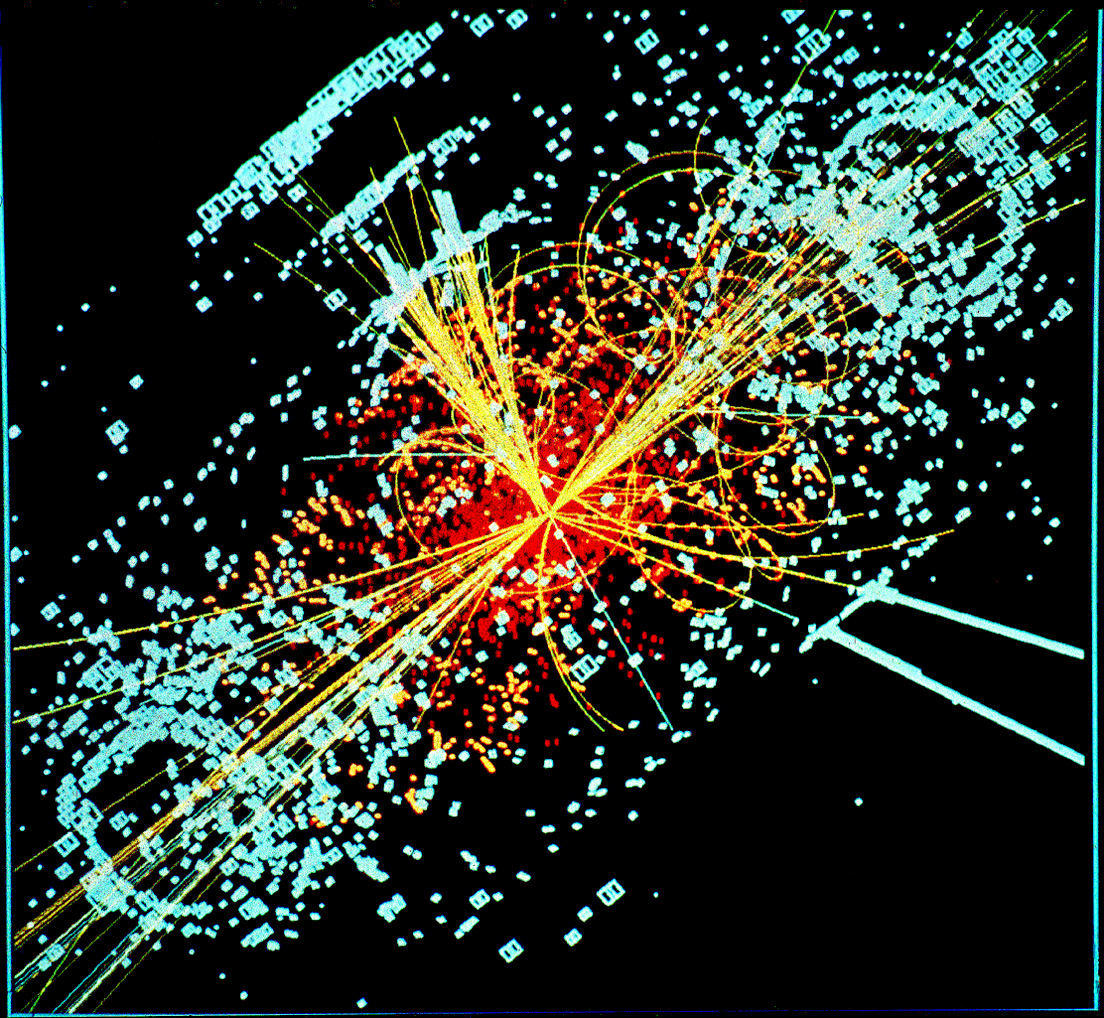
Una traza hipotética del bosón de Higgs en una colisión simulada de protón-protón.
ComposiciónPartícula elemental
FamiliaBosón
EstadoParcialmente confirmada: descubierta en el CERN una nueva partícula con propiedades compatibles.[1]
Símbolo(s)H0
TeorizadaR. Brout, F. Englert, P. Higgs, G. S. Guralnik, C. R. Hagen y T. W. B. Kibble (1964)
DescubiertaUna partícula compatible ha sido hallada por ATLAS y CMS (4 julio de 2012.[1] )
Tipos1 en el Modelo estándar;
5 o más en la Supersimetría
Masa125.3 ± 0.4 (estad.) ± 0.5 (sis.) GeV/c2,[2] 126.0 ± 0.4 (estad.) ± 0.4 (sis.) GeV/c2[3] [1]
Vida media1.56×10−22 s[Nota 1]
Carga eléctrica0
Carga de color0
Espín0 (parcialmente confirmado en 125 GeV)[5] (predicho por el Modelo Estándar)
Paridad+1 (parcialmente confirmado en 125 GeV)[5
El bosón de Higgs o partícula de Higgs es una partícula elemental propuesta en el Modelo estándar de física de partículas. Recibe su nombre en honor a Peter Higgs quien, junto con otros, propuso en 1964, el hoy llamado mecanismo de Higgs, para explicar el origen de la masa de las partículas elementales. El Bosón de Higgs constituye el cuanto del campo de Higgs, (la más pequeña excitación posible de este campo). Según el modelo propuesto, no posee espín, carga eléctrica o color, es muy inestable y se desintegra rápidamente, su vida media es del orden del zeptosegundo. En algunas variantes del Modelo estándar puede haber varios bosones de Higgs.[6]
La existencia del bosón de Higgs y del campo de Higgs asociado serían el más simple de varios métodos del Modelo estándar de física de partículas que intentan explicar la razón de la existencia de masa en las partículas elementales. Esta teoría sugiere que un campo impregna todo el espacio, y que las partículas elementales que interactúan con él adquieren masa, mientras que las que no interactúan con él, no la tienen. En particular, dicho mecanismo justifica la enorme masa de los bosones vectoriales W y Z, como también la ausencia de masa de los fotones. Tanto las partículas W y Z, como el fotón son bosones sin masa propia, los primeros muestran una enorme masa porque interactúan fuertemente con el campo de Higgs, y el fotón no muestra ninguna masa porque no interactúa en absoluto con el campo de Higgs.
El bosón de Higgs ha sido objeto de una larga búsqueda en física de partículas.
El 4 de julio de 2012, el CERN anunció la observación de una nueva partícula «consistente con el bosón de Higgs», pero se necesitaría más tiempo y datos para confirmarlo.[1] El 14 de marzo de 2013 el CERN, con dos veces más datos de los que disponía en el anuncio del descubrimiento en julio de 2012, encontraron que la nueva partícula se ve cada vez más como el bosón de Higgs. La manera en que interactúa con otras partículas y sus propiedades cuánticas, junto con las interacciones medidas con otras partículas, indican fuertemente que es un bosón de Higgs. Todavía permanece la cuestión de si es el bosón de Higgs del Modelo estándar o quizás el más liviano de varios bosones predichos en algunas teorías que van más allá del Modelo estándar.[7]
El 8 de Octubre de 2013 le es concedido, junto a François Englert, el Premio Nobel de física "por el descubrimiento teórico de un mecanismo que contribuye a nuestro entendimiento del origen de la masa de las partículas subatómicas, y que, recientemente fue confirmado gracias al descubrimiento de la predicha partícula fundamental, por los experimentos ATLAS y CMS en el Colisionador de Hadrones del CERN".
Wikipedia.
 

New results indicate that particle discovered at CERN is a Higgs boson

Geneva, 14 March 2013. At the Moriond Conference today, the ATLAS and CMS collaborations at CERN1’s Large Hadron Collider (LHC) presented preliminary new results that further elucidate the particle discovered last year. Having analysed two and a half times more data than was available for the discovery announcement in July, they find that the new particle is looking more and more like a Higgs boson, the particle linked to the mechanism that gives mass to elementary particles. It remains an open question, however, whether this is the Higgs boson of the Standard Model of particle physics, or possibly the lightest of several bosons predicted in some theories that go beyond the Standard Model. Finding the answer to this question will take time.
Whether or not it is a Higgs boson is demonstrated by how it interacts with other particles, and its quantum properties. For example, a Higgs boson is postulated to have spin 0, and in the Standard Model its parity – a measure of how its mirror image behaves – should be positive. CMS and ATLAS have compared a number of options for the spin-parity of this particle, and these all prefer no spin and positive parity. This, coupled with the measured interactions of the new particle with other particles, strongly indicates that it is a Higgs boson.
“The preliminary results with the full 2012 data set are magnificent and to me it is clear that we are dealing with a Higgs boson though we still have a long way to go to know what kind of Higgs boson it is.” said CMS spokesperson Joe Incandela.
"The beautiful new results represent a huge effort by many dedicated people. They point to the new particle having the spin-parity of a Higgs boson as in the Standard Model. We are now well started on the measurement programme in the Higgs sector," said ATLAS spokesperson Dave Charlton.
To determine if this is the Standard Model Higgs boson, the collaborations have, for example, to measure precisely the rate at which the boson decays into other particles and compare the results to the predictions. The detection of the boson is a very rare event - it takes around 1 trillion (1012) proton-proton collisions for each observed event. To characterize all of the decay modes will require much more data from the LHC.

Footnote(s)

1. CERN, the European Organization for Nuclear Research, is the world's leading laboratory for particle physics. It has its headquarters in Geneva. At present, its member states are Austria, Belgium, Bulgaria, the Czech Republic, Denmark, Finland, France, Germany, Greece, Hungary, Italy, the Netherlands, Norway, Poland, Portugal, Slovakia, Spain, Sweden, Switzerland and the United Kingdom. Romania is a candidate for accession. Cyprus, Israel and Serbia are associate members in the pre-stage to membership. India, Japan, the Russian Federation, the United States of America, Turkey, the European Commission and UNESCO have observer status.

Guillermo Gonza,o Sánchez Achutegui

martes, 5 de marzo de 2013

The New York Times - Chasing the Higgs Boson

At the Large Hadron Collider near Geneva, two armies of scientists struggled to close in on physics' most elusive particle.
 
 Peter Higgs, center, of the University of Edinburgh, was one of the first to propose the particle’s existence. From left, physicists at CERN who helped lead the hunt for it: Sau Lan Wu, Joe Incandela, Guido Tonelli and Fabiola Gianotti.

MEYRIN, Switzerland — Vivek Sharma missed his daughter.
A professor at the University of California, San Diego, Dr. Sharma had to spend months at a time away from home, coordinating a team of physicists at the Large Hadron Collider, here just outside Geneva. But on April 15, 2011, Meera Sharma’s 7th birthday, he flew to California for some much-needed family time. “We had a fine birthday, a beautiful day,” he recalled.
Then Dr. Sharma was alerted to a blog post. There it was reported that a rival team of physicists had beaten his team to the discovery of the Higgs boson — the long-sought “God particle.”
If his rivals were right, it would mean a cascade of Nobel Prizes flowing in the wrong direction and, even more vexingly, that Dr. Sharma and his colleagues had missed one of nature’s clues and thus one of its greatest prizes; that the dream of any physicist — to know something that nobody else has ever known — was happening to someone else.
He flew back to Geneva the next day. “My wife was stunned,” he recalled.
He would not see them again for months.
Dr. Sharma and his colleagues had every reason to believe that they were closing in on the Great White Whale of modern science: the Higgs boson, a particle whose existence would explain all the others then known and how they fit together into the jigsaw puzzle of reality.
For almost half a century, physicists had chased its quantum ghost through labyrinths of mathematics and logic, and through tons of electronics at powerful particle colliders, all to no avail.
Now it had come down to the Large Hadron Collider, where two armies of physicists, each 3,000 strong, struggled against each other and against nature, in a friendly but deadly serious competition.
In physics tradition, they were there to check and complement each other in a $10 billion experiment too valuable to trust to only one group, no matter how brilliant and highly motivated.
The stakes were more than just Nobel Prizes, bragging rights or just another quirkily named addition to the zoo of elementary particles that make up nature at its core. The Higgs boson would be the only visible manifestation of the Harry Potterish notion put forward back in 1964 (most notably by Peter Higgs of the University of Edinburgh) that there is a secret, invisible force field running the universe. (The other theorists were François Englert and Robert Brout, both of Université Libre de Bruxelles; and Tom Kibble of Imperial College, London, Carl R. Hagen of the University of Rochester and Gerald Guralnik of Brown University.)
Elementary particles — the electrons and other subatomic riffraff running around in our DNA and our iPhones — would get their masses from interacting with this field, the way politicians draw succor from cheers and handshakes at the rope line.
Rex Features, via Associated Press
ATOMIC IMPACT CERN's Large Hadron Collider tears protons apart by putting them on a collision course at nearly the speed of light. Physicists monitoring the mammoth collider hoped to catch a fleeting glimpse of hidden Higgs in the subatomic rubble.
Without this mystery field, everything in the universe would be pretty much the same, a bland fizz of particles running around at the speed of light. With it, there could be atoms and stars, and us.
Leon Lederman, the former director of the Fermi National Accelerator Laboratory, or Fermilab, in Illinois, where the boson was being sought, once called it “the God particle,” scandalizing his colleagues but delighting journalists, who kept using the name. Dr. Lederman later said that he wanted to call it the “goddamn particle.”
The “Easter Bump Hunt” of April 2011, as it came to be called, was only one episode in a roller coaster of sleepless nights, bright promises, missed clues, false alarms, euphoria, depression, gritty calculation, cooperation and envy, all the tedium and vertiginous notions of modern science.
On the way to fulfill what they thought was their generation’s rendezvous with scientific destiny, the physicists dangled from harnesses in hard hats to construct detectors bigger than apartment buildings in underground caverns. They strung wires and cranked bolts to coax thousand-ton magnets to less than a thousandth of an inch of where they needed to be. They wrote millions of lines of code to calibrate and run devices that would make NASA engineers stand by the track with their hats in their hands in admiration.
In their down time, they proposed marriage and made rap videos in the tunnels where subatomic particles collided. They ate, slept and partied, threw snowballs and worried that an unguarded smile in the cafeteria or a glance at a friend’s laptop could bias a half-billion-dollar experiment or give away cosmic secrets.
Maria Spiropulu, a professor at the California Institute of Technology, put it this way in an e-mail, “The experiments are very large collaborations and they have the good, the bad, the crooks, the Sopranos, the opportunists — a prototype of the world as we know it.”
 August 2010: Promised Fireballs:
Everybody agreed that the Large Hadron Collider was the last stand in the hunt for the Higgs boson. Circling for 17 miles underneath the complex of aging postwar buildings outside Geneva (and out into France) that constitute the European Organization for Nuclear Research, or CERN, the collider was designed to accelerate the subatomic particles known as protons to more than 99 percent of the speed of light — an energy of seven trillion electron volts — and crash them together.
The resulting tiny fireballs would recreate temperatures and densities that prevailed when the universe was only a trillionth of a second old. This was unexplored territory, and anything could happen, including — about once in every four billion collisions, according to theoretical calculations — a Higgs boson. To record it all, the two teams erected detectors, mountains of wire and computers, on opposite sides of the underground ring to capture the collisions.
“Either we find the Higgs boson, or some stranger phenomenon must happen,” said Fabiola Gianotti, a CERN scientist who led one of the groups, named Atlas. Their rival was called CMS. Both were named after their gigantic detectors. (Two other detectors, named Alice and LHCb, were built to investigate more specialized physics at the collider.)
The collider, 15 years and $10 billion in the making, was first turned on in September 2008. Then, just a week later, a section of it blew up when some electrical circuits proved unable to handle the currents needed for the giant superconducting magnets that steered the protons. Repairs took a year and a half; in March 2010, the collider started up again at half power to avoid stressing the circuits.
When I visited in August 2010, Dr. Gianotti’s desk on the fourth floor of a new building a stone’s throw from the main CERN cafeteria was as sleek and uncluttered as an aircraft’s wing, the few papers on it arranged with geometrical precision. A slender woman with dancing eyes, Dr. Gianotti gave the impression of being as graceful and strong as piano wire. She needed all of that.
As the spokeswoman for the Atlas collaboration, Dr. Gianotti, then 46, was the nominal herder of 3,000 putative Einsteins, the orchestrator of a hive mind of brilliance — responsible for getting all the trains to run on time; for all the calibrations and simulations to match; for all the physicists, from the computer analysts who massaged the final data to anyone who ever wielded a screwdriver in the detector cavern, to sign off on the results from those fireball collisions.
That made Dr. Gianotti the most visible woman in high-energy physics, a field notoriously laden with testosterone. Journalists always asked about that, but it was no big deal, she said, adding that a quarter of the Atlas collaborators are women — so many that on occasion she had gone out and recruited men to attend management meetings.
Growing up in Milan, Dr. Gianotti had been fascinated by philosophy. Seduced into physics by reading some of Einstein’s early work, she had taken two years off to study piano at the Milan Conservatory before getting a Ph.D. at the University of Milan in subnuclear physics in 1989 and joining CERN.
“Music is always in my mind,” she reflected one night, in lightly accented English, as we were driving home from dinner. Asked what kind, she punched a button on the CD player, and the car suddenly filled with Schubert — “the most romantic of the classicists and the most classic of the romantics,” she said.
Rex Features, via Associated Press
SUBATOMIC SPEEDWAY The Large Hadron Collider extends for 17 miles underneath the Swiss and French countrysides. At full power, protons race around the entire loop 11,245 times a second.
At her desk, Dr. Gianotti was all business. She had made her mark working on liquid argon calorimeters, devices that could measure the energies and tracks of particles. Now she said she sometimes missed the chance to get her own hands dirty.
But then she gestured to the papers awaiting review on her desk.
“There is no typical day,” she said, ticking off a list of meetings. “My days are very full, this is for sure. I think they are wonderful.”
Asked what made her a good spokeswoman, Dr. Gianotti replied that it was her cheerfulness. Alluding to the explosion and shutdown, she said, “People in a difficult time want to see you are confident and optimistic.” Now, she added, “You can see the excitement in their eyes.”
Just down the hall was Dr. Gianotti’s opposite number and rival of sorts, Guido Tonelli, 63, an ebullient professor from the University of Pisa, newly installed as the spokesman of the CMS collaboration. The Atlas and CMS teams shared the same building, facing each other over an atrium covered with posters of their devices and a coffee bar, using the same printers — and sometimes, the joke went, sleeping with one another.
Dr. Tonelli was the third physicist to head the CMS team and perhaps the one who had traveled the longest road. The son of a farmer and a railroad worker, he had grown up in Pisa and was the first of his family to attend college — a result of effort and sacrifice “that I have tried to reward doing my best in the studies first and in my work later.”
He confessed that he had helped his own cause back then by allowing his professors to believe (incorrectly) that he was related to Leonida Tonelli, a distinguished mathematician whose statue stands near the university’s entrance. Guido Tonelli’s CERN office was dominated by a large poster of his daughter, a ballerina.
Dr. Tonelli had his heart set on discovering the Higgs boson, which he said was crucial to understanding the future as well as the past: measuring it could help determine whether the universe was stable or whether the Higgs field could twitch and dissolve us all back into that bland soup of massless particles.

December 2010: Game of Bumps.-

Dr. Tonelli described his job as the search for anomalies.

For all their equipment and brainy multitudes, physicists would never be able to hold the Higgs boson in their hands. As soon as it was created, it would disintegrate in a shower of lesser particles — sometimes, for example, in a flash of gamma rays, or into a spray of lightweight particles.
So the signature of a Higgs boson or any other paradigm-shattering new particle would be an unexpected excess of gamma rays or some other particles — an anomalous bump on a graph. Dr. Tonelli said this happened about once a month now that the collider was running, but random flukes would also produce bumps.
If they were flukes, more data would make them fade into the statistical background, just as a flipped coin will eventually revert to an equal number of heads and tails. If not, the bumps would grow in slow motion into a bona fide discovery.
To physicists, the gold standard for a discovery is “5-sigma,” a term meaning that the odds it occurred by chance are less than 1 in 3.5 million.
So “we crosscheck everything” and “try to kill” any anomaly that might be merely random, Dr. Tonelli said. Ninety-nine percent of the time, that is just what happens.
“But you never know when one of them will change everything,” he said, adding, “Those have been the most exciting, intense days of my life.”
In a perfect world, the same 5-sigma answer would emerge from each group independently and simultaneously. But each wanted to be first, if only by a hair: neither wanted to be the team that failed to flag a bump that eventually grew to a major discovery, or the one that jumped too soon on a fluke and wound up looking foolish. On each side, there were hundreds of physicists monitoring the different ways in which the Higgs or something else could show up.
In December 2010, Dr. Tonelli heard a rumor that his team’s rivals in Atlas were chasing an auspicious bump that would be an even bigger deal than the Higgs: an unexpected massive new particle.
“This would be totally new physics,” Dr. Tonelli said.
Dr. Tonelli put together a “quick reaction team” to check out its own data. “After a few days of frantic crosschecks we concluded there was nothing there,” he said.
He said he was later told by an Atlas member whose name he cannot recall that the Atlas investigators had been encouraged by a plot from his own CMS team. It was shown during a workshop in Germany, and there was a small bump on it. Had Dr. Tonelli and his colleagues been chasing their own tail?
An Atlas physicist, Gustaaf Brooijmans of Columbia University, said that he vaguely remembered seeing a CMS plot, but that Atlas had undertaken the study in question of its own accord.
On another occasion the following year, another bump — implying the existence of a massive new force particle — had Dr. Tonelli and his colleagues convinced for a couple of months that they had discovered evidence of extra dimensions of space time. They notified the director general of CERN and drafted a paper — never published — describing the discovery. And then the signal faded like an old tied balloon.
“We’ve made many discoveries,” Dr. Tonelli said, “most of them false.”

CERN/Getty Images
MAGNETIC MUSCLE The length of the Large Hadron Collider contains a total of 9,300 magnets to accelerate and control the protons on their way to collision.
Spring 2011: The Easter Egg Hunt
The biggest false alarm, one that went around the world, came from Atlas.
For Sau Lan Wu, of the University of Wisconsin by way of Hong Kong and Vassar, the Higgs boson was unfinished business. She was one of a handful of scientists who thought they were seeing the evidence of the Higgs back in 2000 in data from an earlier CERN collider called LEP. Unconvinced, CERN shut that collider down so the Large Hadron Collider could be built in its place. In the spring of 2011, Dr. Wu thought she had found the Higgs again.
A cheerful and controlling presence, partial to wearing red, Dr. Wu thinks of herself as a mother to the 47 former students and postdoctoral fellows whose portraits line the hallway outside her CERN office. As a young postdoc at M.I.T. in 1974, she had helped Samuel Ting win a Nobel Prize for discovering the J/psi, a particle that was the last big surprise in physics, and later was co-discoverer of the gluon, the particle that holds quarks together in protons.
Dr. Wu’s team in Wisconsin was the first American group to join the Atlas collaboration, back in 1993. When the collider was restarted, they had hit the ground running. By Easter 2011, they had detected a telltale excess of gamma rays, pointing to the same Higgs she and others had thought they were discovering 10 years earlier.
Even more provocatively, Dr. Wu’s gamma-ray signal was much stronger than theory predicted, suggesting that on its way to oblivion the Higgs had temporarily changed into other massive particles yet unknown to science, a discovery that could dwarf that of the boson and shake not just physics but cosmology.
Her group wrote a short paper, an “internal note” to alert their Atlas colleagues, suggesting “that the present result is the first definitive observation of physics beyond the standard model.”
Their note was supposed to be confidential — results are not supposed to be released to the outside world until the entire collaboration has checked and approved them — but within hours the note’s abstract was posted in the comments section of a physics blog, Not Even Wrong, run by Peter Woit, a mathematician at Columbia.
Bedlam ensued in the physics world. Dr. Sharma and hundreds of other physicists abandoned their families and canceled vacations to go back to CERN.
The aftermath, when the signal turned out to be another fluke, was brutal. It was suggested that whoever was responsible for leaking the report should leave the Atlas collaboration.
Many physicists, Dr. Wu admits, thought that she herself had leaked the report. A year and a half later, she still found it hard to talk about the Easter event.
“I was so excited I couldn’t control my emotions,” Dr. Wu recalled. She wrote the note as a way of alerting the Atlas community, she said. “I thought CMS would go on vacation and we could get ahead. I’m sorry I did that.”
For Dr. Gianotti, the incident was a lesson in the need for keeping your mouth shut, helping to cement her distrust of bloggers. “Things should be properly understood inside the collaboration before being blogged outside.” Still, “things happen in life,” she added. “My attitude is always positive.”
For CMS, the incident served as what Dr. Sharma called “a good drill.”
Dr. Tonelli said: “In retrospect, this fear of being scooped by Atlas was useful. Once you are under attack, you start to focus.”

July 2011: Still Missing.-

Thus tested, both collaborations began drinking from a fire hose of data as the collider kept racking up collisions by the hundreds of trillions. In the early summer of 2011, both Atlas and CMS began recording a surplus of W bosons, particles that carry the so-called weak nuclear force that drives radioactive decay. That was another telltale sign of the Higgs. On the eve of a big conference in Grenoble, France, Dr. Sharma, of CMS, and Bill Murray, of Atlas, held a summit meeting in the CERN cafeteria and opened their laptops.
“I showed mine, and he showed his,” Dr. Sharma said. “We had many coffees.”
Dr. Murray recalled: “Bang! It’s all looking good.”
The results were reported at the Grenoble conference with great hoopla.
But by the next big conference a month later, in Mumbai, India, the bump was gone.
Dr. Murray said, “It was bizarre: twice as much data and there was nothing.”
This was beginning to be the story of the Higgs.
Physicists already knew by the time the CERN collider started up that if the Higgs existed, it would be found in a narrow window of possible masses — equivalent to 115 billion to 200 billion electron volts of energy. Their task was to sort through that window, looking for the telltale excess, or bump, like a sports fan scanning the radio dial in his car looking for the Yankees broadcast.
By the fall of 2011, most of that window had been ruled out, and physicists worried that the whole window might be closed by the end of the year, meaning that the Higgs, or at least the simplest version predicted by the theorists, did not exist — and sending theorists back to their blackboards in search of a better understanding of our origins.
Paradoxically, many physicists, including Dr. Sharma, who admitted to an “anarchic tendency,” found that prospect thrilling.
The Higgs boson fit like a key into a lock into the Standard Model, a suite of equations that was a battle-tested explanation of most of the forces of nature. But physics, Dr. Sharma explained, advances on surprises.
“Every measurement I’ve made in my career has been in confirmation of the Standard Model,” he grumbled.
For Dr. Tonelli, however, it was a dark time. He recalled being at a conference in November where a theorist had summarized the situation by showing a “terrible slide” of a grave with the name Higgs on it. “Since Peter was 83,” he said of the physicist from whom the boson takes its name, “that was not a good idea.”
Luis Davilla/Getty Images
SOLAR HOT/SPACE COLD While temperatures inside the tiny beams of colliding particles can reach temperatures 100,000 times hotter than the Sun, the cooling system circulating around the accelerator ring is lowered to around -456 degrees Fahrenheit -- colder than outer space.
October 2011: Too Big to Ignore
In the fall, there was a changing of the guard in Atlas. Eilam Gross, a former rock musician complete with earring and a Lou Reed haircut, from the Weizmann Institute of Science in Israel, joined Dr. Murray as co-convenor of the Higgs search, filling in for a colleague who was going on maternity leave.
Dr. Gross had followed an unlikely route to this mission. After serving in the Israeli military as an intelligence officer, he was studying sound engineering in New York when he happened to read “The Tao of Physics,” by Fritjof Capra, a popular book melding physics and Eastern thought.
He dropped everything and went back to Israel, studied string theory at the Hebrew University of Jerusalem and then moved on to experimental work, all the while trying to keep up his music career.
He became what he called a “Higgs soldier” while working on the LEP accelerator. “There are 6,000 Higgs soldiers,” he said of the Large Hadron Collider, “and they all deserve the Nobel Prize.”
He had been applying for the Higgs job in Atlas for years, and had given up until he got a call one day.
When it finally happened for him, Dr. Gross recalled expressing some trepidation about his new role. “What will I do?” he asked.
Dr. Murray told him not to worry, he was going to have the time of his life.
It didn’t take long.
While physicists fretted about the death of the Higgs, something was happening out in the wilds of uncertainty. One bump on physicists’ charts, from the W bosons, was disappearing. But another was blooming like the shy girl at a dance.
In retrospect, nobody could remember exactly when she had come in. But she was the one who would marry the prince.
The bump may have appeared as early as May. It was then, Dr. Murray said, that the Atlas group had discovered an “excess” in gamma rays corresponding to a mass of about 128 billion electron volts. (By comparison, a proton, the building block of the atomic nucleus, is about a billion electron volts.) The bump corresponded to a single particle, a flake of hypothetical energy, that weighed as much as an atom of iodine.
Nobody paid any attention. “End of story,” Dr. Murray said.
The bump persisted, rising and falling as data from more collisions and more channels were added, and kept being dismissed. It continued to grow over the fall until it had reached the 3-sigma level — the chances of being a fluke were less than 1 in 740, enough for physicists to admit it to the realm of “evidence” of something, but not yet a discovery.
Dr. Gianotti recalled being shown the bump during a meeting. Her reaction was characteristically guarded: “Hmm, hmm. That was nice, but let’s hope.”
Dr. Gross had a markedly different reaction. One evening late in November, he was in Paris at a workshop, staying at a colleague’s house. After a wine-soaked meal and some grappa, he fell asleep on the couch.
While he slept, a new data analysis came in from CERN. At 3 a.m. his colleagues Marumi Kado and Alex Read decided to wake up their gently snoring boss. They asked him if he wanted to see the Higgs boson.
Dr. Gross jumped up. “What? Where?” he asked. As he described it later in a blog post, they were all in a state of shock. The bump was too big to ignore anymore.
“We couldn’t believe our eyes. We looked at the screen for ages before we started to digest what we were seeing,” he said. “I think this was the first time Marumi, me and Alex realized it could be the real thing.”

November 2011: Oozing Into View

Illustration by Sean McCabe/Photographs by David Ahntholz, Daniel Auf der Mauer and Michal Czerwonka for The New York Times
Clockwise from top left, Vivek Sharma, Higgs analysis coordinator for CMS. Eilam Gross, coordinator of the Higgs search at Atlas. Bill Murray, physicist and Atlas deputy physics coordinator at CERN. Rolf-Dieter Heuer, director general of CERN.
On the other side of the wall of (mostly) silence between the teams, a signal was also oozing into view.
Dr. Tonelli, of CMS, saw it first on Nov. 8. He was making his rounds, talking to his young recruits. In the morning, one group showed him a pair of events that had resulted in a spray of four light particles, a rare “four-lepton” signal. That was one of the signature ways that a Higgs boson would dissolve.
That afternoon he met with a second group in the cafeteria. One of them opened a laptop and showed him a bump in the gamma-gamma channel, the other big Higgs decay channel. It was almost 3-sigma and was at the same energy as the morning bump, about 125 billion electron volts.
“At the end of the meeting, there was some light in their eyes,” he said. “It was my birthday. I considered it a sort of gift.”
The following week, at a meeting in Paris, some people were still talking about the death of the Higgs. Dr. Tonelli was one of the few people in the world who knew differently.
“I was laughing internally,” he said.
Dr. Sharma, of CMS, went home for Thanksgiving and a long-awaited reunion with his family.
In his pocket as he ate was a new plot combining the results from both channels, a new bump indicating a Higgs boson at 125 billion electron volts. A neighbor pestered him with questions about the search, but Dr. Sharma wouldn’t talk.
A year earlier, many of his colleagues had been ready to write off the Higgs boson, and with it the Standard Model. But “on Thanksgiving Day,” he said, “we knew the jig in some sense was up.”
“I would have preferred it the other way,” he said with a sigh, then added: “I knew before the rest of the world. That is all I need.”
Afterward he marveled at how attitudes toward physics had changed from a few years earlier, when some people feared the new collider would destroy Earth. That and the “God particle” talk had gotten the public’s attention, he had to admit: “Once neighbors find out that Sharma is involved in that black hole thing, the dog doesn’t pee in my yard anymore.”

Dec. 13, 2011: The Long Hello
Neither Atlas nor CMS knew what the other had until Nov. 28, when the two team leaders, Dr. Gianotti and Dr. Tonelli, met with CERN’s director general, Rolf-Dieter Heuer, in his office.
It was apparent from the outset that nature had dealt Atlas the stronger hand, at least for the first round. Dr. Murray, of Atlas, felt both reassured and relieved.
“If there really is a Higgs, Atlas got lucky and CMS got unlucky,” he said.
According to Atlas, the new particle had a mass of 126 billion electron volts; according to CMS, it was 124 billion.
Neither experiment was even close to having the statistical goods — a 5-sigma level of significance — to declare a discovery. But the fact that two separate experiments were hinting at roughly the same answer was encouraging, and worth telling the world about. CERN scheduled a special seminar on Dec. 13. Dr. Gianotti, speaking through the pain of a toothache and dental surgery to an overflow crowd at CERN and physics fans everywhere clustered around Webcasts, went first.
“If we are just being lucky, it will take a lot of data to kill it,” she said.
It would also take a lot more data to confirm what was still at best a promising hint, with a 1-in-100 chance of being a fluke.
The results put the focus on the next big meeting, the International Conference on High Energy Physics, scheduled for July 4 in Melbourne, Australia, by which time the amount of data from the collider would have doubled. At the very least it would be an interesting progress report to see if the bumps were still there.
Dr. Tonelli made no bones about his belief that this was the Higgs at long last. He told Dr. Heuer, the director general, to “prepare the troops,” and his old friend Dr. Englert, a founder of the Higgs theory, not to book vacation for the beginning of July.
But the experimentalists had all seen promising bumps (and promising reputations staked on them) come and go. “I don’t see the smoking guns,” said Dr. Spiropulu, the Caltech professor. And Dr. Sharma cautioned: “The game is still on. People have to be prepared for there to be no Higgs.”


Top, Peter Ginter/Getty Images; bottom, Valerio Mezzanotti for The New York Times
FRIENDLY RIVALRY The CMS and Atlas detectors have different DNA, but have the same purpose in life — to detect the Higgs boson in the aftermath of particle collisions. The Atlas detector, bottom, has a triggering system that pulls out 100 events from 1,000 million every second. CMS generates a magnetic field that is 100,000 times that of Earth’s to do its work.
January 2012: The Mother of Everything
Characteristically, Dr. Gianotti was playing her cards close to the vest. She was less excited about the nearly overlapping bumps, she said, than about the fact that they had now managed to exclude almost the whole mass range that had existed for the Higgs only a year before. Now there was nowhere left for it to be.
“This was really important,” she said. “For me, it was clear now where we were going to focus in the next months. So no additional distractions in other mass regions.”
From now on, the rules would be different.
To avoid bias, both teams proceeded to “blind” themselves and not look at the relevant data until the Melbourne meeting. Somewhere along that time, Dr. Gianotti admitted, she had stopped playing the piano, unable to give it the focus it deserved.
In January 2012, Dr. Tonelli handed the reins of CMS to Joe Incandela of the University of California, Santa Barbara. Asked if this was a bittersweet moment to step down, Dr. Tonelli said he had been living a dream. He compared himself to the third runner in a four-man relay race, “a runner that did a fantastic time in his fraction.” He said, “I could not have asked more of my life.”
Dr. Incandela, a man with a warm casual demeanor, was not so sure at all that the Higgs had been discovered on the previous watch.
“Every other day I think we’ve found it, and every other day I think we haven’t,” he said over lunch shortly after taking over. He described collaborations like CMS as “the last bastion of communism,” and his new job as “a crisis a day.” The group had only a month after recording the last data to analyze the results from 2011, he complained. “So much stress,” he said. “We’ll have to do it again this year.”
He firmly rejected one idea that was buzzing around the blogosphere — that by combining their results the two collaborations could take a shortcut to the 5-sigma goal. “There’s no race — this is a 20-year program,” he snapped. “This is a serious business.”
Dr. Incandela had wandered into science from the art world. Growing up in Chicago, he studied at its Art Institute, intending to be a sculptor. He got interested in science while studying the chemistry of ceramics, went on to get a Ph.D. from the University of Chicago, and then worked at CERN and Fermilab, where in 1995 he helped discover the top quark, the last missing matter particle in the Standard Model.
He brought with him a deeply philosophical and historical viewpoint on the quest to understand nature. The Higgs boson reminded him of the ancient Stoic notion of “pneuma,” a sort of force or tension that permeated space and gave substance to things. It was the first example in history of people wondering about the origin of mass.
“The Higgs is sort of like the mother of everything,” he said. “It tells you something very fundamental about the entire universe. So measuring its mass, for instance, could tell us whether the universe is stable or not. This is really unbelievable if you think about it.”
“So that tells you how deeply we’ve touched into this fabric,” he went on, “and this fabric is everywhere. Throughout the universe. So for me that is a really profound thing about the Higgs. It’s not like other particles.”
In March, adding to the sense of momentum that the Higgs was finally being run to earth, physicists from Fermilab said they had measured their own bump in data from the lab’s Tevatron collider, which had been the world’s biggest for 20 years but had shut down for good the previous fall because the government couldn’t afford to run it anymore. As at CERN, there had been two groups and two detectors who were now combining their data for what would amount to a last hurrah and a what-might-have-been for the Tevatron. The Fermilab physicists had found a broad hump in their data, between 115 billion and 135 billion electron volts — the same general area as the CERN results.
Dmitri Denisov, a leader of the Fermilab effort, wrote in an e-mail at the time, “It is clearly not the answer to crossword, but an important piece of the puzzle!”
The data were of scant statistical significance, however, having a chance of about 1 in 100 of being a fluke. Over the following weeks, Fermilab would improve those statistics to a chance of 1 in 550, heartbreakingly short of the 3-sigma criteria required to claim “evidence” of the Higgs. If there really had been a race, one of the contestants was now out.
Back in Switzerland that same month, during a break when the Large Hadron Collider was not running, Dr. Gross took his girlfriend, Talia Levy Tytiun, down into the Atlas cavern. “I decided that I want to propose to Talia in the place which was the symbol of my life at this Higgs hunting period,” he explained.
“But believe me, I checked a thousand times with her before to make sure she will say yes.”


June 2012: Opening the Box

Peter Ginter/Getty Images
MAMMOTH ENDEAVOR The CMS detector helped gather data for the physicists, who were looking for a “5-sigma” discovery, meaning that the odds that it occurred by chance are less than 1 in 3.5 million.
On June 18, the two experiments stopped recording data in order to get ready for Melbourne. By then they had already collected as many collisions — some 400 trillion — as they had the entire previous year.
The Atlas teams had already begun analyzing the first batch of this data a week before. Dr. Gianotti was at a conference at Fermilab when her colleague Dr. Kado sent her a plot of the new data.
The gamma rays were still there, and had grown in significance, putting the boson on the verge of reality. Dr. Gianotti scrawled a note back: “Oh, my God.”
A week later, her team looked at another important decay channel, and her enthusiasm deflated. There was nothing. She spent a few days and nights with her “neurons spinning,” she recalled, wondering how they could have been fooled.
In the next two batches of data, however, nine candidates showed up in the “zed” channel, as they called it. “It was just beautiful to see those,” Dr. Gianotti said.
At 10 p.m. on June 14, small teams of CMS physicists began “opening the box” on their data. Later that night, Dr. Incandela received a plot from the so-called 4-lepton channel, showing a spike at 124 billion electron volts.
He later told the writer Ian Sample that his life changed at that moment.
That afternoon, almost 300 physicists crowded into the room to hear talks on the first results of the unblinding, and the entire collaboration learned that the Higgs was nigh. People were sitting on the floor and standing, Dr. Tonelli said. Another 307 people had linked in by videoconference.
The room was too hot, all the doors had been opened. Dr. Tonelli said, “Everybody was really feeling we were doing something important.”
On June 22, Dr. Heuer announced that there would be a special symposium at CERN on the morning of July 4, the day the Melbourne meeting was to start. Scientists who had already bought tickets to Australia rushed to rebook.
At the time, it seemed like a gamble: neither experiment had yet reached the all-important 5-sigma level. But as various scientists were pointing out, CERN couldn’t go on almost discovering the Higgs boson forever. Some said CERN should just shut up until the discovery was official.
“If you only have 4.9 you are not allowed to call it a discovery,” Dr. Heuer said later. “But it was sure that even if being short of 5-sigma, if I see both experiments I can still call it a discovery because we are beyond 5 if we combine the two.”
The members of each of the collaborations had to approve anything that was to be presented at Melbourne, which meant that their leaders had a week to mobilize an army and read a thousand pages of papers and reports.
Dr. Incandela, of CMS, said he felt “like a hunted animal.”
“I felt tremendous stress, obviously, because things were very tight,” he recalled. “Several times per day, I would just say, ‘O.K., don’t panic, we’re going to make this.’ But my goal was to make sure we did everything right, and that the collaboration would not regret it, and that the collaboration would all feel part of it, because everyone worked on this in one way or another.”
In a conference room near his office, he set up a SWAT team of a dozen of his brightest young analysts, his “kids,” as he called them. “Keep your smiles to yourself,” he warned them, if they happened to find themselves in the company of their rivals.
On the night of June 24, the graduate students and postdocs in Atlas were tiptoeing toward the 5-sigma finish line. Among them was Sven Kreiss, a New York University graduate student who got a preliminary glimpse of the answer alone in his office late that night when, as part of a crosscheck, he combined the data from two signatures of the Higgs decay and found the result breached 5-sigma. The next day he sent a plot to his adviser Kyle Cranmer, whose birthday it was, saying he had a present for him.
Dr. Cranmer shot back a joyful expletive worthy of the discovery of a sacred particle.
The job of ultimately confirming the boson’s discovery had been entrusted to another pair of graduate students, Haoshuang Ji, a Wisconsin student, and Aaron Armbruster of the University of Michigan — who had sent the plot that Dr. Gross had woken up to in November. They were each working to combine all the Higgs data from all the myriad ways it could fall apart and leave a trace in the detectors. This calculation would make or break the Higgs, because the boson had to behave properly in all its guises.
On the afternoon of June 25, Mr. Ji announced he had gotten a result of 5.08 sigma, causing cheers to go ringing down the corridor outside Dr. Wu’s office; everybody ran to sign the printout. The next day, Mr. Armbruster arrived at the same result.
Atlas was at 5-sigma.
The scorecard, as later enumerated by Dr. Wu:
1,000 trillion proton-proton collisions
240,000 Higgs bosons
350 pairs of gamma rays
8 sets of lightweight particles from the lepton channel.
From this trickle of a trickle of atomic pitter-pat, 6,000 physicists had finally started to put a face on the ghost of the vacuum, the secret controller of cosmic destiny.
Filling in that face could take years. Not knowing yet how closely the new particle matched the predictions of the Standard Model, the physicists took to calling it a “Higgs-like boson.” Or as Dr. Cranmer put it, “Not a God particle but a God-like particle.”
“We don’t know what nature has prepared for us,” Dr. Gianotti said.
She added, “Clearly if we had not discovered the Higgs boson it would have been much more intriguing from a physics point of view. But it is so nice to find a new particle.”
On the eve of the scheduled announcement, Dr. Incandela rehearsed his talk and found that his team was still nervous. Were they ready to go public? It was too late, he told them. They were at 5-sigma. The train had left the station. “We have to stand by our data,” he said.
Later, he said it was what they needed to hear.

Dr. Natalia Panikashvili
TOASTING EXISTENCE On July 4, 2012, members of CERN celebrated the discovery of a Higgs-like particle. Over its life, the project involved more than 6,000 physicists and cost over $10 billion.
July 4, 2012: Champagne and Pandemonium
CERN officials locked their auditorium three days before the special symposium to prevent people from camping out in it. Still, the night before, students and scientists began sleeping on the steps. Dr. Higgs and the other founders of the Higgs theory, Dr. Englert, Dr. Hagen and Dr. Guralnikwalked into the auditorium on the morning of July 4 to a standing ovation.
Dr. Incandela finished writing his talk at 8:42 that morning. The seminar started at 9. When he walked in, he recalled, “I was just so happy that everything came together — I really enjoyed giving the talk.”
At one point, he noticed that the hand holding a laser pointer was shaking. “It was just the adrenaline,” he said. “My heart was pounding.”
At the end, he flashed a plot of CMS’s final data analysis, showing the big new bump. The room exploded in applause.
He thanked CERN and the world. “These results are global,” he said, “and now shared with all of mankind.”
Dr. Gianotti, of Atlas, now had to follow Dr. Incandela, having gone first in December. After the news from CMS, she wondered if anyone would even be interested in what she had to say. “I’m saying to myself, ‘Well, even if our results were essential, in some sense they will be nothing new compared to what they’ve seen already.’”
If nothing else, she thought, her talk would be a valentine to the passion and competence of the 3,000 Atlas scientists.
“Every slide was a reward to the work of many, many people,” she said. “So I was feeling so proud.”
“And I think I got the energy from the eyes of some of my Atlas colleagues who were sitting here in the auditorium,” she added. “The fact that they were looking at me with such intensity and attention was giving me really the strength to go on.”
When she showed the Atlas 5-sigma result, the audience exploded again. The applause seemed to go on forever. It had been left to Dr. Heuer to declare officially that a new particle had been discovered.
“I think we have it,” he said. The cheers began again. Dr. Higgs was seen wiping away tears.
The morning dissolved into pandemonium and Champagne, in the CERN auditorium and in labs, classrooms, conference rooms and living rooms in every time zone in which humans wondered about their universe. Dr. Wu waded through the crowd. She hugged Dr. Higgs.
“I’ve been looking for you my whole life,” she said.
“Well,” he replied, “now you have found me.”
The New York Times.
Guillermo Gonzalo Sánchez Achutegui
ayabaca@gmail.com
ayabaca@hotmail.com
ayabaca@yahoo.com
 Inscríbete en el Foro del blog y participa : A Vuelo De Un Quinde - El Foro!

domingo, 8 de julio de 2012

Física: Peter Higgs: ´Algunas veces está muy bien tener razón´

Hola Amigos: A VUELO DE UN QUINDE EL BLOG., Medio siglo después de postular su teoría sobre la existencia de la "partícula de Dios", que habría permitido la formación del Universo y de todo lo que existe, su autor, el físico inglés Peter Higgs, se mostró hoy orgulloso de haber tenido la razón.

 Peter Higgs: ´Algunas veces está muy bien tener razón´

Medio siglo después de postular su teoría sobre la existencia de la "partícula de Dios", que habría permitido la formación del Universo y de todo lo que existe, su autor, el físico inglés Peter Higgs, se mostró hoy orgulloso de haber tenido la razón.

"Ha sido una larga espera pero podría haber sido incluso mayor y no habría estado aquí para verla. Algunas veces está muy bien tener razón", afirmó el profesor emérito de la Universidad escocesa de Edimburgo, de 83 años, durante una rueda de prensa celebrada hoy en esta institución.
Higgs habló por primera vez en el Reino Unido, su país natal, del descubrimiento de una nueva partícula que podría ser el llamado "bosón de Higgs", por parte de científicos del Centro Europeo de Física de Partículas (CERN).
Según la teoría del investigador inglés, este bosón dotaría de masa a todas las demás partículas y habría permitido la formación del Universo y de todo lo que existe.
"Al principio no tenía ni idea de si el descubrimiento llegaría durante mi vida porque en un primer momento sabíamos muy poco sobre ella o sobre cuánta energía necesitaría la máquina para poder detectarla", explicó Higgs.
Gran Acelerador de Hadrones
El hallazgo, considerado por muchos el avance científico más importante de las últimas décadas, ha requerido medio siglo de investigación y miles de millones de dólares en distintos experimentos, y abrirá muchas puertas en el campo de la física.
"Han sido muchos años de desarrollo de la tecnología y del diseño de una maquinaria capaz de producir niveles cada vez mayores de energía, y el Gran Acelerador de Hadrones (LHC, en sus siglas en inglés) es la única con la potencia e intensidad suficientes", añadió el físico, nacido en la localidad inglesa de Newcastle.
Si el Gran Acelerador de Hadrones hubiese descartado la existencia del bosón, los físicos tendrían que haberse replanteando desde el principio el modelo estándar de física de partículas.
La existencia de esta partícula es "tan crucial para entender cómo funciona el resto de la teoría que sería muy duro para mí comprender que no estuviese ahí", añadió Higgs.
"Todavía hay mucho que hacer"
En diciembre de 2011, los científicos del CERN anunciaron que habían detectados los primeros destellos de la partícula, pero el proceso para probar su existencia es muy lento y requerirá aún más tiempo para conocer con detalle sus propiedades.
"Todavía hay mucho que hacer. A primera vista parece que (los científicos del CERN) han logrado un hallazgo pero aún no saben mucho del objeto descubierto", subrayó el físico inglés, que considera que aún serán necesarios muchos análisis y medidas para establecer si se trata del bosón o si constituye una parte de una estructura mucho más elaborada.
Según el profesor Richard Kenway, de la Universidad de Edimburgo, "el descubrimiento del bosón de Higgs completa nuestro puzzle de las partículas elementales conocidas, pero éstas solo constituyen el 4 por ciento del universo".
Representantes de la Universidad de Edimburgo aprovecharon la ocasión para anunciar la creación del Centro de Física Teórica, con una inversión inicial de 750.000 libras (944.000 euros).
EFE
Guillermo Gonzalo Sánchez Achutegui
 ayabaca@gmail.com
 ayabaca@hotmail.com
 ayabaca@yahoo.com
 Inscríbete en el Foro del blog y participa : A Vuelo De Un Quinde - El Foro!

miércoles, 4 de julio de 2012

Física: Sigue el misterio sobre nueva partícula descubierta por el CERN

Hola amigos : A VUELO DE UN QUINDE EL BLOG., nos es muy grato difundir la noticia del descubrimiento de la Partícula de Bosón de HIGGS, por la Organización Europea para la Investigación Nuclear (CERN).

CERN Press Release: CERN experiments observe particle consistent with long-sought Higgs boson

Geneva, 4 July 2012. At a seminar held at CERN today as a curtain raiser to the year’s major particle physics conference, ICHEP2012 in Melbourne, the ATLAS and CMS experiments presented their latest preliminary results in the search for the long sought Higgs particle. Both experiments observe a new particle in the mass region around 125-126 GeV.
CERN physicists await the start of the Higgs seminar.
“We observe in our data clear signs of a new particle, at the level of 5 sigma, in the mass region around 126 GeV. The outstanding performance of the LHC and ATLAS and the huge efforts of many people have brought us to this exciting stage,” said ATLAS experiment spokesperson Fabiola Gianotti, “but a little more time is needed to prepare these results for publication.”
"The results are preliminary but the 5 sigma signal at around 125 GeV we’re seeing is dramatic. This is indeed a new particle. We know it must be a boson and it’s the heaviest boson ever found,” said CMS experiment spokesperson Joe Incandela. “The implications are very significant and it is precisely for this reason that we must be extremely diligent in all of our studies and cross-checks."
“It’s hard not to get excited by these results,” said CERN Research Director Sergio Bertolucci. “ We stated last year that in 2012 we would either find a new Higgs-like particle or exclude the existence of the Standard Model Higgs. With all the necessary caution, it looks to me that we are at a branching point: the observation of this new particle indicates the path for the future towards a more detailed understanding of what we’re seeing in the data.”
The results presented today are labelled preliminary. They are based on data collected in 2011 and 2012, with the 2012 data still under analysis.  Publication of the analyses shown today is expected around the end of July. A more complete picture of today’s observations will emerge later this year after the LHC provides the experiments with more data.
The next step will be to determine the precise nature of the particle and its significance for our understanding of the universe. Are its properties as expected for the long-sought Higgs boson, the final missing ingredient in the Standard Model of particle physics? Or is it something more exotic? The Standard Model describes the fundamental particles from which we, and every visible thing in the universe, are made, and the forces acting between them. All the matter that we can see, however, appears to be no more than about 4% of the total. A more exotic version of the Higgs particle could be a bridge to understanding the 96% of the universe that remains obscure.
“We have reached a milestone in our understanding of nature,” said CERN Director General Rolf Heuer. “The discovery of a particle consistent with the Higgs boson opens the way to more detailed studies, requiring larger statistics, which will pin down the new particle’s properties, and is likely to shed light on other mysteries of our universe.”
Positive identification of the new particle’s characteristics will take considerable time and data. But whatever form the Higgs particle takes, our knowledge of the fundamental structure of matter is about to take a major step forward.

What does the news tell us?

With strong evidence of a new particle with a mass around 126 GeV, will our interpretation of the Universe change? In an interview with the Bulletin, CERN theorist Ignatios Antoniadis explains.
The Main CERN Auditorium this morning, Wednesday 4 July.
Is today’s news an answer or the first of a new set of questions about Nature?
Ignatios Antoniadis: Based on the current data, this new particle looks like the long awaited Higgs boson. In this respect, the result is an important answer. However, the properties of the new particle have not been fully studied yet and therefore a final label will only come after further investigations.
The next step will be looking into the new particle’s decay rates. Together with mass, decay rates characterize particles. If we find that this new particle decays in the ways expected and with the rates expected from the Standard Model, we will be able to really identify it with the particle responsible for the electroweak symmetry breaking (*).
Otherwise?
Antoniadis: Otherwise we will have to understand whether the Standard Model needs small adjustments to include the existence of the new particle or if new physics processes need to be looked for in order to explain its nature.
Let’s stay with the Standard Model. What is the new particle telling us?
Antoniadis: If the new particle is confirmed to be a Standard Model Higgs boson, then we must observe that it is relatively light, perhaps lighter that what a large part of the community was expecting up until just a few months ago.
The Higgs field associated with the boson would still permeate the Universe but it may need to be partly reinterpreted. Given the low mass of the boson, the potential that describes the field could for instance present two minima instead of just one. The universe is currently set in one of the two minima but quantum mechanics could allow for a transition to the second minimum. This, in my opinion, might signal the existence of some new physics that would compensate for this instability (**).
Has the current result already ruled out some previously possible descriptions of the Universe?
Antoniadis: Yes. Because of its low mass, such a Higgs boson would allow us to rule out theories known as “Technicolor” and some of the theoretical models used in Supersymmetry. However, other supersymmetric or not scenarios could still apply, as well as extra-dimensional theories.
Let’s now leave the Standard Model for a moment. What is the new particle telling us?
Antoniadis: The new particle could have properties that are not those predicted by our current theories. In this case, in order to unveil the theoretical scenarios to fit the new description of the Universe we would need to know exactly what its decay modes and rates are. The good news for theorists is that experimentalists may be able to provide us with this information over the next a few months. Our (and your) curiosity will soon be satisfied!
This result opens a new era of physics with new possible discoveries likely to come.


For articles by Peter Higgs, Robert Brout, François Englert, John Ellis, Giovanni Ridolfi, Fabio Zwirner, Ignatios Antoniadis and other scientists, please visit: http://www.sciencedirect.com/science/journal/16310705/8/9
(*) Please read FAQ n. 2.
(**) For a recent study of the possible instability of the Higgs potential, see: http://arXiv.org/pdf/1205.6497.pdf

Interview by Antonella Del Rosso

It’s no miracle...

“The LHC has been a huge effort over more than 15 years. It’s not always been easy but today it is performing so spectacularly well that the people who built it should be very proud.” Lyn Evans, head of the LHC project since its beginning and until its commissioning in 2011, shares his recollections with us on the day of the long-awaited discovery.
Lyn Evans, former head of the LHC project, in the LHC tunnel, 2008.
While you were building the LHC, were you expecting it to perform so well?
Lyn Evans: I knew that the machine had been beautifully designed and was being built extremely well – but I could not have expected that such wonderful results could be achieved in so little time.
What are the reasons for such a good performance?
Evans: The LHC was designed to really push the limits; I think that the machine has got more than 30 years of accumulated experience in its design. The fact is the LHC has already exceeded the design luminosity at the energy it’s at now. At 4 TeV it should be at 5 x1033 – and it is quite a bit higher.
So, the LHC has exceeded expectations – and the reason is because of the quality of the design. There are no miracles; this is why the machine has been working so incredibly well. The quality of the magnets and the stability of the power supplies are fantastic – much better than has ever been achieved before. And the quality of the instrumentation is essential - the LHC is instrumented like nothing ever before. Even during the financial crisis in 2001, when there was a lot of pressure to reduce cost, we never gave in a single centime for instrumentation.
A financial crisis that was about to jeopardize the whole project…
Evans: When the project started we said that we would review the cost at mid-term and adjust accordingly. When we did that, we found it 18% higher than the 1993 cost projection. This, on such a technically advanced project that had never been built before, could be regarded as a relatively small variation. However, it did indeed cause a lot of reactions.
What are the challenges that you had to face?
Evans: The challenges changed over time. In the first few years, they were essentially political. The challenge was with getting approvals, and getting some big countries on board (the non-Member States). Then, of course, the challenge became development and design. When we got the approval from the CERN Council, we didn’t have a single magnet that worked. After that, the challenge became massive manufacturing, where we had lots of problems. You will certainly remember, for instance, issues with the cryogenic line.
Of course the real kick in the teeth was the last one, when we were taking the very last sector up to high current and a joint failed. It caused a lot of pain, although we did have spare parts, which was the most important thing.
So, all the way along the challenges have been different. I had to face 5 bankruptcy cases – and, I can tell you, that’s not funny. When you’re in the middle of production and suddenly the firm goes bust, how do you react? So – let’s say – there was a whole spectrum of things that had to be dealt with.
And we all remember the commissioning – the day of the first beam in the LHC – when the pressure was absolutely immense. But in one hour we had the machine beam circulating, and I’d never seen anything like it before. Normally, this would have taken 2 weeks!
You were recently appointed Linear Collider Director by the International Committee for Future Accelerators. Cutting-edge accelerators are still inspiring you!
Evans: Well, I came to CERN as a laser physicist, not as a HEP physicist. I first came to CERN in October 1969 for 3 months because they were working with high power lasers. And then I got a fellowship and – just by chance – became involved in building an experimental linear accelerator. That was my first taste of accelerator physics. It was a 3 MeV accelerator which was basically the prototype for LINAC2 and LINAC4.
In 1971, I started working on building the SPS. And, after the idea of stochastic cooling had been proved in the late 70s, I worked on converting the SPS into a proton-proton collider, all the way through to the Nobel Prize in 1984. I also worked for a while at Fermilab’s Tevatron, so I learned about superconducting machines there. I had a relatively short spell – 4 years, from 1990 to 1993 – as division leader of the SPS LEP division. And I was responsible for running and developing LEP, after which I took on developing the LHC. In 1996 we got full approval. I was LHC project leader the whole time, until the commissioning of the machine. So, the LHC has been a big part of my life.
I am lucky to have been involved in all the big projects here at CERN – and I guess that’s the way you learn. Of course, you can’t help but be motivated when you are working in such a fantastic place.
What do you think is the future of the LHC after the Higgs?
Evans: I think that it has a long future. There is nothing like it and there will be nothing like it for a very long time. Even if a linear collider is approved in the next 3 or 4 years, it is going to take around 15 years to build. Furthermore, the LHC is now the only instrument that can access very high energies. I think the LHC is going to be developed to its full capability – both the machine and its detectors will be improved over the coming years. The detectors are already a marvel and the way that they perform is incredible.
I hope that there will be many discoveries coming up for the LHC – the Higgs is just the first step. I think it is CERN’s job – independent of whether we build a linear collider or not – to exploit the LHC to its full potential. It may be that science will tell us that we need a higher energy LHC – which today would be very, very difficult to build. But there is still R&D going on – one could imagine doubling the LHC energy, for instance. We build accelerators because science tells us that that is what we need to make achievements possible.
Anyway, I think the LHC works so well because of the people: the people who designed it and built it, and also the people who are running it right now, who are just a fantastic group.

.. It’s a blooming miracle - a special LHC Report

Wrestling a 27 km superconducting collider under control is not easy. Throw in high intensity beams and it can sometimes seem a continual, frustrating battle with the vagaries of a hugely complex problem space.
This problem space has been thoroughly explored over the last three or four years. The myriad of potential obstacles to smooth operation ranges from unidentified falling objects (UFOs), electron clouds, beam dynamics, radiation to electronics, vacuum instabilities, “transparent” software changes, Radio Frequency (RF) trips, electrical network glitches etc. etc. The huge extended systems, such as the beam loss monitors, cryogenics, and quench protection systems, have a phenomenal number of components that inevitably have occasional failures (there is, of course, a higher probability that these occur late Friday evening and over the weekend). On the cryogenics front, cooling and keeping 36,000 tonnes of magnets at 1.9 K is a challenging prerequisite for everything else that follows.
Despite their complexity, we have very well behaved magnets and overall the machine is stable and magnetically reproducible. The magnets are well understood following a long and careful measurement campaign carried out during production. A sophisticated magnet model is even capable of dealing with the once feared dynamic effects. Together with the accuracy and stability of the power converters, our carefully optimized machine stays optimized. The injection, ramp and squeeze have been mastered and, as a general rule, injected beam makes it into collisions.
Exploitation of the LHC’s potential is helped by the presence of excellent beam instrumentation and powerful high-level software architecture. Together with some applied intelligence, these have allowed the development of tools (e.g. measurement and correction of optics, an on-line aperture model) which have opened the way to maximizing the performance of the machine. Most notably, accurate measurements of the aperture in the regions adjacent to the experiments have allowed us to reduce the beam size at the interaction points to unexpectedly low values. The better-than-expected aperture reflects good observance of tolerances during installation and very good alignment of all elements by the survey group.
The LHC has enjoyed from the start very good beam quality (both protons and ions) from the injector complex. The bunch currents have been well above, and the beam sizes well below, the nominal values quoted in the design report. The production of beam in the LINAC, Booster, PS, and SPS is distinctly non-trivial and requires continual care and attention to maintain the beam parameters, however this diligence is reflected directly in delivered luminosity.
Naturally, a cautious approach marked the re-starting in November 2009 following recovery from the 2008 incident. This was most clearly reflected in the choice to run at an initial beam energy of 3.5 TeV. Having experienced first hand the destructiveness of magnetic energy, awareness of the damage potential of the beam to the machine has underpinned the operational approach and marked the subsequent evolution in beam intensity. The full and proper functioning of the extended machine protection system (MPS) has always been an absolute priority.
The MPS consists of a federation of inputs from various systems into a beam interlock system (BIS). When the BIS is triggered it provokes a beam dump within 3 to 4 turns (that is, in a few hundred millionths of a second). The MPS has worked flawlessly, always pulling a beam abort when called upon to do so.
In addition to the MPS, the beam drives a subtle interplay of the beam dump system, the collimation system and protection devices, all of which rely on a well-defined aperture, orbit and optics for guaranteed safe operation. Assuring this throughout high intensity operation remains paramount. Numerous interlocks are in place to ensure that posted limits are always respected.
One notable feature during LHC commissioning and operation is the collective ability of CERN teams to resolve problems. There is in-depth expertise and experience on all systems, including vacuum, collimation, RF, fast kicker magnets and so on. Serious issues, such as radiation to electronics, and the lack of redundancy in protection systems, are targeted rigorously as they become apparent.  
Although precision and rigour are needed when dealing with the tightly synchronized choreography and the ever present dangers of magnetic and beam energy, an open and mostly friendly atmosphere pervades. A recent visitor to an 8:30 meeting noted the lack of defensiveness, and a willingness to directly engage a problem without needing to assign blame. There is amazing dedication from everybody involved. Problems that stop the operation of the machine happen anytime, with a slight preference for nighttime and the weekend. Despite this, there is unfailing support from all teams. Coming out of the technical stop this last weekend the Machine Protection and Electrical Integrity team worked until 5 in the morning on Saturday, and the control and timing teams were in from 2 to gone 6 on Sunday morning dealing with the effects of an innocent leap second.
Finally, trying to hold everything together across the accelerator complex is a talented, smart, moderately good-looking operations team who have necessarily developed an advanced sense of humour.
The LHC came out of a five-day technical stop on the evening of Friday 29 June. For real-time information on the operation of the machine, visit the LHC Page 1 status page.

A landmark day (not only) in CERN's history

Today, the ATLAS and CMS experiments announced that they had observed a new particle. We don’t yet know what that particle is, but it is consistent with the long –sought Higgs boson, and work will soon be underway to positively identify it. Days like this do not come around very often, and it’s a cause for celebration.
Today we are privileged to be joined by many important guests, including some of the early authors of electroweak symmetry breaking: Peter Higgs, François Englert, Gerry Guralnik and Carl Hagen. We also have around 100 representatives of the media here to cover the event, and finally lay to rest the speculation and anticipation that has been building over the last few weeks.
Now that we have the discovery, we need to thoroughly investigate all the properties of this new particle to establish whether it is the Higgs boson that completes the Standard Model, or something more exotic. The Standard Model is a beautiful theory that accounts for the fundamental particles that make up the visible universe, and all their interactions with the exception of gravity. We know, however, that the visible universe is only about 4% of the total. A more exotic version of the Higgs particle could be a bridge to understanding the 96% of the universe that remains obscure.
The fact that we have reached this point so quickly has come as a surprise even to me, and it’s thanks to the incredible work of everyone involved in the LHC programme. Your efforts have delivered the data, processed and analysed them with efficiency unthinkable just one generation of experiments ago. The LHC and all the infrastructure that supports it continue to perform beyond all expectations. Analyses are refined at a breathtaking rate: it’s been fascinating to see how the signal at 125-126 GeV has evolved over the last 12 months from a whisper to a shout. And the Worldwide LHC Computing Grid continues to take all this comfortably in its stride.
I’d like to thank all of you for today. I am no longer directly involved in the research, but thanks to your efforts, I have a most privileged position to see science history in the making.
Rolf Heuer

Frequently Asked Questions: The Higgs!

Why have we tried so hard to find the Higgs particle? How does the Higgs mechanism work? What is the difference in physics between strong evidence and a discovery? Why do physicists speak in terms of "sigmas"? Find out here!
  1. Why have we tried so hard to find the Higgs particle?
Because it could be the answer to the question: how does Nature decide whether or not to assign mass to particles?
All the fundamental particles making up matter – the electron, the quarks, etc. – have masses. Moreover, quantum physics requires that forces are also carried by particles. The W and Z particles that carry the weak force responsible for radioactivity must also have masses, whereas the photon, the carrier of the electromagnetic force, has no mass at all. This is the root of the “Higgs problem”: how to give masses to the fundamental particles and break the symmetry between the massive W and Z and the massless photon? Just assigning masses by hand leads to an inconsistent theory and nonsensical predictions. Nature must therefore have a way of correcting this inconsistency, and the mechanism proposed by Englert, Brout and Higgs could be the answer.
  1. How does the Higgs mechanism work?
According to the Englert-Brout-Higgs mechanism, the property that we measure as the ‘mass’ of a particle is the result of a constant interaction with a field that permeates the Universe like a sort of “ether”. The existence of this Englert-Brout-Higgs field is definitively proven by the discovery of the corresponding quantum particle - the Higgs boson.
Originally, the Englert-Brout-Higgs mechanism was put forward to explain why one of Nature’s fundamental forces has a very short range, whereas another similar force has an infinite range. The forces in question are the electromagnetic force (infinite range) – which carries light to us from the stars, drives electricity around our homes, and holds together the atoms and molecules from which we are all made – and the weak force (very short range), which is responsible for radioactivity and drives the energy-generating processes of the stars. Today we know that the electromagnetic force is carried by particles called photons, which have no mass, whereas the weak force is carried by particles called W and Z, which do have mass. Rather like people passing a ball, interacting particles exchange these force carriers. The heavier the ball, the shorter the distance it can be thrown – and the heavier the force carrier, the shorter its range. The W and Z particles were discovered in a Nobel prize winning enterprise at CERN in the 1980s, but the mechanism that gives rise to their mass had not yet been understood, and that’s where the Higgs boson comes in.
The Englert-Brout-Higgs mechanism in its basic form is the simplest theoretical model that could account for the mass difference between photons and the W and Z particles, and by extension could account for the masses of other fundamental particles. The presence of the Englert-Brout-Higgs field enables these forces to cohabit a single unified electroweak theory.
It should not be thought that the Englert-Brout-Higgs field is responsible for all the mass in the Universe. Your interaction with the field actually contributes less than 1 kg to your mass. The remainder comes mainly from the strong force binding quarks inside nucleons, with a tiny contribution from the electromagnetic force that reigns over the atomic and molecular scales.
Higgs bosons are quantum fluctuations in the Englert-Brout-Higgs field that are visible experimentally only when energy is “injected” into the field. Concentrating the right amount of energy in proton-proton collisions at the LHC excites the Englert-Brout-Higgs field, which resonates at a precise energy corresponding to the mass of the Higgs boson.  The Higgs boson appears momentarily before decaying into other particles that the LHC experiments can measure. Some theories predict the existence of multiple Higgs bosons.
  1. Is the Higgs boson the only possible answer to the “mass problem”?
No, there are other theories that predict the existence of different mechanisms to explain how Nature deals with the mass problem. For example, there are rival theories that suggest the existence of extra dimensions of space.
Also, despite the fact that we see strong evidence of its existence, we do not yet know whether the Higgs boson is an elementary particle as postulated in the Standard Model, or some more complex object. Nor do we know whether there is only one Higgs boson or if there are more of them. Further studies and analysis will have to be carried out to reply to these questions.
  1. Why is it called the “God particle”?
The term was coined for Leon Lederman's popular science book on particle physics: “The God Particle: If the Universe Is the Answer, What Is the Question?”
  1. Is Peter Higgs the only theorist who proposed this mechanism as a solution to the “mass conundrum”?
No. In 1964 independently and almost simultaneously, The theory of the Higgs field was proposed by three groups of physicists: François Englert and Robert Brout, Peter Higgs, and Gerald Guralnik, C. R. Hagen, and Tom Kibble. However, Peter Higgs was the only one of these who pointed out explicitly the existence of the particle that bears his name and calculated some of its properties.
  1. What is the difference in physics between “strong evidence” and a discovery? Why do physicists speak in terms of “sigmas”?
The Higgs boson cannot be observed directly because its lifetime is too short for our apparatus. At the end of its life, the boson decays and transforms into other particles, and the detectors may detect these decay products. As an example, one of the ways a Higgs particle can decay is into two photons, which can then be detected. However, there are many other processes that also produce two photons, so researchers compare the number of so-called “two-photon events” measured with the number expected from known processes. They do this for all the possible decay modes, and only when they see a statistically significant excess of events can scientists claim a discovery.
In particle physics, people talk of 95% confidence levels, which means that a given signal, such as that for a Higgs particle decaying to two photons, has only a 5% chance of being due to a statistical fluctuation. However, 95% confidence is not enough to claim a discovery. For that, the probability of a statistical fluctuation being responsible for the measurement has to be much smaller, less than one in a million. This is what physicists call a five-sigma effect. It is considered the gold standard for significance; six sigmas correspond to one chance in half a billion that the result is a random fluke.
  1. Why did it take so long to come to such a result?
First of all, accelerators have to be powerful enough to produce the high-energy collisions that allow any given particle to be created. The lowest energy that you need in a collision in order to create a given particle is the mass of the particle itself. However, the particle you are looking for might be produced together with other particles, in which case a higher collision energy would be needed.
In a proton-proton collider such as the LHC, the physics processes are such that the probability to produce a Higgs boson increases considerably when the energy collision is increased. As an example, the Higgs boson production rate in 2011 – when the LHC was operated at 3.5 TeV per beam – was about 27% less than the production rate in 2012, when the LHC is being operated at 4 TeV per beam.
In general, the processes associated with the observation of the Higgs boson are very rare, and therefore statistics come into play. The statistical error, i.e., the expected range of statistical fluctuations, goes down as the inverse of the square root of the data sample size. For example, to halve the error bar you must quadruple the data sample. This is why physicists always try to collect more data: to reduce the size of possible statistical fluctuations.
One might think that, once the analysis is defined, it is just a matter of passing all the newly accumulated data through those selection criteria in order to extract the type of events we want to study. However, producing new results requires an incredible number of checks and cross-checks.
The analysis technique works as follows: a theoretical model is used to predict what phenomena and particles might be seen, and experimental physicists estimate what their detector response would be to such events, using complex simulation methods. They do this first for all known processes, so that they can predict the various expected types of events that will come out of the LHC. These simulated events look just like the events collected in the detectors, except they are generated using all our knowledge of what can be produced when protons collide in the LHC.
Then the experimentalists determine a series of criteria for selecting new physics, partly defined using simulations. The selection criteria are designed for the sole purpose of spotting a needle in a field full of haystacks. For this, physicists study in detail the characteristics of possible interesting events (such as the Higgs boson), comparing these characteristics with those of known processes. At this stage, the name of the game is to isolate the signal from all other types of events, which physicists refer to as background. Most of the time, the background constitutes the bulk of all collected events.
The final step is to compare the simulations of the known processes that survive the selection criteria to the collected data set. In some cases, comparison with simulations might not be necessary, and physicists may just need to subtract potential Higgs signals from the background directly inferred from the actual data.
The more data are collected, the more precise these comparisons get, making the result more significant. In the end, the goal is to produce absolutely trustworthy results, excluding flaws, bugs and oversights.
  1. What are the next steps?
The data recorded so far in 2012 have not been completely analysed, and the LHC is still taking data. Further analysis is needed and ongoing. Despite the strong evidence for its existence, the properties of the Higgs boson need to be explored and understood.
As the particle is identified and studied more completely, the physics models will have to be updated (also read Question 9).
In the meantime, the LHC will continue its scientific programme of which the Higgs is only one item. By exploring the world of infinitely small particles, physicists hope to provide answers to the origin and fate of our universe. What happened just after the Big Bang? Why did matter dominate over anti-matter when, in laboratory settings, they are created in equal amounts? Finding out what dark matter is made of is certainly high on the LHC agenda, even if popular models such as supersymmetry have not manifested themselves yet, despite all our attempts at unveiling them. What would you say if you found out we do not live in a four-dimensional world (three dimensions of space and one of time), but rather one containing extra hidden dimensions? There are enough strange, puzzling questions and even stranger possible answers to blow your mind!
In particle physics as in other research fields, scientists will continue to study how the Universe works. With the Higgs, the Universe has disclosed just one of its numerous mysteries.  
  1. What is the impact of such a Higgs boson on the current description we use for the Universe?
The Higgs boson will complete our description of the visible matter in the Universe, and of the fundamental processes governing the Big Bang since it was a trillionth of a second old. The Higgs boson may have played a role in generating the matter in the Universe, and may be linked to dark matter. It may even provide a clue how the Universe inflated to its present size. On the other hand, the Higgs boson is a very different particle from the others we know, and poses almost as many questions as it answers. For example, what determines the mass of the Higgs boson and the density of dark energy? According to conventional ideas, both should be much larger than their observed values. The quest continues.

 CERN Bulletin

La imagen muestra las huellas de dos fotones de alta energía, en un experimento del tipo utilizado para determinar la presencia de partículas subatómicas.


Sigue el misterio sobre nueva partícula descubierta por el CERN

La institución europea reveló que encontró una partícula "consistente con el bosón de Higgs", aunque no pueden confirmar que se trate del buscado elemento, clave para entender la formación del universo.


GINEBRA.- El Centro Europeo de Física de Partículas (CERN) anunció hoy el descubrimiento de una nueva partícula que podría ser el buscado "bosón de Higgs", aunque todavía no puede confirmarlo con certeza científica.

Miles de científicos del CERN y otros laboratorios del mundo trabajan desde hace décadas en la búsqueda de esa partícula, que es la clave para entender mejor la formación del universo.

Los primeros indicios del enigmático descubrimiento se conocieron el martes, cuando un video publicado por error en el sitio del CERN anunció la detección de la partícula, que tendría una masa cercana a la del bosón de Higgs.

"Hemos observado una nueva partícula y tenemos indicios muy fuertes de que hay algo", señaló en el video el físico Joe Incandela, de  la Universidad de California y portavoz de uno de los dos equipos que buscan la partícula elemental en el Cern, lo que despertó alerta entre los científicos de todo el globo.

Esta mañana, el CERN anunció que encontró una nueva partícula, con certeza 4,9 sigma. Joe Incandela explicó que "sabemos que debe ser un bosón y que sería el más pesado encontrado hasta ahora. Las implicancias son muy significativas y es precisamente por esto que debemos ser extremadamente diligentes en todos nuestros estudios y confirmaciones".

Los datos publicados hoy fueron obtenidos en 2011 y 2012, aunque todavía hay resultados que no se han analizado. La información analizada coincide con el periodo más prolífico del Gran Acelerador de Hadrones (LHC).

Los próximos pasos, según publicó el CERN, es confirmar la naturaleza de la partícula encontrada; si es el bosón de Higgs o si es una partícula más exótica. Ambas alternativas son interesantes: una explicaría el origen de la materia del universo (que equivale al 4% de éste) y la otra podría dar luces sobre el 96% restante.

"Maldita" partícula
En el "modelo estándar" (teoría de la estructura fundamental de la materia  elaborada en la década de 1960 para describir a todas las partículas y fuerzas del  universo), el bosón de Higgs es considerado la partícula que brinda su masa a todas las demás.

Al intentar aislar los más pequeños componentes de la materia, los físicos descubrieron varias series de partículas elementales. Así, seis tipos de quarks (llamados "up" en inglés, lo cual significa "arriba",  "down" o "abajo", "charm" o "encanto", "strange" o "extraño", "top" o "cima" y  "bottom" o "fondo") forman parte de los componentes básicos o "ladrillos elementales" de la materia, al igual que el electrón y sus hermanos mayores, el  muon y el tau, y tres tipos de neutrinos.

Estas 12 partículas interactúan entre ellas, por intermedio de mensajeros, llamados bosones. Uno de ellos es el fotón, que porta la radiación electromagnética, y otro el gluon, que brinda cohesión a los núcleos atómicos.

El fotón, que viaja a la velocidad de la luz, no tiene masa, característica que, según los científicos, no proviene de las partículas mismas.

En 1964, por deducción, el físico británico Peter Higgs postuló que existía el bosón que hoy lleva su nombre y que debía dar su masa a otras partículas.

"La idea es que hay partículas que chocan permanentemente con bosones de Higgs. Estos choques frenan su movimiento, que se vuelve más lento, y le dan la apariencia de una masa", explica el físico y filósofo Etienne Klein.

El especialista compara este fenómeno con un hombre que intenta pasar corriendo en  medio de una multitud que "frena su carrera" y le hace aminorar su velocidad. También compara al campo de Higgs con una especie de pegamento en medio del cual se encontrarían relativamente adheridas las partículas, lo que se percibiría como masa.

Al bosón de Higgs se le llama "partícula de Dios", como consecuencia de un  libro al que se le cambió el título. No obstante, el premio Nobel de Física Leon Lederman  quería llamarlo "The Goddamn Particle" ("la partícula maldita"), por lo difícil que era encontrarla.

El editor sacó la terminación "damn" y lo llamó "The God Particle", ya que temía que la palabra "goddamn" fuera considerada insultante.
 Emol.com


Qué es la Partícula de Biggs?
La Enciclopedia Wikipedia nos dice:
El bosón de Higgs es una hipotética partícula subatómica que constituye el cuanto del campo de Higgs. Tanto él como su campo asociado están relacionados con el origen de la masa de las partículas elementales. Al bosón de Higgs se le denomina habitualmente la partícula de Dios o la partícula divina, debido al libro La partícula divina: si el universo es la respuesta, ¿cuál es la pregunta? de Leon Lederman, ganador del premio Nobel de Física en 1988.
La existencia del bosón de Higgs fue predicha en 1964 como parte del mecanismo de Higgs, propuesto para explicar la masa de las partículas elementales del modelo estándar. En particular dicho mecanismo justifica la masa de los bosones vectoriales W y Z, que los diferencia de otros bosones que median interacciones fundamentales, como el fotón.
El bosón de Higgs recibe su nombre de Peter Higgs, que fue uno de los seis autores que en la década de 1960 desarrolló la idea del mecanismo ahora conocido por su nombre. Según el modelo estándar interacciona con todas las partículas con masa,2 no posee espín ni carga eléctrica o de color, y como su nombre indica es un bosón. Además es muy inestable y se desintegra rápidamente.
Debido a que su masa es presumiblemente muy grande, sólo puede ser detectado a altas energías en un acelerador de partículas. Este es uno de los objetivos principales del Gran Colisionador de Hadrones (LHC) del CERN, situado en Ginebra (Suiza), que comenzó sus experimentos en 2010. Anteriormente también se intentó en LEP (un acelerador previo del CERN) y en Tevatron (de Fermilab, situado cerca de Chicago en Estados Unidos).
El 4 de julio de 2012 se presentaron en el CERN los resultados preliminares de los análisis conjuntos de los datos tomados por el LHC en 2011 y 2012. Los dos principales experimentos del acelerador (ATLAS y CMS) anunciaron la observación de una nueva partícula «compatible con el bosón de Higgs», con una masa de unos 125 GeV/c2. El estudio de las propiedades de la nueva partícula, para confirmar si se trata efectivamente del bosón u otra posibilidad, necesita aún más tiempo y datos.1
 

Físico británico Higgs elogia hallazgo de bosón de Higgs

 LONDRES, 4 jun (Xinhua) -- El físico británico Peter Higgs, quien propuso la existencia del bosón de Higgs en 1964, elogió hoy los hallazgos del Consejo Europeo para la Investigación Nuclear (CERN, por sus siglas en francés) y los describió como una "ocasión para celebrar".

El CERN confirmó hoy con anterioridad que sus físicos observaron una nueva partícula consistente con el largamente buscado bosón de Higgs, una partícula subatómica teórica que se cree confiere la masa.

"Para mí es realmente increíble que esto haya ocurrido durante mi vida", dijo Higgs en una conferencia de prensa ofrecida en Ginebra.

Profesor emérito de la Universidad de Edimburgo, Higgs también señaló a través de la oficina de prensa de la universidad que los "científicos del CERN deben ser felicitados por los resultados de hoy, lo cuales son un gran logro para el Gran Colisionador de Hadrones y de otros experimentos que condujeron a esto".

"Estoy atónito por la increíble velocidad con la cual surgieron estos resultados. Son un testimonio del conocimiento de los investigadores y de las elaboradas tecnologías existentes", dijo el profesor en la declaración.

Por otra parte, el director de la Universidad de Edimburgo, el profesor Timothy O'Shea, dijo en una declaración que "estamos encantados con este significativo acontecimiento en la búsqueda del bosón de Higgs y felicitamos al profesor Peter Higgs".

O'shea elogió a Higgs, ahora de 83 años, porque "a lo largo de los años ha inspirado a muchos colegas y estudiantes, algunos de los cuales han participado en los experimentos del Gran Colisionador de Hadrones. Su legado seguirá inspirando a generaciones futuras de físicos en Edimburgo y más allá".

Los científicos han pasado décadas buscando el bosón de Higgs, frecuentemente llamado la "partícula de Dios", que se cree se desintegra casi de forma instantánea tras interactuar con otras partículas.
 Guillermo Gonzalo Sánchez Achutegui
 ayabaca@gmail.com
 ayabaca@hotmail.com
 ayabaca@yahoo.com
 Inscríbete en el Foro del blog y participa : A Vuelo De Un Quinde - El Foro!

Mi lista de blogs