Mostrando entradas con la etiqueta The plants. Mostrar todas las entradas

jueves, 14 de enero de 2016

NSF: Discovery Peering into the secret world of life beneath winter snows .- Mirando en el mundo secreto de la vida bajo las nieves del invierno

Hola amigos: A VUELO DE UN QUINDE EL BLOG.,  la Fundación de Ciencias de los Estados Unidos de América, the National Science Foundation (NSF), ha hecho un gran descubrimiento como viven la fauna y la flora, durante le crudo invierno en el Hemisferio Norte.
NSF, nos dice : La nieve cubre alrededor del 40 por ciento de las masas de tierra años de la Tierra tras año. Y, como los científicos están descubriendo, la nieve es crítica para los animales y plantas que viven en las latitudes del norte, así como aquellos en latitudes muy lejos del sur, como la Patagonia en la punta de América del Sur. Asegura su - y nuestra - la supervivencia.

"Sin la nieve, la vida vegetal y animal sería completamente diferente", dice el biólogo Jonathan Pauli de la Universidad de Wisconsin-Madison.

Pauli y científicos como Ben Zuckerberg, también de la Universidad de Wisconsin-Madison, son miembros de una nueva generación de investigadores llamados ecologistas invierno. El campo, que se centra en las relaciones entre los animales, plantas y sus entornos nevados, es relativamente nuevo.

"En comparación con otros hábitats, ecosistemas de nieve han sido escasamente explorado", dice Pauli. "Eso es un descuido importante, teniendo en cuenta la importancia de la nieve es en la vida de tantas especies."
More information.....

Snow sustains species from frogs to birds to mammals in winter and beyond
illustration showing plants and animals under snow
A secret world, unseen by most humans, is alive just beneath the winter snow.
Credit and Larger Version
January 5, 2016
Snow covers some 40 percent of Earth's land masses year in and year out. And, as scientists are discovering, snow is critical to animals and plants that live in northern latitudes, as well as those in far southern latitudes like Patagonia at the tip of South America. It ensures their -- and our -- survival.
"Without snow, plant and animal life would be completely different," says biologist Jonathan Pauli of the University of Wisconsin-Madison.
Pauli and scientists such as Ben Zuckerberg, also of the University of Wisconsin-Madison, are members of a new breed of researchers called winter ecologists. The field, which focuses on relationships among animals, plants and their snow-covered environments, is relatively new.
"Compared to other habitats, snow ecosystems have been barely explored," Pauli says. "That's a major oversight, considering how important snow is in the lives of so many species."
That list of species includes humans. Our spring and summer water resources depend heavily on meltwater from winter snows.
 
Nature's igloo
 
With a grant from the National Science Foundation (NSF)'s MacroSystems Biology Program, Pauli and Zuckerberg conduct research on what's called the subnivium, a seasonal and sensitive refuge beneath the snow's surface that's insulated and maintains a constant temperature. It's nature's igloo.
"We know very little about plants and animals that survive winter beneath the snow," says Liz Blood, a program director in NSF's Directorate for Biological Sciences. "This research is taking an innovative approach to studying the consequences of climate change on overwintering success of plants and animals in the subnivium."
What will happen if snow disappears in a warmer world?
Pauli and colleagues believe warming winters caused by climate change reduce the subnivium's duration, depth and insulation.
As a result of these altered conditions, they report in the journals Frontiers in Ecology and the Environment and PLOS One, the subnivium is showing more temperature variability and decreased -- not increased -- temperatures. Without enough snow, temperatures fall due to loss of insulation.
"In a warmer world with less snow, winter soils would be colder because the insulating snow layer on top is reduced," says Henry Gholz, a program director in NSF's Division of Environmental Biology. "That has implications for farmers planting crops in spring, as well as for the many burrowing mammals, microbes and insects that overwinter in snow."
The changes will have important implications for species that need the subnivium to survive, Zuckerberg says, "and will lead to large-scale shifts in their ranges."
Everything depends, adds Pauli, on having enough snow.
 
No two snowflakes, nor snows, alike
 
As children learn, no two snowflakes form in quite the same way. And, as northern peoples like the Inuit of Alaska know, nor are there two snows, nor snowfalls, exactly alike.
Annui, api, pukak. Qali, siqoq, kimoagruk. Upsik, qamaniq, siqoqtoaq -- these are the snow-words of the Inuit of northwestern Alaska. They've also become terms for snow used by many winter ecologists.
  • Perhaps you're reading this article nestled by a roaring fire, protected from the elements in a warm den or living room. Outside your icicle-laden window, you notice falling snow: annui.
  • Should you awaken one morning to snow covering the ground, you're seeing api.
  • Pukak is the layer at the bottom of a snow bank, "which is critical to the small mammals that live there in winter," Pauli says. "There's an entire world going on beneath the snow that we can't see."
  • Qali snow, nature's paintbrush, frosts the limbs of trees, and is no less ecologically important, providing shelter to birds and other animals seeking escape from the cold. The golden-crowned kinglet, for example, a tiny songbird of northern forests, survives winter's frigid nights because it can huddle under qali on conifer branches.
  • Trees whose branches are iced-over are said to be covered with kanik, and snow that swirls in whorls is siqoq. When those snows form drifts, they're known as kimoagruk.
  • Winter winds may eventually compact snow into a hard surface, called upsik, which offers a highway to animals like deer and moose that navigate best on hard-packed surfaces.
  • Qamaniq leaves hollows around the bases of trees; it offers shelter to birds such as ruffed and spruce grouse, and to snowshoe hares.
  • As spring arrives, it brings siqoqtoaq, "the sun crust" in the surface layer of snow that melts by day and re-freezes by night. In siqoqtoaq, microbes called snow algae, dormant during early winter months, bloom bright red and green.
Species need snow
 
Gazelles in the Gobi Desert in northern China and southern Mongolia rely on "snow mines," oases of water from melting snows buried beneath the sand. Other species use snow in ways that are just as resourceful.
Tiny mammals like shrews don't migrate but spend their winters in the subnivium. River otters slide down snowbanks and through openings in ice-covered waters to find fish. Gangly moose use snow as a footstools, to better reach tender shoots at the ends of branches. And some of the tiniest forms of life -- fungi and other microorganisms that live in and under the snow -- remain active throughout the winter.
Without fungi, wildflowers' summer bloom in mountain environments wouldn't happen. Fungi increase their metabolism as winter progresses, releasing nutrients from their by-products as snow melts in spring.
 
Snow research in a greenhouse
 
Since plants and animals depend on snow cover in winter, what lies ahead when the global climate's increased warmth has reduced snow levels?
"We should be very concerned about these changes," Pauli says.
He, Zuckerberg, Warren Porter of the University of Wisconsin-Madison and Brian McMahon of Operation Fresh Start are working to assess climate change effects on the sensitive subnivian habitat.
Using micro-greenhouses placed at sites in Wisconsin, Minnesota and Michigan, the ecologists mimic climate conditions predicted for the Great Lakes region by 2050. The micro-greenhouses automatically open when it snows, allowing a subnivium to form inside.
The research reveals how future subnivium conditions will affect the physiology, survival and distribution of species dependent on this realm-beneath-the-snow.
To date, micro-greenhouse experiments show that although ambient temperature within a micro-greenhouse is set at 5 degrees Celsius warmer than the temperature outside the greenhouse, "the natural daily minimum subnivium temperature drops significantly lower inside," Pauli says.
Translation: less snow is falling.
Without snow cover and its insulation, the greenhouse interior -- and its subnivian inhabitants such as hibernating amphibians -- are exposed to the winter cold.
"Our findings suggest climate change could have considerable effects on the refuge quality of the subnivium," Pauli says.
The future for plants and animals, including us, say Pauli and Zuckerberg, looks brightest as a white, not green, winter.
-- Cheryl Dybas, NSF (703) 292-7734
 cdybas@nsf.gov
Related Programs MacroSystems Biology
Related WebsitesNSF Grant: Warming Winters and Regional Implications for the Subnivean Climate: http://www.nsf.gov/awardsearch/showAward?AWD_ID=1340632&HistoricalAwards=false
NSF Discovery: The Search for White Gold: Snowmelt:
http://nsf.gov/discoveries/disc_summ.jsp?cntn_id=127580
NSF Discovery: The Depths of Winter: How Much Snow Is In Fact On the Ground?: http://www.nsf.gov/news/news_summ.jsp?cntn_id=123106
NSF Discovery: Dust-on-Snow: On Spring Winds, Something Wicked This Way Comes: http://www.nsf.gov/discoveries/disc_summ.jsp?cntn_id=116707
NSF Discovery: Inside a Snowstorm: Scientists Obtain Close-Up Look at Old Man Winter: http://www.nsf.gov/news/news_summ.jsp?cntn_id=118365
NSF Discovery: A Tree Stands in the Sierra Nevada: The Link Among Conifers, Snowmelt and Water Resources:
 http://www.nsf.gov/discoveries/disc_summ.jsp?cntn_id=125091&org=NSF
Video: Snow in warming winters:
 https://vimeo.com/134676387
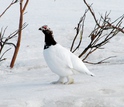
a willow ptarmigan
The willow ptarmigan is a common resident of the subnivium; it uses snow as an insulating blanket.
Credit and Larger Version
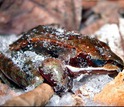
frozen wood frog on snow
How do wood frogs survive being frozen in winter? By living under the snow surface.
Credit and Larger Version
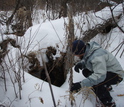
A winter ecologist peers beneath the subnivium and into the den of a porcupine living there.
A winter ecologist peers beneath the subnivium and into a porcupine den.
Credit and Larger Version
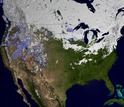
map of north america showing snwo cover
The depth and extent of snow cover in North America are rapidly decreasing, affecting the subnivium.
Credit and Larger Version
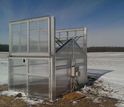
A micro-greenhouse and research equipment in the field with snow
A micro-greenhouse can reproduce climate change's effects on the world under snow.
Credit and Larger Version
the National Science Foundation (NSF)
Guillermo Gonzalo Sánchez Achutegui
ayabaca@gmail.com
ayabaca@hotmail.com
ayabaca@yahoo.com
Inscríbete en el Foro del blog y participa : A Vuelo De Un Quinde - El Foro!
viernes, 27 de septiembre de 2013

nsf.gov - National Science Foundation - 'Talking to the animals'

Chemical ecologists translate the language of the sea
Photo of marine organisms under water
Chemical signals are the primary "language" used by ocean organisms to communicate.
Credit and Larger Version
September 25, 2013
If Dr. Dolittle could talk to the animals, it's more likely he was a chemical ecologist than a linguist, says marine scientist Mark Hay of the Georgia Institute of Technology in Atlanta--at least when it came to talking to the animals (and plants) of the sea.
Chemical signals are the primary "language" used by ocean organisms. Using a kind of extra-sensory perception of the deep, marine animals and plants react to other species and to their environment based on these cues.
Humans are poorly designed to understand such chemically-driven interactions "because we sense the world primarily via visual and auditory input," Hay says.
"In contrast, many ocean species lack eyes and ears. They sense much of their world via chemical signals. In the sea, even species that see and hear rely on chemical cues."
Dark New York City streets--in the sea
Imagine walking along a bustling New York City street at night. Suddenly, the boulevard goes pitch-black and deathly silent--permanently.
How would you find food, a mate or protect yourself against thieves and murderers? What if you had to rely on detecting chemicals produced by other people and other animals to survive?
"For ocean animals and plants, it's like that every minute of every day," says Hay. For most marine species, chemical cues determine whether they consume, fight with, run from or mate with the creatures next to them--and whether they are eaten by, infected by or overgrown by natural enemies.
Welcome to New York City...eerily silent and utterly dark...beneath the waves.
Dead ahead are the shapeshifters, marine denizens that use chemical cues to change their outward appearances.
 
Facing the shape-shifters
When the bloom-forming phytoplankton Phaeocystis globosa chemically senses its next-door neighbors under attack by ciliates, which feast on small foods like phytoplankton, it shifts shape and grows in colonies too big for the ciliates to consume.
Then when the phytoplankton's neighbors are attacked by copepods, says Hay, which feed on large foods, Phaeocystis globosa suppresses colony formation and grows as single cells too small to interest the copepods.
"These shifts could alter energy flow, nutrient cycling and patterns of carbon sequestration in the sea," says Hay. "Chemical cues affect not only individual behavior and population-level processes, but also community organization and ecosystem function."
 
Finding food: no clues but molecules
What if you had to fly a plane over an area the size of Canada to locate a grocery store with no cues but a few simple "fresh food" molecules wafting through the air?
Tube-nosed seabirds--storm-petrels, albatrosses, petrels, shearwaters and others--do exactly that. They use a chemical cue to track high-productivity areas in open seas where they forage on zooplankton, fish and squid.
They're responding to the presence of dimethyl sulfide (DMS), produced when zooplankton feed on blooms of phytoplankton then excrete this substance.
"At scales of thousands of square kilometers, DMS may function as an olfactory landscape," says Hay, "indicating ocean areas where phytoplankton and zooplankton accumulate and where the search for prey should be most successful."
 
Chemical cues: from oceans to human health
To discover how chemical signals play a part in ocean ecosystems, and perhaps human health, Hay and colleagues are studying marine organisms and how they produce and deploy their chemical arsenals.
Understanding substances that cloak seaweeds and other species could allow scientists to adapt these compounds for use against microbial pathogens, HIV, cancer and other human diseases.
As part of a project supported by the National Science Foundation (NSF), Hay and colleagues have analyzed compounds from more than 800 species in the waters around Fiji Islands like Yanuca. The project is co-funded by the National Institutes of Health's International Cooperative Biodiversity Group program.
"The study of chemical signaling on Fiji Island coral reefs will help us better understand the interactions that keep the oceans healthy," says David Garrison, program director in NSF's Division of Ocean Sciences, which funded the research.
One species has emerged as a frontrunner in Hay's investigations: the red seaweed Callophycus serratus.
The alga is adept at fighting infections. Chemical extracts from Callophycus serratus fend off disease-causing microbes. The compounds are among the largest groups of algal antifungal chemical defenses discovered to date.
"We're in effect ‘listening in' on the fight between this red seaweed and a fungus that's trying to attack it," says Hay. "What we hear may allow us to translate the language of the sea into that of human biomedicine."
 
Tuning into The Deep
He may be tuning in for some time. Callophycus serratus produces at least 28 bioactive compounds.
Why would a single species of seaweed produce so many bioactive substances? The compounds may work together against a host of enemies, says Hay. "Or they may have separate uses we don't yet comprehend."
Hay is busy deciphering. He and colleagues have found that Callophycus serratus contains bromophycolides--in ocean-speak, chemicals that have shown promise as new treatments for infectious diseases.
Whether working along the shores of Fiji or in the seas around Florida, Panama or the Caribbean Islands, Hay is proving that we can interpret the language of marine organisms.
"Knowing what's being communicated will provide a deeper understanding of marine ecosystems," says Hay, "and improve our ability to serve as wise stewards of these natural resources."
-- Cheryl Dybas, NSF (703) 292-7734 
cdybas@nsf.gov
 
Related WebsitesNSF News: Killer Seaweed: Scientists Find First Proof that Chemicals from Seaweeds Damage Coral on Contact: http://www.nsf.gov/news/news_summ.jsp?cntn_id=116813
NSF News: Coral Reef 911: Corals Attacked by Seaweed Use Chemical Signals to Summon Help: http://www.nsf.gov/news/news_summ.jsp?cntn_id=125894
NSF Award: Killer Seaweeds: Allelopathy against Fijian Corals:
 http://www.nsf.gov/awardsearch/showAward?AWD_ID=0929119&HistoricalAwards=false
Photo of a marine animal and plants under water
Using a kind of "ESP," marine animals and plants react to other species based on chemical cues.
Credit and Larger Version
Photo of varios marine organisms in the ocean
Scientists are studying how chemical signals play a part in ocean ecosystems.
Credit and Larger Version
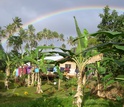
Photo of researchers' base camp  surrounded by banana trees and clothes out to dry in Fiji.
Ecologist Mark Hay and colleagues conduct research on Fiji; its islands are their "base camp."
Credit and Larger Version
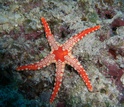
Photo of a starfish on a rock under water
Eat, fight with, run from or mate with? For most marine species, the answer lies in biochemistry.
Credit and Larger Version
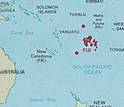
Map showing Fiji islands next to Australia
Researchers have studied more than 800 species in the waters around Fiji's many islands.
Credit and Larger Version
 
The National Science Foundation (NSF),
Guillermo Gonzalo Sánchez Achutegui

jueves, 4 de octubre de 2012

Science : Why We Need Insects--Even "Pesky" Ones

Hi My Friends: A VUELO DE UN QUINDE EL BLOG., Hard evidence of evolution: a five-year study shows that plants may quickly lose important traits through evolution soon after insects are removed from the environment
Download the high-resolution JPG version of the image. (2.6 MB)
A large natural population of evening primrose (yellow), which is a common plant in eastern North America.

Agrawal's team set up 16 identical plots. During each growing season for five years, eight of the plots were treated biweekly with an insecticide; the other eight were controls.

Credit: Anurag Agrawal


View a video interview with Anurag Agrawal of Cornell University.
At first blush, many people would probably love to get rid of insects, such as pesky mosquitoes, ants and roaches. But a new study indicates that getting rid of insects could trigger some unwelcome ecological consequences, such as the rapid loss of desired traits in plants, including their good taste and high yields.
Specifically, the study--described in the Oct. 5, 2012 issue of Science and funded by the National Science Foundation showed that evening primroses grown in insecticide-treated plots quickly lost, through evolution, defensive traits that helped protect them from plant-eating moths. The protective traits lost included the production of insect-deterring chemicals and later blooms that gave evening primroses temporal distance from plant-eating larvae that peak early in the growing season.
These results indicate that once the plants no longer needed their anti-insect defenses, they lost those defenses. What's more, they did so quickly--in only three or four generations.
Anurag Agrawal, the leader of the study and a professor of ecology and evolutionary biology at Cornell University, explains, "We demonstrated that when you take moths out of the environment, certain varieties of evening primrose were particularly successful. These successful varieties have genes that produce less defenses against moths."
In the absence of insects, the evening primroses apparently stopped investing energy in their anti-insect defenses, and so these defenses disappeared through natural selection. Agrawal says that he was "very surprised" by how quickly this process occurred, and that such surprises, "tell us something about the potential speed and complexities of evolution. In addition, experiments like ours that follow evolutionary change in real-time provide definitive evidence of evolution."
Agrawal believes that his team's study results are applicable to many other insect-plant interactions beyond evening primroses and moths.  Here's why: The ubiquitous consumption of plants by insects represents one of the dominant species interactions on Earth. With insect-plant relationships so important, it is widely believed that many plant traits originally evolved solely as defenses against insects. Some of these anti-insect plant defenses, such as the bitter taste of some fruits, are desirable.
"This experimental demonstration of how rapid evolution can shape ecological interactions supports the idea that we need to understand feedbacks between evolutionary and ecological processes in order to be able to predict how communities and ecosystems will respond to change," said Alan Tessier, a program director in NSF's Directorate for Biological Sciences.
"One of the things farmers are trying to do is breed agricultural crops to be more resistant to pests," said Agrawal. "Our study indicates that various genetic tradeoffs may make it difficult or impossible to maintain certain desired traits in plants that are bred for pest resistance."
In addition, oils produced by evening primroses have been used medicinally for hundreds of years and are beginning to be used as herbal remedies. Agrawal's insights about pests that attack these plants and about chemical compounds produced by these plants may ultimately be useful to the herbal and pharmaceutical industries.
Agrawal says that most previous real-time experiments on evolution have been conducted with bacteria in test tubes in laboratories. "One of things we were excited about is that we were able to repeat that kind of experiment in nature. You can expect to see a lot more of this kind of thing in future. We will keep our experiment running as a long-term living laboratory. "
More information about this study is available from a Cornell University press release. 
-NSF-
Media Contacts John Carberry, Cornell University (607) 255-5353 johncarberry@cornell.edu
Lily Whiteman, National Science Foundation (703) 292-8310 lwhitema@nsf.gov
Program Contacts Alan Tessier, National Science Foundation (703) 292-7198 atessier@nsf.gov
Principal Investigators Anurag Agrawal, Cornell University (607) 254-4255 aa337@cornell.edu
The National Science Foundation (NSF) is an independent federal agency that supports fundamental research and education across all fields of science and engineering. In fiscal year (FY) 2012, its budget is $7.0 billion. NSF funds reach all 50 states through grants to nearly 2,000 colleges, universities and other institutions. Each year, NSF receives over 50,000 competitive requests for funding, and makes about 11,000 new funding awards. NSF also awards nearly $420 million in professional and service contracts yearly.
Useful NSF Web Sites:
NSF Home Page: http://www.nsf.gov
NSF News: http://www.nsf.gov/news/
For the News Media: http://www.nsf.gov/news/newsroom.jsp
Science and Engineering Statistics: http://www.nsf.gov/statistics/
Awards Searches: http://www.nsf.gov/awardsearch/

 The National Science Foundation (NSF)
Guillermo Gonzalo Sánchez Achutegui
ayabaca@gmail.com
ayabaca@hotmail.com
ayabaca@yahoo.com 
 Inscríbete en el Foro del blog y participa : A Vuelo De Un Quinde - El Foro!
Mi lista de blogs