Mostrando entradas con la etiqueta InSight Mars Lander. Mostrar todas las entradas

lunes, 10 de diciembre de 2018

NASA : MARTE .- INSIGHT .- Insight Escucha el Viento Marciano

Hola amigos: A VUELO DE UN QUINDE EL BLOG., la Agencia Espacial NASA, informa, que  el Robot Insight, ha escuchado los vientos marcianos.
NASA .- narra: ........... " La sonda espacial InSight, que aterrizó en Marte hace solo 10 días, ha proporcionado los primeros "sonidos" de vientos marcianos en el Planeta Rojo.
Los sensores de InSight capturaron un inquietante murmullo causado por las vibraciones del viento, que se estima que soplaba entre 5 a 7 metros por segundo el 1 de diciembre, de noroeste a sureste. Los vientos fueron consistentes con la dirección de las rayas de un remolino observado en el área de aterrizaje, que se observaron desde la órbita.
"La captura de este audio fue un tratamiento no planificado", dijo Bruce Banerdt, investigador principal de InSight en el Laboratorio de Propulsión a Chorro (JPL) de la NASA en Pasadena, California. "Pero una de las cosas a las que hemos dedicado nuestra misión es a medir el movimiento en Marte, y naturalmente eso incluye el movimiento causado por las ondas de sonido".
Dos sensores muy sensibles en la nave detectaron estas vibraciones del viento: un sensor de presión de aire dentro del módulo de aterrizaje y un sismómetro sentado en la plataforma del módulo de aterrizaje, a la espera de ser desplegado por el brazo robótico de InSight...."

https://www.nasa.gov/mission_pages/insight/main/index.HTML
VIDEO, completo de la Misión : InSight Mars Lander

https://www.lanasa.net/misiones/marte/asi-se-recibio-la-primera-senal-en-la-tierra-desde-insight-en-marte
Insight Escucha el Viento Marciano
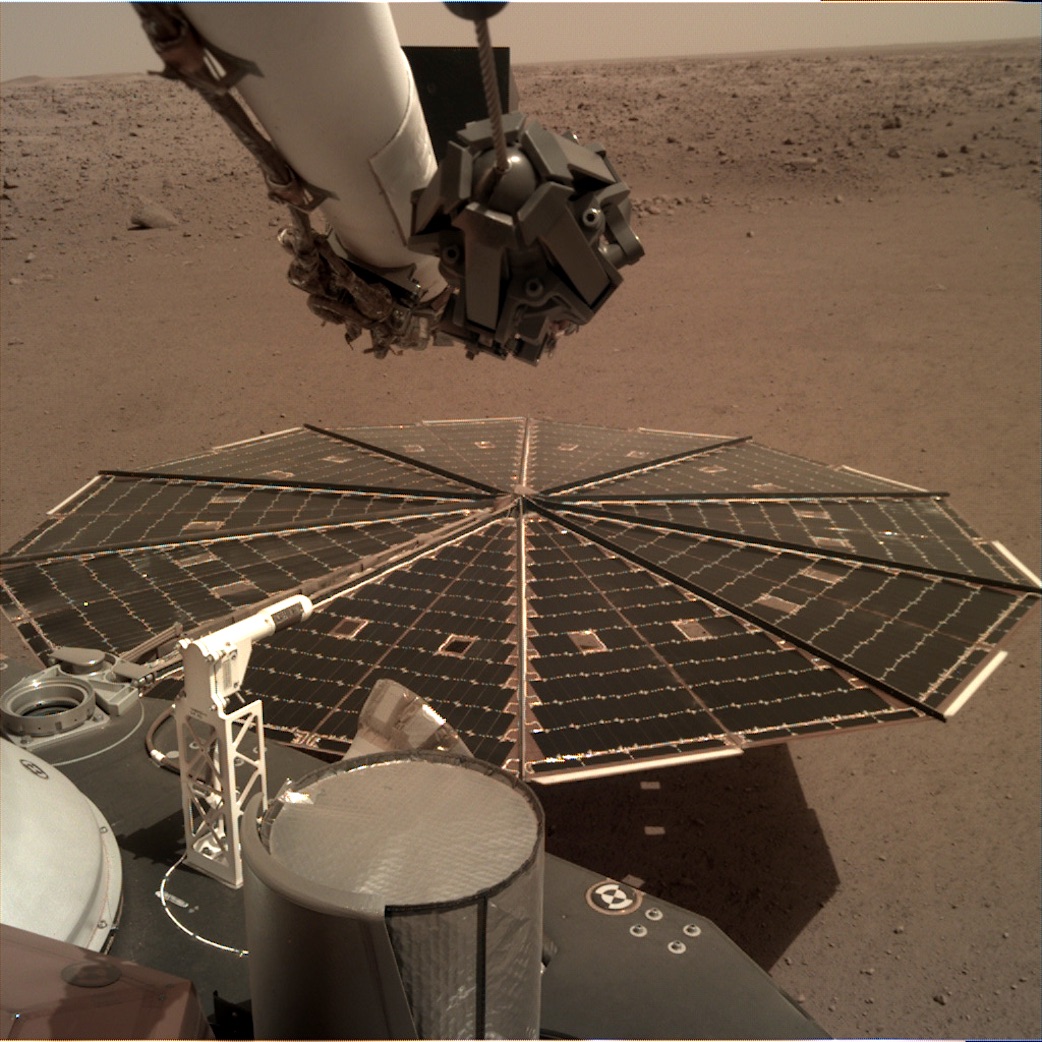
Primeros sonidos de Marte
Image Credit: NASA/JPL-Caltech
 
La sonda espacial InSight, que aterrizó en Marte hace solo 10 días, ha proporcionado los primeros "sonidos" de vientos marcianos en el Planeta Rojo.
Los sensores de InSight capturaron un inquietante murmullo causado por las vibraciones del viento, que se estima que soplaba entre 5 a 7 metros por segundo el 1 de diciembre, de noroeste a sureste. Los vientos fueron consistentes con la dirección de las rayas de un remolino observado en el área de aterrizaje, que se observaron desde la órbita.
"La captura de este audio fue un tratamiento no planificado", dijo Bruce Banerdt, investigador principal de InSight en el Laboratorio de Propulsión a Chorro (JPL) de la NASA en Pasadena, California. "Pero una de las cosas a las que hemos dedicado nuestra misión es a medir el movimiento en Marte, y naturalmente eso incluye el movimiento causado por las ondas de sonido".
Dos sensores muy sensibles en la nave detectaron estas vibraciones del viento: un sensor de presión de aire dentro del módulo de aterrizaje y un sismómetro sentado en la plataforma del módulo de aterrizaje, a la espera de ser desplegado por el brazo robótico de InSight.
 
NOTA: Si no escuchas el sonido al principio, es debido a que no tienes unos altavoces adecuados.
Espera a la parte final del vídeo para escuchar el sonido en una frecuencia normal audible.

Actualizado: 8/12/2018
 
Así se Recibió la Primera Señal en la Tierra desde InSight en Marte
La primera señal y foto que InSight envió desde Marte se recibió en las antenas del MDSCC, en Robledo de Chavela, España. ¡Todo un orgullo!
 
Primera Señal de InSight desde Marte
Primera señal que se recibió en la tierra desde la nave InSight, en Marte, confirmando así el final exitoso de los 7 minutos de terror.
La señal fue recibida con las antenas de este centro de seguimiento, MDSCC, en Robledo de Chavela. Todo un honor y un orgullo. Image Credit: MDSCC/JPL/NASA
 
Primera señal que se recibió en el MDSCC España desde la nave InSight, en Marte
Momento en el que se recibe la señal de InSight confirmando que está sobre el suelo de Marte. En verde, la antena de la red de espacio profundo del MDSCC de NASA en España que está recibiendo la primera foto de InSight en Marte.  Image Credit: JPL/NASA/MDSCC
 Para más información visita: www.mdscc.nasa.gov
Actualizado: 8/12/2018
 
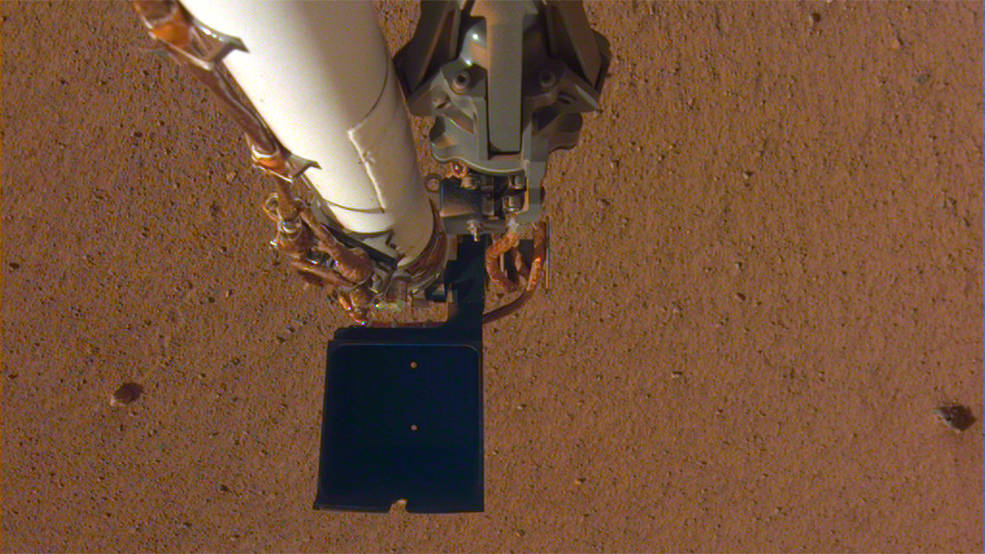
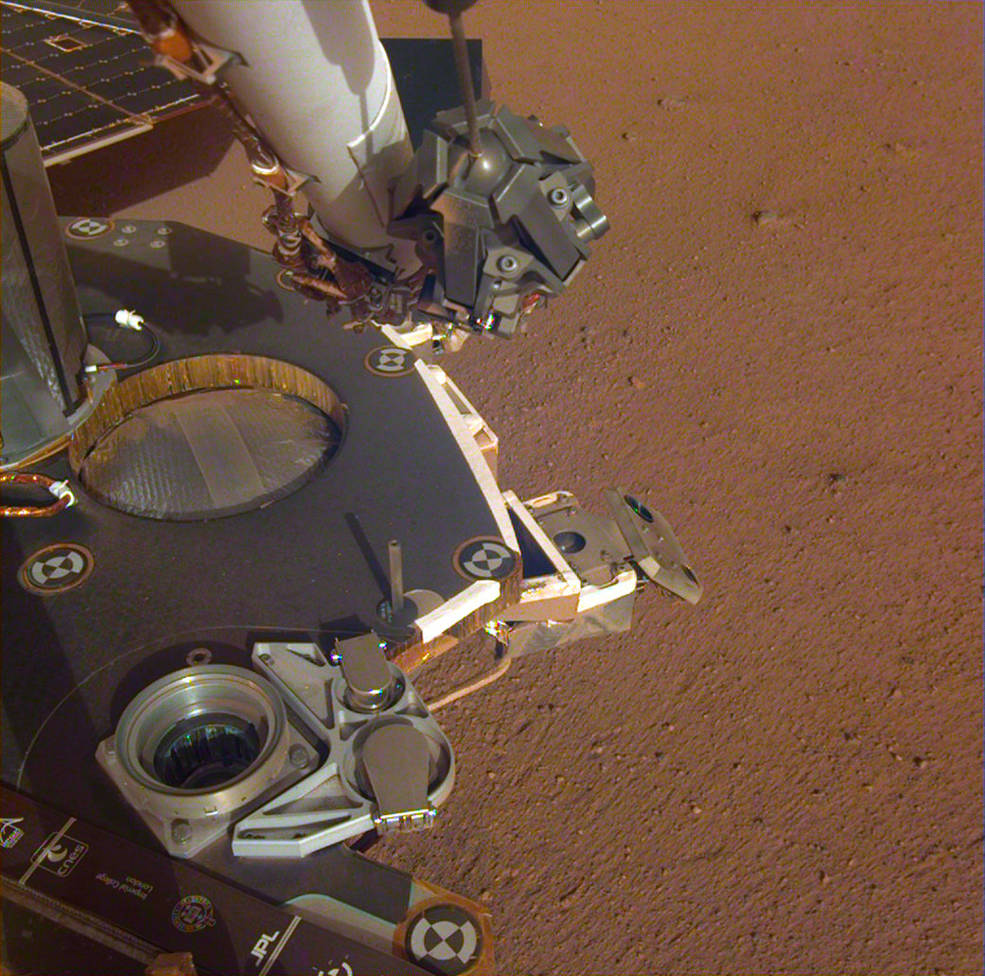
InSight Flexiona su Brazo Robótico

InSight Flexiona su Brazo Robótico 1
Image Credit: NASA/JPL-Caltech
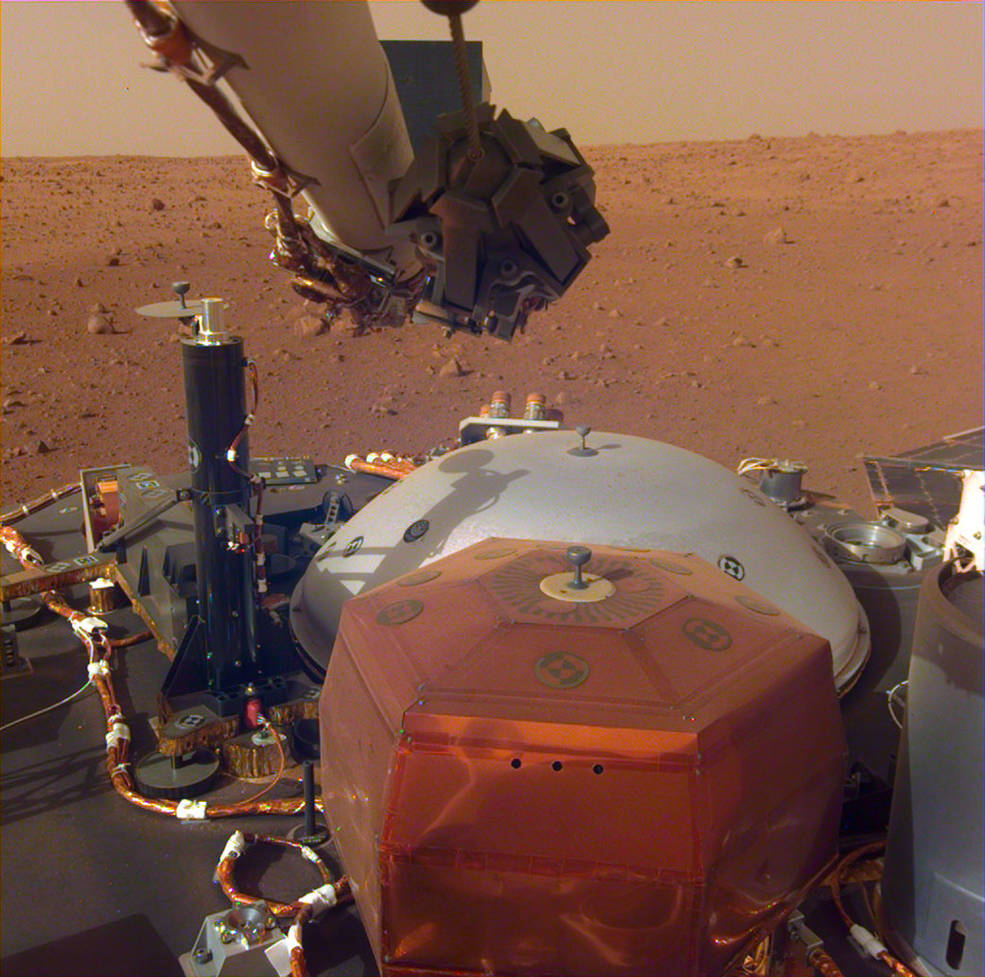
Nuevas imágenes de la sonda espacial InSight de la NASA en Marte muestran que su brazo robótico está listo para levantarse.
 
Con un alcance de casi 2 metros, el brazo se usará para recoger instrumentos científicos de la plataforma del módulo de aterrizaje, colocándolos suavemente en la superficie marciana en Elysium Planitia, la llanura de lava donde InSight aterrizó el 26 de Noviembre.
 
Cámara de Implementación de Instrumentos.
Image Credit: NASA/JPL-Caltech
Pero primero, el brazo utilizará su Cámara de Implementación de Instrumentos, ubicada en su codo, para tomar fotos del terreno frente al módulo de aterrizaje. Estas imágenes ayudarán a los miembros del equipo de la misión a determinar dónde colocar el sismómetro y la sonda de flujo de calor de InSight, los únicos instrumentos que se han colocado robóticamente en la superficie de otro planeta.
"Hoy podemos ver los primeros destellos de nuestro espacio de trabajo", dijo Bruce Banerdt, investigador principal de la misión en el Laboratorio de Propulsión a Chorro de la NASA en Pasadena, California. "A principios de la próxima semana, estaremos creando imágenes con mayor detalle y creando un mosaico completo".
Otra cámara, llamada Cámara de contexto de instrumento, se encuentra debajo de la plataforma del módulo de aterrizaje. También ofrecerá vistas del área de trabajo, aunque la vista no será tan bonita.
 
InSight Flexiona su Brazo Robótico. 3
Image Credit: NASA/JPL-Caltech
"Teníamos una cubierta protectora en la Cámara de Contexto del Instrumento, pero de alguna manera el polvo aún lograba llegar a la lente", dijo Tom Hoffman, de JPL, gerente del proyecto InSight. "Si bien esto es desafortunado, no afectará al trabajo de la cámara, que es tomar imágenes del área frente al módulo de aterrizaje donde finalmente se colocarán nuestros instrumentos".
La colocación es crítica, y el equipo está procediendo con precaución. Pueden transcurrir de dos a tres meses antes de que los instrumentos hayan sido ubicados y calibrados.


Actualizado: 8/12/2018
NASA
Guillermo Gonzalo Sánchez Achutegui
ayabaca@gmail.com
ayabaca@hotmail.com
ayabaca@yahoo.com
Inscríbete en el Foro del blog y participa : A Vuelo De Un Quinde - El Foro!

domingo, 13 de marzo de 2016

NASA : NASA Targets May 2018 Launch of Mars InSight Mission .-. Objetivos de la NASA, puede ser el lanzamiento del Mars InSight Mission en 2018...

Hola amigos: A VUELO DE UN QUINDE EL BLOG., hemos recibido información de la Agencia Espacial NASA, que ha cifrado sus objetivos en lanzar a marte su : Mars InSight Mission o NASA’s Interior Exploration using Seismic Investigations, Geodesy and Heat Transport (InSight) mission , en 2018.
More information....

Artist's concept of InSight
NASA has set a new launch opportunity, beginning May 5, 2018, for the InSight mission to Mars. This artist's concept depicts the InSight lander on Mars after the lander's robotic arm has deployed a seismometer and a heat probe directly onto the ground. InSight is the first mission dedicated to investigating the deep interior of Mars. The findings will advance understanding of how all rocky planets, including Earth, formed and evolved.
Credits: NASA/JPL-Caltech
 
NASA’s Interior Exploration using Seismic Investigations, Geodesy and Heat Transport (InSight) mission to study the deep interior of Mars is targeting a new launch window that begins May 5, 2018, with a Mars landing scheduled for Nov. 26, 2018.

InSight’s primary goal is to help us understand how rocky planets – including Earth – formed and evolved. The spacecraft had been on track to launch this month until a vacuum leak in its prime science instrument prompted NASA in December to suspend preparations for launch.

InSight project managers recently briefed officials at NASA and France's space agency, Centre National d'Études Spatiales (CNES), on a path forward; the proposed plan to redesign the science instrument was accepted in support of a 2018 launch.

“The science goals of InSight are compelling, and the NASA and CNES plans to overcome the technical challenges are sound," said John Grunsfeld, associate administrator for NASA’s Science Mission Directorate in Washington. "The quest to understand the interior of Mars has been a longstanding goal of planetary scientists for decades. We’re excited to be back on the path for a launch, now in 2018.”  

NASA’s Jet Propulsion Laboratory (JPL) in Pasadena, California, will redesign, build and conduct qualifications of the new vacuum enclosure for the Seismic Experiment for Interior Structure (SEIS), the component that failed in December. CNES will lead instrument level integration and test activities, allowing the InSight Project to take advantage of each organization’s proven strengths. The two agencies have worked closely together to establish a project schedule that accommodates these plans, and scheduled interim reviews over the next six months to assess technical progress and continued feasibility. 

The cost of the two-year delay is being assessed. An estimate is expected in August, once arrangements with the launch vehicle provider have been made. 

The seismometer instrument's main sensors need to operate within a vacuum chamber to provide the exquisite sensitivity needed for measuring ground movements as small as half the radius of a hydrogen atom. The rework of the seismometer's vacuum container will result in a finished, thoroughly tested instrument in 2017 that will maintain a high degree of vacuum around the sensors through rigors of launch, landing, deployment and a two-year prime mission on the surface of Mars.

The InSight mission draws upon a strong international partnership led by Principal Investigator Bruce Banerdt of JPL. The lander's Heat Flow and Physical Properties Package is provided by the German Aerospace Center (DLR). This probe will hammer itself to a depth of about 16 feet (five meters) into the ground beside the lander.

SEIS was built with the participation of the Institut de Physique du Globe de Paris and the Swiss Federal Institute of Technology, with support from the Swiss Space Office and the European Space Agency PRODEX program; the Max Planck Institute for Solar System Research, supported by DLR; Imperial College, supported by the United Kingdom Space Agency; and JPL.

"The shared and renewed commitment to this mission continues our collaboration to find clues in the heart of Mars about the early evolution of our solar system," said Marc Pircher, director of CNES's Toulouse Space Centre.

The mission’s international science team includes researchers from Austria, Belgium, Canada, France, Germany, Japan, Poland, Spain, Switzerland, the United Kingdom and the United States.

JPL manages InSight for NASA's Science Mission Directorate. InSight is part of NASA's Discovery Program, managed by the agency’s Marshall Space Flight Center in Huntsville, Alabama. The InSight spacecraft, including cruise stage and lander, was built and tested by Lockheed Martin Space Systems in Denver. It was delivered to Vandenberg Air Force Base, California, in December 2015 in preparation for launch, and returned to Lockheed Martin's Colorado facility last month for storage until spacecraft preparations resume in 2017.

NASA is on an ambitious journey to Mars that includes sending humans to the Red Planet, and that work remains on track. Robotic spacecraft are leading the way for NASA’s Mars Exploration Program, with the upcoming Mars 2020 rover being designed and built, the Opportunity and Curiosity rovers exploring the Martian surface, the Odyssey and Mars Reconnaissance Orbiter spacecraft currently orbiting the planet, along with the Mars Atmosphere and Volatile Evolution Mission (MAVEN) orbiter, which is helping scientists understand what happened to the Martian atmosphere.
NASA and CNES also are participating in ESA’s (European Space Agency's) Mars Express mission currently operating at Mars. NASA is participating on ESA’s 2016 and 2018 ExoMars missions, including providing telecommunication radios for ESA's 2016 orbiter and a critical element of a key astrobiology instrument on the 2018 ExoMars rover.

For addition information about the mission, visit:


More information about NASA's journey to Mars is available online at:


-end-
Dwayne Brown / Laurie Cantillo
Headquarters, Washington
202-358-1726 / 202-358-1077
dwayne.c.brown@nasa.gov / laura.l.cantillo@nasa.gov

Guy Webster
Jet Propulsion Laboratory, Pasadena, Calif.
818-354-6278
guy.w.webster@jpl.nasa.gov

Pascale Bresson / Nathalie Journo
Centre National d'Études Spatiales, Paris
+33-1-44-76-75-39 / +33-5-61-27-39-11
pascale.bresson@cnes.fr / nathalie.journo@cnes.fr

Manuela Braun
German Aerospace Center (DLR)
+49 2203 601 3882
manuela.braun@dlr.de
Last Updated: March 9, 2016
Editor: Sarah Ramsey
NASA
Guillermo Gonzalo Sánchez Achutegui
Inscríbete en el Foro del blog y participa : A Vuelo De Un Quinde - El Foro!

viernes, 25 de diciembre de 2015

NASA : NASA Suspends 2016 Launch of InSight Mission to Mars .- NASA suspende 2016 Lanzamiento de InSight Misión a Marte

Hola amigos: A VUELO DE UN QUINDE EL BLOG., Después de un examen a fondo, los administradores de la NASA han decidido suspender el planeado lanzamiento en marzo del  2016  de la misión:  The Interior Exploration using Seismic Investigations Geodesy and Heat Transport (InSight) misión.  La decisión se produce tras los intentos fallidos para reparar una fuga en una sección del instrumento primordial en la carga útil científica.
More information..............

Artist's Concept of InSight Lander on Mars - Annotated
This artist's concept from August 2015 depicts NASA's InSight Mars lander fully deployed for studying the deep interior of Mars. The mission will launch during the period March 4 to March 30, 2016, and land on Mars Sept. 28, 2016.
Credits: NASA/JPL-Caltech

After thorough examination, NASA managers have decided to suspend the planned March 2016 launch of the Interior Exploration using Seismic Investigations Geodesy and Heat Transport (InSight) mission. The decision follows unsuccessful attempts to repair a leak in a section of the prime instrument in the science payload.

“Learning about the interior structure of Mars has been a high priority objective for planetary scientists since the Viking era,” said John Grunsfeld, associate administrator for NASA’s Science Mission Directorate in Washington. “We push the boundaries of space technology with our missions to enable science, but space exploration is unforgiving, and the bottom line is that we’re not ready to launch in the 2016 window. A decision on a path forward will be made in the coming months, but one thing is clear: NASA remains fully committed to the scientific discovery and exploration of Mars.”

The instrument involved is the Seismic Experiment for Interior Structure (SEIS), a seismometer provided by France’s Centre National d'Études Spatiales (CNES). Designed to measure ground movements as small as the diameter of an atom, the instrument requires a vacuum seal around its three main sensors to withstand the harsh conditions of the Martian environment. 

“InSight's investigation of the Red Planet's interior is designed to increase understanding of how all rocky planets, including Earth, formed and evolved,” said Bruce Banerdt, InSight Principal Investigator at NASA’s Jet Propulsion Laboratory (JPL), Pasadena, California. “Mars retains evidence about the rocky planets' early development that has been erased on Earth by internal churning Mars lacks. Gaining information about the core, mantle and crust of Mars is a high priority for planetary science, and InSight was built to accomplish this."
A leak earlier this year that previously had prevented the seismometer from retaining vacuum conditions was repaired, and the mission team was hopeful the most recent fix also would be successful. However, during testing on Monday in extreme cold temperature (-49 degrees Fahrenheit/-45 degrees Celsius) the instrument again failed to hold a vacuum.

NASA officials determined there is insufficient time to resolve another leak, and complete the work and thorough testing required to ensure a successful mission.

“It’s the first time ever that such a sensitive instrument has been built. We were very close to succeeding, but an anomaly has occurred, which requires further investigation. Our teams will find a solution to fix it, but it won’t be solved in time for a launch in 2016,” said Marc Pircher, Director of CNES’s Toulouse Space Centre.

The spacecraft, built by Lockheed Martin, was delivered to Vandenberg Air Force Base in California, on Dec. 16. With the 2016 launch canceled, the spacecraft will be returned from Vandenberg to Lockheed’s facility in Denver.

The relative positions of the planets are most favorable for launching missions from Earth to Mars for only a few weeks every 26 months. For InSight, that 2016 launch window existed from March 4 to March 30.

“In 2008, we made a difficult, but correct decision to postpone the launch of the Mars Science Laboratory mission for two years to better ensure mission success,” said Jim Green, director, Planetary Science Division, in Washington. “The successes of that mission's rover, Curiosity, have vastly outweighed any disappointment about that delay."

NASA is on an ambitious journey to Mars that includes sending humans to the Red Planet, and that work remains on track despite Tuesday’s decision. Robotic spacecraft are leading the way for NASA’s Mars Exploration Program, with the upcoming Mars 2020 rover being designed and built, the Opportunity and Curiosity rovers exploring the Martian surface, the Odyssey and Mars Reconnaissance Orbiter spacecraft currently orbiting the planet, along with the MAVEN orbiter, which recently helped scientists understand what happened to the Martian atmosphere.

NASA and CNES also are participating in the European Space Agency's (ESA’s) Mars Express mission currently operating at Mars and plans to participate on ESA’s 2016 and 2018 ExoMars missions, including providing telecommunication radios for ESA's 2016 orbiter and a critical element of a key astrobiology instrument on the 2018 ExoMars rover.

“The JPL and CNES teams and their partners have made a heroic effort to prepare the InSight instrument, but have run out of time given the celestial mechanics of a launch to Mars,” said JPL Director Charles Elachi. “It is more important to do it right than take an unacceptable risk.”

InSight’s science payload includes two key instruments: SEIS, provided by CNES, and the Heat Flow and Physical Properties Package (HP3), provided by the German Aerospace Center (DLR).

SEIS was built with the participation of the Institut de Physique du Globe de Paris (IPGP) and the Swiss Federal Institute of Technology (ETH), with support from the Swiss Space Office and the European Space Agency PRODEX program; the Max Planck Institute for Solar System Research (MPS), supported by DLR; Imperial College, supported by the United Kingdom Space Agency; and JPL.
NASA will hold a media teleconference at 3:30 p.m. EST today to provide details on the agency’s decision. Briefing participants are:

  • John Grunsfeld, associate administrator of the Science Mission Directorate at NASA Headquarters in Washington
  • Jim Green, director of the Planetary Science Division at NASA Headquarters
  • Marc Pircher, CNES director
  • Philippe Laudet, CNES project manager for SEIS
  • Bruce Banerdt, InSight principal investigator, JPL

To participate in the teleconference by phone, media must email their name, media affiliation and phone number to Karen Northon at karen.northon@nasa.gov by 3:30 p.m.
NASA will audio stream the teleconference live at:


For more information about NASA's Mars programs visit:


-end-
Dwayne Brown / Laurie Cantillo
Headquarters, Washington                                                                     
202-358-1726 / 202-358-1077
dwayne.c.brown@nasa.gov / laura.l.cantillo@nasa.gov

Guy Webster
Jet Propulsion Laboratory, Pasadena, Calif.
818-354-6278
guy.w.webster@jpl.nasa.gov

Julien WATELET
Media Manager du CNES
Tel. 01 44 76 78 37 / port. 06 88 06 11 48
julien.watelet@cnes.fr
Last Updated: Dec. 23, 2015
Editor: Karen Northon

Artist's Concept of InSight Lander on Mars


This artist's concept depicts NASA's InSight Mars lander fully deployed for studying the deep interior of Mars
This artist's concept from August 2015 depicts NASA's InSight Mars lander fully deployed for studying the deep interior of Mars.  The mission will launch during the period March 4 to March 30, 2016, and land on Mars Sept. 28, 2016.

InSight, short for Interior Exploration using Seismic Investigations, Geodesy and Heat Transport, will investigate processes that formed and shaped Mars. Its findings will improve understanding about the evolution of our inner solar system's rocky planets, including Earth.

The lander will be the first mission to permanently deploy instruments directly onto Martian ground using a robotic arm. The two instruments to be placed into a work area in front of the lander are a seismometer (contributed by the French space agency Centre National d'Etudes Spatiales, or CNES) to measure the microscopic ground motions from distant marsquakes providing information about the interior structure of Mars, and a heat-flow probe (contributed by the German Aerospace Center, or DLR) designed to hammer itself 3 to 5 meters (about 16 feet) deep and monitor heat coming from the planet's interior. The mission will also track the lander's radio to measure wobbles in the planet's rotation that relate to the size of its core and a suite of environmental sensors to monitor the weather and variations in the magnetic field. Two cameras will aid in instrument deployment and monitoring the local environment.

Lockheed Martin Space Systems, Denver, is building and testing the spacecraft.
InSight is part of NASA's Discovery Program of competitively selected solar system exploration missions with highly focused scientific goals. NASA's Marshall Space Flight Center in Huntsville, Alabama, manages the Discovery Program for the agency's Science Mission Directorate in Washington. NASA's Jet Propulsion Laboratory, a division of the California Institute of Technology, Pasadena, manages InSight for the NASA Science Mission Directorate. For more information about InSight, visit:
Additional information on the Discovery Program is available at:

Image Credit:  NASA/JPL-Caltech

Last Updated: Aug. 18, 2015
Editor: Tony Greicius
NASA
Guillermo Gonzalo Sánchez Achutegui
Inscríbete en el Foro del blog y participa : A Vuelo De Un Quinde - El Foro!

martes, 23 de junio de 2015

NASA : NASA Administrator Signs Agreements to Advance Agency's Journey to Mars .- Administrador de la NASA firma acuerdos con agencias como un avance de viaje a Marte

Hola amigos: A VUELO DE UN QUINDE EL BLOG., hemos recibido información de la Agencia Espacial NASA, sobre la firma de acuerdos con Agencias de otros países;  como un avance al próximo viaje hacia Marte, previsto en el 2020.
NASA, así nos informa: "Para avanzar en nuestro viaje a Marte a través de la continua cooperación internacional, administrador de la NASA Charles Bolden firmó acuerdos Martes, 16 de junio 2015 con Jean-Yves Le Gall, presidente de la agencia espacial francesa Centro Nacional de Estudios Espaciales, Francisco Marín Pérez, director general de el Centro para el Desarrollo Tecnológico Industrial de España, e Ignacio Azqueta Ortiz, director general del Instituto Nacional de Técnica Aeroespacial....."

More information..............
http://www.nasa.gov/press-release/nasa-administrator-signs-agreements-to-advance-agencys-journey-to-mars

NASA Administrator Signs Agreements to Advance Agency's Journey to Mars

NASA signs MOUs with Spain and France to further journey to Mars
To advance our journey to Mars through continued international cooperation, NASA Administrator Charles Bolden signed agreements Tuesday, June 16, 2015 with Jean-Yves Le Gall, president of the French space agency Centre National d’Etudes Spatiales, Francisco Marín Pérez, director general of the Center for the Development of Industrial Technology of Spain, and Ignacio Azqueta Ortiz, director general of the National Institute for Aerospace Technology.
Credits: NASA


NASA's Mars Curiosity rover
NASA agreements with Spain's Center for the Development of Industrial Technology and National Institute for Aerospace Technology continue operation of and coordination on the Remote Environmental Monitoring Station (REMS) instrument suite and High Gain Antenna (HGA) subsystem currently on NASA's Mars Curiosity rover.
Credits: NASA
 
NASA's Mars InSight Lander
Spain will provide a suite of sensors for NASA's Mars InSight lander called Temperature and Wind on InSight (TWINS).
Credits: NASA
 
NASA’s Mars 2020 rover
France's space agency, Centre National d’Etudes Spatiales, will provide the mast for the SuperCam component of NASA’s Mars 2020 rover. Spain will equip the rover with a High Gain Antenna subsytem, Mars Environmental Dynamics Analyzer (MEDA) instrument suite and calibration targets for the SuperCam.
Credits: NASA
 
NASA Administrator Charles Bolden signed agreements with two European partners to advance Mars exploration and our journey to the Red Planet during meetings Tuesday at the Paris Air Show.
Bolden and Jean-Yves Le Gall, president of the French space agency, Centre National d’Etudes Spatiales (CNES), signed an agreement for France to provide the mast for the SuperCam component of NASA’s Mars 2020 rover.
In terms of design, SuperCam is similar to the ChemCam on the Curiosity rover, which is currently traversing the surface of Mars. ChemCam analyzes rocks and soil to determine their compositions and identify samples for analysis by other instruments onboard Curiosity. SuperCam, however, will have significantly enhanced capabilities, equipped with four scientific instruments that will allow it to look for biosignatures – indicators of the past presence of life -- and identify samples for collection and possible return to Earth. 
“I’m delighted that our long time partners CNES will join us on the next step in our journey to Mars,” Bolden said, “We’re paving the way for humans to visit the Red Planet and working to answer one of the key questions for all humanity: has there ever been life elsewhere?”
Bolden also signed an agreement that extends cooperation with Spain on the Mars Science Laboratory Curiosity rover, the NASA InSight mission that will launch next year to study the core of Mars, and the Mars 2020 rover. Bolden and Francisco Marín Pérez, director general of the Center for the Development of Industrial Technology of Spain (CDTI), and Ignacio Azqueta Ortiz, director general of the National Institute for Aerospace Technology of Spain (INTA) finalized the agreement.
The NASA-CDTI-INTA agreement continues operation and coordination of the Remote Environmental Monitoring Station (REMS) instrument suite and the High Gain Antenna (HGA) subsystem currently on the Curiosity rover. REMS provides important data on Mars’ weather, while the HGA provides an important communications link for transmitting data from the mission. Spain will provide the HGA subsytem for the Mars 2020 rover, as well.  For the InSight lander, Spain will provide a suite of sensors called Temperature and Wind on InSight (TWINS).
Through other agreements in development, Spain also will equip the Mars 2020 rover with a Mars Environmental Dynamics Analyzer (MEDA) instrument suite and calibration targets for the SuperCam.
“NASA is proud to continue our strong collaboration with Spain that is already producing amazing results on Mars,” Bolden said. “We look forward to this next phase of our partnership and a wealth of data about Mars, the next destination for human exploration.”
For more information about NASA’s Journey to Mars, visit:
For more information about NASA and agency programs, visit:
-end-
Last Updated: June 23, 2015
Editor: Karen Northon
Tags:  InSight Mars Lander, Journey to Mars, Mars 2020 Rover, Mars Science Laboratory (Curiosity)
 NASA
Guillermo Gonzalo Sánchez Achutegui
ayabaca@gmail.com
ayabaca@hotmail.com
ayabaca@yahoo.com
Inscríbete en el Foro del blog y participa : A Vuelo De Un Quinde - El Foro!

viernes, 29 de mayo de 2015

NASA : NASA Begins Testing Mars Lander in Preparation for Next Mission to Red Planet .- NASA, se prepara para la próxima misión de viajar al Planeta Marte...

Hola amigos: A VUELO DE UN QUINDE EL BLOG., hemos recibido información de la Agencia Espacial NASA, sobre los preparativos que está haciendo para su próximo viaje a Marte.

More information...............
http://www.nasa.gov/press-release/nasa-begins-testing-mars-lander-in-preparation-for-next-mission-to-red-planet

Testing is underway on NASA’s next mission on the journey to Mars, a stationary lander scheduled to launch in March 2016.
The lander is called InSight, an abbreviation for Interior Exploration using Seismic Investigations, Geodesy and Heat Transport. It is about the size of a car and will be the first mission devoted to understanding the interior structure of the Red Planet. Examining the planet's deep interior could reveal clues about how all rocky planets, including Earth, formed and evolved.
InSight Solar Arrays
Engineers and technicians at Lockheed Martin Space Systems, Denver, run a test of deploying the solar arrays on NASA's InSight lander. Photo taken April 30, 2015.
Credits: NASA/JPL-Caltech/Lockheed Martin
The current testing will help ensure InSight can operate in and survive deep space travel and the harsh conditions of the Martian surface. The spacecraft will lift off from Vandenberg Air Force Base in California, and land on Mars about six months later.
The technical capabilities and knowledge gained from Insight, and other Mars missions, are crucial to NASA's journey to Mars, which includes sending astronauts to the Red Planet in the 2030s.
"Today, our robotic scientific explorers are paving the way, making great progress on the journey to Mars," said Jim Green, director of NASA's Planetary Science Division at the agency's headquarters in Washington. "Together, humans and robotics will pioneer Mars and the solar system."

InSight Solar Arrays
The solar arrays on NASA's InSight lander are deployed in this April 30 test inside a clean room. This configuration is how the spacecraft will look on the surface of Mars.
Credits: NASA/JPL-Caltech/Lockheed Martin
During the environmental testing phase at Lockheed Martin's Space Systems facility near Denver, the lander will be exposed to extreme temperatures, vacuum conditions of nearly zero air pressure simulating interplanetary space, and a battery of other tests over the next seven months. The first will be a thermal vacuum test in the spacecraft's "cruise" configuration, which will be used during its seven-month journey to Mars. In the cruise configuration, the lander is stowed inside an aeroshell capsule and the spacecraft's cruise stage – for power, communications, course corrections and other functions on the way to Mars -- is fastened to the capsule.
"The assembly of InSight went very well and now it's time to see how it performs," said Stu Spath, InSight program manager at Lockheed Martin Space Systems, Denver. "The environmental testing regimen is designed to wring out any issues with the spacecraft so we can resolve them while it's here on Earth. This phase takes nearly as long as assembly, but we want to make sure we deliver a vehicle to NASA that will perform as expected in extreme environments."
Other tests include vibrations simulating launch and checking for electronic interference between different parts of the spacecraft.  The testing phase concludes with a second thermal vacuum test in which the spacecraft is exposed to the temperatures and atmospheric pressures it will experience as it operates on the Martian surface.
The mission's science team includes U.S. and international co-investigators from universities, industry and government agencies.
"It's great to see the spacecraft put together in its launch configuration," said InSight Project Manager Tom Hoffman at NASA's Jet Propulsion Laboratory (JPL), Pasadena, California. "Many teams from across the globe have worked long hours to get their elements of the system delivered for these tests. There still remains much work to do before we are ready for launch, but it is fantastic to get to this critical milestone."
 
The InSight mission is led by JPL's Bruce Banerdt. The Centre National d’Etudes Spatiales, France’s space agency, and the German Aerospace Center are each contributing a science instrument to the two-year scientific mission. InSight's international science team includes researchers from Austria, Belgium, Canada, France, Germany, Japan, Poland, Spain, Switzerland, the United Kingdom and the United States.
JPL manages InSight for NASA's Science Mission Directorate in Washington. InSight is part of NASA's Discovery Program, managed by the agency’s Marshall Space Flight Center in Huntsville, Alabama. Lockheed Martin Space Systems Company built the lander.
For addition information about the mission, visit:

More information about NASA's journey to Mars is available online at:
-end-
Dwayne Brown
Headquarters, Washington
202-358-1726
dwayne.c.brown@nasa.gov
Guy Webster
Jet Propulsion Laboratory, Pasadena, Calif.
818-354-6278
guy.webster@jpl.nasa.gov
Last Updated: May 29, 2015
Editor: Sarah Ramsey
Tags:  InSight Mars Lander, Journey to Mars, Mars
 NASA
Guillermo Gonzalo Sánchez Achutegui
ayabaca@hotmail.com
ayabaca@gmail.com
ayabaca@hotmail.com


Inscríbete en el Foro del blog y participa : A Vuelo De Un Quinde - El Foro!

Mi lista de blogs