Mostrando entradas con la etiqueta ESA's XMM-Newton. Mostrar todas las entradas

domingo, 27 de noviembre de 2016

ESA : ESASky, todo el cielo a tu alcance

http://www.esa.int/esl/ESA_in_your_country/Spain/ESASky_todo_el_cielo_a_tu_alcance

ESASky, todo el cielo a tu alcance

22 noviembre 2016
¿Cómo ve XMM-Newton un remanente de supernova en rayos X? ¿Y cómo se aprecia el mismo objeto en las observaciones en luz visible del telescopio espacial Hubble? Es fácil saberlo a través de la aplicación web ESASky, que pone a nuestra disposición los datos públicos de todas las misiones científicas de la ESA.
Haciendo click aquí, podemos ver el cielo en todas las diferentes longitudes de onda con las que lo observan los observatorios y satélites de la agencia.
Esos datos científicos se archivan en ESAC, el Centro Europeo de Astronomía Espacial, que centraliza el almacenaje de los datos científicos de las misiones de la ESA, y que ha puesto en marcha ESASky para acercar esas observaciones al gran público.  “El funcionamiento es muy sencillo y muy visual”, afirma Bruno Merín, Product Owner de ESASky, que añade que “de cada objeto se puede elegir la visualización en diferentes longitudes de onda y la misión que lo ha observado”.

Para todos los públicos

La interfaz de ESASky presenta, directamente, una vista del cielo y unos menús desplegables que permiten elegir, para un mismo objeto, entre distintas misiones y distintas visualizaciones; es decir, para la galaxia M51, por ejemplo, podemos verla a través de las observaciones en óptico de la cámara ACS del Hubble o del cartografiado DSS2, podemos elegir una vista en rayos-X de XMM-Newton o submilimétrica de Herschel, y tomar un pantallazo de ella. Lo que hace ESASky es integrar todos los archivos científicos de astronomía de la ESA en una única aplicación web fácil de usar.

Además de esa posibilidad de visualizar objetos concretos, también existe la opción de ver panorámicas completas del cielo en las que podemos ampliar sectores para obtener mayor detalle o subir a la herramienta una lista con nombres de objetos celestes y visitarlos en una secuencia. Esas panorámicas están confeccionadas con datos de misiones como INTEGRAL, XMM-Newton, Hubble, AKARI, ISO, Herschel y Planck, que reúnen observaciones en rayos gamma, rayos X y ultravioleta, ópticas, en infrarrojo cercano y lejano y en longitudes de onda submilimétricas. De este modo, el usuario tiene a su alcance una completa visión del cielo y de todas las regiones observadas por los telescopios espaciales de la ESA a lo largo de la historia. Pero ese usuario no sólo son científicos. Bruno Merín señala que ESASky está abierta tanto a investigadores como a aficionados a la astronomía, y por eso se ha diseñado buscando un manejo intuitivo y sencillo. Para los investigadores o para usuarios inquietos, se incluye la posibilidad de descargar los datos que necesiten para sus trabajos.
En ESAC trabajan en una versión 2.0 de la aplicación que incluirá datos espectrales, observaciones de nuevas misiones y la posibilidad de ver los objetos celestes no sólo en diferentes longitudes de onda, sino también en diferentes momentos en el tiempo. Esta versión también se podrá usar fácilmente con dispositivos móviles como tabletas y teléfonos inteligentes.
ESA
Guillermo Gonzalo Sánchez Achutegui
Inscríbete en el Foro del blog y participa : A Vuelo De Un Quinde - El Foro!

domingo, 20 de diciembre de 2015

ESO : Cacería XXL de cúmulos de galaxias en el Lado Oscuro de El Universo.

Hola amigos: A VUELO DE UN QUINDE EL BLOG., el Observatorio Austral Europeo ESO, nos informa sobre el sondeo  del lado oscuro del Universo, que: Los cúmulos de galaxias son congregaciones masivas de galaxias que albergan inmensos reservorios de gas caliente cuyas temperaturas son tan altas que se producen rayos X.  Estas estructuras resultan útiles para los astrónomos, pues se cree que su construcción está influenciada por los componentes más extraños del Universo: la materia oscura y la energía oscura.  Por medio del estudio de sus propiedades en diferentes etapas de la historia del Universo, los cúmulos de galaxia podrían arrojar luz sobre el poco conocido lado oscuro del Universo.
Se constituyó un :  Equipo, conformado por más de 100 astrónomos de todo el mundo, comenzó la búsqueda de estos monstruos cósmicos en el año 2011.  Si bien la radiación de alta energía de los rayos X que revela su ubicación es absorbida por la atmósfera de la Tierra, puede ser detectada por los observatorios de rayos X en el espacio. Por lo tanto, combinaron el sondeo  XMM-Newton de ESA, que significó la mayor adjudicación de tiempo de observación jamás otorgada a este telescopio en órbita, junto con observaciones provenientes de ESO y otros observatorios. El resultado es una enorme y creciente recopilación de datos de todo el espectro electromagnético [1], que se ha denominado colectivamente el sondeo XXL.
Leer más información en informe abajo adjunto.................

Observaciones desde telescopios de ESO proporcionan tercera dimensión, clave en sondeo del lado oscuro del Universo

15 de Diciembre de 2015
Los telescopios de ESO han brindado a un equipo internacional de astrónomos el regalo de la tercera dimensión en una enorme búsqueda de las mayores estructuras ligadas gravitacionalmente en el Universo – los cúmulos de galaxias. Las observaciones realizadas con el VLT y el NTT complementan a las realizadas desde otros observatorios en la tierra y el espacio, como parte del sondeo XXL – una de las mayores búsquedas de cúmulos de este tipo.
 
Los cúmulos de galaxias son congregaciones masivas de galaxias que albergan inmensos reservorios de gas caliente cuyas temperaturas son tan altas que se producen rayos X.  Estas estructuras resultan útiles para los astrónomos, pues se cree que su construcción está influenciada por los componentes más extraños del Universo: la materia oscura y la energía oscura.  Por medio del estudio de sus propiedades en diferentes etapas de la historia del Universo, los cúmulos de galaxia podrían arrojar luz sobre el poco conocido lado oscuro del Universo.
El equipo, conformado por más de 100 astrónomos de todo el mundo, comenzó la búsqueda de estos monstruos cósmicos en el año 2011.  Si bien la radiación de alta energía de los rayos X que revela su ubicación es absorbida por la atmósfera de la Tierra, puede ser detectada por los observatorios de rayos X en el espacio. Por lo tanto, combinaron el sondeo  XMM-Newton de ESA, que significó la mayor adjudicación de tiempo de observación jamás otorgada a este telescopio en órbita, junto con observaciones provenientes de ESO y otros observatorios. El resultado es una enorme y creciente recopilación de datos de todo el espectro electromagnético [1], que se ha denominado colectivamente el sondeo XXL.
“El principal objetivo del sondeo XXL es proporcionar un muestreo bien definido de unos 500 cúmulos de galaxias, a una distancia en que el Universo tenía la mitad de su edad actual”, explica la Investigadora Principal del sondeo XXL, Marguerite Pierre de CEA, Saclay, Francia.
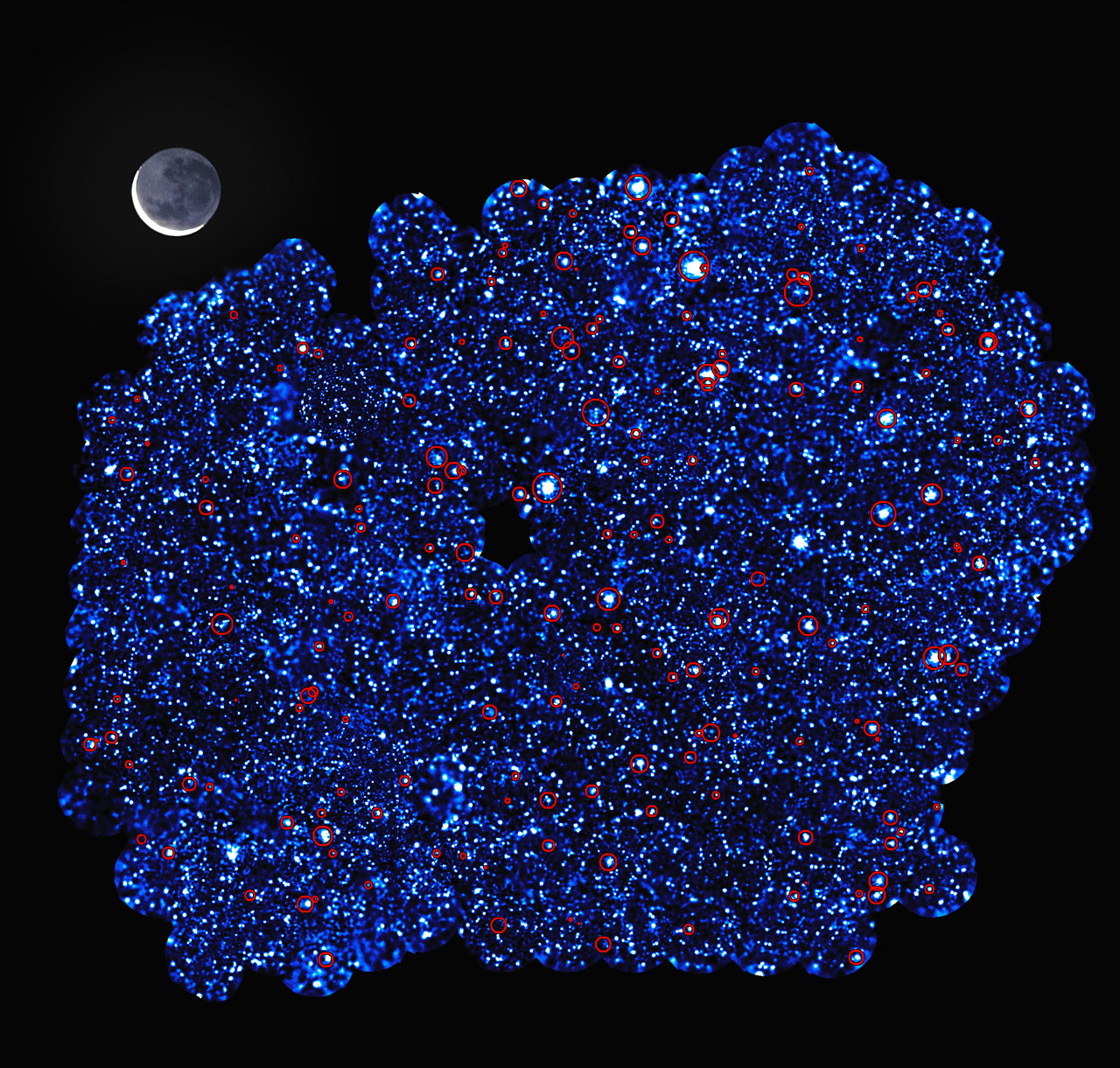
El telescopio Newton XMM captó imágenes de dos zonas del cielo – cada una de un tamaño de cien veces el área de la luna llena – en un intento por descubrir un gran número de cúmulos de galaxias no conocidas previamente.  El equipo del sondeo XXL ha publicado sus conclusiones en una serie de artículos científicos acerca de los 100 cúmulos más brillantes descubiertos [2].
Asimismo se usaron observaciones realizadas con el instrumento EFOSC2, instalado en el New Technology Telescope (NTT), junto con el instrumento FORS acoplado al Very Large Telescope de ESO (VLT), para analizar cuidadosamente la luz proveniente de galaxias dentro de estos cúmulos de galaxias.  Fundamentalmente, esto permitió al equipo medir las distancias exactas hasta los cúmulos de galaxias, proporcionando una vista tridimensional del cosmos, requerida para realizar mediciones precisas de la materia oscura y energía oscura [3].
Se espera que el sondeo XXL genere diversos resultados interesantes e imprevistos, pero aún con la quinta parte de los datos finales, ya han surgido importantes y sorprendentes hallazgos.
Uno de los artículos científicos informa del descubrimiento de cinco nuevos súper cúmulos – cúmulos de cúmulos de galaxias – que se agregan a los ya conocidos, como nuestro propio súper cúmulo, denominado Laniakea Supercluster.
Otro informe se refiere a las observaciones de seguimiento a un cúmulo de galaxias en particular (informalmente conocido como XLSSC-116), ubicado a una distancia de seis mil millones de años luz [4].  Utilizando el instrumento MUSE del VLT, se observó en dicho cúmulo una fuente de luz inusualmente brillante y difusa.
“Esta es la primera vez que logramos analizar en detalle la luz difusa en un cúmulo de galaxias distante, lo cual demuestra la potencia de MUSE para estas valiosas investigaciones,” explica Christoph Adami, del Laboratorio de Astrofísica de Marsella, Francia, co-autor del artículo.
El equipo también usó los datos para confirmar el concepto que postula que los cúmulos de galaxias fueron, en el pasado, versiones a escala reducida de aquellos que observamos actualmente – un descubrimiento importante para la comprensión teórica de la evolución de los cúmulos a lo largo de la historia del Universo.
El simple acto de contar los cúmulos de galaxias en los datos XXL ha confirmado, también, un peculiar resultado previo  – existen menos cúmulos distantes que los esperables basados en predicciones con parámetros cosmológicos calculados por el telescopio Planck de ESA.  Se desconoce el motivo de esta discrepancia, aunque el equipo espera llegar a comprender esta curiosidad cosmológica con el muestreo completo de cúmulos, en el año 2017.
Estos cuatro resultados importantes no son más que un anticipo de lo que se espera conseguir con este enorme  sondeo de algunos de los objetos más masivos del Universo.

Notas

 
[1] El sondeo XXL combina datos de archivo con nuevas observaciones de cúmulos de galaxias que cubren las longitudes de onda de 1x10⁻⁴ μm (rayos X, observados con XMM) hasta 492 μm (rango submilimétrico, observado con el Giant Metrewave Radio Telescope [GMRT]).
[2] Los cúmulos de galaxias informados en los trece artículos científicos se encuentran en corrimientos al rojo entre z = 0.05 and z = 1.05, que corresponden al periodo en que la edad del Universo era de 13 a 5.7 mil millones de años, respectivamente.
[3] El sondeo de los cúmulos de galaxias requirió conocer sus distancias con exactitud.  Si bien las distancias aproximadas – corrimientos hacia el rojo fotométricos – se pueden medir analizando sus colores a diversas longitudes de onda, se requieren desplazamientos hacia el rojo espectroscópicos más precisos. Corrimientos al rojo espectroscópicos también fueron obtenidos de los datos de archivo, como parte del VIMOS Public Extragalactic Redshift Survey (Sondeo Público del Corrimiento al Rojo VIMOS) (VIPERS), el VIMOS-VLT Deep Survey (VVDS) y el sondeo GAMA.
[4] Este cúmulo de galaxias se encontró en un corrimiento hacia el rojo de z = 0.543.
 

Información adicional

 
La descripción del sondeo y algunos de sus primeros resultados científicos se presentarán en una serie de artículos científicos publicados en la revista Astronomy & Astrophysics con fecha 15 de diciembre de 2015.
El listado completo del equipo XXL se encuentra aquí.
XXL es un Proyecto internacional basado alrededor de un Programa Muy Amplio XMM que sondea dos campos extra-galácticos de 25 grados cuadrados a una profundidad de ~5 x 10-15 erg cm-2 s-1 en la banda [0.5-2] keV para fuentes puntuales.  El sitio web de XXL está aquí. La información de multi-banda y seguimiento espectroscópico de las fuentes de rayos X se pueden obtener a través de un número de programas de rastreo, resumidos aquí.
ESO es la principal organización astronómica intergubernamental de Europa y el observatorio astronómico más productivo del mundo. Cuenta con el respaldo de dieciséis países: Alemania, Austria, Bélgica, Brasil, Dinamarca, España, Finlandia, Francia, Italia, Países Bajos, Polonia, Portugal, el Reino Unido, República Checa, Suecia y Suiza, junto con el país anfitrión, Chile. ESO desarrolla un ambicioso programa centrado en el diseño, construcción y operación de poderosas instalaciones de observación terrestres que permiten a los astrónomos hacer importantes descubrimientos científicos. ESO también desarrolla un importante papel al promover y organizar la cooperación en investigación astronómica. ESO opera en Chile tres instalaciones de observación únicas en el mundo: La Silla, Paranal y Chajnantor. En Paranal, ESO opera el Very Large Telescope, el observatorio óptico más avanzado del mundo, y dos telescopios de rastreo. VISTA (siglas en inglés de Telescopio de Rastreo Óptico e Infrarrojo para Astronomía) trabaja en el infrarrojo y es el telescopio de rastreo más grande del mundo, y el VST (VLT Survey Telescope, Telescopio de Rastreo del VLT) es el telescopio más grande diseñado exclusivamente para rastrear el cielo en luz visible. ESO es el socio europeo de un revolucionario telescopio, ALMA, actualmente el mayor proyecto astronómico en funcionamiento del mundo. Además, cerca de Paranal, en Cerro Armazones, ESO está construyendo el E-ELT (European Extremely Large Telescope), el telescopio óptico y de infrarrojo cercano de 39 metros que llegará a ser “el ojo más grande del mundo para mirar el cielo”.

Enlaces

Contactos

Marguerite Pierre
CEA
Saclay, France
Correo electrónico: marguerite.pierre@cea.fr
Richard Hook
ESO Public Information Officer
Garching bei München, Germany
Tlf.: +49 89 3200 6655
Móvil: +49 151 1537 3591
Correo electrónico: rhook@eso.org

Imágenes

Imagen en rayos X del área sur del sondeo XXL
Combinación de vistas con rayos X y luz visible de un cúmulo de galaxias distante
Vista en luz visible de un cúmulo de galaxias distantes, descubiertas por el sondeo XXL
Combinación de vistas con rayos X y luz visible de un cúmulo de galaxias distante

Comparación de imágenes

Comparación de un cúmulo de galaxias distante, vista con rayos X y luz visible

Ver también

Esta es una traducción de la nota de prensa de ESO eso1548.
ESO
Guillermo Gonzalo Sánchez Achutegui
Inscríbete en el Foro del blog y participa : A Vuelo De Un Quinde - El Foro!

domingo, 29 de noviembre de 2015

NASA : A Precocious Black Hole .- Un precioso Agujero negro en al Galaxia CID-947..............

Hola amigos: A VUELO DE UN QUINDE EL BLOG., En julio de 2015, los investigadores anunciaron el descubrimiento de un agujero negro, que se muestra en la ilustración anterior, que creció mucho más rápidamente que su galaxia anfitriona. El descubrimiento pone en cuestión los supuestos anteriores sobre el desarrollo de las galaxias. El agujero negro fue descubierto originalmente usando el Telescopio Espacial Hubble de la NASA, y luego se detectó en el Sloan Digital Sky Survey y por XMM-Newton de la ESA y el Observatorio de Rayos X Chandra de la NASA.
More information..............

Illustration of supermassive black hole at center of normal sized galaxy
In July 2015, researchers announced the discovery of a black hole, shown in the above illustration, that grew much more quickly than its host galaxy. The discovery calls into question previous assumptions on the development of galaxies. The black hole was originally discovered using NASA's Hubble Space Telescope, and was then detected in the Sloan Digital Sky Survey and by ESA's XMM-Newton and NASA's Chandra X-ray Observatory.
 
Benny Trakhtenbrot, from ETH Zurich's Institute for Astronomy, and an international team of astrophysicists, performed a follow-up observation of this black hole using the 10 meter Keck telescope in Hawaii and were surprised by the results. The data, collected with a new instrument, revealed a giant black hole in an otherwise normal, distant galaxy, called CID-947.
Illustration Credit: M. Helfenbein, Yale University / OPAC
Last Updated: Nov. 27, 2015
Editor: Sarah Loff
NASA
Guillermo Gonzalo Sánchez Achutegui
ayabaca@gmail.com
ayabaca@hotmail.com
ayabaca@yahoo.com
Inscríbete en el Foro del blog y participa : A Vuelo De Un Quinde - El Foro!

domingo, 14 de septiembre de 2014

NASA : Unprecedented X-ray View of Supernova Remains


Unprecedented X-ray View of Supernova Remains
The destructive results of a powerful supernova explosion reveal themselves in a delicate tapestry of X-ray light, as seen in this image from NASA’s Chandra X-Ray Observatory and the European Space Agency's XMM-Newton.
The image shows the remains of a supernova that would have been witnessed on Earth about 3,700 years ago. The remnant is called Puppis A, and is around 7,000 light years away and about 10 light years across. This image provides the most complete and detailed X-ray view of Puppis A ever obtained, made by combining a mosaic of different Chandra and XMM-Newton observations. Low-energy X-rays are shown in red, medium-energy X-rays are in green and high energy X-rays are colored blue.
These observations act as a probe of the gas surrounding Puppis A, known as the interstellar medium. The complex appearance of the remnant shows that Puppis A is expanding into an interstellar medium that probably has a knotty structure.
Supernova explosions forge the heavy elements that can provide the raw material from which future generations of stars and planets will form. Studying how supernova remnants expand into the galaxy and interact with other material provides critical clues into our own origins.
A paper describing these results was published in the July 2013 issue of Astronomy and Astrophysics and is available online. The first author is Gloria Dubner from the Instituto de Astronomía y Física del Espacio in Buenos Aires in Argentina.
Image credit: NASA/CXC/IAFE/G.Dubner et al & ESA/XMM-Newton
NASA
Guillermo Gonzalo Sánchez Achutegui
Inscríbete en el Foro del blog y participa : A Vuelo De Un Quinde - El Foro!

domingo, 29 de septiembre de 2013

NASA - Neutron Star Undergoes Wild Behavior Changes


Neutron Star Undergoes Wild Behavior Changes
These two images from NASA's Chandra X-ray Observatory show a large change in X-ray brightness of a rapidly rotating neutron star, or pulsar, between 2006 and 2013. The neutron star − the extremely dense remnant left behind by a supernova − is in a tight orbit around a low mass star. This binary star system, IGR J18245-2452 is a member of the globular cluster M28.

As described in a press release from the European Space Agency, IGR J18245-2452 provides important information about the evolution of pulsars in binary systems. Pulses of radio waves have been observed from the neutron star as it makes a complete rotation every 3.93 milliseconds (an astonishing rate of 254 times every second), identifying it as a "millisecond pulsar."

The widely accepted model for the evolution of these objects is that matter is pulled from the companion star onto the surface of the neutron star via a disk surrounding it. During this so-called accretion phase, the system is described as a low-mass X-ray binary because bright X-ray emission from the disk is observed. Spinning material in the disk falls onto the neutron star, increasing its rotation rate. The transfer of matter eventually slows down and the remaining material is swept away by the whirling magnetic field of the neutron star as a millisecond radio pulsar forms.

The complete evolution of a low-mass X-ray binary into a millisecond pulsar should happen over several billion years, but in the course of this evolution, the system might switch rapidly between these two states. The source IGR J18245-2452 provides the first direct evidence for such drastic changes in behavior. In observations from July 2002 to May 2013 there are periods when it acts like an X-ray binary and the radio pulses disappear, and there are times when it switches off as an X-ray binary and the radio pulses turn on.

The latest observations with both X-ray and radio telescopes show that the transitions between an X-ray binary and a radio pulsar can take place in both directions and on a time scale that is shorter than expected, maybe only a few days. They also provide powerful evidence for an evolutionary link between X-ray binaries and radio millisecond pulsars.

The X-ray observations contained data from Chandra, ESA's XMM-Newton, the International Gamma-Ray Astrophysics Laboratory (INTEGRAL) and NASA's Swift/XRT and the radio observations used the Australia Telescope Compact Array, the Green Bank Telescope, Parkes radio telescope and the Westerbok Synthesis Radio Telescope.

The observations of IGR J18245-2452 and their implications are described in a paper published in the September 26th, 2013 issue of Nature. The first author is Alessandro Papitto from the Institute of Space Sciences in Barcelona, Spain. The co-authors are C. Ferrigno and E. Bozzo from Universite´ de Gene`ve, Versoix, Switzerland; N. Rea from the Institute of Space Sciences in Barcelona, Spain; L. Pavan from Universite´ de Gene`ve, Versoix, Switzerland; L. Burderi from Universit´a di Cagliari, Monserrato, Italy; M. Burgay from INAF-Osservatorio Astronomico di Cagliari, Capoterra, Italy; S. Campana from INAF-Osservatorio Astronomico di Brera, Lecco, Italy; T. Di Salvo from Universit´a di Palermo, Palermo, Italy; M. Falanga from International Space Science Institute, Bern, Switzerland; M. Filipovi´c from University of Western Sydney, Penrith, Australia; P. Freire from Max-Planck-Institut f´ur Radioastronomie, Bonn, Germany; J. Hessels from Netherlands Institute for Radio Astronomy, Dwingeloo, The Netherlands; A. Possenti from INAF-Osservatorio Astronomico di Cagliari, Capoterra, Italy; S. Ransom from National Radio Astronomy Observatory, Charlottesville, VA; A. Riggio from Universit´a di Cagliari, Monserrato, Italy; P. Romano from INAF-Istituto di Astrosica Spaziale e Fisica Cosmica, Palermo, Italy; J. Sarkissian from CSIRO Astronomy and Space Science, Epping, Australia; I. Stairs from University of British Columbia, Vancouver, Canada; L. Stella from INAF-Osservatorio Astronomico di Roma, Roma, Italy; D. Torres from the Institute of Space Sciences in Barcelona, Spain; M. Wieringa from CSIRO Astronomy and Space Science, Narrabri, Australia and G. Wong from University of Western Sydney, Penrith, Australia.

NASA's Marshall Space Flight Center in Huntsville, Ala., manages the Chandra Program for NASA's Science Mission Directorate in Washington. The Smithsonian Astrophysical Observatory controls Chandra's science and flight operations from Cambridge, Mass.
Image credit: X-ray: NASA/CXC/ICE/A. Papitto et al.
NASA
Guillermo Gonzalo Sánchez Achutegui

lunes, 29 de julio de 2013

NASA - NASA's Chandra Sees Eclipsing Planet in X-rays for First Time


A Nearby Stellar Cradle
The Milky Way and other galaxies in the universe harbor many young star clusters and associations that each contain hundreds to thousands of hot, massive, young stars known as O and B stars. The star cluster Cygnus OB2 contains more than 60 O-type stars and about a thousand B-type stars. Deep observations with NASA's Chandra X-ray Observatory have been used to detect the X-ray emission from the hot outer atmospheres, or coronas, of young stars in the cluster and to probe how these fascinating star factories form and evolve. About 1,700 X-ray sources were detected, including about 1,450 thought to be stars in the cluster. In this image, X-rays from Chandra (blue) have been combined with infrared data from NASA's Spitzer Space Telescope (red) and optical data from the Isaac Newton Telescope (orange).
Image Credit: NASA
 
NASA's Chandra Sees Eclipsing Planet in X-rays for First Time
For the first time since exoplanets, or planets around stars other than the sun, were discovered almost 20 years ago, X-ray observations have detected an exoplanet passing in front of its parent star.
An advantageous alignment of a planet and its parent star in the system HD 189733, which is 63 light-years from Earth, enabled NASA’s Chandra X-ray Observatory and the European Space Agency’s XMM Newton Observatory to observe a dip in X-ray intensity as the planet transited the star.
"Thousands of planet candidates have been seen to transit in only optical light," said Katja Poppenhaeger of Harvard-Smithsonian Center for Astrophysics (CfA) in Cambridge, Mass., who led a new study to be published in the Aug. 10 edition of The Astrophysical Journal. "Finally being able to study one in X-rays is important because it reveals new information about the properties of an exoplanet."
The team used Chandra to observe six transits and data from XMM Newton observations of one.
The planet, known as HD 189733b, is a hot Jupiter, meaning it is similar in size to Jupiter in our solar system but in very close orbit around its star. HD 189733b is more than 30 times closer to its star than Earth is to the sun. It orbits the star once every 2.2 days.
HD 189733b is the closest hot Jupiter to Earth, which makes it a prime target for astronomers who want to learn more about this type of exoplanet and the atmosphere around it. They have used NASA's Kepler space telescope to study it at optical wavelengths, and NASA's Hubble Space Telescope to confirm it is blue in color as a result of the preferential scattering of blue light by silicate particles in its atmosphere.
The study with Chandra and XMM Newton has revealed clues to the size of the planet's atmosphere. The spacecraft saw light decreasing during the transits. The decrease in X-ray light was three times greater than the corresponding decrease in optical light.
"The X-ray data suggest there are extended layers of the planet's atmosphere that are transparent to optical light but opaque to X-rays," said co-author Jurgen Schmitt of Hamburger Sternwarte in Hamburg, Germany. "However, we need more data to confirm this idea."
The researchers also are learning about how the planet and the star can affect one another.
Astronomers have known for about a decade ultraviolet and X-ray radiation from the main star in HD 189733 are evaporating the atmosphere of HD 189733b over time. The authors estimate it is losing 100 million to 600 million kilograms of mass per second. HD 189733b's atmosphere appears to be thinning 25 percent to 65 percent faster than it would be if the planet's atmosphere were smaller.
"The extended atmosphere of this planet makes it a bigger target for high-energy radiation from its star, so more evaporation occurs," said co-author Scott Wolk, also of CfA.
The main star in HD 189733 also has a faint red companion, detected for the first time in X-rays with Chandra. The stars likely formed at the same time, but the main star appears to be 3 billion to 3 1/2 billion years younger than its companion star because it rotates faster, displays higher levels of magnetic activity and is about 30 times brighter in X-rays than its companion.
"This star is not acting its age, and having a big planet as a companion may be the explanation," said Poppenhaeger. "It's possible this hot Jupiter is keeping the star's rotation and magnetic activity high because of tidal forces, making it behave in some ways like a much younger star."
The paper is available online at:
For Chandra images, multimedia and related materials, visit:
For an additional interactive image, podcast, and video on the finding, visit:
 
NASA
Guillermo Gonzalo Sánchez Achutegui

NASA - Exoplanet HD 189733b


Exoplanet HD 189733b
This graphic depicts HD 189733b, the first exoplanet caught passing in front of its parent star in X-rays. As described in our press release , NASA’s Chandra X-ray Observatory and the European Space Agency’s XMM Newton Observatory have been used to observe a dip in X-ray intensity as HD 189733b transits its parent star.
The main figure is an artist’s impression showing the HD 189733 system, containing a Sun-like star orbited by HD 189733b, an exoplanet about the size of Jupiter. This “hot Jupiter” is over 30 times closer to its star than Earth is to the Sun and goes around the star once every 2.2 days, as determined from previous observations. Also in the illustration is a faint red companion star, which was detected for the first time in X-rays with these observations. This star orbits the main star about once every 3,200 years.
The inset contains the Chandra image of HD 189733. The source in the middle is the main star and the source in the lower right is the faint companion star. The source at the bottom of the image is a background object not contained in the HD 189733 system.
The exoplanet itself cannot be seen in the Chandra image, as the transits involve measuring small decreases in X-ray emission from the main star. The authors estimate that the percentage decrease in X-ray light during the transits is about three times greater than the corresponding decrease in optical light. This tells them that the region blocking X-rays from the star is substantially larger than the region blocking optical light from the star, helping to determine the size of the planet's atmosphere. The extended atmosphere implied by these results is shown by the light blue color around the planet. Recent observations of HD 189733b with the Hubble Space Telescope have confirmed that the lower atmosphere of the planet has a deep blue color, due to the preferential scattering of blue light by silicate particles in its atmosphere.
For about a decade astronomers have known that ultraviolet and X-ray radiation from the main star in HD 189733 are evaporating the atmosphere of its closely orbiting planet over time. The authors of the new study estimate that HD 189733b is losing between 100 million and 600 million kilograms per second. This rate is about 25% to 65% higher than it would be if the planet's atmosphere were not extended.
At a distance of just 63 light years, HD 189733b is the closest hot Jupiter to Earth, which makes it a prime target for astronomers who want to learn more about this type of exoplanet and the atmosphere around it.
Chandra was used to make observations of six transits by HD 189733b and the team also used archival data from XMM-Newton for one transit. These results are available online and will appear in the August 10th issue of The Astrophysical Journal.
Credit: X-ray: NASA/CXC/SAO/K. Poppenhaeger et al; Illustration: NASA/CXC/M. Weiss
› View large image:
NASA
Guillermo Gonzalo Sánchez Achutegui

domingo, 10 de marzo de 2013

NASA - Probing Extreme Matter Via Neutron Stars

Globular Cluster 47 Tucanae
 47 Tucanae, a globular cluster located about 15,000 light years away in the outskirts of the Milky Way
 Neutron stars, the ultra-dense cores left behind after massive stars collapse, contain the densest matter known in the Universe outside of a black hole. New results from Chandra and other X-ray telescopes have provided one of the most reliable determinations yet of the relation between the radius of a neutron star and its mass. These results constrain how nuclear matter – protons and neutrons, and their constituent quarks – interact under the extreme conditions found in neutron stars.

Three telescopes – Chandra, ESA's XMM-Newton, and NASA's Rossi X-ray Timing Explorer (RXTE) – were used to observe 8 different neutron stars, including one in 47 Tucanae, a globular cluster located about 15,000 light years away in the outskirts of the Milky Way. The image shown here was constructed from a long Chandra observation of 47 Tucanae. Lower-energy X-rays are red, X-rays with intermediate energies are green, and the highest-energy X-rays are shown in blue.

In the image, the double, or binary, star system labeled as X7 contains a neutron star slowly pulling gas away from a companion star with a mass much lower than the Sun. In 2006, researchers used observations of the amount of X-rays from X7 at different energies together with theoretical models to determine a relationship between the mass and the radius of the neutron star. A similar procedure was used for Chandra observations of a neutron star in another globular cluster, NGC 6397, and for two other neutron stars in clusters observed by ESA’s XMM-Newton.

Four other neutron stars were observed with RXTE to undergo bursts of X-rays that cause the atmosphere of the neutron star to expand. By following the cooling of the star, its surface area can be calculated. Then, by folding in independent estimates of the distance to the neutron star, scientists were able to gather more information on the relationships between the masses and radii of these neutron stars.

Because the mass and radius of a neutron star is directly related to interactions between the particles in the interior of the star, the latest results give scientists new information about the inner workings of neutron stars.

The researchers used a wide range of different models for the structure of these collapsed objects and determined that the radius of a neutron star with a mass that is 1.4 times the mass of the Sun is between 10.4 and 12.9 km (6.5 to 8.0 miles). They also estimated the density at the center of a neutron star was about 8 times that of nuclear matter found in Earth-like conditions. This translates into a pressure that is over ten trillion trillion times the pressure required for diamonds to form inside the Earth.

The results apply whether the entire set of bursting sources, or the most extreme of the other sources, are removed from the sample. Previous studies have used smaller samples of neutron stars or have not accounted for as many uncertainties in using the models.

The new values for the neutron star's structure should hold true even if matter composed of free quarks exists in the core of the star. Quarks are fundamental particles that combine to form protons and neutrons and are not usually found in isolation. It has been postulated that free quarks may exist inside the centers of neutron stars, but no firm evidence for this has ever been found.

The researchers also made an estimate of the distances between neutrons and protons in atomic nuclei here on earth. A larger neutron star radius naturally implies that, on average, neutrons and protons in a heavy nucleus are farther apart. Their estimate is being compared with values from terrestrial experiments.

The neutron star observations also provided new information about the so-called "symmetry energy" for nuclear matter, which is the energy cost required to create a system with a different number of protons than neutrons. The symmetry energy is important for neutron stars because they contain almost ten times as many neutrons as protons. It is also important for heavy atoms on Earth, like Uranium, because they often have more neutrons than protons. The results show that the symmetry energy does not change much with density.

These results will be published in a paper in the March 1st, 2013 issue of The Astrophysical Journal Letters. The authors are Andrew Steiner, from the Institute for Nuclear Theory at the University of Washington, James Lattimer from Stony Brook University in New York and Edward Brown from Michigan State University.

NASA's Marshall Space Flight Center in Huntsville, Ala., manages the Chandra program for NASA's Science Mission Directorate in Washington. The Smithsonian Astrophysical Observatory controls Chandra's science and flight operations from Cambridge, Mass.

Credits: NASA/CXC/Michigan State/A.Steiner et al

› Read more/access all images
› Chandra's Flickr photoset


J.D. Harrington, 202-358-0321
Headquarters, Washington
j.d.harrington@nasa.gov

Janet Anderson, 256-544-0034
Marshall Space Flight Center, Huntsville, Ala.
janet.l.anderson@nasa.gov

Megan Watzke 617-496-7998
Chandra X-ray Center, Cambridge, Mass.
mwatzke@cfa.harvard.edu
NASA
Guillermo Gonzalo Sánchez Achutegui
ayabaca@gmail.com
ayabaca@hotmail.com
ayabaca@yahoo.com
 Inscríbete en el Foro del blog y participa : A Vuelo De Un Quinde - El Foro!

Mi lista de blogs