Mostrando entradas con la etiqueta Atmosphere. Mostrar todas las entradas

domingo, 2 de abril de 2017

ESA : Swarm detects asymmetry .- Swarm detecta asimetría

http://www.esa.int/Our_Activities/Observing_the_Earth/Swarm/Swarm_detects_asymmetry

Seasonal asymmetry
 
22 March 2017  a vuelo
Strong electric currents in the upper atmosphere are known to vary according to the season, but ESA’s Swarm mission has discovered that this seasonal variation is not the same in the north and south polar regions.
Named after Kristian Birkeland, the scientist a century ago who first postulated that the ‘northern lights’ were linked to electrically charged particles in the solar wind, these currents flow along Earth’s magnetic field lines in the polar regions.
Magnetic field measurements from ESA’s Swarm satellite constellation are allowing scientists to understand more about these powerful currents, which carry up to 1 TW of electric power to the upper atmosphere. This is about 30 times the energy consumed in New York during a heatwave.
It is important to understand the interplay between these Birkeland currents and the solar wind that bombards our planet and that can potentially cause power and communication blackouts.
New findings, presented this week at the Swarm science meeting in Canada, show how three years of measurements from the mission were combined with measurements from Germany’s earlier Champ satellite to produce global climatological maps of these currents.
 
Earth's protective shield
 
Moreover, these results show differences between currents in the northern and southern hemisphere, how they change with the season and how they vary according to the strength of the solar wind.
Karl Laundal, from the Birkeland Centre for Space Science, explained, “Interaction between Earth’s magnetic field and the interplanetary magnetic field – meaning part of the Sun’s magnetic field carried by solar wind – depends on how the interplanetary field is orientated.
“While this sounds complicated, it means that hardly any solar wind can enter the magnetosphere and arrive at Earth if the interplanetary magnetic field points north, parallel to Earth’s magnetic field.
“On the other hand, if the interplanetary field points south, the opposite is true and this allows a connection to be made with Earth’s magnetic field.
“Part of the energy in solar wind then further energises the charged particles that are responsible for the visible light displays of the auroras.”
 
Swarm
 
Birkeland currents therefore tend to be weak for a northwards interplanetary field and strong for a southwards field.
Importantly, these new results also reveal that the strength of the currents is not the same in both hemispheres. These hemispheric differences may relate to asymmetry in Earth’s main magnetic field.
In fact, the two geomagnetic poles are not geometrically opposite to one another, and the magnetic field intensity is also not the same in the north as in the south.
Dr Laundal said, “The main reason for this probably has to do with differences in Earth’s main field. Such differences imply that the ionosphere–magnetosphere coupling is different in the two hemispheres.
“In particular, the magnetic pole is more offset with respect to the geographic pole in the south compared to north, which leads to different variations in sunlight in the ‘magnetic hemispheres’. Because of these differences, the two hemispheres do not respond symmetrically to solar wind driving or changing seasons.
“Swarm is a fantastic tool for space science studies. The high-quality measurements and the fact that there are three satellites working in concert hold many new clues about how our home planet interacts with the space around it. It’s a fascinating time.”
 
Asymmetry detail


Asymmetry detail

Related articles


ESA
Guillermo Gonzalo Sánchez Achutegui
ayabaca@gmail.com
ayabaca@hotmail.com
ayabaca@yahoo.com
Inscríbete en el Foro del blog y participa : A Vuelo De Un Quinde - El Foro!

domingo, 26 de marzo de 2017

ESA : ESA Euronews : Atmospheric pollution .- ESA Euronews: Contaminación atmosférica


  • Watch in:
  • en
  • fr
  • de
  • it
  • es
  • pt
  • gr
  • hu
  • DOWNLOADMP4(72.42 MB)
    SOURCEMP4(221.13 MB)
     

    Details

    Open/Close
    • Title ESA Euronews : Atmospheric pollution
    • Released: 17/03/2017
    • Length 00:08:30
    • Language English, French, German, Italian, Spanish, Portuguese, Greek, Hungarian
    • Footage Type Animation
    • Copyright ESA/Euronews
    • Description
      This special edition of Space explores how atmospheric pollution is measured – and forecast – by satellites.
      You have probably used an app on your mobile phone to get the weather forecast. Now, thanks to a satellite network and ground-based stations, it is possible to get through an app on your phone information about pollution in your cities.
      Earth's atmosphere is a complicated system, influenced by a large number of factors. Observation satellites orbiting around our planet constantly monitor the state of the air we breathe and how natural and man-made pollution are affecting the quality of the atmosphere.
      Researchers at the University of Bremen have pioneered the measurement of atmospheric pollution. a vuelo

    TAGS

    Open/Close
    ESA
    Guillermo Gonzalo Sánchez Achutegui
    ayabaca@gmail.com
    ayabaca@hotmail.com
    ayabaca@yahoo.com
    Inscríbete en el Foro del blog y participa : A Vuelo De Un Quinde - El Foro!

    viernes, 22 de agosto de 2014

    NASA : Ozone-Depleting Compound Persists, NASA Research Shows


    Satellites observed the largest ozone hole over Antarctica in 2006. Purple and blue represent areas of low ozone concentrations in the atmosphere; yellow and red are areas of higher concentrations.
    Satellites observed the largest ozone hole over Antarctica in 2006. Purple and blue represent areas of low ozone concentrations in the atmosphere; yellow and red are areas of higher concentrations.
    Image Credit: 
    NASA
     
    NASA research shows Earth's atmosphere contains an unexpectedly large amount of an ozone-depleting compound from an unknown source decades after the compound was banned worldwide.

    Carbon tetrachloride (CCl4), which was once used in applications such as dry cleaning and as a fire-extinguishing agent, was regulated in 1987 under the Montreal Protocol along with other chlorofluorocarbons that destroy ozone and contribute to the ozone hole over Antarctica. Parties to the Montreal Protocol reported zero new CCl4 emissions between 2007-2012.
    However, the new research shows worldwide emissions of CCl4 average 39 kilotons per year, approximately 30 percent of peak emissions prior to the international treaty going into effect.
    "We are not supposed to be seeing this at all," said Qing Liang, an atmospheric scientist at NASA's Goddard Space Flight Center in Greenbelt, Maryland, and lead author of the study. "It is now apparent there are either unidentified industrial leakages, large emissions from contaminated sites, or unknown CCl4 sources."

    Youtube Override: 
    NASA video discusses new research that shows Earth's atmosphere contains an unexpectedly large amount of an ozone-depleting compound from an unknown source decades after the compound was banned worldwide.
     
    As of 2008, CCl4 accounted for about 11 percent of chlorine available for ozone depletion, which is not enough to alter the decreasing trend of ozone-depleting substances. Still, scientists and regulators want to know the source of the unexplained emissions.

    For almost a decade, scientists have debated why the observed levels of CCl4 in the atmosphere have declined slower than expectations, which are based on what is known about how the compound is destroyed by solar radiation and other natural processes.
    "Is there a physical CCl4 loss process we don't understand, or are there emission sources that go unreported or are not identified?" Liang said.
    With zero CCl4 emissions reported between 2007-2012, atmospheric concentrations of the compound should have declined at an expected rate of 4 percent per year. Observations from the ground showed atmospheric concentrations were only declining by 1 percent per year.
    To investigate the discrepancy, Liang and colleagues used NASA's 3-D GEOS Chemistry Climate Model and data from global networks of ground-based observations. The CCl4 measurements used in the study were made by scientists at the National Oceanic and Atmospheric Administration's (NOAA's) Earth System Research Laboratory and NOAA's Cooperative Institute for Research in Environmental Sciences at the University of Colorado, Boulder.
    Model simulations of global atmospheric chemistry and the losses of CCl4 due to interactions with soil and the oceans pointed to an unidentified ongoing current source of CCl4. The results produced the first quantitative estimate of average global CCl4 emissions from 2000-2012.
    In addition to unexplained sources of CCl4, the model results showed the chemical stays in the atmosphere 40 percent longer than previously thought. The research was published online in the Aug. 18 issue of Geophysical Research Letters.
    "People believe the emissions of ozone-depleting substances have stopped because of the Montreal Protocol," said Paul Newman, chief scientist for atmospheres at NASA's Goddard Space Flight Center, and a co-author of the study. "Unfortunately, there is still a major source of CCl4 out in the world."
    NASA monitors Earth's vital signs from land, air and space with a fleet of satellites and ambitious airborne and ground-based observation campaigns. NASA develops new ways to observe and study Earth's interconnected natural systems with long-term data records and computer analysis tools to better see how our planet is changing. The agency shares this unique knowledge with the global community and works with institutions in the United States and around the world that contribute to understanding and protecting our home planet.
    For more information about NASA's Earth science activities in 2014, visit:
    For information on the Antarctic ozone hole, visit:

    NASA
    Guillermo Gonzalo Sánchez Achutegui
    ayabaca@gmail.com
    ayabaca@hotmail.com
    ayabaca@yahoo.com
    Inscríbete en el Foro del blog y participa : A Vuelo De Un Quinde - El Foro!

    viernes, 18 de octubre de 2013

    NASA : Northern Lights Viewed From the International Space Station


    Northern Lights Viewed From the International Space Station
    Astronaut Mike Hopkins, aboard the International Space Station, shared this picture of the northern lights on Oct. 9, 2013, saying "The pic doesn't do the northern lights justice. Covered the whole sky. Truly amazing!" The northern lights are caused by collisions between fast-moving particles (electrons) from space and the oxygen and nitrogen gas in our atmosphere. These electrons originate in the magnetosphere, the region of space controlled by Earth’s magnetic field. As they rain into the atmosphere, the electrons impart energy to oxygen and nitrogen molecules, making them excited. When the molecules return to their normal state, they release photons, small bursts of energy in the form of light.
    Astronauts have used hand-held cameras to photograph the Earth for more than 40 years. Beginning with the Mercury missions in the early 1960s, astronauts have taken more than 700,000 photographs of the Earth. Today, the space station continues the NASA tradition of Earth observation from human-tended spacecraft.
    Image Credit: NASA
    NASA
    Guillermo Gonzalo Sánchez Achutegui
    ayabaca@gmail.com
    ayabaca@hotmail.com
    ayabaca@yahoo.com
    Inscríbete en el Foro del blog y participa : A Vuelo De Un Quinde - El Foro!

    domingo, 29 de septiembre de 2013

    nsf.gov - National Science Foundation - NSF awards first coastal sustainability grants for research on world's most populated areas

    In wake of storms such as Hurricane Sandy, grants will lead to better management of coastal environments.-
    House sinking into sand by a coast
    Coastal systems are crucial to regional and national economies.
    Credit and Larger Version
    September 27, 2013
    More than half the world's human population lived in coastal areas in the year 2000; that percentage is expected to rise to 75 percent by 2025.
    With our large footprint in coastal sands--and in the wake of severe storms such as Hurricane Sandy--how do we co-exist with our coastlines? How do we use them sustainably?
    A sustainable world is one in which human needs are met equitably, without sacrificing the ability of future generations to meet their needs. The National Science Foundation (NSF)'s Science, Engineering, and Education for Sustainability investments aim to address this challenge.
    NSF's coastal SEES program is focused on the sustainability of coastal systems: the swath of land closely connected to the sea, including barrier islands, wetlands, mudflats, beaches and estuaries, as well as coastal cities, towns, recreational areas and maritime facilities; the continental seas and shelves; and the overlying atmosphere.
    NSF's coastal SEES program has funded its first awards for studies of coasts in the U.S. and around the world. The 11 awards total $13.1 million.
    Coastal systems are crucial to regional and national economies. They host human-built infrastructure and provide ecosystem services that sustain our well-being, says David Conover, director of NSF's Division of Ocean Sciences.
    "We benefit from coastal environments for enjoyment, housing, food, industrial uses and commerce," says Conover. "In the process, however, we alter them physically, chemically and ecologically."
    "These changes influence and interact with natural variability, extreme events and long-term directions to affect the system as a whole, including the benefits humans derive."
    We need to better comprehend this coupled human-natural system, he says, so we might make better decisions about its future.
    Toward that end, NSF's new coastal SEES projects address topics such as developing high-performance green infrastructure to sustain coastal cities; sustainability of the largest estuary in the U.S., Chesapeake Bay; planning for the hydrologic and ecological effects of sea level rise on coastal water resources; brine discharge from desalination plants; achieving sustainable urban estuaries; and the resilience of coral reefs.
    2013 Coastal SEES Awards
    Patricia Culligan, Columbia University:
    Wayne Geyer, Woods Hole Oceanographic Institution:
    Andrew Pershing, University of Maine:
    Christopher Hein, College of William & Mary Virginia Institute of Marine Science:
    Carl Hershner, College of William & Mary Virginia Institute of Marine Science:
    Sally Holbrook, University of California-Santa Barbara:
    Jonathan Martin, University of Florida:
    Steven Murawski, University of South Florida:
    -NSF-
    Media Contacts Cheryl Dybas, NSF (703) 292-7734 cdybas@nsf.gov
    Related WebsitesNSF's Science, Engineering and Education for Sustainability programs: http://www.nsf.gov/sees
    NSF Publication: Discoveries in Sustainability:
    The National Science Foundation (NSF) is an independent federal agency that supports fundamental research and education across all fields of science and engineering. In fiscal year (FY) 2012, its budget was $7.0 billion. NSF funds reach all 50 states through grants to nearly 2,000 colleges, universities and other institutions. Each year, NSF receives about 50,000 competitive requests for funding, and makes about 11,500 new funding awards. NSF also awards about $593 million in professional and service contracts yearly.
    Useful NSF Web Sites:
    NSF Home Page:
     http://www.nsf.gov
    NSF News:
    http://www.nsf.gov/news/
    For the News Media:
     http://www.nsf.gov/news/newsroom.jsp
    Science and Engineering Statistics:
    The National Science Foundation (NSF)
    Guillermo Gonzalo Sánchez Achutegui

    jueves, 6 de diciembre de 2012

    NASA - The Sun's Innermost Atmosphere


    This combined image from Nov. 8-9, 2012, shows the sun's innermost atmosphere as seen by the Solar Dynamics Observatory (SDO) inside a larger image provided by the Solar and Heliospheric Observatory (SOHO). Image credit: ESA/NASA

    Download Image

    › Full Size 
     
    NASA
    Guillermo Gonzalo Sánchez Achutegui
    ayabaca@gmail.com
    ayabaca@hotmail.com
    ayabaca@yahoo.com
     Inscríbete en el Foro del blog y participa : A Vuelo De Un Quinde - El Foro!

    martes, 4 de diciembre de 2012

    ESA Portal - Have Venusian volcanoes been caught in the act?


    http://www.esa.int/images/VenusExpressSeq21__H1.jpg

    Download:
     Artist’s impression of an active volcano on Venus. Results from a long-term study of Venus find evidence of a clear injection of sulphur dioxide into its upper atmosphere. One possible interpretation is that volcanic activity increased the sulphur dioxide component of the upper atmosphere, although an alternative is that a change in atmospheric circulation dredged up the gas. 
    Credits: ESA/AOES

     Six years of observations by ESA’s Venus Express have shown large changes in the sulphur dioxide content of the planet’s atmosphere, and one intriguing possible explanation is volcanic eruptions.

    The thick atmosphere of Venus contains over a million times as much sulphur dioxide as Earth’s, where almost all of the pungent, toxic gas is generated by volcanic activity.
    Most of the sulphur dioxide on Venus is hidden below the planet’s dense upper cloud deck, because the gas is readily destroyed by sunlight.
    That means any sulphur dioxide detected in Venus’ upper atmosphere above the cloud deck must have been recently supplied from below.
    Venus is covered in hundreds of volcanoes, but whether they remain active today is much debated, providing an important scientific goal for Venus Express.
    The mission has already found clues pointing to volcanism on geologically recent timescales, within the last few hundreds of thousands to millions of years.
    A previous analysis of infrared radiation from the surface pointed to lava flows atop a volcano with a composition distinct from those of their surroundings, suggesting that the volcano had erupted in the planet’s recent past.
    Now, an analysis of sulphur dioxide concentration in the upper atmosphere over six years provides another clue.  
    http://www.esa.int/images/GH9_v3_2b_H.jpg
    Download:
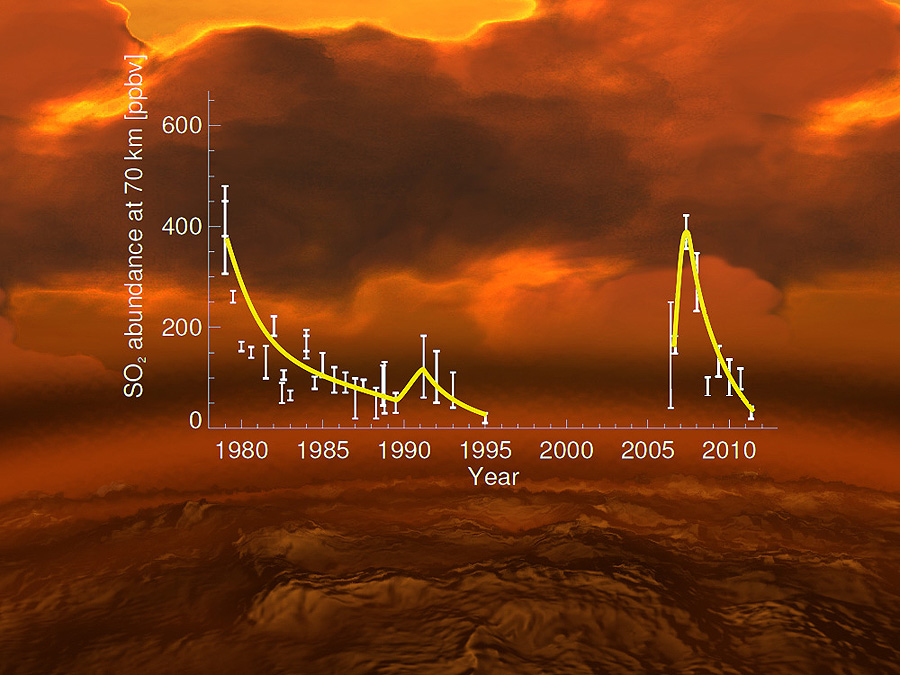
     The rise and fall of sulphur dioxide in the upper atmosphere of Venus over the last 40 years, expressed in units of parts per billion by volume (ppbv). The dataset on the left is mostly from NASA’s Pioneer Venus, which was in orbit around Venus from 1978 to 1992. The dataset on the right is from ESA’s Venus Express, which has been studying Venus since 2006. A clear rise in the concentration of sulphur dioxide (SO2) concentration was observed at the start of the mission, with a subsequent decrease. The increase in sulphur dioxide can be interpreted either as evidence for volcanic activity or for decadal-scale variations in the circulation of Venus’ vast atmosphere.
    The data are superimposed on an artist impression of Venus, depicting a volcanic terrain surrounded by a thick, noxious atmosphere. 
    Credits: Data: E. Marcq et al. (Venus Express); L. Esposito et al. (earlier data); background image: ESA/AOES

     Immediately after arriving at Venus in 2006, the spacecraft recorded a significant increase in the average density of sulphur dioxide in the upper atmosphere, followed by a sharp decrease to values roughly ten times lower by today.
    A similar fall was also seen during NASA’s Pioneer Venus mission, which orbited the planet from 1978 to 1992.
    At that time, the preferred explanation was an earlier injection of sulphur dioxide from one or more volcanoes, with Pioneer Venus arriving in time for the decline.
    “If you see a sulphur dioxide increase in the upper atmosphere, you know that something has brought it up recently, because individual molecules are destroyed there by sunlight after just a couple of days,” says Dr Emmanuel Marcq of Laboratoire Atmosphères, Milieux, Observations Spatiales, France, and lead author of the paper published in Nature Geoscience.
    “A volcanic eruption could act like a piston to blast sulphur dioxide up to these levels, but peculiarities in the circulation of the planet that we don’t yet fully understand could also mix the gas to reproduce the same result,” adds co-author Dr Jean-Loup Bertaux, Principal Investigator for the instrument on Venus Express that made the detections.
    Venus has a ‘super-rotating’ atmosphere that whips around the planet in just four Earth-days, much faster than the 243 days the planet takes to complete one rotation about its axis.
    Such rapid atmospheric circulation spreads the sulphur dioxide around, making it difficult to isolate any individual points of origin for the gas.
    Dr Marcq’s team speculate that if volcanism was responsible for the initial increase, then it could come from a relatively gentle increased output of several active volcanoes rather than one dramatic eruption.
    “Alternatively, and taking into account the similar trend observed by Pioneer Venus, it’s possible that we are seeing decadal-scale variability in the circulation of the atmosphere, which is turning out to be even more complex than we could ever have imagined,” he notes.
    “By following clues left by trace gases in the atmosphere, we are uncovering the way Venus works, which could point us to the smoking gun of active volcanism,” adds Håkan Svedhem, ESA’s Project Scientist for Venus Express.


    Notes for Editors
     ESA
    Guillermo Gonzalo Sánchez Achutegui
    ayabaca@gmail.com
    ayabaca@hotmail.com
    ayabaca@yahoo.com
     Inscríbete en el Foro del blog y participa : A Vuelo De Un Quinde - El Foro!

    domingo, 22 de julio de 2012

    The Earth : Carbon Monoxide

    Hi My Friends: A VUELO DE UN QUINDE EL BLOG., In the United States, Europe, and eastern China, on the other hand, the highest carbon monoxide concentrations occur around urban areas as a result of vehicle and industrial emissions. Fires burning over large areas in North America and Russia in some years can be an important source. The MOPITT observations often show that pollution emitted on one continent can travel across oceans to have a big impact on air quality on other continents.
     Global Maps
    colorbar

    Carbon Monoxide

    Carbon Monoxide
    May 2012 March 2000
    Skip to beginning
    Step back one
    Play
    Step forward one
    Skip to end
    Colorless, odorless, and poisonous, carbon monoxide is one of the six major air pollutants regulated in the United States and in many other nations around the world. When carbon-based fuels, such as coal, wood, and oil, burn incompletely or inefficiently, they produce carbon monoxide. The gas is spread by winds and circulation patterns throughout the lower atmosphere (called the troposphere).
    These maps show monthly averages of global concentrations of tropospheric carbon monoxide at an altitude of about 12,000 feet. The data were collected by the MOPITT (Measurements Of Pollution In The Troposphere) sensor on NASA’s Terra satellite. Concentrations of carbon monoxide are expressed in parts per billion by volume (ppbv). A concentration of 1 ppbv means that for every billion molecules of gas in the measured volume, one of them is a carbon monoxide molecule. Yellow areas have little or no carbon monoxide, while progressively higher concentrations are shown in orange and red. Places where the sensor didn’t collect data, perhaps due to clouds, are gray.
    In different parts of the world and in different seasons, the amounts and sources of atmospheric carbon monoxide change. In Africa, for example, the seasonal shifts in carbon monoxide are tied to the widespread agricultural burning that shifts north and south of the equator with the seasons. Fires are an important source of carbon monoxide pollution in other regions of the Southern Hemisphere, such as the Amazon and Southeast Asia.
    In the United States, Europe, and eastern China, on the other hand, the highest carbon monoxide concentrations occur around urban areas as a result of vehicle and industrial emissions. Fires burning over large areas in North America and Russia in some years can be an important source. The MOPITT observations often show that pollution emitted on one continent can travel across oceans to have a big impact on air quality on other continents.
    Carbon monoxide is a trace gas in the atmosphere, and it does not have a direct effect on the global temperature, like methane and carbon dioxide do. However, carbon monoxide plays a major role in atmospheric chemistry, and it affects the ability of the atmosphere to cleanse itself of many other polluting gases. In combination with other pollutants and sunshine, it also takes part in the formation of lower-atmospheric (“bad”) ozone and urban smog.
    View, download, or analyze more of these data from NASA Earth Observations (NEO):
    Carbon Monoxide
    NASA
    Guillermo Gonzalo Sánchez Achutegui
    ayabaca@hotmail.com
    ayabaca@gmail.com
    ayabaca@yahoo.com
     Inscríbete en el Foro del blog y participa : A Vuelo De Un Quinde - El Foro!

    Mi lista de blogs