Mostrando entradas con la etiqueta InSight. Mostrar todas las entradas

domingo, 26 de diciembre de 2021

CIENCIA : Estos son los avances científicos más importantes de 2021 según la revista ‘Science’

Hola amigos: A VUELO DE UN QUINDE EL BLOG., durante el año 2021, que está terminando la ciencia ha logrado múltiples avances, tal como lo destaca la revista científica SCIENCE, que destaca la capacidad de predecir la estructura tridimensional 3D, de las proteínas mediante la inteligencia artificial, destaca asimismo el desplazamiento sobre Marte el Modulo de Aterrizaje  Insight y la extracción del ADN humano antiguo en sedimentos, entre otros adelantos científicos ....... ...siga leyendo...... 

La capacidad de predecir la estructura tridimensional de las proteínas mediante inteligencia artificial encabeza este año el ranking de los hitos científicos, entre los que también figuran otros como los nuevos fármacos contra la covid-19, medidas del muon que desafían el modelo estándar de la física, aplicaciones in vivo de CRISPR y la extracción de ADN humano antiguo en sedimentos.


17 de diciembre de 2021, 14:00 | Actualizado a 


Modelos de estructura en 3D de distintas proteínas por el algoritmo RoseTTAFold.

Foto: Minkyung Baek & AAAS

Predicción de la estructura de las proteínas mediante IA

La solución a un problema que ha tenido en jaque a los científicos durante casi 50 años es, para Science, el descubrimiento más destacado de 2021.

Utilizando un algoritmo de inteligencia artificial (AlphaFold, de la empresa británica Deepmind), los científicos han logrado predecir la compleja estructura tridimensional que adopta una cadena de aminoácidos al plegarse para dar lugar a una proteína funcional.

“Esto supone un avance en dos frentes”, explica el editor jefe de ScienceHolden Thorp, “primero porque resuelve un problema que ha traído de cabeza a los investigadores durante casi medio siglo; y, segundo, porque va a convertirse en una herramienta revolucionaria que incrementará el desarrollo científico, como en su día lo fueron CRISPR o la criomicroscopía electrónica”.

AlphaFold predice la compleja estructura tridimensional que adoptará una cadena de aminoácidos al plegarse para dar lugar a una proteína funcional

Las proteínas son consideradas los ladrillos fundamentales de la vida, y su funcionalidad depende directamente de la estructura tridimensional que adopten. En el pasado, determinar su estructura requería tiempo y el uso de complejos y costosos procesos de laboratorio.

Pero este año, dos artículos simultáneos publicados en Nature y Science presentaron los algoritmos de aprendizaje automático AlphaFold y RoseTTA- Fold. Ambos resuelven el “problema del plegamiento de proteínas”, demostrando que pueden determinar la estructura en la que se pliega una proteína basándose solo en los aminoácidos que contiene. Todo un hito histórico en biotecnología.

Los autores han hecho pública la base de datos con los modelos de predicciones, que está disponible para aquellos investigadores o investigadoras que quieran usarla.

Dos avances para luchar contra la COVID-19

Las vacunas están teniendo un papel crucial para frenar la pandemia, pero un nuevo actor se ha unido a ellas: los antivirales, que previenen los síntomas y la muerte si se toman en una fase temprana de la infección. Se ha informado de resultados positivos con PF-07321332 de Pfizer y Molnupiravir de Merck, y algunos genéricos como la fluvoxamina (usada en el tratamiento del trastorno obsesivo-compulsivo) también podrían resultar útiles, pero se sigue investigando.

Estos antivirales representan otro de los logros del año para la revista Science, que apunta uno más en este campo: el desarrollo de medicamentos basados en anticuerpos monoclonales, ya que ayudan a luchar contra el SARS-CoV-2 y otros virus, como el VIH. Para fabricarlos se aíslan los anticuerpos más potentes de animales de laboratorio y humanos, y luego se reproducen en cantidades masivas.

Este año se han presentado diversos medicamentos antivirales que ayudan a combatir el SARS-CoV-2, incluyendo algunos basados en anticuerpos monoclonales

En el caso de la COVID-19, su objetivo es la proteína de la espiga o S del coronavirus (que este utiliza para entrar en las células humanas), impidiendo así su función.

Algunos ejemplos son los medicamentos Ronapreve y Regkirona, que en noviembre la Comisión Europea consideró como opciones terapéuticas prometedoras, o casirivimab e imdevimab, recomendados por la OMS en ciertos casos. Si se utilizan en las primeras etapas de la infección, reducen significativamente la hospitalización y las muertes en pacientes con riesgo de COVID-19 grave.

Nuevas medidas de muon que desafían el modelo estándar

En abril de 2021 se publicaron las conclusiones del experimento Muon g-2, llevados a cabo en el laboratorio estadounidense Fermilab.

Los resultados generaron un gran revuelo en la comunidad científica al mostrar que los muones —partículas fundamentales 200 veces más masivas que el electrón— se comportan de una forma distinta a la que predice el modelo estándar de física de partículas, lo que parece insinuar que están interaccionando con otras partículas o fuerzas desconocidas.

El comportamiento de los muones parece desafiar el modelo estándar de física de partículas

Sin embargo, los datos combinados de Fermilab y un experimento anterior, realizado en el Laboratorio Nacional de Brookhaven (EE.UU.), muestran una discrepancia con la teoría que presenta una desviación estándar o significación de 4,2 sigma, un poco menos de las 5 sigma que los científicos requieren para afirmar un verdadero descubrimiento.

Aun así, es una señal convincente de nueva física. Según los investigadores, la probabilidad de que los resultados sean una fluctuación estadística es de aproximadamente 1 entre 40.000.

El análisis de los datos del segundo y tercer run —período de ejecución— de Muon g-2 ya se está realizando, la cuarta fase está en curso, y hay prevista una quinta. La combinación de los resultados de las cinco ejecuciones proporcionará a los científicos una medición aún más precisa del bamboleo del muon, revelando con mayor certeza si efectivamente se esconden fuerzas o física desconocida dentro de la espuma cuántica.

Observaciones sísmicas del interior de Marte

En julio de 2021 se publicaron los primeros datos del módulo de aterrizaje Insight de la NASA, diseñado para recoger la actividad sísmica del planeta rojo.

Los editores de Science lo han elegido entre los hitos más representativos de la ciencia en este año porque Insight ha proporcionado información clave sobre la estructura interna y composición del cuarto planeta del sistema solar.

Las ondas sísmicas mostraron que el planeta rojo tiene una fina corteza, un manto poco profundo y un núcleo líquido inusualmente grande. Los nuevos datos ofrecen pistas sobre cómo se formó Marte hace miles de millones de años y cómo ha evolucionado a su estado actual.

Insight cuenta con participación española en su estación medioambiental TWINS, diseñada por el Centro de Astrobiología.


El módulo de aterrizaje de la NASA, Insight.

Foto: NASA

Obtención de ADN humano antiguo en sedimentos

Hace poco más de una década, el sueco Svante Pääbo revolucionaba el campo de la paleontología fundando la paleogenómica, el análisis de ADN antiguo a partir de restos fósiles.

Pero, como destaca Science, en 2021 se ha demostrado que ya no son imprescindibles esos restos humanos fósiles para secuenciar el ADN, si no que basta con analizar el sedimento de una cueva prehistórica para identificar a sus antiguos pobladores.

Ya no hacen falta restos humanos fósiles para secuenciar el ADN, si no que basta con analizar el sedimento de una cueva prehistórica

Gracias a esta técnica, el equipo liderado por Benjamin Vernot, del Instituto Max Planck de Antropología Evolutiva (Alemania), ha conseguido obtener ADN mitocondrial y ADN nuclear de varios individuos neandertales —de los que no existen restos fósiles— en dos yacimientos de los montes Altai, en Siberia, y en la Galería de las Estatuas de la Cueva Mayor de la Sierra de Atapuerca (Burgos).

Aplicación in vivo de la técnica CRISPR

Las aplicaciones de la técnica de edición genética CRISPR-Cas9, —que valió a sus creadoras el Nobel de Química en 2020— no paran de aumentar. Hasta ahora, todos los tratamientos que usaban estas tijeras genéticas eran ex vivo, es decir, administrados en una muestra en el laboratorio. La revista Science destaca que este año se ha dado un paso más aplicando la tecnología CRISPR directamente en el cuerpo, in vivo.

En 2021 los científicos han dado un paso más con la tecnología CRISPR al aplicarla directamente en el cuerpo de pacientes, con enfermedades como la amiloidosis heridataria y la amaurosis congénita

Para luchar contra la amiloidosis hereditaria mediada por transtiretina (AhTTR), una enfermedad en la que una proteína TTR mal plegada se acumula y daña los nervios y el corazón, investigadores de Intellia Therapeutics y Regeneron Pharmaceuticals (EE UU) administraron a seis pacientes diminutas bolas de grasa que con un ARN guía y las instrucciones de una enzima CRISPR para cortar el gen defectuoso, y funcionó. Al cabo de cuatro semanas, los niveles medios de TTR en sangre se redujeron un 52 % o un 87 %, según la dosis, según informaron en The New England Journal of Medicine.

En otra investigación, científicos de Editas Medicine (EE UU) inyectaron un virus inofensivo portador de ADN CRISPR en los ojos de seis adultos con un trastorno hereditario de la visión denominado amaurosis congénita de Leber, y al cabo de unos meses dos pacientes, que habían estado casi completamente ciegos, podían percibir más luz y uno de ellos pudo correr una carrera de obstáculos con poca luz.

El desarrollo exitoso de este tipo de terapia puede sentar las bases para el tratamiento de multitud de dolencias de origen genético, aunque estas investigaciones se encuentran todavía en una fase incipiente.

La ‘cría’ de embriones abre ventanas en el desarrollo temprano

El conocimiento de las primeras etapas del desarrollo embrionario ayuda a entender los abortos espontáneos y los defectos congénitos, así como a perfeccionar los protocolos de fecundación in vitro, pero limitaciones legales y éticas restringen el estudio con embriones humanos.

Se ha conseguido alargar la vida de embriones de ratón extraídos de la madre y crear réplicas de blastocistos, una etapa embrionaria crucial

Este año, la comunidad científica ha avanzado en posibles soluciones. En marzo un equipo consiguió alargar hasta 11 días (en lugar de 3 o 4 como hasta ahora) la vida de embriones de ratón extraídos de la madre. El paso clave es girar los frascos donde están, como si fuera una noria, de tal forma que los nutrientes llegan mejor. Los embriones se sometieron a una etapa de reorganización celular y les crecieron algunos órganos y las patas traseras.

Otros equipos crearon réplicas de blastocisto (una etapa embrionaria crucial) a partir de células madre embrionarias humanas o bien células adultas reprogramadas. Estos trabajos permitirán comprender mejor los defectos del desarrollo temprano y a avanzar en nuevas terapias de reproducción asistida. No son embriones reales, pero ayudan en la investigación y son menos controvertidos.

En 2021, la organización internacional que establece las directrices para la investigación con células madre también ha relajado la prohibición de cultivar embriones humanos en el laboratorio durante más de 14 días, lo que facilita su estudio más allá de esas dos semanas.

Drogas psicodélicas para tratar el estrés postraumático

El trastorno de estrés postraumático es una dolencia psiquiátrica que afecta a la vida de cientos de millones de personas al año. El poder de alteración de la mente de las drogas psicodélicas ha suscitado la esperanza de que puedan aliviar enfermedades psiquiátricas como esta, pero pocos ensayos grandes y rigurosos han demostrado su eficacia.

En este contexto, en mayo se publicó un estudio que destaca la utilidad y efectividad de drogas recreativas actualmente ilegales, como el MDMA —éxtasis— o el alucinógeno psilocibina. Estas sustancias, combinadas con terapia conversacional, pueden crear una sensación de bienestar y empatía que ayude a las personas a procesar sus experiencias traumáticas

En noviembre, la empresa británica COMPASS Pathways anunció también los resultados positivos de un ensayo aleatorio realizado con psilocibina, un compuesto obtenido de las setas con potencial para ser aplicado en personas con depresión resistente al tratamiento. En cualquier caso, las investigaciones sobre todos estos controvertidos compuestos y el debate sobre su regulación continúa.

Resultado inesperado en fusión nuclear

Este año se ha producido un resultado en la National Ignition Facility (NIF, en EE.UU.) que sorprendió a sus propios investigadores: una reacción de fusión que se acercó como nunca antes al ‘punto de equilibrio’ oficial, aquel en el que una reacción produce más energía que la que necesita el láser para encenderla.

En la National Ignition Facility de EE UU este año se ha obtenido un resultado sobre fusión nuclear que ha sorprendido a sus propios científicos

La fusión nuclear, que alimenta al Sol y otras estrellas, se considera como una futura solución a los problemas energéticos de la Tierra, pero conseguir las enormes presiones y temperaturas que requiere es extremadamente difícil. Muchos esfuerzos se centran en confinar un plasma supercaliente en un campo magnético mediante enormes electroimanes, como en el ITER que se está construyendo en Francia.

Lo que utiliza el NIF es el pulso del láser de mayor energía del mundo para comprimir una cápsula del tamaño de un grano de pimienta con isótopos de deuterio y tritio. A principios de este año, este método generó 170 kilojulios de energía de fusión por disparo, muy por debajo de la entrada del láser de 1,9 megajulios, pero otro ‘tiro’ el 8 de agosto lo aumentó a 1,35 megajulios.

Este buen resultado, destacado también por Science, todavía no ha sido analizado por una revista científica y los investigadores tratan de entenderlo e incluso mejorarlo. Varios expertos predicen que lograrán generar energía mucho antes que el ITER, que tiene en frente a otros proyectos de fusión nuclear (Commonwealth Fusion Systems, Tokamak Energy, General Fusion y TAE Technologies Energy) que también han presentado avances en 2021.

La vacunación COVID-19 infantil con todo detalle: 17 preguntas y respuestas útiles

MÁS INFORMACIÓN

17 PREGUNTAS Y RESPUESTAS SOBRE LA VACUNACIÓN INFANTIL

*SINC, el Servicio de Información y Noticias Científicas, es la agencia de noticias científicas de la Fundación Española para la Ciencia y la Tecnología (FECYT)

NATIONAL GEOGRAPHIC
Guillermo Gonzalo Sánchez Achutegui

viernes, 30 de noviembre de 2018

MARTE : NASA .- ROBOT INSIGHT .- InSight Aterriza con Éxito en Marte y Despliega sus Paneles Solares

Hola amigos: A VUELO DE UN QUINDE EL BLOG., la agencia espacial norteamericana NASA, logró con éxito el aterrizaje(amartizaje) del Robot InSight en Elysium Planitia  en el Planeta Marte; el 26 de noviembre del 2018.
NASA .- narró : El aterrizador InSight de la NASA ha enviado señales a la Tierra indicando que sus paneles solares están abiertos y que recogen luz solar en la superficie marciana. La sonda espacial Mars Odyssey de la NASA transmitió las señales que se recibieron en la Tierra aproximadamente a la 1:30 GMT de la madrugada del martes 27 de Noviembre. El despliegue de los paneles solares garantiza que la nave pueda recargar sus baterías cada día. Odyssey también transmitió un par de imágenes que muestran el lugar del aterrizaje de InSight.
"El equipo de InSight puede descansar un poco más fácil esta noche ahora que sabemos que los paneles solares de la nave espacial están desplegados y recargando las baterías", dijo Tom Hoffman, gerente del proyecto InSight en el Laboratorio de Propulsión a Chorro de la NASA en Pasadena, California, que lidera la misión. "Ha sido un día largo para el equipo. Pero mañana comienza un nuevo y emocionante capítulo para InSight: operaciones de superficie y el comienzo de la fase de implementación del instrumento..."


InSight es la NASA robotic lander diseñado para estudiar el interior del planet Mars. La misionera lanzada el 5 de mayo de 2018 a las 11:05 UTC y se espera que sea de tierra en la superficie de Mars a Elysium Planitia el 26 de noviembre de 2018. ESA ha apoyado la misión desde que fue lanzada, En el caso de que se produzca un error en el sistema operativo, se debe tener en cuenta que el sistema operativo no es compatible con el sistema operativo.
http://www.esa.int/spaceinimages/Images/2018/11/NASA_s_InSight_lander_operating_on_the_surface_of_Mars
ESA

InSight Aterriza con Éxito en Marte y Despliega sus Paneles Solares

InSight Aterriza con Éxito en Marte y Despliega sus Paneles Solares
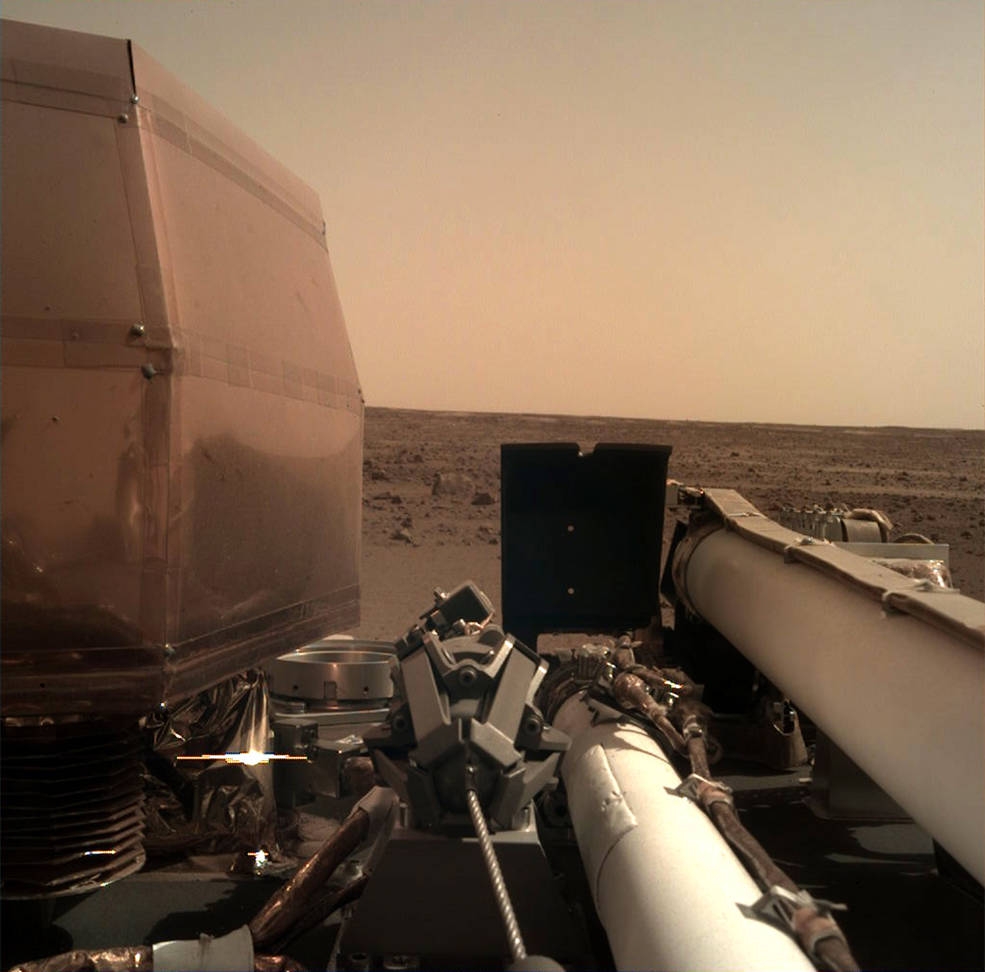
La Cámara de Implementación de Instrumentos (IDC), ubicada en el brazo robot de InSight, tomó esta fotografía de la superficie marciana el 26 de Noviembre de 2018,
el mismo día en que la nave espacial aterrizó en el Planeta Rojo. La cubierta transparente para el polvo de la cámara aún está en esta imagen, para evitar que las
partículas levantadas durante el aterrizaje se asienten en la lente de la cámara. Esta imagen fue transmitida desde InSight a la Tierra a través de la nave espacial
Odyssey de la NASA, actualmente en órbita alrededor de Marte. Image Credit: NASA/JPL-Caltech

El aterrizador InSight de la NASA ha enviado señales a la Tierra indicando que sus paneles solares están abiertos y que recogen luz solar en la superficie marciana. La sonda espacial Mars Odyssey de la NASA transmitió las señales que se recibieron en la Tierra aproximadamente a la 1:30 GMT de la madrugada del martes 27 de Noviembre. El despliegue de los paneles solares garantiza que la nave pueda recargar sus baterías cada día. Odyssey también transmitió un par de imágenes que muestran el lugar del aterrizaje de InSight.
"El equipo de InSight puede descansar un poco más fácil esta noche ahora que sabemos que los paneles solares de la nave espacial están desplegados y recargando las baterías", dijo Tom Hoffman, gerente del proyecto InSight en el Laboratorio de Propulsión a Chorro de la NASA en Pasadena, California, que lidera la misión. "Ha sido un día largo para el equipo. Pero mañana comienza un nuevo y emocionante capítulo para InSight: operaciones de superficie y el comienzo de la fase de implementación del instrumento".
Los paneles solares gemelos de InSight tienen 2,2 metros de ancho; cuando están abiertos, todo el módulo de aterrizaje tiene aproximadamente el tamaño de un coche convertible grande de la década de 1960. Marte tiene una luz solar más débil que la Tierra porque está mucho más lejos del Sol. Pero el módulo de aterrizaje no necesita mucho para operar: los paneles proporcionan de 600 a 700 vatios en un día claro, suficiente para alimentar una licuadora doméstica y mucho para mantener a sus instrumentos dirigiendo la ciencia en el Planeta Rojo. Incluso cuando el polvo cubra los paneles, lo que es probable que ocurra con frecuencia en Marte, deberían poder proporcionar al menos de 200 a 300 vatios.
Los paneles están inspirados en aquellos utilizados con el Phoenix Mars Lander de la NASA, aunque los de InSight son un poco más grandes para proporcionar más potencia y aumentar su resistencia estructural. Estos cambios fueron necesarios para apoyar las operaciones durante un año completo en Marte (dos años terrestres).
En los próximos días, el equipo de la misión desarmará el brazo robótico de InSight y usará la cámara adjunta para tomar fotos del suelo para que los ingenieros puedan decidir dónde colocar los instrumentos científicos de la nave espacial. Pasarán de dos a tres meses antes de que esos instrumentos se implementen por completo y envíen datos.
Mientras tanto, InSight utilizará sus sensores meteorológicos y magnetómetro para tomar lecturas de su lugar de aterrizaje en Elysium Planitia, su nuevo hogar en Marte.
 
Actualizado: 27/11/2018

Todo Listo Para la Llegada a Marte de la Misión InSight el Próximo Lunes

Todo Listo Para la Llegada a Marte de la Misión InShight el Próximo Lunes
Concepto artístico de la reentrada de InSight en la atmósfera de Marte. Image Credit: NASA/JPL-Caltech

La nave espacial InSight va por buen camino para un aterrizaje suave en la superficie del Planeta Rojo el 26 de Noviembre, el lunes después del Día de Acción de Gracias. Pero no será un fin de semana relajante con sobras de pavo, fútbol y compras para el equipo de la misión de InSight. Los ingenieros estarán atentos al flujo de datos que indican la salud y trayectoria de InSight, y monitorearán los informes meteorológicos marcianos para determinar si el equipo necesita realizar algún ajuste final en la preparación para el aterrizaje, a solo unos días.
"Llegar a Marte es difícil. Requiere habilidad, enfoque y años de preparación", dijo Thomas Zurbuchen, administrador asociado de la Dirección de Misiones Científicas en la sede de la NASA en Washington. "Teniendo en cuenta nuestro ambicioso objetivo de enviar a los humanos a la superficie de la Luna y luego a Marte, sé que nuestro increíble equipo de ciencia e ingeniería, el único en el mundo que ha aterrizado con éxito una nave espacial en la superficie marciana, hará todo lo que pueda. Puede aterrizar con éxito InSight en el Planeta Rojo ".
InSight, la primera misión para estudiar el interior profundo de Marte, despegó desde la Base de la Fuerza Aérea de Vandenberg en el centro de California el 5 de Mayo de 2018. Ha sido un vuelo sin incidentes a Marte, y los ingenieros lo aprecian así. Tendrán mucha emoción cuando InSight llegue a la cima de la atmósfera marciana a 19.800 kilómetros por hora y reduzca la velocidad a 8 kilómetros por hora, antes de que sus tres patas toquen el suelo marciano. Esa desaceleración extrema tiene que suceder en poco menos de siete minutos. Tras esos siete minutos de descenso atravesando la peligrosa atmósfera de Marte, InSight tocará suelo marciano el lunes sobre las 20:00 GMT.  
"Hay una razón por la que los ingenieros llaman el aterrizaje los siete minutos del terror de Marte", dijo Rob Grover, líder de entrada, descenso y aterrizaje (EDL) de InSight, con sede en el Laboratorio de Propulsión a Chorro de la NASA en Pasadena, California. "No podemos usar el joystick para el aterrizaje, por lo que tenemos que confiar en los comandos que pre-programamos en la nave. Hemos pasado años probando nuestros planes, aprendiendo de otros aterrizajes de Marte y estudiando todas las condiciones que Marte puede ofrecernos. Y nos mantendremos atentos hasta que InSight se establezca en su hogar en la región de Elysium Planitia ".
Una forma en que los ingenieros pueden confirmar rápidamente las actividades que InSight ha completado durante esos siete minutos de terror es si la misión experimental de CubeSat conocida como Mars Cube One (MarCO) transmite datos de InSight a la Tierra casi en tiempo real durante su sobrevuelo el 26 de Noviembre. Las dos naves espaciales MarCO (A y B) están progresando hacia su punto de encuentro, y sus radios ya han pasado sus primeras pruebas en el espacio profundo.
"Solo sobreviviendo al viaje hasta el momento, los dos satélites MarCO han dado un gran salto para los CubeSats", dijo Anne Marinan, ingeniera de sistemas de MarCO con sede en JPL. "Y ahora nos estamos preparando para la próxima prueba de las MarCO: servir como un posible modelo para un nuevo tipo de retransmisión de comunicaciones interplanetarias".
Si todo va bien, los MarCO pueden tardar unos segundos en recibir y formatear los datos antes de enviarlos a la Tierra a la velocidad de la luz. Esto significaría que los ingenieros de JPL y otro equipo de Lockheed Martin Space en Denver podrían decir lo que hizo el módulo de aterrizaje durante el EDL aproximadamente ocho minutos después de que InSight complete sus actividades. Sin MarCO, el equipo de InSight tendría que esperar varias horas para que los datos de ingeniería regresen a través de las vías de comunicación principales: los relevos a través de las sondas espaciales MRO y Odyssey de la NASA en Marte.
Una vez que los ingenieros sepan que la nave espacial ha aterrizado de manera segura en una de las varias formas en que tienen que confirmar este hito y que los paneles solares de InSight se han desplegado correctamente, el equipo puede instalarse en el proceso cuidadoso de tres meses de implementación de instrumentos científicos.
"Aterrizar en Marte es emocionante, pero los científicos esperan con ansias el momento después de que InSight aterrice", dijo Lori Glaze, directora en funciones de la División de Ciencia Planetaria en la sede de la NASA. "Una vez que InSight se haya establecido en el Planeta Rojo y se hayan desplegado sus instrumentos, comenzará a recopilar información valiosa sobre la estructura del interior profundo de Marte, información que nos ayudará a comprender la formación y evolución de todos los planetas rocosos, incluido el que llamamos casa."
"Las misiones anteriores no han sido tan profundas en Marte", agregó Sue Smrekar, investigadora principal adjunta de la misión InSight en JPL. "Los científicos de InSight no pueden esperar para explorar el corazón de Marte".

 
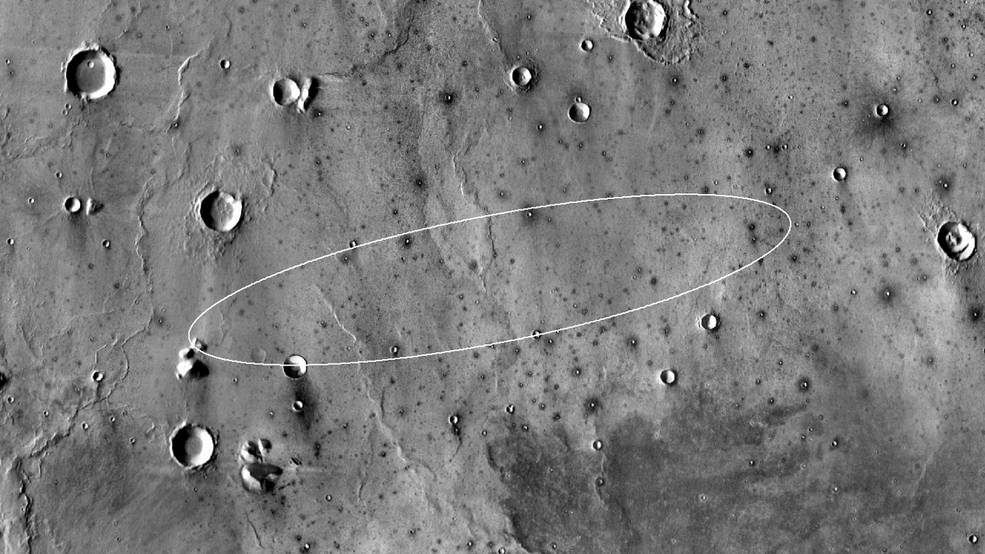
Lugar aterrizaje de InSight
La sonda espacial Mars Odyssey tomó esta imagen de la zona de aterrizaje de InSight. Image Credit: NASA/JPL-Caltech
 
 
Actualizado: 22/11/2018    

NASA InSight Team on Course for Mars Touchdow

 artist's impression of NASA InSight's entry, descent and landing at Mars
An artist's impression of NASA InSight's entry, descent and landing at Mars, scheduled for Nov. 26, 2018.
Credits: NASA/JPL-Caltech
NASA's Mars Interior Exploration using Seismic Investigations, Geodesy and Heat Transport (InSight) spacecraft is on track for a soft touchdown on the surface of the Red Planet on Nov. 26, the Monday after Thanksgiving. But it's not going to be a relaxing weekend of turkey leftovers, football and shopping for the InSight mission team. Engineers will be keeping a close eye on the stream of data indicating InSight's health and trajectory, and monitoring Martian weather reports to figure out if the team needs to make any final adjustments in preparation for landing, only five days away.

"Landing on Mars is hard. It takes skill, focus and years of preparation," said Thomas Zurbuchen, associate administrator for the Science Mission Directorate at NASA Headquarters in Washington. "Keeping in mind our ambitious goal to eventually send humans to the surface of the Moon and then Mars, I know that our incredible science and engineering team — the only in the world to have successfully landed spacecraft on the Martian surface — will do everything they can to successfully land InSight on the Red Planet."

InSight, the first mission to study the deep interior of Mars, blasted off from Vandenberg Air Force Base in Central California on May 5, 2018. It has been an uneventful flight to Mars, and engineers like it that way. They will get plenty of excitement when InSight hits the top of the Martian atmosphere at 12,300 mph (19,800 kph) and slows down to 5 mph (8 kph) — about human jogging speed — before its three legs touch down on Martian soil. That extreme deceleration has to happen in just under seven minutes.
 
 artist's illustration shows NASA's four successful Mars rovers
This artist's illustration shows NASA's four successful Mars rovers (from left to right): Sojourner, Spirit and Opportunity, and Curiosity. The image also shows the upcoming Mars 2020 rover and a human explorer.
Credits: NASA
 
"There's a reason engineers call landing on Mars 'seven minutes of terror,'" said Rob Grover, InSight's entry, descent and landing (EDL) lead, based at NASA's Jet Propulsion Laboratory in Pasadena, California. "We can't joystick the landing, so we have to rely on the commands we pre-program into the spacecraft. We've spent years testing our plans, learning from other Mars landings and studying all the conditions Mars can throw at us. And we're going to stay vigilant till InSight settles into its home in the Elysium Planitia region."

One way engineers may be able to confirm quickly what activities InSight has completed during those seven minutes of terror is if the experimental CubeSat mission known as Mars Cube One (MarCO) relays InSight data back to Earth in near-real time during their flyby on Nov. 26. The two MarCO spacecraft (A and B) are making good progress toward their rendezvous point, and their radios have already passed their first deep-space tests.
 
Science Fleet depicts the scope of NASA’s activity
NASA Science missions circle Earth, the Sun, the Moon, Mars and many other destinations within our solar system, including spacecraft that look out even further into our universe. The Science Fleet depicts the scope of NASA's activity and how our missions have traveled throughout the solar system.
Credits: NASA/GSFC
 
"Just by surviving the trip so far, the two MarCO satellites have made a giant leap for CubeSats," said Anne Marinan, a MarCO systems engineer based at JPL. "And now we are gearing up for the MarCOs' next test — serving as a possible model for a new kind of interplanetary communications relay."

If all goes well, the MarCOs may take a few seconds to receive and format the data before sending it back to Earth at the speed of light. This would mean engineers at JPL and another team at Lockheed Martin Space in Denver would be able to tell what the lander did during EDL approximately eight minutes after InSight completes its activities. Without MarCO, InSight's team would need to wait several hours for engineering data to return via the primary communications pathways — relays through NASA's Mars Reconnaissance Orbiter and Mars Odyssey orbiter.
 
This map shows the temperature of the Martian atmosphere 16 miles above the surface
This map shows the temperature of the Martian atmosphere 16 miles above the surface. The data were taken on Nov. 18, 2018, by NASA’s Mars Reconnaissance Orbiter, about one week before NASA's InSight lander is scheduled to touchdown on the Martian surface. The temperature indicates to mission scientists the amount of dust activity in the atmosphere. The map shows a range of latitudes, with temperatures clearly dropping near the planet's north pole. The landing locations of various NASA Mars landers are shown for context.
Credits: NASA/JPL-Caltech
 
Once engineers know that the spacecraft has touched down safely in one of the several ways they have to confirm this milestone and that InSight's solar arrays have deployed properly, the team can settle into the careful, three-month-long process of deploying science instruments.

"Landing on Mars is exciting, but scientists are looking forward to the time after InSight lands," said Lori Glaze, acting director of the Planetary Science Division at NASA Headquarters. "Once InSight is settled on the Red Planet and its instruments are deployed, it will start collecting valuable information about the structure of Mars' deep interior — information that will help us understand the formation and evolution of all rocky planets, including the one we call home."
 
This artist’s concept depicts the smooth, flat ground that dominates InSight's landing ellipse in the Elysium Planitia region
This artist’s concept depicts the smooth, flat ground that dominates InSight's landing ellipse in the Elysium Planitia region of Mars.
Credits: NASA/JPL-Caltech
 
"Previous missions haven't gone more than skin-deep at Mars," added Sue Smrekar, the InSight mission's deputy principal investigator at JPL. "InSight scientists can’t wait to explore the heart of Mars."
Image from the Mars Odyssey orbiter took this image of the target landing site for NASA's InSight lander.
The Mars Odyssey orbiter took this image of the target landing site for NASA's InSight lander.
Credits: NASA/JPL-Caltech/ASU
 
JPL manages InSight for NASA's Science Mission Directorate. InSight is part of NASA's Discovery Program, managed by the agency's Marshall Space Flight Center in Huntsville, Alabama. Lockheed Martin Space in Denver built the InSight spacecraft, including its cruise stage and lander, and supports spacecraft operations for the mission.
 
Artist's impression shows the major interior layers of Earth, Mars and the Moon.
The artist's impression shows the major interior layers of Earth, Mars and the Moon.
Credits: NASA/JPL-Caltech
 
A number of European partners, including France's Centre National d'Études Spatiales (CNES) and the German Aerospace Center (DLR), are supporting the InSight mission. CNES and the Institut de Physique du Globe de Paris (IPGP) provided the Seismic Experiment for Interior Structure (SEIS) instrument, with significant contributions from the Max Planck Institute for Solar System Research (MPS) in Germany, the Swiss Institute of Technology (ETH) in Switzerland, Imperial College and Oxford University in the United Kingdom, and JPL. DLR provided the Heat Flow and Physical Properties Package (HP3) instrument, with significant contributions from the Space Research Center (CBK) of the Polish Academy of Sciences and Astronika in Poland. Spain’s Centro de Astrobiología (CAB) supplied the wind sensors.
 
NASA's InSight Mars Lander in fully landed configuration in the clean room
NASA's InSight Mars Lander in fully landed configuration in the clean room at Lockheed Martin Space in Littleton, Colorado. Once the solar arrays are fully deployed on Mars, they can provide 600-700 watts on a clear day, or just enough to power a household blender.
Credits: Lockheed Martin

For more detailed information on the InSight mission, visit:


 For more information about MarCO, visit:


Jia-Rui Cook / D.C. Agle​
Jet Propulsion Laboratory, Pasadena, Calif.
818-354-5011
jccook@jpl.nasa.gov / agle@jpl.nasa.gov

Dwayne Brown / JoAnna Wendel
Headquarters, Washington
202-358-1726 / 202-358-1003
dwayne.c.brown@nasa.gov / joanna.r.wendel@nasa.gov
2018-272
Last Updated: Nov. 26, 2018
Editor: Tony Greicius


NASA InSight Landing on Mars: Milestones

This illustration shows a simulated view of NASA's InSight lander descending on its parachute
This illustration shows a simulated view of NASA's InSight lander descending on its parachute toward the surface of Mars.
Credits: NASA/JPL-Caltech
 
On Nov. 26, NASA's InSight spacecraft will blaze through the Martian atmosphere and attempt to set a lander gently on the surface of the Red Planet in less time than it takes to hard-boil an egg. InSight's entry, descent and landing (EDL) team, based at NASA's Jet Propulsion Laboratory in Pasadena, California, along with another part of the team at Lockheed Martin Space in Denver, have pre-programmed the spacecraft to perform a specific sequence of activities to make this possible.

The following is a list of expected milestones for the spacecraft, assuming all proceeds exactly as planned and engineers make no final changes the morning of landing day. Some milestones will be known quickly only if the experimental Mars Cube One (MarCO) spacecraft are providing a reliable communications relay from InSight back to Earth. The primary communications path for InSight engineering data during the landing process is through NASA's Mars Reconnaissance Orbiter and Mars Odyssey. Those data are expected to become available several hours after landing.

If all goes well, MarCO may take a few seconds to receive and format the data before sending it back to Earth at the speed of light. The one-way time for a signal to reach Earth from Mars is eight minutes and seven seconds on Nov. 26. Times listed below are in Earth Receive Time, or the time JPL Mission Control may receive the signals relating to these activities.

  • 11:40 a.m. PST (2:40 p.m. EST) — Separation from the cruise stage that carried the mission to Mars
  • 11:41 a.m. PST (2:41 p.m. EST) — Turn to orient the spacecraft properly for atmospheric entry
  • 11:47 a.m. PST (2:47 p.m. EST) — Atmospheric entry at about 12,300 mph (19,800 kph), beginning the entry, descent and landing phase
  • 11:49 a.m. PST (2:49 p.m. EST) — Peak heating of the protective heat shield reaches about 2,700°F (about 1,500°C)
  • 15 seconds later — Peak deceleration, with the intense heating causing possible temporary dropouts in radio signals
  • 11:51 a.m. PST (2:51 p.m. EST) — Parachute deployment
  • 15 seconds later — Separation from the heat shield
  • 10 seconds later — Deployment of the lander's three legs
  • 11:52 a.m. PST (2:52 p.m. EST) — Activation of the radar that will sense the distance to the ground
  • 11:53 a.m. PST (2:53 p.m. EST) — First acquisition of the radar signal
  • 20 seconds later — Separation from the back shell and parachute
  • 0.5 second later — The retrorockets, or descent engines, begin firing
  • 2.5 seconds later — Start of the "gravity turn" to get the lander into the proper orientation for landing
  • 22 seconds later — InSight begins slowing to a constant velocity (from 17 mph to a constant 5 mph, or from 27 kph to 8 kph) for its soft landing
  • 11:54 a.m. PST (2:54 p.m. EST) — Expected touchdown on the surface of Mars
  • 12:01 p.m. PST (3:01 p.m. EST) — "Beep" from InSight's X-band radio directly back to Earth, indicating InSight is alive and functioning on the surface of Mars
  • No earlier than 12:04 p.m. PST (3:04 p.m. EST), but possibly the next day — First image from InSight on the surface of Mars
  • No earlier than 5:35 p.m. PST (8:35 p.m. EST) — Confirmation from InSight via NASA's Mars Odyssey orbiter that InSight's solar arrays have deployed

For the latest updates on InSight’s status, visit:


The InSight press kit, with additional information about the mission time line, is available at:


JPL manages InSight for NASA's Science Mission Directorate. InSight is part of NASA's Discovery Program, managed by the agency's Marshall Space Flight Center in Huntsville, Alabama. Lockheed Martin Space in Denver built the InSight spacecraft, including its cruise stage and lander, and supports spacecraft operations for the mission.

A number of European partners, including France's Centre National d'Études Spatiales (CNES) and the German Aerospace Center (DLR), are supporting the InSight mission. CNES provided the Seismic Experiment for Interior Structure (SEIS) instrument, with significant contributions from the Max Planck Institute for Solar System Research (MPS) in Germany, the Swiss Institute of Technology (ETH) in Switzerland, Imperial College and Oxford University in the United Kingdom, and JPL. DLR provided the Heat Flow and Physical Properties Package (HP3) instrument, with significant contributions from the Space Research Center (CBK) of the Polish Academy of Sciences and Astronika in Poland. Spain’s Centro de Astrobiología (CAB) supplied the wind sensors.

For more information about InSight, visit:


InSight's success does not depend on MarCO being able to relay communications. Additional information about how InSight will communicate during entry, descent and landing is available here. JPL, a division of the California Institute of Technology in Pasadena, manages MarCO for NASA's Science Mission Directorate in Washington.


Jia-Rui Cook / Andrew Good
Jet Propulsion Laboratory, Pasadena, Calif.
818-354-5011
jccook@jpl.nasa.gov / andrew.c.good@jpl.nasa.gov

Dwayne Brown / JoAnna Wendel
NASA Headquarters, Washington
202-358-1726 / 202-358-1003
dwayne.c.brown@nasa.gov / joanna.r.wendel@nasa.gov
2018-273
Last Updated: Nov. 21, 2018
Editor: Tony Greicius


Mars New Home 'a Large Sandbox'

NASA’s InSight spacecraft popped the lens cover off its Instrument Context Camera (ICC) on Nov. 30, 2018
NASA’s InSight spacecraft popped the lens cover off its Instrument Context Camera (ICC) on Nov. 30, 2018, and captured this view of Mars. Located below the deck of the InSight lander, the ICC has a fisheye view, creating a curved horizon. Some clumps of dust are visible on the camera’s lens. One of the spacecraft’s footpads can be seen in the lower right corner. The seismometer’s tether box is in the upper left corner.
Credits: NASA/JPL-Caltech
 
With InSight safely on the surface of Mars, the mission team at NASA's Jet Propulsion Laboratory in Pasadena, California, is busy learning more about the spacecraft's landing site. They knew when InSight landed on Nov. 26 that the spacecraft had touched down on target, a lava plain named Elysium Planitia. Now they've determined that the vehicle sits slightly tilted (about 4 degrees) in a shallow dust- and sand-filled impact crater known as a "hollow." InSight has been engineered to operate on a surface with an inclination up to 15 degrees.

"The science team had been hoping to land in a sandy area with few rocks since we chose the landing site, so we couldn't be happier," said InSight project manager Tom Hoffman of JPL. "There are no landing pads or runways on Mars, so coming down in an area that is basically a large sandbox without any large rocks should make instrument deployment easier and provide a great place for our mole to start burrowing."

Rockiness and slope grade factor into landing safety and are also important in determining whether InSight can succeed in its mission after landing. Rocks and slopes could affect InSight's ability to place its heat-flow probe — also known as "the mole," or HP3 — and ultra-sensitive seismometer, known as SEIS, on the surface of Mars.
 
Animation of InSight spacecraft
As visible in this two-frame set of images, NASA’s InSight spacecraft unlatched its robotic arm on Nov. 27, 2018, the day after it landed on Mars.
Credits: NASA/JPL-Caltech
 
Touching down on an overly steep slope in the wrong direction could also have jeopardized the spacecraft's ability to get adequate power output from its two solar arrays, while landing beside a large rock could have prevented InSight from being able to open one of those arrays. In fact, both arrays fully deployed shortly after landing.

The InSight science team's preliminary assessment of the photographs taken so far of the landing area suggests the area in the immediate vicinity of the lander is populated by only a few rocks. Higher-resolution images are expected to begin arriving over the coming days, after InSight releases the clear-plastic dust covers that kept the optics of the spacecraft's two cameras safe during landing.

"We are looking forward to higher-definition pictures to confirm this preliminary assessment," said JPL's Bruce Banerdt, principal investigator of InSight. "If these few images — with resolution-reducing dust covers on — are accurate, it bodes well for both instrument deployment and the mole penetration of our subsurface heat-flow experiment."  

Once sites on the Martian surface have been carefully selected for the two main instruments, the team will unstow and begin initial testing of the mechanical arm that will place them there. 

Data downlinked from the lander also indicate that during its first full day on Mars, the solar-powered InSight spacecraft generated more electrical power than any previous vehicle on the surface of Mars.

"It is great to get our first 'off-world record' on our very first full day on Mars," said Hoffman. "But even better than the achievement of generating more electricity than any mission before us is what it represents for performing our upcoming engineering tasks. The 4,588 watt-hours we produced during sol 1 means we currently have more than enough juice to perform these tasks and move forward with our science mission." 

Launched from Vandenberg Air Force Base in California May 5, InSight will operate on the surface for one Martian year, plus 40 Martian days, or sols — the equivalent of nearly two Earth years. InSight will study the deep interior of Mars to learn how all celestial bodies with rocky surfaces, including Earth and the Moon, formed.

JPL manages InSight for NASA's Science Mission Directorate. InSight is part of NASA's Discovery Program, managed by the agency's Marshall Space Flight Center in Huntsville, Alabama.

A number of European partners, including France's Centre National d'Études Spatiales (CNES) and the German Aerospace Center (DLR), are supporting the InSight mission. CNES, and the Institut de Physique du Globe de Paris (IPGP), provided the SEIS instrument, with significant contributions from the Max Planck Institute for Solar System Research (MPS) in Germany, the Swiss Institute of Technology (ETH) in Switzerland, Imperial College and Oxford University in the United Kingdom, and JPL. DLR provided the HP3 instrument, with significant contributions from the Space Research Center (CBK) of the Polish Academy of Sciences and Astronika in Poland. Spain's Centro de Astrobiología (CAB) supplied the wind sensors.

For more information about InSight, visit:


For more information about NASA's Mars missions, go to:

DC Agle
Jet Propulsion Laboratory, Pasadena, Calif.
818-393-9011
agle@jpl.nasa.gov

Dwayne Brown / JoAnna Wendel
NASA Headquarters, Washington
202-358-1726 / 202-358-1003
dwayne.c.brown@nasa.gov / joanna.r.wendel@nasa.gov 
2018-278
Last Updated: Nov. 30, 2018
Editor: Tony Greicius

The Mars InSight Landing Site Is Just Plain Perfect

This artist’s concept depicts the smooth, flat ground that dominates InSight's landing ellipse in the Elysium Planitia region
This artist’s concept depicts the smooth, flat ground that dominates InSight's landing ellipse in the Elysium Planitia region of Mars.
Credits: NASA/JPL-Caltech
 
No doubt about it, NASA explores some of the most awe-inspiring locations in our solar system and beyond. Once seen, who can forget the majesty of astronaut Jim Irwin standing before the stark beauty of the Moon's Hadley Apennine mountain range, of the Hubble Space Telescope's gorgeous "Pillars of Creation" or Cassini's magnificent mosaic of Saturn?

Mars also plays a part in this visually compelling equation, with the high-definition imagery from the Curiosity rover of the ridges and rounded buttes at the base of Mount Sharp bringing to mind the majesty of the American Southwest. That said, Elysium Planitia – the site chosen for the Nov. 26 landing of NASA's InSight mission to Mars – will more than likely never be mentioned with those above because it is, well, plain. 

"If Elysium Planitia were a salad, it would consist of romaine lettuce and kale – no dressing," said InSight principal investigator Bruce Banerdt at NASA's Jet Propulsion Laboratory in Pasadena, California. "If it were an ice cream, it would be vanilla."

Yes, the landing site of NASA's next Mars mission may very well look like a stadium parking lot, but that is the way the Interior Exploration using Seismic Investigations, Geodesy and Heat Transport (InSight) project likes it.

"Previous missions to the Red Planet have investigated its surface by studying its canyons, volcanoes, rocks and soil," said Banerdt. "But the signatures of the planet's formation processes can be found only by sensing and studying evidence buried far below the surface. It is InSight's job to study the deep interior of Mars, taking the planet's vital signs – its pulse, temperature and reflexes."

Taking those vital signs will help the InSight science team look back to a time when the rocky planets of the solar system formed. The investigations will depend on three instruments:

A six-sensor seismometer called the Seismic Experiment for Interior Structure (SEIS) will record seismic waves traveling through the interior structure of the planet. Studying seismic waves will tell scientists what might be creating the waves. (On Mars, scientists suspect that the culprits may be marsquakes or meteorites striking the surface.)

The mission's Heat Flow and Physical Properties Package (HP3) will burrow deeper than any other scoop, drill or probe on Mars before to gauge how much heat is flowing out of the planet. Its observations will shed light on whether Earth and Mars are made of the same stuff.

Finally, InSight's Rotation and Interior Structure Experiment (RISE) experiment will use the lander's radios to assess the wobble of Mars' rotation axis, providing information about the planet's core.

For InSight to do its work, the team needed a landing site that checked off several boxes, because as a three-legged lander – not a rover – InSight will remain wherever it touches down.
 
 
The landing site for InSight
The landing site for InSight, in relation to landing sites for seven previous missions, is shown on a topographic map of Mars.
Credits: NASA/JPL-Caltech

"Picking a good landing site on Mars is a lot like picking a good home: It's all about location, location, location," said Tom Hoffman, InSight project manager at JPL. "And for the first time ever, the evaluation for a Mars landing site had to consider what lay below the surface of Mars. We needed not just a safe place to land, but also a workspace that's penetrable by our 16-foot-long (5-meter) heat-flow probe."

The site also needs to be bright enough and warm enough to power the solar cells while keeping its electronics within temperature limits for an entire Martian year (26 Earth months).

So the team focused on a band around the equator, where the lander's solar array would have adequate sunlight to power its systems year-round. Finding an area that would be safe enough for InSight to land and then deploy its solar panels and instruments without obstructions took a little longer.

"The site has to be a low-enough elevation to have sufficient atmosphere above it for a safe landing, because the spacecraft will rely first on atmospheric friction with its heat shield and then on a parachute digging into Mars' tenuous atmosphere for a large portion of its deceleration," said Hoffman. "And after the chute has fallen away and the braking rockets have kicked in for final descent, there needs to be a flat expanse to land on – not too undulating and relatively free of rocks that could tip the tri-legged Mars lander."

Of 22 sites considered, only Elysium Planitia, Isidis Planitia and Valles Marineris met the basic engineering constraints. To grade the three remaining contenders, reconnaissance images from NASA's Mars orbiters were scoured and weather records searched. Eventually, Isidis Planitia and Valles Marineris were ruled out for being too rocky and windy.

That left the 81-mile long, 17-mile-wide (130-kilometer-long, 27-kilometer-wide) landing ellipse on the western edge of a flat, smooth expanse of lava plain.
"If you were a Martian coming to explore Earth's interior like we are exploring Mars' interior, it wouldn't matter if you put down in the middle of Kansas or the beaches of Oahu," said Banerdt. "While I'm looking forward to those first images from the surface, I am even more eager to see the first data sets revealing what is happening deep below our landing pads. The beauty of this mission is happening below the surface. Elysium Planitia is perfect."


This map shows the single area under continuing evaluation
This map shows the single area under continuing evaluation as the InSight mission's Mars landing site, as of a year before the mission's May 2016 launch. The finalist ellipse marked is within the northern portion of flat-lying Elysium Planitia about four degrees north of Mars' equator.
Credits: NASA/JPL-Caltech
 
After a 205-day journey that began on May 5, NASA's InSight mission will touch down on Mars on Nov. 26 a little before 3 p.m. EST (12 p.m. PST). Its solar panels will unfurl within a few hours of touchdown. Mission engineers and scientists will take their time assessing their "workspace" prior to deploying SEIS and HP3 on the surface – about three months after landing – and begin the science in earnest.

InSight was the 12th selection in NASA's series of Discovery-class missions. Created in 1992, the Discovery Program sponsors frequent, cost-capped solar system exploration missions with highly focused scientific goals. 

JPL manages InSight for NASA's Science Mission Directorate. InSight is part of NASA's Discovery Program, managed by the agency's Marshall Space Flight Center in Huntsville, Alabama. Lockheed Martin Space in Denver built the InSight spacecraft, including its cruise stage and lander, and supports spacecraft operations for the misión.

A number of European partners, including France's Centre National d'Études Spatiales (CNES) and the German Aerospace Center (DLR), support the InSight mission. CNES provided the SEIS instrument, with significant contributions from the Max Planck Institute for Solar System Research (MPS) in Germany, the Swiss Institute of Technology (ETH) in Switzerland, Imperial College and Oxford University in the United Kingdom, and JPL. DLR provided the HP3 instrument.

For more information about InSight, visit:

https://mars.nasa.gov/insight/

For more information about NASA's Mars missions, go to:

https://mars.nasa.gov
 
DC Agle
Jet Propulsion Laboratory, Pasadena, Calif.
818-393-9011
agle@jpl.nasa.gov
Dwayne Brown / JoAnna Wendel
NASA Headquarters, Washington
202-358-1726 / 202-358-1003
dwayne.c.brown@nasa.gov / joanna.r.wendel@nasa.gov
2018-258
Last Updated: Nov. 21, 2018
Editor: Tony Greicius
 
NASA
Guillermo Gonzalo Sánchez Achutegui
Inscríbete en el Foro del blog y participa : A Vuelo De Un Quinde - El Foro!

Mi lista de blogs