Mostrando entradas con la etiqueta ESA’s Swarm mission scientist. Mostrar todas las entradas

domingo, 30 de octubre de 2016

ESA : Swarm reveals why satellites lose track .- Swarm revela por qué los satélites pierden la pista de su recorrido

http://www.esa.int/Our_Activities/Observing_the_Earth/Swarm/Swarm_reveals_why_satellites_lose_track
http://www.esa.int/Our_Activities/Observing_the_Earth/Swarm/Introducing_Swarm
 

GPS interruptions
 
28 October 2016
Satellite engineers have been puzzling over why GPS navigation systems on low-orbiting satellites like ESA’s Swarm sometimes black out when they fly over the equator between Africa and South America. Thanks to Swarm, it appears ‘thunderstorms’ in the ionosphere are to blame.
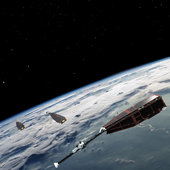
Launched in 2013, the Swarm trio is measuring and untangling the different magnetic fields that stem from Earth’s core, mantle, crust, oceans, ionosphere and magnetosphere – an undertaking of at least four years.
As with many satellites, ESA’s three Swarm satellites carry GPS receivers as part of their positioning system so that operators keep them in the correct orbits. In addition, GPS pinpoints where the satellites are making their scientific measurements.
However, sometimes the satellites lose their GPS connection. In fact, during their first two years in orbit, the link was broken 166 times.
A paper published recently describes how Swarm has revealed there is a direct link between these blackouts and ionospheric ‘thunderstorms’, around 300–600 km above Earth.
Claudia Stolle from the GFZ research centre in Potsdam, Germany said, “Ionospheric thunderstorms are well known, but now we have been able to show a direct link between these storms and the loss of connection to GPS.
 

GPS losses

“This is thanks to Swarm because it is the first time that high-resolution GPS and ionospheric patterns can be detected from the same satellite.”
These thunderstorms occur when the number of electrons in the ionosphere undergoes large and rapid changes. This tends to happen close to Earth’s magnetic equator and typically just for a couple of hours between sunset and midnight.
As its name suggests, the ionosphere is where atoms are broken up by sunlight, which leads to free electrons. A thunderstorm scatters these free electrons, creating small bubbles with little or no ionised material. These bubbles disturb the GPS signals so that the Swarm GPS receivers can lose track.
It transpires that 161 of the lost signal events coincided with ionospheric thunderstorms. The other five were over the polar regions and corresponded to increased strong solar winds that cause Earth’s protective magnetosphere to ‘wobble’.
Resolving the mystery of blackouts is not only good news for Swarm, but also for other low-orbiting satellites experiencing the same problem. It means that engineers can use this new knowledge to improve future GPS systems to limit signal losses.
Christian Siemes, who works at ESA on the mission, said, “In light of this new knowledge, we have been able to tune the Swarm GPS receivers so they are more robust, resulting in fewer blackouts.
 

Earth's protective shield
 
“Importantly, we are able to measure variations in the GPS signal which is not only interesting for engineers developing GPS instruments, but also interesting to advance our scientific understanding of upper-atmosphere dynamics.”
ESA’s Swarm mission manager, Rune Floberghagen, added, “What we see here is a striking example of a technical challenge being turned into exciting science, a true essence of an Earth Explorer mission such as Swarm.
“These new findings demonstrate that GPS can be used as a tool for understanding dynamics in the ionosphere related to solar activity. Perhaps one day we will also be able to link these ionospheric thunderstorms with the lightning we see from the ground.”
ESA
Guillermo Gonzalo Sánchez Achutegui
ayabaca@gmail.com
ayabaca@hotmail.com
ayabaca@yahoo.com
Inscríbete en el Foro del blog y participa : A Vuelo De Un Quinde - El Foro!

miércoles, 5 de octubre de 2016

ESA : Magnetic oceans and electric Earth .- Océanos Magnéticos de La Tierra................

http://www.esa.int/Our_Activities/Observing_the_Earth/Swarm/Magnetic_oceans_and_electric_Earth


Magnetic signal from ocean tides

3 October 2016 Oceans might not be thought of as magnetic, but they make a tiny contribution to our planet’s protective magnetic shield. Remarkably, ESA’s Swarm satellites have not only measured this extremely faint field, but have also led to new discoveries about the electrical nature of inner Earth.
The magnetic field shields us from cosmic radiation and charged particles that bombard Earth from the Sun. Without it, the atmosphere as we know it would not exist, rendering life virtually impossible.
Scientists need to learn more about our protective field to understand many natural processes, from those occurring deep inside the planet, to weather in space caused by solar activity. This information will then yield a better understanding of why Earth’s magnetic field is weakening.
Although we know that the magnetic field originates in different parts of Earth and that each source generates magnetism of different strengths, exactly how it is generated and why it changes is not fully understood.
 

Earth's protective shield
 
This is why, in 2013, ESA launched its trio of Swarm satellites.
While the mission is already shedding new light on how the field is changing, this latest result focuses on the most elusive source of magnetism: ocean tides.
When salty ocean water flows through the magnetic field, an electric current is generated and this, in turn, induces a magnetic response in the deep region below Earth’s crust – the mantle.  Because this response is such a small portion of the overall field, it was always going to be a challenge to measure it from space.
Last year, scientists from the Swiss Federal Institute of Technology, ETH Zurich, showed that if it could be measured from space – never done before – it should also tell us something about Earth’s interior. However, this all remained a theory – until now.
Thanks to Swarm’s precise measurements along with those from Champ – a mission that ended in 2010 after measuring Earth’s gravity and magnetic fields for more than 10 years – scientists have not only been able to find the magnetic field generated by ocean tides but, remarkably, they have used this new information to image the electrical nature of Earth’s upper mantle 250 km below the ocean floor.
 

Magnetic field sources
 
Alexander Grayver, from ETH Zurich, said, “The Swarm and Champ satellites have allowed us to distinguish between the rigid ocean ‘lithosphere’ and the more pliable ‘asthenosphere’ underneath.”
The lithosphere is the rigid outer part of the earth, consisting of the crust and upper mantle, while the asthenosphere lies just below the lithosphere and is hotter and more fluid than the lithosphere.
“Effectively, ‘geo-electric sounding from space’, this result is a first for space exploration,” he continues.
“These new results are important for understanding plate tectonics, the theory of which argues that Earth’s lithosphere consists of rigid plates that glide on the hotter and less rigid asthenosphere that serves as a lubricant, enabling plate motion.”
Roger Haagmans, ESA’s Swarm mission scientist, explained, “It’s astonishing that the team has been able to use just two years’ worth of measurements from Swarm to determine the magnetic tidal effect from the ocean and to see how conductivity changes in the lithosphere and upper mantle.
 

Swarm constellation over Earth
 
“Their work shows that down to about 350 km below the surface, the degree to which material conducts electric currents is related to composition.
“In addition, their analysis shows a clear dependence on the tectonic setting of the ocean plate. These new results also indicate that, in the future, we could get a full 3D view of conductivity below the ocean.”
Rune Floberghagen, ESA’s Swarm mission manager, added, “We have very few ways of probing deep into the structure of our planet, but Swarm is making extremely valuable contributions to understanding Earth’s interior, which then adds to our knowledge of how Earth works as a whole system.”
The research paper was published in Science Advances on 30 September.

Related articles


ESA
Guillermo Gonzalo Sánchez Achutegui
ayabaca@gmail.com
ayabaca@hotmail.com
ayabaca@yahoo.com
Inscríbete en el Foro del blog y participa : A Vuelo De Un Quinde - El Foro!

Mi lista de blogs