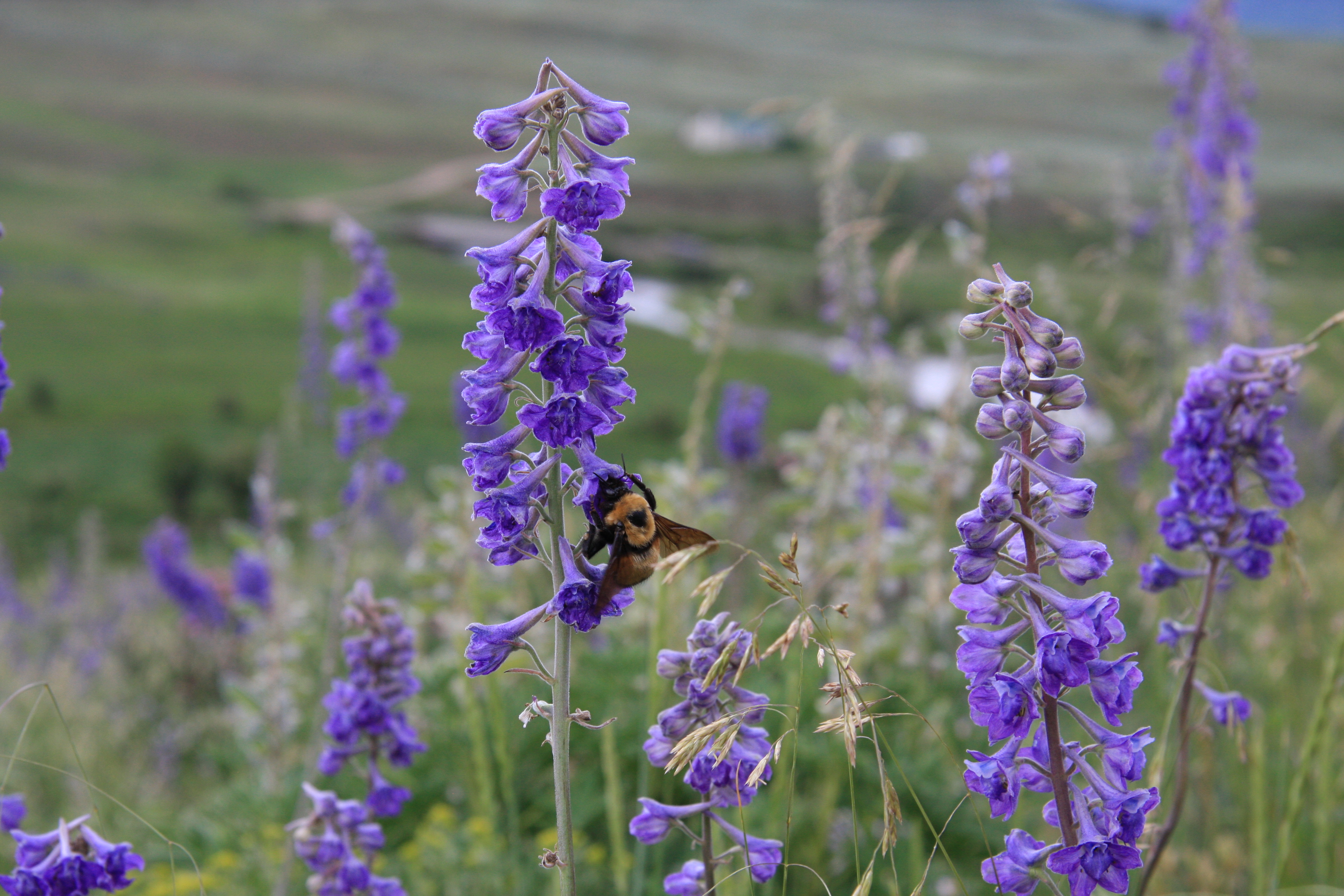
Hola amigos: A VUELO DE UN QUINDE EL BLOG., hemos recibido información de la Fundación Nacional de Ciencias de Los Estados Unidos, sobre la protección que debe realizarse con las abejas las productoras de la miel.
NSF, nos dice: "Los portadores de miel llegados a principios del siglo 17, llevaron a los Estados Unidos por los primeros colonos europeos. Apis mellifera - el nombre realmente se traduce como la miel de abeja-portador, a pesar de que son más conocidas como las abejas de miel.
Durante los siglos siguientes, que florecieron en el clima templado de América del Norte, tanto éxito se han convertido en una parte integral de nuestra economía agrícola, contribuyendo con más de $ 14 mil millones en los servicios de polinización cada año. Están en camiones a nuestros huertos de manzanos y granjas de arándanos, nuestros campos de calabaza y sandía.
Durante la última década, sin embargo, los portadores de miel han sufrido. Han muerto en cifras alarmantes, colonias enteras colapsando en la ruina. El culpable parece ser un complejo cuarteto de factores :
Durante los siglos siguientes, que florecieron en el clima templado de América del Norte, tanto éxito se han convertido en una parte integral de nuestra economía agrícola, contribuyendo con más de $ 14 mil millones en los servicios de polinización cada año. Están en camiones a nuestros huertos de manzanos y granjas de arándanos, nuestros campos de calabaza y sandía.
Durante la última década, sin embargo, los portadores de miel han sufrido. Han muerto en cifras alarmantes, colonias enteras colapsando en la ruina. El culpable parece ser un complejo cuarteto de factores :
- nutrición pobre,
- parásitos,
- patógenos
- pesticidas -
y los científicos todavía están descubriendo cómo estas tensiones perjudican a las abejas y cómo se pueden prevenir.
More information..........
http://www.nsf.gov/discoveries/disc_summ.jsp?cntn_id=135470&WT.mc_id=USNSF_1
Ancestors of American honey bees shed light on pollinator health
 Credit and Larger Version |
The honey bearers arrived in the early 17th century, carried into the United States by early European settlers. Apis mellifera--the name truly translates as bee honey-bearer, though they are better known as honey bees.
Over the ensuing centuries, they flourished in the temperate North
American climate, so successful they've become an integral part of our
agricultural economy, contributing more
than $14 billion in pollination services each year. They're trucked to
our apple orchards and blueberry farms, our fields of squash and
watermelon.
During the last decade, however, the honey bearers have suffered.
They've died off in alarming numbers, entire colonies collapsing into
ruin. The culprit seems to be a complex quartet of factors--poor
nutrition, parasites, pathogens and pesticides--and scientists are still uncovering how these stresses harm bees and how they can be prevented.
Could the answers to some of these questions lie in Apis mellifera's African ancestors?
"If we can understand the genetic and physiological mechanisms that allow Africanhttp://www.nsf.gov/discoveries/disc_summ.jsp?cntn_id=135470&WT.mc_id=USNSF_1http://www.nsf.gov/discoveries/disc_summ.jsp?cntn_id=135470&WT.mc_id=USNSF_1 to withstand parasites and viruses,
we can use this information for breeding programs or management
practices in U.S. bee populations," says Christina Grozinger, director
of the Center for Pollinator Research at Pennsylvania State University.
Grozinger was part of a National
Science Foundation (NSF)-funded project researching East African
honeybees, analyzing the health of bee populations at 24 sites across
Kenya. The team included scientists from Penn State, the International Centre of Insect Physiology and Ecology (icipe) in Kenya and South Eastern Kenyan University.
NSF's Basic Research to Enable Agricultural Development, or BREAD, program funded the award. BREAD supports creative, fundamental research
designed to help small-holder farms in the developing world. The
program is a collaboration between NSF and the Bill & Melinda Gates Foundation.
"The BREAD partnership has allowed NSF to build and fully support
international collaborations, as well as innovative proof-of-concept
basic research with broad implications for global agriculture," says Jane Silverthorne, deputy assistant director of NSF's Biological Sciences
Directorate, which funded the research. "This study continues to
provide unique insights into how environmental conditions affect the
health of honey bee colonies in Kenya."
In 2010, the team of researchers from icipe and Penn State first discovered the deadly Varroa mite in Kenyan bees. A tiny red beast that attaches, shield-like, to the back of a bee, Varroa feeds on hemolymph (bee blood). It transmits diseases and wreaks havoc with a bee's immune system. The parasite's full name--Varroa destructor--is apt; it is the culprit for thousands upon thousands of bee deaths in North America and Europe.
That research was the first time Varroa was documented in East Africa.
"Since Varroa is the most deadly parasite of honey bees and
has decimated populations of honey bees wherever it has spread in the
world, it was vital to track the effects of the introduction of Varroa on East African bee populations," Grozinger said.
So the team applied for the BREAD award and began analyzing honey
bees across Kenya, studying how parasites, pathogens and viruses were
affecting the African bees.
What they found was that--despite Varroa--the African bees
were surviving, were tolerating the parasites. The bees did not seem to
be actively fighting or removing the mites; instead, they had a higher
tolerance for them. Researchers also discovered a link between elevation
and Varroa: Bee colonies at higher elevations had higher instances of Varroa.
This suggests a bee's environment may make it more or less susceptible
to the mites. And since environment is also closely related to
nutrition--higher elevations often have less flowering plants, which
means less food options for honey bees--improving bee nutrition could be
one way to combat Varroa.
The relationship
between elevation, nutrition and pathogens needs to be examined
further, but Grozinger calls it a "very intriguing" correlation.
Increasing the diversity of flowering plant species in a landscape--one
way to boost bee nutrition--could potentially help bees help themselves, by increasing a bee's natural ability to tolerate Varroa.
The research, published last year in PLOS One,
is just a "first blush" at analyzing African bee populations, said
Maryann Frazier, a senior extension associate at Penn State and another
scientist on the project.
But she says it's important to study honey bees in other parts of the
world, and not just because pollinators are a global resource (in
Kenya, honey bees not only pollinate, but provide crucial income and
nutrition for farmers and rural families).
"What we're really interested in are the mechanisms that allow them
to be more resistant. And then we can use that knowledge to select for
those behaviors and physiological traits."
Much about those mechanisms remains undiscovered. Frazier, Grozinger,
their Kenyan counterparts and others from Penn State are sequencing
whole genomes of individual bees collected from different parts of
Kenya; this should allow them to identify specific genes that have
helped the bees adapt to different environments and potentially resist
different diseases. They're also analyzing whether different hive
types--many Kenyan beekeepers use hollow logs or trees as hives--affect
honey bee health and productivity.
Other NSF-funded honey bee projects are studying the role of gut microbes in bee health, how bees develop colony-level social immunity and much more: the foundation supports more than 250 current pollinator-related projects, many highlighted in the recent Pollinator Research Action Plan,
a national strategy to better understand pollinator losses and improve
pollinator health. And ensure the honey-bearers thrive for many years to
come.
| -- | Jessica Arriens, (703) 292-2243 jarriens@nsf.gov |
Investigators
Harland Patch
James Frazier
James Tumlinson
Maryann Frazier
Christina Grozinger
James Frazier
James Tumlinson
Maryann Frazier
Christina Grozinger
Related Institutions/Organizations
Pennsylvania State Univ University Park
Related Awards
#0965441 BREAD: Sustainable Solutions for Preserving Pollinator Health in East Africa
#0965441 BREAD: Sustainable Solutions for Preserving Pollinator Health in East Africa
..............


Elliud Muli, of Kenya's International Centre of Insect Physiology and Ecology, inspects a brood.
Credit and Larger Version

Varroa mites, a deadly bee parasite, on drone brood.
Credit and Larger Version

Apis mellifera scutellata, one of the subspecies of honey bees found in Kenya.
Credit and Larger Version
The National Science Foundation (NSF)
Guillermo Gonzalo Sánchez Achutegui
ayabaca@hotmail.com
ayabaca@gmail.com
ayabaca@yahoo.com
Inscríbete en el Foro del blog y participa : A Vuelo De Un Quinde - El Foro!