Mostrando entradas con la etiqueta European Space Agency (ESA). Mostrar todas las entradas

domingo, 25 de diciembre de 2016

ESA : Our year in space.- Nuestro año en el espacio

http://www.esa.int/spaceinvideos/Videos/2016/12/Highlights_2016


Details

Open/Close
  • Title Highlights 2016
  • Released: 20/12/2016
  • Length 00:06:00
  • Language English
  • Footage Type TV Exchanges
  • Copyright ESA
  • Description 2016 has been an incredible year for the European Space Agency. With astronauts visiting the ISS, Galileo deployment going at full speed and initial services declared. Or pioneering missions such as ExoMars. ESA is once again proving it is at the forefront of cutting edge technology and that its missions are an enrichment for the whole of humanity.
ESA
Guillermo Gonzalo Sánchez Achutegui
ayabaca@gmail.com
ayabaca@Hhotmail.com
ayabaca@yahoo.com
Inscríbete en el Foro del blog y participa : A Vuelo De Un Quinde - El Foro!

domingo, 11 de septiembre de 2016

ESA : Rosetta’s descent towards region of active pits .- El descenso de Rosetta hacia la región de los pozos activos

http://www.esa.int/Our_Activities/Space_Science/Rosetta/Rosetta_s_descent_towards_region_of_active_pits

Rosetta’s last week at the comet

Rosetta’s descent towards region of active pits

9 September 2016 Squeezing out unique scientific observations until the very end, Rosetta’s thrilling mission will culminate with a descent on 30 September towards a region of active pits on the comet’s ‘head’.
The region, known as Ma’at, lies on the smaller of the two lobes of Comet 67P/Churyumov–Gerasimenko. It is home to several active pits more than 100 m in diameter and 50–60 m in depth – where a number of the comet’s dust jets originate.
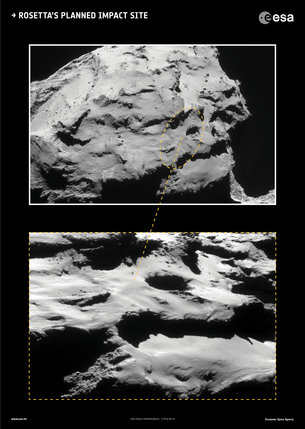
 

Rosetta’s planned impact site
 
The walls of the pits also exhibit intriguing metre-sized lumpy structures called ‘goosebumps’, which scientists believe could be the signatures of early ‘cometesimals’ that assembled to create the comet in the early phases of Solar System formation.
Rosetta will get its closest look yet at these fascinating structures on 30 September: the spacecraft will target a point adjacent to a 130 m-wide, well-defined pit that the mission team has informally named Deir el-Medina, after a structure with a similar appearance in an ancient Egyptian town of the same name.  
Like the archaeological artefacts found inside the Egyptian pit that tell historians about life in that town, the comet’s pit contains clues to the geological history of the region.
Rosetta will target a point very close to Deir el-Medina, within an ellipse about 700 x 500 m.
Since 9 August, Rosetta has been flying elliptical orbits that bring it progressively closer to the comet – on its closest flyby, it may come within 1 km of the surface, closer than ever before.
 “Although we’ve been flying Rosetta around the comet for two years now, keeping it operating safely for the final weeks of the mission in the unpredictable environment of this comet and so far from the Sun and Earth, will be our biggest challenge yet,” says Sylvain Lodiot, ESA’s spacecraft operations manager.
“We are already feeling the difference in gravitational pull of the comet as we fly closer and closer: it is increasing the spacecraft’s orbital period, which has to be corrected by small manoeuvres. But this is why we have these flyovers, stepping down in small increments to be robust against these issues when we make the final approach.”
The final flyover will be complete on 24 September. Then a short series of manoeuvres needed to line Rosetta up with the target impact site will be executed over the following days as it transfers from flying elliptical orbits around the comet onto a trajectory that will eventually take it to the comet’s surface on 30 September.

Understanding Rosetta’s final signal
 
The impact is predicted to occur within 20 minutes of 10:40 GMT, with uncertainties linked to the exact trajectory of Rosetta on the day, and the influence of gravity close to the comet. Taking into account the additional 40 minute signal travel time between Rosetta and Earth on 30 September, this means that the confirmation of impact is expected at ESA’s mission control in Darmstadt, Germany, within 20 minutes of 11:20 GMT (13:20 CEST). The times will be updated as the trajectory is refined.
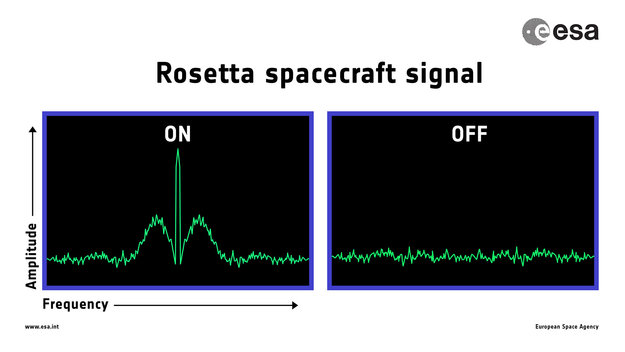
Mirroring Rosetta’s wake-up from deep space hibernation in January 2014, where a rising peak at the right frequency confirmed that the spacecraft was alive and transmitting its carrier signal, mission controllers will see that peak disappear for a final time once Rosetta impacts. It will not be possible to retrieve any data after this time.
“Last month we celebrated two thrilling years since arriving at the comet, and also a year since the comet’s closest approach to the Sun along its orbit,” says Matt Taylor, ESA’s Rosetta project scientist.
“It’s hard to believe that Rosetta’s incredible 12.5 year odyssey is almost over, and we’re planning the final set of science operations, but we are certainly looking forward to focusing on analysing the reams of data for many decades to come.”
“This pioneering mission may be coming to an end, but it has certainly left its mark in the technical, scientific and public spheres as being one of outstanding success, with incredible achievements contributing to the current and future understanding of our Solar System,” adds Patrick Martin, ESA’s Rosetta mission manager.

More information

All times and details regarding the end of mission are preliminary and subject to change as Rosetta’s final trajectory is refined. Even on the day, timings will have uncertainties owing to circumstances at the comet beyond the control of the mission team.
For further information, you can consult the end-of-mission FAQ.
Application for accredited media and social media representatives to attend the event in Darmstadt on 30 September is possible via the Call for Media. Science journalists will also be eligible to attend a briefing on 29 September focusing on the scientific results of the mission. Livestream details will also be provided nearer the time.
An ESA Hangout on Air is planned for Monday 19 September 12:00 GMT (1400 CEST) to present the latest information regarding the details of the last week’s operations and the story of the search behind finding Philae. More details will be provided soon.
 
For more information, please contact:
Markus Bauer


ESA Science and Robotic Exploration Communication Officer


Tel: +31 71 565 6799


Mob: +31 61 594 3 954


Email: markus.bauer@esa.int
Matt Taylor
ESA Rosetta Project Scientist
Email: matt.taylor@esa.int
Sylvain Lodiot
ESA Rosetta Spacecraft Operations Manager
Email: sylvain.lodiot@esa.int
Patrick Martin
ESA Rosetta Mission Manager
Email: patrick.martin@esa.int
ESA
Guillermo Gonzalo Sánchez Achutegui
ayabaca@gmail.com
ayabaca@hotmail.com
ayabaca@yahoo.com
Inscríbete en el Foro del blog y participa : A Vuelo De Un Quinde - El Foro!

ESA : Call for Media: Rosetta’s grand finale .- Llamado a los medios de comunicación: El gran final de Rosetta

http://www.esa.int/Our_Activities/Space_Science/Rosetta/Call_for_Media_Rosetta_s_grand_finale

Rosetta approaching comet

Call for Media: Rosetta’s grand finale

9 September 2016 Rosetta is set to complete its mission in a controlled descent to the surface of its comet on 30 September.
Members of the media are invited to join Rosetta science and mission control experts at the ESA’s European Space Operations Centre (ESOC) in Darmstadt, Germany, on 29 and 30 September, to follow the conclusion of this historic mission.
 

Rosetta’s final destination
 
ESA’s Rosetta spacecraft arrived at Comet 67P/Churyumov–Gerasimenko on 6 August 2014, following a ten-year journey through the Solar System after its launch on 2 March 2004. The Philae lander was sent down to the surface of the comet on 12 November 2014.
After two years living with the comet, returning an unprecedented wealth of scientific information during its closest approach to the Sun, Rosetta and the comet are now heading out beyond the orbit of Jupiter again.
Travelling further from the Sun than ever before, and faced with a significant reduction in solar power that it needs to operate, Rosetta’s destiny has been set: it will follow Philae down onto the surface of the comet.
Confirmation of the end of mission is expected from ESA’s main control room at 11:20 GMT or 13:20 CEST +/- 20 minutes (Earth time) on 30 September, with the spacecraft set on a collision course with the comet the evening before.
The final hours of descent will enable Rosetta to make many once-in-a-lifetime measurements, including analysing gas and dust closer to the surface than ever possible before, and taking very high resolution images of the comet nucleus, including the open pits of the Ma’at region where the spacecraft is expected to make its controlled impact.
These data should be returned during the descent up to the moment of final impact, after which communication with the spacecraft will not be possible.
Media are invited to cover the final hours of operations at ESOC from 10:00 CEST on 30 September, and join mission representatives in celebrating the success of this incredible adventure.
In addition, scientific journalists are invited to apply to attend an afternoon with Rosetta science experts the day before, on 29 September, dedicated to reviewing the key scientific highlights of the mission so far.
Both the science session on 29 September and the main mission finale on 30 September will be live streamed for all interested media at www.esa.int.
 
Programme at ESOC
(all times in CEST, programme/times subject to change)
 
29 September
Livestream of Rosetta science talks from 14:30 to 17:00 at www.esa.int
Rosetta has provided many important clues for scientists to put together to solve key questions regarding the comet’s origin and evolution, its place in the early Solar System, and the possible role of comets in delivering ingredients considered crucial for the emergence of life on Earth, including water and organic materials.
Rosetta scientists will take us on a comprehensive scientific journey, putting those puzzle pieces together. The tour will start with an explanation of the comet’s varied landscape, its interior properties and the nature of the dust ejected from the nucleus, followed by a close look at its changing activity over the course of the mission, and the interaction of the comet with its surroundings as it orbits the Sun. We will also discover more about the organic molecules detected at the comet, and finally what the consequences all of these findings have for our understanding of the evolution of our Solar System.
 
30 September
11:00 – 15:00 (doors open at 10:00)
The programme for media will follow the operational highlights of the descent of Rosetta, which will be relayed live via videostream from the Main Control Room to the Media Centre. Mission experts will also explain the scientific highlights of the mission so far, and present the final images as Rosetta gets closer and closer to the surface of the comet.
Members of the wide international Rosetta team, including scientists, spacecraft operators, and engineers, as well as representatives from ESA and its partner agencies, along with industry and some special guests, will witness and celebrate the final hours of this iconic mission together.
All will be available for media interviews.
 
Media accreditation
Media with valid press and/or social media credentials should register at https://myconvento.com/public/event_register/index/1438240
for the main finale on 30 September. Journalists with specific scientific interest should also register to attend the 29 September scientific session, although numbers may be limited.
 
Follow online
The briefings on 29 and 30 September will be livestreamed at: esa.int
Live coverage of operational milestones in the final days of the mission will also be provided via the Rosetta blog and via @ESA_Rosetta and @esaoperations on Twitter. Please use the #CometLanding hashtag on social media.
 
Hangout on air event – 19 September
In preparation for the mission end, we will host a hangout on air at 14:00 CEST on 19 September  to present and discuss Rosetta’s final days and hours of operation. The sequence of the descent, as well of the images and scientific data to be acquired will be presented, as well as a summary of the results of the search that led to the announcement of the discovery of Philae on Comet 67P/Churyumov–Gerasimenko on 5 September.
 
For broadcasters
Information on available footage, broadcast times and satellite parameters will be availabale at: http://www.esa.int/esatv/Television
For further information, please contact:
ESA Media Relations Office
Tel: +33 1 53 69 72 99
Email: media@esa.int
ESA
Guillermo Gonzalo Sánchez Achutegui
ayabaca@gmail.com
ayabaca@hotmail.com
ayabaca@yahoo.com
Inscríbete en el Foro del blog y participa : A Vuelo De Un Quinde - El Foro!

ESA : Fantastic four: November’s Galileos reach Europe’s Spaceport.- Cuatro fantásticos satélites GALILEOS, ya se encuentran en el Puerto Europeo de Lanzamientos Espaciales para lanzarlos en noviembre....

 http://www.esa.int/Our_Activities/Navigation/Galileo/Launching_Galileo/Fantastic_four_November_s_Galileos_reach_Europe_s_Spaceport                                                                                           
Un vuelo trasatlántico entregó cuatro satélites Galileo a la Guayana francesa el martes, en preparación para el lanzamiento compartido  de este mes de noviembre  por Ariane 5 - la primera constelación de navegación por satélite europeo..................
 

Galileo quartet landing

Fantastic four: November’s Galileos reach Europe’s Spaceport

9 September 2016 A transatlantic flight delivered four Galileo satellites to French Guiana on Tuesday, in preparation for a shared launch this November by Ariane 5 – the first for Europe’s satnav constellation.
The satellites’ odyssey began the previous day, when they left ESA’s technical centre in Noordwijk, the Netherlands, where every Galileo satellite is tested.
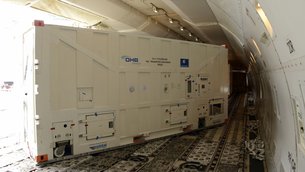
Each satellite was placed into protective containers before leaving the cleanroom environment of the test facility. These containers incorporate sophisticated environmental control, satellite monitoring systems and shock absorbers.
 

Galileo container unloaded
 
They were then driven by separate lorries to Luxembourg Findel Airport. On Tuesday morning they were flown by 747 aircraft to Cayenne–Félix Eboué Airport in French Guiana, touching down around 10:30 local time.
They were taken to the S1A payload preparation building of the Guiana Space Centre, to be unboxed the following day.
The building will remain their home as their launch campaign begins. The first activity is a ‘fit check’ with the dispenser that will release them into orbit from the rocket’s upper stage.
The modified Ariane 5 that will carry the four Galileos into orbit arrived in French Guiana a fortnight ago.
In development since 2012, this new variant has evolved from the Ariane 5 used to place ESA’s 20 tonne supply ferry for the International Space Station into low orbit.
This new version will carry a lighter payload – four fully fuelled 738 kg Galileo satellites plus their dispenser – but must take it up to the much higher altitude of 23 222 km.
 

Satellites leaving ESTEC
 
November’s launch is a major step up for Galileo. The 14 Galileo satellites already in orbit have been launched two at a time, by Soyuz from French Guiana.
Having 18 satellites in orbit should enable initial Galileo operational services to begin, a decision that will be taken by the European Commission, the system’s owner.
Two more Galileo launches by Ariane 5 are due in the next two years.

About Galileo
 

Galileos on the road

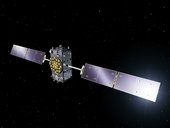
Galileo is Europe’s civil global satellite navigation system. It will allow users worldwide to know their exact position in time and space with great precision and reliability. Once complete, the system will consist of 24 operational satellites and the ground infrastructure for the provision of positioning, navigation and timing services.
The Galileo programme is funded and owned by the EU. The European Commission has the overall responsibility for the programme, managing and overseeing the implementation of all programme activities.
 

Galileo
 
Galileo’s deployment, the design and development of the new generation of systems and the technical development of infrastructure are entrusted to ESA. The definition, development and in-orbit validation phases were carried out by ESA, and co-funded by ESA and the European Commission.
The European Global Navigation Satellite System Agency (GSA) is ensuring the uptake and security of Galileo. Galileo operations and provision of services will be entrusted to the GSA from 2017.

VERSIÓN EN ESPAÑOL :
Spain
http://www.esa.int/esl/ESA_in_your_country/Spain/Los_cuatro_fantasticos_el_Puerto_Espacial_Europeo_recibe_a_los_nuevos_satelites_Galileo

Los cuatro Galileo a punto de aterrizar

Los cuatro fantásticos: el Puerto Espacial Europeo recibe a los nuevos satélites Galileo

9 septiembre 2016 El martes pasado, cuatro satélites Galileo llegaron a la Guayana Francesa en un vuelo trasatlántico, dentro de los preparativos para su lanzamiento conjunto el próximo noviembre a bordo de un Ariane 5. Será la primera vez que se ponen en órbita cuatro satélites de esta constelación al mismo tiempo.
Su odisea comenzó el día antes, cuando salieron del centro tecnológico de la ESA en Noordwijk, Países Bajos, donde se prueban todos los satélites.
Cada satélite se introdujo en un contenedor de protección antes de abandonar el entorno de sala limpia de las instalaciones de ensayo. Estos contenedores incorporan un sofisticado sistema de control ambiental, así como sistemas de monitorización y amortiguadores. 
 

Un contenedor antes de su descarga

A continuación, se dirigieron en camiones independientes hasta el aeropuerto luxemburgués de Findel, desde donde volaron el martes por la mañana a bordo de un 747 con destino al aeropuerto Félix Eboué de Cayenne, en la Guayana Francesa, aterrizando sobre las 10:30 hora local.
Desde allí se trasladaron al edificio de preparación de carga útil S1A del Centro Espacial de la Guayana, donde fueron desembalados al día siguiente.
El edificio acogerá los cuatro satélites hasta que se inicie su campaña de lanzamiento. Lo primero será comprobar su estado con el dispensador que los pondrá en órbita desde la etapa superior del cohete. 
Este cohete, un Ariane 5 modificado, llegó a la Guayana Francesa dos semanas antes. En desarrollo desde 2012, se trata de una versión modificada del Ariane 5 utilizado para situar en órbita baja las 20 toneladas de la nave de suministro de la Estación Espacial Internacional.
Esta nueva versión transportará una carga útil menor —cuatro satélites Galileo de 738 kg llenos de combustible, además del dispensador correspondiente— pero tendrá que alcanzar una altitud mucho mayor, de 23.222 km. 
 

Los satélites salen de ESTEC

El lanzamiento de noviembre será un hito clave para el programa Galileo. Los 14 satélites ya en órbita fueron lanzados de dos en dos a bordo de cohetes Soyuz desde la Guayana Francesa.
La presencia de 18 satélites en órbita permitiría dar comienzo a los servicios iniciales de Galileo, pero la decisión depende de la Comisión Europea, propietaria del sistema.
En los próximos dos años se llevarán a cabo otros dos lanzamientos mediante cohetes Ariane 5 dentro del programa Galileo. 


Los satélites en camino

Galileo es el sistema global de navegación por satélite de carácter civil de la Unión Europea. Permite a usuarios de todo el mundo conocer su posición en el tiempo y en el espacio con gran precisión y fiabilidad. Una vez completado, el sistema estará formado por 24 satélites operativos y una infraestructura de tierra para la provisión de servicios de posicionamiento, navegación y determinación de la hora.
Galileo es financiado por la UE, que es la propietaria del programa. Su responsable es la Comisión Europea, que gestiona y supervisa la implementación de todas sus actividades.
 

Galileo

La Comisión ha encargado a la ESA el diseño, el desarrollo y la implantación de la nueva generación de sistemas, así como el desarrollo técnico de las infraestructuras. La ESA ha llevado a cabo las fases de definición, desarrollo y validación en órbita, financiadas conjuntamente por la ESA y la Comisión Europea.
La Autoridad Europea de Supervisión del sistema global de navegación por satélite (GSA) garantiza el uso y la seguridad de Galileo. A partir de 2017, la GSA se encargará de todas las operaciones de Galileo y de la provisión de servicios.
ESA
Guillermo Gonzalo Sánchez Achutegui
ayabaca@gmail.com
ayabaca@hotmail.com
ayabaca@yahoo.com
Inscríbete en el Foro del blog y participa : A Vuelo De Un Quinde - El Foro!

ESA : Vega to launch ESA’s wind mission .- Vega se pone en marcha con ESA’s wind mission....................

http://www.esa.int/Our_Activities/Observing_the_Earth/The_Living_Planet_Programme/Earth_Explorers/ADM-Aeolus/Vega_to_launch_ESA_s_wind_misión


Measuring cyclones

7 September 2016 Today, ESA and Arianespace signed a contract to secure the launch of the Aeolus satellite. With this milestone, a better understanding of Earth’s winds is another step closer.
The contract was signed at ESA headquarters in Paris, France, by ESA’s Director of Earth Observation Programmes, Josef Aschbacher, and CEO of Arianespace, Stéphane Israël.
Josef Aschbacher said, “Aeolus has certainly had its fair share of problems. However, with the main technical hurdles resolved and the launch contract now in place, we can look forward to it lifting off on a Vega rocket from French Guiana, which we envisage happening by the end of 2017.”
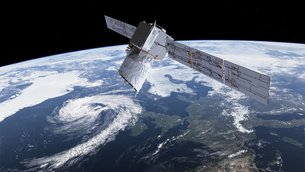
Carrying pioneering ultraviolet lasers, never before flown in space, Aeolus will provide slices through the world’s winds along with information on aerosols and clouds.
 

Aeolus launch contract

This will not only advance our knowledge of atmospheric dynamics, but also provide much-needed information to improve weather forecasts.
As part of the Earth Explorer series, it has been developed to contribute to our understanding of the way Earth works and how human activity is affecting the delicate balance.
While the mission responds to the needs of the scientific community, it will also demonstrate cutting-edge technology that could pave the way for new ways of observing our planet and future applications of Earth observation data.
In fact, Aeolus will be the first satellite to provide profiles of the wind on a global scale. To do so it carries one of the most challenging pieces of space technology ever developed: the Aladin wind ‘lidar’ – a laser form of radar.
Several years in the making, this state-of-the-art instrument houses two powerful lasers, a large telescope and very sensitive receivers.
 

Aladin joins Aeolus
 
The laser generates ultraviolet light that is beamed towards Earth. This light bounces off air molecules and small particles such as dust, ice and droplets of water in the atmosphere. The fraction of light that is reflected back to the satellite is collected by Aladin’s telescope and measured.
The movement of the air molecules, particles or droplets cause this reflected light to change frequency slightly. By comparing the frequencies returned from various altitudes with the original laser, the winds below the satellite can be determined.
Despite numerous setbacks developing it, recent tests show that Aladin is now up to the demanding task that lies ahead.
With these development problems resolved, engineers at Airbus Defence and Space in Stevenage, UK, are now busy adding the instrument to the satellite. Once Aeolus is complete and thoroughly tested, the satellite will be prepared for shipping to Europe’s Spaceport in French Guiana.
Vega rockets can place 300–1500 kg satellites into low orbits. The first ESA Earth observation satellite to be taken into orbit on a Vega was Sentinel-2A in 2015.
 

Related articles


ESA
Guillermo Gonzalo Sánchez Achutegui
Inscríbete en el Foro del blog y participa : A Vuelo De Un Quinde - El Foro!

domingo, 19 de junio de 2016

ESA : How the Sun was born .- Así nació El Sol

Hola amigos: A VUELO DE UN QUINDE EL BLOG., hemos recibido información de la Agencia Espacial Europea ESA, dándonos detalles como nació El Sol.
ESA, nos dice: "Se puede ver como una estrella, que se puede llamar una estrella, pero todavía no generar energía como una estrella normal. Esto es porque aún se está formando esta estrella.Se ofrece una visión fascinante de nuestro propio pasado debido a nuestro Sol comienza su vida como tal una estrella 'T Tauri' hace unos 4,6 millones de años.Situado a 1800 años luz de distancia en la constelación de Cygnus, V1331 Cyg fue originalmente nada más que una nube difusa de gas en el espacio. Poco a poco con el tiempo, la gravedad ha tirado juntos, pero el proceso no ha terminado todavía. V1331 aún no está completamente formado y también lo es aún mayor de lo que con el tiempo será una vez que la gravedad ha hecho su trabajo. Se está brillando debido a la energía de ser liberado como se contrae.Eventualmente, será lo suficientemente compacta que la temperatura en su centro se encender la fusión nuclear. El hidrógeno a continuación, se transforma en helio y esto dará a conocer los torrentes de energía que harán V1331 Cyg brillar durante miles de millones de años como una estrella de buena fe.Las franjas de polvo que rodean a la estrella son los restos de la nube de la cual se condensa. A menudo, este disco circum oscurece nuestra visión del objeto estelar joven, pero, por casualidad, nos ha tocado estar mirando hacia abajo en el polo de rotación de la estrella, por lo que aparece como un rayo deslumbrante 'reflector'.Este disco circunestelar es el sitio donde los planetas pueden estar formándose, y en el caso de tiempo V1331 Cyg se está acabando. Una estrella T Tauri produce un fuerte "viento" de las partículas atómicas que disipa el disco, con lo que la formación de planetas a su fin....."La imagen fue tomada por la
• / ESA telescopio espacial Hubble de la NASA
• y es una combinación de tres exposiciones tomadas en diferentes longitudes de onda. Estos casi corresponden a la vista humana: azul, verde y, en lugar de luz roja que nuestros ojos verían, Hubble utilizó en el infrarrojo cercano.• Id 361840
More information..............
http://www.esa.int/spaceinimages/Images/2016/06/Young_star_offers_a_glimpse_of_the_Sun_s_past

Young star offers a glimpse of the Sun’s past .- Estrella joven ofrece una visión del pasado del Sol

Details

Open/Close
  • Title Young star offers a glimpse of the Sun’s past
  • Released 13/06/2016 12:45 pm
  • Copyright ESA/Hubble, NASA, K. Stapelfeldt (GSFC), B. Stecklum & A. Choudhary (Thüringer Landessternwarte Tautenburg, Germany)
  • Description
    It may look like a star, it may be called a star, but it does not yet generate energy like a normal star. This is because this star is still being formed.
    It offers a fascinating glimpse into our own past because our Sun began its life as such a ‘T Tauri’ star some 4.6 billion years ago.
    Located 1800 light-years away in the constellation Cygnus, V1331 Cyg was originally nothing but a diffuse cloud of gas in space. Slowly over time, gravity has pulled it together, but the process is not yet over. V1331 is not yet fully formed and so is still larger than it will eventually be once gravity has done its job. It is shining because of the energy being released as it shrinks.
    Eventually, it will be compact enough that the temperature in its centre will ignite nuclear fusion. Hydrogen will then be transformed into helium and this will release the torrents of energy that will make V1331 Cyg shine for billions of years as a bona fide star.
    The swathes of dust that surround the star are the remnants of the cloud from which it condensed. Often, this circumstellar disc obscures our view of the young stellar object but, by chance, we happen be looking down on the rotational pole of the star, so it appears as a dazzling ‘searchlight’ beam.
    This circumstellar disc is the site where planets may be forming, and in the case of V1331 Cyg time is running out. A T Tauri star produces a strong ‘wind’ of atomic particles that dissipates the disc, bringing planet formation to an end.
    The image was taken by the
  • and is a combination of three exposures taken at different wavelengths. These almost correspond to human eyesight: blue, green and, instead of red light that our eyes would see, Hubble used near-infrared.
  • Id 361840
ESA
Guillermo Gonzalo Sánchez Achutegui
ayabaca@gmail.com
ayabaca@Hotmail.com
ayabaca@yahoo.com

jueves, 25 de diciembre de 2014

NASA : Hubble Sees the Beautiful Side of Galaxy IC 335.- Telescopio Espacial Hubble ve el lado hermoso de la galaxia IC 335

Hola amigos: A VUELO DE UN QUINDE EL BLOG., la Agencia Espacial NASA, nos informa que el Telescopio Espacial Hubble, ha captado una bella imagen de la Galaxia IC 335; Esta nueva imagen del telescopio espacial Hubble de la NASA / ESA  muestra la galaxia IC 335 frente a un telón de fondo de las galaxias distantes. IC 335 es parte de un grupo de galaxias que contiene otras tres galaxias, y situado en el cúmulo de Galaxias Fornax 60 millones de años-luz de distancia.
Como se observa en esta imagen, el disco de IC 335 aparece de canto desde el punto de vista de la Tierra. Esto hace que sea más difícil para los astrónomos clasifican, ya que la mayoría de las características de la morfología de una galaxia - los brazos de una espiral o el bar de enfrente del centro - son sólo visibles en su rostro. Aún así, el 45 000 años luz de largo galaxia podría ser clasificado como un tipo SO.(http://es.wikipedia.org/wiki/Galaxia)
Estas galaxias lenticulares son un estado intermedio en sistemas de clasificación morfológica de galaxias entre cierto galaxias espirales y elípticas. Tienen un disco estelar delgada y un bulto, como las galaxias espirales, pero a diferencia de las galaxias espirales típicas que han utilizado la mayor parte del medio interestelar. Sólo unas pocas estrellas nuevas se pueden crear a partir del material que queda y la tasa de formación de estrellas es muy baja. Por lo tanto, la población de estrellas en las galaxias S0 se compone principalmente de estrellas viejas, muy similar a la población de estrellas en las galaxias elípticas.(http://es.wikipedia.org/wiki/Galaxia_lenticular)
Como galaxias S0 sólo han mal definida brazos espirales que se confunden fácilmente con las galaxias elípticas si son vistos inclinado cara o de canto como IC 335 aquí. Y, en efecto, a pesar de las diferencias morfológicas entre S0 y la clase  galaxias elípticas,  comparten algunas características comunes, como tamaños típicos y las características espectrales.
Ambas clases también se consideran "galaxias de tipo temprano", debido a que están evolucionando de forma pasiva. Sin embargo, mientras que las galaxias elípticas pueden ser pasivamente evolución cuando los observamos, que han tenido por lo general las interacciones violentas con otras galaxias en su pasado. Por el contrario, las galaxias S0 son o bien el envejecimiento y la decoloración galaxias espirales, que nunca tuvieron ninguna interacción con otras galaxias, o que son el resultado del envejecimiento de una única fusión entre dos galaxias espirales en el pasado. La naturaleza exacta de estas galaxias es todavía un tema de debate.
 
 
Hubble Sees the Beautiful Side of Galaxy IC 335
This new NASA/ESA Hubble Space Telescope image shows the galaxy IC 335 in front of a backdrop of distant galaxies. IC 335 is part of a galaxy group containing three other galaxies, and located in the Fornax Galaxy Cluster 60 million light-years away.
As seen in this image, the disk of IC 335 appears edge-on from the vantage point of Earth. This makes it harder for astronomers to classify it, as most of the characteristics of a galaxy’s morphology — the arms of a spiral or the bar across the center — are only visible on its face. Still, the 45 000 light-year-long galaxy could be classified as an S0 type.
These lenticular galaxies are an intermediate state in galaxy morphological classification schemes between true spiral and elliptical galaxies. They have a thin stellar disk and a bulge, like spiral galaxies, but in contrast to typical spiral galaxies they have used up most of the interstellar medium. Only a few new stars can be created out of the material that is left and the star formation rate is very low. Hence, the population of stars in S0 galaxies consists mainly of aging stars, very similar to the star population in elliptical galaxies.
As S0 galaxies have only ill-defined spiral arms they are easily mistaken for elliptical galaxies if they are seen inclined face-on or edge-on as IC 335 here. And indeed, despite the morphological differences between S0 and elliptical class galaxies, they share some common characteristics, like typical sizes and spectral features.
Both classes are also deemed "early-type" galaxies, because they are evolving passively. However, while elliptical galaxies may be passively evolving when we observe them, they have usually had violent interactions with other galaxies in their past.  In contrast,  S0 galaxies are either aging and fading spiral galaxies, which never had any interactions with other galaxies, or they are the aging result of a single merger between two spiral galaxies in the past. The exact nature of these galaxies is still a matter of debate.
European Space Agency
Credit: ESA/Hubble and NASA
NASA
Guillermo Gonzalo Sánchez Achutegui
Inscríbete en el Foro del blog y participa : A Vuelo De Un Quinde - El Foro!

domingo, 23 de noviembre de 2014

NASA: Mixing Paints . - Mezcla de Pinturas en los Anillos de Saturno

Hola amigos: A VUELO DE UN QUINDE EL BLOG., hemos recibido un espectacular imagen de la Agencia Espacial NASA, sobre lo que ellos llaman una "Mezcla de Pinturas  en Saturno".... el arte natural de un artista esta vez parece haber dejado que sus pinturas se arremolinan juntos un poco..................
"Lo que el espectador puede percibir que sea la superficie de Saturno es realmente sólo la parte superior de sus más altas capas de nubes. Todo lo que vemos es el resultado de la dinámica de fluidos. Los astrónomos estudian dinámica de las nubes de Saturno, en parte para probar y mejorar nuestra comprensión de los flujos de fluidos. Esperemos que lo que aprendemos será útil para la comprensión de nuestra propia atmósfera y la de otros cuerpos planetarios..................
"Esta vista se dirige hacia el lado iluminado de los anillos desde unos 25 grados por encima del plano de los anillos. La imagen fue tomada en luz roja con la cámara de ángulo estrecho de Nave  Cassini el 23 de agosto de 2014..........................."
Mixing Paints
Nature is an artist, and this time she seems to have let her paints swirl together a bit.
What the viewer might perceive to be Saturn's surface is really just the tops of its uppermost cloud layers. Everything we see is the result of fluid dynamics. Astronomers study Saturn's cloud dynamics in part to test and improve our understanding of fluid flows. Hopefully, what we learn will be useful for understanding our own atmosphere and that of other planetary bodies.
This view looks toward the sunlit side of the rings from about 25 degrees above the ringplane. The image was taken in red light with the Cassini spacecraft narrow-angle camera on Aug. 23, 2014.
The view was acquired at a distance of approximately 1.1 million miles (1.8 million kilometers) from Saturn and at a Sun-Saturn-spacecraft, or phase, angle of 127 degrees. Image scale is 7 miles (11 kilometers) per pixel.
The Cassini-Huygens mission is a cooperative project of NASA, the European Space Agency and the Italian Space Agency. The Jet Propulsion Laboratory, a division of the California Institute of Technology in Pasadena, manages the mission for NASA's Science Mission Directorate, Washington, D.C. The Cassini orbiter and its two onboard cameras were designed, developed and assembled at JPL. The imaging operations center is based at the Space Science Institute in Boulder, Colo.
For more information about the Cassini-Huygens mission
The Cassini imaging team homepage is at
Credit: NASA/JPL-Caltech/Space Science Institute
NASA
Guillermo Gonzalo Sánchez Achutegui
ayabaca@gmail.com
ayabaca@hotmail.com
ayabaca@yahoo.com
 

Inscríbete en el Foro del blog y participa : A Vuelo De Un Quinde - El Foro!

sábado, 15 de noviembre de 2014

NASA : Welcome to a Comet, from Lander on Surface.- Bienvenido Lander sobre el sobre el cometa.

Hola amigos : A VUELO DE UN QUINDE EL BLOG., la Agencia Espacial NASA, nos informa lo que pasó después de la gran hazaña  de la Misión Rosetta al  colocar  la sonda: Philae  sobre el cometa:  Comet 67P/Churyumov-Gerasimenko, un prodigio de la tecnología espacial, fue un trabajo de la Agencia Europea del Espacio ESA.

Welcome to a Comet, from Lander on Surface
The Philae lander of the European Space Agency's Rosetta mission is safely on the surface of Comet 67P/Churyumov-Gerasimenko, as these first two images from the lander's CIVA camera confirm. One of the lander’s three feet can be seen in the foreground. The view is a two-image mosaic taken on Nov. 12, 2014.
The lander separated from the orbiter at 09:03 UTC (1:03 a.m. PST) for touch down on comet 67P seven hours later.
Rosetta and Philae had been riding through space together for more than 10 years. Philae is the first probe to achieve soft landing on a comet, and Rosetta is the first to rendezvous with a comet and follow it around the sun. The information collected by Philae at one location on the surface will complement that collected by the Rosetta orbiter for the entire comet.
Rosetta is a European Space Agency mission with contributions from its member states and NASA. Rosetta's Philae lander is provided by a consortium led by the German Aerospace Center, Cologne; Max Planck Institute for Solar System Research, Gottingen; French National Space Agency, Paris; and the Italian Space Agency, Rome. NASA's Jet Propulsion Laboratory, a division of the California Institute of Technology, Pasadena, manages the U.S. participation in the Rosetta mission for NASA's Science Mission Directorate in Washington.  Rosetta carries three NASA instruments in its 21-instrument payload.
For more information on the U.S. instruments aboard Rosetta, visit: http://rosetta.jpl.nasa.gov . For more information about Rosetta, visit http://www.esa.int/rosetta .
Copyright: ESA/Rosetta/Philae/CIVA

NASA
Guillermo Gonzalo Sánchez Achutegui
Inscríbete en el Foro del blog y participa : A Vuelo De Un Quinde - El Foro!

viernes, 14 de noviembre de 2014

NASA : Mars Spacecraft Reveal Comet Flyby Effects on Martian Atmosphere.- Las naves espaciales de Marte , revela Efectos del cometa sobrevuelo del Ambiente marciano

Hola amigos: A VUELO DE UN QUINDE EL BLOG.,la Agencia Espacial NASA, nos  revela sobre los efectos que produjo sobre la atmósfera de Marte el sobrevuelo del Cometa : Comet C/2013 A1 Siding Spring, la agencia utilizó dos satélites:  NASA's Mars Atmosphere and Volatile Evolution (MAVEN) misión, y  NASA’s Mars Reconnaissance Orbiter (MRO), con el apoyo de la Agencia: European Space Agency (ESA) con su nave:  Mars Express spacecraft.
El cometa pasó tan cerca de Marte, que NASA  nos informa así: "El cometa C / 2013 A1 Siding Spring viajó desde la región más distante de nuestro sistema solar, llamada la Nube de Oort, e hizo un acercamiento cercano alrededor de 14:27 EDT dentro de aproximadamente 87.000 millas (139.500 kilometros) del planeta rojo. Esto es menos de la mitad de la distancia entre la Tierra y la Luna, y menos de una décima parte de la distancia de cualquier sobrevuelo del cometa conocido de la Tierra...

Artist’s concept of Comet Siding Spring approaching Mars, shown with NASA’s orbiters preparing to make science observations of this unique encounter.
Image Credit: 
NASA/JPL
 
Youtube Override: 
This movie begins with an animation (artist's rendering) of NASA's Mars Reconnaissance Orbiter spacecraft above Mars. The scene zooms into an "X-ray" view of the spacecraft, revealing the High Resolution Imaging Science Experiment (HiRISE) camera.
 
Five images of comet Siding Spring
Five images of comet Siding Spring taken within a 35-minute period as it passed near Mars on Oct. 19, 2014, provide information about the size of the comet's nucleus. The images were acquired by the High Resolution Imaging Science Experiment (HiRISE) camera on NASA's Mars Reconnaissance Orbiter.
Image Credit: 
NASA/JPL-Caltech/University of Arizona
 
Spectrograms from the MARSIS instrument
These spectrograms from the MARSIS instrument on the European Space Agency's Mars Express orbiter show the intensity of radar echo in Mars' far-northern ionosphere at three times on Oct. 19 and 20, 2014. The middle plot reveals effects attributed to dust from a comet that passed near Mars that day.
Image Credit: 
ASI/NASA/ESA/JPL/Univ. of Rome/Univ. of Iowa
Feature Link: 
Two NASA and one European spacecraft that obtained the first up-close observations of a comet flyby of Mars on Oct. 19, have gathered new information about the basic properties of the comet’s nucleus and directly detected the effects on the Martian atmosphere.

Data from observations carried out by NASA's Mars Atmosphere and Volatile Evolution (MAVEN) mission, NASA’s Mars Reconnaissance Orbiter (MRO), and a radar instrument on the European Space Agency's (ESA’s) Mars Express spacecraft have revealed that debris from the comet added a temporary and very strong layer of ions to the ionosphere, the electrically charged layer high above Mars. In these observations, scientists were able to make a direct connection from the input of debris from a specific meteor shower to the formation of this kind of transient layer in response; that is a first on any planet, including Earth.
Comet C/2013 A1 Siding Spring traveled from the most distant region of our solar system, called the Oort Cloud, and made a close approach around 2:27 p.m. EDT within about 87,000 miles (139,500 kilometers) of the Red Planet. This is less than half the distance between Earth and our moon and less than one-tenth the distance of any known comet flyby of Earth.
Dust from the comet impacted Mars and was vaporized high in the atmosphere, producing what was likely an impressive meteor shower. This debris resulted in significant temporary changes to the planet’s upper atmosphere and possible longer-term perturbations. Earth-based and a host of space telescopes also observed the unique celestial object.
“This historic event allowed us to observe the details of this fast-moving Oort Cloud comet in a way never before possible using our existing Mars missions,” said Jim Green, director of NASA’s Planetary Science Division at the agency’s Headquarters in Washington. “Observing the effects on Mars of the comet's dust slamming into the upper atmosphere makes me very happy that we decided to put our spacecraft on the other side of Mars at the peak of the dust tail passage and out of harm's way.”
The MAVEN spacecraft, recently arrived at Mars, detected the comet encounter in two ways. The remote-sensing Imaging Ultraviolet Spectrograph observed intense ultraviolet emission from magnesium and iron ions high in the atmosphere in the aftermath of the meteor shower. Not even the most intense meteor storms on Earth have produced as strong a response as this one. The emission dominated Mars' ultraviolet spectrum for several hours after the encounter and then dissipated over the next two days.
MAVEN also was able to directly sample and determine the composition of some of the comet dust in Mars’ atmosphere. Analysis of these samples by the spacecraft’s Neutral Gas and Ion Mass Spectrometer detected eight different types of metal ions, including sodium, magnesium and iron. These are the first direct measurements of the composition of dust from an Oort Cloud comet. The Oort Cloud, well beyond the outer-most planets that surround our sun, is a spherical region of icy objects believed to be material left over from the formation of the solar system.
Elsewhere above Mars, a joint U.S. and Italian instrument on Mars Express observed a huge increase in the density of electrons following the comet's close approach. This instrument, the Mars Advanced Radar for Subsurface and Ionospheric Sounding (MARSIS), saw a huge jump in the electron density in the ionosphere a few hours after the comet rendezvous. This spike occurred at a substantially lower altitude than the normal density peak in the Martian ionosphere. The increased ionization, like the effects observed by MAVEN, appears to be the result of fine particles from the comet burning up in the atmosphere.
MRO’s Shallow Subsurface Radar (SHARAD) also detected the enhanced ionosphere. Images from the instrument were smeared by the passage of the radar signals through the temporary ion layer created by the comet's dust. SHARAD scientists used this smearing to determine that the electron density of the ionosphere on the planet's night side, where the observations were made, was five to 10 times higher than usual.
Studies of the comet itself, made with MRO's High Resolution Imaging Science Experiment (HiRISE) camera, revealed the nucleus is smaller than the expected 1.2 miles (2 kilometers). The HiRISE images also indicate a rotation period for the nucleus of eight hours, which is consistent with recent preliminary observations by NASA’s Hubble Space Telescope.
MRO’s Compact Reconnaissance Imaging Spectrometer for Mars (CRISM) also observed the comet to see whether signs of any particular chemical constituents stood out in its spectrum. Team members said the spectrum appears to show a dusty comet with no strong emission lines at their instrument’s sensitivity.
In addition to these immediate effects, MAVEN and the other missions will continue to look for long-term perturbations to Mars’ atmosphere.
MAVEN's principal investigator is based at the University of Colorado's Laboratory for Atmospheric and Space Physics in Boulder, and NASA's Goddard Space Flight Center in Greenbelt, Maryland, manages the mission. NASA's Jet Propulsion Laboratory, a division of Caltech in Pasadena, manages the Mars Reconnaissance Orbiter. Mars Express is a project of the European Space Agency; NASA and the Italian Space Agency jointly funded the MARSIS instrument.
For more information about NASA's Mars missions, visit:
 
NASA
Guillermo Gonzalo Sánchez Achutegui
Inscríbete en el Foro del blog y participa : A Vuelo De Un Quinde - El Foro!

Mi lista de blogs