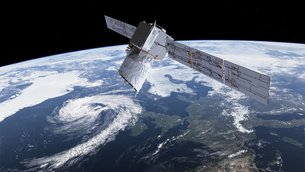
Measuring cyclones
7 September 2016 Today, ESA and Arianespace signed a contract to secure the launch of the Aeolus satellite. With this milestone, a better understanding of Earth’s winds is another step closer.
The contract was signed at ESA headquarters in Paris, France, by ESA’s Director of Earth Observation Programmes, Josef Aschbacher, and CEO of Arianespace, Stéphane Israël.
Josef Aschbacher said, “Aeolus has certainly had its fair share of problems. However, with the main technical hurdles resolved and the launch contract now in place, we can look forward to it lifting off on a Vega rocket from French Guiana, which we envisage happening by the end of 2017.”
Carrying pioneering ultraviolet lasers, never before flown in space, Aeolus will provide slices through the world’s winds along with information on aerosols and clouds.

Aeolus launch contract
This will not only advance our knowledge of atmospheric dynamics, but also provide much-needed information to improve weather forecasts.
As part of the Earth Explorer series, it has been developed to contribute to our understanding of the way Earth works and how human activity is affecting the delicate balance.
While the mission responds to the needs of the scientific community, it will also demonstrate cutting-edge technology that could pave the way for new ways of observing our planet and future applications of Earth observation data.
In fact, Aeolus will be the first satellite to provide profiles of the wind on a global scale. To do so it carries one of the most challenging pieces of space technology ever developed: the Aladin wind ‘lidar’ – a laser form of radar.
Several years in the making, this state-of-the-art instrument houses two powerful lasers, a large telescope and very sensitive receivers.
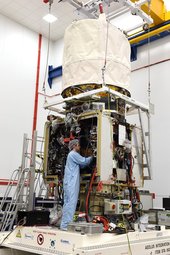
Aladin joins Aeolus
The laser generates ultraviolet light that is beamed towards Earth. This light bounces off air molecules and small particles such as dust, ice and droplets of water in the atmosphere. The fraction of light that is reflected back to the satellite is collected by Aladin’s telescope and measured.
The movement of the air molecules, particles or droplets cause this reflected light to change frequency slightly. By comparing the frequencies returned from various altitudes with the original laser, the winds below the satellite can be determined.
Despite numerous setbacks developing it, recent tests show that Aladin is now up to the demanding task that lies ahead.
With these development problems resolved, engineers at Airbus Defence and Space in Stevenage, UK, are now busy adding the instrument to the satellite. Once Aeolus is complete and thoroughly tested, the satellite will be prepared for shipping to Europe’s Spaceport in French Guiana.
Vega rockets can place 300–1500 kg satellites into low orbits. The first ESA Earth observation satellite to be taken into orbit on a Vega was Sentinel-2A in 2015.
Related articles

Aladin wind probe ready for Aeolus02 August 2016

Perseverance paves way for wind laser 22 April 2015

Wind laser survives extremes15 January 2014
ESA
Guillermo Gonzalo Sánchez Achutegui
Inscríbete en el Foro del blog y participa : A Vuelo De Un Quinde - El Foro!


