Mostrando entradas con la etiqueta Ecosystems. Mostrar todas las entradas

domingo, 13 de agosto de 2017

The National Science Foundation (NSF) :Is the coast clear? Not in many beachfront areas .- Descubrimiento ¿Está clara la costa? No en muchas zonas frente al mar...

https://www.nsf.gov/discoveries/disc_summ.jsp?cntn_id=242562&WT.mc_id=USNSF_1


Marine scientists evaluate coastal armoring and its ecological effects

Científicos marinos evalúan el blindaje costero y sus efectos ecológicos
Large rock revetment in the intertidal zone of a sandy beach in Santa Barbara County, California.

Large rock revetment in the intertidal zone of a sandy beach in Santa Barbara County, California.
Credit and Larger Version

July 24, 2017

Find related stories on NSF's Long-Term Ecological Research Sites.
For nearly a century, the O'Shaughnessy seawall has held back the sand and seas of San Francisco's Ocean Beach. At work even longer: the Galveston seawall, built after America's deadliest hurricane killed thousands in Texas in 1900.
These are just two examples of how America's coasts -- especially those with large urban populations -- have been armored with human-made structures.
Though these structures help protect communities against natural disasters, these "lines in the sand" limit the ability of the shoreline to respond to changes in sea level and other coastal processes.
Recent research on the resulting ecological effects has largely been conducted in specific settings, making it difficult to generalize the results across ecosystems and structure types.
Now a study by marine scientists affiliated with three coastal sites in the National Science Foundation's (NSF) Long-Term Ecological Research (LTER) network provides a key first step toward generalizing ecological responses to armoring in the widely diverse coastal settings where these structures are used.
The team's findings appear online this week in a paper in Estuaries and Coasts, and will be published this fall in a special issue of the journal.
"This is one of the first attempts to assess how engineering structures on beaches and other sedimentary environments affect the biota that inhabits these locations," said David Garrison, an LTER program director at NSF, which supported the research. With some 40 percent of the nation's human population living in coastal counties, Garrison noted that the study is very timely.
The type of armoring structure varies widely according to the environmental setting, ranging from huge seawalls and revetments along the wave-exposed open coast to smaller bulkheads and human-designed oyster reefs in tidal marshes and estuaries.
"The size and shape of these structures often result in the loss of intertidal habitats," said lead author Jenny Dugan, a biologist at the University of California, Santa Barbara (UCSB). "The extent of that loss is related to the environmental setting, structure type and how far seaward and along the shore the structure extends."
Scientists at three LTER sites have been working on the ecological impact of coastal armoring. At NSF's Santa Barbara Coastal LTER site, studies of seawalls on open coast beaches have revealed significant ecological effects on marine species, including birds. Researchers at the Georgia Coastal Ecosystems LTER site have conducted studies of small-scale armoring in salt marshes. And investigations at the Virginia Coast Reserve LTER site have focused on the use of oyster reefs and living shorelines as coastal protection strategies.
"What's new about this cross-site collaboration is putting these site-specific studies into perspective by making comparisons across a broad range of habitats," said paper co-author Merryl Alber, a marine scientist at the University of Georgia and principal investigator of the Georgia Coastal Ecosystems LTER site.
The study synthesizes the findings of existing literature, examining different types of armoring across a variety of soft sediment ecosystems. The scientists used those data to evaluate a new conceptual model.
"Our model looks at the environmental setting of the armoring structure in terms of hydrodynamic energy, like waves and tides, and the degree to which a structure was built to slow water movement or stop it from getting through," Dugan explained. "We then reviewed results from a wide spectrum of studies in the literature and used that information to evaluate how well our model could predict the ecological effects of armoring."
Of the 88 studies the researchers reviewed, the majority had been conducted in very low-energy environments -- predominantly salt marshes and tidal creeks, and also mangroves -- and about one-quarter in medium-energy systems, such as harbors, river mouths and estuaries. Only 15 percent focused on high-energy environments, mostly open coast sandy beaches.
Six categories of ecological responses had been examined in previous studies; negative effects of shoreline armoring were reported in all six. The existing literature focused largely on changes in habitat and species distribution, leaving questions about how shoreline armoring affects other ecological responses such as nutrient cycling, connectivity, productivity and trophic structure.
"Our review not only revealed major gaps in knowledge, but also highlighted the fact that existing information on ecological responses to armoring is unevenly distributed across soft sediment habitat types and does not necessarily cover the range of potential environmental and armoring contexts," said paper co-author Kyle Emery of UCSB.
According to Dugan, as sea level continues to rise, existing coastal armoring structures are likely to experience greater hydrodynamic energy, such that of waves and tides, regardless of their environment. That will magnify ecological effects in many settings, she said.
Dugan noted that the model generated useful predictions of the direction and relative effect of different types of shoreline armoring across soft sediment ecosystems.
"Understanding how these ecological responses vary with hydrodynamic energy, and their effect on water flow, could help people design and install armoring structures that could have fewer ecological effects," she said. "Then their options would include the cost of the structure, and an idea of the ecological implications of the type of structure based on the environmental setting."
Other co-authors of the paper are Clark Alexander, James Byers, Alyssa Gehman and Natalie McLenaghan, all of the University of Georgia, and Sarah Sojka of Randolph College in Lynchburg, Virginia.
-- Cheryl Dybas, NSF (703) 292-7734 cdybas@nsf.gov
-- Julie Cohen, UCSB (805) 893-7220 julie.cohen@ucsb.edu
Seawall in the intertidal zone of a sandy beach in Santa Barbara County, California.

Bulkhead and dock structure in a salt marsh in coastal Georgia.
Credit and Larger Version
Salt marsh sunset at Sapelo Island, Georgia. Such sites are studied for coastal armoring effects.
Credit and Larger Version
Artificial reefs from concrete blocks, called oyster castles, can decrease salt marsh erosion.
Credit and Larger Version
Oyster castles provide substrate for artificial reefs that reduce wave effects onshore.
Credit and Larger Version
The National Science Foundation (NSF)
Guillermo Gonzalo Sánchez Achutegui
ayabaca@gmail.com
ayabaca@hotmail.com
ayabaca@yahoo.com
Inscríbete en el Foro del blog y participa : A Vuelo De Un Quinde - El Foro!
lunes, 21 de noviembre de 2016

The National Science Foundation (NSF): Forest die-offs ricochet to distant ecosystems .- Los muertos en los bosques rebotan en ecosistemas lejanos

https://www.nsf.gov/news/news_summ.jsp?cntn_id=190154&WT.mc_id=USNSF_51&WT.mc_ev=click
Impacts of drought, heat, beetle infestations on forests go far beyond local landscape

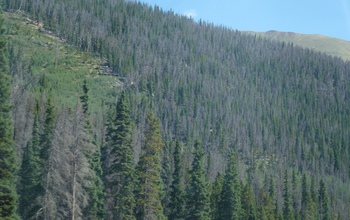
Dead trees west of Denver, Colorado, killed by a combination of drought and beetle infestations.

Dead trees west of Denver, Colorado, killed by a combination of drought and beetle infestations.
Credit and Larger Version

November 16, 2016
This is the eighth in a series on NSF's MacroSystems Biology Program. Please also visit numbers one, two, three, four, five, six and seven.
Major forest die-offs due to drought, heat, beetle infestations or deforestation could have consequences far beyond the local landscape, results from a new study show.
According to a paper published today in the journal PLOS ONE, wiping out an entire forest can have significant effects on global climate patterns and alter vegetation on the other side of the world. The study was funded by the National Science Foundation (NSF)'s MacroSystems Biology Program.
"This research shows that local events like forest die-offs in one part of the globe influence climate and ecology in other, often distant locations," said Tim Kratz, NSF program director for MacroSystems Biology. "Unraveling these far-reaching effects is critical to understanding how nature works at continental to global scales."
 
Similar to El Niño effects
 
Similar to how El Niño - the weather phenomenon in the tropical Pacific Ocean characterized by warm ocean temperatures - can affect global weather patterns, the ramifications of forest loss extend far beyond the local area. Forest loss can even affect distant plants.
"When trees die in one place, it can be good or bad for plants elsewhere, because it causes changes in one place that can ricochet to shift climate in another place," said Elizabeth Garcia, a University of Washington atmospheric scientist and the paper's lead author. "The atmosphere provides the connection."
Scientists have a clear understanding about certain local effects of deforestation. For example, forest loss has a localized cooling effect, as treeless surfaces absorb less sunlight. The loss of vegetation also makes air drier.
The new study describes how major forest losses can alter global climate by shifting the path of large-scale atmospheric waves or changing the amount of sunlight absorbed in the Northern versus the Southern hemispheres. Such changes can shift tropical rain bands and other climate features.
"People have thought about how forest loss matters for an ecosystem, and maybe for local temperatures, but they haven't thought about how that interacts with the global climate," said paper co-author Abigail Swann, an atmospheric scientist and biologist at the University of Washington. "We are only starting to think about these larger-scale implications."
 
Far-apart regions linked
 
Researchers ran a climate model with a drastic forest-loss scenario on two areas currently losing trees: western North America, a region stretching from the southwestern U.S. to Alaska that suffers from drought, heat and beetle infestations, and the Amazon rainforest, which has experienced decades of intense human development.
The results showed that tree loss in western North America caused cooling and slow forest growth in Siberia. That same tree loss made the air drier in the southeastern U.S., harming forests in regions like the Carolinas. Forests in South America benefited from the tree loss, however, with areas south of the equator becoming cooler and wetter.
In the second simulation, removing most of the Amazon rainforest also caused Siberia to become colder and more barren, but it had a slight positive effect on forest growth in the southeastern U.S.
Forest loss in the Amazon also significantly affected neighboring forests in eastern South America -- mostly by increasing the precipitation there during the Southern Hemisphere summer.
"It's really interesting that these effects happen through different mechanisms, depending on where you look," Swann said.
The model's parameters for forest changes are still preliminary, so researchers have not yet produced exact cause-and-effect mapping for each location.
The researchers are conducting field studies to better characterize the temperature and humidity changes from altering different forest types. They also hope to pinpoint which locations are most sensitive to triggering such shifts, or to being affected by the changes.
Other paper co-authors are: Juan Villegas at the University of Antioquia in Colombia; David Breshears, Darin Law and Scott Saleska at the University of Arizona; and Scott Stark at Michigan State University. The study was also funded by the U.S. Department of Energy.
-NSF-
Media Contacts Cheryl Dybas, NSF, (703) 292-7734, cdybas@nsf.gov
Hannah Hickey, University of Washington, (206) 543-2580, hickeyh@uw.edu

Related WebsitesNSF Grant: Collaborative Research: Ecoclimate Teleconnections between Amazonia and Temperate North America: Cross-Region Feedbacks among Tree Mortality, Land Use Change, and the Atmosphere:
 https://www.nsf.gov/awardsearch/showAward?AWD_ID=1340649&HistoricalAwards=false


The National Science Foundation (NSF) is an independent federal agency that supports fundamental research and education across all fields of science and engineering. In fiscal year (FY) 2016, its budget is $7.5 billion. NSF funds reach all 50 states through grants to nearly 2,000 colleges, universities and other institutions. Each year, NSF receives more than 48,000 competitive proposals for funding and makes about 12,000 new funding awards. NSF also awards about $626 million in professional and service contracts yearly.
 Get News Updates by Email 
Useful NSF Web Sites:
NSF Home Page: https://www.nsf.gov
NSF News: https://www.nsf.gov/news/
For the News Media: https://www.nsf.gov/news/newsroom.jsp
Science and Engineering Statistics: https://www.nsf.gov/statistics/
Awards Searches: https://www.nsf.gov/awardsearch/
View of a tropical forest in the Amazon from the top of a research tower in Brazil.
Credit and Larger Version
Scientists Abigail Swann, Dave Minor and Juan Villegas measure live and dead trees in New Mexico.
Credit and Larger Version
Dead pinyon pine trees, a result of drought and beetles, near Mountainair, New Mexico.
Credit and Larger Version
Researchers Darin Law and Juan Villegas investigate dying trees and local climate in New Mexico.
Credit and Larger Version
Using LiDAR near Mountainair, New Mexico, Scott Stark and Dave Minor record tree structures.
Credit and Larger Version
The National Science Foundation (NSF)
Guillermo Gonzalo Sánchez Achutegui
ayabaca@gmail.com
ayabaca@yahoo.com
ayabaca@hotmail.com
Inscríbete en el Foro del blog y participa : A Vuelo De Un Quinde - El Foro!

sábado, 24 de octubre de 2015

NSF: Morticulture: Forests of the living dead .- Morticulture: Bosques de los muertos vivientes

Hola amigos: A VUELO DE UN QUINDE EL BLOG., ¿Qué es más vivo: un árbol vivo o un muerto? La respuesta podría sorprenderle.
En un árbol vivo, sólo una fina capa de madera y corteza crecen y se transportan agua y nutrientes desde las raíces hasta las hojas. Un árbol muerto está llena de vida: insectos, hongos, bacterias y otros organismos. Muchos árboles caídos tienen alfombras verdes de las plantas cubiertas a través de sus superficies.
Árboles muertos tardan mucho tiempo en desaparecer, lo que permite una nueva vida a surgir dentro de ellos. El biólogo Mark Harmon, de la Universidad Estatal de Oregon (OSU), también conocido como "Doctor Muerte" por su interés científico en la mortalidad bosque, participa en un estudio de 200 años de duración para controlar la descomposición de los árboles.
Puede parecer un proyecto de ciencias de largo, pero refleja el ritmo al que se produce el cambio en los registros.
"La vida en el interior de un tronco en descomposición es un bosque microscópica dentro de un bosque, lleno de vida en miniatura," dice Matt Kane de la División de Biología Ambiental de la Fundación Nacional de Ciencia (NSF), que financia la investigación de Harmon través de su OPUS o Oportunidades para la Promoción Comprender a través de síntesis, el programa. "Estas formas de vida más pequeñas - insectos, hongos y bacterias - son reservas de diversidad que reciclan nuestra biosfera."
More information............
Scientists unearth importance of dead wood to forest ecosystems
dead trees in a forest
Nutrients from decomposing logs go back to the forest floor, where they feed life in soils.
Credit and Larger Versión
October 19, 2015
The following is part 19 in a series on the National Science Foundation's Long-Term Ecological Research (LTER) Network. Visit parts one, two, three, four, five, six, seven, eight, nine, 10, 11, 12,13, 14, 15, 16, 17, and 18.
Which is more alive: a live tree or a dead one? The answer might surprise you.
In a live tree, only a thin layer of wood and bark grow and transport water and nutrients from roots to leaves. A dead tree teems with life: insects, fungi, bacteria and other organisms. Many downed trees have verdant carpets of plants draped across their surfaces.
Dead trees take a long time to disappear, allowing new life to spring up within them. Biologist Mark Harmon of Oregon State University (OSU), also known as "Dr. Death" for his scientific interest in forest mortality, is taking part in a 200-year-long study to monitor the decomposition of trees.
It may seem like a long science project, but it reflects the pace at which change happens in logs.
"Life inside a decaying log is a microscopic forest within a forest, teeming with miniature life," says Matt Kane of the Division of Environmental Biology at the National Science Foundation (NSF), which funds Harmon's research through its OPUS, or Opportunities for Promoting Understanding through Synthesis, program. "These tiniest life forms--insects, fungi and bacteria--are reservoirs of diversity that recycle our biosphere."
 
From death, life
 
In the mid-1980s, Harmon and other scientists dragged hundreds of logs with different diameters into an old-growth Douglas fir forest at NSF's H.J. Andrews Long-Term Ecological Research (LTER) site in Oregon.
They watched as beetles moved into the dead logs. "Beetles foster decomposition through the fungal spores they track deep into the logs," says Harmon. "The fungi use the toughest part of the wood as food. In doing so, they help release nutrients into the soil."
Over 30 years of observation, scientists estimate that hundreds of species have moved in and called the dead trees home.
Despite the expectation that all dead wood would decompose at a slow and steady rate, Harmon has found that tree rotting is a unique process. It depends on the tree species, the fungi that take up residence, the moisture content, the geographic location and the size of the tree.
 
Decomposing logs replenish soils
 
Scientists now know that some of the nutrients from a rotting log are returned to the forest floor to replenish the soil almost immediately.
Before Harmon's study, foresters often spent considerable expense and effort on removing dead trees and log debris. Now it's common for loggers to leave downed trees in the forest, a practice Harmon calls "morticulture."
Doing so creates a more diverse landscape, leaves nutrients on site, and provides habitat for species like bluebirds and woodpeckers that nest in tree cavities.
 
Dead wood: an important resource
 
Dead wood was long considered a wasted resource and a hazard in forest landscapes.
But it performs a range of ecological functions: as habitat and food sources for many terrestrial and aquatic species; seedbeds for plants, including new trees; a source of water, energy, carbon and nutrients for the entire forest; and an agent that controls stream structure and function, reports Harmon in a 2013 paper in the journal Forest Ecology and Management.
Research on dead wood has since gone global. Dead wood is now a key feature of understanding forest biodiversity and carbon cycling as well as how stream systems function.
Knowing the ecological value of dead wood influenced forestry practices and development in the Pacific Northwest. That, in turn, changed forest management plans throughout North America and around the world.
Today, many stream habitat restoration projects, for example, focus on the reintroduction and maintenance of large pieces of dead wood in channels to create habitat for species such as salmon.
 
The art of dead Wood
 
Harmon and other scientists at OSU have invited artists to use the idea of dead wood as a starting point for creating various types of artwork. An exhibit, "Rot: The Art of Dead Wood or The Afterlife of Trees," will be unveiled in February 2016 at the Corvallis Art Center.
Harmon hopes the exhibit will bring an awareness of the value of dead trees to the public.
"Dead trees don't go to Heaven," Harmon says. "They're right here, sometimes buried under leaf litter, but nonetheless present."
Logs aren't forest ghosts, says Dr. Death. They're still among us, filled with life.
-- Cheryl Dybas, NSF (703) 292-7734 cdybas@nsf.gov
Investigators Mark Harmon
Related Institutions/Organizations Oregon State University
Total Grants $146,900
Related WebsitesNSF H.J. Andrews LTER Site:
 http://www.lternet.edu/sites/and
NSF News: Opportunities for Promoting Understanding through Synthesis program awards $1.5 million in new grants:
logs and tress near a stream
Scientists are finding that dead wood is very much alive.
Credit and Larger Version
Biologist Mark Harmon in the forest holding a piece of dead tree
Biologist Mark Harmon, also known as "Dr. Death," studies the importance of dead trees to forests.
Credit and Larger Version
A decaying log covered with plants
A decaying log is a microscopic forest within a forest.
Credit and Larger Version
trees killed by an infestation of the spruce budworm
Trees killed by an infestation of the spruce budworm will soon fall.
Credit and Larger Version
New growing trees next to dead log in a forest
From death, life. New growth sprouts from lifeless logs, and will soon replenish the forest.
Credit and Larger Version
the National Science Foundation (NSF),
Guillermo Gonzalo Sánchez Achutegui
Inscríbete en el Foro del blog y participa : A Vuelo De Un Quinde - El Foro!

domingo, 20 de septiembre de 2015

NSF: Mercury-laden fog swirls over coastal California, scientists find .- Los científicos encuentran remolinos de niebla cargada de mercurio en California.....

Hola amigos: A VUELO DE UN QUINDE EL BLOG., hemos información de la Fundación Nacional de Ciencias de Los Estados Unidos, sobre el descubrimiento de remolinos de niebla cargados de mercurio en las costas de California.
More information....

Ultimately makes its way into ecosystems along shore
Fog over the estuary of the Klamath River along the Pacific Coast.
Fog sits over the estuary of the Klamath River along the Pacific Coast.
Credit and Larger Version
August 26, 2015
What do the roof of a building in a West Coast redwood forest, a bluff in California chaparral, and a research vessel in Monterey Bay have in common?
They're often draped in tendrils of fog. That makes them prime sites for collecting fog water samples. And there's something else that can be found at those sites: mercury, according to atmospheric chemist Peter Weiss-Penzias of the University of California at Santa Cruz (UCSC).
 
Mercury: rolling in with fog
 
Sea fog is a significant, but previously overlooked, source of toxic monomethyl mercury deposited in coastal environments, Weiss-Penzias and colleagues reported at the December 2014, American Geophysical Union (AGU) Fall Meeting in San Francisco.
Their research is funded by the National Science Foundation (NSF)'s Chemical Oceanography Program in its Division of Ocean Sciences.
"'Fog drip' could deliver unsafe levels of monomethyl mercury to upland and near-shore ecosystems along the Pacific Coast," Weiss-Penzias says.
Other scientists had previously found high levels of mercury in Monterey Bay during coastal upwelling events--occasions when winds drive surface water offshore and colder water from the deep moves in to replace it. That gave Weiss-Penzias and colleagues the idea to find out whether mercury was somehow stealing ashore in fog.
Mercury is a heavy metal neurotoxin that bioaccumulates and bioconcentrates--primarily as monomethyl mercury--in aquatic food webs. It often reaches high levels in fish and other animals, making them unsafe for human consumption.
The source of monomethyl mercury in aquatic organisms has been debated, says Weiss, "but atmospheric deposition has been implicated as a pathway. Emissions such as coal combustion likely make a significant contribution."
That deposition affects all forms of precipitation: rain, snow and fog.
Weiss-Penzias and other researchers started their search by collecting fog samples by dark of night from June through August 2011.
They worked only in blackness so there would be no decomposition of mercury from sunlight, moving a single fog water collector among four locations near Santa Cruz: the roof of a UCSC building located in a redwood forest; a bluff at UCSC's Long Marine Laboratory; the Moss Landing Marine Labs' research vessel John H. Martin in Moss Landing Harbor; and an offshore spot in Monterey Bay where the John H. Martin was temporarily moored.
 
FogNet: a dragnet for mercury
 
The scientists then expanded their goals. Their NSF-funded project, called FogNet, involves sampling fog from seven locations along the California coast, from Eureka to Monterey.
FogNet is a collaborative effort among researchers at UCSC, Moss Landing Marine Labs, California State University-Monterey Bay, Humboldt State University Marine Laboratory, University of California-Davis Bodega Bay Marine Laboratory, San Francisco State University, Pepperwood Preserve and the U.S. Geological Survey.
The project will collect fog water during the summers of 2014 through 2016 for chemical characterization and quantification of fog deposition volume, Weiss-Penzias says.
The new data show elevated monomethyl mercury concentrations, similar to those the team revealed at the December AGU conference, as well as in a paper published in 2012 in the AGU journal Geophysical Research Letters.
"The hypothesis we're now testing," Weiss-Penzias says, "is whether a form of mercury called dimethyl mercury produced in the coastal ocean can be incorporated into cloud droplets, then be deposited in ecosystems on land and become an important, or even dominant, contributor to monomethyl mercury there."
Fog samples are being collected at Marina Airport, Long Marine Laboratory, UCSC, Montara Lighthouse, Bodega Bay, Pepperwood Preserve, and Humboldt State University Marine Laboratory.
 
Hidden in the mist
 
The average monomethyl mercury concentration in the fog water samples taken in 2011 was five-fold greater than the previously reported highest monomethyl mercury levels in rain water.
"There haven't been reports of monomethyl mercury measurements in fog water in the scientific literature," says Weiss. "But these elevated concentrations suggest that fog could be a significant source in coastal environments."
Could fog be a vector for not only mercury, but other toxic elements?
"We really don't know," says Weiss. "The potentially far-reaching consequences of these results, however, underscore the need to collect fog water in various locations along the coast."
Weiss-Penzias has teamed with UCSC biologist Chris Wilmers for one of the next steps in the research. Wilmers is providing hair and whisker samples from mountain lions that roam the oft-foggy Santa Cruz Mountains and Sierra Nevada foothills, where mercury was used in the Gold Rush era due to its ability to extract the precious metal from other materials.
Early results show that whiskers from coastal mountain lions contain mercury levels that are, on average, 10 times higher than those of their inland counterparts.
"We're looking at whether the mercury is linked with plants eaten by the mountain lions' main prey--deer," says Weiss-Penzias.
The scientist says he's constantly looking for mercury. When he walks down his driveway to pick up the morning paper, he wonders what's in the dew.
"If my feet are wet when I get back in," he says, "I'm thinking: 'it was foggy enough last night to get a good sample.'"
-- 
Cheryl Dybas, NSF (703) 292-7734 cdybas@nsf.gov
Investigators Peter Weiss-Penzias
Related Institutions/Organizations University of California-Santa Cruz
Related Programs Chemical Oceanography
Related Awards #1333738 Collaborative Research: Investigations on the Cycling of Mercury from the Ocean to Fog and Deposition to Land in Coastal California
Total Grants $334,159
Related WebsitesFogNet: Fog Water Collection Network in Coastal California: http://fognet.ucsc.edu/
a fog collector on a mountain in Big Creek Reserve in California's Big Sur.
A FogNet station in Big Creek Reserve in California's Big Sur collects fog.
Credit and Larger Version
San Francisco's Golden Gate Bridge and Bay Bridge loom above a blanket of fog.
Credit and Larger Version
California's coastal mountains covered in mist
Looking like a traditional Chinese painting, California's coastal mountains are covered in mist.
Credit and Larger Version
Fog in California's Redwood National Park.
Fog adheres to trees in California's Redwood National Park, forms drops and falls to the ground.
Credit and Larger Version
The fog shadow of a communication antenna in San Francisco called Sutro Tower.
The Sutro Tower communication antenna in San Francisco cast a shadow in fog.
Credit and Larger Versión

The National Science Foundation (NSF),
Guillermo Gonzalo Sánchez Achutegui
ayabaca@gmail.com
ayabaca@Hotmail.com
ayabaca@yahoo.com
Inscríbete en el Foro del blog y participa : A Vuelo De Un Quinde - El Foro!

domingo, 17 de mayo de 2015

nsf.gov - National Science Foundation - As Massachusetts ecosystems shrink, hard-working "hotspots" emerge.- Como los ecosistemas en Massachusetts encogen, "puntos calientes" ha costado trabajo emergen

Hola amigos: A VUELO DE UN QUINDE EL BLOG., hemos recibido información de la Fundación Nacional de Ciencia de Los Estados Unidos, sobre la investigación de los ecosistemas en el estado de Massachusetts, se comprueba que todas las tierras que no son iguales. Algunos ecosistemas hacen triple deber de los beneficios que aportan la sociedad. Bosques de Massachusetts, por ejemplo, filtrar el agua potable pública, son el hábitat de especies amenazadas y almacenar carbono para combatir el cambio climático..........
 
More information....
Researchers call hotspots valuable, but say their growing numbers might be cause for concern
forest
Ecosystem "hotspots" provide many benefits to society, including recreation and drinking water.
Credit and Larger Version
May 14, 2015
The following is part 18 in a series on the National Science Foundation's Long-Term Ecological Research (LTER) Network. Visit parts one,two, three, four, five, six, seven, eight, nine, 10, 11, 12,13, 14, 15, 16 and 17.
All land is not created equal. Some ecosystems do triple-duty in the benefits they provide society.
Massachusetts forests, for example, filter public drinking water, provide habitat for threatened species and store carbon to combat climate change.
 
Hotspots: hardest-working ecosystems
 
Ecologists single out the hardest-working ecosystems--called "hotspots"--for their exceptional value.
Results of a study published this week in the Journal of Applied Ecology show that the number of hotspots has increased in Massachusetts over the past decade, with more and more popping up in metro Boston.
But, the authors of the paper say, more hotspots may not be a good thing.
Jonathan Thompson, an ecologist at the National Science Foundation's (NSF) Harvard Forest Long-Term Ecological Research (LTER) site and co-author of the paper, says that the increasing number of hotspots signals a degradation of other ecosystems across the state.
"Over the past 10 years, urban development has increased by more than 6 percent, at the expense of forests and agricultural lands," Thompson says.
"When we lose intact forests, we lose stable flows of clean water, climate regulation, recreational opportunities and wildlife habitat. The remaining forest is left to pick up the slack."
The result is more hotspots that do the work of larger forests.
 
Emerging ecosystems
 
Meghan Blumstein of Harvard University, lead author of the paper, notes that hotspots are valuable and worth saving.
But, she adds, "an increase in their number reflects an ongoing division of the natural landscape into smaller units, which are expected to produce the same number of services with less."
Saran Twombly, lead program director for the NSF LTER program--which funded the research through NSF's Division of Environmental Biology--says that the study takes a broad view to show that exploitation of land affects a wide range of services we expect the natural environment to provide.
"Humans have used the land for millennia to satisfy particular needs," Twombly says.
 
Satellite mapping
 
Using satellite maps, the team tracked changes in land cover, such as forest clearing for agriculture or development, across Massachusetts from 2001 to 2011.
In each 30-meter square on the map grid (about the size of two basketball courts), the scientists used computer models to assess which benefits each ecosystem could provide and how those benefits changed over time.
The researchers found that some benefits, such as providing habitats for wildlife, declined state-wide over the study period.
But other benefits, including carbon sequestration and outdoor recreation, increased. Intact forests are growing rapidly and more land is being conserved.
 
Study scale important
 
For some benefits, the scale of the analysis made a big difference, Blumstein says.
When analyzed at a local scale, an area of forest in the state's Quabbin Reservoir may look less like a hotspot than it does a local park.
But when examined at a regional scale, the continuous forest area around the Quabbin Reservoir provides clean drinking water for millions of Massachusetts residents.
"The sustained delivery of benefits from nature requires an approach that considers conservation at multiple scales," Blumstein says.
In other words, the researchers say, we need to be able to see the forest, not just the trees.
-- Cheryl Dybas, NSF (703) 292-7734 cdybas@nsf.gov
-- Clarisse Hart, NSF Harvard Forest LTER Site (986) 756-6157 hart3@fas.harvard.edu
Investigators David Foster
Related Institutions/Organizations Harvard University
Total Grants $2,940,003
Related WebsitesNSF Long-Term Ecological Research Network:
 http://www.lternet.edu/
NSF Harvard Forest LTER Site:
 http://harvardforest.fas.harvard.edu/research/LTER
Discoveries in Long-Term Ecological Research:
Forests around Quabbin Reservoir in Massachusetts
Forests around Quabbin Reservoir in Massachusetts provide drinking water for metro Boston.
Credit and Larger Version
a moose behind trees
Large, intact blocks of forest offer good habitat for moose and other species.
Credit and Larger Version
leaves on a tree
Ecosystem services recently increased in some areas due to the rapid growth of intact forests.
Credit and Larger Version
Development in Massachusetts surrounded by forest
Development in Massachusetts increased by more than 6 percent from 2001 to 2011.
Credit and Larger Version
houses and roads surrounded by forest
Landscapes perforated by development are less able to provide benefits to society.
Credit and Larger Versión
The National Science Foundation (NSF)
Guillermo Gonzalo Sánchez Achutegui
ayabaca@gmail.com
ayabaca@Hotmail.com
ayabaca@yahoo.com
Inscríbete en el Foro del blog y participa : A Vuelo De Un Quinde - El Foro!

domingo, 14 de septiembre de 2014

nsf.gov - National Science Foundation - Whither the diversity of life on Earth? NSF partners award $23 million for studies of planet's biodiversity

Research will fill in biodiversity knowledge gaps; results applicable to health, agriculture, energy and manufacturing

A view of tropical forest biodiversity 15 years after former pastures were abandoned.
Credit and Larger Version
September 10, 2014
Tropical deforestation has dramatic effects on biodiversity--and on the functioning of entire ecosystems.
Scientist Jorge Rodrigues of the University of California, Davis is investigating how microbial diversity in Amazon rainforests responds to changes in land use and how these changes affect the cycling of methane, a greenhouse gas.
Results from the study will help answer how biodiversity responds to and recovers from deforestation in Amazon forests. It will also help answer the extent to which microbes can regulate methane in these altered ecosystems.
Rodrigues' project is one of twelve funded this year by the National Science Foundation's (NSF) Dimensions of Biodiversity Program.
A total of $23 million dollars has been invested with contributions from NSF's Directorates for Biological Sciences and Geosciences, the São Paulo Research Foundation and the National Natural Science Foundation of China.
The Dimensions of Biodiversity Program is unique in its approach. In contrast to traditional biodiversity research that focuses on one taxonomic group or ecosystem, Dimensions of Biodiversity integrates multiple aspects into research projects.
The program links functional, genetic and phylogenetic/taxonomic dimensions of biodiversity, offering opportunities to make rapid advances in understanding the generation, maintenance and loss of biodiversity.
"This year's portfolio of projects will accelerate our understanding of biodiversity across disciplines and across scales of time and space," says Penny Firth, director of NSF's Division of Environmental Biology. "Through this program, we're witnessing a transformation in our ability to bridge scientific approaches and perspectives."
The research will fill in gaps in biodiversity knowledge, Firth says. It also has the potential for significant impacts in the realms of agriculture, fuel, manufacturing and health.
For example, plant and animal extinctions are detrimental to human health, scientists have found. Species losses in ecosystems such as forests and fields result in increases in pathogens or disease-causing organisms. The species most likely to disappear as biodiversity declines are often those that buffer infectious disease transmission. Those that remain tend to be the ones that magnify diseases such as West Nile virus, Lyme disease and hantavirus.
Economic sustainability, researchers say, depends on the diversity of life on Earth. Many industrial materials, such as fiber and dye, come from biological sources. Biodiversity is also important to such resources as water and food.
Dimensions of Biodiversity scientists are working to stem the tide of species losses around the world.
The new Dimensions of Biodiversity projects focus on interactions between microbes and intertidal macroalgae and how their relationships change in response to natural and human-driven stresses; the role novel microbes play in fixing atmospheric nitrogen in Western pine trees; understanding the diversity and adaptive strategies of microorganisms in permafrost; investigating the genetic and ecological factors that foster diversification among yeast relatives; and the diversity of plant metabolism strategies in water-limited environments.
The Dimensions Program is also funding research to understand dormancy and its role in maintaining microbial biodiversity; relationships and interactions between ants and their gut microflora; mechanisms behind sensory adaptations in bats; parallel radiations of plants and microbes in United States' and Chinese forests and how historical constraints and local adaptations affect these interactions; the diversity of relationships among South American plants, caterpillars and parasites in food webs; and how the diversity of coral microbial communities explains the overall vulnerability of corals to stress and disease.
Dimensions of Biodiversity is part of NSF's Science, Engineering and Education for Sustainability (SEES) initiative.
2014 NSF Dimensions of Biodiversity Awards
Susan Brawley, University of Maine:
Dimensions: The macroalgal microbiome in space and time -- Maintaining primary producers in the Atlantic rocky intertidal zone
Liliana Davalos Alvarez, State University of New York at Stony Brook:
 Dimensions: Discovering genomic and developmental mechanisms that underlie sensory innovations critical to adaptive diversification
Lee Dyer, University of Nevada Reno and Massuo Jorge Kato, University of São Paulo:
 Dimensions US-Biota São Paulo: Chemically mediated multi-trophic interaction diversity across tropical gradients
Anna Carolin Frank, University of California, Merced:
 Dimensions: Taxonomic, genetic and functional biodiversity of above-ground bacterial endophytes in subalpine conifers
Christopher Hittinger, University of Wisconsin, Madison:
 Dimensions: The Making of Biodiversity Across the Yeast Subphylum
James Leebens-Mack, University of Georgia:
Dimensions: Molecular, ecological and evolutionary dynamics of carbon fixation and diversification in Agavoideae (Asparagaceae) and Oncidiinae (Orchidaceae)
Jay Lennon, Indiana University:
Dimensions: Microbial seed banks: processes and patterns of dormancy-driven biodiversity
Corrie Moreau, Field Museum of Natural History:
Dimensions: Identifying how the ecological and evolutionary interactions between host and symbiont shape holobiont biodiversity
Jorge Rodrigues, University of California, Davis and Siu Mui Tsai, University of São Paulo: Dimensions US-BIOTA-São Paulo: Integrating dimensions of microbial biodiversity across land use change in tropical forests
Pamela Soltis, University of Florida and Zhiduan Chen, Institute of Botany, Chinese Academy of Sciences:
Dimensions US-China: How historical constraints, local adaptation, and species interactions shape biodiversity across an ancient floristic disjunction
Rebecca Vega, Oregon State University:
 Dimensions: Coevolution of scleractinian corals and their associated microorganisms
Tatiana Vishnivetskaya, University of Tennessee, Knoxville:
 Dimensions: Genetic, phylogenetic, and functional microbial diversity in permanently frozen aquatic sediments over geologic time
-NSF-

Media Contacts Cheryl Dybas, NSF, (703) 292-7734, cdybas@nsf.gov

Related WebsitesDOB 2013 Awards: In race against time, NSF grants fund research on Earth's threatened biodiversity: http://www.nsf.gov/news/news_summ.jsp?cntn_id=129242
DOB 2012 Awards: Stemming the Tide of Biodiversity Loss on Earth: http://www.nsf.gov/news/news_summ.jsp?cntn_id=125495&org=NSF&from=news
DOB 2011 Awards: NSF Awards Grants for Study of Dimensions of Biodiversity: http://www.nsf.gov/news/news_summ.jsp?cntn_id=122098
DOB 2010 Awards: NSF Awards Grants to Study Dimensions of Earth's Biodiversity: http://www.nsf.gov/news/news_summ.jsp?cntn_id=117811&org=NSF&from=news
DOB: A Stream Is a Stream Is a Stream: Or Is It?: http://www.nsf.gov/discoveries/disc_summ.jsp?cntn_id=123855&org=NSF
DOB: Staple of recipe favorites--the tomato--reveals processes that maintain biodiversity: http://nsf.gov/discoveries/disc_summ.jsp?cntn_id=129676


The National Science Foundation (NSF) is an independent federal agency that supports fundamental research and education across all fields of science and engineering. In fiscal year (FY) 2014, its budget is $7.2 billion. NSF funds reach all 50 states through grants to nearly 2,000 colleges, universities and other institutions. Each year, NSF receives about 50,000 competitive requests for funding, and makes about 11,500 new funding awards. NSF also awards about $593 million in professional and service contracts yearly.
 Get News Updates by Email 
Useful NSF Web Sites:
NSF Home Page:
 http://www.nsf.gov
NSF News:
http://www.nsf.gov/news/
For the News Media:
 http://www.nsf.gov/news/newsroom.jsp
Science and Engineering Statistics:
 http://www.nsf.gov/statistics/
Awards Searches:
http://www.nsf.gov/awardsearch/
NSF Dimensions of Biodiversity scientists will look at coral reef ecosystems around the world.
Credit and Larger Version
Jamaican fruit bat in flight: this bat species can smell the volatile compounds in fruit.
Jamaican fruit bat in flight: this bat species can "smell" the volatile compounds in fruit.
Credit and Larger Version
Qiyunshan, a national park in eastern China, has similar forests to those of eastern North America.
Credit and Larger Version
Caterpillar parasitized by an unknown wasp; white splotches are the silk cocoons of wasp larvae.
Credit and Larger Version
Researchers will study the biodiversity of subalpine forests in Colorado's Rocky Mountains.
Credit and Larger Versión
The National Science Foundation (NSF)
Guillermo Gonzalo Sánchez Achutegui
ayabaca@gmail.com
ayabaca@hotmail.com
ayabaca@yahoo.com
Inscríbete en el Foro del blog y participa : A Vuelo De Un Quinde - El Foro!

nsf.gov - National Science Foundation - A river runs through it: U.S. cities' waterways show consistent patterns of evolution

Urban waters record salt in our food, cement in our sidewalks
Stream restoration involving reconnection of an urban waterway near Baltimore with its floodplain.
Credit and Larger Version
September 10, 2014
The following is part sixteen in a series on the National Science Foundation's Long-Term Ecological Research (LTER) Network. Visit parts one, two, three, four, five, six, seven, eight, nine, ten, eleven, twelve, thirteen, fourteen, and fifteen.
Boston and Baltimore, San Juan and Tucson. What do they have in common?
The cities' ecosystems, especially their waterways, are all threatened by road salt, dissolved concrete, sewage overflows and algae blooms, say urban ecologists publishing a series of 14 papers this week in a special issue of the journal Biogeochemistry.
The issue is edited by University of Maryland geologist Sujay Kaushal and University of New Hampshire ecologists William McDowell and Wilfred Wollheim.
The studies were funded by the National Science Foundation (NSF), with much of the research conducted at NSF's Long-Term Ecological Research (LTER) sites in Baltimore, Md.; Plum Island, Mass.; and Luquillo, Puerto Rico, among others.
NSF's Critical Zone Observatory(CZO) Network, through the Luquillo CZO site, also supported the research.
"This synthesis brings the power of evolutionary biology to understanding ecosystem processes in urban environments, some of the most rapidly changing habitats globally," says Saran Twombly, NSF LTER program director.
"Merging evolutionary biology with ecosystem sciences is an exciting frontier for long-term ecological research, beginning with this issue on biogeochemical cycles."
 
Urban research from Boston to Baltimore, San Juan to Tucson
 
In the journal papers, scientists from across the United States review the effects of human actions on the geology, chemistry and biology of urban ecosystems.
Urban landscapes are more complex than they seem, but from coast to coast may work in surprisingly similar ways, says Kaushal.
"Urban ecosystems can change relatively quickly in response to human activities," he says. "These changes can result in rapid losses of ecosystem functions, like flood protection and pollution filtration--or can result in progress toward ecological health and productivity. The difference depends on how they are managed."
In an overview article, Kaushal, McDowell and Wollheim point out the factors that affect the evolution of urban ecosystems. For example, the streams, lakes and land surfaces that make up cities' watersheds show consistent patterns of change over time.
 
Waterways need a low-salt diet
 
Urban waters are becoming saltier, partly due to road salt used for de-icing, and partly because the salt people eat ends up in urban streams.
Excess salt in the human diet is excreted in human waste and captured by sewer systems. Crumbling sewage pipes leak this chloride-laden waste into groundwater, where it eventually mingles with surface water.
The researchers propose that one way to track the spread of urbanization is by looking at the chloride content of cities' freshwater rivers and streams.
 
Dissolved concrete: gone but not forgotten
 
City streams and rivers carry the chemical signature of dissolving concrete, a major building material in urban areas since the mid-20th century.
Most concrete contains cement made of powdered limestone, which weathers easily when exposed to acid rain or chemicals.
The scientists found that many cities now have their own human-made geology: concrete surfaces that mimic a type of limestone called karst.
This "urban karst" is constantly breaking down into its constituent elements, including calcium and carbonate minerals, which flow into urban streams and affect their pH, or acidity, and therefore their ability to sustain aquatic life.
 
Urban hotspots: sewage overflows, auto exhaust degrade rivers and streams
 
Urban ecosystems develop "hot spots," such as road crossings where automobile exhaust, litter, de-icing salt and other human-made substances may alter downstream water quality.
They also experience what the researchers call "hot moments," such as heavy rainstorms that wash large pulses of organic matter and manufactured chemicals into streams, or cause sewage overflows. These hot moments can suddenly change water chemistry in ways that shock natural systems.
 
Where does one watershed end and another begin?
 
The networks that supply cities with water--including storm drains, sewer pipes, roofs and gutters--evolve and expand over time, leaking groundwater and wastewater that humans bring into the area.
Boundaries between nearby cities' watersheds are blurring, making it hard to define, study and manage them.
 
Hope for the future
 
"There's a lot of good urban restoration work underway," says McDowell, "but often it only has a short-term effect, because urban watersheds follow their own evolutionary paths.
"For example, utility managers may build a stormwater retention pond to capture polluted runoff, such as excess nitrogen. And it may work very well for a few years. Then it fills in with sediment and becomes a wetland, and it's no longer functioning the way engineers designed it to work."
Adds Kaushal, "We hope scientists, managers and citizens will work together to make decisions that allow for what we call 'urban evolution'--that is, changes in the ecology of cities over time.
"If we do that, we can find effective ways to understand and manage urban ecosystems toward sustainability."
Copies of the 14 papers in the special issue are available free-of-charge for 30 days at the Biogeochemistry website.
-- Cheryl Dybas, NSF (703) 292-7734 cdybas@nsf.gov
-- Heather Dewar, University of Maryland (301) 405-9267
  hdewar@umd.edu
Related WebsitesNSF Grant: Baltimore Ecosystem Study Phase III: Adaptive Processes in the Baltimore Socio-Ecological System from the Sanitary to the Sustainable City: http://www.nsf.gov/awardsearch/showAward?AWD_ID=1027188&HistoricalAwards=false
NSF Grant: LTER-PIE: Interactions Between External Drivers, Humans and Ecosystems in Shaping Ecological Process in a Mosaic of Coastal Landscapes and Estuarine Seascapes: http://www.nsf.gov/awardsearch/showAward?AWD_ID=1238212&HistoricalAwards=false
NSF Grant: Luquillo CZO: The role of hot spots and hot moments in tropical landscape evolution and functioning of the critical zone:
http://www.nsf.gov/awardsearch/showAward?AWD_ID=1331841&HistoricalAwards=false
NSF Publication: Discoveries in Long-Term Ecological Research: http://www.nsf.gov/pubs/2013/nsf13083/nsf13083.pdf
NSF Publication: Where Life Meets Rock: Discoveries in the Critical Zone: http://www.nsf.gov/pubs/2013/nsf13112/nsf13112.pdf
Urban landscapes change with human activities such as creation of stormwater ponds.
Credit and Larger Version
A Maryland State Highway Administration loader moves salt stored for use in winter.
Credit and Larger Version
Aging sewer lines and erosion of stream banks contribute to water pollution in cities.
Credit and Larger Version
Algae blooms often occur in urban streams; excess nutrients lead to the blooms.
Credit and Larger Version
Extreme heat events affect urban ecosystems in cities such as Phoenix.
Credit and Larger Versión

the National Science Foundation (NSF),
Guillermo Gonzalo Sánchez Achutegui
ayabaca@gmail.com
ayabaca@hotmail.com
ayabaca@yahoo.com
Inscríbete en el Foro del blog y participa : A Vuelo De Un Quinde - El Foro!

Mi lista de blogs