Mostrando entradas con la etiqueta ESA’s XMM-Newton X-ray observatory. Mostrar todas las entradas

miércoles, 14 de noviembre de 2012

ESA - Space Science - Life and death in a star-forming cloud


Download:
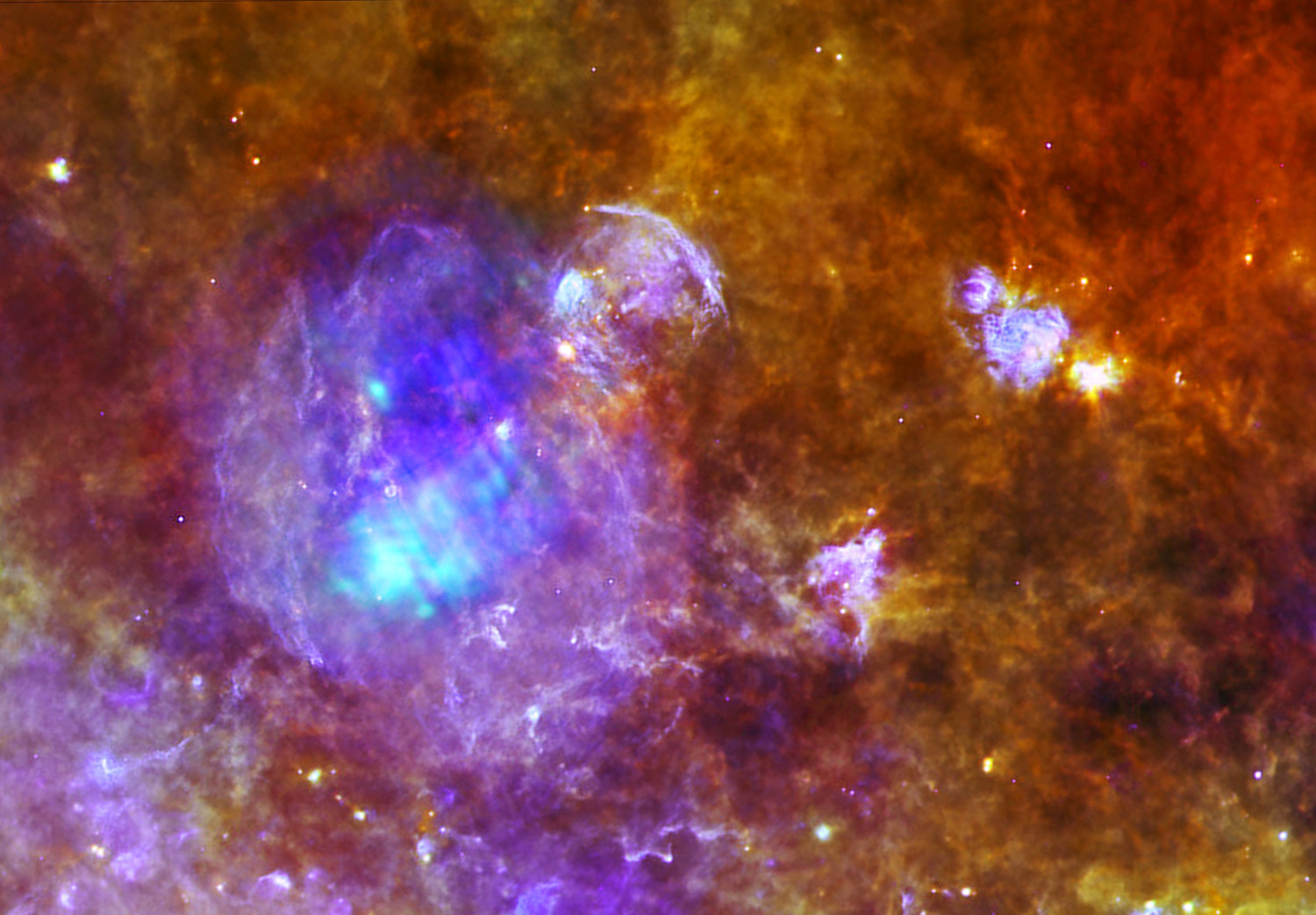
 Supernova remnant W44 is the focus of this new image created by combining data from ESA’s Herschel and XMM-Newton space observatories. W44 is the vast purple sphere that dominates the left hand side of this image, and measures about 100 light-years across. XMM-Newton data reveal that the remnant is filled with X-ray emission from extremely hot gas. Herschel’s three-colour infrared view comprises PACS 70 and 160 micron and SPIRE 250 micron images. X-ray data from XMM-Newton’s EPIC instrument for W44 only has been added in light and dark blue to represent high- (2–8 keV) and low-energy (1.2–2 keV) X-ray emission, respectively. The field of view is about 1º across. North is towards the bottom left of the image; east is to the top right. 
Credits: Herschel: Q. Nguyen Luong & F. Motte, HOBYS Key Program consortium, Herschel SPIRE/PACS/ESA consortia. XMM-Newton: ESA/XMM-Newton


 The aftershock of a stellar explosion rippling through space is captured in this new view of supernova remnant W44, which combines far-infrared and X-ray data from ESA’s Herschel and XMM-Newton space observatories.

W44, located around 10 000 light-years away within a forest of dense star-forming clouds in the constellation of Aquila, the Eagle, is one of the best examples of a supernova remnant interacting with its parent molecular cloud.

The product of a massive star that has already reached the end of its life and expelled its outer layers in a dramatic explosion, all that remains of the stellar behemoth is the spinning core of a neutron star, or pulsar.
Identified as PSR B1853+01, the pulsar is the bright point to the top left in W44, coloured light blue in this image. 
Download:
 Herschel’s three-colour infrared view of supernova remnant W44 and surrounding regions comprising PACS 70 and 160 micron and SPIRE 250 micron images. 
Credits: Herschel: Q. Nguyen Luong & F. Motte, HOBYS Key Program consortium, Herschel SPIRE/PACS/ESA consortia


It is thought to be around 20 000 years old and as it rapidly rotates it sweeps out a wind of highly energetic particles and beams of light ranging from radio to X-ray energies.

The centre of the supernova remnant is also bright in X-rays, coming from the hot gas that fills the shell, at temperatures of several million degrees. Dense knots of high-energy emission reflect regions where heavier elements are more commonly found.
At the cooler edge of the cavity, gas is swept up as the supernova remnant propagates through space.
Download:
 HI-RES JPEG (Size: 174 kb)
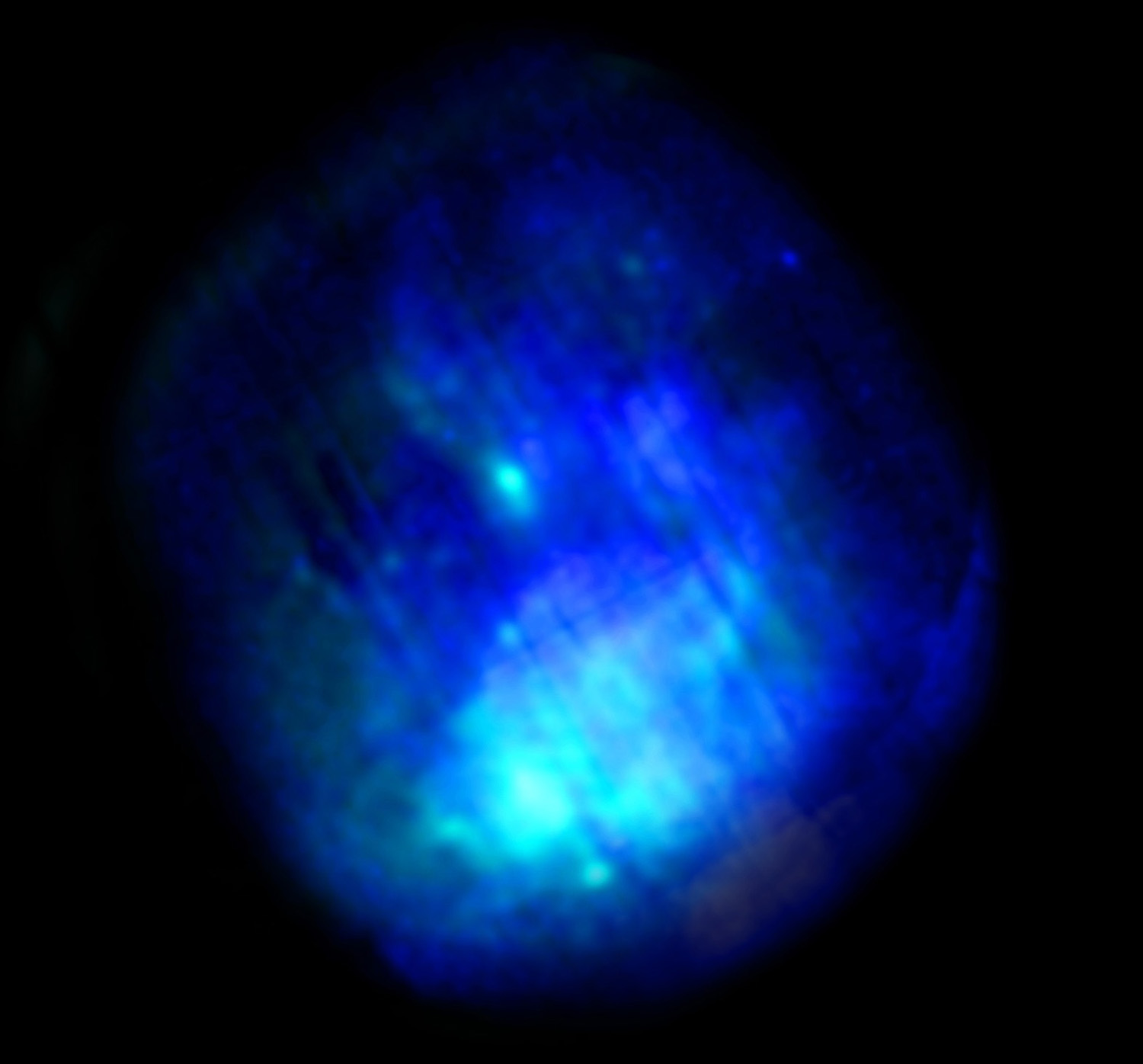
 Supernova remnant W44 revealed by XMM-Newton at high (light blue) and low (dark blue) energy X-ray emission corresponding to energies of 2–8 keV and 1.2-2 keV, respectively. Knots of dense X-ray emission represent locations where the abundance of heavier elements is elevated. Pulsar PSR B1853+01 can be seen as the bright point source coloured light blue towards the top left of W44 in this image. The striping is a result of the image processing. 
Credits: ESA/XMM-Newton


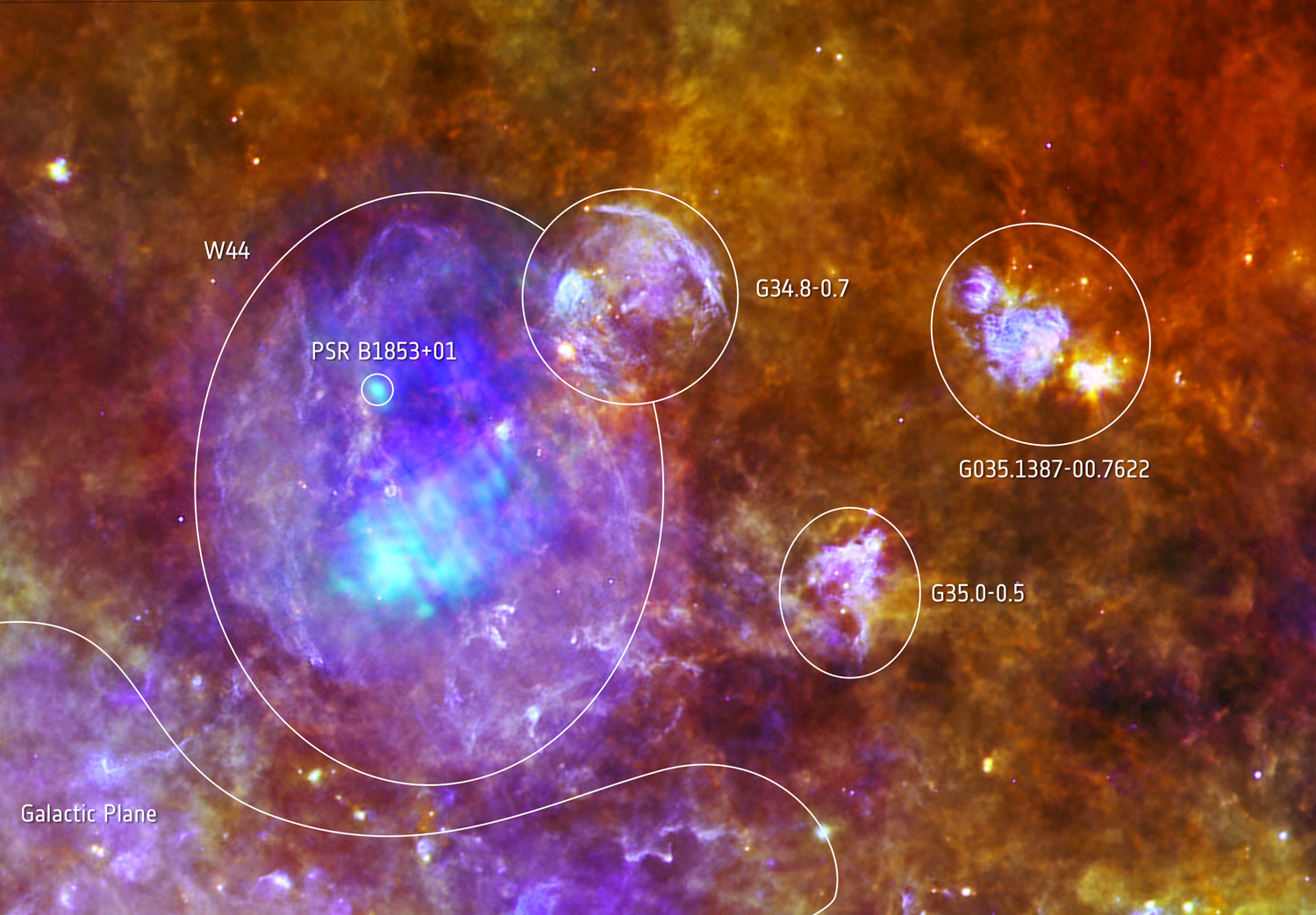
At the top right of the expanding shell, there is a smaller cavity, with the shock from the supernova remnant impacting the bight arc-shaped feature. This region is filled with hot gas that has been ionised by the intense ultraviolet radiation from embedded young massive stars. Herschel’s far-infrared eyes can also seek out regions of gently heated gas and dust further from W44, where new stars are congregating. 

Download:
 HI-RES JPEG (Size: 446 kb)
Annotated image of W44 and surrounds.

Credits: Herschel: Q. Nguyen Luong & F. Motte, HOBYS Key Program consortium, Herschel SPIRE/PACS/ESA consortia. XMM-Newton: ESA/XMM-Newton


Examples include the arrowhead-shaped star-formation region to the right of W44, which appears to point to another trio of intricate clouds further to the right and above.
More broadly, a number of compact objects scattered across the scene map the cold seeds of future stars that will eventually emerge from their dusty cocoons.
Finally, diffuse purple emission towards the bottom left of the image provides a glimpse of the Galactic plane.
Contact for further information ESA
Guillermo Gonzalo Sánchez Achutegui
ayabaca@gmail.com
ayabaca@hotmail.com
ayabaca@yahoo.com
 Inscríbete en el Foro del blog y participa : A Vuelo De Un Quinde - El Foro!

lunes, 29 de octubre de 2012

ESA Portal - Spain - Una burbuja en el caldero cósmico

Download:
Its orbit takes it almost a third of the way to the Moon, so that astronomers can enjoy long, uninterrupted views of celestial objects.
This unique X-ray observatory was launched by Ariane 5 from the European spaceport at Kourou in French Guiana on 10 December 1999. It derives its name from its X-ray multi-mirror design and honours Sir Isaac Newton. 
Credits: ESA - D. Ducros
Burbuja de Wolf-Rayet
Download:
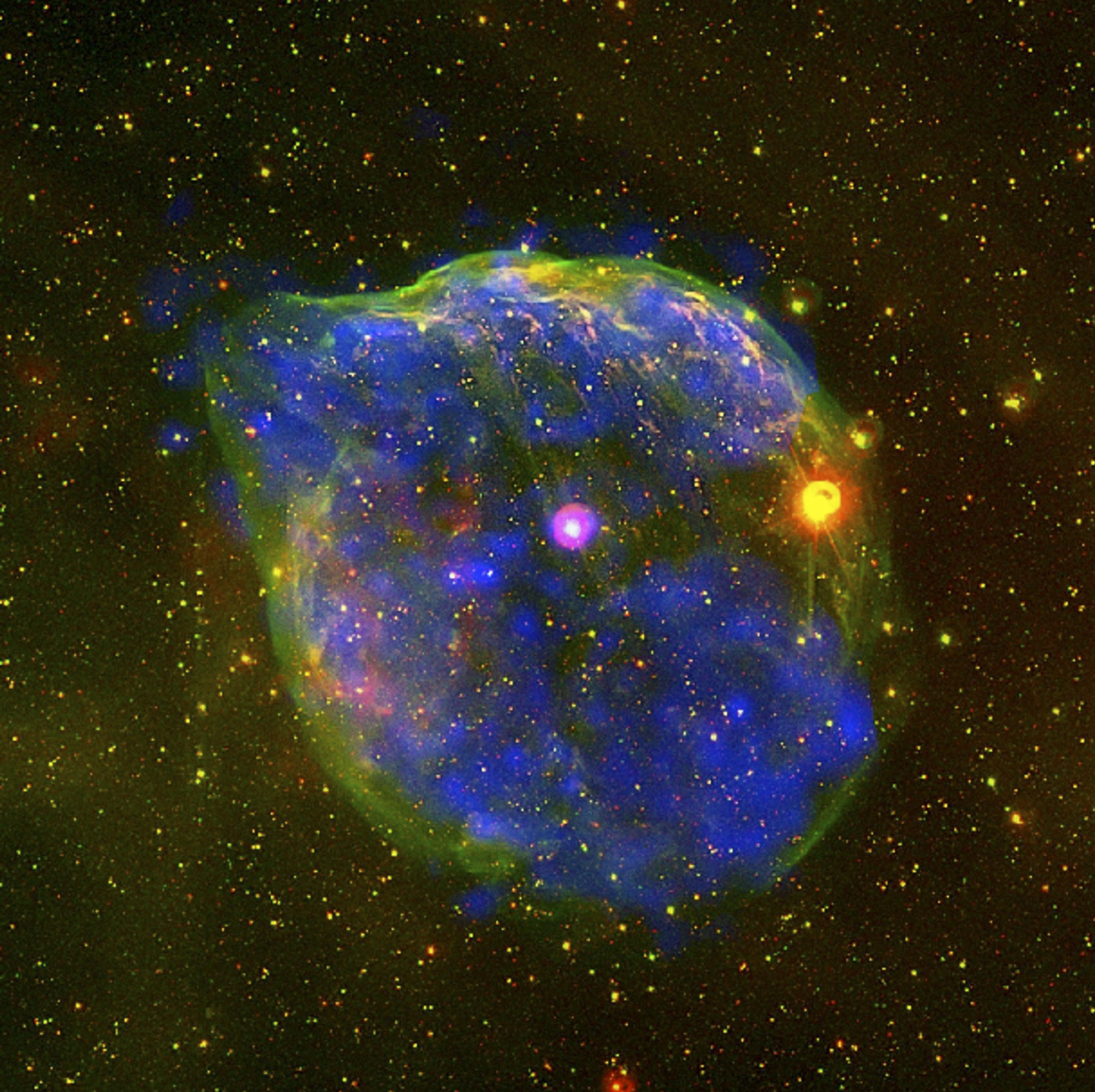
 A giant bubble blown by the massive Wolf-Rayet star HD 50896, the pink star in the centre of the image.

X-ray data from XMM-Newton’s EPIC camera are shown in blue, while optical images were acquired using the Michigan Curtis Schmidt Telescope at Cerro Tololo Inter-American Observatory (CTIO) and presented in red (H-alpha) and green (OIII).

The bubble, known as S 308, is about 60 light-years across and is located 5000 light-years away in the constellation of Canis Major.

Credits: ESA, J. Toala & M. Guerrero (IAA-CSIC), Y.-H. Chu & R. Gruendl (UIUC), S. Arthur (CRyA–UNAM), R. Smith (NOAO/CTIO), S. Snowden (NASA/GSFC) and G. Ramos-Larios (IAM)

 El telescopio espacial XMM-Newton de la ESA nos envía una imagen de este fantasmagórico rostro en rayos X para celebrar Halloween. Se trata de una burbuja producida por el intenso viento de una estrella que ‘vivirá rápido y morirá joven’.

Esta burbuja se encuentra a 5000 años luz de la Tierra, en la constelación de Canis Major, el ‘Can Mayor’, y parece la cara de un perro o de un lobo.
La burbuja abarca unos 60 años luz, y se creó bajo la acción del intenso viento emitido por la estrella de Wolf-Rayet HD 50896 – la estrella rosa en el centro de la imagen, que sería el ojo derecho de este peculiar espectro.
Las estrellas de Wolf-Rayet son astros calientes y masivos – con una masa unas 35 veces mayor que la de nuestro Sol – que expulsan grandes cantidades de materia a través de un intenso viento estelar, una corriente de plasma a millones de grados centígrados que emite rayos X, representados en azul en esta imagen.
El material que rodea a la estrella se enciende en tonos rojizos al interactuar con el fuerte viento estelar, como se puede ver en la zona de la ‘mejilla’.
El halo verde es el resultado de la colisión de una onda de choque que escapa de la estrella con las capas de materia expulsada con anterioridad.
Una ‘llamarada’ de rayos X en la esquina superior izquierda da forma a la oreja del ‘lobo’, y la región más densa de la esquina inferior derecha se asemeja a un hocico.
La ‘hora de las brujas’ se acerca para esta burbuja y para su estrella. La burbuja explotará y se terminará dispersando, mientras que la estrella terminará sus días con una dramática explosión de supernova.
El artículo X-Ray Emission from the Wolf-Rayet Bubble S 308, de J. Toala et al, ha sido publicado en el Astrophysical Journal 755, 77 (2012).
ESA
Guillermo Gonzalo Sánchez Achutegui
ayabaca@gmail.com
ayabaca@hotmail.com
ayabaca@yahoo.com 
 Inscríbete en el Foro del blog y participa : A Vuelo De Un Quinde - El Foro!

domingo, 14 de octubre de 2012

ESA - Space Science: X-raying stellar winds in a high-speed collision

 
XMM-Newton observation of the core of the very massive cluster Cyg OB2 located in the constellation of Cygnus, 4700 light-years from Earth. The cluster contains massive O-type stars that shine brightly in X-rays. Cyg OB2 #9 is seen as the bright star just below the central star, and in 2008 was determined to be a binary system. ESA’s XMM-Newton and NASA’s Swift space telescopes have now found evidence for the winds of these hot, massive stars colliding at the closest points of their orbits, resulting in a four-fold increase in X-ray emission. Hundreds of lower mass stars also fill the field of view, which spans nearly 22 x 16 arcminutes. 
Credits: ESA/G. Rauw

 Two massive stars racing in orbit around each other have had their colliding stellar winds X-rayed for the first time, thanks to the combined efforts of ESA’s XMM-Newton and NASA’s Swift space telescopes.

Stellar winds, pushed away from a massive star’s surface by its intense light, can have a profound influence on their environment.
In some locations, they may trigger the collapse of surrounding clouds of gas and dust to form new stars.
In others, they may blast the clouds away before they have the chance to get started.
Now, XMM-Newton and Swift have found a ‘Rosetta stone’ for such winds in a binary system known as Cyg OB2 #9, located in the Cygnus star-forming region, where the winds from two massive stars orbiting around each other collide at high speeds.  

Cyg OB2 #9 remained a puzzle for many years. Its peculiar radio emission could only be explained if the object was not a single star but two, a hypothesis that was confirmed in 2008.
At the time of the discovery, however, there was no direct evidence for the winds from the two stars colliding, even though the X-ray signature of such a phenomenon was expected.
This signature could only be found by tracking the stars as they neared the closest point on their 2.4-year orbit around each other, an opportunity that presented itself between June and July 2011.
As the space telescopes looked on, the fierce stellar winds slammed together at speeds of several million kilometres per hour, generating hot plasma at a million degrees which then shone brightly in X-rays.
 The telescopes recorded a four-fold increase in energy compared with the normal X-ray emission seen when the stars were further apart on their elliptical orbit.
“This is the first time that we have found clear evidence for colliding winds in this system,” says Yael Nazé of the Université de Liège, Belgium, and lead author of the paper describing the results reported in Astronomy & Astrophysics.
“We only have a few other examples of winds in binary systems crashing together, but this one example can really be considered an archetype for this phenomenon.”
Unlike the handful of other colliding wind systems, the style of the collision in Cyg OB2 #9 remains the same throughout the stars’ orbit, despite the increase in intensity as the two winds meet.
“In other examples the collision is turbulent; the winds of one star might crash onto the other when they are at their closest, causing a sudden drop in X-ray emission,” says Dr Nazé.
“But in the Cyg OB2 #9 system there is no such observation, so we can consider it the first ‘simple’ example that has been discovered – that really is the key to developing better models to help understand the characteristics of these powerful stellar winds. ”
“This particular binary system represents an important stepping stone in our understanding of stellar wind collisions and their associated emissions, and could only be achieved by tracking the two stars orbiting around each other with X-ray telescopes,” adds ESA’s XMM-Newton project scientist Norbert Schartel.
  Notes for Editors
ESA
Guillermo Gonzalo Sánchez Achutegui
ayabaca@gmail.com
ayabaca@hotmail.com

martes, 14 de agosto de 2012

Astronomía: Los restos de una explosión estelar

Hola amigos: A VUELO DE UN QUINDE EL BLOG., El observatorio espacial XMM-Newton de la ESA nos muestra esta semana los restos de una explosión de supernova, el dramático final de una estrella masiva, suspendidos en el tiempo y en el espacio.

Download:
 Composite optical and X-ray picture of supernova remnant G272.2-03.2, taken on 11 December 2001 by ESA’s XMM-Newton. The remnant was discovered in 1994 with ROSAT. The image is 40 x 40 arc minutes.
Credits: XMM-Newton/ESA


 El observatorio espacial XMM-Newton de la ESA nos muestra esta semana los restos de una explosión de supernova, el dramático final de una estrella masiva, suspendidos en el tiempo y en el espacio.

En las longitudes de onda de rayos X, los nudos de gas caliente brillan en tonos verdosos –lo que indica que presentan una temperatura de millones de grados Celsius– llenando la región central del remanente de supernova G272.2-03.2, todavía en expansión.
Un remanente de supernova es la estructura nebulosa que queda cuando una estrella masiva –con una masa de más de ocho veces la de nuestro Sol– agota su reserva de combustible y colapsa sobre sí misma, expulsando sus últimas capas de gas en una explosión cegadora.
En el corazón de la explosión puede quedar una estrella de neutrones o un agujero negro, oculto tras la capa de material compuesta por los restos de la explosión y por el medio interestelar barrido por su onda de choque.
En esta imagen se pueden distinguir dos puntos brillantes cerca del borde derecho del remanente, iluminados por la interacción de las ondas de choque con el medio que las rodea. Estos restos tan sólo tienen unos pocos miles de años – la expansión de la onda de choque tarda cientos de miles de años en frenarse.
Al estudiar los remanentes de supernovas en las longitudes de onda de los rayos X, los astrónomos son capaces de determinar la abundancia y la distribución de los distintos elementos químicos que había forjado la estrella durante las últimas etapas de su vida.
Estos datos pueden aportar nuevas pistas sobre la masa de la estrella original y sobre la dinámica de la explosión.
Las motas azules y blancas que salpican la imagen son objetos estelares que rodean a los restos de la supernova. 
 ESA
Guillermo Gonzalo Sánchez Achutegui
ayabaca@gmail.com
ayabaca@hotmail.com
ayabaca@yahoo.com
 Inscríbete en el Foro del blog y participa : A Vuelo De Un Quinde - El Foro!

miércoles, 18 de enero de 2012

Astronomía: La famosa Nebulosa del Águila cambia de imagen

Hola amigos: A VUELO DE UN QUINDE EL BLOG., La Nebulosa del Águila, como nunca ha sido vista antes. En 1995, la imagen Pilares de la Creación de la Nebulosa del Águila, obtenida por el telescopio espacial Hubble, se convirtió en una de las imágenes icono del siglo XX. Dos telescopios espaciales de la ESA proporcionan ahora nuevos datos sobre esta enigmática región de formación estelar.

Combining almost opposite ends of the electromagnetic spectrum, this composite of the Herschel in far-infrared and XMM-Newton’s X-ray images shows how the hot young stars detected by the X-ray observations are sculpting and interacting with the surrounding ultra-cool gas and dust, which, at only a few degrees above absolute zero, is the critical material for star formation itself. Both wavelengths would be blocked by Earth’s atmosphere, so are critical to our understanding of the lifecycle of stars

Credits: far-infrared: ESA/Herschel/PACS/SPIRE/Hill, Motte, HOBYS Key Programme Consortium; X-ray: ESA/XMM-Newton/EPIC/XMM-Newton-SOC/Boulanger


This 1995 Hubble Space Telescope image of the ‘Pillars of Creation’ is probably the most famous astronomical image of the 20th Century. Taken in visible light using a combination of SII/H-alpha and OIII filters, it shows a part of the Eagle Nebula where new stars are forming. The tallest pillar is around 4 light-years high

Credits: NASA/ESA/STScI, Hester & Scowen (Arizona State University)

La Nebulosa del Águila, como nunca ha sido vista antes. En 1995, la imagen Pilares de la Creación de la Nebulosa del Águila, obtenida por el telescopio espacial Hubble, se convirtió en una de las imágenes icono del siglo XX. Dos telescopios espaciales de la ESA proporcionan ahora nuevos datos sobre esta enigmática región de formación estelar. La Nebulosa del Águila está a 6.500 años luz, en la constelación Serpens. Contiene un cúmulo estelar joven caliente, NGC6611, visible con telescopios de aficionados, que esculpe e ilumina el gas y el polvo a su alrededor; genera así gigantescas formaciones huecas con aspecto de columna, de varios años luz de extensión cada una.
La imagen del Hubble sugería que en estos pilares se estaban formando nuevas estrellas, en concreto dentro de aglomeraciones de gas conocidas como EGG, siglas en inglés de Glóbulos Gaseosos en Evaporación. Pero el polvo presente en la región impedía al Hubble ver lo que ocurría, y comprobar que efectivamente los pilares albergan estrellas en formación.

Las nuevas imagines obtenidas ahora por el telescopio espacial Herschel, de la ESA, muestran en toda su amplitud los pilares y el gas y el polvo que los rodea. Las observaciones de Herschel, en longitudes de onda del infrarrojo lejano, permiten a los astrónomos ver el interior de las estructuras.
En paralelo, nuevas observaciones en rayos X obtenidas con el telescopio XMM-Newton, de la ESA, revelan la presencia de las jóvenes estrellas calientes responsables de esculpir los pilares.
XMM-Newton’s images of the Eagle Nebula region in X-rays, which here is colour-coded to show different energy levels (red: 0.3–1 keV, green: 1–2 keV and blue: 2–8 keV) is helping astronomers to investigate a theory that the Eagle Nebula is being powered by a hidden supernova remnant. The researchers are looking for signs of very diffuse emission and how far this extends around the region. They believe that an absence of this X-ray emission beyond that found by previous orbiting space telescopes (Chandra and Spitzer) would support the supernova remnant theory. The work on this is continuing

Credits: ESA/XMM-Newton/EPIC/XMM-Newton-SOC/Boulanger

Estos datos de ambos telescopio espaciales han sido además combinados con observaciones obtenidas con el telescopio VLT del Observatorio Austral Europeo (ESO), en Paranal (Chile), en el infrarrojo cercano; y en luz visible con el telescopio Max Planck Gesellschaft, de 2,2 metros de diámetro, situado en La Silla (Chile). El resultado es magnífico: imágenes de una belleza única, reveladoras de los procesos en marcha en está icónica región del cielo.
Messier 16 is a diffuse emission nebula that contains the young open cluster NGC6611. The iconic ‘Pillars of Creation’ image taken with the Hubble Space Telescope in 1995 is captured in near-infrared by the VLT, which penetrates straight through the obscuring gas and dust, rendering them almost invisible. The pillars are only a small portion of the extensive nebulous region imaged in far-infrared by ESA’s Herschel Space Observatory, which shows cool dust and gas tendrils being carved away by the hot stars seen in the X-ray image from XMM-Newton. The wide-field optical image from the ESO MPG telescope puts the pillars into context against the full scale of the nebula, which is over 75 light-years across

Credits: far-infrared: ESA/Herschel/PACS/SPIRE/Hill, Motte, HOBYS Key Programme Consortium; ESA/XMM-Newton/EPIC/XMM-Newton-SOC/Boulanger; optical: MPG/ESO;

near-infrared: VLT/ISAAC/McCaughrean & Andersen/AIP/ESO

En longitudes de onda visible la nebulosa brilla principalmente por la luz estelar reflejada y por el gas caliente que llena las cavidades gigantes, cubriendo la superficie de los pilares y otras estructuras polvorientas.
Vídeo en varias The 8.2m-diameter VLT’s ANTU telescope imaged the famous Pillars of Creation region and its surroundings in near-infrared using the ISAAC instrument. This enabled astronomers to penetrate the obscuring dust in their search to detect newly formed stars. The research into the ‘evaporating gaseous globules’ (EGGs), which were first detected in the Hubble images, needed the near-infrared capabilities and resolution of the VLT to peel back the layers of dust and detect the low-mass young stars cocooned within the EGG shells. The near-infrared results showed that 11 of the 73 EGGs detected possibly contained stars, and that the tips of the pillars contain stars and nebulosity not seen in the Hubble image

Credits: VLT/ISAAC/McCaughrean & Andersen/AIP/ESO

La imagen revela brillantes filigranas de gas y polvo, lo que da pistas a los astrónomos acerca de cómo interacciona este material con las estrellas calientes vistas por XMM-Newton.
El 2001, las imágenes en el infrarrojo cercano del VLT indicaban que sólo era probable que albergaran estrellas en formación una minoría de EGGs.
La imagen de Herschel permite ahora buscar estrellas jóvenes en una región mucho más amplia; podrá comprenderse así mucho mejor las fuerzas creadores y destructoras que actúan en la Nebulosa del Águila
This Herschel image of the Eagle Nebula, colour coded to 70 microns for blue and 160 microns for green using the PACS (Photodetector Array Camera) and 250 microns for red using the SPIRE (Spectral and Photometric Imaging Receiver) shows the self-emission of the intensely cold nebula’s gas and dust as never seen before. Each colour shows a different temperature of dust, from around 10 degrees above absolute zero (10K) for the red, up to around 40K for the blue. In the far–infrared, the nebula shows its intricate tendril nature, with vast cavities forming an almost cave-like surrounding to the famous pillars, which take on an ethereal ghostly appearance. The gas and dust provide the material for the star formation that is still under way inside this enigmatic nebula

Credits: ESA/Herschel/PACS/SPIRE/Hill, Motte, HOBYS Key Programme Consortium

Las observaciones anteriores en el infrarrojo medio obtenidas con los telescopios ISO (Observatorio Espacial Infrarrojo), de la ESA, y Spitzer, de la NASA, y los nuevos datos de XMM-Newton, sugieren a los astrónomos que una de las estrellas masivas y calientes en NGC6611 podría haber explotado como supernova hace 6000 años, generando una onda de choque que destruyó los pilares.
Los potentes telescopios basados en tierra siguen proporcionando vistas asombrosas de nuestro universo, pero desde tierra, debido al efecto de la atmósfera, es imposible obtener imágenes en el infrarrojo medio, en el infrarrojo lejano y en rayos X.

Up to 1998 the ESA ISO (Infrared Space Observatory) was the most sensitive mid infrared telescope ever built. ISO observations were performed at 7 microns (and 15 microns, not shown) aiming to detect embedded sources in the pillars

Credits: ESA/ISO/Pilbratt et al.
Los telescopios espaciales, como Herschel y XMM-Newton, ya no están cubiertos por este velo y contemplan así la belleza del universo en todas las longitudes de onda del espectro electromagnético.
Con regiones como la Nebulosa del Águila, combinar todas estas observaciones ayuda a los astrónomos a entender el complejo pero impresionante ciclo vital de las estrellas . ESA
Guillermo Gonzalo Sánchez Achutegui
ayabaca@gmail.com
ayabaca@hotmail.com
ayabaca@yahoo.com
Inscríbete en el Foro del blog y participa : A Vuelo De Un Quinde - El Foro!

viernes, 30 de septiembre de 2011

ASTRONOMÍA: Telescopios de la ESA diseccionan la materia en torno a un agujero negro supermasivo

Hola amigos: A VUELO DE UN QUINDE EL BLOG., Varios observatorio espaciales, entre los que se encuentran los telescopios de la ESA XMM-Newton e Integral, han observado en las inmediaciones de un agujero negro supermasivo unas enormes bolsas de gas que se alejan del gran ‘monstruo gravitacional’.

Aquí en la imagen observamos a la : Galaxy Markarian 509 as seen by the Hubble Space Telescope's WFPC2.

Credits: NASA, ESA, J. Kriss (STScI) and J. de Plaa (SRON)


El agujero negro estudiado está alojado en el centro de la galaxia Markarian 509, a 500 millones de años luz. Se trata de un agujero negro colosal, de una masa de más de 300 millones de soles que sigue creciendo a medida que devora más materia.
Los investigadores decidieron observar Markarian 509 porque se sabe que su brillo varía, lo que indica que el flujo de materia que cae en el agujero negro es turbulento. La radiación emitida desde la región más próxima al agujero empuja hacia fuera el chorro de gas.
Los telescopios vigilaron el agujero durante cien días. “XMM-Newton lideró las observaciones, por la amplitud de su cobertura en rayos X y por su cámara de luz visible”, ha dicho Jelle Kaastra, del SRON Netherlands Institute for Space Research, que ha coordinado el equipo internacional de 26 astrofísicos de 21 instituciones que han llevado a cabo el estudio.
Durante la campaña, la galaxia Markarian 509 se superó a sí misma; su brillo, en vez de fluctuar el 25% habitual, lo hizo en un 60%. Es un indicio de que en el flujo de gas en torno al agujero negro se han producido alteraciones importantes.
Las observaciones han mostrado que el chorro de gas está hecho en realidad de balas gigantes propulsadas a millones de kilómetros por hora. Estas bolsas de gas son arrancadas de un reservorio de materia ‘en lista de espera’ para caer en el agujero. La sorpresa es que este reservorio está situado a más de 15 años luz del agujero, más lejos de lo que algunos astrónomos creen posible que se pueda originar este tipo de viento.

An artist's impression of the central engine of an active galaxy. A black hole is surrounded by matter waiting to fall in. Fearsome radiation from near the black hole drives an outflow of gas. Credits: NASA and M. Weiss (Chandra X-ray Center)

"Hace tiempo que hay un debate en astronomía sobre el origen del chorro de gas”, señala Kaastra.
El reservorio de gas y polvo toma la forma de una rosquilla que rodea el agujero negro. La materia cae hacia el agujero describiendo una espiral, creando un disco de acreción en que el gas se comporta como el agua cayendo por un sumidero.
Las observaciones muestran también que el disco de acreción tiene una piel de gas caliente, a una temperatura de millones de grados. De este gas caliente proceden los rayos X y gamma que empujan hacia afuera el chorro de gas que se aleja.
Además de XMM-Newton e Integral, los investigadores recurrieron al telescopio espacial Hubble, de la NASA y la ESA; a los telescopios Chandra y Swift, de la NASA; y a los telescopios basados en tierra WHT y PARITEL. En conjunto, esta batería de telescopios ha cubierto un amplísimo rango del espectro electromagnético: desde el infrarrojo a los rayos gamma, pasando por el visible, el ultravioleta y los rayos X.
“Los resultados demuestran la importancia de llevar a cabo observaciones y campañas de vigilancia a largo plazo en la investigación de objetos variables. XMM-Newton hizo todos los cambios en su organización para hacer posible estas observaciones, y ahora el esfuerzo está dando resultados”, dice Norbert Schartel, jefe científico de XMM-Newton en la ESA.
Para ampliar información hacer click aquí
Guillermo Gonzalo Sánchez Achutegui
ayabaca@gmail.com
ayabaca@hotmail.com
ayabaca@yahoo.com
Inscríbete en el Foro del blog y participa : A Vuelo De Un Quinde - El Foro!

Mi lista de blogs