Mostrando entradas con la etiqueta Carbon dioxide(CO2). Mostrar todas las entradas

viernes, 5 de agosto de 2016

NSF: Earlier snowmelt decreases streamflow, reduces forests' ability to regulate atmospheric carbon dioxide.- Deshielo temprano disminuye el caudal, reduce la capacidad de los bosques para regular el dióxido de carbono atmosférico

http://www.nsf.gov/news/news_summ.jsp?cntn_id=189304&WT.mc_id=USNSF_51&WT.mc_ev=click
By mid-century, shift in snowmelt timing could lead to 45 percent reduction of forest CO2 uptake

A Colorado Rocky Mountain forest during the winter-spring transition period, which is changing.

A Colorado Rocky Mountain forest during the winter-spring transition period, which is changing.
Credit and Larger Version

August 3, 2016
Earlier annual snowmelt periods may hinder the ability of forests to regulate atmospheric carbon dioxide (CO2), according to the results of a new study.
The findings, published in Geophysical Research Letters, a journal of the American Geophysical Union, predict that this shift in snowmelt timing each spring could result in a 45 percent reduction of snowmelt period forest carbon by mid-century.
A second study, also published in Geophysical Research Letters, found that earlier, slower snowmelt reduces the amount of streamflow, which has consequences for agriculture, municipal water supplies and recreational opportunities in Colorado and other states in the western U.S.
"The recent western drought has been accompanied by a snowpack restricted to higher elevations, with a significant effect on the ski industry," said Tom Torgersen, program director in the National Science Foundation (NSF) Division of Earth Sciences, which funded the research. NSF's Long-Term Ecological Research (LTER) program also supported the studies through the Niwot Ridge, Colorado, LTER site.
"Climate variability also leads to conditions favoring earlier and slower snowmelt, with a decreased and prolonged peak streamflow," Torgersen said. "This water flow affects mountain fishing and results in less forest growth. The effects of drought and climate variability on snowmelt reach far beyond farm productivity and urban water restrictions."
 
Implications for western U.S.
 
Forests in seasonally snow-covered areas serve as key CO2 sinks, thanks to the natural processes by which trees take in carbon. This carbon uptake is restrained during winter, but increases to peak capacity in spring when snowmelt provides abundant water to trees.
University of Colorado Boulder (CU-Boulder) scientists working at Niwot Ridge in Colorado's Rocky Mountains studied 15 years of snowmelt and atmospheric CO2 data to determine the effects of changes in snowmelt periods.
They found that earlier snowmelt triggered by climate change reduces forests' ability to take CO2 out of the atmosphere.
"The implications of this research are profound as mountains in the western U.S. are an important part of the regional cycling of carbon and water," said Noah Molotch, the director of CU-Boulder's Center for Water, Earth Science & Technology, and a co-author of both studies.
Added Taylor Winchell of CU-Boulder's Institute for Arctic and Alpine Research (INSTAAR) and lead author of one of the studies: "Early melting reduces trees' ability to uptake carbon during the snowmelt period, a key time for seasonal carbon uptake."
 
Downstream water resources
 
Snowmelt also provides water resources to downstream communities. Previous research shows that the timing and rate at which snow melts can affect the amount and quality of water available for vegetation, farming and fishing.
The researchers used a unique modeling system to study the effects of earlier snowmelt across various regions of the western U.S., including the Cascade Range, the Sierra Nevada, the Wasatch Range and the Rocky Mountains. These areas see significant seasonal snow accumulations that generate water resources for downstream communities.
The results show that earlier, slower snowmelt, triggered by warmer temperatures, reduces streamflow. These slower "trickle" melts reduce percolation in hillslope soils and allow more water to evaporate, resulting in less streamflow overall.
"Of all the regions we studied, streamflow from Colorado's Rocky Mountains is most sensitive to changes in snowmelt," said Theodore Barnhart of INSTAAR, lead author of the second study. "This analysis suggests that all the regions studied will experience a decrease in streamflow with a decrease in snowmelt rate, with some regions having more streamflow sensitivity than others."
CU-Boulder's Molotch added that the findings have broad implications for the scientific community.
"Given that 60 million people in the western U.S. depend on snowmelt for their water supply, the future decline in snowmelt-derived streamflow may place additional stress on over-allocated water supplies," he said. "These two studies are reshaping the way scientists -- and land and water managers -- think about climate change in mountain regions."
-NSF-
Media Contacts Cheryl Dybas, NSF, (703) 292-7734,
 cdybas@nsf.gov
Trent Knoss, University of Colorado Boulder, (303) 735-0528,
 trent.knoss@colorado.edu
Lauren Lipuma, American Geophysical Union, (202) 777-7396,
llipuma@agu.org

Related WebsitesNSF Grant: Snowpack energy and mass balance: implications for biogeochemical feedbacks in alpine basins: https://www.nsf.gov/awardsearch/showAward?AWD_ID=1032308&HistoricalAwards=false
Study Ties Forest "Greenness" in Western U.S. to Snowpack Extent: https://www.nsf.gov/news/news_summ.jsp?cntn_id=125359&org=NSF


The National Science Foundation (NSF) is an independent federal agency that supports fundamental research and education across all fields of science and engineering. In fiscal year (FY) 2016, its budget is $7.5 billion. NSF funds reach all 50 states through grants to nearly 2,000 colleges, universities and other institutions. Each year, NSF receives more than 48,000 competitive proposals for funding and makes about 12,000 new funding awards. NSF also awards about $626 million in professional and service contracts yearly.
 Get News Updates by Email 
Useful NSF Web Sites:
NSF Home Page:
https://www.nsf.gov
NSF News:
https://www.nsf.gov/news/
For the News Media:
https://www.nsf.gov/news/newsroom.jsp
Science and Engineering Statistics:
 https://www.nsf.gov/statistics/
Awards Searches:
 https://www.nsf.gov/awardsearch/

Mid-summer snowfields in the mountains of Washington State; most snow has melted.
Credit and Larger Version
The Collegiate Peaks viewed from the Arkansas River Valley in Colorado.
Credit and Larger Version
Scientists gauge streamflow in the Sagehen Experimental Watershed in California.
Credit and Larger Version
Colorado's San Juan Mountains covered in late spring snow. Snowmelt timing is shifting here.
Credit and Larger Version
The Yellowstone River in Yellowstone National Park after a late spring snowstorm.
Credit and Larger Version

The National Science Foundation (NSF)
Guillermo Gonzalo Sánchez Achutegui
ayabaca@gmail.com
ayabaca@hotmail.com
ayabaca@yahoo.com
Inscríbete en el Foro del blog y participa : A Vuelo De Un Quinde - El Foro!

jueves, 26 de diciembre de 2013

NASA : OCO-2 Observatory Conducts Environmental Tests


OCO-2 Observatory Conducts Environmental Tests
 
NASA's Orbiting Carbon Observatory (OCO)-2 spacecraft is moved into a thermal vacuum chamber at Orbital Sciences Corporation's Satellite Manufacturing Facility in Gilbert, Ariz., for a series of environmental tests. The tests confirmed the integrity of the observatory's electrical connections and subjected the OCO-2 instrument and spacecraft to the extreme hot, cold and airless environment they will encounter once in orbit. The observatory's solar array panels were removed prior to the test.
OCO-2 is NASA's first mission dedicated to studying atmospheric carbon dioxide and is the latest mission in NASA's study of the global carbon cycle. Carbon dioxide is the most significant human-produced greenhouse gas and the principal human-produced driver of climate change. The mission will uniformly sample the atmosphere above Earth's land and ocean, collecting between 100,000 and 200,000 measurements of carbon dioxide concentration over Earth's sunlit hemisphere every day for at least two years. It will do so with the accuracy, resolution and coverage needed to provide the first complete picture of the regional-scale geographic distribution and seasonal variations of both human and natural sources of carbon dioxide emissions as well as the places where carbon dioxide is removed from the atmosphere and stored.
Image Credit: Orbital Sciences Corporation/NASA/JPL-Caltech


NASA
Guillermo Gonzalo Sánchez Achutegui
ayabaca@gmail.com
ayabaca@hotmail.com
ayabaca@yahoo.com

Inscríbete en el Foro del blog y participa : A Vuelo De Un Quinde - El Foro!


domingo, 10 de noviembre de 2013

NASA : Study Finds Climate Link to 'Atmospheric River' Storms


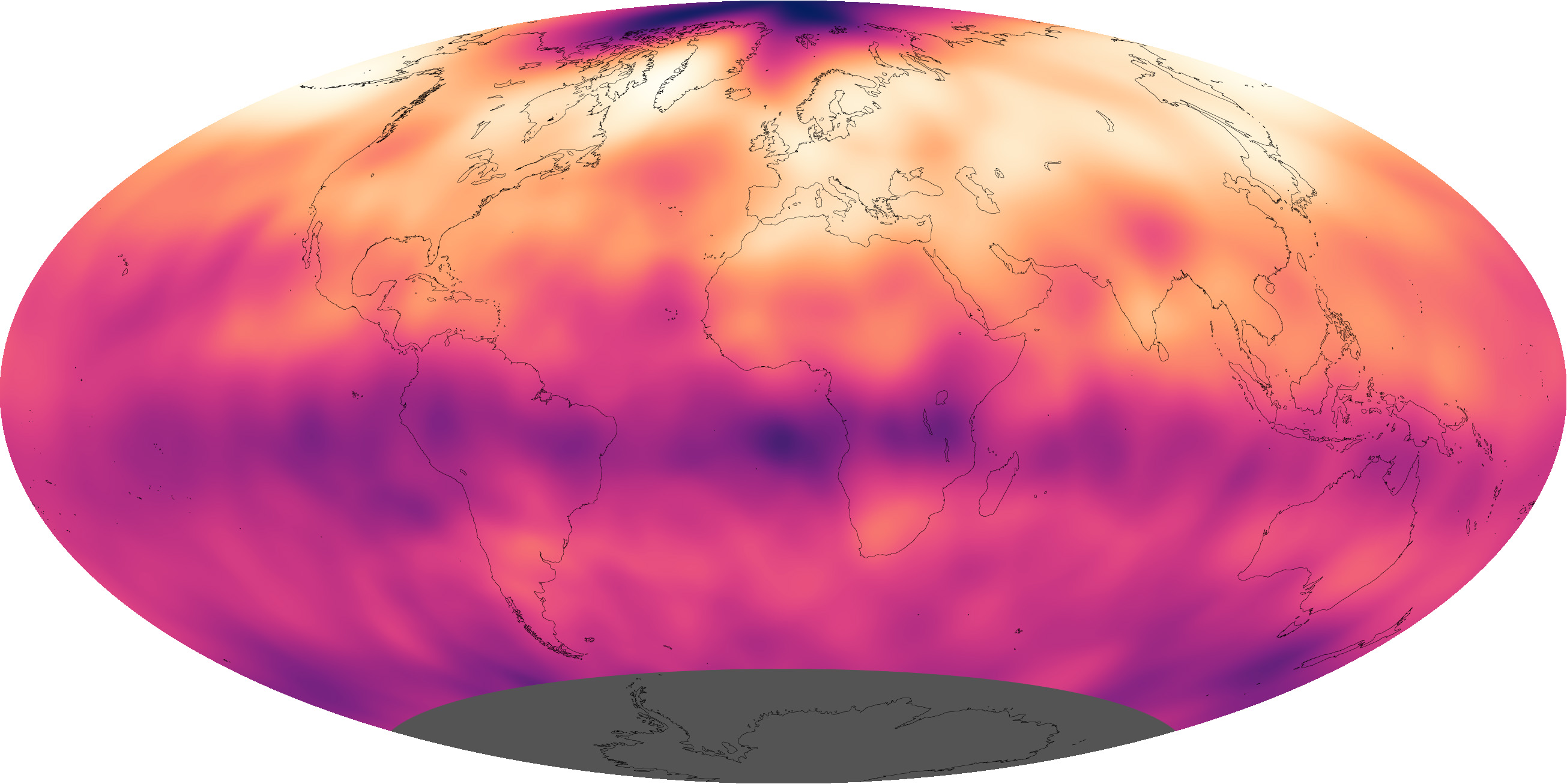
Global Patterns of Carbon Dioxide
Color bar for Global Patterns of Carbon Dioxide
acquired May 1 - 31, 2013download large image (498 KB, JPEG, 2610x1306)
Global Patterns of Carbon Dioxide
acquired March 1, 1958 - August 31, 2013download large image (76 KB, PDF)
Almost any discussion of global warming begins or ends with carbon dioxide. Because of its molecular structure, carbon dioxide is a greenhouse gas, which means it allows visible light from the Sun to pass through the atmosphere while absorbing and reemitting infrared energy, heating the Earth. Greenhouse gases act as insulation and are responsible for making Earth’s climate comfortable—without them, our planet would have an average temperature of -18 Celsius (0 Fahrenheit). Since the beginning of the Industrial Revolution, people have been releasing carbon dioxide into the atmosphere by burning fossil fuels and clearing forests. By adding extra greenhouse gases to the atmosphere, people are raising the planet’s temperature with wide-ranging impacts.
Carbon dioxide is neither the most potent, nor the most abundant greenhouse gas, but it is the one most responsible for altering global temperatures. This close connection between climate and carbon is a compelling reason to keep track of carbon dioxide concentrations in the atmosphere. The first space-based instrument to independently measure atmospheric carbon dioxide day and night, and under both clear and cloudy conditions over the entire globe, is the Atmospheric Infrared Sounder (AIRS) on NASA’s Aqua satellite.
The map above shows carbon dioxide in the mid-troposphere, the part of the atmosphere where most weather occurs. The data was collected in May 2013, when carbon dioxide levels reached their highest point in at least 800,000 years. The highest concentrations, shown in yellow, are in the Northern Hemisphere. Concentrations are lower in the Southern Hemisphere. In May, the Northern Hemisphere growing season was just beginning, so plants were removing little carbon from the atmosphere.
The AIRS instrument measures 2,378 different infrared channels, or segments, of infrared light. Carbon dioxide absorbs and emits very specific wavelengths of infrared light, giving it a unique fingerprint. By measuring the emitted thermal infrared radiation, AIRS can detect this fingerprint, giving scientists a way to estimate carbon dioxide concentrations globally.
AIRS has shown that carbon dioxide is not evenly distributed over the globe; it is patchy with high concentrations in some places and lower concentrations in others. The gas’s transport and distribution through the atmosphere is controlled by the jet stream, by large weather systems, and by other large-scale atmospheric circulations. The findings from AIRS have raised new questions about how carbon dioxide is transported from one place to another—both horizontally and vertically—through the atmosphere. To address these questions and others, NASA is preparing to launch the Orbiting Carbon Observatory in 2014. It will be the first satellite dedicated to monitoring carbon dioxide, and it will do so with greater precision and detail than current instruments.
Much of what we now know about atmospheric carbon dioxide concentrations comes from a monitoring station in Mauna Loa, Hawaii, started by Charles David Keeling in 1958. The graph below shows measurements from that ground station, which peaked in May 2013 at 399.76 parts per million. At the beginning of the Industrial Revolution, carbon dioxide levels in the atmosphere were roughly 278 parts per million.
The impact of rising carbon dioxide concentrations—including warmer global temperatures, altered weather patterns, changes in ecosystems, and melting ice—are summarized in the new Fifth Assessment Report from the Intergovernmental Panel on Climate Change (IPCC), which will be released on September 30, 2013. The report’s summary for policy makers will be presented in a webcast on September 27. The last summary assessment report was released in 2007.
  1. Related Reading

  2. Bloomberg (2013, September 20) New coal plants must capture carbon dioxide output: EPA. Accessed September 25, 2013.
  3. Earth Observatory (2011, June 16) The carbon cycle. Accessed September 25, 2013.
  4. Earth Observatory (2010, June 3) Global warming. Accessed September 25, 2013.
  5. Global Carbon Project (2013) Global carbon budget highlights. Accessed September 25, 2013.
  6. NCAR UCAR (2011) Greenhouse effect movie – Scott Denning. Accessed September 25, 2013.
NASA Earth Observatory image by Rob Simmon and Jesse Allen with data courtesy the AIRS science team. Mauna Loa data courtesy NOAA Earth System Research Laboratory. Caption by Holli Riebeek.
Instrument:
Aqua - AIRS
NASA
Guillermo Gonzalo Sánchez Achutegui

domingo, 22 de septiembre de 2013

nsf.gov - National Science Foundation - Tropical forest carbon sink hinges on 'odd couple'


Unique housing arrangement between trees and bacteria
Tropical rainforest on Barro Colorado Island, Panama.
Tropical rainforest on Barro Colorado Island, Panama, near the site of the study.
Credit and Larger Version
September 16, 2013
A unique housing arrangement between a specific tree species and carbo-loading bacteria may determine how well tropical forests can absorb carbon dioxide from the atmosphere, says new research today in an advance online publication of the journal Nature.
The findings suggest that the role of tropical forests in offsetting the atmospheric buildup of carbon from fossil fuels depends on tree diversity, particularly in forests recovering from exploitation.
Tropical forests thrive on natural nitrogen fertilizer pumped into the soil by trees in the legume family, a diverse group of plants that includes beans and peas, the researchers report.
"Fast-growing nitrogen-fixing trees are not common outside of the tropics, but are found in surprisingly high diversity there," said Henry Gholz, program director in the National Science Foundation's (NSF) Division of Environmental Biology, which funded the research.
"These findings place the trees' ability to capture atmospheric nitrogen and to use it to stimulate growth in the context of long-term tropical forest development," Gholz said. "This process not only allows these trees to get out of the gate quickly after a disturbance, but to maintain dominance decades to centuries later."
The researchers studied recovering forests in Panama that had been exploited five to 300 years earlier.
The presence of legume trees ensured rapid forest growth, and thus a substantial carbon sink, in the first 12 years of recovery.
Tracts of land that were pasture only 12 years before had already accumulated as much as 40 percent of the carbon found in fully mature forests. Legumes contributed more than half the nitrogen needed to make that happen.
These fledgling woodlands had the capacity to store 50 metric tons of carbon per hectare, which equates to roughly 185 tons of carbon dioxide, or the exhaust of some 21,285 gallons of gasoline.
That much fuel would take the average car in the United States more than half a million miles.
Though the legumes' nitrogen fertilizer output waned in later years, the species nonetheless took up carbon at rates that were up to 9 times faster than non-legume trees.
The legumes' secret is a process known as "nitrogen fixation" carried out in concert with infectious bacteria known as rhizobia, which dwell in small pods, known as root nodules, inside the tree's roots.
As a nutrient, nitrogen is essential for plant growth, but tropical soil is short on nitrogen and surprisingly non-nutritious for trees.
Legumes use secretions to invite rhizobia living in the soil to infect their roots, and the bacteria signal back to initiate nodule growth.
The rhizobia move into the root cells of the host plant and--in exchange for carbohydrates produced by photosynthesis in the tree--convert nitrogen from the air into fertilizer plants need.
Excess nitrogen from the legume eventually creates a nitrogen cycle that benefits neighboring trees.
By nurturing bigger, healthier trees that take up more carbon, legumes have a newly realized importance when it comes to influencing atmospheric carbon dioxide, said paper co-author Lars Hedin of Princeton University.
Scientists recently assigned numbers to track how much carbon forests as a whole absorb, suggesting that the world's forests took up 2.4 quadrillion tons of carbon from 1990 to 2007.
"Tropical forests are a huge carbon sink," said Hedin.
"If trees could just grow and store carbon, you could have a rapid sink, but if they don't have enough nitrogen they don't take up carbon," he said, adding that nitrogen-fixing trees are uncommon in temperate forests such as those in most of North America and Europe.
"Legumes are a group of plants that perform a valuable function in tropical forests, but no one knew how much they help with the carbon sink," Hedin said. "This work shows that the level of biodiversity in a tropical forest determines the size of the carbon sink."
First author Sarah Batterman of Princeton said that legumes, or "nitrogen-fixers," are especially important for forests recovering from agricultural use, logging, fire or other human activities.
The researchers studied 16 forest plots that were formerly pasture and are maintained by the Smithsonian Tropical Research Institute (STRI).
Forest degradation, however, comes with a loss of biodiversity that can affect nitrogen-fixers, too, even though legumes are not specifically threatened, Batterman said.
If the number and diversity of nitrogen-fixers plummet, the health of the surrounding forest would likely be affected for a long time, she said.
"This study shows that there is an important place for nitrogen-fixation in these disturbed areas," Batterman said.
"Nitrogen-fixers are a component of biodiversity and are important for the function of these forests, but we don't know enough about how this valuable group of trees influences forests. While some species may thrive on disturbance, others may be sensitive to human activities."
The researchers found that the nine legume species they studied did not contribute nitrogen to surrounding trees at the same time.
Certain species were more active in the youngest forests, others in middle-aged forests, and still other species went into action mainly in 300-year-old tracts, though not nearly to the same extent as legumes in younger plots.
The researchers found that individual trees reduced their fixation as nitrogen accumulated in soils, with the number of legumes actively "fixing" nitrogen dropping from 71 to 23 percent between 12- and 80-year-old forests.
"The diversity of species present in the forest is critical because it ensures that there can be fixation at different time periods of forest recovery," Batterman said.
"If you were to lose one of those species and it turned out to be essential for a specific time period, fixation might drop dramatically."
Such details can improve what scientists know about future climate change, Batterman said.
Computer models that calculate the global balance of atmospheric carbon dioxide also must factor in sinks that offset carbon, such as tropical forests.
And if forests take up carbon differently depending on the abundance and diversity of legumes, models should reflect that variation, she said.
"Other researchers can now put this role of nitrogen-fixation into their models and improve predictions about the carbon sink," Batterman said.
Batterman and Hedin worked with Michiel van Breugel and Jefferson Hall at STRI, Johannes Ransijn at the University of Copenhagen and Dylan Craven at Yale University.
The work was also supported by grants from the National Oceanic and Atmospheric Administration; the Smithsonian Tropical Research Institute; and the Cooperative Institute for Climate Science and the Carbon Mitigation Initiative, both at Princeton University.
-NSF-
Media Contacts Cheryl Dybas, NSF (703) 292-7734
cdybas@nsf.gov
Morgan Kelly, Princeton University (609) 258-5729
Related WebsitesNSF Grant: Biogeochemical Controls on Nitrogen Fixation in a Diverse Neotropical Forest: http://www.nsf.gov/awardsearch/showAward?AWD_ID=0614116&HistoricalAwards=false
The National Science Foundation (NSF) is an independent federal agency that supports fundamental research and education across all fields of science and engineering. In fiscal year (FY) 2012, its budget was $7.0 billion. NSF funds reach all 50 states through grants to nearly 2,000 colleges, universities and other institutions. Each year, NSF receives about 50,000 competitive requests for funding, and makes about 11,500 new funding awards. NSF also awards about $593 million in professional and service contracts yearly.
Useful NSF Web Sites:
NSF Home Page:
 http://www.nsf.gov
NSF News:
 http://www.nsf.gov/news/
For the News Media:
 http://www.nsf.gov/news/newsroom.jsp
Science and Engineering Statistics:

Map showing the location of Barro Colorado Island, Panama.
Map marking the location of Barro Colorado Island, Panama.
Credit and Larger Version
Rainforests on Barro Colorado Island
Rainforests like this one on Barro Colorado Island depend on an "odd couple" relationship.
Credit and Larger Version
Symbiotic root nodules in a lowland tropical rainforest
Symbiotic root nodules in a lowland tropical rainforest in Panama.
Credit and Larger Version
Photo of houses on Barro Colorado Island where the researchers studied tropical forests.
The station on Barro Colorado Island where the researchers studied tropical forests.
Credit and Larger Version
Photo of a red-eyed tree frog.
Tropical forests on Barro Colorado Island are home to such animals as red-eyed tree frogs.
Credit and Larger Version

The National Science Foundation (NSF)
Guillermo Gonzalo Sánchez Achutegui

martes, 27 de agosto de 2013

nsf.gov - Ocean acidification: Making new discoveries through National Science Foundation research grants

 Acidifying marine ecosystems of increasing concern
Photo of anemones and symbiotic algae.
NSF awardees will study how ocean acidification affects anemones and symbiotic algae.
Credit and Larger Version
August 26, 2013
With increasing levels of carbon dioxide accumulating in the atmosphere and moving into marine systems, the world's oceans are becoming more acidic.
The oceans may be acidifying faster today than at any time in the past 300 million years, scientists have found.
To address the concern for acidifying marine ecosystems, the National Science Foundation (NSF) has awarded new grants totaling $12 million in its Ocean Acidification Program.
The program is part of NSF's Science, Engineering and Education for Sustainability (SEES) investment.
The awards, the third round in this program, are supported by NSF's Directorates for Geosciences and Biological Sciences.
"These new awards will expand the scope of our knowledge about the types of marine organisms, populations, communities, and ecosystems that may be affected in unique ways by a more acidic ocean," says David Conover, director of NSF's Division of Ocean Sciences.
From tropical oceans to icy seas, the projects will foster research on the nature, extent and effects of ocean acidification on marine environments and organisms in the past, present and future.
"NSF is excited to add these high-quality research projects to our growing ocean acidification award portfolio," says David Garrison, program director in NSF's Directorate for Geosciences and chair of NSF's Ocean Acidification Working Group.
Ocean acidification affects marine ecosystems, organisms' life histories, ocean food webs and biogeochemical cycling, scientists have discovered.
Researchers believe there is a need to understand the chemistry of ocean acidification and its interplay with marine biochemical and physiological processes, before Earth's seas become inhospitable to life as we know it.
Animal species from pteropods--delicate, butterfly-like planktonic drifters--to hard corals are affected by ocean acidification. So, too, are the unseen microbes that fuel ocean productivity and influence the chemistry of ocean waters.
As the oceans become more acidic, the balance of molecules needed for shell-bearing organisms to manufacture shells and skeletons is altered.
The physiology of many marine species, from microbes to fish, may be affected. Myriad chemical reactions and cycles are influenced by the pH, or acidity, of the oceans.
The newly funded projects include studies of whether populations of animals have the genetic capacity to adapt to ocean acidification. The findings, scientists say, will yield new insights about how a future more acidic ocean will affect marine life.
"These awards will extend our understanding of the physiological abilities of organisms to adjust to acidifying oceans in the near-term, and the evolutionary capacities of populations to adapt to predicted ocean acidification in the next century," says William Zamer, program director in NSF's Directorate for Biological Sciences.
Has ocean life faced similar challenges in our planet's past?
"Earth system history informs our understanding of the effects of ocean acidification in the present and the future," says Garrison.
For a true comprehension of how acidification will change the oceans, he says, we need to integrate paleoecology with marine chemistry, physics, ecology and an understanding of the past environmental conditions on Earth.
NSF Ocean Acidification Program grantees will ask questions such as: Will regional differences in marine chemistry and physics increase acidification? Are there complex interactions, cascades and bottlenecks that will emerge as the oceans acidify, and what are their ecosystem implications? And if current trends continue, how far-reaching will the changes be?
NSF 2013 Ocean Acidification awardees, their institutions and projects are:
Additional Collaborators: Patricia Matrai and Peter Countway, Bigelow Laboratory for Ocean Sciences
Additional Collaborators: Christof Meile, William Fitt and Yongchen Wang, University of Georgia
Additional Collaborators: Steven Dudgeon, California State University
Additional Collaborators: Ann Tarrant and Amy Maas, Woods Hole Oceanographic Institution
Additional Collaborators: Richard Lenski, Michigan State University
Additional Collaborators: Nitin Baliga, Institute for Systems Biology
Additional Collaborators: Todd Martz, University of California, San Diego, Scripps Institution of Oceanography
Additional Collaborators: Adam Marsh, University of Delaware
-NSF-
Media Contacts Cheryl Dybas, NSF (703) 292-7734 cdybas@nsf.gov
Related WebsitesNSF News: Natural Underwater Springs Show How Coral Reefs Respond to Ocean Acidification:
 http://www.nsf.gov/news/news_summ.jsp?cntn_id=128243
NSF News: World Oceans Month Brings Mixed News for Oysters:
 http://www.nsf.gov/news/news_summ.jsp?cntn_id=128228
NSF News: Ocean Acidification Linked With Larval Oyster Failure in Hatcheries:
 http://www.nsf.gov/news/news_summ.jsp?cntn_id=123822
NSF Discovery: Trouble in Paradise: Ocean Acidification This Way Comes:
 http://www.nsf.gov/discoveries/disc_summ.jsp?cntn_id=122642
NSF News and Audioslideshow: On 'Earth Week,' World Is No Longer Our Oyster:
 http://www.nsf.gov/news/news_summ.jsp?cntn_id=116767
NSF Science, Engineering and Education for Sustainability Investments: http://www.nsf.gov/sees
NSF Publication: Discoveries in Sustainability:
The National Science Foundation (NSF) is an independent federal agency that supports fundamental research and education across all fields of science and engineering. In fiscal year (FY) 2012, its budget was $7.0 billion. NSF funds reach all 50 states through grants to nearly 2,000 colleges, universities and other institutions. Each year, NSF receives about 50,000 competitive requests for funding, and makes about 11,500 new funding awards. NSF also awards about $593 million in professional and service contracts yearly.
Useful NSF Web Sites:
NSF Home Page:
 http://www.nsf.gov/news/
For the News Media:
 http://www.nsf.gov/news/newsroom.jsp
Science and Engineering Statistics:
 
David Conover
View Video
NSF Ocean Sciences Division Director David Conover answers questions about ocean acidification.
Credit and Larger Version
Oceanus research vessel
View Video
Join scientists studying ocean acidification aboard the research vessel Oceanus.
Credit and Larger Version

Photo of coral reef and fish
Decreased ocean pH will affect coral reef habitats and the organisms that call them home.
Credit and Larger Version
Encrusting red algae
Encrusting red algae are likely to be affected by ocean acidification.
Credit and Larger Version
floating marine snail
Ocean acidification harms the shells of floating marine snails called pteropods.
Credit and Larger Version
Organisms in estuaries, where rivers meet the seas, are affected by ocean acidification.
Credit and Larger Version
diatoms, marine phytoplankton
Marine phytoplankton such as diatoms may evolve in acidified conditions.
Credit and Larger Version

The National Science Foundation (NSF)
Guillermo Gonzalo Sánchez Achutegui
ayabaca@gmail.com
ayabaca@hotmail.com
ayabaca@yahoo.com
Inscríbete en el Foro del blog y participa : A Vuelo De Un Quinde - El Foro!

viernes, 26 de julio de 2013

NASA - Tropical Ecosystems Boost Carbon Dioxide as Temperature Rises

Temperature and Vegetation Seasonality Diminishment over Northern Lands

NCC_paper
The research finding reports that decreasing temperature difference between the seasons in the North is increasing plant growth and blurring the distinction between the normally more-seasonal North and abutting less-seasonal South.
A greenhouse effect initiated by increased atmospheric concentration of heat-trapping gasses, such as water vapor, carbon dioxide, methane, etc., causes the Earth’s surface and nearby air to warm. The warming reduces the extent of polar sea ice and snow cover on the large land mass girdling the Arctic ocean, which increases the amount of solar energy absorbed by the now somewhat less-white surface. This sets in motion a cycle of positive reenforcement between warming and loss of sea ice and snow cover – the amplified greenhouse effect.
This amplified warming in the North, roughly above the border between Canada and the USA for example, is reducing temperature seasonality over time because the colder seasons are warming more rapidly than the summer.
Consequently, the total amount of heat available for plant growth in these cold climes is increasing from enhanced level of warming overall and a lengthening thaw season. The result is numerous large patches of vigorously productive vegetation, totaling more than a third of the Northern landscape, in resemblance of their lusher and less-seasonal Southern counterparts.
This linked diminishment of temperature and vegetation seasonality is reported by an international team of 21 authors from 17 institutions in 7 countries. They used a new 30-year satellite data set of vegetation greenness developed by coauthors Drs. Compton Tucker and Jorge Pinzon of NASA Goddard Space Flight Center in Greenbelt, USA, in addition to two independent data sets of temperature. To determine the growing season, the authors used 20 years of twice-daily satellite observations of freeze/thaw state of the ground developed under NASA’s auspices.
The study cast seasonality changes using latitude as a yardstick because total growing season warmth and plant growth of circumpolar belts of land monotonically decrease poleward from about 50°N latitude. This allowed definition of reference latitudinal profiles of these quantities and translation of their changes over time as shifts along these reference profiles.
As an example, consider the Arctic, the far northern tree-less circumpolar belt of shrubs, grass and sedge meadows. Arctic plant growth during the early 1980s, the reference period, equaled that of lands north of 64°N, while now, 30 years later, it equals that of lands north of 57°N during the reference period – a reduction in vegetation seasonality of about 7°N in latitude. This manner of analyses suggested a decline in temperature and vegetation seasonality of about 4 to 7° latitude over the past 30 years.
The diminishment of vegetation seasonality, or increased greenness, in the Arctic is visually evident on the ground as increasing abundance of shrubs, their height and also tree incursions in several locations. The greening in the adjacent Boreal areas is much less conspicuous in North America than in Eurasia, reasons for which are not known, but likely involve increasingly divergent precipitation patterns between the continents.
Indeed a key finding of this study is the accelerating decline of vegetation seasonality, that is, increasing greening rate over time, in the Arctic and a decelerating decline of vegetation seasonality in the Boreal region, in the face of nearly-constant rate of temperature seasonality diminishment in these regions over the past 30 years. Perhaps this portends a decoupling between growing season warmth and vegetation productivity in the North, as the ramifications of amplified greenhouse effect, such as permafrost thawing, increased risks of fires and pest infestations, summer time aridity, etc., come in to play.
The future does indeed look disturbing. The authors report diminishment of temperature seasonality in the North of over 20° latitude during the last decade of this century, relative to the reference period 1951-1980, based on analysis of 17 state-of-the-art climate model simulations. The prediction of temperature seasonality decline by these models for the decade 2001-2010 is actually less than the observed decline. As we do not know the actual trajectory of atmospheric concentration of various agents capable of forcing a change in climate, such projections should of course be interpreted cautiously.
The soils in the North can release significant amount of greenhouse gases, such as carbon dioxide and methane, which are currently locked up in the permanently frozen ground. Any large-scale deep-thawing of these soils has the potential to further amplify the overall greenhouse effect.
The way of life of many organisms on Earth is tightly linked to seasonal changes in temperature and availability of food, and all food on land comes first from plants. Think of migration of birds to the Arctic in the summer and hibernation of bears in the winter. Any significant alterations to temperature and vegetation seasonality are likely to impact life not only in the North but elsewhere in ways that we do not yet know.

Attachments

34-temp-ssnlty-dim-globe-large.jpg
temperature seasonality diminishment
753.8 KB
39-plant-growth_large.jpg
plant growth change
1.2 MB
07-temp-veg-ssnlty.jpg
vegetation seasonality is tightly coupled to temperature seasonality in the North.
1.2 MB
38-veg-map.jpg
Arctic and Boreal Vegetated Lands
981.5 KB
36-plant-growth-changes.jpg
Trend in Arctic and Boreal Region with respect to 1982 (% per decade)
1.0 MB
15-avg-ndvi-large.jpg
Climatological NDVI derived from 30-years of AVHRR data
1.0 MB

Tags

Everyone's Tags

Popular Resources

Discussions

  • Sangram Ganguly, 4 months, 2 weeks
    The codes will be available initially to the NEX community for research purpose. Please register in NEX for account approval. Thanks
 
Tropical Ecosystems Boost Carbon Dioxide as Temperature Rises
WASHINGTON -- NASA scientists and an international team of researchers have found tropical ecosystems can generate significant carbon dioxide when temperatures rise, unlike ecosystems in other parts of the world.
The researchers discovered a temperature increase of just 1 degree Celsius in near-surface air temperatures in the tropics leads to an average annual growth rate of atmospheric carbon dioxide equivalent to one-third of the annual global emissions from combustion of fossil fuels and deforestation combined. In tropical ecosystems carbon uptake is reduced at higher temperatures. This finding provides scientists with a key diagnostic tool to better understand the global carbon cycle.
"What we learned is that in spite of droughts, floods, volcano eruptions, El Niño and other events, the Earth system has been remarkably consistent in regulating the year-to-year variations in atmospheric carbon dioxide levels," said Weile Wang, a research scientist at NASA's Ames Research Center in Moffett Field, Calif., and lead author of a paper published Wednesday, July 24, in the Proceedings of the National Academy of Sciences.
The study provides support for the "carbon-climate feedback" hypothesis proposed by many scientists. This hypothesis asserts a warming climate will lead to accelerated carbon dioxide growth in the atmosphere from vegetation and soils. Multiple Earth system processes, such as droughts and floods, also contribute to changes in the atmospheric carbon dioxide growth rate. The new finding demonstrates observed temperature changes are a more important factor than rainfall changes in the tropics.
The team used a state-of-the-art, high-performance computing and data access facility called NASA Earth Exchange (NEX) at Ames to investigate the mechanisms underlying the relationship between carbon dioxide levels and increased temperatures. The NEX facility allowed scientists to analyze widely available data of atmospheric carbon dioxide concentrations and global air temperatures between 1959 and 2011, while studying outputs from several global dynamic vegetation models.
"Climate warming is what we know with certainty will happen under climate change in the tropics," said Josep G. Canadell, executive director of the Global Carbon Project in Canberra, Australia, and co-author on the paper. "This implies the release of carbon dioxide from the tropical ecosystems will very likely be accelerated with future warming."
Events that can temporarily influence climate, such as volcanic eruptions, may disturb the strength of the relationship between annual temperature and carbon dioxide growth for a few years, but the coupling always recovers after such events.
"The study really highlights the importance of long-term Earth observations for improving our understanding of the Earth system," said Rama Nemani, principal scientist at Ames for the NEX project. "Conclusions drawn from analysis of shorter records could be misleading."
The study was supported by the Earth Science Division in the Science Mission Directorate at NASA Headquarters in Washington.
For more information about the NEX program, visit:
 
For more information about NASA and agency programs, visit:
 
NASA
Guillermo Gonzalo Sánchez Achutegui

martes, 18 de junio de 2013

nsf.gov - National Science Foundation - Natural Underwater Springs Show How Coral Reefs Respond to Ocean Acidification

Ocean acidification reduces the density of coral skeletons, making them more vulnerable.-
 
 Coral reef as seen underwater 
Researchers study how coral responds to ocean acidification at natural undersea springs.
Credit: Elizabeth Crook
 Download the high-resolution JPG version of the image. (960 KB)

 corals and fish at submarine springs along the Caribbean Coast of Mexico.
Vibrant coral community at submarine springs along the Caribbean Coast of Mexico.
Credit: Elizabeth Crook
Download the high-resolution JPG version of the image. (400 KB)
 Diver deploying a metal pH sensor near coral reef
Scientists deploy pH sensors to find out how acid the waters are near the springs.
Credit: Elizabeth Crook
Download the high-resolution JPG version of the image. (194 KB)
 Fish, plants and the coral reef
Submarine springs and the coral reefs that live near them sustain other species.
Credit: Elizabeth Crook
Download the high-resolution JPG version of the image. (1.6 MB)
 Denizens of the reefs near springs
Denizens of the reefs near the springs depend on healthy corals.
Credit: Elizabeth Crook
Download the high-resolution JPG version of the image. (2.3 MB)
 Eroded coral growing in more acidic conditions
Some corals grow in low pH (more acid) conditions, but are more easily eroded.
Credit: Elizabeth Crook
Download the high-resolution JPG version of the image. (2.4 MB)

Ocean acidification due to rising carbon dioxide levels reduces the density of coral skeletons, making coral reefs more vulnerable to disruption and erosion.
The results are from a study of corals growing where underwater springs naturally lower the pH of seawater. (The lower the pH, the more acidic.)
The findings are published today in the journal Proceedings of the National Academy of Sciences and are the first to show that corals are not able to fully acclimate to low pH conditions in nature.
"People have seen similar effects in laboratory experiments," said paper co-author Adina Paytan, a marine scientist at the University of California at Santa Cruz (UCSC).
"We looked in places where corals are exposed to low pH for their entire life span. The good news is that they don't just die. They are able to grow and calcify, but they are not producing robust structures."
With atmospheric carbon dioxide rising steadily, the oceans are absorbing more carbon dioxide, which lowers the pH of surface waters.
Ocean acidification refers to changes in seawater chemistry that move it closer to the acidic range of the pH scale, although seawater is not expected to become literally acidic.
"In our efforts to understand and predict ocean acidification and its long-term effects on marine chemistry and ecosystems, we must deal with a slow process that challenges our ability to detect change," said Don Rice, program director in the National Science Foundation's (NSF) Division of Ocean Sciences.
"This study shows that, with a little effort, we can find ocean sites where nature is already doing the experiments for us."
NSF funded the research through its Ocean Acidification Program, part of the agency's Science, Engineering and Education for Sustainability Investment.
The scientists studied coral reefs along the Caribbean coastline of Mexico's Yucatan Peninsula, where submarine springs lower the pH of the surrounding seawater in a natural setting.
The effect is similar to the widespread ocean acidification that's occurring as the oceans absorb increasing amounts of carbon dioxide from the atmosphere.
Led by first author Elizabeth Crook of UCSC, the researchers deployed instruments to monitor seawater chemistry around the springs and removed skeletal cores from colonies of Porites astreoides, an important Caribbean reef-building coral.
They performed CT scans of the cores in the lab of co-author Anne Cohen at the Woods Hole Oceanographic Institution in Woods Hole, Mass., to measure densities and determine annual calcification rates.
The results show that coral calcification rates decrease significantly along a natural gradient in seawater pH.
Ocean acidification lowers the concentration of carbonate ions in seawater, making it more difficult for corals to build their calcium carbonate skeletons.
"Carbonate ions are the building blocks corals need to grow skeletons," said Paytan.
"When the pH is lower, corals have to use more energy to accumulate these carbonate building blocks internally. As a result, the calcification rate is lower and they lay down less dense skeletons."
The reduced density of the coral skeletons makes them more vulnerable to mechanical erosion during storms, to organisms that bore into corals and to parrotfish, which sometimes feed on corals.
This could lead to a weakening of the reef framework and degradation of the coral reef ecosystem.
"There are likely to be major shifts in reef species and some loss of coral cover, but if ocean acidification is the only factor there won't be total destruction," Paytan said.
"We need to protect corals from other stressors, such as pollution and overfishing. If we can control those, the impact of ocean acidification might not be as bad."
In addition to Crook, Cohen and Paytan, co-authors of the paper include Mario Rebolledo-Vieyra and Laura Hernandez of the Centro de Investigacion Cientifica de Yucatan.
The research was also funded by UC-MEXUS.
-NSF-
Media Contacts Cheryl Dybas, NSF (703) 292-7734
 cdybas@nsf.gov
Tim Stephens, UCSC (831) 459-2495  
Related WebsitesNSF Science, Engineering and Education for Sustainability Programs:
 http://www.nsf.gov/sees
NSF Publication: Discoveries in Sustainability: 
http://www.nsf.gov/pubs/2012/disco12001/disco12001.pdf
NSF News Release: Ocean Acidification: Finding New Answers Through National Science Foundation Research Grants:
The National Science Foundation (NSF) is an independent federal agency that supports fundamental research and education across all fields of science and engineering. In fiscal year (FY) 2012, its budget was $7.0 billion. NSF funds reach all 50 states through grants to nearly 2,000 colleges, universities and other institutions. Each year, NSF receives about 50,000 competitive requests for funding, and makes about 11,500 new funding awards. NSF also awards about $593 million in professional and service contracts yearly.
Useful NSF Web Sites:
NSF Home Page:
 http://www.nsf.gov
NSF News:
 http://www.nsf.gov/news/
For the News Media:
 http://www.nsf.gov/news/newsroom.jsp
Science and Engineering Statistics:
 http://www.nsf.gov/statistics/
Awards Searches: 
 The National Science Foundation (NSF)

 Guillermo Gonzalo Sánchez Achutegui
ayabaca@gmail.com
ayabaca@hotmail.com
ayabaca@yahoo.com
Inscríbete en el Foro del blog y participa : A Vuelo De Un Quinde - El Foro!

miércoles, 3 de abril de 2013

nsf.gov - In Last Great Age of Warmth, Carbon Dioxide at Work...But Not Alone

Scientists find that cloud feedbacks and ocean mixing likely played role in Pliocene warming.-

 Photo showing the geochemistry of microscopic plankton
The geochemistry of microscopic plankton (foraminifera) was used to reconstruct ocean temperatures.
Credit and Larger Version

 Drillship JOIDES Resolution at sea.
Scientists aboard the ocean drillship JOIDES Resolution retrieve deep-sea sediment cores.
Credit: IODP
Download the high-resolution JPG version of the image. (1.9 MB)
 Scientists remove the core catcher from a core barrel.
Aboard the JOIDES Resolution, crew members remove the core catcher from a core barrel.
Credit: IODP
Download the high-resolution JPG version of the image. (235 KB)
Close-up photo of a fossil coral compared to the size of a penny
Former dwellers in Pliocene seas: fossil coral found on modern-day Cyprus.
Credit: Wikimedia Commons
Download the high-resolution JPG version of the image. (473 KB)


Close-up photo of a fossil gastropod and attached tubeworm.
A fossil gastropod and attached tubeworm from the Pliocene, found on Cyprus.
Credit: Wikimedia Commons
Download the high-resolution JPG version of the image. (257 KB)

Temperature patterns during Earth's last prolonged global "hot spell"--the Pliocene, some 5.3 to 2.6 million years ago--differed dramatically from those of modern times, according to results reported in this week's issue of the journal Nature.
Cloud feedbacks, ocean mixing and other factors must have played a greater role in Pliocene warming than previously recognized, and these must be accounted for to make meaningful predictions of Earth's future climate, the scientists said.
"This study shows that no one mechanism can explain all the observations," says Candace Major, a program director in the National Science Foundation's (NSF) Division of Ocean Sciences, which funded the research.
The data come from studies of the geochemistry of microfossils (microscopic shells of tiny plankton) preserved in deep-sea sediments.
The sediments were retrieved by researchers affiliated with the Deep Sea Drilling Project, the later Ocean Drilling Program and the current Integrated Ocean Drilling Program--all supported by NSF.
Yale University climate scientist Alexey Fedorov and colleagues compiled records of sea surface temperatures going back five million years, to the early Pliocene.
The records reveal a world with fairly uniform warm temperatures in the Tropics before four million years ago--a scenario that typical climate model simulations fail to show.
"If we want to understand our future climate, we have to be able to understand the climate of the past," said Fedorov, an author of this week's paper.
"The Pliocene Epoch attracts particular attention because of similar carbon dioxide levels to what we have had over the last few decades, but its climate was markedly different in several important ways," he said.
"If we're able to simulate early Pliocene climate, however, we will be more confident in our ability to predict future climate change."
Warm and temperate, the Pliocene is widely viewed as a potential analog for a future hot Earth.
Using chemical fingerprints in ocean sediments to estimate sea surface temperatures, the researchers describe long-term climate trends from the early Pliocene to the present, comparing that ancient climate with today's.
The Pliocene Earth had the same maximum temperature as today, and a similar concentration of atmospheric carbon dioxide, but waters in the Tropics--off the coast of Peru, for example--were much warmer than they are now, resembling modern El Niño conditions.
There was little to no east-to-west temperature variation along the equator. Temperature differences between high latitudes and the Tropics were also much smaller.
Kira Lawrence of Lafayette College, also an author of the paper, said that "we have been focused on changes in the global mean temperature. What our study demonstrates is the potential for climate patterns to be markedly different in a world that is not that much warmer than today's."
Previous attempts to explain Pliocene climate have emphasized tectonic changes in Indonesia and Central America.
But accounting for this in climate models still results in a conflict with actual temperature patterns.
The scientists have proposed several factors to explain warm temperatures during the Pliocene.
They include ocean mixing in subtropical waters, perhaps due to widespread hurricanes and diminished cloud reflectivity, maybe a result of a different aerosol composition. Both would tend to warm the ocean.
When combined in models with higher levels of carbon dioxide, they help replicate conditions of the warm Pliocene Earth.
But so far these factors have not been included in climate models used to make future projections, the researchers said.
A better understanding of what drove Pliocene climate, with its nearly uniform tropical ocean temperatures, will increase our confidence in the models, said Fedorov.
"We can't discount a possible future that has a vast pool of warm water covering the tropics, and the changes in atmospheric circulation and rainfall that would go along with that," said paper author Chris Brierley of the University College London.
Other authors include Zhonghui Liu of the University of Hong Kong, Petra Dekens of San Francisco State University and Christina Ravelo of University of California, Santa Cruz.
In addition to NSF, the research was supported by the U.S. Department of Energy, the David and Lucile Packard Foundation and Yale University.
-NSF-
Media Contacts Cheryl Dybas, NSF (703) 292-7734 cdybas@nsf.gov
Eric Gershon, Yale University (203) 432-8555 eric.gershon@yale.edu
Matthew Wright, Consortium for Ocean Leadership/IODP (202) 448-1254 mwright@oceanleadership.org
Related WebsitesIntegrated Ocean Drilling Program: http://www.iodp.org
The National Science Foundation (NSF) is an independent federal agency that supports fundamental research and education across all fields of science and engineering. In fiscal year (FY) 2012, its budget is $7.0 billion. NSF funds reach all 50 states through grants to nearly 2,000 colleges, universities and other institutions. Each year, NSF receives over 50,000 competitive requests for funding, and makes about 11,000 new funding awards. NSF also awards nearly $420 million in professional and service contracts yearly.
Useful NSF Web Sites:
NSF Home Page: http://www.nsf.gov
NSF News: http://www.nsf.gov/news/
For the News Media: http://www.nsf.gov/news/newsroom.jsp
Science and Engineering Statistics: http://www.nsf.gov/statistics/
Awards Searches: http://www.nsf.gov/awardsearch/
 The National Science Foundation (NSF)
 Guillermo Gonzalo Sánchez Achutegui
ayabaca@gmail.com
ayabaca@hotmail.com
ayabaca@yahoo.com
Inscríbete en el Foro del blog y participa : A Vuelo De Un Quinde - El Foro!

Mi lista de blogs