Mostrando entradas con la etiqueta Carbon dioxide (CO2). Mostrar todas las entradas

miércoles, 31 de mayo de 2017

BBC Mundo Noticias : MEDIO AMBIENTE .- 4 claves para entender la importancia del Acuerdo de París sobre el cambio climático del que Donald Trump amenaza con retirar a Estados Unidos.....

http://www.bbc.com/mundo/noticias-internacional-40113224
              http://unfccc.int/portal_espanol/informacion_basica/la_convencion/items/6196.php

https://unfccc.int/resource/docs/convkp/convsp.pdf

http://unfccc.int/portal_espanol/informacion_basica/la_convencion/objetivos/items/6199.php

http://www.un.org/sustainabledevelopment/es/cop21/

http://www.iwgia.org/derechos-humanos/procesos-internacionales/convencion-marco-sobre-el-cambio-climatico-cmnucc-

El momento en el que los líderes globales celebraban el consenso sobre el Acuerdo de París.Derechos de autor de la imagen Getty Images
Image caption
                                    El momento en el que los líderes globales celebraban el consenso sobre el Acuerdo de París.
El Acuerdo de París sobre cambio climático alcanzado hace un año y medio es considerado por muchos como el mayor logro en materia ambiental en la historia.
195 de los 197 países partes de la Convención Marco de las Naciones Unidas sobre el Cambio Climático se sumaron al tratado ambiental aprobado el 12 de diciembre de 2015 en la capital francesa.
Sólo Nicaragua y Siria se negaron a ser parte del acuerdo.
A esos dos países se les puede sumar Estados Unidos en los próximos días si el presidente Donald Trump decide cumplir su promesa de campaña de retirar a EE.UU. del tratado.

ProtestaDerechos de autor de la imagen Reuters
Image caption
                                    Trump en campaña llegó a decir que el cambio climático es "un invento de China".
Este miércoles, Trump anunció que hará pública su decisión al respecto este jueves a las 3 de la tarde hora local (19 horas GMT) y tiene al mundo expectante ante su próxima decisión.
 
El texto, que se aprobó después de dos semanas de negociaciones dentro de la reunión del clima COP21 (y años de trabajo previo), señala que tanto naciones desarrolladas como países en desarrollo se comprometen a gestionar la transición hacia una economía baja en carbono.
El tratado indica que los países ricos deben dar apoyo financiero a los demás para ayudarles a reducir sus emisiones y adaptarse a los efectos del cambio climático.

El Arco del Triunfo de París anuncia el acuerdoDerechos de autor de la imagen AFP
Image caption
                                    195 de los 197 países partes de la Convención Marco de las Naciones Unidas sobre el Cambio Climático se plegaron al tratado ambiental aprobado el 12 de diciembre de 2015.
Pese al logro, algunos expertos advierten desde 2015 que el tratado firmado en la capital francesa debe i rmás lejos si se quiere tener una posibilidad real de frenar el calentamiento global, un fenómeno sobre el que existe consenso entre la comunidad científica, pese a que hay quien no cree en él.
Ese es el caso del presidente Trump, quien en campaña llegó a decir que el cambio climático es "un invento de China" para dañar la competitividad de la economía estadounidense.
A continuación te contamos cuatro elementos clave del histórico tratado que en las últimas horas las Naciones Unidas, la Unión Europea y China anunciaron defenderán, aún si Donald Trump retira a Estados Unidos del mismo.

1. "Muy por debajo" de dos grados centígrados

El texto de París establece el objetivo de lograr que el aumento de las temperaturas se mantenga "muy por debajo" de los dos grados centígrados con respecto a la era preindustrial.
Además, compromete a los firmantes a "realizar esfuerzos" para limitar este aumento a 1,5 grados como máximo.
Todo esto para evitar llegar a lo que los científicos consideran como "niveles peligrosos e irreversibles" de cambio climático.
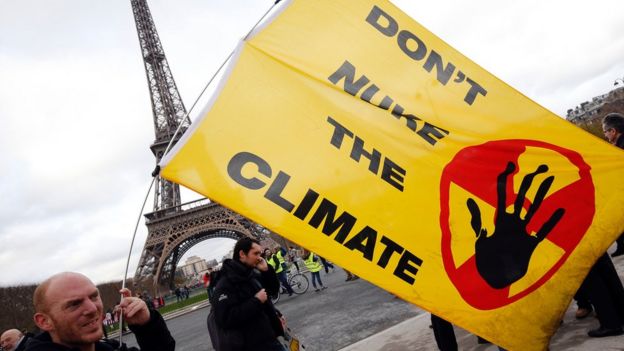
Activista ambiental en París.Derechos de autor de la imagen Getty Images
Image caption
                                    Millares de activistas ambientales acompañaron la cumbre climática de París en 2015.
El mundo ya está casi a mitad de camino hacia ese punto, en casi 1 grado centígrado de calentamiento en comparación con la era preindustrial.
Los líderes de los países con altitudes bajas y que se enfrentan a niveles cada vez más insostenibles de subida del mar piden que el límite sea mucho menor a los 1,5 grados.

2. Limitar la cantidad de gases de efecto invernadero

El acuerdo de París señala que los gases de efecto invernadero emitidos por la actividad humana deberán equipararse con los niveles que los árboles, el suelo y los océanos puedan absorber naturalmente.
Este objetivo, según el tratado, deberá lograrse en algún punto entre los años 2050 y 2100.
Los principales gases de efecto invernadero en la atmósfera terrestre son el vapor de agua, el dióxido de carbono (CO2), el metano, el óxido de nitrógeno y el ozono, siendo las emisiones de CO2 las que más preocupan por sus enormes efectos en el cambio climático.
En 2016 se llegó a niveles récord de emisiones de dióxido de carbono, algo que los expertos llamaron una "nueva era" para el calentamiento global y la "prueba irrefutable" de la responsabilidad humana sobre el cambio climático.
Cuando se llegó a esta marca, la Organización Meteorológica Internacional señaló que "si no se aborda el problema de las emisiones de CO2, no se puede combatir el cambio climático y mantener el aumento de temperatura en menos de dos grados centígrados".
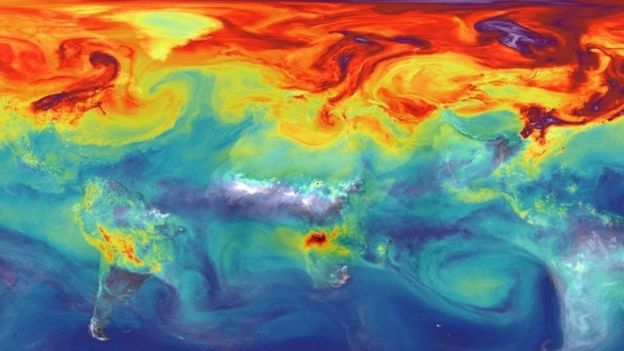
Emisiones de CO2 en el mundoDerechos de autor de la imagen NASA
Image caption
                                    Las emisiones de CO2 son las que más preocupan por sus enormes efectos en el cambio climático (imagen de 2016).
China y Estados Unidos son responsables del 40% de las emisiones de dióxido de carbono del mundo.
En diciembre de 2015, la Casa Blanca señaló que el documento de París era "el acuerdo más ambicioso sobre el cambio climático en la historia" y destacó que el mismo establece "un marco duradero y de largo plazo" para la reducción de las emisiones de gases de efecto invernadero.

3. Revisar la reducción de las emisiones de los países cada cinco años

Sólo algunos de los elementos del pacto de París pueden ser jurídicamente vinculantes.
Los compromisos de los países para reducir las emisiones son voluntarios, y los argumentos sobre cuándo se deben revisar las metas establecidas (con el objetivo de ampliar las mismas) fueron todo un obstáculo en las conversaciones.
El acuerdo establece hacer una evaluación del progreso en 2018, con revisiones adicionales cada cinco años.
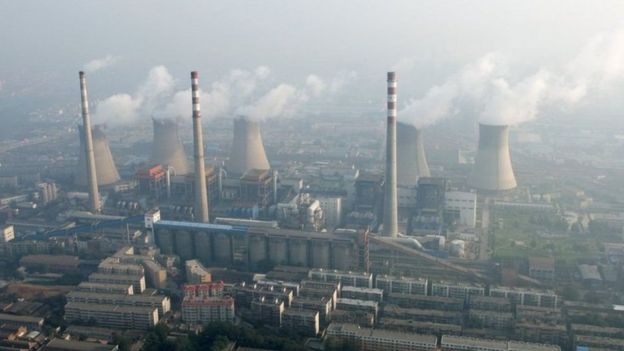
Plantas industriales de ChinaDerechos de autor de la imagen Reuters
Image caption
                                    Reducir sus emisiones de carbono significará para China cambiar sus fuentes energéticas.
Como señalan los analistas, París es sólo el comienzo de un cambio hacia un mundo con bajas emisiones de carbono y las metas deberán ampliarse más y más.
En criterio del profesor John Shepherd, del Centro Nacional de Oceanografía de la Universidad de Southampton, el acuerdo de 2015 representa apenas algunas aspiraciones de partida.
El experto añade que los objetivos finales, una economía e industria bajas en carbono, serán realmente difíciles de conseguir.

4. Financiación climática

Los países ricos accedieron apoyar a las naciones en desarrollo con recursos económicos para sobrellevar los efectos actuales y futuros del calentamiento global.
Este punto fue otro de los que más conflicto generó durante todas las cumbres climáticas previas a la de París.
Los países en desarrollo plantearon, además, que requieren ayuda financiera y tecnológica para superar los combustibles fósiles y pasar a las energías renovables.
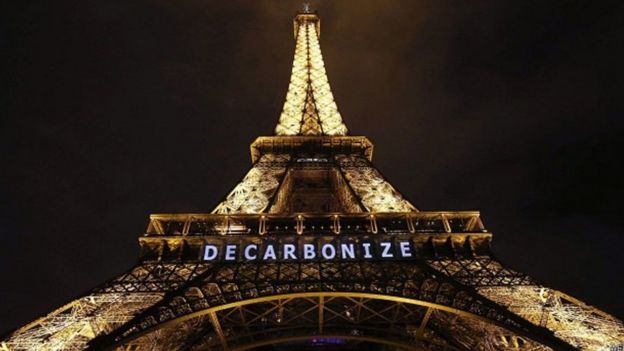
La Torre Eiffel con un cartel a favor de reducir las emisiones de CO2.Derechos de autor de la imagen AFP
Image caption
                                    Los países ricos accedieron apoyar a las naciones en desarrollo con recursos económicos para sobrellevar los efectos actuales y futuros del calentamiento global.
La promesa en ese entonces fue de US$100.000 millones al año desde 2020, un monto menor al demandado por algunos países en las negociaciones.
El acuerdo establece que esa cifra será usada como una "base" para definir el apoyo adicional que se discutirá en 2025.
En criterio de Ilan Kelman, profesor del University College de Londres, la cifra inicial es importante, pero insuficiente.
"La base de US$100.000 millones al año es útil, pero sigue siendo inferior al 8% del gasto militar declarado en todo el mundo cada año", apuntó.
Así como Kelman, el resto de los expertos señalan que París apenas un punto de partida.
Un acuerdo que fue llamado histórico, pero también es considerado insuficiente y frágil.
Mucho más si una de las partes con mayor relevancia lo abandona.

Temas relacionados

Contenido relacionado

BBC Mundo Noticias
Guillermo Gonzalo Sánchez Achutegui
ayabaca@gmail.com
ayabaca@hotmail.com
ayabaca@yahoo.com
Inscríbete en el Foro del blog y participa : A Vuelo De Un Quinde - El Foro!

domingo, 27 de noviembre de 2016

ESA : Icy surprises at Rosetta's comet .- Sorpresas heladas en el cometa de Rosetta

http://www.esa.int/Our_Activities/Space_Science/Rosetta/Icy_surprises_at_Rosetta_s_comet
A day at the comet

Icy surprises at Rosetta's comet

17 November 2016
As Rosetta’s comet approached its most active period last year, the spacecraft spotted carbon dioxide ice – never before seen on a comet – followed by the emergence of two unusually large patches of water ice.
The carbon dioxide ice layer covered an area comparable to the size of a football pitch, while the two water ice patches were each larger than an Olympic swimming pool and much larger than any signs of water ice previously spotted at the comet.
The three icy layers were all found in the same region, on the comet’s southern hemisphere.
A combination of the complex shape of the comet, its elongated path around the Sun and the substantial tilt of its spin, seasons are spread unequally between the two hemispheres of the double-lobed Comet 67P/Churyumov–Gerasimenko.
When Rosetta arrived in August 2014, the northern hemisphere was still undergoing its 5.5 year summer, while the southern hemisphere was in winter and much of it was shrouded in darkness.
However, shortly before the comet’s closest approach to the Sun in August 2015, the seasons changed and the southern hemisphere experienced a brief but intense summer, exposing this region to sunlight again.
In the first half of 2015, as the comet steadily became more active, Rosetta observed water vapour and other gases pouring out of the nucleus, lifting its dusty cover and revealing some of the comet’s icy secrets.
In particular, on two occasions in late March 2015, Rosetta’s visible, infrared and thermal imaging spectrometer, VIRTIS, found a very large patch of carbon dioxide ice in the Anhur region, in the comet’s southern hemisphere.
This is the first detection of solid carbon dioxide on any comet, although it is not uncommon in the Solar System – it is abundant in the polar caps of Mars, for example.
 
Carbon dioxide detection
“We know comets contain carbon dioxide, which is one of the most abundant species in cometary atmospheres after water, but it’s extremely difficult to observe it in solid form on the surface,” explains Gianrico Filacchione from Italy’s INAF-IAPS Istituto di Astrofisica e Planetologia Spaziali, who led the study.
In the comet environment, carbon dioxide freezes at –193ºC, much below the temperature where water turns into ice. Above this temperature, it changes directly from a solid to a gas, hampering its detection in ice form on the surface.
By contrast, water ice has been found at various comets, and Rosetta detected plenty of small patches on several regions.
“We hoped to find signs of carbon dioxide ice and had been looking for it for quite a while, but it was definitely a surprise when we finally detected its unmistakable signature,” adds Gianrico.
The patch, consisting of a few percent of carbon dioxide ice combined with a darker blend of dust and organic material, was observed on two consecutive days in March. This was a lucky catch: when the team looked at that region again around three weeks later, it was gone.
Assuming that all of the ice had turned into gas, the scientists estimated that the 80 x 60 m patch contained about 57 kg of carbon dioxide, corresponding to a 9 cm-thick layer. Its presence on the surface is likely an isolated rare case, with the majority of carbon dioxide ice being confined to deeper layers of the nucleus.
Gianrico and his collaborators believe the icy patch dates back a few years, when the comet was still in the cold reaches of the outer Solar System and the southern hemisphere was experiencing its long winter. At that time, some of the carbon dioxide still outgassing from the interior of the nucleus condensed on the surface, where it remained frozen for a very long while, and vaporised only as the local temperature finally rose again in April 2015.
This reveals a seasonal cycle of carbon dioxide ice, which unfolds over the comet’s 6.5 year orbit, as opposed to the daily cycle of water ice, also spotted by VIRTIS shortly after Rosetta’s arrival.
Interestingly, shortly after the carbon dioxide ice had disappeared, Rosetta’s OSIRIS narrow-angle camera detected two unusually large patches of water ice in the same area, between the southern regions of Anhur and Bes.
 
Large patches of water ice
“We had already seen many metre-sized patches of exposed water ice in various regions of the comet, but the new detections are much larger, spanning some 30 x 40 m each, and they persisted for about 10 days before they completely disappeared,” says Sonia Fornasier from LESIA–Observatoire de Paris and Université Paris Diderot, France, lead scientist of the study focusing on seasonal and daily surface colour variations.
These ice-rich areas appear as very bright portions of the comet surface reflecting light that is bluer in colour compared with the redder surroundings. Scientists have experimented with mixtures of dust and water ice to show that, as the concentration of ice in them increases, the reflected light becomes gradually bluer in colour, until reaching a point where equal amounts of light are reflected in all colours.
The two newly detected patches contain 20–30% of water ice mixed with darker material, forming a layer up to 30 cm thick of solid ice. One of them was likely lurking underneath the carbon dioxide ice sheet revealed by VIRTIS about a month before.
 
Comet colours
 
“On a global scale, we also found that the entire comet surface turned increasingly bluer in colour as it approached the Sun and the intense activity lifted off large amounts of dust, exposing more of the ice-rich terrain underneath,” explains Sonia.
As the comet moved away from the Sun, the scientists observed the overall colour of the comet surface gradually turning redder again.
They also revealed local variations of colour, indicative of the daily cycle of water ice. Quickly turning into water vapour when exposed to sunlight during the local daytime, it condensed back into thin layers of frost and ice as the temperature decreases after sunset, only to vaporise again on the following day.
The distribution of water ice beneath the dusty surface of the comet seems widely but not uniformly spread, with small patches punctuating the nucleus, appearing and disappearing as a result of the comet's activity.
Occasionally, larger and thicker portions of ice are also uncovered, dating back to a previous approach to the Sun.
“These two studies of the comet's icy content are revealing new details about the composition and history of the nucleus,” says Matt Taylor, ESA Rosetta project scientist.
“While the flight part of the mission is now over, the scientific exploitation of the enormous quantity of data collected by Rosetta continues.”
Notes for Editors
For further information, please contact:
Gianrico Filacchione
INAF-IAPS Istituto di Astrofisica e Planetologia Spaziali
Rome, Italy
Email: gianrico.filacchione@iaps.inaf.it
Sonia Fornasier
LESIA–Observatoire de Paris
and Université Paris Diderot
Paris, France
Email: sonia.fornasier@obspm.fr
Matt Taylor
ESA Rosetta project scientist
Email: matthew.taylor@esa.int
Markus Bauer 


ESA Science and Robotic Exploration Communication Officer


Tel: +31 71 565 6799


Mob: +31 61 594 3 954


Email: markus.bauer@esa.int

ESA
Guillermo Gonzalo Sánchez Achutegui
ayabaca@gmail.com
ayabaca@hotmail.com
ayabaca@yahoo.com
Inscríbete en el Foro del blog y participa : A Vuelo De Un Quinde - El Foro!

domingo, 15 de mayo de 2016

NSF: Natural regeneration of tropical forests helps global climate mitigation and forest restoration.- La regeneración natural de los bosques tropicales ayuda a mitigar el cambio climático global y la restauración de los bosques

Hola amigos: A VUELO DE UN QUINDE EL BLOG., la Fundación Nacional de Ciencias de Los Estados Unidos, nos alcanza la información que hay una regeneración natural de bosques tropicales en América Latina, que de alguna manera ayudan a mitigar el cambio climático global.
More information..........

New study looks at 43 regions in Latin America

Photo of small patches of tropical dry forest  on hills
Small patches of tropical dry forest are regrowing spontaneously in a former pastureland.
Credit and Larger Version
May 13, 2016
This article is the ninth in a series on NSF's Long Term Research in Environmental Biology (LTREB) awards. Visit parts one, two, three, four, five, six , seven and eight.
Climate scientists have long recognized the importance of forest conservation and forest regrowth in climate mitigation and carbon sequestration -- capturing carbon dioxide (CO2) from the atmosphere. But the detailed information required to make accurate estimates of this potential has remained elusive.
Now, an international team of 60 scientists, working together as the 2ndFOR Network, has completed studies on the effects of forest conservation and secondary forest regeneration across 43 regions in Latin America.
In an article titled "Carbon sequestration potential of second-growth forest regeneration in the Latin American tropics," published today in the journal Science Advances, University of Connecticut ecologist and evolutionary biologist Robin Chazdon and her colleagues report a series of new findings.
 
Long-term studies
 
"This study uses knowledge gained from long-term studies of tropical forests to address a pressing societal need," says Saran Twombly, program director in the National Science Foundation (NSF) Division of Environmental Biology, which funded the research through NSF's Long Term Research in Environmental Biology, and Dynamics of Coupled Natural and Human Systems, programs. "It shows that natural processes alone can provide a solution to the excess carbon dioxide threatening the planet."
The studies aimed to model the areas covered by regrowth forests across the lowlands of the Latin American Tropics in two age classes; to project potential above-ground carbon storage in these young forests over four decades; and to illustrate alternative scenarios for carbon storage where 0-80 percent of these forests are allowed to regenerate.
Chazdon says that "this research is vital because actively growing vegetation takes carbon dioxide out of the atmosphere and converts it to plant tissues such as wood and leaves. Old-growth forests contain large stocks of carbon in their biomass. When these forests are cleared and burned, this carbon is released into the atmosphere, contributing to global warming. This is one of the main reasons why it is important to halt deforestation."
But scientists have also learned that when forests regrow, their carbon stocks in above-ground biomass increase over time, depending on climate, prior land use and features of the surrounding landscape.
"This regrowth can happen without planting trees, through the spontaneous process of natural regeneration," says Chazdon. "This is a low-cost way of restoring forests and of reaching carbon mitigation goals."
Major findings
Among the major findings of the study are:
  • Models of forest age in 2008 show that 17 percent of the forest area in lowland Latin America consists of young second-growth forest (1-20 years) and 11 percent consists of intermediate age forest (20-60 years).
  • Assuming that 100 percent of the second growth persists and regenerates over 40 years, carbon storage capacity doubles in young second growth and increases by 120 percent in intermediate age forests. In both forest age classes, a net gain of 8.48 trillion kilograms of carbon is stored over 40 years.
  • This amount is equivalent to 31.09 trillion kilograms of CO2, which equals all the carbon emissions from fossil fuel use and other industrial processes in all the countries of Latin America and the Caribbean from 1993 to 2014.
  • Ten countries account for 95 percent of this carbon storage potential, led by Brazil, Colombia, Venezuela and Mexico.
Forest-based climate change solutions
Chazdon says that, remarkably, this huge amount of carbon storage doesn't require costly tree plantings or conversion of farmlands. "It is all based on natural forest regrowth and only requires persistence and protection of the young forests and abandoned agricultural fields."
Forest-based solutions provide many other benefits, including hydrologic regulation, habitats and corridors for conserving biodiversity, and provision of non-timber forest products to local people, Chazdon says.
Prior carbon storage efforts have placed emphasis on avoiding deforestation. But, Chazdon says, "avoiding deforestation and supporting forest regeneration are complementary and mutually reinforcing activities."
While forest regeneration and protection alone cannot fully compensate for greenhouse gas emissions on a global scale, researchers say the study affirms that this strategy can contribute significantly toward reaching national and international carbon mitigation targets.
-NSF-
Media Contacts Cheryl Dybas, NSF, (703) 292-7734,cdybas@nsf.gov
Sheila Foran, UCONN, (860) 486-5385,
Related WebsitesNSF Grant: LTREB: Successional Pathways and Rates of Change in Tropical Forests of Brazil, Costa Rica and Mexico:
 http://www.nsf.gov/awardsearch/showAward?AWD_ID=1147429&HistoricalAwards=false
NSF Grant: CNH: The Emergence of Adaptive Governance Arrangements for Tropical Forest Ecosystems:
The National Science Foundation (NSF) is an independent federal agency that supports fundamental research and education across all fields of science and engineering. In fiscal year (FY) 2016, its budget is $7.5 billion. NSF funds reach all 50 states through grants to nearly 2,000 colleges, universities and other institutions. Each year, NSF receives more than 48,000 competitive proposals for funding and makes about 12,000 new funding awards. NSF also awards about $626 million in professional and service contracts yearly.
Useful NSF Web Sites:
NSF Home Page:
 http://www.nsf.gov
NSF News:
http://www.nsf.gov/news/
For the News Media:
 http://www.nsf.gov/news/newsroom.jsp
Science and Engineering Statistics:
 http://www.nsf.gov/statistics/
Awards Searches:
http://www.nsf.gov/awardsearch/
Cattle on pasture and a forest in the background in Chiapas, Mexico.
Pasture with young second-growth forest in the background in Chiapas, Mexico.
Credit and Larger Version
An 18-year-old second-growth wet tropical forest in Costa Rica that was once a pasture.
Credit and Larger Version
Photo of rainforest at Rio Cachoiera Nature Reserve in Brazil.
Extensive natural regeneration of Atlantic rainforest at Rio Cachoiera Nature Reserve in Brazil.
Credit and Larger Version
Old-growth Atlantic rainforest in background with second-growth in foreground in Bahia, Brazil.
Credit and Larger Version
The National Science Foundation (NSF)
Guillermo Gonzalo Sánchez Achutegui
ayabaca@gmail.com
ayabaca@hotmail.com
ayabaca@yahoo.com
Inscríbete en el Foro del blog y participa : A Vuelo De Un Quinde - El Foro!

martes, 22 de marzo de 2016

NSF : Human-driven carbon release rate unprecedented in past 66 million years .- la velocidad de liberación de carbono humana impulsada sin precedentes en los últimos 66 millones de años

Hola amigos: A VUELO DE UN QUINDE EL BLOG.,hemos recibido información de la Fundación Nacional de Ciencias de Los Estados Unidos, sobre la utilización y medición del carbono durante los últimos 66 millones de años.
NSF, nos dice: "Las primeras mediciones del clima de la Tierra utilizando termómetros y otros instrumentos comienzan en la década de 1850.
Para buscar más atrás en el tiempo, los científicos investigan las burbujas de aire atrapadas en los núcleos de hielo, ampliar el alcance de los registros climáticos de casi un millón de años. Pero para estudiar la historia de la Tierra durante millones de años, los investigadores examinan las firmas químicas y biológicas en los sedimentos de aguas profundas.
Una nueva investigación publicada hoy en la revista Nature Geoscience por geociencias Richard Zeebe de la Universidad de Hawai en Manoa y sus colegas analiza los cambios en la temperatura y el dióxido de carbono atmosférico (CO2) de la Tierra desde el fin de la era de los dinosaurios. La evidencia está en los núcleos de sedimentos recuperados de debajo del lecho marino por los geólogos que trabajan a bordo del buque de perforación JOIDES Resolution océano.
More information....

Humans responsible for carbon release 10 times faster than any event since age of dinosaurs

The drillship JOIDES Resolution at sea
The scientists conducted research on sediment cores retrieved by the drillship JOIDES Resolution.
Credit and Larger Version
March 21, 2016
The earliest measurements of Earth's climate using thermometers and other tools start in the 1850s.
To look further back in time, scientists investigate air bubbles trapped in ice cores, expanding the scope of climate records to nearly a million years. But to study Earth's history over millions of years, researchers examine the chemical and biological signatures in deep-sea sediments.
New research published today in the journal Nature Geoscience by geoscientist Richard Zeebe of the University of Hawai'i at Manoa and colleagues looks at changes in Earth's temperature and atmospheric carbon dioxide (CO2) since the end of the age of the dinosaurs. The evidence is in sediment cores retrieved from beneath the seafloor by geologists working aboard the ocean drillship JOIDES Resolution.
"In studying one of the most dramatic episodes of global change since the dinosaurs, the researchers show that we are currently in uncharted territory in the rate carbon is being released into the atmosphere and oceans," said Candace Major, program director in the National Science Foundation (NSF) Division of Ocean Sciences, which funded the research.
The findings suggest that humans are responsible for releasing carbon about 10 times faster than during any time in the past 66 million years.
The research team developed a new approach and was able to determine the duration of the onset of an important past climate event, the Paleocene-Eocene Thermal Maximum (PETM), 56 million years ago.
"As far as we know, the PETM had the largest carbon release during the past 66 million years," Zeebe said.
Zeebe and co-authors Andy Ridgwell, of the University of Bristol and University of California, and James Zachos, of the University of California, combined analyses of chemical properties of sediment cores dating back to the PETM with numerical simulations of Earth's climate and carbon cycle.
The new method allowed them to extract rates of change from a sediment record.
Applied to the PETM, they calculated how fast the carbon was released, how fast Earth's surface warmed, and what constrained the time scale of the onset, which was across 4,000 years.
The rate of carbon release during the PETM was much smaller than the current input of carbon to the atmosphere from human activities.
Carbon release rates from human sources reached a record high in 2014 of about 37 billion metric tons of CO2. The researchers estimated that the maximum sustained carbon release rate during the PETM was less than four billion metric tons of CO2 per year -- about one-tenth the current rate.
"Because our carbon release rate is unprecedented over such a long time period in Earth's history, it also means that we have effectively entered a 'no-analogue' state," said Zeebe. "This represents a big challenge for projecting future climate change because we have no good comparison from the past."
Whereas large climate transitions in the past may have been relatively smooth, there is no guarantee for the future, the scientists said. The climate system is non-linear, which means that its response to inputs, such as CO2 emissions, is a complex process involving multiple components.
"If you kick a system very fast, it usually responds differently than if you nudge it slowly but steadily," Zeebe said. "It is likely that future disruptions of ecosystems will exceed the relatively limited extinctions observed at the PETM."
The PETM suggests that the consequences of our massive burning of fossil fuels will have much longer-lasting effects, said Zeebe.
"Everyone is focused on what happens by 2100, but that's only two generations from today," he said. "It's very clear that over a longer time scale there will be much bigger changes."
The scientists are continuing their work on the PETM to study other aspects of the event -- for example, determining how severe ocean acidification was during that time and what effect it had on calcifying organisms in the ocean. The results will provide insights about what to expect in the future as Earth's climate likely continues to warm and oceans keep acidifying.
-NSF-

Media Contacts Cheryl Dybas, NSF, (703) 292-7734, cdybas@nsf.gov
Marcie Grabowski, University of Hawaii - Manoa, (808) 956-3151, mworkman@hawaii.edu


The National Science Foundation (NSF) is an independent federal agency that supports fundamental research and education across all fields of science and engineering. In fiscal year (FY) 2016, its budget is $7.5 billion. NSF funds reach all 50 states through grants to nearly 2,000 colleges, universities and other institutions. Each year, NSF receives more than 48,000 competitive proposals for funding and makes about 12,000 new funding awards. NSF also awards about $626 million in professional and service contracts yearly.
 Get News Updates by Email 
Useful NSF Web Sites:
NSF Home Page:
 http://www.nsf.gov
NSF News:
 http://www.nsf.gov/news/
For the News Media:
http://www.nsf.gov/news/newsroom.jsp
Science and Engineering Statistics:
 http://www.nsf.gov/statistics/
Awards Searches:
 http://www.nsf.gov/awardsearch/
Sediment cores side by side
Sediment cores from beneath the ocean floor hold clues to Earth's carbon dioxide levels over time.
Credit and Larger Version
image of power plant with smoking chimneys
Carbon dioxide levels are increasing faster than at any time since the end of the dinosaurs.
Credit and Larger Version
image of corals and fish swimming in the ocean
The scientists are continuing their work to determine ocean acidification levels during the PETM.
Credit and Larger Version
image of a sea fan
Today the common sea fan is one of the many species affected by ocean acidification.
Credit and Larger Versión
The National Science Foundation (NSF)
Guillermo Gonzalo Sánchez Achutegui
ayabaca@gmail.com
ayabaca@hotmail.com
ayabaca@yahoo.com
Inscríbete en el Foro del blog y participa : A Vuelo De Un Quinde - El Foro!

viernes, 13 de noviembre de 2015

NASA : Carbon Dioxide Measurements from OCO-2.- Medidas Dióxido de carbono de OCO-2.-


The Orbiting Carbon Observatory-2 satellite is providing NASA’s first detailed, global measurements of carbon dioxide in the atmosphere at the Earth’s surface. OCO-2 recently released its first full year of data — critical to analyzing the annual cycle carbon dioxide concentrations in the atmosphere.
Credits: NASA/JPL-Caltech
El Observatorio de 2 satélites en órbita de carbono está proporcionando primeras mediciones globales de la NASA detallados, de dióxido de carbono en la atmósfera en la superficie de la Tierra. OCO-2 lanzado recientemente su primer año completo de datos - fundamental para el análisis de las concentraciones anuales de dióxido de carbono del ciclo en la atmósfera.

As Earth Warms, NASA Targets ‘Other Half’ of Carbon, Climate Equation

During a noon EST media teleconference today, NASA and university scientists will discuss new insights, tools and agency research into key carbon and climate change questions, as the agency ramps up its efforts to understand how Earth’s ocean, forest, and land ecosystems absorb nearly half of emitted carbon dioxide today.


Carbon dioxide emitted into the atmosphere by human activities influences the amount of the sun’s energy trapped by Earth’s atmosphere. These emissions are the subject of a United Nations climate conference in Paris later this month. To improve the information available to policymakers on this issue, scientists are grappling with the complex question of whether Earth’s oceans, forests and land ecosystems will maintain their capacity to absorb about half of all human-produced carbon dioxide emissions in the future.

“NASA is at the forefront of scientific understanding in this area, bringing together advanced measurement technologies, focused field experiments, and cutting-edge research to reveal how carbon moves around the planet and changes our climate,” said Michael Freilich, director of NASA’s Earth Science Division. “Understanding how the planet responds to human carbon emissions and increasing atmospheric CO2 levels will position our nation to take advantage of the opportunities and face the challenges that climate changes present.”

https://www.youtube.com/watch?v=xk11DVaAjEA&feature=player_embedded#t=0
Atmospheric carbon dioxide levels recently surpassed a concentration of 400 parts per million (ppm) -- higher than at any time in at least 400,000 years -- and continue to increase at about 2 ppm per year. Levels of the even more potent heat-trapping gas methane -- also carbon-based -- now exceed pre-industrial amounts by about 2.5 times. Calculations show that, on average, only about half of the carbon emitted by human activities remains in the atmosphere.

This “other half” of the carbon problem -- how and where it is absorbed on land and sea -- is a priority for carbon cycle scientists at NASA and around the world. Scientists are investigating how Earth’s warming environment will affect the ability of ecosystems around the world to absorb carbon naturally, and what changes in those ecosystems could mean for future climate. It’s a major research question involving several NASA satellite missions, multi-year field campaigns and new instruments that will fly on the International Space Station in coming years.

Scientists discussed the ongoing analysis of the first year-plus of satellite data from NASA’s recently launched Orbiting Carbon Observatory-2 -- the agency’s first satellite designed to measure carbon dioxide from the top of Earth’s atmosphere to its surface.

“As carbon dioxide is the largest human-produced driver of our changing climate, having regular observations from space is a major step forward for our ability to understand and predict climate change,” said Annmarie Eldering, OCO-2 deputy project scientist at NASA’s Jet Propulsion Laboratory (JPL) in Pasadena, California. “Precisely measuring carbon dioxide in the atmosphere has been one of the most difficult observations to make from space.”

https://www.youtube.com/watch?v=UyBlO6LN4rU&feature=player_embedded#t=0
Animation of carbon dioxide released from two different sources: fires (biomass burning) and massive urban centers known as megacities. The animation covers a five day period in June 2006. The model is based on real emission data and is then set to run so that scientists can observe how the greenhouse gas behaves once it has been emitted.
Credits: Global Modeling and Assimilation Office, NASA's Goddard Space Flight Center
 
NASA
Guillermo Gonzalo Sánchez Achutegui
Incríbete en el Foro del blog y participa : A Vuelo De Un Quinde - El Foro!

miércoles, 11 de noviembre de 2015

NASA : NASA Holds Media Briefing on Carbon’s Role in Earth’s Future Climate .- NASA Sostiene Reunión informativa sobre el papel de Carbono en futuro clima de la Tierra

Hola amigos: A VUELO DE UN QUINDE EL BLOG., NASA está avanzando nuevas herramientas como el modelo supercomputadora que creó esta simulación de dióxido de carbono en la atmósfera para comprender mejor lo que sucederá con el clima de la Tierra si la tierra y el mar ya no pueden absorber casi la mitad de todas las emisiones de CO2 con el  calentamiento del clima.
More information.......

NASA simulation of carbon dioxide in the atmosphere
NASA is advancing new tools like the supercomputer model that created this simulation of carbon dioxide in the atmosphere to better understand what will happen to Earth’s climate if the land and ocean can no longer absorb nearly half of all climate-warming CO2 emissions.
Credits: NASA/GSFC
 
NASA will host a media teleconference at noon EST on Thursday, Nov. 12 to discuss the latest insights into how Earth is responding to rising levels of heat-trapping gases in the atmosphere, and what this means for our future climate.

Later this month, a United Nations climate meeting in Paris will focus on setting limits on future levels of human-produced carbon emissions. This NASA briefing will present new observations from the Orbiting Carbon Observatory-2 (OCO-2) mission, NASA’s first satellite dedicated to measuring carbon dioxide, and preview field work planned in the North Atlantic and Alaska.

The panelists will be:
  • Michael Freilich, director of NASA’s Earth Science Division at the agency’s headquarters in Washington
  • Mike Behrenfeld, principal investigator for NASA’s NAAMES field campaign, Oregon State University in Corvallis
  • George Hurtt, lead for NASA’s Carbon Monitoring System, University of Maryland in College Park
  • Annmarie Eldering, deputy project scientist for NASA’s OCO-2 mission at the agency’s Jet Propulsion Laboratory in Pasadena, California
  • Lesley Ott, research scientist in the Global Modeling and Assimilation Office at NASA’s Goddard Space Flight Center in Greenbelt, Maryland

To participate, media must email their name and affiliation to Steve Cole at stephen.e.cole@nasa.gov by 11 a.m. on Thursday. Media and the public also may ask questions during the briefing on Twitter using the hashtag #askNASA.

Earth’s land and ocean currently absorb about half of all carbon dioxide emissions from the burning of fossil fuels, but it’s uncertain whether the planet can keep this up in the future. NASA’s Earth science program works to improve our understanding of how carbon absorption and emission processes work in nature and how they could change in a warming world with increasing levels of carbon dioxide and methane emissions from human activities.

Audio of the briefing will stream live at:


For more information about NASA's Earth science programs, visit:


-end-
Steve Cole
Headquarters, Washington
202-358-0918
stephen.e.cole@nasa.gov
Last Updated: Nov. 9, 2015
Editor: Karen Northon
 
NASA
Guillermo Gonzalo Sánchez Achutegui
Inscríbete en el Foro del blog y participa : A Vuelo De Un Quinde - El Foro!

domingo, 15 de febrero de 2015

NASA : NASA Study Finds Carbon Emissions Could Dramatically Increase Risk of U.S. Megadroughts .- Estudio de la NASA Encuentra las emisiones de carbono podría aumentar dramáticamente el riesgo de megasequías estadounidenses

Hola amigos: A VUELO DE UN QUINDE EL BLOG., la Agencia Espacial NASA, nos informa que el aumento de las emisiones de carbono a la atmósfera, originará megasequias en los llanos estadounidenses, parece que recién están entendiendo que ellos son los primeros contaminantes del espacio, y justamente su propio territorio será víctima de esas emisiones del  Efecto Invernadero: Las sequías en los EE.UU. suroeste y llanos centrales durante la última mitad de este siglo podrían ser más seco y más largo que las condiciones de sequía se ven en esas regiones en los últimos 1.000 años, según un nuevo estudio de la NASA.
El estudio, publicado el jueves en la revista: the journal Science Advances, se basa en las proyecciones de varios modelos climáticos, incluyendo uno patrocinado por la NASA. Los que se encuentran el aumento continuado de investigación en las emisiones de gases de efecto invernadero producidos por el hombre eleva el riesgo de sequías severas en estas regiones.


Youtube Override: 
NASA scientists used tree rings to understand past droughts and climate models incorporating soil moisture data to estimate future drought risk in the 21st century.
Image Credit: 
NASA's Goddard Space Flight Center
Feature Link: 
 
Droughts in the U.S. Southwest and Central Plains during the last half of this century could be drier and longer than drought conditions seen in those regions in the last 1,000 years, according to a new NASA study.
Youtube Override: 
Soil moisture 30 cm below ground projected through 2100 for two emissions scenarios. Brown is drier and blue is wetter than the 20th c. average. RCP 4.5 assumes reduced CO2 emissions. RCP 8.5 is "business as usual."
Image Credit: 
NASA's Goddard Space Flight Center
Feature Link: 
The study, published Thursday in the journal Science Advances, is based on projections from several climate models, including one sponsored by NASA. The research found continued increases in human-produced greenhouse gas emissions drives up the risk of severe droughts in these regions.
North American map of estimated ground moisture in 2095 based on a high emissions scenario
Soil moisture 30 cm below ground projected through 2100 for high emissions scenario RCP 8.5. The soil moisture data are standardized to the Palmer Drought Severity Index and are deviations from the 20th century average.
Image Credit: 
NASA's Goddard Space Flight Center
 
"Natural droughts like the 1930s Dust Bowl and the current drought in the Southwest have historically lasted maybe a decade or a little less," said Ben Cook, climate scientist at NASA's Goddard Institute for Space Studies and the Lamont-Doherty Earth Observatory at Columbia University in New York City, and lead author of the study. "What these results are saying is we're going to get a drought similar to those events, but it is probably going to last at least 30 to 35 years."
North American map of estimated ground moisture in 2095 based on a moderate emissions scenario
Soil moisture 30 cm below ground projected through 2100 for moderate emissions scenario RCP 4.5. The soil moisture data are standardized to the Palmer Drought Severity Index and are deviations from the 20th century average.
Image Credit: 
NASA's Goddard Space Flight Center
 
According to Cook, the current likelihood of a megadrought, a drought lasting more than three decades, is 12 percent. If greenhouse gas emissions stop increasing in the mid-21st century, Cook and his colleagues project the likelihood of megadrought to reach more than 60 percent.
However, if greenhouse gas emissions continue to increase along current trajectories throughout the 21st century, there is an 80 percent likelihood of a decades-long megadrought in the Southwest and Central Plains between the years 2050 and 2099.
The scientists analyzed a drought severity index and two soil moisture data sets from 17 climate models that were run for both emissions scenarios. The high emissions scenario projects the equivalent of an atmospheric carbon dioxide concentration of 1,370 parts per million (ppm) by 2100, while the moderate emissions scenario projects the equivalent of 650 ppm by 2100. Currently, the atmosphere contains 400 ppm of CO2.
In the Southwest, climate change would likely cause reduced rainfall and increased temperatures that will evaporate more water from the soil. In the Central Plains, drying would largely be caused by the same temperature-driven increase in evaporation.
The Fifth Assessment Report, issued by the United Nations Intergovernmental Panel on Climate Change (IPCC) in 2013, synthesized the available scientific studies and reported that increases in evaporation over arid lands are likely throughout the 21st century. But the IPCC report had low confidence in projected changes to soil moisture, one of the main indicators of drought.
Until this study, much of the previous research included analysis of only one drought indicator and results from fewer climate models, Cook said, making this a more robust drought projection than any previously published.
"What I think really stands out in the paper is the consistency between different metrics of soil moisture and the findings across all the different climate models," said Kevin Anchukaitis, a climate scientist at the Woods Hole Oceanographic Institution in Woods Hole, Massachusetts, who was not involved in the study. "It is rare to see all signs pointing so unwaveringly toward the same result, in this case a highly elevated risk of future megadroughts in the United States."
This study also is the first to compare future drought projections directly to drought records from the last 1,000 years.
"We can't really understand the full variability and the full dynamics of drought over western North America by focusing only on the last century or so," Cook said. "We have to go to the paleoclimate record, looking at these much longer timescales, when much more extreme and extensive drought events happened, to really come up with an appreciation for the full potential drought dynamics in the system."
Modern measurements of drought indicators go back about 150 years. Cook and his colleagues used a well-established tree-ring database to study older droughts. Centuries-old trees allow a look back into the distant past. Tree species like oak and bristle cone pines grow more in wet years, leaving wider rings, and vice versa for drought years. By comparing the modern drought measurements to tree rings in the 20th century for a baseline, the tree rings can be used to establish moisture conditions over the past 1,000 years.
The scientists were interested in megadroughts that took place between 1100 and 1300 in North America. These medieval-period droughts, on a year-to-year basis, were no worse than droughts seen in the recent past. But they lasted, in some cases, 30 to 50 years.
When these past megadroughts are compared side-by-side with computer model projections of the 21st century, both the moderate and business-as-usual emissions scenarios are drier, and the risk of droughts lasting 30 years or longer increases significantly.
Connecting the past, present and future in this way shows that 21st century droughts in the region are likely to be even worse than those seen in medieval times, according to Anchukaitis.
"Those droughts had profound ramifications for societies living in North America at the time. These findings require us to think about how we would adapt if even more severe droughts lasting over a decade were to occur in our future," Anchukaitis said.
NASA monitors Earth's vital signs from land, air and space with a fleet of satellites and ambitious airborne and ground-based observation campaigns. NASA develops new ways to observe and study Earth's interconnected natural systems with long-term data records and computer analysis tools to better see how our planet is changing. The agency shares this unique knowledge with the global community and works with institutions in the United States and around the world that contribute to understanding and protecting our home planet.
For more information about NASA's Earth science activities, visit:
 
 
NASA
Guillermo Gonzalo Sánchez Achutegui
Inscríbete en el Foro del blog y participa : A Vuelo De Un Quinde - El Foro!

Mi lista de blogs