Mostrando entradas con la etiqueta Apollo 8. Mostrar todas las entradas

domingo, 24 de abril de 2016

NASA : Astronaut Photography from Space Helped 'Discover the Earth' .- La fotografía del astronauta del espacio Ayudado 'Descubre la Tierra'

Hola amigos: A VUELO DE UN QUINDE EL BLOG., En diciembre de 1968, la tripulación del Apolo 8 se convirtieron en los primeros seres humanos a abandonar la órbita terrestre y la cabeza de la luna. También se convirtieron en los primeros en mirar hacia atrás en su planeta de origen y ver el mundo entero en un solo vistazo. La vista que compartían tuvo un impacto eterno.Las fotografías de la Tierra tomadas en los viajes lunares Apollo proporcionan una visión conocida como la "canica azul". Una de las más conocidas imágenes de la NASA es la imagen de la Tierra elevarse por encima de la superficie de la luna desierta."Es la imagen que fue acreditado con el inicio del movimiento ambiental", escribió el autor Jeffrey Kluger, haciendo referencia a la foto de salida de la Tierra en un artículo de 2013 para la revista Time.En "100 fotografías que cambiaron el mundo" de la revista LIFE edición publicada en 2003, reconocido fotógrafo Galen Rowell desierto llama la fotografía salida de la Tierra, "la fotografía con mayor influencia ambiental jamás tomada".

More information....
http://www.nasa.gov/feature/astronaut-photography-from-space-helped-discover-the-earth


Earthrise
Contrasted against the stark, crater-marked lunar surface, the Earth is seen rising above the moon on Dec. 24, 1968. As Apollo 8 orbited the moon, Earth is 240,000 miles away.
Credits: NASA/Bill Anders
Sunrise over Florida
The morning sun reflects on the Gulf of Mexico and the Atlantic Ocean as seen from the Apollo 7 spacecraft on Oct. 20, 1968. Most of the Florida peninsula appears as a dark silhouette at an altitude of 120 miles above Earth.
Credits: NASA
California's Rim Fire Seen From Station
An Expedition 36 crew member recorded this view of the massive drought-aided fire in and around California's Yosemite National Park and the Stanislaus National Forest on Aug. 26, 2013. Some 3,700 firefighters battled the blaze which covered more than 224 square miles.
Credits: NASA
Station views storm off coast of Australia
On March 29, 2014, Expedition 39 crew members used a digital still camera to photograph this pre-winter storm located just off the coast of southwestern Australia. A solar array panel on the orbital outpost is in the left side of the frame.
Credits: NASA
Volcano eruption
On May 23, 2006, Expedition 13 astronaut Jeff Williams contacted the Alaska Volcano Observatory to report that the Cleveland Volcano had produced a plume of ash. Shortly after the activity began, he took this photograph. Cleveland Volcano, situated on the western half of Chuginadak Island, is one of the most active of the volcanoes in the Aleutian Islands.
Credits: NASA/Jeff Williams
Night Image
In this night image from Jan. 29, 2012, human presence is clearly visible as the space station passed over the Gulf of Mexico looking north to the southeastern United States. The brightly lit metropolitan areas of Atlanta, Georgia, center, and Jacksonville, Florida, lower right, appear largest with other urban areas forming an interconnected network of light.
Credits: NASA
By Bob Granath
NASA's Kennedy Space Center, Florida

In December 1968, the crew of Apollo 8 became the first humans to leave Earth orbit and head for the moon. They also became the first to look back at their home planet and see the entire world in one glimpse. The view they shared had an everlasting impact.
Photographs of the Earth taken on the Apollo lunar voyages provided a view known as the "blue marble." One of the best-known NASA pictures is the image of the Earth rising above the desolate surface of the moon.
"It's the picture that was credited with starting the environmental movement," wrote author Jeffrey Kluger, referencing the Earthrise photo in a 2013 article for Time magazine.
In Life Magazine's "100 Photographs that Changed the World" edition published in 2003, renowned wilderness photographer Galen Rowell called the Earthrise photo, "the most influential environmental photograph ever taken."
The impact of seeing the world from the vantage point of a lunar mission was best summed up by Apollo 8 astronaut Bill Anders.
"We came all this way to explore the moon, and the most important thing is that we discovered the Earth," he said.
One result of the increased environmental awareness provide by the pictures of Earth taken on the nine Apollo missions to the moon was the establishment of Earth Day.
Earth Day was founded as an annual event less than two years after Apollo 8. First celebrated on April 22, 1970, activities now take place around the world, including NASA's Kennedy Space Center in Florida. The focus is to demonstrate support for protecting the environment.
"Observing our home is at the core of NASA’s mission, and it continues to be a dynamic and growing area of our activity," said NASA Administrator Charlie Bolden in an Earth Day message to agency employees and contractors in 2015. "We want to know how our planet works, how we affect it, and how it might change in the future."
According to Earth Day Network, the organization that coordinates the global event is designed to inspire, challenge and motivate people to action.
"In 1970, the year of our first Earth Day, the movement gave voice to an emerging consciousness, channeling human energy toward environmental issues," said the Earth Day Network website.
Since its inception in 1958, much of NASA's work has focused on studying Earth and better understanding weather, climate and the forces that make a difference in people’s lives around the world.
NASA’s work in Earth science is making a difference in people’s lives around the world every day. From farms to our national parks, from today’s response to natural disasters to tomorrow’s air quality, from the Arctic to the Amazon, NASA is working for you 24/7.
Satellites launched in recent years such as Landsat, Jason-3, the Deep Space Climate Observatory, Orbiting Carbon Observatory-2 and Soil Moisture Active Passive are aiding scientists in research, yielding extensive benefits. These include improved environmental forecasts, better understanding of natural hazards and helping researchers determine ways to enhance utilization of the Earth's resources.
But the view with human eyes remains priceless.
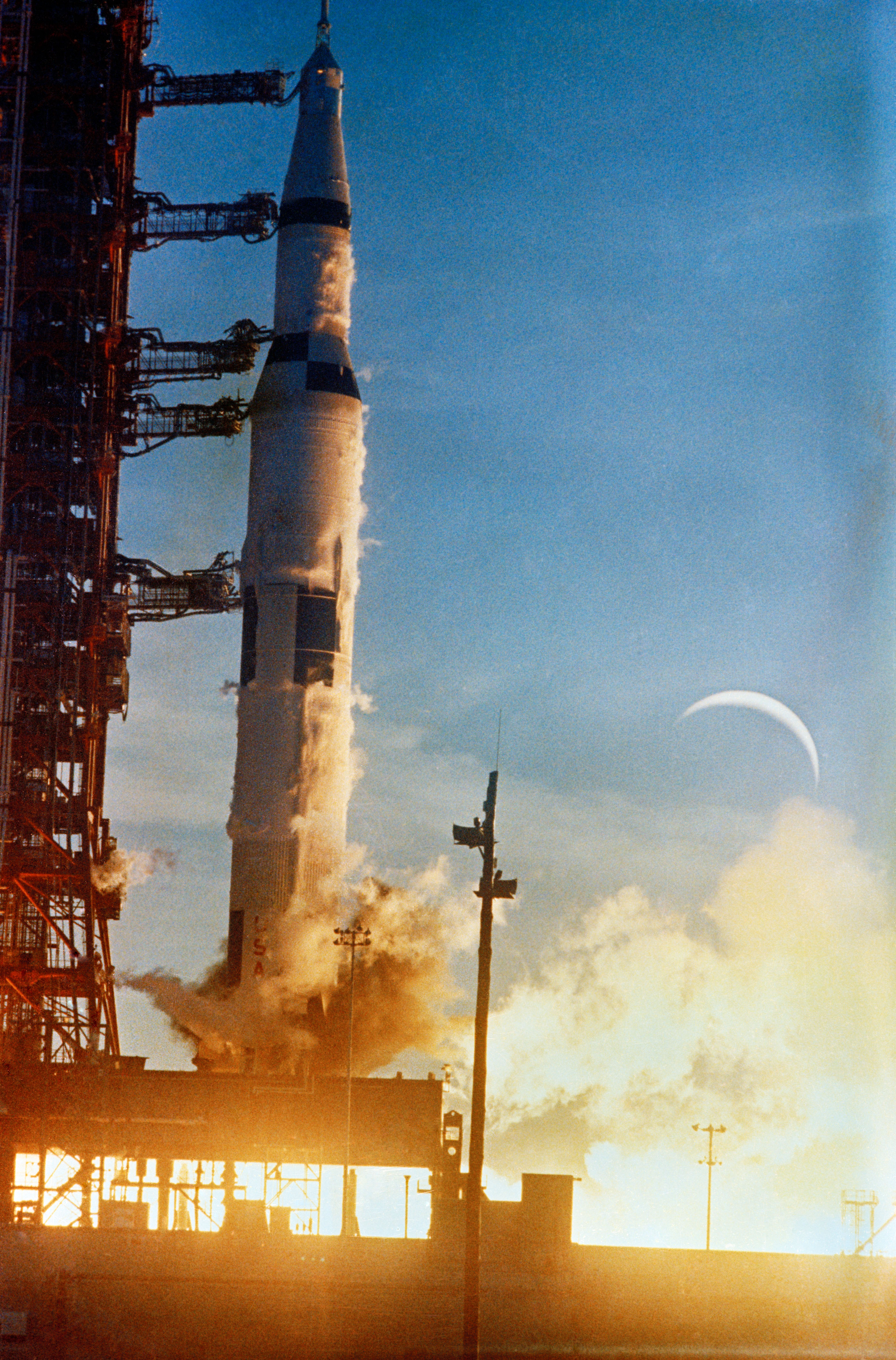
On Dec. 21, 1968, Anders along with Apollo 8 crewmates Frank Borman and Jim Lovell fired the upper stage of their Saturn V rocket, leaving Earth orbit on a trajectory to the moon. As they turned their Apollo command-service module around, the view was striking.
"We see the Earth now, almost as a disk," said Borman.
Lovell described the view to Mission Control.
"We have a beautiful view of Florida now," he said. "We can see the Cape (Canaveral), just the point. And at the same time, we can see Africa. West Africa is beautiful. I can also see Gibraltar at the same time I'm looking at Florida."
"Get a picture of it," said fellow astronaut and spacecraft communicator Mike Collins in Mission Control.
The pictures were as historic as they were stunning.
Three days after launch, Apollo 8 was completing 10 orbits of the moon. During a Christmas Eve television broadcast, Lovell noted the contrast between the stark, cratered lunar surface and the view of the 240,000-mile distant world.
"The vast loneliness up here of the moon is awe-inspiring," he said, "It makes you realize just what you have back there on Earth. The Earth from here is a grand oasis in the big vastness of space."
Now that the International Space Station has been permanently staffed since November 2000, Earth photography has been an important objective.
"The view from the station is absolutely breathtaking," said Expeditions 29 and 30 astronaut Dan Burbank when he returned to Kennedy and spoke to employees on June 7, 2013. "We have some impressive cameras on the space station. The vantage point of seeing this incredible planet from 240 miles above is just unbelievable."
While showing daytime photographs of Earth, Burbank noted that there are striking differences between daylight and night images of the planet.
"It's hard to get a sense that this planet is populated by humans, except at night," he said. "That's when all the cities come to life with lights that show up at night."
ISS Expedition 26 and 27 astronaut Cady Coleman spoke to Kennedy employees on Sept. 20, 2012. She explained that the view out the window gives a different perspective on life below.
"When you see our whole planet like this," she said, "you realize we are altogether citizens of the world."
Astronaut Ron Garan expressed similar beliefs when he spoke at Kennedy on Aug. 8, 2012, following ISS Expeditions 27 and 28. He noted the need to care for Earth.
"When you see the beauty of our planet, it is striking, it's sobering," Garan said. "For the 50 years that we've been flying humans in space, astronauts and cosmonauts have always commented about how beautiful, how fragile and how peaceful our planet looks from space. Seeing this from space really had a big impact on me."
The "Blue Marble"
The 'Blue Marble'
NASA scientific camera aboard the Deep Space Climate Observatory (DSCOVR) satellite returned this view of Earth on July 6, 2015, from a distance of one million miles. The DSCOVR satellite is a partnership between NASA, the National Oceanic and Atmospheric Administration (NOAA) and the U.S. Air Force to maintain the nation’s real-time solar wind monitoring capabilities, which are critical to the accuracy and lead time of space weather alerts and forecasts from NOAA.
Credits: NASA

Last Updated: April 22, 2016
Editor: Bob Granath

Guillermo Gonzalo Sánchez Achutegui
Inscríbete en el Foro del blog y participa : A Vuelo De Un Quinde - El Foro!

domingo, 7 de julio de 2013

NASA - Earthrise


Full resolution(6,253 × 7,955 pixels, file size: 4.54 MB, MIME type: image/jpeg)
 Left to right: Lovell, Anders, Borman
Wikipedia
Wikipedia
Full resolution(680 × 1,024 pixels, file size: 594 KB, MIME type: image/jpeg)

Apollo 8 during launch, with a double exposure of the Moon, which was not visible at the time
Wikipedia.

Earthrise
Apollo 8, the first manned mission to the moon, entered lunar orbit on Christmas Eve, Dec. 24, 1968. That evening, the astronauts-Commander Frank Borman, Command Module Pilot Jim Lovell, and Lunar Module Pilot William Anders-held a live broadcast from lunar orbit, in which they showed pictures of the Earth and moon as seen from their spacecraft. Said Lovell, "The vast loneliness is awe-inspiring and it makes you realize just what you have back there on Earth." They ended the broadcast with the crew taking turns reading from the book of Genesis.

Image Credit: NASA

Earthrise

Earthrise, as seen from Apollo 8, December 24, 1968
When the spacecraft came out from behind the Moon for its fourth pass across the front, the crew witnessed Earthrise for the first time in human history (NASA's Lunar Orbiter 1 took the very first picture of an Earthrise from the vicinity of the Moon, on August 23, 1966).[42] Borman saw the Earth emerging from behind the lunar horizon and called in excitement to the others, taking a black-and-white photo as he did so. In the ensuing scramble Anders took the more famous color photo, later picked by Life magazine as one of its hundred photos of the century.[43] Due to the synchronous rotation of the Moon about the Earth, Earthrise is not generally visible from the lunar surface. Earthrise is generally only visible when orbiting the Moon, other than at selected places near the Moon's limb, where libration carries the Earth slightly above and below the lunar horizon.
Anders continued to take photographs while Lovell assumed control of the spacecraft so Borman could rest.[43] Despite the difficulty resting in the cramped and noisy spacecraft, Borman was able to sleep for two orbits, awakening periodically to ask questions about their status.[43] Borman awoke fully, however, when he started to hear his fellow crew members make mistakes. They were beginning to not understand questions and would have to ask for the answers to be repeated. Borman realized that everyone was extremely tired having not had a good night's sleep in over three days. Taking command, he ordered Anders and Lovell to get some sleep and that the rest of the flight plan regarding observing the Moon be scrubbed. At first Anders protested saying that he was fine, but Borman would not be swayed. At last Anders agreed as long as Borman would set up the camera to continue to take automatic shots of the Moon. Borman also remembered that there was a second television broadcast planned, and with so many people expected to be watching he wanted the crew to be alert. For the next two orbits Anders and Lovell slept while Borman sat at the helm. On subsequent Apollo missions, crews would avoid this situation by sleeping on the same schedule.
Menu
0:00
The Apollo 8 Genesis reading.
As they rounded the Moon for the ninth time, the second television transmission began. Borman introduced the crew, followed by each man giving his impression of the lunar surface and what it was like to be orbiting the Moon. Borman described it as being "a vast, lonely, forbidding expanse of nothing."[44] Then, after talking about what they were flying over, Anders said that the crew had a message for all those on Earth. Each man on board read a section from the Biblical creation story from the Book of Genesis. Borman finished the broadcast by wishing a Merry Christmas to everyone on Earth. His message appeared to sum up the feelings that all three crewmen had from their vantage point in lunar orbit. Borman said, "And from the crew of Apollo 8, we close with good night, good luck, a Merry Christmas and God bless all of you - all of you on the good Earth."[45]
The only task left for the crew at this point was to perform the Trans-Earth Injection (TEI), which was scheduled for 2½ hours after the end of the television transmission. The TEI was the most critical burn of the flight, as any failure of the SPS to ignite would strand the crew in lunar orbit, with little hope of escape. As with the previous burn, the crew had to perform the maneuver above the far side of the Moon, out of contact with Earth.
The burn occurred exactly on time. The spacecraft telemetry was reacquired as it re-emerged from behind the Moon at 89 hours, 28 minutes, and 39 seconds, the exact time calculated. When voice contact was regained, Lovell announced, "Please be informed, there is a Santa Claus," to which Ken Mattingly, the current CAPCOM, replied, "That's affirmative, you are the best ones to know."[46] The spacecraft began its journey back to Earth on December 25, Christmas Day.
 Wikipedia.


Apollo 8
 
Apollo 8 mission patch
› View larger image

"'Round the moon and back..."

Crew
Frank Borman
Commander

William A. Anders
Lunar Module Pilot

James A. Lovell Jr.
Command Module Pilot

Backup Crew
Neil Armstrong
Commander

Fred W. Haise Jr.
Lunar Module Pilot

Edwin E. Aldrin Jr.
Command Module Pilot

Payload
CSM-103

Prelaunch Milestones
12/24/67 - S-II stage ondock at Kennedy
12/27/67 - S-IC stage ondock at Kennedy
12/30/67 - S-IVB ondock at Kennedy
1/4/68 - S-IU ondock at Kennedy
8/14/68 - launch vehicle at pad
10/17/68 - spacecraft at Pad
12/11/68 - Countdown Demonstration Test

Launch
Dec. 21, 1968; 7:51 a.m. EST
Launch Pad 39A
Saturn-V AS-503
High Bay 1
Mobile Launcher Platform-1
Firing Room 1

Orbit
Altitude: 118.82 miles
Inclination: 32.509 degrees
Orbits: 10 revolutions
Duration: six days, three hours, 42 seconds
Distance: 579,606.9 miles

Landing
Dec. 27, 1968; 10:52 a.m. EST
Pacific Ocean
Recovery Ship: USS Yorktown


 Mission Objective
The mission objectives for Apollo 8 included a coordinated performance of the crew, the command and service module, or CSM, and the support facilities. The mission also was to demonstrate translunar injection; CSM navigation, communications and midcourse corrections; consumable assessment; and passive thermal control. The detailed test objectives were to refine the systems and procedures relating to future lunar operations.

All primary mission objectives and detailed test objectives were achieved. All launch vehicle and spacecraft systems performed according to plan. Engineering accomplishments included use of the ground network with onboard navigational techniques to sharpen the accuracy of lunar orbit determination and the successful use of Apollo high-gain antenna -- a four-dish unified S-band antenna that deployed from the service module, or SM, after separation from the third stage.


Mission Highlights
Apollo 8 launched from Cape Kennedy on Dec. 21, 1968, placing astronauts Frank Borman, James Lovell Jr. and William Anders into a 114 by 118 mile parking orbit at 32.6 degrees.

During the second revolution, at two hours, 50 minutes ground elapsed time, the S-IVB third stage restarted for a five-minute, 17-second burn, initiating translunar coast. Following S-IVB/CSM separation at three hours, 21 minutes, a 1.5 feet per second radial burn of the SM reaction control engines was initiated to establish sufficient distance for S-IVB propellant dumping. Following the propellant dumping, which sent the stage into diverging trajectory and solar orbit, the separation distance still was deemed inadequate and a second SM reaction control burn of 7.7 feet per second was performed.

The first midcourse correction occured at about 10 hours, 55 minutes into the mission and provided a first check on the service propulsion system, or SPS, engine prior to committing spacecraft to lunar orbit insertion. The second and final midcourse correction prior to lunar orbit insertion occurred at 61 hours, 8 minutes, 54 seconds.

Loss of signal occurred at 68 hours, 58 minutes, 45 seconds when Apollo 8 passed behind the moon. At that moment, NASA's three astronauts became the first humans to see the moon's far side. The first lunar orbit insertion burn, at 69 hours, 8 minutes, 52 seconds, lasted four minutes, two seconds and reduced the spacecraft's 8,400 feet per second velocity by 2,994 feet per second, resulting in an initial lunar orbit of 70 by 193 miles. The orbit circularized at 70 miles by the second lunar orbit insertion burn of 135 feet per second, performed at the start of the third revolution, again on the back side of the moon, at 73 hours, 35 minutes, five seconds.

During the 20-hour period in lunar orbit, the crew conducted a full, sleepless schedule of tasks including landmark and landing site tracking, vertical stereo photography, stereo navigation photography and sextant navigation. At the end of the 10th lunar orbit, at 89 hours, 19 minutes, and 16 seconds, a three-minute, 23-second trans-Earth injection burn was conducted, adding 3,522 feet per second. Only one midcourse correction, a burn of five feet per second conducted at 104 hours, was required instead of the three scheduled.

Six telecasts were conducted during the mission: two during translunar coast, two during lunar orbit and two during trans-Earth coast. These transmissions were telecast worldwide and in real time to all five continents. During a telecast on Christmas Eve, the crew read verses from the first chapter of Genesis and wished viewers, "Good night, good luck, a Merry Christmas and God bless all of you -- all of you on the good Earth." All telecasts were of excellent quality. Voice communications also were exceptionally good throughout the mission.

Separation of the command module, or CM, from the SM occurred at 146 hours, 31 minutes. A double-skip maneuver conducted during the re-entry steering phase resulted in an altitude gain of 25,000 to 30,000 feet. The re-entry velocity was 24,696 mph, with heatshield temperatures reaching 5,000 degrees F. Parachute deployment and other re-entry events were nominal. Apollo 8 splashed down in the Pacific Ocean at 10:51 a.m. EST Dec. 27. The splashdown was about 5,100 yards from the recovery ship USS Yorktown, 147 hours after launch and precisely on time. According to prior planning, helicopters and aircraft hovered over the spacecraft, and pararescue personnel were not deployed until local sunrise, 50 minutes after splashdown. The Apollo 8 crew reached the recovery ship at 12:20 p.m. EST. 
NASA
 
Apollo 8:
This spacecraft was the first of the Apollo series to successfully orbit the moon, and the first manned spacecraft to leave Earth's gravity and reach the Moon. The mission achieved operational experience and tested the Apollo command module systems, including communications, tracking, and life-support, in cis-lunar space and lunar orbit, and allowed evaluation of crew performance on a lunar orbiting mission. The crew photographed the lunar surface, both farside and nearside, obtaining information on topography and landmarks as well as other scientific information necessary for future Apollo landings. Additionally, six live television transmission sessions were done by the crew during the mission, including the famous Christmas Eve broadcast in which the astronauts read from the book of Genesis. All systems operated within allowable parameters and all objectives of the mission were achieved. The flight carried a three man crew: Commander Frank Borman, Command Module Pilot James A. Lovell, Jr., and Lunar Module Pilot William A. Anders.

The Apollo 8 spacecraft consisted of a command module similar to Apollo 7 except that the forward pressure and ablative hatches were replaced by a combined forward hatch, which would be used for transfer to the Lunar Module on later missions. The spacecraft mass of 28,817 kg is the mass of the CSM including propellants and expendables. A Lunar Module was not used on the Apollo 8 mission but a Lunar Module Test Article which was equivalent in mass (9027 kg) to a Lunar Module was mounted in the spacecraft/launch vehicle adapter as ballast for mass loading purposes.
The spacecraft was launched on December 21, 1968 at 12:51:00 UT (7:51 a.m. EST), and was placed in a 190.6 km x 183.2 km Earth parking orbit with a period of 88.2 minutes and an inclination of 32.51 degrees. At 15:41:37 UT a third-stage burn injected the Apollo spacecraft into translunar trajectory. Orbit insertion took place on 24 December at 09:59:20 UT into an elliptical 310.6 km by 111.2 km lunar orbit. Two orbits later a second burn placed Apollo 8 into a near-circular 110.4 by 112.3 km orbit for eight orbits. The transearth injection burn took place on 25 December at 06:10:16 UT after a total of 10 lunar orbits.
Apollo 8 splashed down in the Pacific Ocean on 27 December 1968 at 15:51:42 UT (10:51:42 a.m. EST) after a mission elapsed time of 147 hrs, 0 mins, 42 secs. The splashdown point was 8 deg 7.5 min N, 165 deg 1.2 min W, 1,000 miles SSW of Hawaii and 5 km (3 mi) from the recovery ship USS Yorktown. The Apollo 8 Command Module is on display at the Chicago Museum of Science and Industry, Chicago, Illinois.
http://abyss.uoregon.edu/~js/space/lectures/lec15.html
NASA
Guillermo Gonzalo Sánchez Achutegui
ayabaca@gmail.com
ayabaca@hotmail.com
ayabaca@yahoo.com

miércoles, 26 de junio de 2013

NASA - Earthrise


Earthrise

Apollo 8, the first manned mission to the moon, entered lunar orbit on Christmas Eve, Dec. 24, 1968. That evening, the astronauts--Commander Frank Borman, Command Module Pilot Jim Lovell, and Lunar Module Pilot William Anders--held a live broadcast from lunar orbit, in which they showed pictures of the Earth and moon as seen from their spacecraft. Said Lovell, "The vast loneliness is awe-inspiring and it makes you realize just what you have back there on Earth." They ended the broadcast with the crew taking turns reading from the book of Genesis.

Image Credit: NASA
NASA
Guillermo Gonzalo Sánchez Achutegui
ayabaca@gmail.com
ayabaca@hotmail.com
ayabaca@yahoo.com
Inscríbete en el Foro del blog y participa : A Vuelo De Un Quinde - El Foro!

Mi lista de blogs