Mostrando entradas con la etiqueta Colorado's Rocky Mountains. Mostrar todas las entradas

miércoles, 24 de julio de 2013

nsf.gov - News - Bee Faithful? Plant-Pollinator Relationships Compromised When Bee Species Decline

Removing even one bumblebee species from an ecosystem affects plant reproduction.-
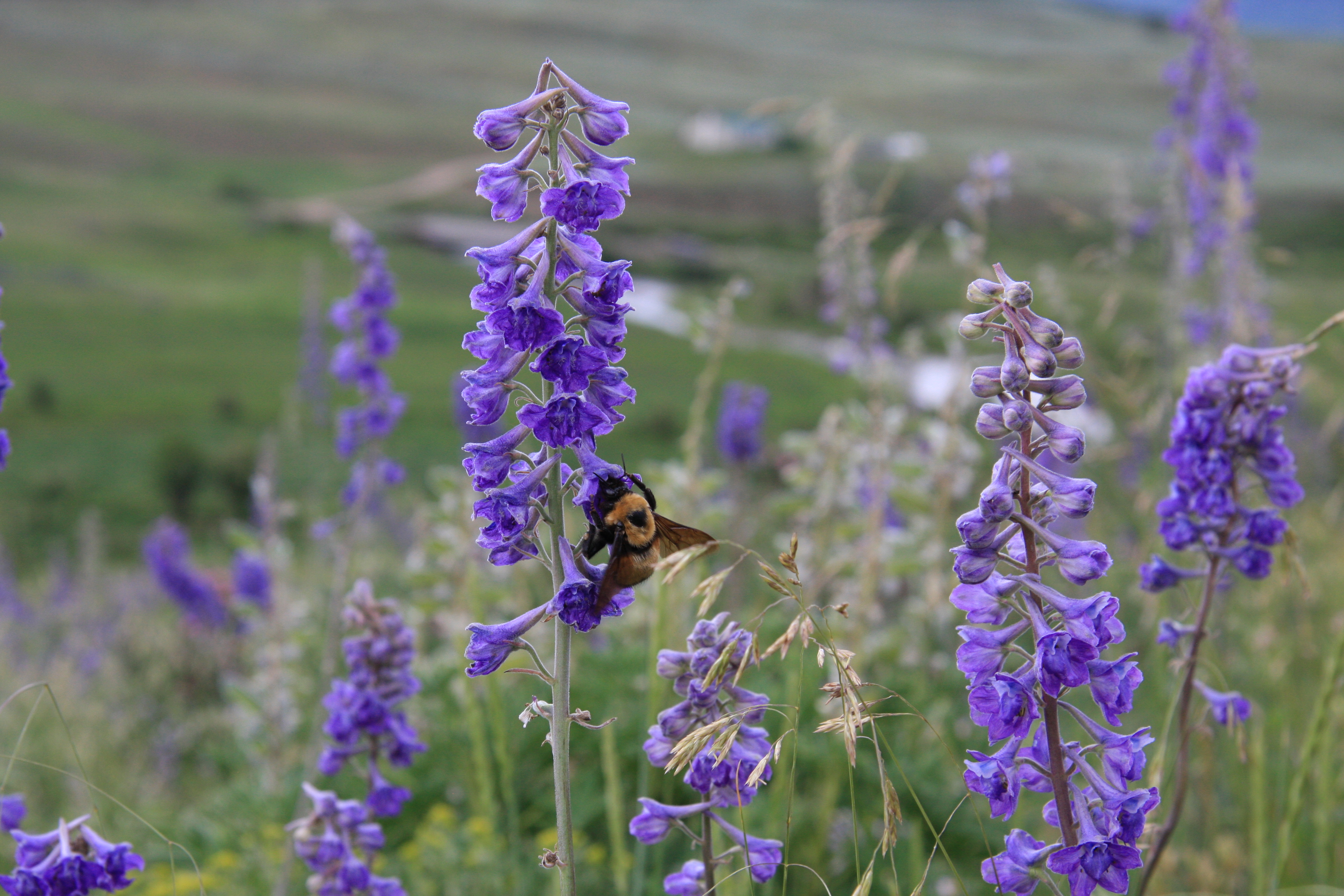
Bumble bee foraging on tall larkspur
Bumble bee foraging on tall larkspur near the Rocky Mountain Biological Laboratory in Colorado.
Credit: Karen Levy, Emory University
Download the high-resolution JPG version of the image. (3.9 MB)
Photo of field with bagged flowers of tall larkspur
Bagged flowers of tall larkspur, used to assess effects of pollinator removal on plants.
Credit: Karen Levy, Emory University
Download the high-resolution JPG version of the image. (7 MB)
Scientist Berry Brosi removes pollen from bumble bees in a field in Gunnison County, Colo.
Credit: Karen Levy, Emory University
Download the high-resolution JPG version of the image. (3.6 MB)
Researchers sample bumble bees in a subalpine meadow in Colorado.
Credit: Karen Levy, Emory University
Download the high-resolution JPG version of the image. (5.9 MB)
Biologist Therese Lamperty holding a bumble bee in a glass tube.
Biologist Therese Lamperty assists with the bumble bee species removal experiment.
Credit: Karen Levy, Emory University
Download the high-resolution JPG version of the image. (4.1 MB)
Close-up of bumble bee in a glass tube
Close-up of bumble bee removed during an experiment and later released unharmed.
Credit: Karen Levy, Emory University
Download the high-resolution JPG version of the image. (3.3 MB)

Remove even one bumblebee species from an ecosystem and the effect is swift and clear: Pollination is less effective, and plants produce significantly fewer seeds.
This according to research published today in the journal Proceedings of the National Academy of Sciences that focuses on the interactions between bumblebees and larkspur wildflowers in Colorado's Rocky Mountains.
The findings show that reduced competition among pollinators disrupts floral fidelity, or specialization, among the remaining bees in the system, leading to less successful plant reproduction.
"We found that these wildflowers produce one-third fewer seeds in the absence of just one bumblebee species," says Emory University ecologist Berry Brosi, who led the study.
"That's alarming and suggests that global declines in pollinators could have a bigger effect on flowering plants and food crops than was previously realized."
The National Science Foundation (NSF) funded the research; the paper was co-authored by ecologist Heather Briggs of the University of California-Santa Cruz.
"This study shows that the loss of a single bee species can harm pollination and reproduction of all flowering plant species in an ecosystem," says Alan Tessier, program director in NSF's Division of Environmental Biology, which funded the research.
"What's equally impressive is the demonstration of the mechanisms--that the loss of a single species changes the foraging behavior of all the remaining bee species."
About 90 percent of plants need animals, mostly insects, to transfer pollen between them so they can fertilize and reproduce.
Bees are by far the most important pollinators worldwide and have co-evolved with the floral resources they need for nutrition.
During the past decade, however, scientists have reported dramatic declines in populations of some bee species.
Some studies have indicated that plants can tolerate losing most pollinator species in an ecosystem as long as other pollinators remain to take up the slack. Those studies, however, were based on theoretical computer modeling.
Brosi and Briggs were curious about whether this theoretical resilience would hold up in real-life scenarios.
The team conducted field experiments to learn how the removal of a single pollinator species would affect the plant-pollinator relationship.
"Most pollinators visit several plant species over their lifetimes, but often will display what we call floral fidelity over shorter time periods," Brosi says.
"They'll tend to focus on one plant while it's in bloom, then a few weeks later move on to the next species in bloom. You might think of them as serial monogamists."
Floral fidelity clearly benefits plants, because a pollinator visit will only lead to plant reproduction when the pollinator is carrying pollen from the same plant species.
"When bees are 'promiscuous,' visiting plants of more than one species during a single foraging session, they are much less effective as pollinators," Briggs says.
The researchers conducted their experiments at the Rocky Mountain Biological Laboratory near Crested Butte, Colo.
Located at 9,500 feet, the facility's subalpine meadows are too high for honeybees, but they are buzzing during the summer months with bumblebees.
The experiments focused on the interactions of the insects with larkspurs, dark purple wildflowers that are visited by 10 of the 11 bumblebee species there.
The researchers studied a series of 20-meter-square wildflower plots, evaluating each one in both a control state, left in its natural condition, and in a manipulated state, in which nets were used to remove the bumblebees of just one species.
The researchers then observed bumblebee behavior in both the control plots and the manipulated plots.
"We'd literally follow around the bumblebees as they foraged," Briggs says. "It's challenging because the bees can fly pretty fast."
Sometimes the researchers could only record between five and 10 movements, while in other cases they could follow the bees to 100 or more flowers.
"When we caught bees to remove target species from the system, or to swab their bodies for pollen, we released them unharmed," Brosi says.
No researchers were harmed either, he adds. "Stings were very uncommon during the experiments. Bumblebees are quite gentle on the whole."
Across the steps of the pollination process, from patterns of bumblebee visits to plants, to picking up pollen, to seed production, the researchers saw a cascading effect of removing one bee species.
While about 78 percent of the bumblebees in the control groups were faithful to a single species of flower, only 66 percent of the bumblebees in the manipulated groups showed such floral fidelity.
The reduced fidelity in manipulated plots meant that bees in those groups carried more types of pollen than those in the control groups.
The changes had direct implications for plant reproduction: Larkspurs produced about one-third fewer seeds when one of the bumblebee species was removed, compared to larkspurs in the control groups.
"The small change in the level of competition made the remaining bees more likely to 'cheat' on the larkspur," Briggs says.
While previous research has shown how competition drives specialization within a species, the bumblebee study is one of the first to link this mechanism to the broader functioning of an ecosystem.
"Our work shows why biodiversity may be key to the conservation of an entire ecosystem," Brosi says.
"It has the potential to open a whole new set of studies into the implications of interspecies interactions."
-NSF-

Media Contacts Cheryl Dybas, NSF (703) 292-7734
 cdybas@nsf.gov
Beverly Cox Clark, Emory University (404) 712-8780

Related WebsitesNSF News: Where Have All the Flowers Gone?:
http://www.nsf.gov/news/news_summ.jsp?cntn_id=119843
NSF Article: It's Wildflower Season on Mountain Peaks, But Alpine Plants May Soon Miss the Date:
 http://www.nsf.gov/discoveries/disc_summ.jsp?cntn_id=124767&org=NSF
NSF News: Where Have All the Hummingbirds Gone?:

The National Science Foundation (NSF) is an independent federal agency that supports fundamental research and education across all fields of science and engineering. In fiscal year (FY) 2012, its budget was $7.0 billion. NSF funds reach all 50 states through grants to nearly 2,000 colleges, universities and other institutions. Each year, NSF receives about 50,000 competitive requests for funding, and makes about 11,500 new funding awards. NSF also awards about $593 million in professional and service contracts yearly.
Useful NSF Web Sites:
NSF Home Page:
http://www.nsf.gov
NSF News:
http://www.nsf.gov/news/
For the News Media:
 http://www.nsf.gov/news/newsroom.jsp
Science and Engineering Statistics:

The National Science Foundation (NSF),-
 
Guillermo Gonzalo Sánchez Achutegui
ayabaca@gmail.com
ayabaca@hotmail.com
ayabaca@yahoo.com
Inscríbete en el Foro del blog y participa : A Vuelo De Un Quinde - El Foro!

lunes, 14 de enero de 2013

nsf.gov - Discovery - High-Peak Creeks, Forest Fires and Landscape Erosion: Could They Be Linked?

Colorado's Boulder Creek watershed: where rushing streams, raging blazes and the Rockies meet.
 Research area in Gordon Gulch, Colo., part of NSF's Boulder Creek Critical Zone Observatory.

Research in Gordon Gulch, Colo., part of NSF's Boulder Creek Critical Zone Observatory.
Credit: Suzanne Anderson, University of Colorado at Boulder
Download the high-resolution JPG version of the image. (963 KB) researcher samples water from Boulder Creek
 See a video of "Where Rock Meets Life" in Boulder Creek, Colo.
Credit: NSF Boulder Creek Critical Zone Observatory
 Boulder Creek and the Rocky Mountains seen from the airplane.

Bird's eye view: Boulder Creek and the Rocky Mountains from the skies above.
Credit: Robert Anderson, University of Colorado at Boulder
Download the high-resolution JPG version of the image. (1.9 MB) Map showing Boulder Creek, and tributary Fourmile Creek, with red burn scar from a wildfire.

Location of Boulder Creek, and tributary Fourmile Creek, with red burn scar from a wildfire
Credit: NASA
Download the high-resolution JPG version of the image. (2.5 MB) Photo of a ponderosa pine extending its roots into rock below.
 A tree grows near Boulder Creek: a ponderosa pine extends its roots into rock below.
Credit: Suzanne Anderson, University of Colorado at Boulder
Download the high-resolution JPG version of the image. (2.8 MB) Scientist Ken Nelson collecting soils beneath trees at the Boulder Creek CZO.
 Scientist Ken Nelson studies the soils beneath trees at the Boulder Creek CZO.
Credit: Suzanne Anderson, University of Colorado at Boulder
Download the high-resolution JPG version of the image. (1.9 MB)  Researcher T. Joe Mills samples winter snows in the Boulder Creek watershed.
 Researcher T. Joe Mills samples winter snows in the Boulder Creek watershed.
Credit: Suzanne Anderson, University of Colorado at Boulder
Download the high-resolution JPG version of the image. (64 KB)

The following is part four in a series on the National Science Foundation's Critical Zone Observatories (CZOs). Part one describes the work of the Susquehanna Shale Hills CZO. Part two focuses on the Southern Sierra CZO. Part three highlights research at the Christina River Basin CZO.
Fire and water. One scorches the other, only to be drowned in return. Could their effects on a watershed be related?
Scientists conducting research in Colorado's Rocky Mountains at the National Science Foundation (NSF) Boulder Creek Critical Zone Observatory (CZO) are finding out.
Boulder Creek is a 31-mile-long stream draining the Rocky Mountains to the west of Boulder, Colo., as well as the city itself and surrounding plains.
At the Boulder Creek CZO, scientists see fire and water as being closely tied to the landscape--and to what's below that landscape in the subsurface environment.
"Ultimately, it's the landscape that controls where fires are most likely," says scientist Suzanne Anderson of the University of Colorado at Boulder, director of the Boulder Creek CZO.
"It all begins with the presence of the mountains," she says, "with the landscape beneath the forests and streams."
The Colorado Front Range, whose mountains Boulder Creek plummets down, are the stage upon which fire, water and forests are set.
Take the Fourmile Canyon Fire of September 2010. It burned 6,400 acres, destroyed 169 homes and caused more than $217 million in damages.
The wildfire raged through the Boulder Creek watershed's rugged terrain. The resulting deforestation, CZO scientists have found, left the area at risk of flooding and erosion, including debris flows from the fire.
NSF's Critical Zone Observatories: where rock meets water meets life
The Boulder Creek CZO is one of six NSF CZOs in watersheds across the nation.
In addition to the Boulder Creek site, CZOs are located in the Southern Sierra Nevada, Christina River Basin on the border of Delaware and Pennsylvania, Susquehanna Shale Hills in Pennsylvania, Luquillo riparian zone in Puerto Rico, and the Jemez River and Santa Catalina Mountains in New Mexico and Arizona.
They're providing researchers with a new understanding of the critical zone--the region between the top of the forest canopy and the base of unweathered rock.
"The critical zone is our living environment," says Enriqueta Barrera, program director in NSF's Division of Earth Sciences, which funds the CZO network. "The CZOs offer us new knowledge about the critical zone and its response to climate and land-use change."
They're the first systems-based observatories dedicated to understanding how Earth's surface processes are coupled, she says. "They will help us predict how the critical zone affects the ecosystem services on which society depends."
The water cycle, the breakdown of rocks and eventual formation of soil, the evolution of rivers and valleys, patterns of plant growth and landforms all result from processes that take place in the critical zone.
"The CZOs," says Barrera, "are fostering a new view of the critical zone as one holistic system."
Fast-moving water--and fire--in the critical zone
What are the long-term effects of the Fourmile Canyon Fire and other wildfires on watersheds such as Boulder Creek?
Studies of streams after wildfires have yielded conflicting results. Some show increases in pH (water that's more basic vs. acidic), turbidity, nutrients, sulfate and metals. Other research reports few effects.
"Many of these studies sampled water chemistry at intervals that didn't catch rapid changes," says Anderson. "At the Boulder Creek CZO, we're conducting high-frequency stream sampling, and evaluating how upland hydrologic and biogeochemical processes affected by fire influence downstream water quality."
Since the Fourmile Canyon Fire, scientists at the Boulder Creek CZO and the U.S. Geological Survey have been tracking discharge rates, nutrients, metals and ecosystem characteristics such as numbers and species of invertebrates that live in streams.
Runoff from burned north- and south-facing slopes is being measured to assess how hillslopes respond differently following fire.
Instruments have been placed on the hillslopes, and in soils along Boulder Creek's banks, to record changes. Stream water and soil chemistry are being compared with those of nearby unburned areas.
Monitoring continues during snowmelt when water levels are high, and during "gully washer" summer thunderstorms.
In the summer of 2011, for example, a severe storm led to an 8,100 percent increase in stream discharge in Fourmile Creek, a tributary of Boulder Creek. "That was some three times higher than had ever been measured," says Anderson.
The storm flooded homes and blocked roads with sediment. It also resulted in concentrations of in-stream total suspended solids that were 4,000-fold above baseline.
Some of that sediment remains in the creek channel, then flows downstream when more rain falls in the area.
"Such precipitation events can lead to catastrophic erosion that affects long-term sediment loads," says Anderson. "Increases in turbidity, nitrate and what's called dissolved organic carbon in turn may affect drinking water treatment processes."
These studies are but a few of "many taking place at the Boulder Creek CZO on everything from how the 'architecture' of the critical zone affects its hydrology, to the role trees play in the critical zone's evolution," says Anderson.
The Front Range: a regional water tower
With its high peaks, the Colorado Front Range "harvests" precipitation from the atmosphere. Most of that precipitation falls as snow. The snowpack becomes a reservoir, and the mountains act as a water tower.
"The distribution of water resources in western North America is actually controlled by the geologic history of the region," says Anderson. "It sets the location, height and width of the moisture-trapping and moisture-holding mountain ranges."
Forests near Boulder Creek--and everywhere in the West--are found in mountain ranges. Moisture is high enough there for trees to flourish, and precipitation evaporates more slowly.
But where forests grow, fires often aren't far behind. "With more droughts in recent years," says Anderson, "we're more at risk of fires."
The role of erosion
The Front Range--more than 10,000 feet high at its crest--is eroding, says Anderson, but very slowly.
For the most part, "it's cool and moist there," she says, "and 'soil-mantled'--the soil wasn't scraped away by the glaciers that covered the region in the distant past."
Most of this slowly eroding terrain has been sliced by rivers, which have hollowed out deep canyons such as Boulder Canyon.
"The canyons are giant drains carved into the terrain," says Anderson. "They lower the water table of surrounding slopes. Their erosion history sets up broad regions of well-drained forested landscape."
That well-drained landscape is the corridor where big fires, such as the one in Fourmile Canyon, have happened.
"The topography of the Front Range is interconnected with water and fire in the landscape," says Anderson.
Past is prologue?
At Boulder Creek, scientists are looking down into the subsurface, Anderson says, "to understand how the landscape evolved into its present state, and how that controls everything from where forests are found, to how fast weathering of subsurface rock takes place, to a watershed's ability to collect and store water." And, perhaps, to put a fire out.
Meanwhile, the creek flows onward, cutting into the mountain landscape as it goes--and carrying parts of the Rockies with it.
"Amber and white and black in the arrested spaces," wrote H.H. Jackson in 1878 in Bits of Travel at Home, "[Boulder Creek] whirls under bridges and round the corners, doubles on itself, leaps over and high above a hundred rocks in a rod, breaks into sheafs and showers of spray, foams and shines and twinkles and glistens; and if there be any other thing which water at its swiftest and sunniest can do, that it does also, even to jumping rope with rainbows."
A perfect description, says Anderson, of the role of fast-flowing streams in the critical zone.
--  Cheryl Dybas, NSF (703) 292-7734 cdybas@nsf.gov
Related Websites
NSF Critical Zone Observatories: Where Rock Meets Life: http://www.criticalzone.org/
NSF Boulder Creek Critical Zone Observatory: http://czo.colorado.edu/
NSF Awards Grants for Three Critical Zone Observatories: 
http://www.nsf.gov/news/news_summ.jsp?cntn_id=110586
NSF Science, Engineering and Education for Sustainability Investment:
 http://www.nsf.gov/sees
NSF Discovery Article: Science on the Graveyard Shift: 
http://www.nsf.gov/discoveries/disc_summ.jsp?cntn_id=125882&org=NSF
NSF Discovery Article: A Tree Stands in the Sierra Nevada: 
http://www.nsf.gov/discoveries/disc_summ.jsp?cntn_id=125091&org=NSF
NSF Discovery Article: Can Marcellus Shale Gas Development and Healthy Waterways Sustainably Coexist?: http://www.nsf.gov/discoveries/disc_summ.jsp?cntn_id=122543
The National Science Foundation.
Guillermo Gonzalo Sánchez Achutegui
ayabaca@gmail.com
ayabaca@hotmail.com
ayabaca@yahoo.com 
 Inscríbete en el Foro del blog y participa : A Vuelo De Un Quinde - El Foro!

Mi lista de blogs