Mostrando entradas con la etiqueta ESA’s Integral space observatory. Mostrar todas las entradas

domingo, 27 de noviembre de 2016

ESA : ESASky, todo el cielo a tu alcance

http://www.esa.int/esl/ESA_in_your_country/Spain/ESASky_todo_el_cielo_a_tu_alcance

ESASky, todo el cielo a tu alcance

22 noviembre 2016
¿Cómo ve XMM-Newton un remanente de supernova en rayos X? ¿Y cómo se aprecia el mismo objeto en las observaciones en luz visible del telescopio espacial Hubble? Es fácil saberlo a través de la aplicación web ESASky, que pone a nuestra disposición los datos públicos de todas las misiones científicas de la ESA.
Haciendo click aquí, podemos ver el cielo en todas las diferentes longitudes de onda con las que lo observan los observatorios y satélites de la agencia.
Esos datos científicos se archivan en ESAC, el Centro Europeo de Astronomía Espacial, que centraliza el almacenaje de los datos científicos de las misiones de la ESA, y que ha puesto en marcha ESASky para acercar esas observaciones al gran público.  “El funcionamiento es muy sencillo y muy visual”, afirma Bruno Merín, Product Owner de ESASky, que añade que “de cada objeto se puede elegir la visualización en diferentes longitudes de onda y la misión que lo ha observado”.

Para todos los públicos

La interfaz de ESASky presenta, directamente, una vista del cielo y unos menús desplegables que permiten elegir, para un mismo objeto, entre distintas misiones y distintas visualizaciones; es decir, para la galaxia M51, por ejemplo, podemos verla a través de las observaciones en óptico de la cámara ACS del Hubble o del cartografiado DSS2, podemos elegir una vista en rayos-X de XMM-Newton o submilimétrica de Herschel, y tomar un pantallazo de ella. Lo que hace ESASky es integrar todos los archivos científicos de astronomía de la ESA en una única aplicación web fácil de usar.

Además de esa posibilidad de visualizar objetos concretos, también existe la opción de ver panorámicas completas del cielo en las que podemos ampliar sectores para obtener mayor detalle o subir a la herramienta una lista con nombres de objetos celestes y visitarlos en una secuencia. Esas panorámicas están confeccionadas con datos de misiones como INTEGRAL, XMM-Newton, Hubble, AKARI, ISO, Herschel y Planck, que reúnen observaciones en rayos gamma, rayos X y ultravioleta, ópticas, en infrarrojo cercano y lejano y en longitudes de onda submilimétricas. De este modo, el usuario tiene a su alcance una completa visión del cielo y de todas las regiones observadas por los telescopios espaciales de la ESA a lo largo de la historia. Pero ese usuario no sólo son científicos. Bruno Merín señala que ESASky está abierta tanto a investigadores como a aficionados a la astronomía, y por eso se ha diseñado buscando un manejo intuitivo y sencillo. Para los investigadores o para usuarios inquietos, se incluye la posibilidad de descargar los datos que necesiten para sus trabajos.
En ESAC trabajan en una versión 2.0 de la aplicación que incluirá datos espectrales, observaciones de nuevas misiones y la posibilidad de ver los objetos celestes no sólo en diferentes longitudes de onda, sino también en diferentes momentos en el tiempo. Esta versión también se podrá usar fácilmente con dispositivos móviles como tabletas y teléfonos inteligentes.
ESA
Guillermo Gonzalo Sánchez Achutegui
Inscríbete en el Foro del blog y participa : A Vuelo De Un Quinde - El Foro!

jueves, 18 de octubre de 2012

ESA - Space Science: Radioactive decay of titanium powers supernova remnant


Download:
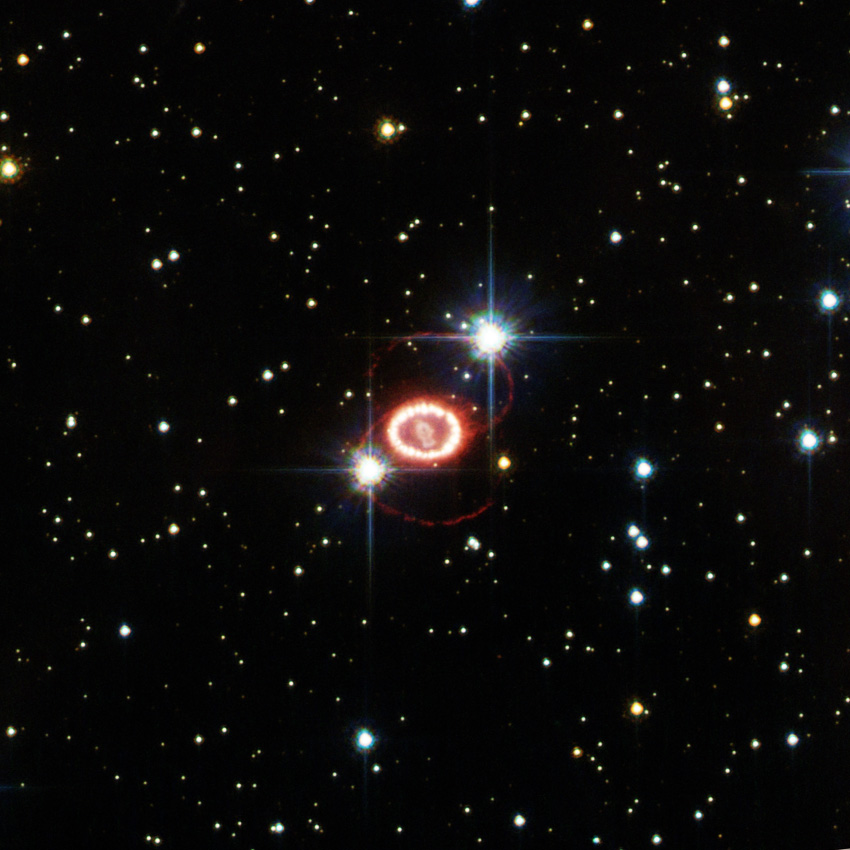
Supernova remnant SNR1987A is located 166 000 light-years away in the Large Magellanic Cloud. The light from the stellar explosion arrived at Earth in 1987, and has since provided astronomers with a natural laboratory to monitor how the brightness of a supernova changes over time.
Dominating this Hubble Space Telescope view of the remnant are two glowing loops and a very bright ring of shocked hotspots surrounding the location of the now-exploded central star. The material making up these loops and rings was probably ejected from the star earlier in its history and is now being illuminated by the supernova and its shockwave.
The titanium-44 detected by Integral is powering only the innermost part of the remnant.
Astronomers expect a neutron star to have been left after the explosion, but no definitive evidence for it has yet been found.
The field of view is about 25 x 25 arcseconds. 
Credits: ESA/Hubble & NASA
 The first direct detection of radioactive titanium associated with supernova remnant 1987A has been made by ESA’s Integral space observatory. The radioactive decay has likely been powering the glowing remnant around the exploded star for the last 20 years.

Stars are like nuclear furnaces, continuously fusing hydrogen into helium in their cores. When stars greater than eight times the mass of our Sun exhaust their hydrogen fuel, the star collapses. This may generate temperatures high enough to create much heavier elements by fusion, such as titanium, iron, cobalt and nickel.
After the collapse, the star rebounds and a spectacular supernova explosion results, with these constituent elements flung into space.
Supernovae can shine as brightly as entire galaxies for a very brief time thanks to the enormous amount of energy released in the explosion.
After the initial flash has faded, the total luminosity of the remnant is provided by the release of energy from the natural decay of radioactive elements produced in the explosion.
Each element emits energy at some characteristic wavelengths as it decays, providing insight into the chemical composition of the supernova ejecta – the shells of material flung out by the exploding star.  
Download:
The first detection of titanium-44 in supernova remnant 1987A. ESA’s Integral space telescope made the detection in the energy range between 65 keV and 82 keV, which brackets two emission lines produced during the decay of titanium-44, at 67.9 keV and 78.4 keV.
The detection required over 1000 hours of observation time with Integral.
Also seen in the field of view are two other bright sources of high-energy emission, the black hole binary known as LMC X-1 and the pulsar PSR B0540-69. 
Credits: ESA/Integral/IBIS–ISGRI/S. Grebenev et al.
 Supernova 1987A, located in one of the Milky Way’s nearby satellite galaxies, the Large Magellanic Cloud, was close enough to be seen by the naked eye when its light first reached Earth in February 1987.
During the peak of the explosion, fingerprints of elements from oxygen to calcium were detected, representing the outer layers of the ejecta.
Soon after, signatures of the material synthesised in the inner layers could be seen in the radioactive decay of nickel-56 to cobalt-56, and its subsequent decay to iron-56.
Now, thanks to more than 1000 hours of observation by Integral, high-energy X-rays from radioactive titanium-44 in supernova remnant 1987A have been detected for the first time.
“This is the first firm evidence of titanium-44 production in supernova 1987A and in an amount sufficient to have powered the remnant over the last 20 years,” says Sergei Grebenev from the Space Research Institute of the Russian Academy of Science in Moscow, and the first author of the paper reporting the results in Nature.
From their analysis of the data, the astronomers estimated that the total mass of titanium-44 that must have been produced just after the core collapse of SN1987A’s progenitor star amounted to 0.03% of the mass of our own Sun.
Download:
 HI-RES JPEG (Size: 66 kb)
This image shows the patch of the sky surrounding the remnant of supernova remnant 1987A as seen in three different bands at high X-ray energies with ESA’s Integral. Titanium-44 is only present in the central image, which spans the 65–82 keV energy range. The panel on the left is based on data collected in the 48–65 keV band, whereas the panel on the right is based on data collected in the 82–99 keV band. The presence of signal corresponding to the position in the sky of SNR 1987A only in the energy range between 65 keV and 82 keV demonstrates that the signal does arise from emission at the specific wavelengths unique to the radioactive decay of Ti-44, at 67.9 keV and 78.4 keV.
Also seen in the field of view are two other bright sources of high-energy emission, the black hole binary known as LMC X-1 and the pulsar PSR B0540-69. 
Credits: ESA/Integral/IBIS–ISGRI/S. Grebenev et al.
 This value is near the upper boundary of theoretical predictions and is nearly twice the amount seen in supernova remnant Cas A, the only other remnant where titanium-44 has been detected.
“The high values of titanium-44 measured in Cas A and SNR1987A are likely produced in exceptional cases, favouring supernovae with an asymmetric geometry, and perhaps at the expense of the synthesis of heavier elements,” says Dr Grebenev.
“This is a unique scientific result obtained by Integral that represents a new constraint to be taken into account in future simulations for supernova explosions,” adds Chris Winkler, ESA’s Integral project scientist and co-author of the Nature paper.
“These observations are broadening our understanding of the processes involved during final stages of a massive star’s life.”
Notes for Editors
ESA
Guillermo Gonzalo Sánchez Achutegui
ayabaca@gmail.com
ayabaca@hotmail.com
ayabaca@yahoo.com
 Inscríbete en el Foro del blog y participa : A Vuelo De Un Quinde - El Foro!

Mi lista de blogs