Mostrando entradas con la etiqueta ESA’s Rosetta spacecraft. Mostrar todas las entradas

viernes, 17 de febrero de 2017

ESA : Spacecraft shadow.- La sombra de la nave

http://www.esa.int/esl/ESA_in_your_country/Spain/La_sombra_de_la_nave
http://www.esa.int/spaceinimages/Images/2017/02/Spacecraft_shadow

Spacecraft shadow

La sombra de la nave

13 febrero 2017
El Día de San Valentín de 2015, la sonda Rosetta de la ESA estaba llegando a su cita con el Cometa 67P/Churyumov-Gerasimenko. En ese momento de la misión, la nave se encontraba más cerca que nunca del cometa, a tan solo 6 km de su superficie.
Pero el sobrevuelo del 14 de febrero no solo fue especial por su proximidad, sino porque Rosetta pasó por una geometría observacional única: por unos momentos, el Sol, la nave y el cometa quedaron exactamente alineados. En esa posición, las estructuras de la superficie apenas proyectaban sombras, lo que permitía determinar las propiedades de reflexión de los materiales superficiales. 
Y, como efecto colateral, se pudo ver la sombra de Rosetta proyectando sobre la superficie del cometa una mancha rectangular poco definida y algo más grande que la propia nave, en este caso, de unos 20 x 50 m. La imagen completa mide unos 228 m transversalmente. 
Esta imagen en particular es la última de una secuencia de 12 fotografías que capturaron la sombra de la nave mientras sobrevolaba la región de Imhotep, en el lóbulo mayor del cometa. 
La imagen fue tomada por el teleobjetivo de la cámara OSIRIS y tiene una resolución de tan solo 11 cm/píxel. 
Rosetta siguió sobrevolando el cometa a una distancia cada vez menor, especialmente durante la fase final de su increíble misión, antes de acabar aterrizando sobre su superficie en septiembre de 2016. 
Esta imagen es una de las miles de fotografías disponibles libremente en el buscador de imágenes de archivo de la ESA.

Spacecraft shadow

Details

Open/Close
  • Title Spacecraft shadow
  • Released 13/02/2017 12:30 pm
  • Copyright ESA/Rosetta/MPS for OSIRIS Team MPS/UPD/LAM/IAA/SSO/INTA/UPM/DASP/IDA
  • Description
    Valentine’s Day 2015 and ESA’s Rosetta swooped in towards Comet 67P/Churyumov–Gerasimenko for a daring close encounter. At just 6 km from the surface, it was the closest the spacecraft had ever been to the comet at that point in the mission.
    The 14 February flyby was not only special because of its proximity, Rosetta also passed through a unique observational geometry: for a short time the Sun, craft and comet were exactly aligned. In this position, surface structures cast almost no shadows, allowing the reflection properties of the surface material to be determined.
    As a side effect, Rosetta’s shadow could also be seen, cast on the surface of the comet as a fuzzy rectangular dark smudge somewhat larger than Rosetta itself, in this case measuring some 20 x 50 m. The full image measures about 228 m across.
    This particular image is the last in a sequence of 12 that captured the spacecraft’s shadow as it tracked over the surface in the Imhotep region on the larger of the comet’s two lobes.
    The image was taken by the OSIRIS narrow-angle camera and the image resolution is just 11 cm/pixel.
    Rosetta subsequently made closer flybys, notably in the final phase of its incredible mission as it drew ever closer to the comet before finally coming to rest on the surface in September 2016.
    The image is one of thousands freely available in ESA’s Archive Image Browser.
  • Id 373217

TAGS

Open/Close
ESA
Guillermo Gonzalo Sánchez Achutegui a vuelo
ayabaca@gmail.com
ayabaca@hotmail.com
ayabaca@yahoo.com
Inscríbete en el Foro del blog y participa : A Vuelo De Un Quinde - El Foro!

domingo, 18 de diciembre de 2016

ESA : Rosetta’s last words: science descending to a comet .- Las últimas palabras de Rosetta: la ciencia descendiendo a un cometa

http://www.esa.int/Our_Activities/Space_Science/Rosetta/Rosetta_s_last_words_science_descending_to_a_comet

http://www.esa.int/esl/ESA_in_your_country/Spain/Cuando_la_ciencia_toca_un_cometa_las_ultimas_palabras_de_Rosetta                               


Última secuencia de toma de imágenes de Rosetta

Cuando la ciencia toca un cometa: las últimas palabras de Rosetta

15 diciembre 2016
La sonda Rosetta de la ESA completó su increíble misión el día 30 de septiembre, recopilando imágenes y datos sin precedentes hasta el momento del contacto con la superficie del cometa 67P/Churyumov-Gerasimenko.
La señal de Rosetta desapareció de las pantallas del control de la misión de la ESA a las 11:19:37 GMT, confirmando así que la nave había llegado a la superficie del cometa y que se había desconectado 40 minutos antes, a 720 millones de kilómetros de la Tierra. 
Una de las últimas informaciones que recibimos de Rosetta procedía de sus sensores de navegación, informando de un ‘gran objeto’ situado en su campo de visión: el horizonte del cometa.
 

Última imagen de Rosetta

Al reconstruir el descenso final se vio que la sonda aterrizó suavemente en la superficie a tan solo 33 m del punto previsto. 
Este nivel de precisión vuelve a demostrar el excelente trabajo realizado por los especialistas en dinámica de vuelo participantes en la misión. 
El lugar del aterrizaje, situado dentro de una antigua fosa en la región de Ma‘at, en la ‘cabeza’ del cometa, recibió el nombre de Sais en honor a la ciudad donde fue descubierta la Piedra de Rosetta original. 
Se tomaron numerosas fotografías de la fosa colindante, capturando increíbles detalles de sus paredes estratificadas, que contribuirán a descifrar la historia geológica del cometa. 
La imagen final fue tomada a unos 20 m por encima del punto de impacto. Además, recogieron datos una serie de instrumentos de análisis de polvo, gas y plasma. 
A medida que la sonda se acercaba a la superficie, se vió cómo aumentaba la presión del flujo de gas procedente del cometa. Los diferentes rastreos revelaron temperaturas de entre −190 y −110 ºC a unos pocos centímetros por debajo de la superficie. Es muy probable que esta variación se deba a sombras y a la topografía local a medida que Rosetta sobrevolaba el cometa. 
La última medición de emisiones de vapor de agua tuvo lugar el 27 de septiembre y se estima que el cometa emitía el equivalente de dos cucharadas de agua por segundo. Durante su periodo más activo en agosto de 2015, los cálculos llegaban al equivalente de unas dos bañeras de agua por segundo. 
 

Zonas de aterrizaje del cometa en contexto
 
Las primeras indicaciones de las lecturas espectrales no muestran diferencias significativas en la composición de la superficie a las altas resoluciones obtenidas durante el descenso, y tampoco se hallaron pruebas obvias de pequeñas acumulaciones de hielo cerca del punto de aterrizaje. 
Las mediciones también sugieren un aumento en el número de minúsculos granos de polvo, posiblemente de una millonésima de milímetro, cerca de la superficie. 
La última observación de la coma de gas que rodea al cometa tuvo lugar el día antes del descenso final, confirmando que seguía emitiéndose dióxido de carbono, incluso a mayores distancias que cuando el cometa se acercaba al Sol.
Durante las últimas mediciones del campo magnético interplanetario y del viento solar reinaron unas condiciones estables, ofreciendo valores de fondo ‘tranquilos’ que resultarán importantes para la calibración. 
A unos 2 km por encima de la superficie se observó un descenso en la densidad del plasma del cometa, sin que se detectaran escapes de gas locales en las fosas de Ma‘at. 


Rosetta impact
 
Las mediciones del campo magnético hasta unos 11 m por encima de la superficie del cometa confirmaron las observaciones previas, que indicaban su naturaleza de cuerpo no magnético. 
Durante el descenso no se recogieron grandes partículas de polvo, un resultado ya interesante en sí mismo. Las primeras impresiones indicaban que la producción de vapor de agua era demasiado baja para levantar de la superficie granos de polvo por encima de un tamaño detectable. 
“Es estupendo contar con estas primeras informaciones procedentes del último conjunto de datos de Rosetta —reconoce Matt Taylor, científico del proyecto Rosetta de la ESA—. Las operaciones terminaron hace más de dos meses y ahora los equipos de los instrumentos están inmersos en el análisis de los enormes conjuntos de datos recopilados durante los más de dos años de Rosetta junto al cometa”. 
“Más adelante, los datos de este periodo quedarán disponibles en nuestros archivos, al igual que los datos de Rosetta”.
Nota para los editores
Para saber más, es posible consultar una entrada del blog con información complementaria y más detallada aquí.

Para más información:
Matt Taylor

ESA Rosetta project scientist

Email: matt.taylor@esa.int
Markus Bauer


ESA Science and Robotic Exploration Communication Officer


Tel: +31 71 565 6799


Mob: +31 61 594 3 954


Email: markus.bauer@esa.int


Rosetta’s final imaging sequence

Rosetta’s last words: science descending to a comet

15 December 2016
ESA’s Rosetta completed its incredible mission on 30 September, collecting unprecedented images and data right until the moment of contact with the comet's surface.
Rosetta’s signal disappeared from screens at ESA’s mission control at 11:19:37 GMT, confirming that the spacecraft had arrived on the surface of Comet 67P/Churyumov–Gerasimenko and switched off some 40 minutes earlier and 720 million kilometres from Earth.
One of the final pieces of information received from Rosetta was sent by its navigation startrackers: a report of a ‘large object’ in the field of view – the comet horizon.
 

Rosetta's last image

Reconstruction of the final descent showed that the spacecraft gently struck the surface only 33 m from the target point.
The accuracy once again highlighted the excellent work of the flight dynamics specialists who supported the entire mission.
The spot, just inside an ancient pit in the Ma’at region on the comet’s ‘head’, was named Sais, after a town where the Rosetta Stone was originally located.
Numerous images were taken of the neighbouring pit, capturing incredible details of its layered walls that will be used to help decipher the comet’s geological history.
The final image was acquired about 20 m above the impact point. In addition, a number of Rosetta’s dust, gas and plasma analysis instruments collected data.
The pressure of the gas outflow from the comet was seen to rise as the surface neared. Scans revealed temperatures between about –190ºC and –110ºC down to a few centimetres below the surface. The variation was most likely due to shadows and local topography as Rosetta flew across the surface.
A last measurement of water vapour emission was made on 27 September, estimating the comet was emitting the equivalent of two tablespoons of water per second. During its most active period in August 2015, estimates were in the region of two bathtubs’ worth of water every second.
 

Comet landing sites in context
 
The first indications from spectral readings show there to be no significant differences in surface composition at the high resolutions obtained all the way down, and there was no obvious indication of small icy patches near the landing site.
The measurements also suggest an increase in very small dust grains – possibly around a millionth of a millimetre – close to the surface.
The last observation of the gas coma surrounding the comet was made the day before the final descent. Carbon dioxide was still being outgassed, at a greater distance from the Sun than when the comet was approaching it.

Stable solar wind conditions reigned during the final measurements of the solar wind and interplanetary magnetic field, providing ‘quiet’ background values that will be important for calibration.
Decreasing comet plasma densities were observed from about 2 km above the surface, with no obvious detection of local outgassing from the Ma’at pits.


Rosetta impact
 
Magnetic field measurements down to an estimated 11 m above the surface confirmed the previous observations of the comet as a non-magnetic body.
No large dust particles were collected during the descent, in itself an interesting result. First impressions are that the observed water vapour production was too low to lift dust grains above a detectable size from the surface.
“It’s great to have these first insights from Rosetta’s last set of data,” says Matt Taylor, ESA’s Rosetta Project Scientist. “Operations have been completed for over two months now, and the instrument teams are very much focused on analysing their huge datasets collected during Rosetta’s two-plus years at the comet.
“Data from this period will eventually be made available in our archives in the same way as all Rosetta data.”
Notes for Editors
More details are provided in the complementary in-depth blog post here.

For more information, please contact:
Matt Taylor

ESA Rosetta project scientist

Email: matt.taylor@esa.int
Markus Bauer


ESA Science and Robotic Exploration Communication Officer


Tel: +31 71 565 6799


Mob: +31 61 594 3 954


Email: markus.bauer@esa.int
ESA
Guillermo Gonzalo Sánchez Achutegui
ayabaca@gmail.com
ayabaca@hotmail.com
ayabaca@yahoo.com
Inscríbete en el Foro del blog y participa : A Vuelo De Un Quinde - El Foro!

sábado, 17 de septiembre de 2016

ESA : ESAHangout: Preparing for Rosetta's grand finale.- ESA Hangout: Preparación para la gran finale.- de Rosetta


Licencia

  • Licencia estándar de YouTube

La última semana de Rosetta junto al cometa

Rosetta descenderá sobre una región de fosas activas

16 septiembre 2016 Aprovechando para realizar observaciones científicas hasta el último momento, la misión Rosetta finalizará el 30 de septiembre con su descenso sobre una región de fosas activas en la ‘cabeza’ de 67P/Churyumov–Gerasimenko.
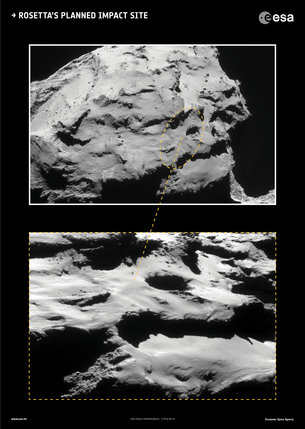
Esta región, conocida como Ma’at, se encuentra en el menor de los dos lóbulos del cometa. Alberga varias fosas activas de más de 100 m de diámetro y entre 50 y 60 m de profundidad, en las que se originan una serie de chorros de polvo.
 

Lugar previsto para el impacto de Rosetta
 
Las paredes de las fosas también muestran unas enigmáticas estructuras granulosas de un metro aproximadamente, denominadas ‘piel de gallina’. Los científicos creen que podrían indicar la existencia de antiguos cometesimales, que al fusionarse en las primeras fases de formación del Sistema Solar dieron lugar al cometa.
El 30 de septiembre, Rosetta observará estas fascinantes estructuras desde más cerca que nunca: ese día, la sonda se dirigirá a un punto adyacente a una fosa bien definida, de 130 m de ancho, que el equipo de la misión ha bautizado de manera informal como Deir el-Medina, ya que cuenta con una estructura de apariencia similar al antiguo poblado egipcio del mismo nombre.  
Igual que los objetos encontrados en el yacimiento arqueológico muestran a los historiadores cómo era la vida en el poblado, la fosa del cometa presenta indicios sobre el devenir geológico de la región.
Rosetta impactará en un punto muy cercano a Deir el-Medina, dentro de una elipse de unos 700 x 500 m.
La sonda lleva desde el 9 de agosto trazando órbitas elípticas cada vez más cercanas al cometa y, durante el último sobrevuelo, podría quedar a 1 km de la superficie, una distancia nunca antes alcanzada. 
“Aunque Rosetta lleva sobrevolando el cometa dos años, nuestro mayor reto será mantenerla operativa sin problemas durante las últimas semanas de la misión en el entorno impredecible de este cometa, y tan lejos del Sol y la Tierra”, explica Sylvain Lodiot, responsable de operaciones de la sonda para la ESA.
“A medida que nos vamos acercando al cometa, ya estamos notando la diferencia en la atracción gravitacional: el periodo orbital de la sonda se está incrementando, por lo que debemos corregirlo mediante pequeñas maniobras. Por eso tenemos que llevar a cabo estas órbitas de descenso gradual, para poder enfrentarnos a estos problemas cuando tenga lugar el acercamiento final”. 
El sobrevuelo final se completará el 24 de septiembre. A continuación, durante los siguientes días se llevarán a cabo una serie de maniobras necesarias para alinear a Rosetta con el lugar del impacto, ya que pasará de las órbitas elípticas alrededor del cometa a una trayectoria que acabará con su impacto sobre la superficie del cometa el día 30 de septiembre.
La maniobra de colisión tendrá lugar la noche del 29 de septiembre, iniciando el descenso desde una altitud de unos 20 km. Rosetta efectuará una lenta caída libre hacia el cometa para maximizar el número de mediciones científicas que se podrán tomar y enviar a la Tierra antes del impacto.
Algunos de los instrumentos científicos de Rosetta recogerán datos durante el descenso, ofreciendo imágenes únicas y otros datos sobre el gas, el polvo y el plasma a muy corta distancia. Aún no se ha determinado qué instrumentos se utilizarán ni su agenda, ya que esto depende de las limitaciones de la trayectoria final prevista y de la velocidad de datos disponible ese día.

La señal final de Rosetta

Está previsto que el impacto se produzca en una ventana de 20 minutos alrededor de las 10:40 GMT, aunque aún no se sabe con certeza cuál será la trayectoria exacta de Rosetta ese día ni la influencia de la gravedad a tan poca distancia del cometa. Teniendo en cuenta que el 30 de septiembre la comunicación entre Rosetta y la Tierra tardará 40 minutos en transmitirse, esperamos obtener la confirmación del impacto en el control de la misión de la ESA en Darmstadt, Alemania, en una ventana de 20 minutos alrededor de las 11:20 GMT (13:20 CEST). Las horas concretas irán actualizándose a medida que la trayectoria se vaya precisando.
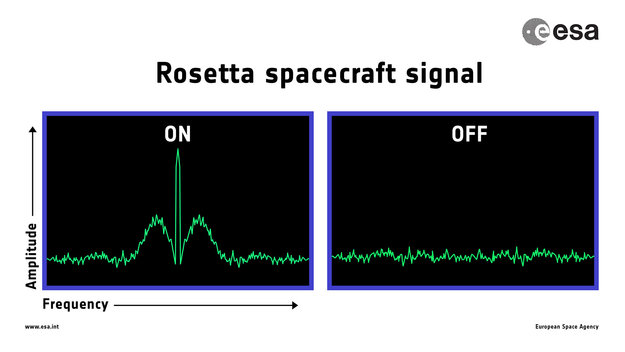
Si, cuando Rosetta despertó de su hibernación en el espacio profundo en enero de 2014, un pico ascendente en la frecuencia correspondiente confirmó que la sonda estaba operativa y transmitía su señal portadora, esta vez los controladores de la misión verán cómo esa señal desaparece definitivamente cuando Rosetta impacte en la superficie del cometa. A partir de ese momento ya no será posible recuperar dato alguno.
“El mes pasado celebramos el segundo aniversario de la llegada al cometa y el primero desde su máximo acercamiento al Sol a lo largo de su órbita, —recuerda Matt Taylor, científico del proyecto Rosetta de la ESA—. Cuesta creer que esta increíble odisea de 12 años y medio de Rosetta esté a punto de terminar y, aunque estamos planificando el último conjunto de operaciones científicas, ya estamos deseando ponernos a analizar el montón de datos disponible, a lo que dedicaremos las próximas décadas”.
Patrick Martin, responsable de la misión Rosetta de la ESA, añade: “Aunque esta misión pionera acabe, su enorme éxito ha dejado huella en los ámbitos técnico, científico y público, con logros increíbles que contribuirán a nuestra comprensión presente y futura del Sistema Solar”.

Información adicional

Todas las horas y los detalles sobre el final de la misión son preliminares y están sujetos a cambios a medida que la trayectoria final de Rosetta se vaya precisando. Incluso el mismo día, las horas pueden variar debido a circunstancias en el cometa fuera del control del equipo de la misión.
Para obtener más información, pueden consultarse las preguntas sobre el final de la misión.
Los medios acreditados y representantes de redes sociales pueden inscribirse para asistir al evento que se celebrará en Darmstadt, Alemania, el 30 de septiembre a través de nuestra convocatoria de medios. Los periodistas especializados también pueden participar en una sesión informativa el 29 de septiembre centrada en los resultados científicos de la misión. Cuando se vayan aproximando las fechas, ofreceremos más datos sobre la transmisión en vivo.
El lunes 19 de septiembre a las 12:00 GMT (14:00 CEST) está previsto celebrar un Hangout en directo para presentar los datos más recientes sobre las operaciones de la última semana y la búsqueda que llevó al descubrimiento de Philae. En breve se ofrecerán nuevos detalles.
 
Para más información:
Markus Bauer


ESA Science and Robotic Exploration Communication Officer


Teléfono: +31 71 565 6799


Móvil: +31 61 594 3 954


Correo electrónico: markus.bauer@esa.int
Matt Taylor
ESA Rosetta Project Scientist
Correo electrónico: matt.taylor@esa.int
Sylvain Lodiot
ESA Rosetta Spacecraft Operations Manager
Correo electrónico: sylvain.lodiot@esa.int
Patrick Martin
ESA Rosetta Mission Manager
Correo electrónico: patrick.martin@esa.int
ESA
Guillermo Gonzalo Sánchez Achutegui
ayabaca@gmail.com
ayabaca@hotmail.com
ayabaca@yahoo.com
Incríbete en el Foro del blog y participa : A Vuelo De Un Quinde - El Foro!

domingo, 11 de septiembre de 2016

ESA : Rosetta’s descent towards region of active pits .- El descenso de Rosetta hacia la región de los pozos activos

http://www.esa.int/Our_Activities/Space_Science/Rosetta/Rosetta_s_descent_towards_region_of_active_pits

Rosetta’s last week at the comet

Rosetta’s descent towards region of active pits

9 September 2016 Squeezing out unique scientific observations until the very end, Rosetta’s thrilling mission will culminate with a descent on 30 September towards a region of active pits on the comet’s ‘head’.
The region, known as Ma’at, lies on the smaller of the two lobes of Comet 67P/Churyumov–Gerasimenko. It is home to several active pits more than 100 m in diameter and 50–60 m in depth – where a number of the comet’s dust jets originate.
 

Rosetta’s planned impact site
 
The walls of the pits also exhibit intriguing metre-sized lumpy structures called ‘goosebumps’, which scientists believe could be the signatures of early ‘cometesimals’ that assembled to create the comet in the early phases of Solar System formation.
Rosetta will get its closest look yet at these fascinating structures on 30 September: the spacecraft will target a point adjacent to a 130 m-wide, well-defined pit that the mission team has informally named Deir el-Medina, after a structure with a similar appearance in an ancient Egyptian town of the same name.  
Like the archaeological artefacts found inside the Egyptian pit that tell historians about life in that town, the comet’s pit contains clues to the geological history of the region.
Rosetta will target a point very close to Deir el-Medina, within an ellipse about 700 x 500 m.
Since 9 August, Rosetta has been flying elliptical orbits that bring it progressively closer to the comet – on its closest flyby, it may come within 1 km of the surface, closer than ever before.
 “Although we’ve been flying Rosetta around the comet for two years now, keeping it operating safely for the final weeks of the mission in the unpredictable environment of this comet and so far from the Sun and Earth, will be our biggest challenge yet,” says Sylvain Lodiot, ESA’s spacecraft operations manager.
“We are already feeling the difference in gravitational pull of the comet as we fly closer and closer: it is increasing the spacecraft’s orbital period, which has to be corrected by small manoeuvres. But this is why we have these flyovers, stepping down in small increments to be robust against these issues when we make the final approach.”
The final flyover will be complete on 24 September. Then a short series of manoeuvres needed to line Rosetta up with the target impact site will be executed over the following days as it transfers from flying elliptical orbits around the comet onto a trajectory that will eventually take it to the comet’s surface on 30 September.

Understanding Rosetta’s final signal
 
The impact is predicted to occur within 20 minutes of 10:40 GMT, with uncertainties linked to the exact trajectory of Rosetta on the day, and the influence of gravity close to the comet. Taking into account the additional 40 minute signal travel time between Rosetta and Earth on 30 September, this means that the confirmation of impact is expected at ESA’s mission control in Darmstadt, Germany, within 20 minutes of 11:20 GMT (13:20 CEST). The times will be updated as the trajectory is refined.
Mirroring Rosetta’s wake-up from deep space hibernation in January 2014, where a rising peak at the right frequency confirmed that the spacecraft was alive and transmitting its carrier signal, mission controllers will see that peak disappear for a final time once Rosetta impacts. It will not be possible to retrieve any data after this time.
“Last month we celebrated two thrilling years since arriving at the comet, and also a year since the comet’s closest approach to the Sun along its orbit,” says Matt Taylor, ESA’s Rosetta project scientist.
“It’s hard to believe that Rosetta’s incredible 12.5 year odyssey is almost over, and we’re planning the final set of science operations, but we are certainly looking forward to focusing on analysing the reams of data for many decades to come.”
“This pioneering mission may be coming to an end, but it has certainly left its mark in the technical, scientific and public spheres as being one of outstanding success, with incredible achievements contributing to the current and future understanding of our Solar System,” adds Patrick Martin, ESA’s Rosetta mission manager.

More information

All times and details regarding the end of mission are preliminary and subject to change as Rosetta’s final trajectory is refined. Even on the day, timings will have uncertainties owing to circumstances at the comet beyond the control of the mission team.
For further information, you can consult the end-of-mission FAQ.
Application for accredited media and social media representatives to attend the event in Darmstadt on 30 September is possible via the Call for Media. Science journalists will also be eligible to attend a briefing on 29 September focusing on the scientific results of the mission. Livestream details will also be provided nearer the time.
An ESA Hangout on Air is planned for Monday 19 September 12:00 GMT (1400 CEST) to present the latest information regarding the details of the last week’s operations and the story of the search behind finding Philae. More details will be provided soon.
 
For more information, please contact:
Markus Bauer


ESA Science and Robotic Exploration Communication Officer


Tel: +31 71 565 6799


Mob: +31 61 594 3 954


Email: markus.bauer@esa.int
Matt Taylor
ESA Rosetta Project Scientist
Email: matt.taylor@esa.int
Sylvain Lodiot
ESA Rosetta Spacecraft Operations Manager
Email: sylvain.lodiot@esa.int
Patrick Martin
ESA Rosetta Mission Manager
Email: patrick.martin@esa.int
ESA
Guillermo Gonzalo Sánchez Achutegui
ayabaca@gmail.com
ayabaca@hotmail.com
ayabaca@yahoo.com
Inscríbete en el Foro del blog y participa : A Vuelo De Un Quinde - El Foro!

ESA : Call for Media: Rosetta’s grand finale .- Llamado a los medios de comunicación: El gran final de Rosetta

http://www.esa.int/Our_Activities/Space_Science/Rosetta/Call_for_Media_Rosetta_s_grand_finale

Rosetta approaching comet

Call for Media: Rosetta’s grand finale

9 September 2016 Rosetta is set to complete its mission in a controlled descent to the surface of its comet on 30 September.
Members of the media are invited to join Rosetta science and mission control experts at the ESA’s European Space Operations Centre (ESOC) in Darmstadt, Germany, on 29 and 30 September, to follow the conclusion of this historic mission.
 

Rosetta’s final destination
 
ESA’s Rosetta spacecraft arrived at Comet 67P/Churyumov–Gerasimenko on 6 August 2014, following a ten-year journey through the Solar System after its launch on 2 March 2004. The Philae lander was sent down to the surface of the comet on 12 November 2014.
After two years living with the comet, returning an unprecedented wealth of scientific information during its closest approach to the Sun, Rosetta and the comet are now heading out beyond the orbit of Jupiter again.
Travelling further from the Sun than ever before, and faced with a significant reduction in solar power that it needs to operate, Rosetta’s destiny has been set: it will follow Philae down onto the surface of the comet.
Confirmation of the end of mission is expected from ESA’s main control room at 11:20 GMT or 13:20 CEST +/- 20 minutes (Earth time) on 30 September, with the spacecraft set on a collision course with the comet the evening before.
The final hours of descent will enable Rosetta to make many once-in-a-lifetime measurements, including analysing gas and dust closer to the surface than ever possible before, and taking very high resolution images of the comet nucleus, including the open pits of the Ma’at region where the spacecraft is expected to make its controlled impact.
These data should be returned during the descent up to the moment of final impact, after which communication with the spacecraft will not be possible.
Media are invited to cover the final hours of operations at ESOC from 10:00 CEST on 30 September, and join mission representatives in celebrating the success of this incredible adventure.
In addition, scientific journalists are invited to apply to attend an afternoon with Rosetta science experts the day before, on 29 September, dedicated to reviewing the key scientific highlights of the mission so far.
Both the science session on 29 September and the main mission finale on 30 September will be live streamed for all interested media at www.esa.int.
 
Programme at ESOC
(all times in CEST, programme/times subject to change)
 
29 September
Livestream of Rosetta science talks from 14:30 to 17:00 at www.esa.int
Rosetta has provided many important clues for scientists to put together to solve key questions regarding the comet’s origin and evolution, its place in the early Solar System, and the possible role of comets in delivering ingredients considered crucial for the emergence of life on Earth, including water and organic materials.
Rosetta scientists will take us on a comprehensive scientific journey, putting those puzzle pieces together. The tour will start with an explanation of the comet’s varied landscape, its interior properties and the nature of the dust ejected from the nucleus, followed by a close look at its changing activity over the course of the mission, and the interaction of the comet with its surroundings as it orbits the Sun. We will also discover more about the organic molecules detected at the comet, and finally what the consequences all of these findings have for our understanding of the evolution of our Solar System.
 
30 September
11:00 – 15:00 (doors open at 10:00)
The programme for media will follow the operational highlights of the descent of Rosetta, which will be relayed live via videostream from the Main Control Room to the Media Centre. Mission experts will also explain the scientific highlights of the mission so far, and present the final images as Rosetta gets closer and closer to the surface of the comet.
Members of the wide international Rosetta team, including scientists, spacecraft operators, and engineers, as well as representatives from ESA and its partner agencies, along with industry and some special guests, will witness and celebrate the final hours of this iconic mission together.
All will be available for media interviews.
 
Media accreditation
Media with valid press and/or social media credentials should register at https://myconvento.com/public/event_register/index/1438240
for the main finale on 30 September. Journalists with specific scientific interest should also register to attend the 29 September scientific session, although numbers may be limited.
 
Follow online
The briefings on 29 and 30 September will be livestreamed at: esa.int
Live coverage of operational milestones in the final days of the mission will also be provided via the Rosetta blog and via @ESA_Rosetta and @esaoperations on Twitter. Please use the #CometLanding hashtag on social media.
 
Hangout on air event – 19 September
In preparation for the mission end, we will host a hangout on air at 14:00 CEST on 19 September  to present and discuss Rosetta’s final days and hours of operation. The sequence of the descent, as well of the images and scientific data to be acquired will be presented, as well as a summary of the results of the search that led to the announcement of the discovery of Philae on Comet 67P/Churyumov–Gerasimenko on 5 September.
 
For broadcasters
Information on available footage, broadcast times and satellite parameters will be availabale at: http://www.esa.int/esatv/Television
For further information, please contact:
ESA Media Relations Office
Tel: +33 1 53 69 72 99
Email: media@esa.int
ESA
Guillermo Gonzalo Sánchez Achutegui
ayabaca@gmail.com
ayabaca@hotmail.com
ayabaca@yahoo.com
Inscríbete en el Foro del blog y participa : A Vuelo De Un Quinde - El Foro!

Mi lista de blogs