Full resolution
(6,253 × 7,955 pixels, file size: 4.54 MB, MIME type: image/jpeg)
Left to right: Lovell, Anders, Borman
Wikipedia.
Wikipedia
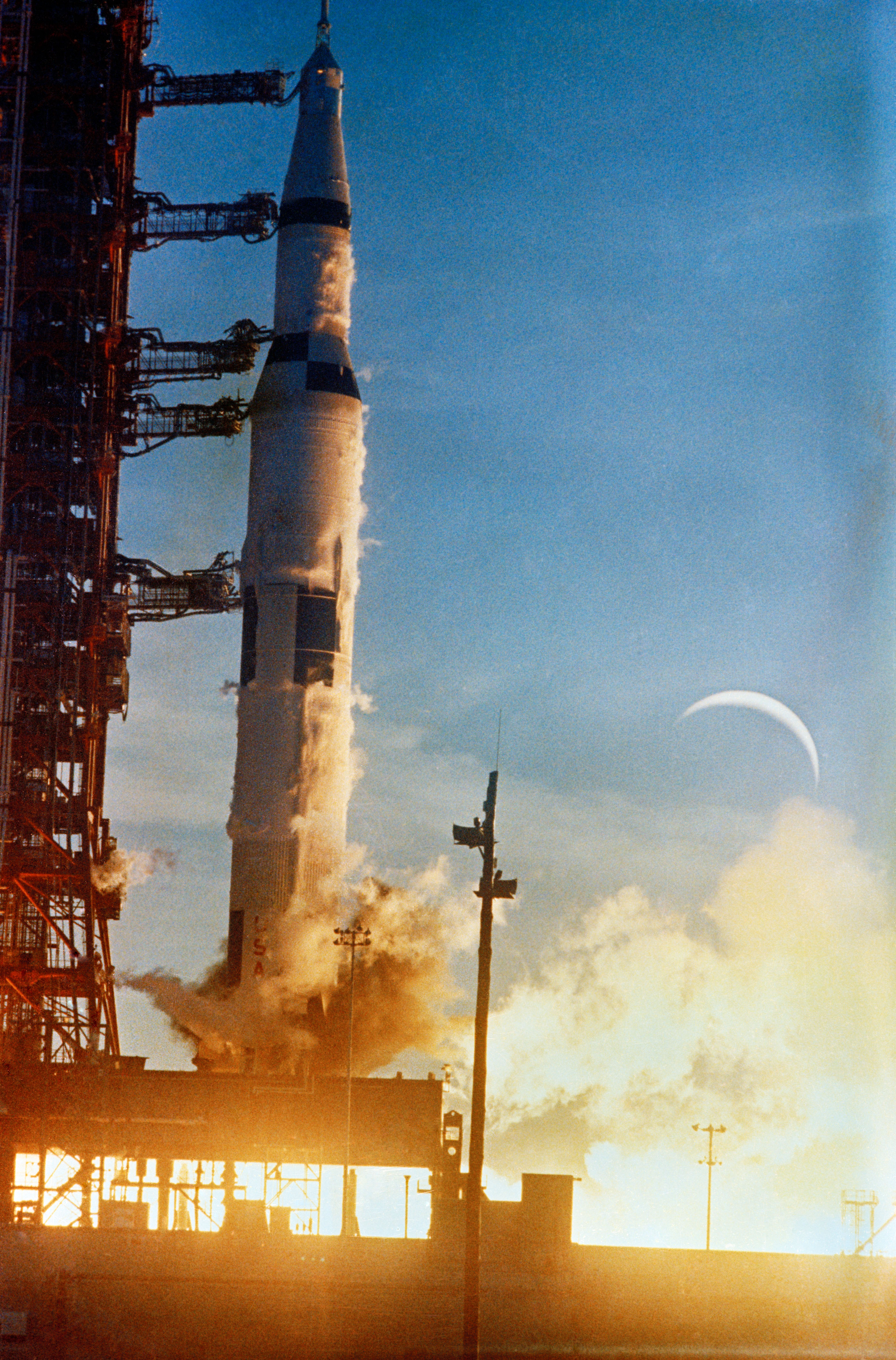
Apollo 8 during launch, with a
double exposure of the Moon, which was not visible at the time
Wikipedia.
Apollo
8, the first manned mission to the moon, entered lunar orbit on
Christmas Eve, Dec. 24, 1968. That evening, the astronauts-Commander
Frank Borman, Command Module Pilot Jim Lovell, and Lunar Module Pilot
William Anders-held a live broadcast from lunar orbit, in which they
showed pictures of the Earth and moon as seen from their spacecraft.
Said Lovell, "The vast loneliness is awe-inspiring and it makes you
realize just what you have back there on Earth." They ended the
broadcast with the crew taking turns reading from the book of Genesis.
Image Credit: NASA
Earthrise

Earthrise, as seen from Apollo 8, December 24, 1968
When the spacecraft came out from behind the Moon for its fourth pass
across the front, the crew witnessed Earthrise for the first time in
human history (NASA's
Lunar Orbiter 1 took the very first picture of an Earthrise from the vicinity of the Moon, on August 23, 1966).
[42]
Borman saw the Earth emerging from behind the lunar horizon and called
in excitement to the others, taking a black-and-white photo as he did
so. In the ensuing scramble Anders took the
more famous color photo, later picked by
Life magazine as one of its hundred photos of the century.
[43] Due to the
synchronous rotation
of the Moon about the Earth, Earthrise is not generally visible from
the lunar surface. Earthrise is generally only visible when orbiting the
Moon, other than at selected places near the Moon's
limb, where
libration carries the Earth slightly above and below the lunar horizon.
Anders continued to take photographs while Lovell assumed control of the spacecraft so Borman could rest.
[43]
Despite the difficulty resting in the cramped and noisy spacecraft,
Borman was able to sleep for two orbits, awakening periodically to ask
questions about their status.
[43]
Borman awoke fully, however, when he started to hear his fellow crew
members make mistakes. They were beginning to not understand questions
and would have to ask for the answers to be repeated. Borman realized
that everyone was extremely tired having not had a good night's sleep in
over three days. Taking command, he ordered Anders and Lovell to get
some sleep and that the rest of the flight plan regarding observing the
Moon be scrubbed. At first Anders protested saying that he was fine, but
Borman would not be swayed. At last Anders agreed as long as Borman
would set up the camera to continue to take automatic shots of the Moon.
Borman also remembered that there was a second television broadcast
planned, and with so many people expected to be watching he wanted the
crew to be alert. For the next two orbits Anders and Lovell slept while
Borman sat at the helm. On subsequent Apollo missions, crews would avoid
this situation by sleeping on the same schedule.
The Apollo 8 Genesis reading.
As they rounded the Moon for the ninth time, the second television
transmission began. Borman introduced the crew, followed by each man
giving his impression of the lunar surface and what it was like to be
orbiting the Moon. Borman described it as being "a vast, lonely,
forbidding expanse of nothing."
[44]
Then, after talking about what they were flying over, Anders said that
the crew had a message for all those on Earth. Each man on board
read a section from the Biblical creation story
from the Book of Genesis. Borman finished the broadcast by wishing a
Merry Christmas to everyone on Earth. His message appeared to sum up the
feelings that all three crewmen had from their vantage point in lunar
orbit. Borman said, "And from the crew of Apollo 8, we close with good
night, good luck, a Merry Christmas and God bless all of you - all of
you on the good Earth."
[45]
The only task left for the crew at this point was to perform the
Trans-Earth Injection
(TEI), which was scheduled for 2½ hours after the end of the television
transmission. The TEI was the most critical burn of the flight, as any
failure of the SPS to ignite would strand the crew in lunar orbit, with
little hope of escape. As with the previous burn, the crew had to
perform the maneuver above the far side of the Moon, out of contact with
Earth.
The burn occurred exactly on time. The spacecraft telemetry was
reacquired as it re-emerged from behind the Moon at 89 hours,
28 minutes, and 39 seconds, the exact time calculated. When voice
contact was regained, Lovell announced, "Please be informed, there is a
Santa Claus," to which
Ken Mattingly, the current CAPCOM, replied, "That's affirmative, you are the best ones to know."
[46] The spacecraft began its journey back to Earth on December 25,
Christmas Day.
Wikipedia.
Mission Objective
The mission objectives for Apollo 8 included a coordinated performance
of the crew, the command and service module, or CSM, and the support
facilities. The mission also was to demonstrate translunar injection;
CSM navigation, communications and midcourse corrections; consumable
assessment; and passive thermal control. The detailed test objectives
were to refine the systems and procedures relating to future lunar
operations.
All primary mission objectives and detailed test objectives were
achieved. All launch vehicle and spacecraft systems performed according
to plan. Engineering accomplishments included use of the ground network
with onboard navigational techniques to sharpen the accuracy of lunar
orbit determination and the successful use of Apollo high-gain antenna
-- a four-dish unified S-band antenna that deployed from the service
module, or SM, after separation from the third stage.
Mission Highlights
Apollo 8 launched from Cape Kennedy on Dec. 21, 1968, placing astronauts
Frank Borman, James Lovell Jr. and William Anders into a 114 by 118
mile parking orbit at 32.6 degrees.
During the second revolution, at two hours, 50 minutes ground elapsed
time, the S-IVB third stage restarted for a five-minute, 17-second burn,
initiating translunar coast. Following S-IVB/CSM separation at three
hours, 21 minutes, a 1.5 feet per second radial burn of the SM reaction
control engines was initiated to establish sufficient distance for S-IVB
propellant dumping. Following the propellant dumping, which sent the
stage into diverging trajectory and solar orbit, the separation distance
still was deemed inadequate and a second SM reaction control burn of
7.7 feet per second was performed.
The first midcourse correction occured at about 10 hours, 55 minutes
into the mission and provided a first check on the service propulsion
system, or SPS, engine prior to committing spacecraft to lunar orbit
insertion. The second and final midcourse correction prior to lunar
orbit insertion occurred at 61 hours, 8 minutes, 54 seconds.
Loss of signal occurred at 68 hours, 58 minutes, 45 seconds when Apollo 8
passed behind the moon. At that moment, NASA's three astronauts became
the first humans to see the moon's far side. The first lunar orbit
insertion burn, at 69 hours, 8 minutes, 52 seconds, lasted four minutes,
two seconds and reduced the spacecraft's 8,400 feet per second velocity
by 2,994 feet per second, resulting in an initial lunar orbit of 70 by
193 miles. The orbit circularized at 70 miles by the second lunar orbit
insertion burn of 135 feet per second, performed at the start of the
third revolution, again on the back side of the moon, at 73 hours, 35
minutes, five seconds.
During the 20-hour period in lunar orbit, the crew conducted a full,
sleepless schedule of tasks including landmark and landing site
tracking, vertical stereo photography, stereo navigation photography and
sextant navigation. At the end of the 10th lunar orbit, at 89 hours, 19
minutes, and 16 seconds, a three-minute, 23-second trans-Earth
injection burn was conducted, adding 3,522 feet per second. Only one
midcourse correction, a burn of five feet per second conducted at 104
hours, was required instead of the three scheduled.
Six telecasts were conducted during the mission: two during translunar
coast, two during lunar orbit and two during trans-Earth coast. These
transmissions were telecast worldwide and in real time to all five
continents. During a telecast on Christmas Eve, the crew read verses
from the first chapter of Genesis and wished viewers, "Good night, good
luck, a Merry Christmas and God bless all of you -- all of you on the
good Earth." All telecasts were of excellent quality. Voice
communications also were exceptionally good throughout the mission.
Separation of the command module, or CM, from the SM occurred at 146
hours, 31 minutes. A double-skip maneuver conducted during the re-entry
steering phase resulted in an altitude gain of 25,000 to 30,000 feet.
The re-entry velocity was 24,696 mph, with heatshield temperatures
reaching 5,000 degrees F. Parachute deployment and other re-entry events
were nominal. Apollo 8 splashed down in the Pacific Ocean at 10:51 a.m.
EST Dec. 27. The splashdown was about 5,100 yards from the recovery
ship USS Yorktown, 147 hours after launch and precisely on time.
According to prior planning, helicopters and aircraft hovered over the
spacecraft, and pararescue personnel were not deployed until local
sunrise, 50 minutes after splashdown. The Apollo 8 crew reached the
recovery ship at 12:20 p.m. EST.
NASA
 Apollo 8:
This spacecraft was the first of the Apollo series to successfully orbit the
moon, and the first manned spacecraft to leave Earth's gravity and reach the
Moon. The mission achieved operational experience and tested the Apollo
command module systems, including communications, tracking, and life-support,
in cis-lunar space and lunar orbit, and allowed evaluation of crew performance
on a lunar orbiting mission. The crew photographed the lunar surface, both
farside and nearside, obtaining information on topography and landmarks as
well as other scientific information necessary for future Apollo landings.
Additionally, six live television transmission sessions were done by the crew
during the mission, including the famous Christmas Eve broadcast in which
the astronauts read from the book of Genesis. All systems operated within
allowable parameters and all objectives of the mission were achieved. The
flight carried a three man crew: Commander Frank Borman, Command Module Pilot
James A. Lovell, Jr., and Lunar Module Pilot William A. Anders.
 The Apollo 8 spacecraft consisted of a command module similar to Apollo 7
except that the forward pressure and ablative hatches were replaced by a
combined forward hatch, which would be used for transfer to the Lunar Module
on later missions. The spacecraft mass of 28,817 kg is the mass of the CSM
including propellants and expendables. A Lunar Module was not used on the
Apollo 8 mission but a Lunar Module Test Article which was equivalent in mass
(9027 kg) to a Lunar Module was mounted in the spacecraft/launch vehicle
adapter as ballast for mass loading purposes.
The Apollo 8 spacecraft consisted of a command module similar to Apollo 7
except that the forward pressure and ablative hatches were replaced by a
combined forward hatch, which would be used for transfer to the Lunar Module
on later missions. The spacecraft mass of 28,817 kg is the mass of the CSM
including propellants and expendables. A Lunar Module was not used on the
Apollo 8 mission but a Lunar Module Test Article which was equivalent in mass
(9027 kg) to a Lunar Module was mounted in the spacecraft/launch vehicle
adapter as ballast for mass loading purposes.
The spacecraft was launched on December 21, 1968 at 12:51:00 UT (7:51 a.m.
EST), and was placed in a 190.6 km x 183.2 km Earth parking orbit with a
period of 88.2 minutes and an inclination of 32.51 degrees. At 15:41:37 UT
a third-stage burn injected the Apollo spacecraft into translunar trajectory.
Orbit insertion took place on 24 December at 09:59:20 UT into an elliptical
310.6 km by 111.2 km lunar orbit. Two orbits later a second burn placed Apollo
8 into a near-circular 110.4 by 112.3 km orbit for eight orbits. The transearth
injection burn took place on 25 December at 06:10:16 UT after a total of 10
lunar orbits.
Apollo 8 splashed down in the Pacific Ocean on 27 December 1968 at 15:51:42
UT (10:51:42 a.m. EST) after a mission elapsed time of 147 hrs, 0 mins, 42
secs. The splashdown point was 8 deg 7.5 min N, 165 deg 1.2 min W, 1,000
miles SSW of Hawaii and 5 km (3 mi) from the recovery ship USS Yorktown. The
Apollo 8 Command Module is on display at the Chicago Museum of Science and
Industry, Chicago, Illinois. http://abyss.uoregon.edu/~js/space/lectures/lec15.html
NASA
Guillermo Gonzalo Sánchez Achutegui
ayabaca@gmail.com
ayabaca@hotmail.com
ayabaca@yahoo.com