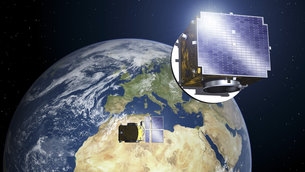
Mostrando entradas con la etiqueta Proba-3. Mostrar todas las entradas

domingo, 23 de julio de 2017

ESA : El Programa Científico da su apoyo a Proba-3

http://www.esa.int/esl/ESA_in_your_country/Spain/El_Programa_Cientifico_da_su_apoyo_a_Proba-3


Proba-3, el fascinante banco de pruebas de la ESA
18 julio 2017
El Programa Científico de la ESA ha acordado dar apoyo a la misión de demostración tecnológica Proba-3, constituida por dos satélites que, volando en formación, observarán una región del Sol normalmente oculta a nuestra vista. 
Los dos satélites de Proba-3, cuyo lanzamiento está previsto para finales de 2020, volarán con una separación precisa para arrojar una sombra a través del espacio que bloqueará el disco del Sol, revelando así detalles de la corona que lo rodea que suelen quedar ocultos por el propio brillo de la luz solar.
Al igual que el resto de las misiones de la serie Proba, Proba-3 es principalmente una misión de demostración tecnológica que explorará las técnicas de vuelo en formación de precisión para que los futuros satélites que vuelen en grupo puedan llevar a cabo labores similares a las de una sola nave gigante.
No obstante, siguiendo la larga tradición de Proba, esta misión también tiene un ambicioso objetivo científico, y es que suministrar datos científicamente útiles es una forma estupenda de demostrar que la tecnología funciona según lo previsto. 
 
Satélites de Proba-3 formando un eclipse artificial

Proba-3 ofrecerá a los científicos solares una ventana al segmento interior de la corona solar, una región llena de misterio más de un millón de grados más caliente que la superficie del Sol a la que rodea. astronomía
Hasta ahora, la mejor forma de observar la corona era hacerlo durante un eclipse solar, aunque la luz parásita que atraviesa la atmósfera de la Tierra es un factor que limita la observación.
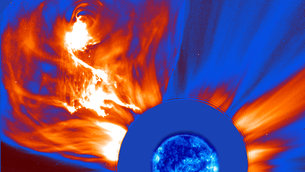
Como alternativa, los ‘coronógrafos’ espaciales crean eclipses artificiales dentro de los satélites de observación solar, como SOHO y Stereo, pero la luz parásita sigue curvándose alrededor de los discos de bloqueo, lo que limita el acceso a la importantísima corona interior.
Para resolver esta dificultad, en Proba-3 el disco del coronógrafo irá a bordo del otro satélite, que volará exactamente a 150 m de distancia, alineado con el Sol. De esta manera se abrirá la puerta a una nueva forma de ver las regiones dinámicas más cercanas a la superficie solar, donde nacen el viento solar y las erupciones denominadas ‘eyecciones de masa coronal’. Estas eyecciones son una de las principales fuentes de perturbaciones por meteorología espacial en la Tierra.  
 
Corona solar vista durante eclipses terrestres
 
La misión Proba-3 se financia a través de la Dirección de Tecnología, Ingeniería y Calidad de la ESA, pero en junio, el Comité para el Programa Científico de la agencia avaló la misión con apoyo adicional a través de la Dirección de Ciencia.
“Estaba claro que resultaría muy beneficioso que esta misión recibiera el apoyo del Programa Científico”, explica Andrei Zhukov, del Real Observatorio de Bélgica e investigador principal del coronógrafo de Proba.
“El entusiasmo se contagió por toda la comunidad de físicos solares. El Comité para el Programa Científico recibe consejo de sus comités asesores, compuestos por científicos de toda Europa que dan su respaldo de forma independiente y que recomendaron que Proba-3 recibiera apoyo al ser una ‘misión de oportunidad’”. 
“El funcionamiento del Centro de Operaciones científicas de Proba-3, que procesará y distribuirá datos científicos a los investigadores de toda Europa, estará financiado por el Programa Científico. Este centro estará ubicado aquí, en Bélgica, con contribuciones al flujo de procesamiento de datos por parte de Alemania, Polonia y Rumanía”. 


Una potente explosión solar
 
“Durante cada una de sus órbitas altamente elípticas de 19,6 horas, Proba-3 tomará imágenes de la corona durante unas seis horas seguidas, a una velocidad típica de una imagen por minuto, aunque contamos con capacidad de aumentar esta frecuencia a una cada dos segundos si se producen fenómenos de especial interés”.
“Así, se suministrará una gran cantidad de datos únicos, incrementando el conocimiento científico del Sol y de la corona que lo rodea”.
El desarrollo del proyecto Proba-3 continúa progresando sin problemas, con una versión del modelo estructural y térmico del coronógrafo ya construida, a la espera de la revisión crítica del diseño que tendrá lugar este otoño, seguida de la del conjunto de la misión. 
El reto está en mantener los satélites controlados con seguridad y posicionados correctamente con relación entre sí. Para ello se emplearán varias tecnologías nuevas, incluyendo un software para el vuelo en formación a medida, información por GPS, enlaces intersatelitales, sensores de estrellas, sensores visuales ópticos y metrología óptica para maniobrar de cerca. 
 

ESA
Guillermo Gonzalo Sánchez Achutegui
ayabaca@gmail.com
ayabaca@hotmail.com
ayabaca@yahoo.com
Inscríbete en el Foro del blog y participa : A Vuelo De Un Quinde - El Foro!

jueves, 15 de septiembre de 2016

ESA : Proba-3: set the controls for the verge of the Sun .- Proba-3, establece los controles al borde El Sol

http://www.esa.int/Our_Activities/Space_Engineering_Technology/Proba_Missions/Proba-3_set_the_controls_for_the_verge_of_the_Sun

Proba-3 satellites form artificial eclipse

Proba-3: set the controls for the verge of the Sun

12 September 2016 By converging in orbit, a pair of small satellites will open a new view on the source of the largest structure in the Solar System: the Sun’s ghostly atmosphere, extending millions of kilometres out into space.
The two satellites together are called Proba-3, set for launch in late 2019. Through precise formation flying, one will cast a shadow across the second to open up an unimpeded view of the inner area of the ‘corona’, which is a million times fainter than the blindingly brilliant solar disc.
“When I first heard of the idea I said ‘Wow! That’s just what we need’,” said Andrei Zhukov of the Royal Observatory of Belgium, serving as Principal Investigator for Proba-3’s solar instrument.
“The best way to observe the corona from the ground is during a solar eclipse, although we still have to cope with stray light – we cannot correct for the influence of Earth’s atmosphere. 
 
Solar eclipses
Solar corona seen during terrestrial eclipses

“The next best method is by using ‘coronagraphs’ to create an articifical eclipse, either on ground telescopes or inside Sun-watching satellites such as SOHO and Stereo.
“The problem is that stray light bending around the edge of the occulting disc limits our view of the most important inner portion of the corona. SOHO’s coronagraph, for instance, can observe no closer in than 1.1 Sun-diameters. Others can see closer, but with strong stray light making detailed observation impossible.
“With Proba-3 we aim to see extremely close to the solar surface in visible light, by flying the occulter and coronagraph on separate satellites some 150 m apart.
 

A fiery solar explosion

“This should give us a ringside seat on the most interesting segment of the corona, where a lot of interesting physics is going on, where the solar wind is born and ‘coronal mass ejections’ originate – gigantic solar eruptions with the potential to affect our terrestrial infrastructure.”
While the Sun’s surface is a comparatively cool 6000ºC, the corona averages a sizzling million degrees. The mystery is how energy travels from the cool Sun to the hot corona, in apparent defiance of the laws of thermodynamics.
“By mapping the fine structure of the inner corona for a prolonged time – we are targeting around six hours – our hope is that we gain insight into the kind of energy flows that are taking place,” notes Dr Zhukov. 
 
Proba-3
Proba-3's pair of satellites

“Our standard observing mode will be once per minute, but we could speed that up to a few seconds within a selected field of view, for instance when tracing the rapid evolution of a mass ejection.
“The ultimate goal is to be able to solve the physics of space weather, in order to forecast coronal mass ejections, which are known to have dramatic effects on terrestrial electricity grids and other infrastructure.”
Proba-3 is first and foremost a technology demonstration, exploring the potential of precise formation flying in orbit, but achieving meaningful scientific results will also help to prove its approach works.

    
Proba-3: Dancing with the stars

ESA
Guillermo Gonzalo Sánchez Achutegui
ayabaca@gmail.com
ayabaca@hotmail.com
ayabaca@yahoo.com
Inscríbete en el Foro del blog y participa : A Vuelo De Un Quinde - El Foro!
martes, 30 de agosto de 2016

ESA : Proba-3: seeing through shadow to view Sun’s corona .- Proba-3: ver a través de la sombra para ver la corona del Sol

http://www.esa.int/Our_Activities/Space_Engineering_Technology/Proba_Missions/Proba-3_seeing_through_shadow_to_view_Sun_s_corona


Proba-3
http://www.esa.int/Our_Activities/Space_Engineering_Technology/Proba_Missions/About_Proba-3


Proba-3 formation flying satellites
 
22 August 2016
Every 18 months or so, scientists and sensation-seekers gather at set points on Earth’s surface, to await awe-inspiring solar eclipses. The Moon briefly blocks the Sun, revealing its mysterious outer atmosphere, the corona. Though what if researchers could induce such eclipses at will?
That’s the scientific vision behind ESA’s double-satellite Proba-3, the world’s first precision formation-flying mission, planned for launch in 2019.
An ‘occulter’ satellite will fly 150 m ahead of a second ‘coronagraph’ satellite, casting a precise shadow to reveal the ghostly tendrils of the solar corona, down to 1.2 solar radii, for hours on end.
“We have two scientific instruments aboard,” explains Damien Galano, Proba-3 Payload Manager. “The primary payload is ASPIICS, a coronagraph to observe the corona in visible light while the DARA radiometer on the occulter measures the total solar irradiance coming from the Sun – a scientific parameter about which there is still some uncertainty. 
 
Proba-3 revealing corona
 
“The corona is a million times fainter than the Sun itself, so the light from the solar disk needs to be blocked in order to see it. The coronagraph idea was conceived by astronomer Bernard Lyot in the 1930s – and since then has been developed and has been incorporated into both Earth-based and space telescopes.
“But because of the wave nature of light, even within the cone of shadow cast by the occulter, some light still spills around the occulter edges, a phenomenon called ‘diffraction’.
“To minimise this unwanted light, the coronagraph can be positioned closer to the occulter – and therefore deeper into the shadow cone. However the deeper it is, the more the solar corona will also be occulted by the occulter. 
 
Coronagraph on single satellite
 
“Hence the advantage of a larger occulter and the maximum possible distance between the occulter and the coronagraph. Obviously a 150-m-long satellite is not a practical proposition, but our formation flying approach should provide us with equivalent performance.
“Furthermore, the ASPIICS coronagraph itself contains a smaller, secondary occulter disk, to cut down on diffracted light still further.
 
Coronagraph across two satellites

“Precision is all – the aperture of the ASPIICS instrument measures 50 mm in diameter, and for corona observation performance it should remain as much as possible in the centre of the shadow, which is about 70 mm across at 150 m.
"So we’ll need to achieve millimetre-scale positioning control between the two spacecraft, effectively forming a single giant instrument across space.”
ASPIICS (Association of Spacecraft for Polarimetry and Imaging of the Corona of the Sun) is being developed for ESA by a consortium led by Centre Spatial de Liège in Belgium, made up of 15 companies and institutes from five ESA Member States.
 
Diffraction of light
 
“Many of these companies are new to ESA, and they’ve proved to be very motivated and eager to show their capabilities,” remarks Damien. “We’ve produced various prototypes of instrument elements, and our first complete ‘structural and thermal model’ should be complete in the autumn, ahead of our end-of-year Critical Design Review.
“We’re also looking into various optical aspects, such as the best occulter edge shape to minimise diffraction.”
There’s a lot of broader interest in this external occulter approach – especially for the imaging of Earth-like exoplanets, which would require the blocking out of their parent stars.
“It’s a similar challenge, the main difference being that the star in question is a point source of light rather than the extended source that our Sun is.
“So it could be that formation-flown external occulters become versatile scientific tools, opening many new vistas in astronomy.”
 
   00:00    
00:00


Proba-3: Dancing with the stars


ESA
Guillermo Gonzalo Sánchez Achutegui
ayabaca@gmail.com
ayabaca@hotmail.com
ayabaca@yahoo.com
Inscríbete en el Foro del blog y participa : A Vuelo De Un Quinde - El Foro!