Mostrando entradas con la etiqueta Supernovas. Mostrar todas las entradas

domingo, 18 de mayo de 2014

ESO : El misterio de la formación de un magnetar, ¿resuelto?

Hola amigos: A VUELO DE UN QUINDE EL BLOG., en el apasionante mundo del cosmos existen fenómenos cósmicos como el llamado: Magnetar, que ha preocupado mucho a los científicos espaciales para llegar a conocer su origen y parece que ya lo lograron:"...
Este descubrimiento permitió a los astrónomos reconstruir la historia de la vida de la estrella que permitió la formación del magnetar en lugar del esperado agujero negro [3]. En la primera etapa de este proceso, la estrella más masiva de la pareja comienza a quedarse sin combustible, transfiriendo sus capas externas a su compañera menos masiva — que está destinada a convertirse en magnetar — haciendo que gire cada vez más rápido. Esta rápida rotación parece ser el ingrediente esencial en la formación del campo magnético ultra-fuerte del magnetar.....al descubrir la EstrellaWesterlund 1-5... "
Asimismo agregan en su comentario....." ....."No es sólo que esta estrella tenga la alta velocidad esperada si está siendo impulsada por una explosión de supernova, sino que además parece imposible replicar, en una estrella individual, las condiciones de baja masa, alta luminosidad y abundancia de carbono en la composición — un pista que indica que debe haberse formado, originalmente, con una compañera binaria", añade Ben Ritchie (Open University), coautor del nuevo artículo.
Amigos los invito a leer ampliamente abajo el artículo facilitado por el Observatorio Europea Austral- ESO.......
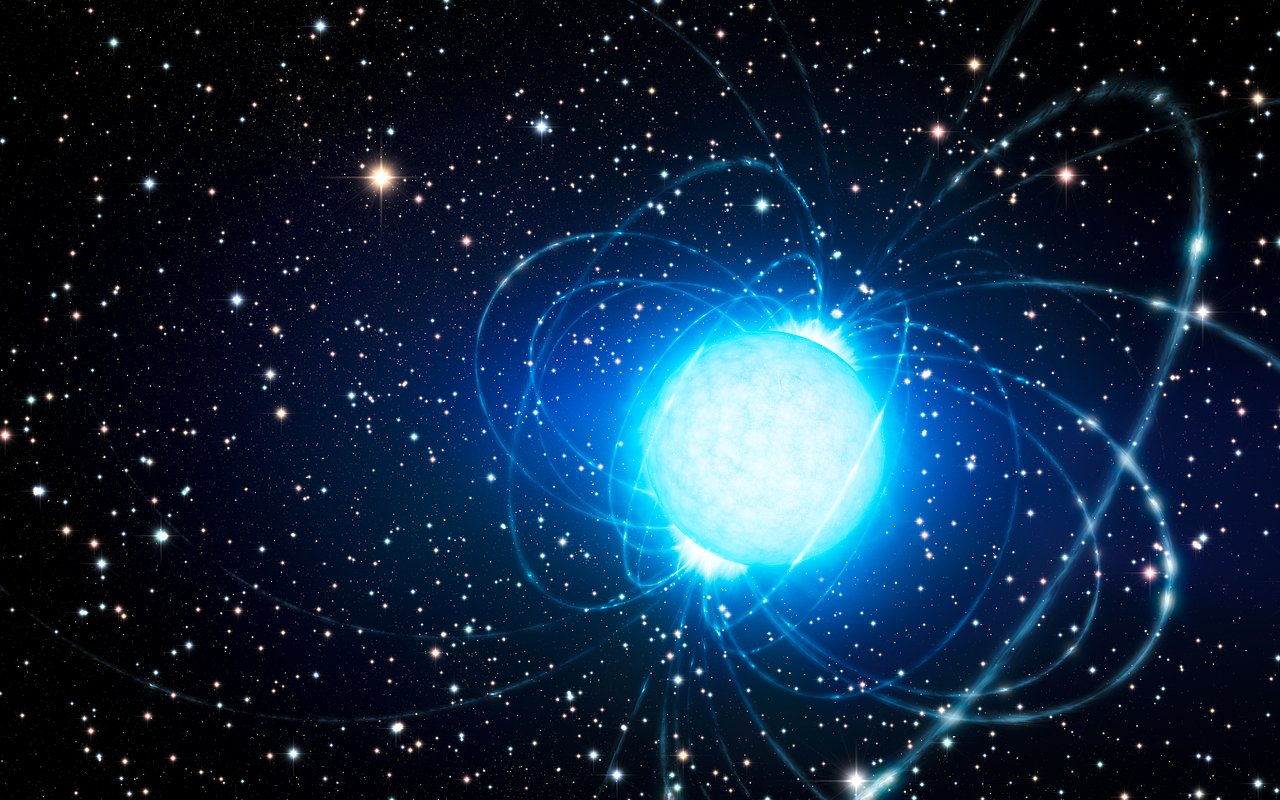


Los magnetares son los extraños remanentes superdensos de explosiones de supernovas. Son los imanes más potentes conocidos en el universo — millones de veces más potentes que los imanes más fuertes de la Tierra. Utilizando el telescopio VLT (Very Large Telescope) de ESO, un equipo de astrónomos europeos cree haber hallado, por primera vez, a la estrella compañera de un magnetar. Este descubrimiento ayuda a explicar cómo se forman los magnetares — un enigma de hace 35 años — y por qué esta estrella particular no colapsó en agujero negro tal y como esperarían los astrónomos.
Cuando una estrella masiva colapsa por su propia gravedad durante una explosión de supernova, puede formar, o bien una estrella de neutrones o un agujero negro. Los magnetares son una forma inusual y muy exótica de estrella de neutrones. Como todos estos objetos extraños, son pequeños y extraordinariamente densos — una cucharadita de materia de estrella de neutrones tendría una masa de aproximadamente mil millones de toneladas — pero también tienen campos magnéticos extremadamente potentes. Las superficies de los magnetares liberan grandes cantidades de rayos gamma cuando atraviesan una etapa de ajuste repentino, conocida como un terremoto estelar (starquake), consecuencia de las enormes tensiones que tienen lugar en sus cortezas.
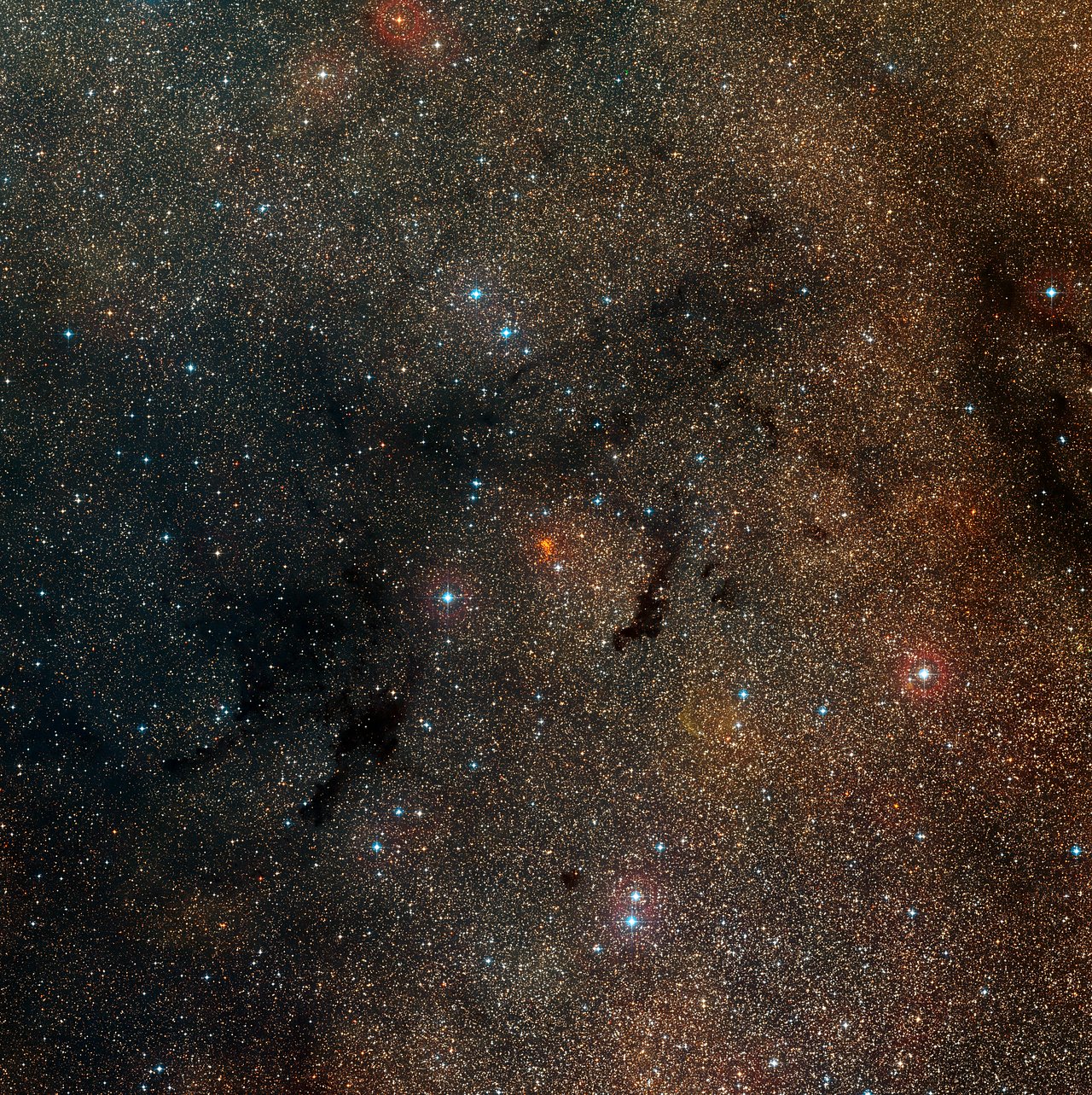
El cúmulo estelar Westerlund 1 [1], situado a 16.000 años luz de la Tierra, en la constelación austral de Ara (el Altar), alberga uno de las dos docenas de magnetares conocidos en la Vía Láctea. Se llama CXOU J164710.2-455216 y ha intrigado enormemente a los astrónomos.
"En nuestro anterior trabajo (eso1034) demostramos que el magnetar del cúmulo Westerlund 1 (eso0510) debe haber nacido de la explosiva muerte de una estrella con unas 40 veces la masa del Sol. Pero este hecho representa un problema en sí mismo, ya que se supone que, tras morir, las estrellas tan masivas colapsan para formar agujeros negros, no estrellas de neutrones. No entendíamos cómo podía haberse transformado en magnetar", afirma Simon Clark, autor principal del artículo que plasma estos resultados.
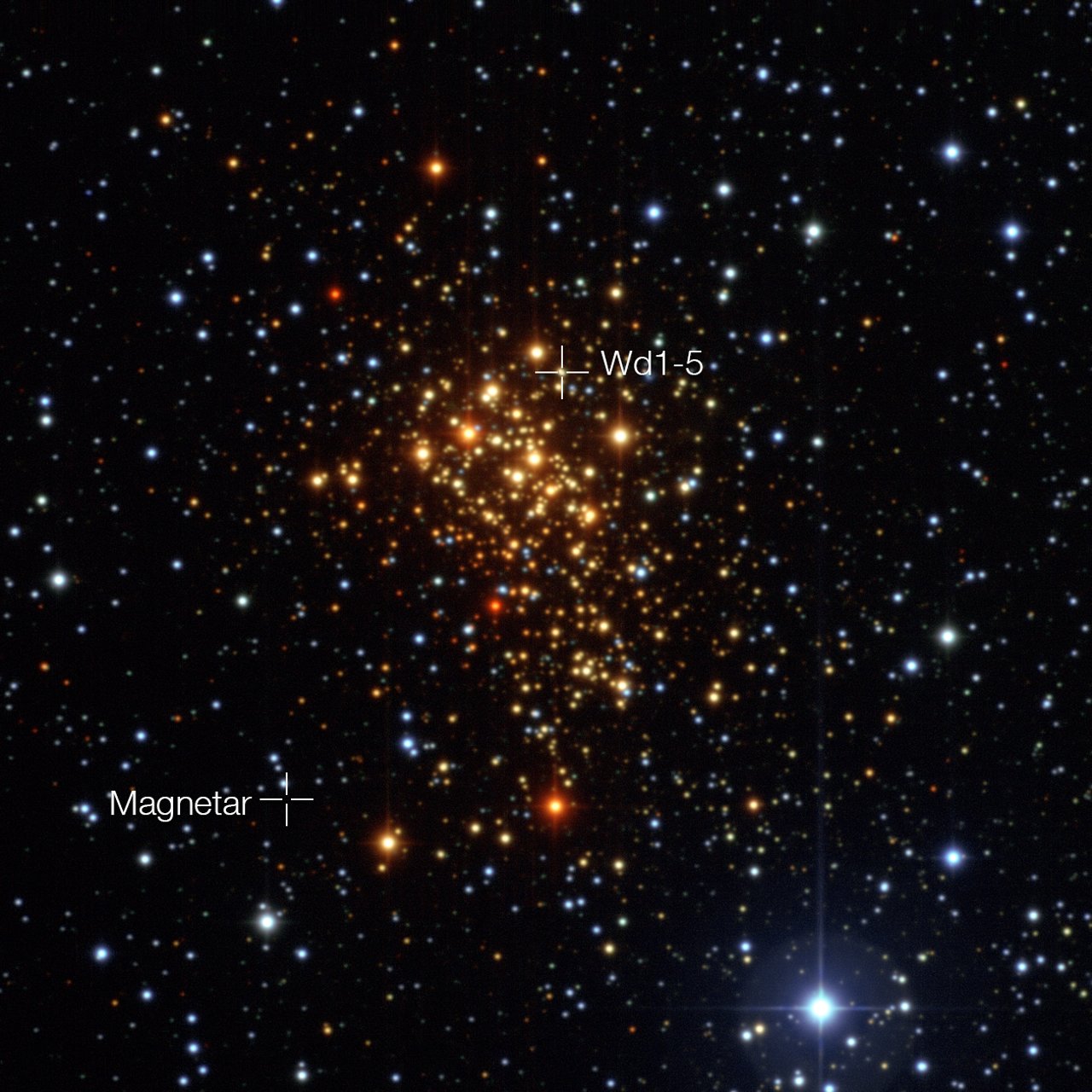
Los astrónomos propusieron una solución a este misterio. Sugirieron que el magnetar se formó por las interacciones de dos estrellas muy masivas en órbita una en torno a la otra, en un sistema binario tan compacto que encajaría dentro de la órbita de la Tierra alrededor del Sol. Pero, hasta ahora, no se había detectado ninguna estrella acompañante en la ubicación del magnetar en Westerlund 1, así que los astrónomos utilizaron el VLT para buscarlo en otras partes del cúmulo. Buscaron estrellas fugitivas — objetos que escapan del cúmulo a grandes velocidades — que podría haber sido expulsadas de la  órbita por la explosión de supernova que formó al magnetar. Se descubrió que una estrella, conocida como Westerlund 1-5 [2], parecía encajar perfectamente con lo que buscaban.
"No es sólo que esta estrella tenga la alta velocidad esperada si está siendo impulsada por una explosión de supernova, sino que además parece imposible replicar, en una estrella individual, las condiciones de baja masa, alta luminosidad y abundancia de carbono en la composición — un pista que indica que debe haberse formado, originalmente, con una compañera binaria", añade Ben Ritchie (Open University), coautor del nuevo artículo.
Este descubrimiento permitió a los astrónomos reconstruir la historia de la vida de la estrella que permitió la formación del magnetar en lugar del esperado agujero negro [3]. En la primera etapa de este proceso, la estrella más masiva de la pareja comienza a quedarse sin combustible, transfiriendo sus capas externas a su compañera menos masiva — que está destinada a convertirse en magnetar — haciendo que gire cada vez más rápido. Esta rápida rotación parece ser el ingrediente esencial en la formación del campo magnético ultra-fuerte del magnetar.
En la segunda etapa, como resultado de esta transferencia de masa, la propia compañera llega a ser tan masiva que, a su vez, desprende una gran cantidad de la masa recientemente adquirida. Gran parte de esta masa se pierde, pero una parte pasa de nuevo a la estrella original, la que todavía hoy vemos brillando y conocemos como Westerlund 1-5.
"Este proceso de intercambio de material ha sido el que ha proporcionado a Westerlund 1-5 su firma química única, y el que ha permitido que la masa de su compañera encoja a niveles lo suficientemente bajos como para que nazca un magnetar en lugar de un agujero negro — ¡una forma de pasarse la “patata caliente” con consecuencias cósmicas!", concluye Francisco Najarro (Centro de Astrobiología, España), miembro del equipo de investigación.
Por tanto, en la receta para formar un magnetar, parece que un ingrediente fundamental es ser una de las componentes de una estrella doble. La rápida rotación generada por la transferencia de masas entre las dos estrellas parece necesaria para generar el campo magnético ultra fuerte y, posteriormente, una segunda fase de transferencia de masa permite al futuro magnetar adelgazar lo suficiente como para no colapsar en agujero negro en el momento de su muerte.

Notas

[1] El cúmulo abierto Westerlund 1 fue descubierto en 1961 desde Australia por el astrónomo sueco Bengt Westerlund, que más tarde se trasladó desde allí para convertirse en Director de ESO en Chile (1970-74). Este cúmulo está detrás de una enorme nube interestelar de gas y polvo, que bloquea la mayor parte de su luz visible. El factor de atenuación es de más de 100.000, por eso ha llevado tanto tiempo descubrir la verdadera naturaleza de este cúmulo particular.
Westerlund 1 es un laboratorio natural único para el estudio de la física estelar extrema, ayudando a los astrónomos a descubrir cómo viven y mueren las estrellas más masivas de la Vía Láctea. De sus observaciones, los astrónomos deducen que este cúmulo extremo probablemente contiene no menos de 100.000 veces la masa del Sol, y todas sus estrellas se encuentran dentro de una región menos de 6 años luz. Westerlund 1 parece ser el cúmulo compacto joven más masivo identificado hasta el momento en nuestra galaxia, la Vía Láctea.
Todas las estrellas analizadas hasta ahora en Westerlund 1 tienen masas de, al menos, 30-40 veces la del Sol. Dado que este tipo de estrellas tienen una vida muy corta — astronómicamente hablando — Westerlund 1 debe ser muy joven. Los astrónomos determinan una edad de entre 3,5 y 5 millones de años. Westerlund 1 es claramente un cúmulo recién nacido en nuestra galaxia.
 [2] El nombre completo de esta estrella es Cl * Westerlund 1 W 5.
 [3] A medida que las estrellas envejecen, sus reacciones nucleares cambiar su composición química — los elementos que alimentan las reacciones se agotan y se acumulan los productos generados por las reacciones. Esta huella química estelar es, primero, rica en hidrógeno y nitrógeno, pero pobre en carbono, y sólo aumenta la cantidad de carbono en fases muy tardías de la vida de las estrellas,  momento en el que se reducen considerablemente el hidrógeno y el nitrógeno — se cree que es imposible que estrellas individuales sean ricas, simultáneamente, en hidrógeno, nitrógeno y carbono, cosa que ocurre con Wd1-5.

Información adicional

La investigación que se presenta en esta nota de prensa de ESO aparecerá en breve en la revista de investigación Astronomy and Astrophysics (“A VLT/FLAMES survey for massive binaries in Westerlund 1: IV.Wd1-5 binary product and a pre-supernova companion for the magnetar CXOU J1647-45” por J. S. Clark et al.). El mismo equipo publicó un primer estudio de este objeto en 2006 (“A Neutron Star with a Massive Progenitor in Westerlund 1” by M. P. Muno et al., Astrophysical Journal, 636, L41).
El equipo está compuesto por Simon Clark y Ben Ritchie (The Open University, Reino Unido), Francisco Najarro (Centro de Astrobiología, España), Norbert Langer (Universidad de Bonn, Alemania, y Universidad de Utrecht, Países Bajos) e Ignacio Negueruela (Universidad de Alicante, España).
Los astrónomos utilizaron el instrumento FLAMES, instalado en el telescopio VLT (Very Large Telescope) de ESO, en Paranal (Chile), para estudiar las estrellas del cúmulo Westerlund 1.
ESO es la principal organización astronómica intergubernamental de Europa y el observatorio astronómico más productivo del mundo. Cuenta con el respaldo de quince países: Alemania, Austria, Bélgica, Brasil, Dinamarca, España, Finlandia, Francia, Holanda, Italia, Portugal, el Reino Unido, República Checa, Suecia y Suiza. ESO desarrolla un ambicioso programa centrado en el diseño, construcción y operación de poderosas instalaciones de observación terrestres que permiten a los astrónomos hacer importantes descubrimientos científicos. ESO también desarrolla un importante papel al promover y organizar la cooperación en investigación astronómica. ESO opera en Chile tres instalaciones de observación únicas en el mundo: La Silla, Paranal y Chajnantor. En Paranal, ESO opera el Very Large Telescope, el observatorio óptico más avanzado del mundo, y dos telescopios de rastreo. VISTA (siglas en inglés de Telescopio de Rastreo Óptico e Infrarrojo para Astronomía) trabaja en el infrarrojo y es el telescopio de rastreo más grande del mundo, y el VST (VLT Survey Telescope, Telescopio de Rastreo del VLT) es el telescopio más grande diseñado exclusivamente para rastrear el cielo en luz visible. ESO es el socio europeo de un revolucionario telescopio, ALMA, el proyecto astronómico más grande en desarrollo. Actualmente ESO está planificando el European Extremely Large Telescope, E-ELT, el telescopio óptico y de infrarrojo cercano de 39 metros, que llegará a ser “el ojo más grande del mundo para mirar el cielo”.
Las traducciones de las notas de prensa de ESO las llevan a cabo miembros de la Red de Divulgación de la Ciencia de ESO (ESON por sus siglas en inglés), que incluye a expertos en divulgación y comunicadores científicos de todos los países miembros de ESO y de otras naciones.

El
nodo español de la red ESON está representado por J. Miguel Mas Hesse y Natalia Ruiz Zelmanovitch.

Enlaces

Contactos

J. Miguel Mas Hesse
Centro de Astrobiología (CSIC-INTA)
Madrid, España
Tlf.: (+34) 918131196
Correo electrónico: mm@cab.inta-csic.es
Simon Clark
The Open University
Milton Keynes, United Kingdom
Tlf.: +44 207 679 4372
Correo electrónico: jsc@star.ucl.ac.uk
Richard Hook
ESO, La Silla, Paranal and E-ELT Press Officer
Garching bei München, Germany
Tlf.: +49 89 3200 6655
Móvil: +49 151 1537 3591
Correo electrónico: rhook@eso.org

Imágenes

Impresión artística del magnetar en el cúmulo estelar Westerlund 1
El cúmulo estelar Westerlund 1 y las posiciones del magnetar y de la que, probablemente, fue su estrella compañera
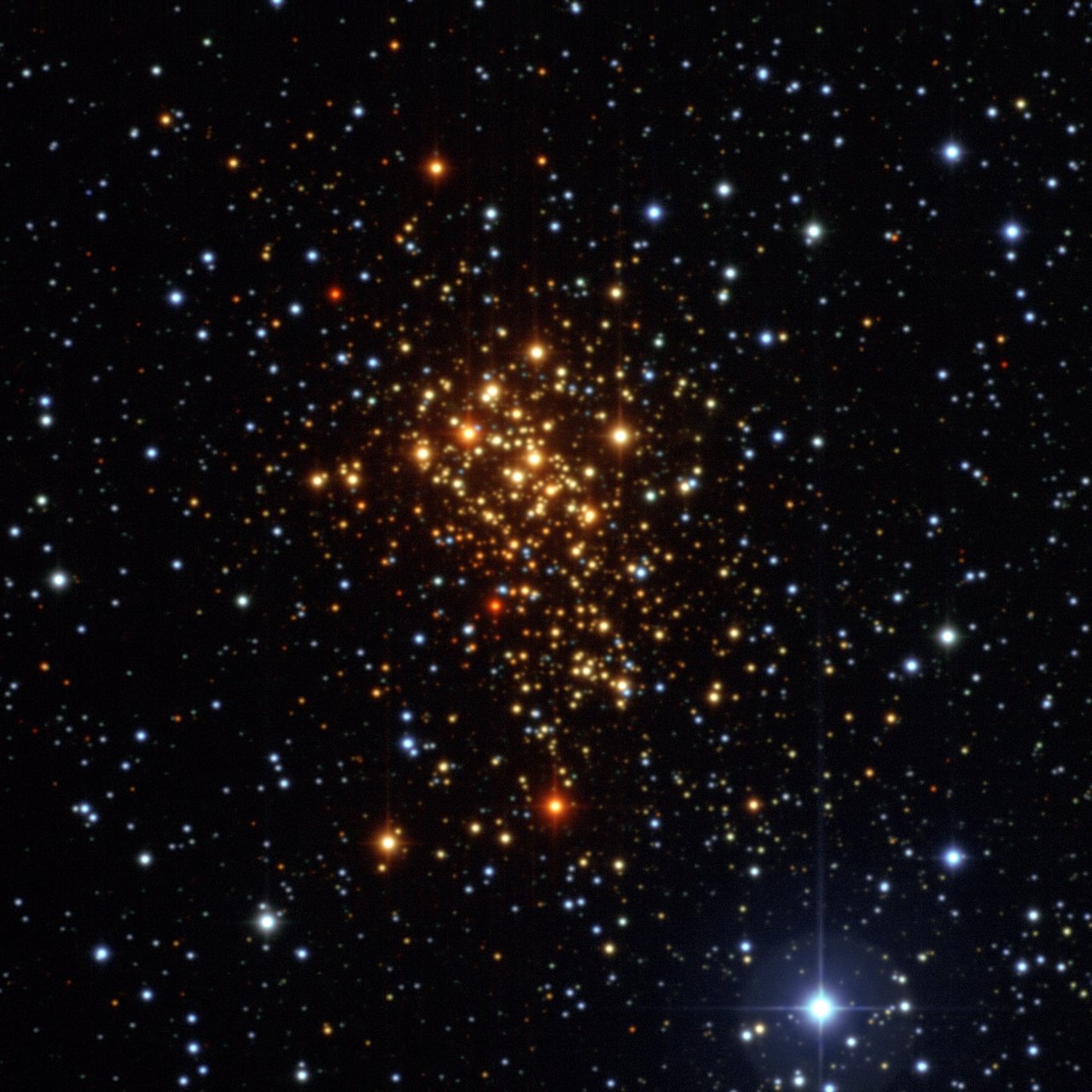
Imagen de Westerlund 1 con el Wide Field Imager (sin anotaciones)
Visión de amplio campo del cielo alrededor del cúmulo Westerlund 1

Videos

Volando a través del joven cúmulo estelar Westerlund 1

Ver también


Esta es una traducción de la nota de prensa de ESO eso1415.
ESO
Guillermo Gonzalo Sánchez Achutegui

martes, 19 de marzo de 2013

NASA - Kepler's Supernova Remnant: Famous Supernova Reveals Clues About Crucial Cosmic Distance Markers


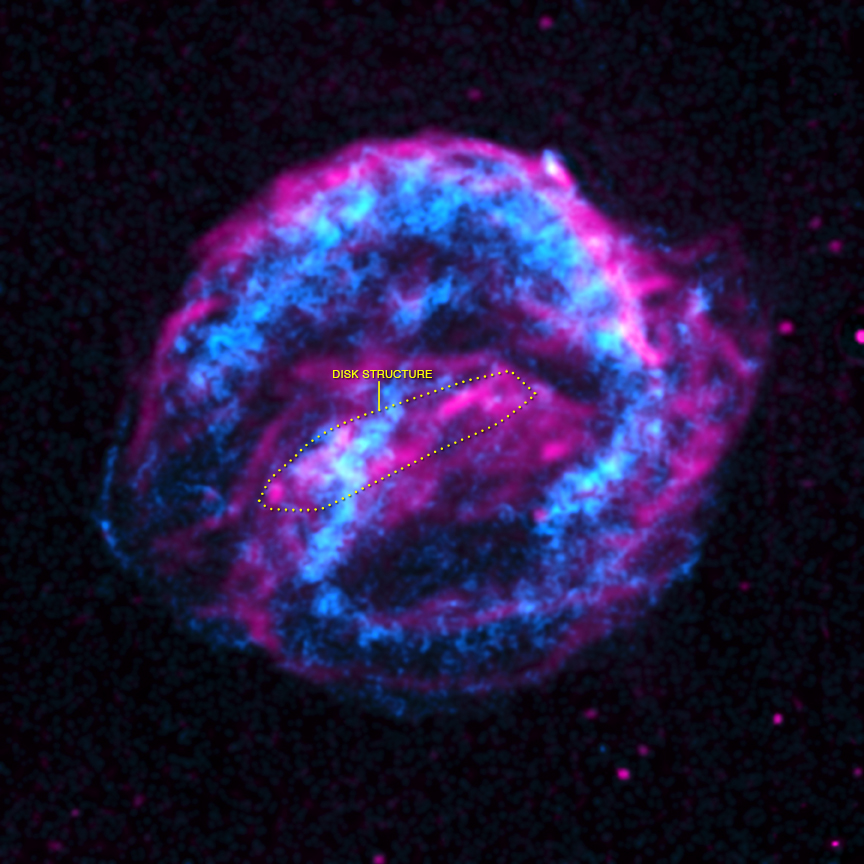
 This is the remnant of Kepler's supernova, the famous explosion that was discovered by Johannes Kepler in 1604. The red, green and blue colors show low, intermediate and high energy X-rays observed with NASA’s Chandra X-ray Observatory, and the star field is from the Digitized Sky Survey.

As reported in our press release, a new study has used Chandra to identify what triggered this explosion. It had already been shown that the type of explosion was a so-called Type Ia supernova, the thermonuclear explosion of a white dwarf star. These supernovas are important cosmic distance markers for tracking the accelerated expansion of the Universe.

However, there is an ongoing controversy about Type Ia supernovas. Are they caused by a white dwarf pulling so much material from a companion star that it becomes unstable and explodes? Or do they result from the merger of two white dwarfs?

The new Chandra analysis shows that the Kepler supernova was triggered by an interaction between a white dwarf and a red giant star. The crucial evidence from Chandra was a disk-shaped structure near the center of the remnant. The researchers interpret this X-ray emission to be caused by the collision between supernova debris and disk-shaped material that the giant star expelled before the explosion. Another possibility was that the structure is just debris from the explosion.

The disk structure seen by Chandra in X-rays is very similar in both shape and location to one observed in the infrared by the Spitzer Space Telescope. This composite image shows Spitzer data in pink and Chandra data from iron emission in blue. The disk structure is identified with a label.

This composite figure also shows a remarkably large and puzzling concentration of iron on one side of the center of the remnant but not the other. The authors speculate that the cause of this asymmetry might be the "shadow" in iron that was cast by the companion star, which blocked the ejection of material. Previously, theoretical work has suggested this shadowing is possible for Type Ia supernova remnants.

The authors also produced a video showing a simulation of the supernova explosion as it interacts with material expelled by the giant star companion. It was assumed that the bulk of this material was expelled in a disk-like structure, with a gas density that is ten times higher at the equator, running from left to right, than at the poles. This simulation was performed in two dimensions and then projected into three dimensions to give an image that can be compared with observations. The good agreement with observations supports their interpretation of the data.

These results were published online and in the February 10th, 2013 issue of The Astrophysical Journal.

Credits: X-ray: NASA/CXC/NCSU/M.Burkey et al; Infrared: NASA/JPL-Caltech

› Read more/access all images
› Chandra's Flickr photoset
  • A long Chandra observation gives clues about the origin of the Kepler supernova remnant.

  • Evidence points to the doomed white dwarf pulling material from a red giant star, not merging with another white dwarf.

  • The explosion that created the Kepler supernova remnant was seen in 1604 by the object's namesake and many others.

This is the remnant of Kepler's supernova, the famous explosion that was discovered by Johannes Kepler in 1604. The red, green and blue colors show low, intermediate and high energy X-rays observed with NASA's Chandra X-ray Observatory, and the star field is from the Digitized Sky Survey.
As reported in our press release, a new study has used Chandra to identify what triggered this explosion. It had already been shown that the type of explosion was a so-called Type Ia supernova, the thermonuclear explosion of a white dwarf star. These supernovas are important cosmic distance markers for tracking the accelerated expansion of the Universe.
However, there is an ongoing controversy about Type Ia supernovas. Are they caused by a white dwarf pulling so much material from a companion star that it becomes unstable and explodes? Or do they result from the merger of two white dwarfs?
The new Chandra analysis shows that the Kepler supernova was triggered by an interaction between a white dwarf and a red giant star. The crucial evidence from Chandra was a disk-shaped structure near the center of the remnant. The researchers interpret this X-ray emission to be caused by the collision between supernova debris and disk-shaped material that the giant star expelled before the explosion. Another possibility was that the structure is just debris from the explosion.
The disk structure seen by Chandra in X-rays is very similar in both shape and location to one observed in the infrared by the Spitzer Space Telescope. This composite image shows Spitzer data in pink and Chandra data from iron emission in blue. The disk structure is identified with a label.
Kepler Elements
X-ray Image (Elements)
This composite figure also shows a remarkably large and puzzling concentration of iron on one side of the center of the remnant but not the other. The authors speculate that the cause of this asymmetry might be the "shadow" in iron that was cast by the companion star, which blocked the ejection of material. Previously, theoretical work has suggested this shadowing is possible for Type Ia supernova remnants.
The authors also produced a video showing a simulation of the supernova explosion as it interacts with material expelled by the giant star companion. It was assumed that the bulk of this material was expelled in a disk-like structure, with a gas density that is ten times higher at the equator, running from left to right, than at the poles. This simulation was performed in two dimensions and then projected into three dimensions to give an image that can be compared with observations. The good agreement with observations supports their interpretation of the data.
These results were published online and in the February 10th, 2013 issue of The Astrophysical Journal.

Fast Facts for Kepler's Supernova Remnant:
Credit  X-ray: NASA/CXC/NCSU/M.Burkey et al; Optical: DSS
Release Date  March 18, 2013
Scale  Image is 12 arcmin across (45 light years)
Category  Supernovas & Supernova Remnants
Coordinates (J2000)  RA 17h 30m 40.80s | Dec -21° 29' 11.00"
Constellation  Ophiuchus
Observation Date  6 pointings between April and July, 2006
Observation Time  205 hours 50 min (8 days 13 hours 50 min)
Obs. ID  6714-6718, 7366
Instrument  ACIS
Also Known As SN 1604, G004.5+06.8, V 843 Ophiuchi
References Burkey, M.T. et al, 2013, ApJ, 764, 63; arXiv:1212.4534
Color Code  X-ray (Red, Green, Blue); Optical (Grayscale)
  Supernovas & Supernova Remnants

Supernova Explosion
Animation of Supernova Explosion
Quicktime Movie
Every 50 years or so, a massive star in our galaxy blows itself apart in a supernova explosion. Supernovas are one of the most violent events in the universe, and the force of the explosion generates a blinding flash of radiation, as well as shock waves analogous to sonic booms.
Supernovas were originally classified on the basis of their optical properties. Type II supernovas show conspicuous evidence for hydrogen in the expanding debris ejected in the explosion; Type Ia explosions do not. Recent research has led to a refinement of these types, and a classification in terms of the types of stars that give rise to supernovas. A Type II, as well as Type Ib and Type Ic explosion, is produced by the catastrophic collapse of the core of a massive star. A Type Ia supernova is produced by a sudden thermonuclear explosion that disintegrates a white dwarf star.
SN 1006
Chandra image of SN 1006
Type II supernovas occur in regions with lots of bright, young stars, such as the spiral arms of galaxies. They apparently do not occur in elliptical galaxies, which are dominated by old, low-mass stars. Since bright young stars are typically stars with masses greater than about 10 times the mass of the sun, this and other evidence led to the conclusion that Type II supernovae are produced by massive stars.
Some Type I supernovas show many of the characteristics of Type II supernovas. These supernovas, called Type Ib and Type Ic, apparently differ from Type II because they lost their outer hydrogen envelope prior to the explosion. The hydrogen envelope could have been lost by a vigorous outflow of matter prior to the explosion, or because it was pulled away by a companion star.

Core-collapse Supernovas
The general picture for Type II, Type Ib and Type Ic supernovas - also called core-collapse supernovas - goes something like this. When the nuclear power source at the center or core of a star is exhausted, the core collapses. In less than a second, a neutron star (or a black hole, if the star is extremely massive) is formed. The formation of a neutron star releases an enormous amount of energy in the form of neutrinos and heat, which reverses the implosion. All but the central neutron star is blown away at speeds in excess of 50 million kilometers per hour as a thermonuclear shock wave races through the now expanding stellar debris, fusing lighter elements into heavier ones and producing a brilliant visual outburst that can be as intense as the light of several billion Suns.
Birth of a Neutron Star and Supernova Remnant

Thermonuclear Supernovas Type Ia supernovas, in contrast, are observed in all kinds of galaxies, and are produced by white dwarf stars, the condensed remnant of what used to be sun-like stars. A white dwarf star, a dense ball primarily composed of carbon and oxygen atoms, is intrinsically the most stable of stars, as long as its mass remains below the so-called Chandrasekhar limit of 1.4 solar masses.
Type 1a
Illustration: NASA/CXC/M.Weiss

Kepler's Supernova Remnant
Chandra image of Kepler's Supernova Remnant
If, however, accretion of matter from a companion star or the merger with another white dwarf, push a white dwarf star over the Chandrasekhar limit of 1.4 solar masses, the temperature in the core of the white dwarf will rise, triggering explosive nuclear fusion reactions that release an enormous amount of energy. The star explodes in about ten seconds, leaving no remnant. The expanding cloud of ejecta glows brightly for many weeks as radioactive nickel produced in the explosion decays into cobalt and then iron.
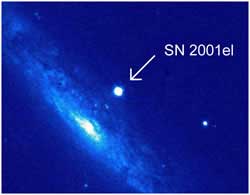
Supernova 2001el
Supernova 2001el (Lawrence Berkeley National Lab)
Because Type Ia supernovas all occur in a star that has a mass of about 1.4 solar masses, they produce about the same amount of light. This property makes them extremely useful as a distance indicator - if one Type Ia supernova is dimmer than another one, it must be further away by an amount that can be calculated. In recent years Type Ia supernova have been used in this way to determine the rate of expansion of the universe. This research has led to the astounding discovery that the expansion of the universe is accelerating, possibly because the universe is filled with a mysterious substance called dark energy.

Pair-Instability Supernovas For extremely massive stars, another, even more violent type of supernova is possible. According to stellar evolution theory, temperatures rise to several billion degrees in the central regions of stars with masses between 140 and 260 suns. At these temperatures the usual process of converting mass into energy (E = mc2) by nuclear reactions is reversed, and energy is converted into mass in the form of pairs of electrons and antielectrons, or positrons.
The production of electron-positron pairs saps energy from the core of the star, disturbing the equilibrium between the outward push of pressure and the inward crush of gravity. This so-called "pair instability" causes violent pulsations that eject a large fraction of the outer layers of the star, and eventually disrupt the star completely in a thermonuclear explosion.
Pair-instability supernovas, if they exist, would be the most energetic thermonuclear explosions in the universe. In stars with masses greater than about 260 suns, the pulsations would be overwhelmed by gravity and the star would collapse to form a black hole without an explosion.

For stars with initial masses above about 200 suns, pair-instability supernovas would produce an abundance of radioactive nickel. Radioactive decay of this large mass of nickel into cobalt and other nuclei would feed energy into the expanding debris for several months, and create an ultra-bright supernova.
Observations with Chandra and optical telescopes indicate that Supernova 2006gy, the most luminous supernova ever recorded, may be a long-sought (40 years) pair-instability supernova.
The intense radiation emitted by a supernova lasts from several months to a few years before fading away. In the meantime, the rapidly expanding (millions of miles per hour) matter from the explosion eventually crashes into circumstellar gas. This collision creates a supernova remnant consisting of hot gas and high-energy particles that glow in radio through X-ray wavelengths for thousands of years.
The process of forming the remnant is somewhat like an extreme version of sonic booms produced by the supersonic motion of an airplane. Expanding stellar debris creates a shock wave that races ahead of the debris. This forward shock wave produces sudden, large changes in pressure and temperature behind the shock wave.
The forward shock wave also accelerates electrons and other charged particles to extremely high energies. Electrons spiraling around the magnetic field behind the shock wave produce radiation over a wide range of wavelengths. Radiation from supernova remnants is especially conspicuous at radio wavelengths, and radio telescopes have traditionally been the primary tools for discovering these objects.
In recent years, supernova remnants have also been discovered with focusing X-ray telescopes. The X-rays are produced by the forward shock wave and by a reverse shock wave that heats the debris, or ejecta, of the exploded star. The reverse shock is formed as the high pressure gas behind the forward shock wave expands and pushes back on the stellar ejecta.
Cassiopeia A
Chandra image of Cassiopeia A
A Chandra observation of the supernova remnant Cassiopeia A (Cas A) clearly shows both the outer shock wave and the debris heated by the reverse shock wave. The study of supernova remnants with radio, infrared, optical and X-ray telescopes enables astronomers to trace the progress of the shock waves and distribution of elements ejected in the explosion. These data are especially significant because supernovas are the primary means for seeding the galaxy with many elements such as carbon, nitrogen, oxygen, silicon and iron that are necessary for planets and life.
Crab Nebula
Chandra image of Crab Nebula
Tycho's Supernova Remnant Chandra image of Tycho's Supernova Remnant
In core-collapse supernovas a rapidly spinning neutron star, or pulsar, can produce a pulsating source of radiation and a magnetized nebula of high-energy particles that lights up the interior of the expanding shell. The Crab Nebula, a remnant of a supernova observed in 1054 A.D., is the most spectacular example.
Chandra's image of the Crab Nebula reveals rings and jets of high-energy particles that appear to have been flung outward over great distances from the neutron star. The diameter of the inner ring is about 1,000 times the diameter of our solar system.
Chandra has been able to detect numerous pulsars and their associated pulsar nebulas. These discoveries are proving to be one of the best ways to identify supernova remnants produced by the core collapse of a massive star, and to distinguish them from remnants produced by the thermonuclear disruption of a white dwarf star (Type Ia supernova).
Another method used to determine the origin of a particular remnant is to study the relative amounts of various elements, especially oxygen and iron. Core-collapse supernovas are rich in oxygen, whereas thermonuclear supernovas produce relatively more iron. The remnants of Tycho's and Kepler's supernovas are thought to have been produced by Type Ia supernovas.
Return to the top of this page


J.D. Harrington, 202-358-0321
Headquarters, Washington
j.d.harrington@nasa.gov

Janet Anderson, 256-544-0034
Marshall Space Flight Center, Huntsville, Ala.
janet.l.anderson@nasa.gov

Megan Watzke 617-496-7998
Chandra X-ray Center, Cambridge, Mass.
mwatzke@cfa.harvard.edu
NASA
Guillermo Gonzalo Sánchez Achutegui
ayabaca@gmail.com
ayabaca@hotmail.com
ayabaca@yahoo.com
Inscríbete en el Foro del blog y participa : A Vuelo De Un Quinde - El Foro!

Mi lista de blogs