Mostrando entradas con la etiqueta The Galileo programme. Mostrar todas las entradas

martes, 9 de octubre de 2012

ESA: Galileo satellites moved to pad for Friday launch

 
http://www.esa.int/images/IOV-fairing-1b,0.jpg
Galileo IOV satellites attached to their launch dispenser and encapsulated beneath the fairing of their Soyuz ST-B launcher 
Credits: © ESA - P. Carril
 The two Galileo satellites and their upper stage have been enclosed within their protective fairing, and moved to join the Soyuz rocket on the launch pad.

The halves of the fairing were sealed together around the satellites, their supporting dispenser and Fregat-MT upper stage on Friday, within the Upper Composite Integration Stand of building S3B of Europe’s Spaceport in French Guiana.
Yesterday, the Upper Composite was moved to the launch site, for vertical mating to its three-stage Soyuz ST-B rocket.
The 4.1 m-diameter fairing protects the satellites from the stresses of launch and flight through the bulk of the atmosphere. It will be ejected about three and a half minutes into the flight, when the upper stage reaches the top of the atmosphere.  
 http://www.esa.int/images/_SCO5068.jpg
http://www.esa.int/SPECIALS/Galileo_IOV/SEM7XP2S18H_0.html
Download:
 Soyuz VS03, the third Soyuz flight from Europe’s Spaceport in French Guiana, was transferred to the launch zone on 8 October 2012. The vehicle was rolled out horizontally on its erector from the preparation building to the launch zone and then raised into the vertical position. Soyuz VS03 will lift off on 12 October 2012. The rocket will carry two satellites of Europe’s Galileo navigation system into orbit. 
Credits: ESA–S. Corvaja, 2012
 Fregat, modified to carry extra propellants, will fire for the first time about 10.5 minutes after launch, raising the satellites up to orbital velocity and their operating altitude of 23 222 km.
As it climbs, Fregat will spin slowly in ‘barbecue mode’, to keep the temperatures of the satellites even.
From launch to final deployment, when the dispenser releases the satellites sideways in opposite directions, will take three hours and 44 minutes.
The launch is scheduled for 18:15:00 GMT (20:15:00 CEST) on 12 October.
 Fairing ejection
http://www.esa.int/SPECIALS/Galileo_IOV/SEM7XP2S18H_0.html
Download:
The two Galileo In-Orbit Validation satellites are protected during their launch by Soyuz by a launch fairing. Once the Soyuz has passed most of the way through the atmosphere, this fairing can then be ejected. 
Credits: ESA - P. Carril

 Galileo taking shape
 
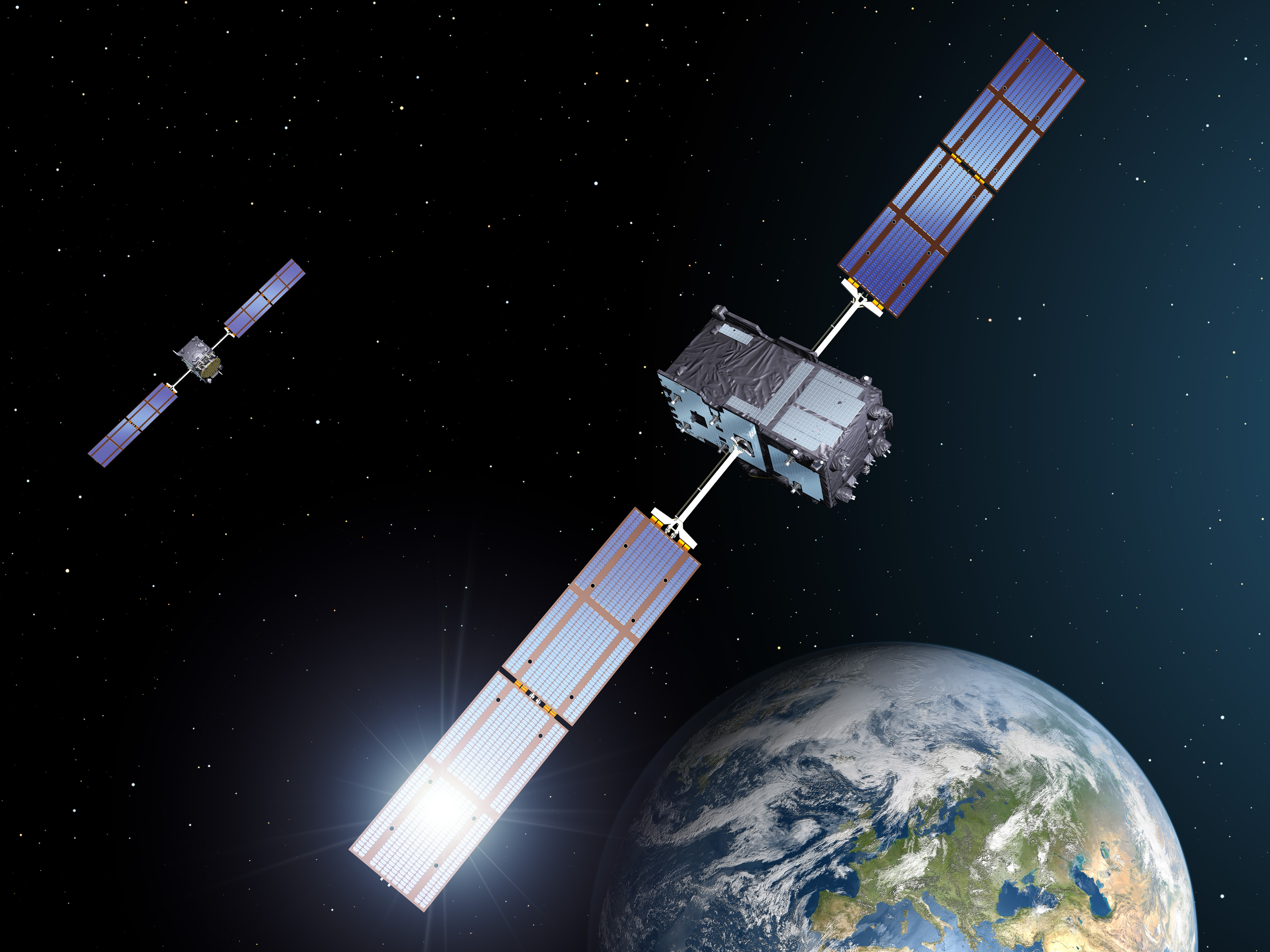
This follow-up launch marks a major step for Europe’s own satellite navigation system.

Four is the minimum number of satellites needed to achieve a navigational fix on the ground, with one satellite each to measure latitude, longitude, altitude and provide a time reference.
So once this second pair of satellites has been commissioned and tested, the quartet will form a completely operational mini-constellation that will be used to validate the Galileo system.
 The performance of the satellites in space together with the worldwide ground infrastructure serving to maintain Galileo’s service accuracy will be assessed in depth, to prepare the way for the launch of further satellites and then deliver initial services by mid-decade and finally build up to full operational capability.
These two new satellites are also the first to carry search and rescue antennas to pinpoint aircraft and ships in distress as part of the international Cospas–Sarsat system.
 European Space Agency (ESA)
Guillermo Gonzalo Sánchez Achutegui
ayabaca@gmail.com
ayabaca@hotmail.com
ayabaca@yahoo.com
 Inscríbete en el Foro del blog y participa : A Vuelo De Un Quinde - El Foro!

jueves, 14 de junio de 2012

Astronomy: Trial by vacuum brings next Galileo satellites closer to launch

Hi My Friends: A VUELO DE UN QUINDE EL BLOG., The next two Galileo navigation satellites have now endured the harsh vacuum and temperature extremes of space on the way to their scheduled 28 September launch.

Download:
 HI-RES JPEG (Size: 1482 kb)
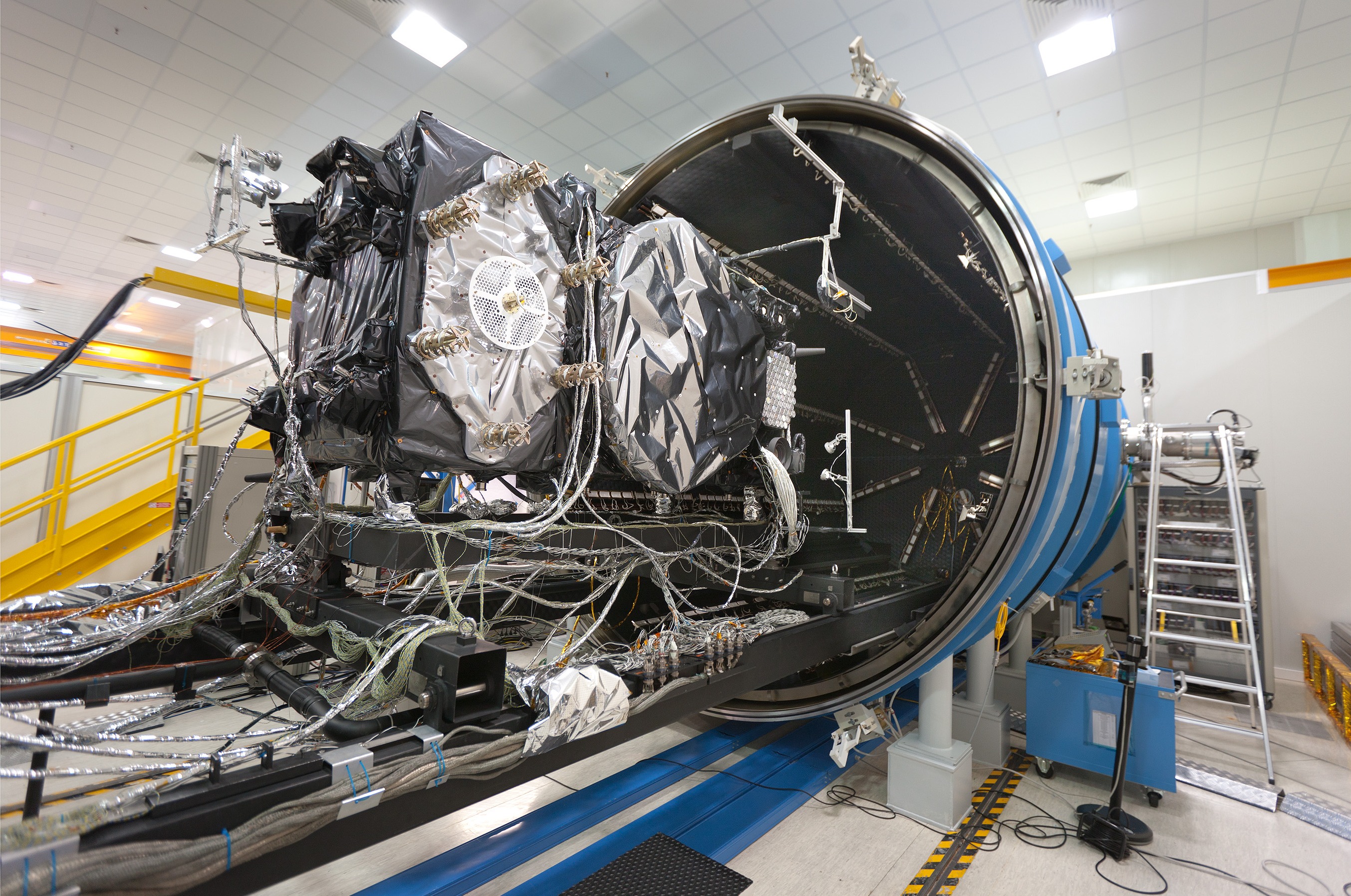
The fourth Galileo In-Orbit Validation flight model satellite, FM4, pictured at the start of thermal vacuum testing at Thales Alenia Space Italy's facility in Rome in May 2012. The third Galileo flight model, FM3, had already undergone this testing. 
Credits: ESA/EADS Astrium – R. Kieffer
 The next two Galileo navigation satellites have now endured the harsh vacuum and temperature extremes of space on the way to their scheduled 28 September launch.

The fourth satellite completed 20 days of thermal vacuum testing at Thales Alenia Space Italy’s plant in Rome at the start of June. The third satellite completed the same tests the previous month.
“These two satellites are almost identical to the first two Galileo satellites that were launched last 21 October,” explained ESA’s Nigel Watts.
“So we don’t need to carry out full-scale qualification tests because we already know from our in-orbit test campaign that the design performs to our expectations. 
21 October 2011: Soyuz lifts off for the first time from Europe’s Spaceport in French Guiana carrying the first two Galileo In-Orbit Validation satellites. 
Credits: ESA – S. Corvaja, 2011
 “Instead, what we are carrying out is acceptance testing: checking the workmanship, performance and readiness to launch of these new satellites.”
Thermal vacuum testing involves placing each satellite into a vacuum chamber and pumping out all the air. Its external surfaces are then variously heated and cooled while the satellite is operated.
With no air in orbit to moderate temperatures, any part of a satellite in sunlight can become extremely hot, while those parts in shadow or facing deep space grow extremely cold. Critical systems must be kept within a set temperature range, however.
 “To give an idea, Galileo’s laser retroreflector on its exterior reached –110°C during the cold phase of testing,” said Guido Barbagallo, Galileo thermal engineer.
“Meanwhile, the navigation high-power amplifiers could be driven to more than +40°C during the hot phase.”
Like most satellites, Galileo’s uses a variety of methods to maintain its temperature range, including multi-layer insulation, heaters, heat pipes relying on evaporating ammonia to shift heat, and radiators to dump waste heat out to space.


Download:
 The first two of four Galileo In-Orbit Validation satellites were launched on 21 October 2011. 
Credits: ESA – P. Carril
 Galileo’s passive hydrogen maser atomic clock at the heart of its navigation services is precise to a second in three million years.
But it requires extremely stable thermal conditions to achieve this. Its operating temperature needs to be regulated within a single degree, though in practice a tenth of that can be achieved.
 

“The passive hydrogen maser is mounted on a 3 mm-thick aluminium plate to help hold a uniform temperature, with waste heat finally radiated to space from the external satellite surface,” added Guido.
The atomic clock and the mounting plate are wrapped in multi-layer insulation and attached to the top panel of the satellite, which is itself kept permanently out of the Sun. 
ESA
What is Galileo?

Galileo is Europe’s own global navigation satellite system, providing a highly accurate, guaranteed global positioning service under civilian control. It is inter-operable with GPS and Glonass, the two other global satellite navigation systems. By offering dual frequencies as standard, Galileo will deliver real-time positioning accuracy down to the metre range. It will guarantee availability of the service under all but the most extreme circumstances and will inform users within seconds of any satellite failure, making it suitable for safety-critical applications such as guiding cars, running trains and landing aircraft.
ESA’s first two navigation satellites, GIOVE-A and –B, were launched in 2005 and 2008 respectively, reserving radio frequencies set aside for Galileo by the International Telecommunications Union and testing key Galileo technologies.
Then on 21 October 2011 came the first two of four operational satellites designed to validate the Galileo concept in both space and on Earth. Two more will follow in 2012. Once this In-Orbit Validation (IOV) phase has been completed, additional satellites will be launched to reach Initial Operational Capability (IOC) around mid-decade.
Galileo services will come with quality and integrity guarantees which marks the key difference of this first complete civil positioning system from the military systems that have come before.
A range of services will be extended as the system is built up from IOC to reach the Full Operational Capability (FOC) by this decade’s end.
The fully deployed Galileo system consists of 30 satellites (27 operational + 3 active spares), positioned in three circular Medium Earth Orbit (MEO) planes at 23 222 km altitude above the Earth, and at an inclination of the orbital planes of 56 degrees to the equator.
http://www.esa.int/esaNA/galileo.html
 Guillermo Gonzalo Sánchez Achutegui
ayabaca@gmail.com 
ayabaca@hotmail.com 
 ayabaca@yahoo.com
 Inscríbete en el Foro del blog y participa : A Vuelo De Un Quinde - El Foro!
Mi lista de blogs