Mostrando entradas con la etiqueta The National Science Foundation (NSF). Mostrar todas las entradas

domingo, 13 de agosto de 2017

The National Science Foundation (NSF) :Is the coast clear? Not in many beachfront areas .- Descubrimiento ¿Está clara la costa? No en muchas zonas frente al mar...

https://www.nsf.gov/discoveries/disc_summ.jsp?cntn_id=242562&WT.mc_id=USNSF_1


Marine scientists evaluate coastal armoring and its ecological effects

Científicos marinos evalúan el blindaje costero y sus efectos ecológicos
Large rock revetment in the intertidal zone of a sandy beach in Santa Barbara County, California.

Large rock revetment in the intertidal zone of a sandy beach in Santa Barbara County, California.
Credit and Larger Version

July 24, 2017

Find related stories on NSF's Long-Term Ecological Research Sites.
For nearly a century, the O'Shaughnessy seawall has held back the sand and seas of San Francisco's Ocean Beach. At work even longer: the Galveston seawall, built after America's deadliest hurricane killed thousands in Texas in 1900.
These are just two examples of how America's coasts -- especially those with large urban populations -- have been armored with human-made structures.
Though these structures help protect communities against natural disasters, these "lines in the sand" limit the ability of the shoreline to respond to changes in sea level and other coastal processes.
Recent research on the resulting ecological effects has largely been conducted in specific settings, making it difficult to generalize the results across ecosystems and structure types.
Now a study by marine scientists affiliated with three coastal sites in the National Science Foundation's (NSF) Long-Term Ecological Research (LTER) network provides a key first step toward generalizing ecological responses to armoring in the widely diverse coastal settings where these structures are used.
The team's findings appear online this week in a paper in Estuaries and Coasts, and will be published this fall in a special issue of the journal.
"This is one of the first attempts to assess how engineering structures on beaches and other sedimentary environments affect the biota that inhabits these locations," said David Garrison, an LTER program director at NSF, which supported the research. With some 40 percent of the nation's human population living in coastal counties, Garrison noted that the study is very timely.
The type of armoring structure varies widely according to the environmental setting, ranging from huge seawalls and revetments along the wave-exposed open coast to smaller bulkheads and human-designed oyster reefs in tidal marshes and estuaries.
"The size and shape of these structures often result in the loss of intertidal habitats," said lead author Jenny Dugan, a biologist at the University of California, Santa Barbara (UCSB). "The extent of that loss is related to the environmental setting, structure type and how far seaward and along the shore the structure extends."
Scientists at three LTER sites have been working on the ecological impact of coastal armoring. At NSF's Santa Barbara Coastal LTER site, studies of seawalls on open coast beaches have revealed significant ecological effects on marine species, including birds. Researchers at the Georgia Coastal Ecosystems LTER site have conducted studies of small-scale armoring in salt marshes. And investigations at the Virginia Coast Reserve LTER site have focused on the use of oyster reefs and living shorelines as coastal protection strategies.
"What's new about this cross-site collaboration is putting these site-specific studies into perspective by making comparisons across a broad range of habitats," said paper co-author Merryl Alber, a marine scientist at the University of Georgia and principal investigator of the Georgia Coastal Ecosystems LTER site.
The study synthesizes the findings of existing literature, examining different types of armoring across a variety of soft sediment ecosystems. The scientists used those data to evaluate a new conceptual model.
"Our model looks at the environmental setting of the armoring structure in terms of hydrodynamic energy, like waves and tides, and the degree to which a structure was built to slow water movement or stop it from getting through," Dugan explained. "We then reviewed results from a wide spectrum of studies in the literature and used that information to evaluate how well our model could predict the ecological effects of armoring."
Of the 88 studies the researchers reviewed, the majority had been conducted in very low-energy environments -- predominantly salt marshes and tidal creeks, and also mangroves -- and about one-quarter in medium-energy systems, such as harbors, river mouths and estuaries. Only 15 percent focused on high-energy environments, mostly open coast sandy beaches.
Six categories of ecological responses had been examined in previous studies; negative effects of shoreline armoring were reported in all six. The existing literature focused largely on changes in habitat and species distribution, leaving questions about how shoreline armoring affects other ecological responses such as nutrient cycling, connectivity, productivity and trophic structure.
"Our review not only revealed major gaps in knowledge, but also highlighted the fact that existing information on ecological responses to armoring is unevenly distributed across soft sediment habitat types and does not necessarily cover the range of potential environmental and armoring contexts," said paper co-author Kyle Emery of UCSB.
According to Dugan, as sea level continues to rise, existing coastal armoring structures are likely to experience greater hydrodynamic energy, such that of waves and tides, regardless of their environment. That will magnify ecological effects in many settings, she said.
Dugan noted that the model generated useful predictions of the direction and relative effect of different types of shoreline armoring across soft sediment ecosystems.
"Understanding how these ecological responses vary with hydrodynamic energy, and their effect on water flow, could help people design and install armoring structures that could have fewer ecological effects," she said. "Then their options would include the cost of the structure, and an idea of the ecological implications of the type of structure based on the environmental setting."
Other co-authors of the paper are Clark Alexander, James Byers, Alyssa Gehman and Natalie McLenaghan, all of the University of Georgia, and Sarah Sojka of Randolph College in Lynchburg, Virginia.
-- Cheryl Dybas, NSF (703) 292-7734 cdybas@nsf.gov
-- Julie Cohen, UCSB (805) 893-7220 julie.cohen@ucsb.edu
Seawall in the intertidal zone of a sandy beach in Santa Barbara County, California.

Bulkhead and dock structure in a salt marsh in coastal Georgia.
Credit and Larger Version
Salt marsh sunset at Sapelo Island, Georgia. Such sites are studied for coastal armoring effects.
Credit and Larger Version
Artificial reefs from concrete blocks, called oyster castles, can decrease salt marsh erosion.
Credit and Larger Version
Oyster castles provide substrate for artificial reefs that reduce wave effects onshore.
Credit and Larger Version
The National Science Foundation (NSF)
Guillermo Gonzalo Sánchez Achutegui
ayabaca@gmail.com
ayabaca@hotmail.com
ayabaca@yahoo.com
Inscríbete en el Foro del blog y participa : A Vuelo De Un Quinde - El Foro!

the National Science Foundation(NSF) : Projected precipitation increases are bad news for water quality .- Los aumentos proyectados de la precipitación son malas noticias para la calidad del agua..

https://www.nsf.gov/news/news_summ.jsp?cntn_id=242494&WT.mc_id=USNSF_51&WT.mc_ev=click

More rainfall would lead to more algae blooms, dead zones
An extensive algae bloom in Lake Erie in August, 2011 resulted from record-breaking nutrient loads.

An extensive algae bloom in Lake Erie in August, 2011 resulted from record-breaking nutrient loads.
Credit and Larger Version

July 27, 2017

Increased precipitation from a changing climate could pollute U.S. waterways with excess nitrogen, increasing the likelihood of severe water quality impairment from coast to coast, according to a new study by scientists Eva Sinha and Anna Michalak of the Carnegie Institution for Science and Venkatramani Balaji of Princeton University.
The results are published in this week's issue of the journal Science.
The effects will be especially strong in the Midwest and Northeast, the researchers found.
Rainfall and other precipitation washes nutrients from human activities like agriculture and fossil fuel combustion into rivers and lakes. When these nutrients overload waterways, a process called eutrophication, the results can be dangerous.
Harmful, toxin-producing algae blooms can develop, as well as dangerous low-oxygen dead zones. Over the past several years, dead zones and algae blooms in coastal regions across the United States -- including the Gulf of Mexico, the Chesapeake Bay and Florida -- have received extensive news coverage.
Sinha and Michalak used models to predict how climate change might affect eutrophication.
"In the 1970s, we discovered human-caused eutrophication and took steps to reverse its course," said Tom Torgersen, director of the National Science Foundation's Water, Sustainability and Climate program, which funded the research. "As this paper shows, however, even seemingly minor climate variations can result in a return to the eutrophication of the past. It will take more research to create better management strategies just to stay even."
In an earlier study, Sinha and Michalak found that, while land use and land management control the supply of nitrogen, precipitation controls how much of that nitrogen flows from the land into waterways.
They noted that the amount of precipitation plays a large role in determining how much nitrogen runoff happens during a given year.
In the current study, they used these insights to predict how future changes to precipitation caused by climate change will, in and of themselves, affect nitrogen runoff and thereby increase the risk of water quality impairment in the U.S.
The scientists leveraged projections from 21 different models and looked at three possible future scenarios.
They found that if trends in greenhouse gas emissions follow a "business-as-usual" scenario, the resulting changes in climate will alter precipitation patterns in the U.S. and increase nutrient pollution by one-fifth by the end of the century. The effects will be particularly strong in the Corn Belt and in the Northeast.
Offsetting the increased amount of nitrogen being washed into waterways would be an enormous task, requiring a whopping one-third reduction in overall nitrogen inputs, such as fertilizer use.
"Our findings demonstrate that it is imperative that water quality management strategies account for the effect of future precipitation changes on nitrogen loading," Michalak said.
Sinha's and Michalak's results are specific to the U.S., but the researchers have identified India, China and Southeast Asia as areas at high risk for large increases in nitrogen pollution due to increased precipitation.
"These are regions that more than half the world's population calls home, so severe water quality impairments could have serious effects," Sinha said.
-NSF-
Media Contacts
Cheryl Dybas, NSF, (703) 292-7734, cdybas@nsf.gov
Natasha Metzler, Carnegie Institution for Science, (202) 939-1142, nmetzler@CarnegieScience.edu

The National Science Foundation (NSF) is an independent federal agency that supports fundamental research and education across all fields of science and engineering. In fiscal year (FY) 2017, its budget is $7.5 billion. NSF funds reach all 50 states through grants to nearly 2,000 colleges, universities and other institutions. Each year, NSF receives more than 48,000 competitive proposals for funding and makes about 12,000 new funding awards.
Useful NSF Web Sites:
NSF Home Page: https://www.nsf.gov
NSF News: https://www.nsf.gov/news/
For the News Media: https://www.nsf.gov/news/newsroom.jsp
Science and Engineering Statistics: https://www.nsf.gov/statistics/
Awards Searches: https://www.nsf.gov/awardsearch/
A cup of fouled water, scooped from Lake Erie during the 2011 algae bloom.
Credit and Larger Version
Fish suffocated in the Lake Erie algae bloom of August,2011.
Fish suffocated in the Lake Erie algae bloom of August, 2011.
Credit and Larger Version
A Lake Okeechobee algae bloom in the summer of 2016. Water discharge led to more downstream blooms.
Credit and Larger Version
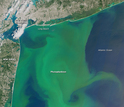
A huge algae bloom happened off the Atlantic coast in August, 2015.
Credit and Larger Version
A large algae bloom off the Pacific Northwest coast occurred in July, 2014.
Credit and Larger Version
The National Science Foundation (NSF)
Guillermo Gonzalo Sánchez Achutegui
ayabaca@gmail.com
ayabaca@hotmail.com
ayabaca@yahoo.com
Inscríbete en el Foro del blog y participa : A Vuelo De Un Quinde - El Foro!

The National Science Foundation (NSF) : Laser mapping project shows effects of physical changes in Antarctica's Dry Valleys .- Proyecto de mapeo láser muestra los efectos de los cambios físicos en los valles secos de la Antártida

https://www.nsf.gov/news/news_summ.jsp?cntn_id=242558&WT.mc_id=USNSF_51&WT.mc_ev=click
https://en.wikipedia.org/wiki/McMurdo_Dry_Valleys

Maps can be compared to similar observations made 13 years ago to observe changes
The Canada Glacier in the McMurdo Dry Valleys.

The Canada Glacier in the McMurdo Dry Valleys.
Credit and Larger Version

August 7, 2017

Researchers funded by the National Science Foundation (NSF) have publicly released high-resolution maps of Antarctica's McMurdo Dry Valleys, a globally unique polar desert.
The high-resolution maps cover 3,564 square kilometers of the McMurdo Dry Valleys and allow researchers to compare present-day conditions with lower-resolution LIDAR surveys conducted almost 13 years ago.
Scientists from Portland State University led the new research project, which mapped the area using more sophisticated LIDAR, a remote-sensing method that uses laser beam pulses to measure the distance from the detector to the Earth's surface.
Two NSF-funded facilities, the OpenTopography Facility and the Polar Geospatial Center, made the LIDAR data publicly available. A paper about the work was published in the journal Earth System Science Data.
The data, collected by aerial survey missions flown in the Southern Hemisphere in the summer of 2014-2015, provide detailed topography of the perpetually ice-free region, where surprising landscape changes, such as rapid erosion along some streams, have been observed in recent years.
The freely available datasets will allow scientists to get a handle on how widespread and how significant changes to the frozen landscape might be in this ecologically sensitive region.
The National Center for Airborne Laser Mapping and the Portland State University team carried out the mapping during an eight-week field season, beginning in December 2015. They flew instruments aboard a Twin Otter aircraft operated by Kenn Borek Air, Ltd., under contract to NSF.
Features of the McMurdo Dry Valleys are interesting to a wide range of scientists, from biologists to geologists to glaciologists. For example, the Dry Valleys are one of the few places on the massive continent -- the size of the U.S. and Mexico combined -- where bedrock is exposed, allowing geologists to reconstruct the continent's geological history from samples.
The region is home to one of NSF's Long-Term Ecological Research (LTER) sites, the McMurdo Dry Valleys LTER. Researchers at the site study the extremely cold and dry habitat, which is dominated by microbial life in the soil and in unique ecosystems under at least one of its glaciers and in several of its highly salty lakes.
The cold, dark environment of the McMurdo Dry Valleys is the ecosystem on Earth that most closely resembles the surface of Mars.
Evidence of past glacial advance and retreat is also more easily observed in the Dry Valleys, providing a window into the past behavior of the vast Antarctic ice sheets and their influence on global sea levels.
-NSF-

TRADUCCIÓN :
Investigadores financiados por la National Science Foundation (NSF) han publicado públicamente mapas de alta resolución de McMurdo Dry Valleys de la Antártida, un desierto polar globalmente único.
Los mapas de alta resolución cubren 3.564 kilómetros cuadrados de los valles secos de McMurdo y permiten a los investigadores comparar las condiciones actuales con las encuestas LIDAR de baja resolución realizadas hace casi 13 años.
Científicos de la Universidad Estatal de Portland lideraron el nuevo proyecto de investigación, que mapeó el área utilizando un LIDAR más sofisticado, un método de detección remota que usa pulsos de haz láser para medir la distancia desde el detector a la superficie de la Tierra.
Dos instalaciones financiadas por la NSF, la instalación OpenTopography y el Centro Geoespacial Polar, pusieron a disposición del público los datos LIDAR. Un artículo sobre el trabajo fue publicado en la revista Earth System Science Data.
Los datos, recopilados por las misiones de reconocimiento aéreo en el Hemisferio Sur en el verano de 2014-2015, proporcionan una topografía detallada de la región perpetuamente libre de hielo, donde se han observado cambios sorprendentes en el paisaje, como la erosión rápida a lo largo de algunos arroyos años.
Los conjuntos de datos disponibles libremente permitirán a los científicos conocer el alcance y la importancia de cambios significativos en el paisaje congelado en esta región ecológicamente sensible.
El Centro Nacional de Cartografía Láser Aerotransportada y el equipo de la Universidad Estatal de Portland llevaron a cabo la cartografía durante una temporada de campo de ocho semanas, comenzando en diciembre de 2015. Volaron instrumentos a bordo de un avión Twin Otter operado por Kenn Borek Air, Ltd., NSF.
Las características de los valles secos de McMurdo son interesantes para una amplia gama de científicos, desde biólogos hasta geólogos y glaciólogos. Por ejemplo, los Valles Secos son uno de los pocos lugares en el continente masivo - el tamaño de los Estados Unidos y México combinados - donde se expone la roca madre, permitiendo a los geólogos reconstruir la historia geológica del continente a partir de muestras.
La región alberga uno de los sitios de Investigación Ecológica a Largo Plazo de la NSF (LTER), el McMurdo Dry Valleys LTER. Los investigadores del sitio estudian el hábitat extremadamente frío y seco, que está dominado por la vida microbiana en el suelo y en ecosistemas únicos bajo al menos uno de sus glaciares y en varios de sus lagos altamente salados.
El ambiente frío y oscuro de los valles secos McMurdo es el ecosistema en la Tierra que más se asemeja a la superficie de Marte.
La evidencia del avance y retroceso de los glaciares pasados ​​también se observa más fácilmente en los Valles Secos, proporcionando una ventana al comportamiento pasado de las inmensas placas de hielo antárticas y su influencia en los niveles globales del mar.
-NSF -
Traductor de Google para empresas:Google Translator ToolkitTraductor de sitios web

Media Contacts
Peter West, NSF, (703) 292-7530, pwest@nsf.gov

Principal Investigators
Andrew Fountain, Portland State University, 503.725.3386, andrew@pdx.edu

The National Science Foundation (NSF) is an independent federal agency that supports fundamental research and education across all fields of science and engineering. In fiscal year (FY) 2017, its budget is $7.5 billion. NSF funds reach all 50 states through grants to nearly 2,000 colleges, universities and other institutions. Each year, NSF receives more than 48,000 competitive proposals for funding and makes about 12,000 new funding awards.
Useful NSF Web Sites:
NSF Home Page: https://www.nsf.gov
NSF News: https://www.nsf.gov/news/
For the News Media: https://www.nsf.gov/news/newsroom.jsp
Science and Engineering Statistics: https://www.nsf.gov/statistics/
Awards Searches: https://www.nsf.gov/awardsearch/
The National Science Foundation (NSF)
Guillermo Gonzalo Sánchez Achutegui
ayabaca@gmail.com
ayabaca@hotmail.com
ayabaca@yahoo.com
Inscríbete en el Foro del blog y participa : A Vuelo De Un Quinde - El Foro!

the National Science Foundation(NSF) : Discovery .- 'Rules of Life' outlines path to predicting phenotype .- Descubrimiento 'Reglas de Vida' esboza el camino hacia la predicción del fenotipo

https://www.nsf.gov/discoveries/disc_summ.jsp?cntn_id=242752&WT.mc_id=USNSF_1

NSF-produced audio documentary envisions future where scientists can predict how cells, brains, bodies and biomes will react to changing environments
El documental de audio producido por la NSF prevé el futuro donde los científicos pueden predecir cómo las células, los cerebros, los cuerpos y los biomas reaccionarán a los ambientes cambiantes
Seedling being watered

Listen to "The Rules of Life," an NSF audio documentary.
Credit and Larger Version

August 8, 2017
Imagine a world where scientists can predict with confidence whether crops will grow in extreme temperatures, just by understanding their genetic makeup. Consider a future where doctors can know what cells will become malignant, well before they have the chance to develop into cancerous growths.
"In that world, we can make a better life for us all," says James Olds, head of the National Science Foundation's (NSF) Biological Sciences Directorate. "We can provide a safe and stable food supply. We can use the body's own immune system to defeat cancer."
The NSF-produced audio documentary "The Rules of Life" shows how NSF and the research community are working toward building that world, by solving the riddle of predicting phenotype.
The biggest gap in biological knowledge is our inability to look at an organism's genetics and environment and predict its observable characteristics, or phenotype. Bridging that gap would open new doors for research that can address some of society's biggest challenges, including curing diseases and increasing food crop yields.
"Imagine someone watching a game of chess, but they don't know the rules," Olds says. "They can't possibly predict with any confidence what a player's next move might be. Likewise, without knowing the basic rules of how genes function and interact with the environment, we cannot predict with any certainty what life's next move will be."
"Understanding the Rules of Life: Predicting Phenotype" is one of NSF's "Big Ideas for Future Investments," a set of research agendas that would ensure future generations reap the benefits of science and engineering.
"The goal of this big idea is to address how we predict the phenotype, the structure, function and behavior of an organism, based on what we know about its genes and environment," Olds says. "If we can identify some of the basic rules of life across scales of time, space and complexity, we may be able to predict how cells, brains, bodies and biomes will respond to changing environments."
The "Rules of Life" audio documentary is available to radio stations and media outlets for broadcast. For more information, contact NSF.
TRADUCCIÓN .- 
Imagine un mundo donde los científicos pueden predecir con confianza si los cultivos crecerán en temperaturas extremas, simplemente entendiendo su composición genética. Considere un futuro donde los médicos pueden saber qué células se convertirán en malignas, mucho antes de que tengan la oportunidad de convertirse en crecimientos cancerosos.

"En ese mundo, podemos hacer una vida mejor para todos nosotros", dice James Olds, director de la Dirección de Ciencias Biológicas de la Fundación Nacional de Ciencias (NSF). "Podemos proporcionar un suministro de alimentos seguro y estable, podemos usar el propio sistema inmunológico del cuerpo para vencer el cáncer".

El documental de audio producido por NSF "The Rules of Life" muestra cómo NSF y la comunidad de investigación están trabajando para construir ese mundo, resolviendo el enigma del fenotipo predictivo.

La mayor brecha en el conocimiento biológico es nuestra incapacidad de mirar la genética y el medio ambiente de un organismo y predecir sus características observables, o fenotipo. Reducir esa brecha abriría nuevas puertas para la investigación que puede resolver algunos de los desafíos más grandes de la sociedad, incluyendo endurecer enfermedades y el aumento de rendimientos de la cosecha alimenticia.

"Imagina a alguien viendo un juego de ajedrez, pero no saben las reglas", dice Olds. "No pueden predecir con seguridad cual será el próximo movimiento de un jugador, sin saber las reglas básicas de cómo funcionan los genes e interactuar con el ambiente, no podemos predecir con certeza cual será el próximo paso de la vida".

"Comprender las reglas de la vida: Predecir el fenotipo" es una de las "Grandes Ideas para Inversiones Futuras" de NSF, un conjunto de agendas de investigación que garantizarían a las generaciones futuras la cosecha de los beneficios de la ciencia y la ingeniería.

"El objetivo de esta gran idea es abordar la forma de predecir el fenotipo, la estructura, la función y el comportamiento de un organismo, sobre la base de lo que sabemos acerca de sus genes y el medio ambiente", dice Olds. "Si podemos identificar algunas de las reglas básicas de la vida a través de escalas de tiempo, espacio y complejidad, podemos ser capaces de predecir cómo las células, los cerebros, los cuerpos y los biomas responderán a los ambientes cambiantes".

El documental de audio "Rules of Life" está disponible para emisoras de radio y medios de comunicación. Para más información
The National Science Foundation (NSF)
Guillermo Gonzalo Sánchez Achutegui

domingo, 23 de julio de 2017

MEDIO AMBIENTE : National Science Foundation (NSF) .- Can an ancient ocean shoreline set the stage for a tropical forest of today? .- ¿Puede un antiguo litoral del mar establecer el escenario para un bosque tropical de hoy?

https://www.nsf.gov/discoveries/disc_summ.jsp?cntn_id=242383&WT.mc_id=USNSF_1

Researchers at NSF Critical Zone Observatory and Long-Term Ecological Research sites are finding out.
Dawn mist covers NSF's Luquillo Critical Zone Observatory and Long-Term Ecological Research sites.

Dawn mist covers NSF's Luquillo Critical Zone Observatory and Long-Term Ecological Research sites.
Credit and Larger Version

July 11, 2017
Find related stories on NSF's Critical Zone Observatory Sites. Find related stories on NSF's Long-Term Ecological Research Sites.
Could an ancient ocean shoreline determine what a tropical forest looks like today? National Science Foundation (NSF)-supported researchers are working to answer that question.
Their study is taking place in the rainforest-covered Luquillo Mountains of eastern Puerto Rico, where two NSF research stations are co-located: the Luquillo Critical Zone Observatory (CZO) and the Luquillo Long-Term Ecological Research (LTER) site.
There geoscientist Jane Willenbring of the Scripps Institution of Oceanography at the University of California, San Diego, and ecologist Maria Uriarte of Columbia University in New York have joined forces to determine how the formation of the Luquillo Mountains and their subsequent weathering resulted in today's Luquillo rainforest ecosystem.
 
Where geology and ecology meet
 
More than 4 million years ago, plate tectonics and the movement of Earth's crust in the Caribbean transformed low-elevation islands into the high Luquillo Mountains.
As the islands rose from the sea, bedrock in these newly-formed mountains was deeply eroded by rivers, especially at lower elevations.
"As a result, the uplands have different soils than those on the slopes lower down," says Uriarte. "There are pronounced changes in erosion rates, soil mineralogy and soil fertility between the upper and lower regions."
The underlying geology determines how fast the soils erode, according to Willenbring. "And erosion sets the tempo for how quickly minerals and nutrients are ferried to the surface," she says. "These minerals and nutrients, in turn, feed the forest above. It's surprising how connected the landscape is. It seems as though the trees understand geomorphology."
 
Life in the critical zone
 
"What lies beneath Earth's surface has a visible influence on ecosystems above," says Richard Yuretich, NSF CZO program director. "For example, geologists often use trees to map underlying bedrock. New relationships between the subsurface and what's above it are emerging from research on what's called the critical zone."
The critical zone is, in essence, where rock meets life. It extends from the top of the tree canopy to the base of weathered bedrock.
The minerals in the soil, the soil's ability to hold and circulate water, and the types of microbes living there all contribute to the viability of a forest's plant and animal communities, Yuretich says. These, in turn, determine how fast the underlying bedrock breaks down and how nutrients are recycled in an ecosystem.
"Geology and biology are inseparable when it comes to regulating Earth's environment," says Yuretich.
Scientist Peter Groffman of the City University of New York agrees. "The idea that 'what goes on below' can influence surface ecosystems' structure, function and response to environmental change has far-reaching scientific implications," stated Groffman at the June 5-6, 2017, NSF CZO principal investigators meeting. Groffman, chair of the LTER Science Council, a group that coordinates research activities in the LTER Network, discussed connections between the LTER and CZO networks.
 
Above -- and below -- Luquillo
 
These links are motivating researchers to ask questions such as how a humid, tropical location like Luquillo could experience a drought; in 2015, Luquillo did just that.
"If I were to tell you that a forest received more than 6 feet of rain in one year, you might be surprised that it was also a time of severe drought," says Louis Kaplan, an NSF LTER program director who participated in a panel discussion at the CZO principal investigators meeting. "For the forests of the Luquillo Mountains, where 11 feet of rain each year is the norm, 2015 was indeed a historic drought."
Long-term research at Luquillo is enabling scientists to consider 2015 in the context of decades of tropical forest studies, Kaplan says, and to conclude that 2015's low rainfall was an outlier.
Researchers at Luquillo also recently discovered that the combined disturbances of hurricanes and human land-use decisions can lead to forests with new compositions of tree species. Beyond drought, hurricanes and human land-use, however, what ultimately drives which tree species make up a forest may be what lies under them.
 
Remote sensing leads to on-the-ground insights
 
Along with scientists Jeffrey Wolf of Columbia University, Gilles Brocard of the University of Sydney in Australia, and Stephen Porder of Brown University, Willenbring and Uriarte published initial results of their underground-to-forest investigations in the journal Remote Sensing.
To unearth the connections between bedrock and trees, the researchers looked to the distant past.
Puerto Rico is an island located near the northern boundary of the Caribbean Plate. "Most of its landmass emerged from the ocean approximately 4.2 million years ago, converting an archipelago of low-elevation islands and surrounding marine platforms into high mountaintops," wrote the scientists in Remote Sensing.
The remains of one such marine platform surround the Luquillo Mountains. The platform encloses what's left of a paleoisland, "El Yunque Island," whose peak today reaches 1,100 meters (3,609 feet). El Yunque is a remnant of an ancient supervolcano named Hato Puerco. The volcano was one of the region's largest and most active volcanoes during the Cretaceous period 145 to 66 million years ago.
 
Fast-forward to the present
 
With LiDAR (Light Detection and Ranging, a method that uses light in the form of a pulsed laser to measure distances), the scientists discovered an abrupt 10-meter (33-foot) decline in forest height across Luquillo's long-ago shoreline, but only where there are rocks formed of hard quartz diorite. There the soils are shallow, and trees have difficulty gaining a foothold and finding nutrients -- so they don't grow as high.
The researchers also found that knickpoints, areas with sharp changes in a river's slope, are where changes in forest composition take place. Nutrients in soils above and below knickpoints, which are partially controlled by the type of bedrock beneath, may be the answer to the different forest heights the scientists observed.
"The finding has led to a new understanding of the role of geology in structuring the forest ecosystem of the Luquillo Mountains," says Uriarte.
Adds Kaplan, "This is the first example of bedrock being linked to tropical forest structure. These results are just the beginning of synergies emerging at the interface of CZO and LTER science."
Field campaign to link ancient shorelines with today's forests
The scientists have launched a field campaign to answer the next question: What factors are contributing to the abrupt changes in Luquillo's forest height? A shift in tree species composition may be one answer.
The researchers are determining whether tree communities living at higher and lower elevations than the ancient shoreline are different, and whether lower-elevation species can migrate upslope, given the low fertility of the higher-elevation soils that lie atop hard quartz diorite.
"That's important because rapid upslope migrations of plant species are happening in tropical mountain ranges as a result of climate change," says Uriarte. When it gets hot at lower elevations, plants and animals start moving to higher, cooler spots.
Adds Willenbring, "If the soils on which tropical mountain forests grow play a strong role in which trees make up those forests, geology adds a layer of complexity in projecting species or entire community migrations to higher elevations in response to warming."
The Luquillo field campaign is centered on remote sensing, and conducted with partners from the U.S. Department of Energy and NASA's Goddard Space Flight Center. The results will lead to the identification of tree species over an entire mountain.
The findings will be important in the management and conservation of forest ecosystems, say Kaplan, Yuretich and other scientists, and to predicting the future of tropical forests in a changing world.
-- Cheryl Dybas, NSF (703) 292-7734
 cdybas@nsf.gov
Water flows along what scientists call a knickpoint: a change in the slope of a river.
Credit and Larger Version
LiDAR map of Luquillo's Rio Blanco watershed (green), streams (blue), and knickpoints (yellow).
Credit and Larger Version
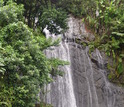
A Luquillo waterfall; such waterfalls are often found at river knickpoints.
Credit and Larger Version
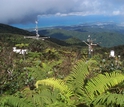
Meteorological station on a clear day in the cloud forest of Puerto Rico's Luquillo Mountains.
Credit and Larger Version
Scientists at Luquillo have shown that carbon cycling by tropical forests is sensitive to climate.
Credit and Larger Version
Representation of the complex food web in the tropical forest of the Luquillo Mountains.
Credit and Larger Versión
National Science Foundation (NSF)
Guillermo Gonzalo Sánchez Achutegui
ayabaca@gmail.com
ayabaca@yahoo.com
ayabaca@hotmail.com
Inscríbete en el Foro del blog y participa : A Vuelo De Un Quinde - El Foro!

The National Science Foundation (NSF) :Researchers discover how wildfires create their own weather .- Los investigadores descubren cómo los incendios forestales crean su propio clima

https://www.nsf.gov/discoveries/disc_summ.jsp?cntn_id=242554&WT.mc_id=USNSF_1


In a season of fast-spreading western U.S. and Canada fires, information is timely
Doppler LiDAR is measuring winds near the plume of the King Fire in California in September, 2014.

Doppler LiDAR is measuring winds near the plume of the King Fire in California in September, 2014.
Credit and Larger Version

July 20, 2017
Find related stories on NSF's geosciences risk and resilience interest area.
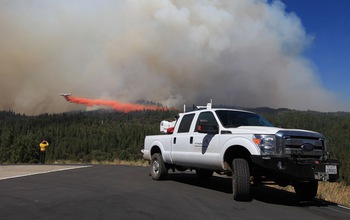
Scientists working close to the line of wildfires are obtaining a new understanding of the fires' smoke plumes. The results are providing real-time information, such as vertical wind profiles, to firefighters battling blazes.
Through this National Science Foundation (NSF)-funded research, Craig Clements, a meteorologist at San José State University (SJSU), and researcher Neil Lareau, also of SJSU, have discovered that wildfires can create their own weather, leading to extreme fire behavior.
In a paper recently published in the Journal of Applied Meteorology and Climatology, the scientists report findings from inside wildfire plumes, information previously obtained only from computer simulations.
"This research offers rare observations of the behavior of wildfire smoke plumes," says Nick Anderson, program director in NSF's Division of Atmospheric and Geospace Sciences, which supported the research. "Improved understanding of wildfire plumes is important for determining whether smoke will stay near the ground and affect air quality and visibility, or whether it will rise into the atmosphere and potentially affect clouds and the amount of sunlight reaching the ground."
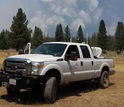
The SJSU researchers mounted Doppler LiDAR (Light Detection and Ranging, a remote-sensing method that uses light in the form of a pulsed laser to measure distances) instruments onto a pickup truck, which they placed near wildfires. "Until now," says Clements, "it has been difficult to sample wildfires with such sophisticated instruments because of logistical and safety concerns."
The team overcame that by obtaining firefighter credentials, which allowed them access to active wildfires, and by using a nimble, truck-mounted system that could be rapidly deployed. "Our work is providing new information about fire-atmosphere interactions and how wildfires spread," says Clements.
In addition to conducting research at active wildfires in the western U.S., the scientists performed controlled field experiments, setting fires and monitoring their rapid spread through an array of atmospheric instrumentation.
These studies gave the researchers information on how wildfires create their own weather systems. Those weather systems, in turn, fuel extreme fire behavior.
In their journal paper, the scientists present observations from the El Portal Fire of July, 2014, in Yosemite National Park, California.
The results revealed vigorous, fire-generated updrafts, says Clements, and strongly turbulent eddies that formed along the fire plume's edges. The data also showed that fire-modified winds extended more than one mile from the fire itself.
The findings confirm longstanding, but previously unvalidated, predictions for how plumes rise from fires, and offer new insights into the processes that control how high and how far wildfire smoke will spread. a vuelo
In addition to the El Portal Fire, the team has studied 22 other large wildfires in the western U.S.
"We're seeing a large number of fires," says Clements. "Many are extreme in terms of intensity. Higher-intensity fires cause deeper plumes, which can help spread fires by lofting embers and causing spot fires.
"That situation is dangerous for both firefighters and communities that are in the paths of fires -- like those in British Columbia and California this summer. We need more sophisticated models to better predict fire behavior, especially in a changing climate."
-- Cheryl Dybas, NSF (703) 292-7734
  cdybas@nsf.gov
-- Robin McElhatton, SJSU (408) 924-1749
  robin.mcelhatton@sjsu.edu

Investigators Craig Clements
Related Institutions/Organizations San Jose State University Foundation
Total Grants $900,337
An experimental grass fire spreads under a meteorological tower.
Credit and Larger Version
The experimental grass fire spreads through instrumentation placed in a research plot.
Credit and Larger Version
Researchers watch the El Portal Fire plume's evolution in Yosemite National Park in July, 2014.
Credit and Larger Version
The plume of California's Bald Fire is sampled with mobile Doppler LiDAR in August, 2014.
Credit and Larger Version
Scientists use a mobile atmospheric profiling system near the Eiler Fire in Calif. in July, 2014.
Credit and Larger Version
National Science Foundation (NSF)
Guillermo Gonzalo Sánchez Achutegui
ayabaca@gmail.com
ayabaca@hotmail.com
ayabaca@yahoo.com
Inscríbete en el Foro del blog y participa : A Vuelo De Un Quinde - El Foro!
domingo, 11 de junio de 2017

The National Science Foundation (NSF) : Decomposing leaves are surprising source of greenhouse gases .- La descomposición de las hojas es una fuente sorprendente de gases de efecto invernadero ....

https://www.nsf.gov/news/news_summ.jsp?cntn_id=242039&WT.mc_id=USNSF_51&WT.mc_ev=click

Scientists find new source of nitrous oxide, a potent greenhouse gas
Researchers grow maize and soybeans to generate plant material for nitrous oxide emission testing.

Researchers grow maize and soybeans to generate plant material for nitrous oxide emission testing.
Credit and Larger Version

June 5, 2017

Find related stories on NSF's Long Term Ecological Research Program.
Scientists have pinpointed a new source of nitrous oxide, a greenhouse gas that's more potent than carbon dioxide. The culprit?
Tiny bits of decomposing  in soil.
The new discovery, led by Michigan State University (MSU) researchers and funded by the National Science Foundation (NSF), is featured in the current issue of the journal Nature Geoscience.
"This study looked at the geometry of pores in soils as a key variable that affects how nitrogen moves through those soils," said Enriqueta Barrera, program director in NSF's Division of Earth Sciences, which funded the research. "Knowing this information will lead to new ways of reducing the emission of nitrous oxide from agricultural soils."
The finding could help refine nitrous oxide emission predictions and guide future agriculture and soil management practices.
"Most nitrous oxide is produced in teaspoon-sized volumes of soil, and these so-called hotspots can emit a lot of nitrous oxide quickly," said Sasha Kravchenko, an MSU plant, soil and microbial scientist and lead author of the study. "But the reason for these hotspots has mystified soil microbiologists since they were discovered several decades ago."
Part of the vexation was due, in part, to scientists looking at larger spatial scales. It's difficult to study and label an entire field as a source of greenhouse gas emissions when the source is grams of soil harboring decomposing leaves.
Changing the view from binoculars to microscopes will help improve nitrous oxide emission predictions, which traditionally are about 50 percent accurate, at best.
Nitrous oxide's climate change potential is 300 times greater than carbon dioxide, and emissions are largely driven by agricultural practices.
To unlock the secrets of nitrous oxide hotspots, Kravchenko and her team took soil samples at NSF's Kellogg Biological Station Long-term Ecological Research (LTER) site. The site is one of 28 NSF LTER sites that span ecosystems from grasslands to deserts, coral reefs to the open sea.
In partnership with scientists from the University of Chicago at Argonne National Laboratory, Kravchenko examined the soil samples at Argonne's synchrotron scanning facility, a more powerful version of a medical CT scanner.
The scanner penetrated the soil and allowed the team to accurately characterize the environments where nitrous oxide is produced and emitted.
"We found that hotspot emissions happen only when large soil pores are present," Kravchenko said. "Leaf particles in soil act as tiny sponges, soaking up water from large pores to create a micro-habitat perfect for the bacteria that produce nitrous oxide."
Areas with smaller pores produce less nitrous oxide.
Small pores, such as those in clay soils, hold water more tightly so leaf particles can't soak it up. Without additional moisture, the bacteria can't produce as much nitrous oxide. Small pores also make it harder for the gas produced to leave the soil before being consumed by other bacteria.
Next up, the researchers will study which plant leaves contribute to higher nitrous oxide emissions. Plants with more nitrogen in their leaves, such as soybeans, will likely give off more nitrous oxide as their leaves decompose. The scientists will also look at leaf and root characteristics to see how they influence emissions.
Additional MSU scientists who were part of the study include: Ehsan Toosi, Andrey Guber, Nathaniel Ostrom and Phil Robertson. Researchers from Khyber Pakhtunkhwa Agricultural University in Peshawar, Pakistan, and the Argonne National Lab also contributed to this paper.
-NSF-
Media Contacts
Cheryl Dybas, NSF, (703) 292-7734, cdybas@nsf.gov
Layne Cameron, MSU, (517) 353-8819, layne.cameron@cabs.msu.edu

Related Websites
NSF Grant: Micro-Scale Mechanisms of N2O Production in Soil:
NSF Kellogg Biological Station LTER Site: https://lter.kbs.msu.edu/

The National Science Foundation (NSF) is an independent federal agency that supports fundamental research and education across all fields of science and engineering. In fiscal year (FY) 2017, its budget is $7.5 billion. NSF funds reach all 50 states through grants to nearly 2,000 colleges, universities and other institutions. Each year, NSF receives more than 48,000 competitive proposals for funding and makes about 12,000 new funding awards.
Useful NSF Web Sites:
NSF Home Page: https://www.nsf.gov
NSF News: https://www.nsf.gov/news/
For the News Media: https://www.nsf.gov/news/newsroom.jsp
Science and Engineering Statistics: https://www.nsf.gov/statistics/
Awards Searches: https://www.nsf.gov/awardsearch/

Soil samples are scanned at Argonne National Lab to produce 3-D images.
Credit and Larger Version
Scientists examine X-ray CT images to determine soil characteristics.
Credit and Larger Version
Two-dimensional mapping of oxygen in soil samples.
Credit and Larger Version
Three-D image of a soil sample showing plant residue in green, water in blue.
Credit and Larger Version
Researchers obtain measurements of nitrous oxide from soil.
Credit and Larger Version
The National Science Foundation (NSF)
Guillermo Gonzalo Sánchez Achutegui
ayabaca@gmail.com
ayabaca@hotmail.com
ayabaca@yahoo.com
Inscríbete en el Foro del blog y participa : A Vuelo De Un Quinde - El Foro!

Mi lista de blogs