Mostrando entradas con la etiqueta Plants. Mostrar todas las entradas

domingo, 5 de marzo de 2017

The National Science Foundation (NSF) :Changes in precipitation patterns influence natural selection at global scale .- Los cambios en los patrones de precipitación influyen en la selección natural a escala global

https://www.nsf.gov/news/news_summ.jsp?cntn_id=191171&WT.mc_id=USNSF_51&WT.mc_ev=click

Climate variation plays key role in evolution of plants and animals in the wild

Red deer on Scotland's Isle of Rum, where scientists are studying precipitation change effects.

Red deer on Scotland's Isle of Rum, where scientists are studying precipitation change effects.
Credit and Larger Version

March 2, 2017
What matters more for the evolution of plants and animals, precipitation or temperature? Scientists have found a surprising answer: rain and snow may play a more important role than how hot or cold it is. a vuelo
Rainfall and snowfall patterns are changing with climate variation, which likely plays a key role in shaping natural selection, according to results published today by an international team of researchers.
Twenty scientists from the United States, Canada, Europe and Australia contributed to the study. Their results were published in the journal Science.
The team assembled a database of 168 published studies that measured natural selection over certain time periods for plant and animal populations worldwide. The results from the data set the scientists examined showed that between 20 and 40 percent of variation in selection within studies could be attributed to variability in local precipitation.
"Previous evidence from other studies indicated that climate variation might be really important in how plants and animals evolve," said lead author and University of Arkansas biologist Adam Siepielski, whose work is supported by the National Science Foundation (NSF). "We wanted to know if we could explain variation in selection across diverse plant and animal populations through a few simple climate variables. It turns out that, yes, we can."
That's significant, he says, "especially considering the global scale of the study. These results suggest that variation in selection is actually partly predictable based on climate features like precipitation."
Adds Doug Levey, program director in NSF's Division of Environmental Biology, "These results show that changes in precipitation can have surprising evolutionary effects on plants and animals worldwide."
In a time of change for rainfall, snowstorms and other forms of precipitation, plants and animals are changing, too, Siepielski said. As an example, Siepielski cited birds that live in the Galápagos Islands, called medium ground finches. The birds' beak sizes and shapes have changed over several generations.
"Differences in precipitation over years have affected the sizes of seeds available for the birds to eat," Siepielski said. "Birds that had bills well-matched to eat particular seed sizes were the ones that tended to survive."
The team found that changes in temperature had much less effect than precipitation. Siepielski called that surprising. "Temperature didn't have much explanatory power," he said. "It might act on a different scale that we couldn't pick up in the data set."
"By showing that selection was influenced by climate variation," the researchers stated in their paper, "our results indicate that climate variability may cause widespread alterations in selection regimes, potentially shifting evolution on a global scale."
Translation: what comes down as rain or snow may radically alter how some species will evolve.
-NSF-
Media Contacts Cheryl Dybas, NSF, (703) 292-7734, cdybas@nsf.gov
Bob Whitby, University of Arkansas, (479) 575-4737, whitby@uark.edu


The National Science Foundation (NSF) is an independent federal agency that supports fundamental research and education across all fields of science and engineering. In fiscal year (FY) 2016, its budget is $7.5 billion. NSF funds reach all 50 states through grants to nearly 2,000 colleges, universities and other institutions. Each year, NSF receives more than 48,000 competitive proposals for funding and makes about 12,000 new funding awards. NSF also awards about $626 million in professional and service contracts yearly.
 Get News Updates by Email 
Useful NSF Web Sites:
NSF Home Page: https://www.nsf.gov
NSF News: https://www.nsf.gov/news/
For the News Media: https://www.nsf.gov/news/newsroom.jsp
Science and Engineering Statistics: https://www.nsf.gov/statistics/
Awards Searches: https://www.nsf.gov/awardsearch/
Medium ground finch in the Galapagos, site of a study of climate and natural selection.
Credit and Larger Version
Soay sheep in driving rain in the St. Kilda Archipelago in Scotland, a research site in the study.
Credit and Larger Version
Blue-tailed damselfly in Sweden, where a long-term precipitation study has been conducted.
Credit and Larger Version
Scientists met to compare findings from their precipitation research project.
Credit and Larger Version
The National Science Foundation (NSF)
Guillermo Gonzalo Sánchez Achutegui
ayabaca@gmail.com
ayabaca@hotmail.com
ayabaca@yahoo.com
Inscríbete en el Foro del blog y participa : A Vuelo De Un Quinde - El Foro!

domingo, 1 de junio de 2014

nsf.gov - National Science Foundation - Harvesting sunlight to help feed and fuel the world

Three U.S./U.K. funded projects have been awarded a total of almost $9 million in additional funding to continue research projects aimed at improving the efficiency of photosynthesis
Field of corn in the sun
Scientists are using novel methods to explore potential new ways to boost photosynthetic efficiency.
Credit and Larger Version
May 30, 2014
Three research teams--each comprised of scientists from the United States and the United Kingdom--have been awarded a second round of funding to continue research on news ways to improve the efficiency of photosynthesis.
 
Societal benefits
The ultimate goal of this potentially high-impact research is to develop methods to increase yields of important crops that are harvested for food and sustainable biofuels. But if this research is successful, it may also be used to support reforestation efforts and efforts to increase the productivity of trees for the manufacture of wood and paper and thousands of other products that are derived from wood and chemicals extracted from trees. Another reason why photosynthesis is an important research topic: It has made the Earth hospitable for life by generating food and oxygen.
The second round of funding to the three refunded research teams is from the U.S.'s National Science Foundation (NSF) and the U.K.'s Biotechnology and Biological Sciences Research Council (BBSRC). This funding will total almost $9 million over three years. Each team is receiving additional funding because of the significant progress it achieved via its initial round of funding, which was also jointly awarded by NSF and the BBSRC in 2011.
 
Why and how can the efficiency of photosynthesis be increased?
A photosynthesizing organism uses sunlight and carbon dioxide to produce sugars that fuel the organism and release oxygen. But photosynthesis is a relatively inefficient process, usually capturing only about 5 percent of available energy, depending on how efficiency is measured. Nevertheless, some species of plants, algae and bacteria have evolved efficiency-boosting mechanisms that reduce energy losses or enhance carbon dioxide delivery to cells during photosynthesis.
Each of the three funded research teams is working, in a new and unique way, to improve, combine or engineer these types of efficiency-boosting mechanisms, so they may eventually be conferred on important crops that provide food or sustainable biofuels.
Scientists have long sought ways to increase the efficiency of photosynthesis but without, thus far, producing significant breakthroughs. The potentially transformational methods currently being pursued by the three funded teams were developed during an "Ideas Lab"--a workshop held in 2010 that was specially designed to generate innovative, potentially transformative research projects that might open longstanding bottlenecks to photosynthesis research.
If successful in helping to open such bottlenecks and generate ways to improve photosynthetic efficiency, any of the three re-funded research projects could provide critical support for efforts to address food and fuel challenges currently created by increasing human populations and other factors.
John Wingfield, NSF's assistant director for the Directorate of Biological Sciences, said, "Photosynthesis captures abundant and free solar energy and generates food and oxygen for the planet. Emerging technologies, like synthetic biology, are used in these potentially transformative projects to address the long-standing quest to increase efficiency of photosynthesis."
 
The three refunded projects:
1. Plug-and-play photosynthesis led by Anne Jones of Arizona State University: Some single-celled microbes capture solar energy and convert it to fuel for self-replication. Plug-and-play photosynthesis aims to distribute the capture and conversion of energy to two environments, so that each environment can be optimized for maximum efficiency for its role.
The plug-and-play team's overall goal is to capture unused energy, which would otherwise be dissipated, from a light-capturing photosynthetic cell--and transfer it to a second cell for fuel production. One way to carry out this energy transfer is to repurpose bacterial nanowires, which are tiny, electrically conductive wires that are present in some bacteria for reasons that are not yet completely understood.
These wires will be bioengineered to form an electrical bridge between light-capturing cells and fuel-producing cells--so that the wires will conduct energy from the former to the latter. To advance this project the plug-and-play team, together with other investigators, have corrected a false, but long accepted, mischaracterization of the biochemical composition of the bacterial nanowires and have thereby provided a new starting point for further study and engineering.
The research team is also working to develop another approach to intercellular energy transfer by creating new chemical pathways that would divert energy from the bacterial light-capturing cell to a designed biofuel-producing cell. The plug-and-play team has advanced this effort by developing a bioelectrochemical device that measures energy production by bacterial light-capturing cells.
 
2. Multi-Level Approaches for Generating Carbon Dioxide (MAGIC) led by John Golbeck of Pennsylvania State University: MAGIC is aimed at engineering a light-driven carbon dioxide pump that will increase the availability of carbon dioxide to an enzyme that promotes photosynthesis and will thereby increase photosynthetic efficiency.
To advance this effort, the team has, through genetic engineering, repurposed a light-sensitive protein, called halorhodopsin, which is found in a one-celled microbe called Natronomonas pharaonis; this protein helps the microbe maintain the correct chemical balance by pumping chloride into it. But the reengineered form of this protein instead pumps carbon dioxide, which is present as bicarbonate, into cells. To evaluate its pump's effectiveness, the team incorporated its light-driven bicarbonate pump into an artificial vesicle. This vesicle contains a dye whose brightness is proportional to carbon dioxide levels in the vesicle's interior--and therefore provides important information about the pump's usefulness. The team is preparing to incorporate its pump into plant cells to determine if resulting increases in the availability of carbon dioxide to plant cells will increase their growth.
 
3. Combining Algal and Plant Photosynthesis (CAPP) led by Martin Jonikas of Stanford University: Chlamydomonas, a unicellular algae, has a pyrenoid--a ball-shaped structure that helps the algae assimilate carbon to improve its photosynthetic efficiency. CAPP is aiming to, for the first time, transplant the algal pyrenoid and its associated components into higher plants--with hopes of improving these plants' photosynthetic efficiency and thus their productivity.
So far, the team has identified novel components of the pyrenoid. It has also made progress towards the development of a protein-based sensor that will be used to compare levels of bicarbonate in several cellular compartments in algae. This sensor will be used to help explain the algae's carbon concentrating mechanism and help evaluate the pyrenoid's effectiveness after it has been transplanted into higher plants.
 
Improving on nature
Jackie Hunter, BBSRC chief executive said, "Nature barely skims the surface when it comes to photosynthesis and making use of the sun's energy. There is huge room for improvement and these research projects are taking steps to help us to unlock hidden potential that could benefit us all. Using the sun's energy more efficiently means a greater potential to produce fuel, food, fibers, useful chemicals and much more."
Gregory Warr, an NSF program director, said, "These projects, if successful, could transform the way we generate the fuel, food, clothing and shelter that plants and microbes provide to us."
-NSF-
Media Contacts Lily Whiteman, National Science Foundation, (703) 292-8310,
lwhitema@nsf.gov
Robert Dawson, U.K. Biotechnology and Biological Sciences Research Council, 01793 413 204, Robert.Dawson@bbsrc.ac.uk
Program Contacts Gregory Warr, National Science Foundation, (703) 292-8284,
 gwarr@nsf.gov
Kent Dearn Chapman, National Science Foundation, (703) 292-7879,
The National Science Foundation (NSF) is an independent federal agency that supports fundamental research and education across all fields of science and engineering. In fiscal year (FY) 2014, its budget is $7.2 billion. NSF funds reach all 50 states through grants to nearly 2,000 colleges, universities and other institutions. Each year, NSF receives about 50,000 competitive requests for funding, and makes about 11,500 new funding awards. NSF also awards about $593 million in professional and service contracts yearly.
Useful NSF Web Sites:
NSF Home Page:
 http://www.nsf.gov
NSF News:
http://www.nsf.gov/news/
For the News Media:
 http://www.nsf.gov/news/newsroom.jsp
Science and Engineering Statistics:
 http://www.nsf.gov/statistics/
Awards Searches:
illustration showing differences between natural and in-lab photosynthetic process
Plug-and-play will separate processes into two environments connected by conductive nanowires.
Credit and Larger Version
Illustration showing a pump will transport into cells bicarbonate  that will be converted into CO2
The MAGIC team's pump will transport into cells bicarbonate (HCO3-) that will be converted into CO2.
Credit and Larger Version
 false-color electron microscopy image showing the pyrenoid of a green algea
CAPP: An algea pyrenoid appears blue and its chloroplast, a photosynthesizing unit, appears green.
Credit and Larger Versión
The National Science Foundation (NSF)
Guillermo Gonzalo Sánchez Achutegui
ayabaca@gmail.com
ayabaca@Hotmail.com
ayabaca@yahoo.com
Inscríbete en el Foro del blog y participa : A Vuelo De Un Quinde - El Foro!

miércoles, 24 de julio de 2013

nsf.gov - News - Bee Faithful? Plant-Pollinator Relationships Compromised When Bee Species Decline

Removing even one bumblebee species from an ecosystem affects plant reproduction.-
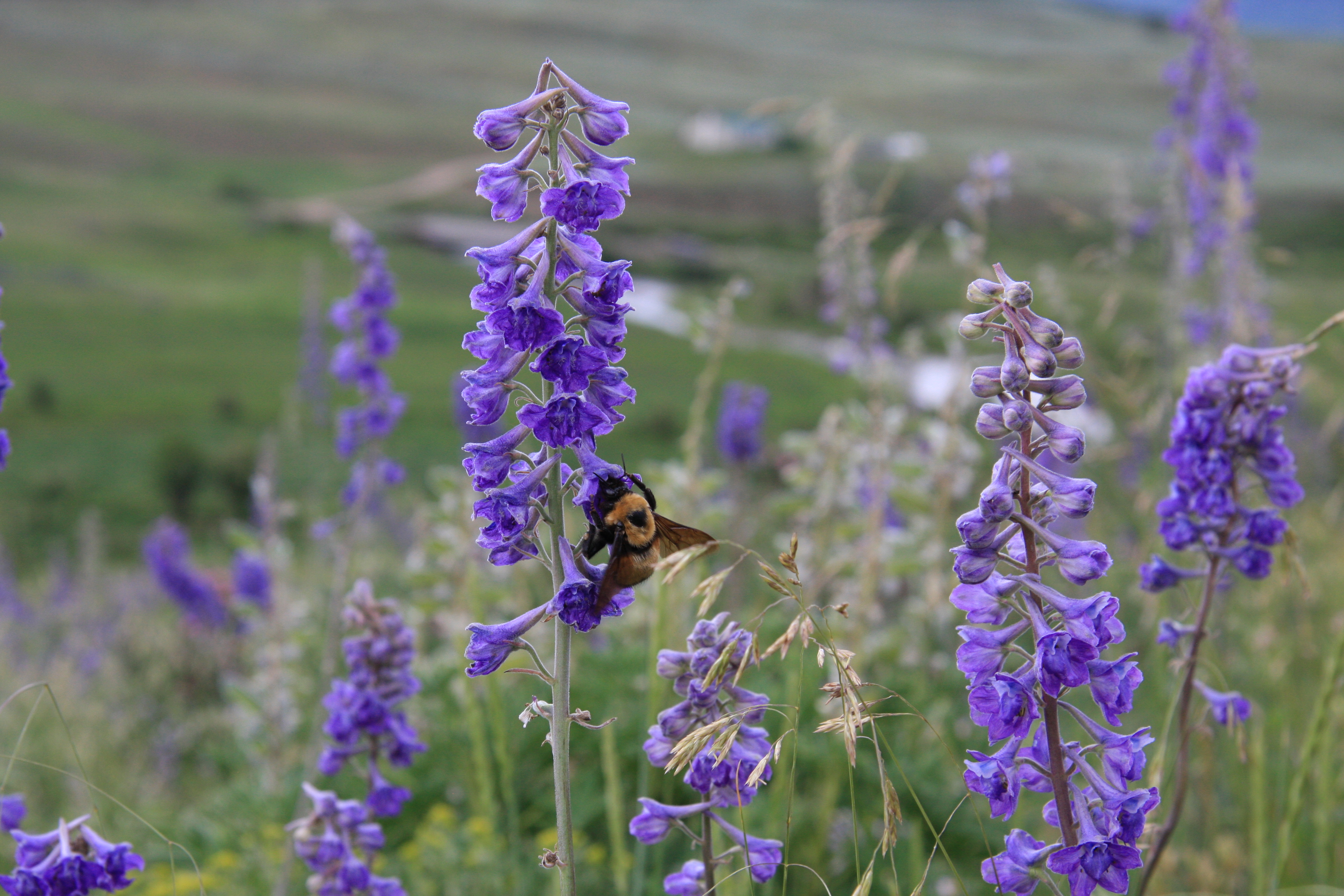
Bumble bee foraging on tall larkspur
Bumble bee foraging on tall larkspur near the Rocky Mountain Biological Laboratory in Colorado.
Credit: Karen Levy, Emory University
Download the high-resolution JPG version of the image. (3.9 MB)
Photo of field with bagged flowers of tall larkspur
Bagged flowers of tall larkspur, used to assess effects of pollinator removal on plants.
Credit: Karen Levy, Emory University
Download the high-resolution JPG version of the image. (7 MB)
Scientist Berry Brosi removes pollen from bumble bees in a field in Gunnison County, Colo.
Credit: Karen Levy, Emory University
Download the high-resolution JPG version of the image. (3.6 MB)
Researchers sample bumble bees in a subalpine meadow in Colorado.
Credit: Karen Levy, Emory University
Download the high-resolution JPG version of the image. (5.9 MB)
Biologist Therese Lamperty holding a bumble bee in a glass tube.
Biologist Therese Lamperty assists with the bumble bee species removal experiment.
Credit: Karen Levy, Emory University
Download the high-resolution JPG version of the image. (4.1 MB)
Close-up of bumble bee in a glass tube
Close-up of bumble bee removed during an experiment and later released unharmed.
Credit: Karen Levy, Emory University
Download the high-resolution JPG version of the image. (3.3 MB)

Remove even one bumblebee species from an ecosystem and the effect is swift and clear: Pollination is less effective, and plants produce significantly fewer seeds.
This according to research published today in the journal Proceedings of the National Academy of Sciences that focuses on the interactions between bumblebees and larkspur wildflowers in Colorado's Rocky Mountains.
The findings show that reduced competition among pollinators disrupts floral fidelity, or specialization, among the remaining bees in the system, leading to less successful plant reproduction.
"We found that these wildflowers produce one-third fewer seeds in the absence of just one bumblebee species," says Emory University ecologist Berry Brosi, who led the study.
"That's alarming and suggests that global declines in pollinators could have a bigger effect on flowering plants and food crops than was previously realized."
The National Science Foundation (NSF) funded the research; the paper was co-authored by ecologist Heather Briggs of the University of California-Santa Cruz.
"This study shows that the loss of a single bee species can harm pollination and reproduction of all flowering plant species in an ecosystem," says Alan Tessier, program director in NSF's Division of Environmental Biology, which funded the research.
"What's equally impressive is the demonstration of the mechanisms--that the loss of a single species changes the foraging behavior of all the remaining bee species."
About 90 percent of plants need animals, mostly insects, to transfer pollen between them so they can fertilize and reproduce.
Bees are by far the most important pollinators worldwide and have co-evolved with the floral resources they need for nutrition.
During the past decade, however, scientists have reported dramatic declines in populations of some bee species.
Some studies have indicated that plants can tolerate losing most pollinator species in an ecosystem as long as other pollinators remain to take up the slack. Those studies, however, were based on theoretical computer modeling.
Brosi and Briggs were curious about whether this theoretical resilience would hold up in real-life scenarios.
The team conducted field experiments to learn how the removal of a single pollinator species would affect the plant-pollinator relationship.
"Most pollinators visit several plant species over their lifetimes, but often will display what we call floral fidelity over shorter time periods," Brosi says.
"They'll tend to focus on one plant while it's in bloom, then a few weeks later move on to the next species in bloom. You might think of them as serial monogamists."
Floral fidelity clearly benefits plants, because a pollinator visit will only lead to plant reproduction when the pollinator is carrying pollen from the same plant species.
"When bees are 'promiscuous,' visiting plants of more than one species during a single foraging session, they are much less effective as pollinators," Briggs says.
The researchers conducted their experiments at the Rocky Mountain Biological Laboratory near Crested Butte, Colo.
Located at 9,500 feet, the facility's subalpine meadows are too high for honeybees, but they are buzzing during the summer months with bumblebees.
The experiments focused on the interactions of the insects with larkspurs, dark purple wildflowers that are visited by 10 of the 11 bumblebee species there.
The researchers studied a series of 20-meter-square wildflower plots, evaluating each one in both a control state, left in its natural condition, and in a manipulated state, in which nets were used to remove the bumblebees of just one species.
The researchers then observed bumblebee behavior in both the control plots and the manipulated plots.
"We'd literally follow around the bumblebees as they foraged," Briggs says. "It's challenging because the bees can fly pretty fast."
Sometimes the researchers could only record between five and 10 movements, while in other cases they could follow the bees to 100 or more flowers.
"When we caught bees to remove target species from the system, or to swab their bodies for pollen, we released them unharmed," Brosi says.
No researchers were harmed either, he adds. "Stings were very uncommon during the experiments. Bumblebees are quite gentle on the whole."
Across the steps of the pollination process, from patterns of bumblebee visits to plants, to picking up pollen, to seed production, the researchers saw a cascading effect of removing one bee species.
While about 78 percent of the bumblebees in the control groups were faithful to a single species of flower, only 66 percent of the bumblebees in the manipulated groups showed such floral fidelity.
The reduced fidelity in manipulated plots meant that bees in those groups carried more types of pollen than those in the control groups.
The changes had direct implications for plant reproduction: Larkspurs produced about one-third fewer seeds when one of the bumblebee species was removed, compared to larkspurs in the control groups.
"The small change in the level of competition made the remaining bees more likely to 'cheat' on the larkspur," Briggs says.
While previous research has shown how competition drives specialization within a species, the bumblebee study is one of the first to link this mechanism to the broader functioning of an ecosystem.
"Our work shows why biodiversity may be key to the conservation of an entire ecosystem," Brosi says.
"It has the potential to open a whole new set of studies into the implications of interspecies interactions."
-NSF-

Media Contacts Cheryl Dybas, NSF (703) 292-7734
 cdybas@nsf.gov
Beverly Cox Clark, Emory University (404) 712-8780

Related WebsitesNSF News: Where Have All the Flowers Gone?:
http://www.nsf.gov/news/news_summ.jsp?cntn_id=119843
NSF Article: It's Wildflower Season on Mountain Peaks, But Alpine Plants May Soon Miss the Date:
 http://www.nsf.gov/discoveries/disc_summ.jsp?cntn_id=124767&org=NSF
NSF News: Where Have All the Hummingbirds Gone?:

The National Science Foundation (NSF) is an independent federal agency that supports fundamental research and education across all fields of science and engineering. In fiscal year (FY) 2012, its budget was $7.0 billion. NSF funds reach all 50 states through grants to nearly 2,000 colleges, universities and other institutions. Each year, NSF receives about 50,000 competitive requests for funding, and makes about 11,500 new funding awards. NSF also awards about $593 million in professional and service contracts yearly.
Useful NSF Web Sites:
NSF Home Page:
http://www.nsf.gov
NSF News:
http://www.nsf.gov/news/
For the News Media:
 http://www.nsf.gov/news/newsroom.jsp
Science and Engineering Statistics:

The National Science Foundation (NSF),-
 
Guillermo Gonzalo Sánchez Achutegui
ayabaca@gmail.com
ayabaca@hotmail.com
ayabaca@yahoo.com
Inscríbete en el Foro del blog y participa : A Vuelo De Un Quinde - El Foro!

domingo, 6 de enero de 2013

nsf.gov - National Science Foundation - Life in the Fast Lane: Racing to Identify Species as Biodiversity Shrinks

A conversation about conserving and naming species.-
 http://www.nsf.gov/news/mmg/media/images/ocean-h.jpg
Without significant changes, more than 50 percent of the world's marine species may be perched on the brink of extinction by 2100, according to UNESCO.
Credit: Dan Norton (for commercial use, contact photobank@coral.org)
Download the high-resolution JPG version of the image. (1.1 MB)
 http://www.nsf.gov/news/mmg/media/images/DAPHNE-h.jpg
 Daphne Fautin searches for new organisms while conducting a marine survey.
Credit: Rita Tan of www.wildsingapore.com
Download the high-resolution JPG version of the image. (272 KB)
 graphic with headphones and text audio only
Name that Species! A conversation about conserving, finding and naming species with NSF Program Manager Daphne Fautin
Credit: National Science Foundation
Download the high-resolution JPG version of the image. (8 KB)
A little more than 39 years ago, on December 28, 1973, the Endangered Species Act was enacted to conserve threatened and endangered species and their ecosystems. To honor this anniversary, Daphne Fautin of the National Science Foundation answered questions about biodiversity.
As a marine biologist, Fautin has literally gone to the ends of the Earth--from the poles to the tropics--to study marine life. She is currently a program manager at the National Science Foundation, a professor of ecology and evolutionary biology at the University of Kansas, and a commissioner with the International Commission on Zoological Nomenclature, which produces rules on giving scientific names to animals.
What is biodiversity?
Biodiversity--short for "biological diversity"--is the variety and abundance of plants, animals and other living things on Earth and in particular locations. Biodiversity is absolutely essential to ecosystem health. And human survival depends on the health of our planet's ecosystem.
Rain forests and coral reefs are known for their biodiversity. Why is so much biodiversity concentrated in these types of ecosystems?
More than 25 percent of the world's fish species and between nine and 12 percent of all of the world's fisheries are associated with coral reefs. More than half of the world's plant and animal species live in rainforests.
We don't know for sure why rain forests and coral reefs harbor so much biodiversity. One idea is that these ecosystems occur in tropical climates, and so they are quite climatically consistent year-round.
According to this idea, tropical organisms diverged because they don't have to deal with the climatic extremes that organisms at higher latitudes (and altitudes) do. A rabbit, for example, that lives in a non-tropical place must be able to eat certain plants in the summer and certain other plants in the winter. Therefore, it must remain a generalist to survive.
By contrast, a rabbit that lives in the tropics may specialize in eating certain plants that are available year-round; at the same time, other species of rabbits (or other organisms) may evolve that specialize in eating other plants. Such specialization promotes diversity.
But some evidence does refute this idea--such as the fact that not all groups of plants and animals demonstrate more diversity in the tropics than at higher latitudes. So, many other ideas have also been proposed to explain the extraordinary biodiversity of the tropics.
Insects account for a large proportion of the biodiversity on Earth. Why?
Many statistics bear out the biodiversity of insects. For example, more than 850,000 insect species have been named. And the total estimated weight of just ants in the Amazon is four times the estimated weight of all land vertebrates in the Amazon--including all mammals, birds, reptiles and amphibians!
We don't really know why insects account for so much of the Earth's biodiversity. That is one of the questions that is being studied by entomologists--the people who research insects.
One idea is that insects began to diversify when flowering plants evolved on Earth, and so insects evolved along with flowering plants because they are so important in the pollination of plants.
Insects tend to be small and specialized: So there may be a certain insect that sucks out the cell sap from the stems of a particular plant; other insects that eat that plant's leaves; other insects that feed on that plant's nectar; and other insects that feed on that plant's pollen and pollinate the plant in the process. So as flowers evolved, many insects evolved as well.
This idea about the evolutionary connections between flowering plants and insects is consistent with what we see in the oceans: Relatively few species of flowering plants live in the oceans, and relatively few species of insects live in the oceans.
(By the way, NSF recently issued a press release that identified some interesting reasons why humans need insects--even pesky ones.)
How many species have been described and named by scientists, so far?
The Encyclopedia of Life estimates that there are 1.9 million known eukaryotic organisms. (Eukaryotic organisms are those that are made of one or more cells with a nucleus; bacteria and viruses are not eukaryotic organisms.)
How many species exist on Earth?
Estimates range from 2 million species to 10 million species.
A recent estimate of 8.7 million species received a lot of press, in part, I suspect, because of its supposed accuracy and because it corresponds quite well to the often-bandied figure that 80 percent of the Earth's biodiversity has yet to be discovered/named. The Encyclopedia of Life states that "at least four times" the number of known species exist on Earth. Based on its own figures, this translates to around 8 million species.
A paper estimating the number of marine species (which I contributed to) was recently published. According to this paper, 226,000 species that live in the ocean have been named and described by scientists, and 72,000 additional species are in collections waiting to be named and described.
But who knows what hasn't been collected yet? And of course, as I previously mentioned, oceans have few insects, but insects account for the bulk of biodiversity.
How can scientists estimate the total number of species on Earth when it is obviously impossible to count what has not yet been counted. In other words, how can we know what we don't know?
People have used various creative methods to estimate the total number of organisms on Earth. For example, there was a very large estimate made years ago by a scientist who went to the jungles of Panama and used insecticide to spray a tree in the jungle. Then, lots of insects died and fell from the tree to the ground. And the scientist and his colleagues identified and counted as many of these fallen insects as they could, and the rest were counted as unknown. Then, the scientist extrapolated from the proportion of species in that one tree that were known vs. unknown to produce a global estimate of known vs. unknown species.
It was good first try. But a lot of people point to the fact that in many parts of the world, the proportion of known species to unkown species is higher than it is in Panama. So this fact would suggest that the estimate may be excessive.
In 2011, an NSF-funded researcher provided the first empirical evidence of what had been long suspected: That biodiversity promotes water quality. What are some of the other reasons why need biodiversity?
We need biodiversity to eat, we need to preserve species that we use as food, including fish from the sea. We also need to preserve those species that serve as food for the fish we eat, so that our food supply persists. And we also need to preserve all the species that create the habitat that enables all of these needed species to live, spawn, and raise their young.
So, there are all of these connections in the great "web of life" that we don't even know yet. And these connections support all of the species on Earth, including species that provide us with food and clothing.
Also, 50 percent of the oxygen we breathe is produced by microscopic plants that live in the ocean and the other 50 percent is produced by plants that live on land.
(If you want to learn more about the ways in which the various species of plants help humans survive, watch this dynamic, upbeat video produced by NSF.)
The planet's ecosystem is sometimes compared to an airplane. You can lose one rivet from an airplane, and the airplane will probably fly. You can lose two rivets for an airplane and the airplane will still probably fly. But eventually, if you lose too many rivets (how many?), the plane will crash.
The same principle applies to ecology: You can lose some species without major harm. But no one knows how many species can be lost before the planet's ecosystem will crash.
What does it mean to discover a new species?
A new species is one that hasn't yet been formally described and named according to scientific procedures--not one that is newly evolved.
People on the street or people in the jungle may have a name for it. But if we haven't followed the internationally recognized rules of nomenclature for describing and naming a species, it doesn't exist for certain scientific purposes.
When we have discovered a new species, it means we have finally found and gone through the procedures of formally describing it (distinguishing it from other species) and giving it a name following the rules of nomenclature.
How many new species are named each year?
Between 15,000 and 20,000 new species are named each year.
A species may be discovered and collected before it is described and named. But it isn't recognized as a new, distinct species until it is described and named.
How many species go extinct each year?
We don't know. The World Wildlife Fund's Web site says that experts have calculated that between .01 percent and .10 percent of all species on Earth go extinct each year.
But because we don't know how many species there are, we don't know how many species those percentages actually represent. And so, if the low estimate of the number of species on Earth is true--if there are around 2 million species on our planet--then between 200 and 2,000 extinctions occur each year.
But if, in fact, there really are 10 million species on Earth, then between 10,000 and 100,000 extinctions occur each year.
What would you say to naysayers who argue that newly discovered species offset species losses, and so there really is no extinction crisis?
"New" species are not newly evolved. They evolved a long time ago. They are simply being newly discovered by science. They may be very well known to the people living in the areas where they live. So they aren't new in that sense; they are only new to those of us who name them.
What does the process of naming a species involve?
It can be long, protracted and difficult process that can take many years. First, you want to be sure that the animal or plant hasn't been named before.
This can be difficult for a variety of reasons. For one thing, many descriptions that were prepared in the early days were very vague. And usually, only small groups of experts have the specialized expertise to know what has and hasn't been described before.
And in order to name a species, you also have to describe it. To do this, you have to know what kinds of features are used to identify species, and figure out what distinguishes the "new" species from known species. This is important, because at least according to the rules of zoological nomenclature, when you publish a description of a new species, you have to write out what makes it different from everything that is already known--including organisms that are not closely related to it, but that look like it anyway.
For example, suppose you have an organism that has a red spot; then you have to distinguish your "new" species from everything that is red-spotted, even if those other red-spotted species are not closely related to your species. That way, when somebody comes across your species, they can say, "AHA! This is another one of those red-spotted organisms that is covered by that new name; it's not another thing with red spots."
Other rules in the codes of nomenclature require you to name species in Latin or make them sound like Latin. You also have make sure a specimen of your species is deposited in a natural history collection (typically in a museum or herbarium). If the "new" species is an animal, you may also have to register the name in ZooBank.
And then you have to publish your description of the species in a scientific journal, so that other scientists can look at it and agree that it is correct.
It is interesting to note that names that are accepted are frequently later "sunk" for various reasons. For example, when the exhaustive homework that is required for describing and naming a "new" species is not conducted in a comprensive and thorough way, it may ultimately turn out that the "new" species has already been described and named.
Alternatively, a name for a "new" species may be sunk because the difference that was thought to distinguish it from others does not hold up. For example, I have a colleague who described several coral reef fish as "new"--only to ultimately discover that the "new" species was a member of a species for which only one sex had previously identified. So the "new" species was really just a female (or male) of a known species!
Do you have to be a professional taxonomist to identify and name new species?
About half of the species that are named each year are named by people who aren't employed as taxonomists--whose job isn't in a museum or university. In fact, some of the people with the most expertise and time to do this are not professionals in the field.
For example, I knew a dentist who is one of the world's foremost authorities on tiger beetles. He had earned a master's degree in entomology. And then he realized that if he had gone into academic entomology, he would be spending his time teaching, writing grant proposals and doing administrative work--but he wanted to catch tiger beetles.
And so he went into dentistry so that he could make enough money to take time off each year to catch tiger beetles. He probably thereby ended up being able to spend more time chasing tiger beetles as a dentist than he would have if he had become a professional entomologist.
A new species of frog was recently identified by an NSF-funded researcher right smack in New York City. Is that common for new species to be discovered in such populated places?
I think that it is quite common for new species to be found in populated areas.
In the summer of 2012, an NSF-funded researcher named a new coral reef crustacean after Bob Marley, the singer. Is that unusual for species to be named after celebrities?
It may be less common than it used to be.
Many years ago, it would be common for a patron to fund the travels of a scientist to exotic places, and then species that were found during those travels would be named for the patron.
Tell me about one of the big problems that is reducing biodiversity in the oceans?
We have depleted the oceans of many of the big fish that we eat.
Part of the reason we are able to overfish is due to technology. We have fish-finders: various types of tracking devices, including sonar equipment, and airplanes that are used to help find schools of fish. And we now know enough about marine biology to predict where fish and crustaceans will be under particular conditions. Fishing is no longer about a fisherman just saying, I'll drop a line here or there." Fishing has become very scientific and methodical.
When we trawl, we drag nets along the ocean floor. And whatever else gets swept by these nets in addition to the target fish is called "bycatch." This bycatch gets thrown back into the ocean because we are not licensed to take it or because it's not profitable to take.
But how many organisms can manage to survive after being caught in a big net, pulled up and then thrown back into the ocean? What's more, trawling destroys habitat; after the ocean floor has been trawled, it may no longer be a suitable home for what is thrown back.
The analogous situation on land would be if we flew an airplane that dragged a big net across the ground to catch grazing cattle. And we would draw up the net periodically--and keep the cattle, but toss back the dogs, trees and everything else that we happened to net in addition to the cattle. That is similar to what we do to the oceans.
Many people assume that it is necessarily better to consume farmed fish and shrimp than wild caught fish and shrimp. But many fish and shrimp farming practices are also harmful to the environment. Just because it is farmed doesn't mean that it is environmentally neutral or preferred over wild caught.
Can you cite any "good news" stories in biodiversity?
I read the other day that we have lost 97 percent of wild tigers in just over a century. Only about 3,200 tigers currently remain in the wild. We can infer that the populations of many smaller species are plummeting just like populations of many large species are plummeting.
But I am happy to say that a few species have come off the endangered species list, like the wolf and the bald eagle, because plans for their recovery were enacted.
Also, there are "good news" stories in the history of whales. Many of them were hunted to the brink of extinction, and then they were listed as endangered. It therefore became legally, socially and economically difficult to harvest whales, and so populations of many whale species have fortunately recovered.
These kinds of successes show that if we stop harvesting species, and if their habitat is conserved, life is resilient and endangered species may recover.
Additional Resources
To learn more about biodiversity and help promote conservation:
--  Lily Whiteman, National Science Foundation (703) 292-8310 lwhitema@nsf.gov
Investigators
Daphne Fautin 
Guillermo Gonzalo Sánchez Achutegui
ayabaca@gmail.com
ayabaca@hotmail.com
ayabaca@yahoo.com  
 Inscríbete en el Foro del blog y participa : A Vuelo De Un Quinde - El Foro!

Mi lista de blogs