Mostrando entradas con la etiqueta Tropical forests. Mostrar todas las entradas

domingo, 23 de julio de 2017

MEDIO AMBIENTE : National Science Foundation (NSF) .- Can an ancient ocean shoreline set the stage for a tropical forest of today? .- ¿Puede un antiguo litoral del mar establecer el escenario para un bosque tropical de hoy?

https://www.nsf.gov/discoveries/disc_summ.jsp?cntn_id=242383&WT.mc_id=USNSF_1

Researchers at NSF Critical Zone Observatory and Long-Term Ecological Research sites are finding out.
Dawn mist covers NSF's Luquillo Critical Zone Observatory and Long-Term Ecological Research sites.

Dawn mist covers NSF's Luquillo Critical Zone Observatory and Long-Term Ecological Research sites.
Credit and Larger Version

July 11, 2017
Find related stories on NSF's Critical Zone Observatory Sites. Find related stories on NSF's Long-Term Ecological Research Sites.
Could an ancient ocean shoreline determine what a tropical forest looks like today? National Science Foundation (NSF)-supported researchers are working to answer that question.
Their study is taking place in the rainforest-covered Luquillo Mountains of eastern Puerto Rico, where two NSF research stations are co-located: the Luquillo Critical Zone Observatory (CZO) and the Luquillo Long-Term Ecological Research (LTER) site.
There geoscientist Jane Willenbring of the Scripps Institution of Oceanography at the University of California, San Diego, and ecologist Maria Uriarte of Columbia University in New York have joined forces to determine how the formation of the Luquillo Mountains and their subsequent weathering resulted in today's Luquillo rainforest ecosystem.
 
Where geology and ecology meet
 
More than 4 million years ago, plate tectonics and the movement of Earth's crust in the Caribbean transformed low-elevation islands into the high Luquillo Mountains.
As the islands rose from the sea, bedrock in these newly-formed mountains was deeply eroded by rivers, especially at lower elevations.
"As a result, the uplands have different soils than those on the slopes lower down," says Uriarte. "There are pronounced changes in erosion rates, soil mineralogy and soil fertility between the upper and lower regions."
The underlying geology determines how fast the soils erode, according to Willenbring. "And erosion sets the tempo for how quickly minerals and nutrients are ferried to the surface," she says. "These minerals and nutrients, in turn, feed the forest above. It's surprising how connected the landscape is. It seems as though the trees understand geomorphology."
 
Life in the critical zone
 
"What lies beneath Earth's surface has a visible influence on ecosystems above," says Richard Yuretich, NSF CZO program director. "For example, geologists often use trees to map underlying bedrock. New relationships between the subsurface and what's above it are emerging from research on what's called the critical zone."
The critical zone is, in essence, where rock meets life. It extends from the top of the tree canopy to the base of weathered bedrock.
The minerals in the soil, the soil's ability to hold and circulate water, and the types of microbes living there all contribute to the viability of a forest's plant and animal communities, Yuretich says. These, in turn, determine how fast the underlying bedrock breaks down and how nutrients are recycled in an ecosystem.
"Geology and biology are inseparable when it comes to regulating Earth's environment," says Yuretich.
Scientist Peter Groffman of the City University of New York agrees. "The idea that 'what goes on below' can influence surface ecosystems' structure, function and response to environmental change has far-reaching scientific implications," stated Groffman at the June 5-6, 2017, NSF CZO principal investigators meeting. Groffman, chair of the LTER Science Council, a group that coordinates research activities in the LTER Network, discussed connections between the LTER and CZO networks.
 
Above -- and below -- Luquillo
 
These links are motivating researchers to ask questions such as how a humid, tropical location like Luquillo could experience a drought; in 2015, Luquillo did just that.
"If I were to tell you that a forest received more than 6 feet of rain in one year, you might be surprised that it was also a time of severe drought," says Louis Kaplan, an NSF LTER program director who participated in a panel discussion at the CZO principal investigators meeting. "For the forests of the Luquillo Mountains, where 11 feet of rain each year is the norm, 2015 was indeed a historic drought."
Long-term research at Luquillo is enabling scientists to consider 2015 in the context of decades of tropical forest studies, Kaplan says, and to conclude that 2015's low rainfall was an outlier.
Researchers at Luquillo also recently discovered that the combined disturbances of hurricanes and human land-use decisions can lead to forests with new compositions of tree species. Beyond drought, hurricanes and human land-use, however, what ultimately drives which tree species make up a forest may be what lies under them.
 
Remote sensing leads to on-the-ground insights
 
Along with scientists Jeffrey Wolf of Columbia University, Gilles Brocard of the University of Sydney in Australia, and Stephen Porder of Brown University, Willenbring and Uriarte published initial results of their underground-to-forest investigations in the journal Remote Sensing.
To unearth the connections between bedrock and trees, the researchers looked to the distant past.
Puerto Rico is an island located near the northern boundary of the Caribbean Plate. "Most of its landmass emerged from the ocean approximately 4.2 million years ago, converting an archipelago of low-elevation islands and surrounding marine platforms into high mountaintops," wrote the scientists in Remote Sensing.
The remains of one such marine platform surround the Luquillo Mountains. The platform encloses what's left of a paleoisland, "El Yunque Island," whose peak today reaches 1,100 meters (3,609 feet). El Yunque is a remnant of an ancient supervolcano named Hato Puerco. The volcano was one of the region's largest and most active volcanoes during the Cretaceous period 145 to 66 million years ago.
 
Fast-forward to the present
 
With LiDAR (Light Detection and Ranging, a method that uses light in the form of a pulsed laser to measure distances), the scientists discovered an abrupt 10-meter (33-foot) decline in forest height across Luquillo's long-ago shoreline, but only where there are rocks formed of hard quartz diorite. There the soils are shallow, and trees have difficulty gaining a foothold and finding nutrients -- so they don't grow as high.
The researchers also found that knickpoints, areas with sharp changes in a river's slope, are where changes in forest composition take place. Nutrients in soils above and below knickpoints, which are partially controlled by the type of bedrock beneath, may be the answer to the different forest heights the scientists observed.
"The finding has led to a new understanding of the role of geology in structuring the forest ecosystem of the Luquillo Mountains," says Uriarte.
Adds Kaplan, "This is the first example of bedrock being linked to tropical forest structure. These results are just the beginning of synergies emerging at the interface of CZO and LTER science."
Field campaign to link ancient shorelines with today's forests
The scientists have launched a field campaign to answer the next question: What factors are contributing to the abrupt changes in Luquillo's forest height? A shift in tree species composition may be one answer.
The researchers are determining whether tree communities living at higher and lower elevations than the ancient shoreline are different, and whether lower-elevation species can migrate upslope, given the low fertility of the higher-elevation soils that lie atop hard quartz diorite.
"That's important because rapid upslope migrations of plant species are happening in tropical mountain ranges as a result of climate change," says Uriarte. When it gets hot at lower elevations, plants and animals start moving to higher, cooler spots.
Adds Willenbring, "If the soils on which tropical mountain forests grow play a strong role in which trees make up those forests, geology adds a layer of complexity in projecting species or entire community migrations to higher elevations in response to warming."
The Luquillo field campaign is centered on remote sensing, and conducted with partners from the U.S. Department of Energy and NASA's Goddard Space Flight Center. The results will lead to the identification of tree species over an entire mountain.
The findings will be important in the management and conservation of forest ecosystems, say Kaplan, Yuretich and other scientists, and to predicting the future of tropical forests in a changing world.
-- Cheryl Dybas, NSF (703) 292-7734
 cdybas@nsf.gov
Water flows along what scientists call a knickpoint: a change in the slope of a river.
Credit and Larger Version
LiDAR map of Luquillo's Rio Blanco watershed (green), streams (blue), and knickpoints (yellow).
Credit and Larger Version
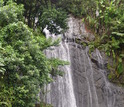
A Luquillo waterfall; such waterfalls are often found at river knickpoints.
Credit and Larger Version
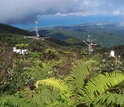
Meteorological station on a clear day in the cloud forest of Puerto Rico's Luquillo Mountains.
Credit and Larger Version
Scientists at Luquillo have shown that carbon cycling by tropical forests is sensitive to climate.
Credit and Larger Version

Representation of the complex food web in the tropical forest of the Luquillo Mountains.
Credit and Larger Versión
National Science Foundation (NSF)
Guillermo Gonzalo Sánchez Achutegui
ayabaca@gmail.com
ayabaca@yahoo.com
ayabaca@hotmail.com
Inscríbete en el Foro del blog y participa : A Vuelo De Un Quinde - El Foro!

domingo, 15 de mayo de 2016

NSF: Natural regeneration of tropical forests helps global climate mitigation and forest restoration.- La regeneración natural de los bosques tropicales ayuda a mitigar el cambio climático global y la restauración de los bosques

Hola amigos: A VUELO DE UN QUINDE EL BLOG., la Fundación Nacional de Ciencias de Los Estados Unidos, nos alcanza la información que hay una regeneración natural de bosques tropicales en América Latina, que de alguna manera ayudan a mitigar el cambio climático global.
More information..........

New study looks at 43 regions in Latin America

Photo of small patches of tropical dry forest  on hills
Small patches of tropical dry forest are regrowing spontaneously in a former pastureland.
Credit and Larger Version
May 13, 2016
This article is the ninth in a series on NSF's Long Term Research in Environmental Biology (LTREB) awards. Visit parts one, two, three, four, five, six , seven and eight.
Climate scientists have long recognized the importance of forest conservation and forest regrowth in climate mitigation and carbon sequestration -- capturing carbon dioxide (CO2) from the atmosphere. But the detailed information required to make accurate estimates of this potential has remained elusive.
Now, an international team of 60 scientists, working together as the 2ndFOR Network, has completed studies on the effects of forest conservation and secondary forest regeneration across 43 regions in Latin America.
In an article titled "Carbon sequestration potential of second-growth forest regeneration in the Latin American tropics," published today in the journal Science Advances, University of Connecticut ecologist and evolutionary biologist Robin Chazdon and her colleagues report a series of new findings.
 
Long-term studies
 
"This study uses knowledge gained from long-term studies of tropical forests to address a pressing societal need," says Saran Twombly, program director in the National Science Foundation (NSF) Division of Environmental Biology, which funded the research through NSF's Long Term Research in Environmental Biology, and Dynamics of Coupled Natural and Human Systems, programs. "It shows that natural processes alone can provide a solution to the excess carbon dioxide threatening the planet."
The studies aimed to model the areas covered by regrowth forests across the lowlands of the Latin American Tropics in two age classes; to project potential above-ground carbon storage in these young forests over four decades; and to illustrate alternative scenarios for carbon storage where 0-80 percent of these forests are allowed to regenerate.
Chazdon says that "this research is vital because actively growing vegetation takes carbon dioxide out of the atmosphere and converts it to plant tissues such as wood and leaves. Old-growth forests contain large stocks of carbon in their biomass. When these forests are cleared and burned, this carbon is released into the atmosphere, contributing to global warming. This is one of the main reasons why it is important to halt deforestation."
But scientists have also learned that when forests regrow, their carbon stocks in above-ground biomass increase over time, depending on climate, prior land use and features of the surrounding landscape.
"This regrowth can happen without planting trees, through the spontaneous process of natural regeneration," says Chazdon. "This is a low-cost way of restoring forests and of reaching carbon mitigation goals."
Major findings
Among the major findings of the study are:
  • Models of forest age in 2008 show that 17 percent of the forest area in lowland Latin America consists of young second-growth forest (1-20 years) and 11 percent consists of intermediate age forest (20-60 years).
  • Assuming that 100 percent of the second growth persists and regenerates over 40 years, carbon storage capacity doubles in young second growth and increases by 120 percent in intermediate age forests. In both forest age classes, a net gain of 8.48 trillion kilograms of carbon is stored over 40 years.
  • This amount is equivalent to 31.09 trillion kilograms of CO2, which equals all the carbon emissions from fossil fuel use and other industrial processes in all the countries of Latin America and the Caribbean from 1993 to 2014.
  • Ten countries account for 95 percent of this carbon storage potential, led by Brazil, Colombia, Venezuela and Mexico.
Forest-based climate change solutions
Chazdon says that, remarkably, this huge amount of carbon storage doesn't require costly tree plantings or conversion of farmlands. "It is all based on natural forest regrowth and only requires persistence and protection of the young forests and abandoned agricultural fields."
Forest-based solutions provide many other benefits, including hydrologic regulation, habitats and corridors for conserving biodiversity, and provision of non-timber forest products to local people, Chazdon says.
Prior carbon storage efforts have placed emphasis on avoiding deforestation. But, Chazdon says, "avoiding deforestation and supporting forest regeneration are complementary and mutually reinforcing activities."
While forest regeneration and protection alone cannot fully compensate for greenhouse gas emissions on a global scale, researchers say the study affirms that this strategy can contribute significantly toward reaching national and international carbon mitigation targets.
-NSF-
Media Contacts Cheryl Dybas, NSF, (703) 292-7734,cdybas@nsf.gov
Sheila Foran, UCONN, (860) 486-5385,
Related WebsitesNSF Grant: LTREB: Successional Pathways and Rates of Change in Tropical Forests of Brazil, Costa Rica and Mexico:
 http://www.nsf.gov/awardsearch/showAward?AWD_ID=1147429&HistoricalAwards=false
NSF Grant: CNH: The Emergence of Adaptive Governance Arrangements for Tropical Forest Ecosystems:
The National Science Foundation (NSF) is an independent federal agency that supports fundamental research and education across all fields of science and engineering. In fiscal year (FY) 2016, its budget is $7.5 billion. NSF funds reach all 50 states through grants to nearly 2,000 colleges, universities and other institutions. Each year, NSF receives more than 48,000 competitive proposals for funding and makes about 12,000 new funding awards. NSF also awards about $626 million in professional and service contracts yearly.
Useful NSF Web Sites:
NSF Home Page:
 http://www.nsf.gov
NSF News:
http://www.nsf.gov/news/
For the News Media:
 http://www.nsf.gov/news/newsroom.jsp
Science and Engineering Statistics:
 http://www.nsf.gov/statistics/
Awards Searches:
http://www.nsf.gov/awardsearch/
Cattle on pasture and a forest in the background in Chiapas, Mexico.
Pasture with young second-growth forest in the background in Chiapas, Mexico.
Credit and Larger Version
An 18-year-old second-growth wet tropical forest in Costa Rica that was once a pasture.
Credit and Larger Version
Photo of rainforest at Rio Cachoiera Nature Reserve in Brazil.
Extensive natural regeneration of Atlantic rainforest at Rio Cachoiera Nature Reserve in Brazil.
Credit and Larger Version
Old-growth Atlantic rainforest in background with second-growth in foreground in Bahia, Brazil.
Credit and Larger Version
The National Science Foundation (NSF)
Guillermo Gonzalo Sánchez Achutegui
ayabaca@gmail.com
ayabaca@hotmail.com
ayabaca@yahoo.com
Inscríbete en el Foro del blog y participa : A Vuelo De Un Quinde - El Foro!

domingo, 22 de septiembre de 2013

nsf.gov - National Science Foundation - Tropical forest carbon sink hinges on 'odd couple'


Unique housing arrangement between trees and bacteria
Tropical rainforest on Barro Colorado Island, Panama.
Tropical rainforest on Barro Colorado Island, Panama, near the site of the study.
Credit and Larger Version
September 16, 2013
A unique housing arrangement between a specific tree species and carbo-loading bacteria may determine how well tropical forests can absorb carbon dioxide from the atmosphere, says new research today in an advance online publication of the journal Nature.
The findings suggest that the role of tropical forests in offsetting the atmospheric buildup of carbon from fossil fuels depends on tree diversity, particularly in forests recovering from exploitation.
Tropical forests thrive on natural nitrogen fertilizer pumped into the soil by trees in the legume family, a diverse group of plants that includes beans and peas, the researchers report.
"Fast-growing nitrogen-fixing trees are not common outside of the tropics, but are found in surprisingly high diversity there," said Henry Gholz, program director in the National Science Foundation's (NSF) Division of Environmental Biology, which funded the research.
"These findings place the trees' ability to capture atmospheric nitrogen and to use it to stimulate growth in the context of long-term tropical forest development," Gholz said. "This process not only allows these trees to get out of the gate quickly after a disturbance, but to maintain dominance decades to centuries later."
The researchers studied recovering forests in Panama that had been exploited five to 300 years earlier.
The presence of legume trees ensured rapid forest growth, and thus a substantial carbon sink, in the first 12 years of recovery.
Tracts of land that were pasture only 12 years before had already accumulated as much as 40 percent of the carbon found in fully mature forests. Legumes contributed more than half the nitrogen needed to make that happen.
These fledgling woodlands had the capacity to store 50 metric tons of carbon per hectare, which equates to roughly 185 tons of carbon dioxide, or the exhaust of some 21,285 gallons of gasoline.
That much fuel would take the average car in the United States more than half a million miles.
Though the legumes' nitrogen fertilizer output waned in later years, the species nonetheless took up carbon at rates that were up to 9 times faster than non-legume trees.
The legumes' secret is a process known as "nitrogen fixation" carried out in concert with infectious bacteria known as rhizobia, which dwell in small pods, known as root nodules, inside the tree's roots.
As a nutrient, nitrogen is essential for plant growth, but tropical soil is short on nitrogen and surprisingly non-nutritious for trees.
Legumes use secretions to invite rhizobia living in the soil to infect their roots, and the bacteria signal back to initiate nodule growth.
The rhizobia move into the root cells of the host plant and--in exchange for carbohydrates produced by photosynthesis in the tree--convert nitrogen from the air into fertilizer plants need.
Excess nitrogen from the legume eventually creates a nitrogen cycle that benefits neighboring trees.
By nurturing bigger, healthier trees that take up more carbon, legumes have a newly realized importance when it comes to influencing atmospheric carbon dioxide, said paper co-author Lars Hedin of Princeton University.
Scientists recently assigned numbers to track how much carbon forests as a whole absorb, suggesting that the world's forests took up 2.4 quadrillion tons of carbon from 1990 to 2007.
"Tropical forests are a huge carbon sink," said Hedin.
"If trees could just grow and store carbon, you could have a rapid sink, but if they don't have enough nitrogen they don't take up carbon," he said, adding that nitrogen-fixing trees are uncommon in temperate forests such as those in most of North America and Europe.
"Legumes are a group of plants that perform a valuable function in tropical forests, but no one knew how much they help with the carbon sink," Hedin said. "This work shows that the level of biodiversity in a tropical forest determines the size of the carbon sink."
First author Sarah Batterman of Princeton said that legumes, or "nitrogen-fixers," are especially important for forests recovering from agricultural use, logging, fire or other human activities.
The researchers studied 16 forest plots that were formerly pasture and are maintained by the Smithsonian Tropical Research Institute (STRI).
Forest degradation, however, comes with a loss of biodiversity that can affect nitrogen-fixers, too, even though legumes are not specifically threatened, Batterman said.
If the number and diversity of nitrogen-fixers plummet, the health of the surrounding forest would likely be affected for a long time, she said.
"This study shows that there is an important place for nitrogen-fixation in these disturbed areas," Batterman said.
"Nitrogen-fixers are a component of biodiversity and are important for the function of these forests, but we don't know enough about how this valuable group of trees influences forests. While some species may thrive on disturbance, others may be sensitive to human activities."
The researchers found that the nine legume species they studied did not contribute nitrogen to surrounding trees at the same time.
Certain species were more active in the youngest forests, others in middle-aged forests, and still other species went into action mainly in 300-year-old tracts, though not nearly to the same extent as legumes in younger plots.
The researchers found that individual trees reduced their fixation as nitrogen accumulated in soils, with the number of legumes actively "fixing" nitrogen dropping from 71 to 23 percent between 12- and 80-year-old forests.
"The diversity of species present in the forest is critical because it ensures that there can be fixation at different time periods of forest recovery," Batterman said.
"If you were to lose one of those species and it turned out to be essential for a specific time period, fixation might drop dramatically."
Such details can improve what scientists know about future climate change, Batterman said.
Computer models that calculate the global balance of atmospheric carbon dioxide also must factor in sinks that offset carbon, such as tropical forests.
And if forests take up carbon differently depending on the abundance and diversity of legumes, models should reflect that variation, she said.
"Other researchers can now put this role of nitrogen-fixation into their models and improve predictions about the carbon sink," Batterman said.
Batterman and Hedin worked with Michiel van Breugel and Jefferson Hall at STRI, Johannes Ransijn at the University of Copenhagen and Dylan Craven at Yale University.
The work was also supported by grants from the National Oceanic and Atmospheric Administration; the Smithsonian Tropical Research Institute; and the Cooperative Institute for Climate Science and the Carbon Mitigation Initiative, both at Princeton University.
-NSF-
Media Contacts Cheryl Dybas, NSF (703) 292-7734
cdybas@nsf.gov
Morgan Kelly, Princeton University (609) 258-5729
Related WebsitesNSF Grant: Biogeochemical Controls on Nitrogen Fixation in a Diverse Neotropical Forest: http://www.nsf.gov/awardsearch/showAward?AWD_ID=0614116&HistoricalAwards=false
The National Science Foundation (NSF) is an independent federal agency that supports fundamental research and education across all fields of science and engineering. In fiscal year (FY) 2012, its budget was $7.0 billion. NSF funds reach all 50 states through grants to nearly 2,000 colleges, universities and other institutions. Each year, NSF receives about 50,000 competitive requests for funding, and makes about 11,500 new funding awards. NSF also awards about $593 million in professional and service contracts yearly.
Useful NSF Web Sites:
NSF Home Page:
 http://www.nsf.gov
NSF News:
 http://www.nsf.gov/news/
For the News Media:
 http://www.nsf.gov/news/newsroom.jsp
Science and Engineering Statistics:

Map showing the location of Barro Colorado Island, Panama.
Map marking the location of Barro Colorado Island, Panama.
Credit and Larger Version
Rainforests on Barro Colorado Island
Rainforests like this one on Barro Colorado Island depend on an "odd couple" relationship.
Credit and Larger Version
Symbiotic root nodules in a lowland tropical rainforest
Symbiotic root nodules in a lowland tropical rainforest in Panama.
Credit and Larger Version
Photo of houses on Barro Colorado Island where the researchers studied tropical forests.
The station on Barro Colorado Island where the researchers studied tropical forests.
Credit and Larger Version
Photo of a red-eyed tree frog.
Tropical forests on Barro Colorado Island are home to such animals as red-eyed tree frogs.
Credit and Larger Version

The National Science Foundation (NSF)
Guillermo Gonzalo Sánchez Achutegui

domingo, 4 de agosto de 2013

nsf.gov - Back to the future: Scientists look into Earth's "Deep Time" to predict future effects of climate change

Express concern for Earth's ability to handle rapid changes.-

Credit and Larger Version

Graphic illsutration showing a spiral with geological time periods
Time spiral: looking back through time to understand future climate change.
Credit: NASA
Download the high-resolution JPG version of the image. (104 KB)

A selection of fungi displayed on a table
Scientists are conducting research on organisms from large to small, here a selection of fungi.
Credit: Wikimedia Commons
Download the high-resolution JPG version of the image. (2.6 MB)

Image of a forested area in a mountenous zone.
Researchers are studying climate change effects on organisms and on ecosystems.
Credit: Wikimedia Commons
Download the high-resolution JPG version of the image. (361 KB)

Image of wheat field with rolls of hey and poppies
Will pollinators and other species be able to keep up with the pace of climate change?
Credit: Wikimedia Commons
Download the high-resolution JPG version of the image. (5.4 MB)

Tropical forests in the Amazon
Tropical forests in places like the Amazon may be hard-hit by future climate change.
Credit: Wikimedia Commons
Download the high-resolution JPG version of the image. (333 KB)

cover of Science magazine
The researchers' findings are described in the Aug. 2, 2013, issue of Science.
Credit: Copyright AAAS, 2013
Download the high-resolution JPG version of the image. (228 KB)

 
Climate change alters the way in which species interact with one another--a reality that applies not just to today or to the future, but also to the past, according to a paper published by a team of researchers in this week's issue of the journal Science.
"We found that, at all time scales, climate change can alter biotic interactions in very complex ways," said paleoecologist Jessica Blois of the University of California, Merced, the paper's lead author.
"If we don't incorporate this information when we're anticipating future changes, we're missing a big piece of the puzzle."
Blois asked for input from researchers who study "deep time," or the very distant past, as well as those who study the present, to help make predictions about what the future holds for life on Earth as climate shifts.
Co-authors of the paper are Phoebe Zarnetske of Yale University, Matthew Fitzpatrick of the University of Maryland, and Seth Finnegan of the University of California, Berkeley.
"Climate change and other human influences are altering Earth's living systems in big ways, such as changes in growing seasons and the spread of invasive species," said Alan Tessier, program director in the National Science Foundation's (NSF) Division of Environmental Biology, which co-funded the research with NSF's Division of Earth Sciences.
"This paper highlights the value of using information about past episodes of rapid change from Earth's history to help predict future changes to our planet's ecosystems."
Scientists are seeing responses in many species, Blois said, including plants that have never been found in certain climates--such as palms in Sweden--and animals like pikas moving to higher elevations as their habitats grow too warm.
"The worry is that the rate of current and future climate change is more than species can handle," Blois said.
The researchers are studying how species interactions may change between predators and prey, and between plants and pollinators, and how to translate data from the past and present into future models.
"One of the most compelling current questions science can ask is how ecosystems will respond to climate change," said Lisa Boush, program director in NSF's Division of Earth Sciences.
"These researchers address this using the fossil record and its rich history," said Boush. "They show that climate change has altered biological interactions in the past, driving extinction, evolution and the distribution of species.
"Their study allows us to better understand how modern-day climate change might influence the future of biological systems and the rate at which that change will occur."
While more research is needed, Blois said, changes can be observed today as well as in the past, although it's harder to gather information from incomplete fossil records.
Looking back, there were big changes at the end of major climate change periods, such as the end of the last Ice Age when large herbivores went extinct.
Without those mega-eaters to keep certain plants at bay, new communities of flora developed, most of which in turn are now gone.
"People used to think climate was the major driver of all these changes," Blois said, "but it's not just climate. It's also extinction of the megafauna, changes in the frequency of natural fires, and expansion of human populations. They're all linked."
People are comfortable with the way things have been, said Blois. "We've known where to plant crops, for example, and where to find water."
Now we need to know how to respond, she said, to changes that are already happening--and to those coming in the near future.
-NSF-
Media Contacts Cheryl Dybas, NSF (703) 292-7734
cdybas@nsf.gov
Lorena Anderson, UC-Merced (209) 228-4406
The National Science Foundation (NSF) is an independent federal agency that supports fundamental research and education across all fields of science and engineering. In fiscal year (FY) 2012, its budget was $7.0 billion. NSF funds reach all 50 states through grants to nearly 2,000 colleges, universities and other institutions. Each year, NSF receives about 50,000 competitive requests for funding, and makes about 11,500 new funding awards. NSF also awards about $593 million in professional and service contracts yearly.
Useful NSF Web Sites:
NSF Home Page: http://www.nsf.gov
NSF News: http://www.nsf.gov/news/
For the News Media: http://www.nsf.gov/news/newsroom.jsp
Science and Engineering Statistics: http://www.nsf.gov/statistics/
Awards Searches: http://www.nsf.gov/awardsearch/
 

The National Science Foundation (NSF).-
Guillermo Gonzalo Sánchez Achutegui
ayabaca@gmail.com
ayabaca@hotmail.com
ayabaca@yahoo.com
Inscríbete en el Foro del blog y participa : A Vuelo De Un Quinde - El Foro!

Mi lista de blogs