Mostrando entradas con la etiqueta The Herschel Space Observatory. Mostrar todas las entradas

viernes, 9 de mayo de 2014

NASA : NASA Simulator Successfully Recreates Space Dust


Scanning Electron Microscope image of a large aggregate of nanograins
Scanning Electron Microscope image of a large (approximately 1.5 micrometer diameter) aggregate of nanograins produced in the Cosmic Simulation Chamber at NASA's Ames Research Center, using a 95 percent Ar – 5% C2H2 gas mixture. The nanograins and aggregates are deposited onto ultra-high vacuum aluminum foil.
Image Credit: NASA/Ames/Farid Salama
 
A team of scientists at NASA's Ames Research Center in Moffett Field, Calif., has successfully reproduced, right here on Earth, the processes that occur in the atmosphere of a red giant star and lead to the formation of planet-forming interstellar dust.
Using a specialized facility, called the Cosmic Simulation Chamber (COSmIC) designed and built at Ames, scientists now are able to recreate and study in the laboratory dust grains similar to the grains that form in the outer layers of dying stars. Scientists plan to use the dust to gather clues to better understand the composition and the evolution of the universe.
Dust grains that form around dying stars and are ejected into the interstellar medium lead, after a life cycle spanning millions of years, to the formation of planets and are a key component of the universe's evolution. Scientists have found the materials that make up the building blocks of the universe are much more complicated than originally anticipated.
"The harsh conditions of space are extremely difficult to reproduce in the laboratory, and have long hindered efforts to interpret and analyze observations from space," said Farid Salama, project leader and a space science researcher at Ames. "Using the COSmIC simulator we can now discover clues to questions about the composition and the evolution of the universe, both major objectives of NASA's space research program."
In the past, the inability to simulate space conditions in the gaseous state prevented scientists from identifying unknown matter. Because conditions in space are vastly different from conditions on Earth, it is challenging to identify extraterrestrial materials. Thanks to COSmIC, researchers can successfully simulate gas-phase environments similar to interstellar clouds, stellar envelopes or planetary atmospheres environments by expanding gases using a cold jet spray of argon gas seeded with hydrocarbons that cools down the molecules to temperatures representative of these environments.
COSmIC integrates a variety of state-of-the-art instruments to allow scientists to recreate space conditions in the laboratory to form, process and monitor simulated planetary and interstellar materials. The chamber is the heart of the system. It recreates the extreme conditions that reign in space where interstellar molecules and ions float in a vacuum at densities that are billionths of Earth's atmosphere, average temperatures can be less than -270 degrees Fahrenheit (about 100 degrees Kelvin), and the environment is bathed in ultraviolet and visible radiation emanating from nearby stars.
"By using COSmIC and building up on the work we recently published in the Astrophysical Journal August 29, 2013, we now can for the first time truly recreate and visualize in the laboratory the formation of carbon grains in the envelope of stars and learn about the formation, structure and size distribution of stellar dust grains," said Cesar Contreras of the Bay Area Environmental Research (BAER) Institute and a research fellow at Ames. "This type of new research truly pushes the frontiers of science toward new horizons, and illustrates NASA's important contribution to science."
The team started with small hydrocarbon molecules that it expanded in the cold jet spray in COSmIC and exposed to high energy in an electric discharge. They detected and characterized the large molecules that are formed in the gas phase from these precursor molecules with highly sensitive detectors, then collected the individual solid grains formed from these complex molecules and imaged them using Ames' Scanning Electron Microscope (SEM).
"During COSmIC experiments, we are able to form and detect nanoparticles on the order of 10 nm size, grains ranging from 100-500 nanometers and aggregates of grains up to 1.5 micrometers in diameter, about a tenth the width of a human hair, and observe their structure with SEM, thus sampling a large size distribution of the grains produced," said Ella Sciamma-O'Brien, of the BAER Institute and a research fellow at Ames.
These results have important implications and ramifications not only for interstellar astrophysics, but also for planetary science. For example, they can provide new clues on the type of grains present in the dust around stars. That in turn, will help us understand the formation of planets, including Earth-like planets. They also will help interpret astronomical data from the Herschel Space Observatory, the Stratospheric Observatory for Infrared Astronomy (SOFIA) and the ground-based Atacama Large Millimeter/submillimeter Array observatory in Chile.
"Today we are celebrating a major milestone in our understanding of the formation and the nature of cosmic dust grains that bears important implications in this new era of exoplanets discoveries," concluded Salama.
This work is funded through the Laboratory Astrophysics Carbon-in-the-Galaxy consortium program, an element of the Astrophysics Division's Astrophysics Research and Analysis program in NASA's Science Mission Directorate at NASA Headquarters in Washington and is supported by Ames' Advanced Studies Laboratories, a partnership between Ames and the University of California in Santa Cruz.
For more information about COSmIC, visit:
For more information about Ames, visit:
NASA
Guillermo Gonzalo Sánchez Achutegui

domingo, 13 de mayo de 2012

: Astronomy: Active Black Hole Squashes Star Formation

Hi My Friends:A VUELO DE UN QUINDE EL BLOG., New data from the Herschel Space Observatory shows that galaxies with the most powerful, active, supermassive black holes at their cores produce fewer stars than galaxies with less ones.

Download Image
› Full Size
› 1600 x 1200
› 1024 x 768
› 800 x 600
Active Black Hole Squashes Star Formation
New data from the Herschel Space Observatory shows that galaxies with the most powerful, active, supermassive black holes at their cores produce fewer stars than galaxies with less ones.

Supermassive black holes are believed to reside in the hearts of all large galaxies. When gas falls upon these monsters, the materials are accelerated and heated around the black hole, releasing great torrents of energy. In the process, active black holes often generate colossal jets that blast out twin streams of heated matter.

Inflows of gas into a galaxy also fuel the formation of new stars. In a new study of distant galaxies, Herschel helped show that star formation and black hole activity increase together, but only up to a point. Astronomers think that if an active black hole flares up too much, it starts spewing radiation that prevents raw material from coalescing into new stars.

This artist concept of the local galaxy Arp 220, captured by the Hubble Space Telescope, helps illustrate the Herschel results. The bright core of the galaxy, paired with an overlaid artist's impression of jets emanating from it, indicate that the central black hole's activity is intensifying. As the active black hole continues to rev up, the rate of star formation will, in turn, be suppressed in the galaxy. Astronomers want to further study how star formation and black hole activity are intertwined.

Herschel is a European Space Agency cornerstone mission, with science instruments provided by consortia of European institutes, with important participation by NASA.

Image Credit: NASA/JPL-Caltech
Guillermo Gonzalo Sánchez Achutegui
ayabaca@gmail.com
ayabaca@hotmail.com
ayabaca@yahoo.com
Inscríbete en el Foro del blog y participa : A Vuelo De Un Quinde - El Foro!

jueves, 10 de mayo de 2012

Astronomy: Overfed Black Holes Shut Down Galactic Star-Making

Hi My Friends: A VUELO DE UN QUINDE EL BLOG., The Herschel Space Observatory has shown galaxies with the most powerful, active black holes at their cores produce fewer stars than galaxies with less active black holes. The results are the first to demonstrate black holes suppressed galactic star formation when the universe was less than half its current age. He
rschel is a European Space Agency-led mission with important NASA contributions.

This artistically modified image of the local galaxy Arp 220, captured by the Hubble Space Telescope, helps illustrate the Herschel results. Image credit: NASA/JPL-Caltech     › Full image and caption

Download Image

› Full Size
› 1600 x 1200
› 1024 x 768
› 800 x 600

Artist's Concept - Active Black Hole Squashes Star Formation

The Herschel Space Observatory has shown that galaxies with the most powerful, active, supermassive black holes at their cores produce fewer stars than galaxies with less active black holes.

Supermassive black holes are believed to reside in the hearts of all large galaxies. When gas falls upon these monsters, the materials are accelerated and heated around the black hole, releasing great torrents of energy. In the process, active black holes often generate colossal jets that blast out twin streams of heated matter.

Inflows of gas into a galaxy also fuel the formation of new stars. In a new study of distant galaxies, Herschel helped show that star formation and black hole activity increase together, but only up to a point. Astronomers think that if an active black hole flares up too much, it starts spewing radiation that prevents raw material from coalescing into new stars.

This artistically modified image of the local galaxy Arp 220, captured by the Hubble Space Telescope, helps illustrate the Herschel results. The bright core of the galaxy, paired with an overlaid artist's impression of jets emanating from it, indicate that the central black hole's activity is intensifying. As the active black hole continues to rev up, the rate of star formation will, in turn, be suppressed in the galaxy. Astronomers want to further study how star formation and black hole activity are intertwined.
Image credit: NASA/JPL-Caltech

PASADENA, Calif. -- The Herschel Space Observatory has shown galaxies with the most powerful, active black holes at their cores produce fewer stars than galaxies with less active black holes. The results are the first to demonstrate black holes suppressed galactic star formation when the universe was less than half its current age. He
rschel is a European Space Agency-led mission with important NASA contributions.
"We want to know how star formation and black hole activity are linked," said Mathew Page of University College London's Mullard Space Science Laboratory in the United Kingdom and lead author of a paper describing these findings in this week's journal Nature. "The two processes increase together up to a point, but the most energetic black holes appear to turn off star formation."
Supermassive black holes, weighing as much as millions of suns, are believed to reside in the hearts of all large galaxies. When gas falls upon these monsters, the material is accelerated and heated around the black hole, releasing great torrents of energy. Earlier in the history of the universe, these giant, luminous black holes, called active galactic nuclei, were often much brighter and more energetic. Star formation was also livelier back then.
Studies of nearby galaxies suggest active black holes can squash star formation. The revved-up, central black holes likely heat up and disperse the galactic reservoirs of cold gas needed to create new stars. These studies have only provided "snapshots" in time, however, leaving the overall relationship of active galactic nuclei and star formation unclear, especially over the cosmic history of galaxy formation.
"To understand how active galactic nuclei affect star formation over the history of the universe, we investigated a time when star formation was most vigorous, between eight and 12 billion years ago," said co-author James Bock, a senior research scientist at NASA's Jet Propulsion Laboratory in Pasadena, Calif., and co-coordinator of the Herschel Multi-tiered Extragalactic Survey. "At that epoch, galaxies were forming stars 10 times more rapidly than they are today on average. Many of these galaxies are incredibly luminous, more than 1,000 times brighter than our Milky Way."
For the new study, Page and colleagues used Herschel data that probed 65 galaxies at wavelengths equivalent to the thickness of several sheets of office paper, a region of the light spectrum known as far-infrared. These wavelengths reveal the rate of star formation, because most of the energy released by developing stars heats surrounding dust, which then re-radiates starlight out in far-infrared wavelengths.
The researchers compared their infrared readings with X-rays streaming from the active central black holes in the survey's galaxies, measured by NASA's Chandra X-ray Observatory. At lower intensities, the black holes' brightness and star formation increased in sync. However, star formation dropped off in galaxies with the most energetic central black holes. Astronomers think inflows of gas fuel new stars and supermassive black holes. Feed a black hole too much, however, and it starts spewing radiation into the galaxy that prevents raw material from coalescing into new stars.
"Now that we see the relationship between active supermassive black holes and star formation, we want to know more about how this process works," said Bill Danchi, Herschel program scientist at NASA Headquarters in Washington. "Does star formation get disrupted from the beginning with the formation of the brightest galaxies of this type, or do all active black holes eventually shut off star formation, and energetic ones do this more quickly than less active ones?"
Herschel is a European Space Agency cornerstone mission, with science instruments provided by consortia of European institutes and important participation by NASA. NASA's Herschel Project Office is based at JPL. JPL contributed mission-enabling technology for two of Herschel's three science instruments. The NASA Herschel Science Center, part of the Infrared Processing and Analysis Center at Caltech, supports the United States astronomical community. Caltech manages JPL for NASA.
For NASA's Herschel website,
visit http://www.nasa.gov/herschel . For ESA's Herschel website, visit http://www.esa.int/SPECIALS/Herschel/index.html .
Guillermo Gonzalo Sánchez Achutegui
ayabaca@gmail.com
ayabaca@hotmail.com
ayabaca@yahoo.com
Inscríbete en el Foro del blog y participa : A Vuelo De Un Quinde - El Foro!

Astronomía: Cygnus-X: Herschel nos muestra al ‘cisne’ en todo su esplendor

Hola amigos: A VUELO DE UN QUINDE EL BLOG., Una caótica maraña de filamentos de polvo y gas conforma la matriz donde se está formando una nueva generación de estrellas masivas, tal y como se puede ver en esta impresionante imagen de Cygnus-X, tomada por el telescopio espacial Herschel de la ESA.

Download:
 HI-RES JPEG (Size: 2381 kb)


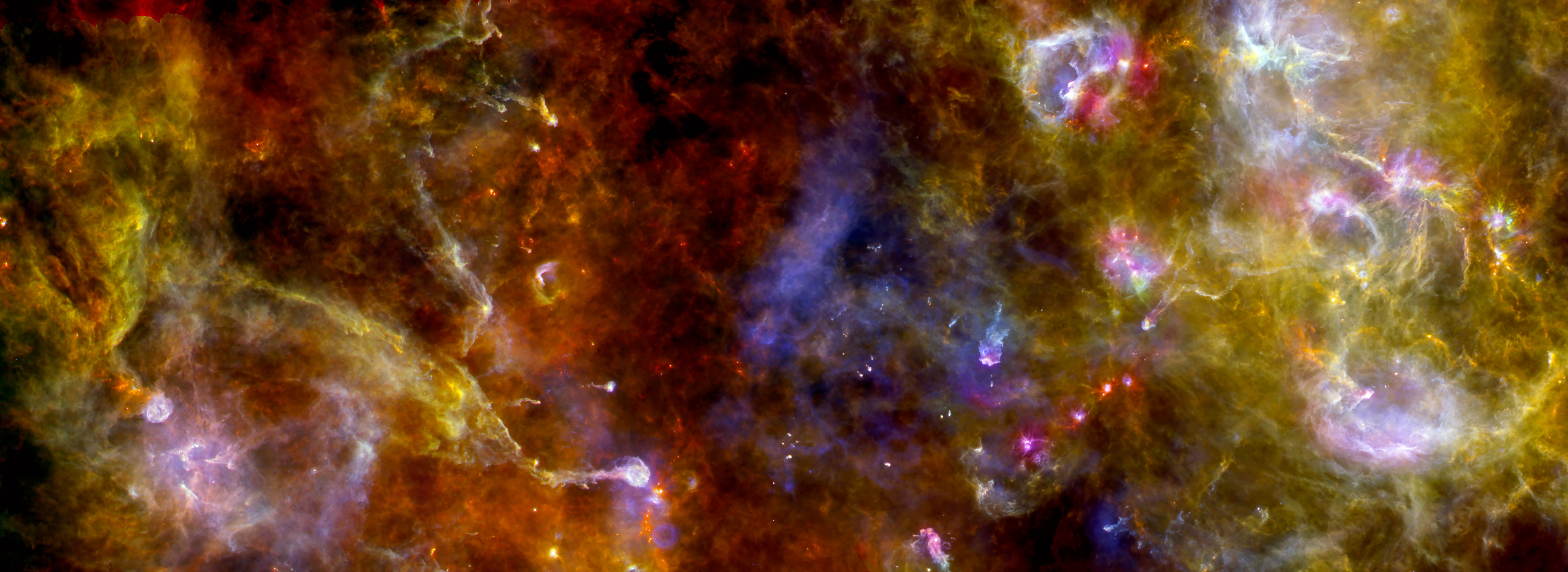
This new view of the Cygnus-X star-formation region by Herschel highlights chaotic networks of dust and gas that point to sites of massive star formation.
The image combines data acquired with the PACS instrument at 70 micron (corresponding to the blue channel) and 160 micron (corresponding to the green channel) and with the SPIRE instrument at 250 micron (corresponding to the red channel). The observations were made on 24 May 2010 and 18 December 2010. North is to the lower-right and east to the upper-right.

Credits: ESA/PACS/SPIRE/Martin Hennemann & Frédérique Motte, Laboratoire AIM Paris-Saclay, CEA/Irfu – CNRS/INSU – Univ. Paris Diderot, France.

Una caótica maraña de filamentos de polvo y gas conforma la matriz donde se está formando una nueva generación de estrellas masivas, tal y como se puede ver en esta impresionante imagen de Cygnus-X, tomada por el telescopio espacial Herschel de la ESA.
http://www.esa.int/SPECIALS/Herschel/SEMCOITWT1H_0.html
Cygnus-X es una región de formación de estrellas extremadamente activa, ubicada a unos 4,500 años-luz de la Tierra, en la constelación de Cygnus, el Cisne.
Gracias a la capacidad de Herschel para captar luz en la banda del infrarrojo lejano, los astrónomos pueden estudiar regiones como ésta, en las que las estrellas fueron calentando lentamente el polvo que las rodeaba, agrupándolo en densos cúmulos en los que se continuarán forjando nuevas estrellas.
Los tonos blancos marcan aquellas zonas en las que no hace mucho que se formaron nuevas estrellas a partir de nubes turbulentas de polvo y gas, como las que se pueden ver en la mitad derecha de la imagen.
En esa región, los filamentos de polvo y gas se entrelazan y colapsan, dando lugar a densos nudos en los que se formarán nuevas estrellas. Por otra parte, la inmensa radiación emitida por las estrellas recién nacidas es capaz de arrastrar el material que las rodea, creando una burbuja a su alrededor.
En el centro de la imagen, la intensa radiación y los fuertes vientos emitidos por las estrellas, que permanecen ocultas a estas longitudes de onda, han calentado y despejado parcialmente el medio interestelar, que brilla en un tono azulado.
La parte izquierda de la imagen está dominada por un gran pilar de gas, cuya forma recuerda al cuello de un cisne.  

Download:
 HI-RES JPEG (Size: 7952 kb)


An annotated version of Herschel’s view of Cygnus-X highlighting numerous dense sites of new star formation in the right-hand complex, and the swan-like structure in the left-hand portion of the scene. Powerful radiation and winds from thousands of stars in the OB2 complex undetected at Herschel’s long wavelengths have partly cleared and heated surrounding material, visible as the diffuse blue glow in the centre of the image. A supergiant star identified as G79.29+0.46 has likely ejected the ring of material seen at the bottom of the image.
Credits: ESA/PACS/SPIRE/Martin Hennemann & Frédérique Motte, Laboratoire AIM Paris-Saclay, CEA/Irfu – CNRS/INSU – Univ. Paris Diderot, France.

Cerca de la esquina inferior derecha se puede distinguir una inmensa burbuja de polvo y gas, que parece haber sido expulsada por una estrella súper masiva que se encuentra en su centro, aunque no se pueda ver directamente en esta imagen.
Las hileras de objetos rojos y compactos esparcidas por toda la imagen se corresponden con las semillas, todavía frías, de lo que terminará convirtiéndose en una nueva generación de estrellas.
Esta imagen demuestra la extraordinaria capacidad de Herschel para estudiar el proceso de formación de las estrellas masivas, y de su influencia sobre el medio interestelar que las rodea, con un nivel de detalle sin precedentes en la banda del infrarrojo lejano.
ESA.
Guillermo Gonzalo Sánchez Achutegui
ayabaca@gmail.com
ayabaca@hotmail.com
ayabaca@yahoo.com
Inscríbete en el Foro del blog y participa : A Vuelo De Un Quinde - El Foro!

jueves, 12 de abril de 2012

Astronomy: Herschel spots comet massacre around nearby star

Hi My Friends: A VUELO DE UN QUINDE EL BLOG., ESA’s Herschel Space Observatory has studied the dusty belt around the nearby star Fomalhaut. The dust appears to be coming from collisions that destroy up to thousands of icy comets every day. This image shows the infrared emission from the young star Fomalhaut and the dust disc surrounding it, as recorded with ESA's Herschel Space Observatory at a wavelength of 70 micron. To explain the emission from Fomalhaut's debris disc, astronomers invoke a steady production of dust particles via comet collisions, with an average rate of 2000 daily collisions between comets of one kilometre across or, alternatively, of 2 daily collisions between 10-kilometre-diameter comets.

Credits: ESA/Herschel/PACS/Bram Acke, KU Leuven, Belgium
ESA’s Herschel Space Observatory has studied the dusty belt around the nearby star Fomalhaut. The dust appears to be coming from collisions that destroy up to thousands of icy comets every day. Fomalhaut is a young star, just a few hundred million years old, and twice as massive as the Sun. Its dust belt was discovered in the 1980s by the IRAS satellite, but Herschel’s new images of the belt show it in much more detail at far-infrared wavelengths than ever before.
Bram Acke, at the University of Leuven in Belgium, and colleagues analysed the Herschel observations and found the dust temperatures in the belt to be between –230 and –170ºC. However, because Fomalhaut is slightly off-centre and closer to the southern side of the belt, the southern side is warmer and brighter than the northern side.
Both the narrowness and asymmetry of the belt are thought to be due to the gravity of a possible planet in orbit around the star, as suggested by earlier Hubble Space Telescope images.
The Herschel data show that the dust in the belt has the thermal properties of small solid particles, with sizes of only a few millionths of a metre across.
But this created a paradox because the Hubble Space Telescope observations suggested solid grains more than ten times larger.
Those observations collected starlight scattering off the grains in the belt and showed it to be very faint at Hubble’s visible wavelengths, suggesting that the dust particles are relatively large. But that appears to be incompatible with the temperature of the belt as measured by Herschel in the far-infrared.
To resolve the paradox, Dr Acke and colleagues suggest that the dust grains must be large fluffy aggregates, similar to dust particles released from comets in our own Solar System. These would have both the correct thermal and scattering properties. However, this leads to another problem.
The bright starlight from Fomalhaut should blow small dust particles out of the belt very rapidly, yet such grains appear to remain abundant there.
The only way to overcome this contradiction is to resupply the belt through continuous collisions between larger objects in orbit around Fomalhaut, creating new dust.
To sustain the belt, the rate of collisions must be impressive: each day, the equivalent of either two 10 km-sized comets or 2000 1 km-sized comets must be completely crushed into small fluffy, dust particles.
“I was really surprised,” says Dr Acke, “To me this was an extremely large number.”
To keep the collision rate so high, there must be between 260 billion and 83 trillion comets in the belt, depending on their size. Our own Solar System has a similar number of comets in its Oort Cloud, which formed from objects scattered from a disc surrounding the Sun when it was as young as Fomalhaut.
“These beautiful Herschel images have provided the crucial information needed to model the nature of the dust belt around Fomalhaut,” says Göran Pilbratt, ESA Herschel Project Scientist.
Contact for further information
Guillermo Gonzalo Sánchez Achutegui
ayabaca@gmail.com
ayabaca@hotmail.com
ayabaca@yahoo.com
Inscríbete en el Foro del blog y participa : A Vuelo De Un Quinde - El Foro!

miércoles, 4 de abril de 2012

Astronomy: The dark heart of a cosmic collision

Hi My Friends: A VUELO DE UN QUINDE EL BLOG., Two of ESA’s space observatories have combined to create a multi-wavelength view of violent events taking place within the giant galaxy of Centaurus A. The new observations strengthen the view that it may have been created by the cataclysmic collision of two older galaxies.

The peculiar galaxy Centaurus A in the far-infrared and X-rays. Inner structural features seen in this image are helping scientists to understand the mechanisms and interactions within the galaxy, as are the jets seen extending over thousands of light years from the black hole believed to be at its heart. Newly-discovered clouds co-aligned with the jets can also be seen in the far-infrared data, which are coloured red and orange. The X-ray image data in this combined picture are shown in blue/cyan/purple and highlight the highly energetic jet region as well as structures that co-align with the far-infrared and X-ray jet (top left).

Credits: Far-infrared: ESA/Herschel/PACS/SPIRE/C.D. Wilson, MacMaster University, Canada; X-ray: ESA/XMM-Newton/EPIC

Two of ESA’s space observatories have combined to create a multi-wavelength view of violent events taking place within the giant galaxy of Centaurus A. The new observations strengthen the view that it may have been created by the cataclysmic collision of two older galaxies.

Centaurus A is the closest giant elliptical galaxy to Earth, at a distance of around 12 million light-years. It stands out for harbouring a massive black hole at its core and emitting intense blasts of radio waves.
Download:
HI-RES QT (Size: 19319 kb)
HI-RES WM (Size: 34470 kb)
Multi wavelength video of Centaurus A Credits: ESA
Download:
HI-RES JPEG (Size: 6724 kb)
The classic visible light view of Centaurus A.

Credits: ESO/MPG 2.2-m telescope on La Silla
While previous images taken in visible light have hinted at a complex inner structure in Centaurus A, combining the output of two of ESA’s observatories working at almost opposite ends of the electromagnetic spectrum reveals the unusual structure in much greater detail.
The galaxy was notably observed by Sir John Herschel in 1847 during his survey of the southern skies. Now, over 160 years later, the observatory bearing his family name has played a unique role in uncovering some of its secrets.
New images taken with the Herschel space observatory with unprecedented resolution at far-infrared wavelengths show that the giant black scar of obscuring dust crossing the centre of Centaurus A all but disappears.

Herschel image of Centaurus A combined from data from the Photoconductor Array Camera and Spectrometer (PACS) at 100 microns and Spectral and Photometric Imaging Receiver (SPIRE) instruments at 250, 350, and 500 microns reveals spectacular detail. The PACS image glows almost golden yellow in the core of the galaxy, where intense star formation is taking place. This parallelogram shaped region of dust can be best described using galaxy formation models where a flat spiral galaxy collides with an elliptical galaxy, and becomes warped in the process. The SPIRE data shown in red shows the jets and surrounding clouds. The observations also reveal for the first time two new clouds at the SPIRE wavelengths which are co-aligned with the jets, at distances of around 50 000 light years from the centre of the galaxy. These are visible only due to Herschel’s extreme sensitivity to emissions from the cold dust at temperatures not far above absolute zero.

Credits: ESA/Herschel/PACS/SPIRE/C.D. Wilson, MacMaster University, Canada
The Herschel data also uncover evidence for intense star birth towards the centre of the galaxy along with two jets emanating from the galaxy’s core – one of them 15 000 light-years long. Newly-discovered clouds co-aligned with the jets can also be seen in the far-infrared.
“The sensitivity of the Herschel observations enables us to see not only the glow from dust in and around the galaxy, but also emission from electrons in the jets spiralling in magnetic fields at velocities close to the speed of light,” explains Göran Pilbratt, Herschel Project Scientist.
http://www.esa.int/esaCP/SEM2FDEWF0H_index_0.html
The highly-energetic jet seen in this XMM-Newton X-ray view is believed to be emanate from a super massive black hole in the centre of the galaxy, over a million times the mass of the Sun. With the X-ray observations only one jet is seen clearly in the images, compared to the two jets seen in the Herschel observations. This is due to a line of sight effect, whereby the brightness of a jet in X-rays coming towards the observer position is significantly greater than that of one moving away from the observer.

Credits: ESA/XMM-Newton/EPIC
ESA’s XMM-Newton X-ray observatory recorded the high-energy glow from one of the jets, extending over 12 000 light years away from the galaxy’s bright nucleus.
XMM-Newton’s X-ray view shows not only the way that the jet interacts with the surrounding interstellar matter, but also the galaxy’s intensely active nucleus, and its large gaseous halo.
“XMM-Newton is well suited to detecting extended weak X-ray emission, often allowing us to see halos around galaxies for the first time,” notes Norbert Schartel, XMM-Newton Project Scientist.
The jets seen by both satellites are evidence of the supermassive black hole – ten million times the mass of our Sun – at the centre of the galaxy.

The component images that make up this new multi-wavelength composite of Centaurus A. Clear correlation is seen between the jet features at far-infrared wavelengths and how they interact with their surroundings in the visible light view from the Very Large Telescope of the European Southern Observatory.

Credits: Far-infrared: ESA/Herschel/PACS/SPIRE/C.D. Wilson, MacMasterUniversity, Canada; X-ray: ESA/XMM-Newton/EPIC; visible: ESO/MPG 2.2-m telescope on La Silla
This unique collaboration, alongside observations from the ground in visible light, has given us a new perspective on the drama in objects like Centaurus A, with a black hole, star birth, and the clashing of two distinct galaxies all rolled in to one. ESA.
Guillermo Gonzalo Sánchez Achutegui
ayabaca@gmail.com
ayabaca@hotmail.com
ayabaca@yahoo.com
Incríbete en el Foro del blog y participa : A Vuelo De Un Quinde - El Foro!

lunes, 12 de marzo de 2012

Astronomy: Orion's Rainbow of Infrared Light

Hi My Friends: A VUELO DE UN QUINDE EL BLOG.,This new view of the Orion Nebula highlights fledgling stars hidden in the gas and clouds. It shows infrared observations taken by NASA's Spitzer Space Telescope and the European Space Agency's Herschel mission, in which NASA plays an important role.Orion's Rainbow of Infrared Light
This new view of the Orion Nebula highlights fledgling stars hidden in the gas and clouds. It shows infrared observations taken by NASA's Spitzer Space Telescope and the European Space Agency's Herschel mission, in which NASA plays an important role.

Stars form as clumps of this gas and dust collapses, creating warm globs of material fed by an encircling disk. These dusty envelopes glow brightest at longer wavelengths, appearing as red dots in this image. In several hundred thousand years, some of the forming stars will accrete enough material to trigger nuclear fusion at their cores and then blaze into stardom.

Spitzer is designed to see shorter infrared wavelengths than Herschel. By combining their observations, astronomers get a more complete picture of star formation. The colors in this image relate to the different wavelengths of light, and to the temperature of material, mostly dust, in this region of Orion. Data from Spitzer show warmer objects in blue, with progressively cooler dust appearing green and red in the Herschel datasets. The more evolved, hotter embryonic stars thus appear in blue.

Infrared data at wavelengths of 8.0 and 24 microns from Spitzer are rendered in blue. Herschel data with wavelengths of 70 and 160 microns are represented in green and red, respectively. This image was released on Feb. 29, 2012.

Image Credit: NASA/ESA/JPL-Caltech/IRAM
Guillermo Gonzalo Sánchez Achutegui

domingo, 4 de marzo de 2012

Astronomía: Estrellas embrionarias titilan en el corazón de Orión

Hola amigos: A VUELO DE UN QUINDE EL BLOG., Gracias a los telescopios espaciales Herschel de la ESA y Spitzer de la NASA, los astrónomos han descubierto que el brillo de las estrellas en formación en el interior de la conocida nebulosa de Orión está cambiando de forma sorprendentemente rápida. This new view of the Orion Nebula shows embryonic stars within extensive gas and dust clouds. Combining far-infrared observations from the Herschel Space Observatory and mid-infrared observations from NASA's Spitzer Space Telescope, the image shows newly forming stars surrounded by remnant gas and dust in the form of discs and larger envelopes.
Data from the PACS instrument on Herschel at wavelengths of 70 and 160 microns (a micron is a millionth of a metre) are shown as green and red, respectively, and reveal emission from the disks and envelopes of the very youngest protostars. Two Spitzer instruments, IRAC and MIPS, were used to obtain images of the same region at 8 and 24 microns, which are combined here as blue. These wavelengths show emission from the hotter regions of discs around somewhat older stars.
The region shown covers roughly 25x25 arcminutes on the sky or 3x3 parsecs at the distance to Orion.

Credits: ESA/PACS/NASA/JPL-Caltech/IRAM


Gracias a los telescopios espaciales Herschel de la ESA y Spitzer de la NASA, los astrónomos han descubierto que el brillo de las estrellas en formación en el interior de la conocida nebulosa de Orión está cambiando de forma sorprendentemente rápida. Al superponer los datos recogidos por el instrumento para el infrarrojo lejano de Herschel con los de dos instrumentos de Spitzer, que operan a longitudes de onda más cortas, se obtuvo esta imagen que muestra con detalle las estrellas en formación en el corazón de uno de los objetos más famosos del cielo nocturno.
La nebulosa de Orión se encuentra a 1350 años luz de la Tierra, y se puede distinguir claramente en el cielo invernal visible desde Europa.
También conocida como la ‘espada’ de Orión, esta nebulosa se encuentra debajo de las tres estrellas que forman el ‘cinturón’ de Orión ‘El Cazador’, una de las constelaciones más fáciles de reconocer.
Es una de las pocas nebulosas observables a simple vista, lo que la convierte en un objetivo popular entre los astrónomos aficionados.
Esta nebulosa alberga el cúmulo de formación de estrellas más cercano a nuestro planeta, en el que las nubes de polvo y gas brillan al ser calentadas por la intensa luz ultravioleta emitida por las estrellas más jóvenes.
Dentro de estas nubes de polvo – impenetrables para la luz visible – se encuentra un gran número de estrellas embrionarias, todavía desarrollándose en la fase más temprana de su proceso de evolución.
Esta combinación de imágenes tomadas en las bandas del infrarrojo medio y del infrarrojo lejano nos permite atravesar esta densa nube de polvo para desvelar los secretos de las estrellas en formación.
El proceso de formación de las estrellas comienza cuando una densa nube de polvo y gas empieza a aglutinarse y a colapsar bajo la acción de su propia gravedad, formando un núcleo central o protoestrella rodeado por un disco de acreción.
A lo largo de cientos de miles de años, el material del disco va cayendo en espiral atraído por la protoestrella, hasta que ésta alcanza la densidad suficiente para arrancar el proceso de fusión y se convierte en una estrella madura.
Una parte del polvo y del gas contenido en el disco de acreción podría llegar a formar un sistema planetario – tal y como pasó en nuestro Sistema Solar.
Un equipo de astrónomos liderado por Nicolás Billot, del Instituto de Radioastronomía Milimétrica (IRAM) en Granada, España, utilizó el telescopio Herschel para tomar una imagen semanal de la nebulosa de Orión durante seis semanas, a finales del invierno y durante gran parte de la primavera del año pasado.
El instrumento PACS de Herschel descubrió partículas de polvo frío en los discos de acreción de las protoestrellas más jóvenes, al observarlas en la banda del infrarrojo lejano.
Estos resultados se combinaron con imágenes de archivo de Spitzer, tomadas en la banda del infrarrojo medio, en las que se pueden distinguir formaciones más antiguas y a mayor temperatura.
Los astrónomos quedaron sorprendidos al descubrir que el brillo de los objetos más jóvenes variaba hasta un 20% en cuestión de semanas, ya que el proceso de acreción puede durar años o incluso siglos. Ahora están tratando de encontrar una explicación para este inusual fenómeno.
Una posible hipótesis apunta a la presencia de filamentos de gas que estén canalizando material desde el disco exterior hasta la región más próxima a la estrella, calentando de forma temporal el interior del disco, lo que le haría brillar.
Otra posibilidad sugiere que se está acumulando material frío en el borde interno del disco de acreción, que proyectaría sombras sobre la región exterior del disco, oscureciéndolo temporalmente.
En cualquier caso, queda claro que la gestación de una nueva estrella dista mucho de ser un proceso uniforme y regular.
“Una vez más, los resultados de Herschel nos sorprenden y nos ayudan a comprender mejor lo que está ocurriendo durante las primeras fases del proceso de formación de las estrellas y de los planetas”, comenta Göran Pilbratt, Científico del Proyecto Herschel para la ESA.
Gracias a su sensibilidad en el infrarrojo lejano y a su resolución sin precedentes, Herschel permite a los astrónomos contemplar y estudiar los procesos físicos que tienen lugar durante el proceso de formación de las estrellas. ESA
Guillermo Gonzalo Sánchez Achutegui
ayabaca@gmail.com
ayabaca@hotmail.com
ayabaca@yahoo.com
Inscríbete en el Foro del blog y participa : A Vuelo De Un Quinde - El Foro!

miércoles, 18 de enero de 2012

Astronomía: La famosa Nebulosa del Águila cambia de imagen

Hola amigos: A VUELO DE UN QUINDE EL BLOG., La Nebulosa del Águila, como nunca ha sido vista antes. En 1995, la imagen Pilares de la Creación de la Nebulosa del Águila, obtenida por el telescopio espacial Hubble, se convirtió en una de las imágenes icono del siglo XX. Dos telescopios espaciales de la ESA proporcionan ahora nuevos datos sobre esta enigmática región de formación estelar.

Combining almost opposite ends of the electromagnetic spectrum, this composite of the Herschel in far-infrared and XMM-Newton’s X-ray images shows how the hot young stars detected by the X-ray observations are sculpting and interacting with the surrounding ultra-cool gas and dust, which, at only a few degrees above absolute zero, is the critical material for star formation itself. Both wavelengths would be blocked by Earth’s atmosphere, so are critical to our understanding of the lifecycle of stars

Credits: far-infrared: ESA/Herschel/PACS/SPIRE/Hill, Motte, HOBYS Key Programme Consortium; X-ray: ESA/XMM-Newton/EPIC/XMM-Newton-SOC/Boulanger


This 1995 Hubble Space Telescope image of the ‘Pillars of Creation’ is probably the most famous astronomical image of the 20th Century. Taken in visible light using a combination of SII/H-alpha and OIII filters, it shows a part of the Eagle Nebula where new stars are forming. The tallest pillar is around 4 light-years high

Credits: NASA/ESA/STScI, Hester & Scowen (Arizona State University)

La Nebulosa del Águila, como nunca ha sido vista antes. En 1995, la imagen Pilares de la Creación de la Nebulosa del Águila, obtenida por el telescopio espacial Hubble, se convirtió en una de las imágenes icono del siglo XX. Dos telescopios espaciales de la ESA proporcionan ahora nuevos datos sobre esta enigmática región de formación estelar. La Nebulosa del Águila está a 6.500 años luz, en la constelación Serpens. Contiene un cúmulo estelar joven caliente, NGC6611, visible con telescopios de aficionados, que esculpe e ilumina el gas y el polvo a su alrededor; genera así gigantescas formaciones huecas con aspecto de columna, de varios años luz de extensión cada una.
La imagen del Hubble sugería que en estos pilares se estaban formando nuevas estrellas, en concreto dentro de aglomeraciones de gas conocidas como EGG, siglas en inglés de Glóbulos Gaseosos en Evaporación. Pero el polvo presente en la región impedía al Hubble ver lo que ocurría, y comprobar que efectivamente los pilares albergan estrellas en formación.

Las nuevas imagines obtenidas ahora por el telescopio espacial Herschel, de la ESA, muestran en toda su amplitud los pilares y el gas y el polvo que los rodea. Las observaciones de Herschel, en longitudes de onda del infrarrojo lejano, permiten a los astrónomos ver el interior de las estructuras.
En paralelo, nuevas observaciones en rayos X obtenidas con el telescopio XMM-Newton, de la ESA, revelan la presencia de las jóvenes estrellas calientes responsables de esculpir los pilares.
XMM-Newton’s images of the Eagle Nebula region in X-rays, which here is colour-coded to show different energy levels (red: 0.3–1 keV, green: 1–2 keV and blue: 2–8 keV) is helping astronomers to investigate a theory that the Eagle Nebula is being powered by a hidden supernova remnant. The researchers are looking for signs of very diffuse emission and how far this extends around the region. They believe that an absence of this X-ray emission beyond that found by previous orbiting space telescopes (Chandra and Spitzer) would support the supernova remnant theory. The work on this is continuing

Credits: ESA/XMM-Newton/EPIC/XMM-Newton-SOC/Boulanger

Estos datos de ambos telescopio espaciales han sido además combinados con observaciones obtenidas con el telescopio VLT del Observatorio Austral Europeo (ESO), en Paranal (Chile), en el infrarrojo cercano; y en luz visible con el telescopio Max Planck Gesellschaft, de 2,2 metros de diámetro, situado en La Silla (Chile). El resultado es magnífico: imágenes de una belleza única, reveladoras de los procesos en marcha en está icónica región del cielo.
Messier 16 is a diffuse emission nebula that contains the young open cluster NGC6611. The iconic ‘Pillars of Creation’ image taken with the Hubble Space Telescope in 1995 is captured in near-infrared by the VLT, which penetrates straight through the obscuring gas and dust, rendering them almost invisible. The pillars are only a small portion of the extensive nebulous region imaged in far-infrared by ESA’s Herschel Space Observatory, which shows cool dust and gas tendrils being carved away by the hot stars seen in the X-ray image from XMM-Newton. The wide-field optical image from the ESO MPG telescope puts the pillars into context against the full scale of the nebula, which is over 75 light-years across

Credits: far-infrared: ESA/Herschel/PACS/SPIRE/Hill, Motte, HOBYS Key Programme Consortium; ESA/XMM-Newton/EPIC/XMM-Newton-SOC/Boulanger; optical: MPG/ESO;

near-infrared: VLT/ISAAC/McCaughrean & Andersen/AIP/ESO

En longitudes de onda visible la nebulosa brilla principalmente por la luz estelar reflejada y por el gas caliente que llena las cavidades gigantes, cubriendo la superficie de los pilares y otras estructuras polvorientas.
Vídeo en varias The 8.2m-diameter VLT’s ANTU telescope imaged the famous Pillars of Creation region and its surroundings in near-infrared using the ISAAC instrument. This enabled astronomers to penetrate the obscuring dust in their search to detect newly formed stars. The research into the ‘evaporating gaseous globules’ (EGGs), which were first detected in the Hubble images, needed the near-infrared capabilities and resolution of the VLT to peel back the layers of dust and detect the low-mass young stars cocooned within the EGG shells. The near-infrared results showed that 11 of the 73 EGGs detected possibly contained stars, and that the tips of the pillars contain stars and nebulosity not seen in the Hubble image

Credits: VLT/ISAAC/McCaughrean & Andersen/AIP/ESO

La imagen revela brillantes filigranas de gas y polvo, lo que da pistas a los astrónomos acerca de cómo interacciona este material con las estrellas calientes vistas por XMM-Newton.
El 2001, las imágenes en el infrarrojo cercano del VLT indicaban que sólo era probable que albergaran estrellas en formación una minoría de EGGs.
La imagen de Herschel permite ahora buscar estrellas jóvenes en una región mucho más amplia; podrá comprenderse así mucho mejor las fuerzas creadores y destructoras que actúan en la Nebulosa del Águila
This Herschel image of the Eagle Nebula, colour coded to 70 microns for blue and 160 microns for green using the PACS (Photodetector Array Camera) and 250 microns for red using the SPIRE (Spectral and Photometric Imaging Receiver) shows the self-emission of the intensely cold nebula’s gas and dust as never seen before. Each colour shows a different temperature of dust, from around 10 degrees above absolute zero (10K) for the red, up to around 40K for the blue. In the far–infrared, the nebula shows its intricate tendril nature, with vast cavities forming an almost cave-like surrounding to the famous pillars, which take on an ethereal ghostly appearance. The gas and dust provide the material for the star formation that is still under way inside this enigmatic nebula

Credits: ESA/Herschel/PACS/SPIRE/Hill, Motte, HOBYS Key Programme Consortium

Las observaciones anteriores en el infrarrojo medio obtenidas con los telescopios ISO (Observatorio Espacial Infrarrojo), de la ESA, y Spitzer, de la NASA, y los nuevos datos de XMM-Newton, sugieren a los astrónomos que una de las estrellas masivas y calientes en NGC6611 podría haber explotado como supernova hace 6000 años, generando una onda de choque que destruyó los pilares.
Los potentes telescopios basados en tierra siguen proporcionando vistas asombrosas de nuestro universo, pero desde tierra, debido al efecto de la atmósfera, es imposible obtener imágenes en el infrarrojo medio, en el infrarrojo lejano y en rayos X.

Up to 1998 the ESA ISO (Infrared Space Observatory) was the most sensitive mid infrared telescope ever built. ISO observations were performed at 7 microns (and 15 microns, not shown) aiming to detect embedded sources in the pillars

Credits: ESA/ISO/Pilbratt et al.
Los telescopios espaciales, como Herschel y XMM-Newton, ya no están cubiertos por este velo y contemplan así la belleza del universo en todas las longitudes de onda del espectro electromagnético.
Con regiones como la Nebulosa del Águila, combinar todas estas observaciones ayuda a los astrónomos a entender el complejo pero impresionante ciclo vital de las estrellas . ESA
Guillermo Gonzalo Sánchez Achutegui
ayabaca@gmail.com
ayabaca@hotmail.com
ayabaca@yahoo.com
Inscríbete en el Foro del blog y participa : A Vuelo De Un Quinde - El Foro!

domingo, 9 de octubre de 2011

Water on Earth: Space Observatory Provides Clues to Creation of Earth's Oceans

Hi my Friends: A VUELO DE UN QUINDE EL BLOG., Astronomers have found a new cosmic source for the same kind of water that appeared on Earth billions of years ago and created the oceans. The findings may help explain how Earth's surface ended up covered in water.
The Same Here as There
New measurements from the Herschel Space Observatory have discovered water with the same chemical signature as our oceans in a comet called Hartley 2 (pictured at right). Previously, astronomers thought icy comets impacting on a young Earth had deposited only about 10 percent of the water comprising our oceans. The new findings, however, suggest that comets played a much bigger role.
The image of comet Harley 2 at top right was taken by NASA's EPOXI mission. The image at bottom right is an artist's concept of a comet.
Image credit: NASA/JPL-Caltech

Heavy and Light just Right
Using the Herschel Space Observatory, astronomers have discovered that comet Hartley 2 possesses a ratio of "heavy water" to light, or normal, water that matches what's found in Earth's oceans. In heavy water, one of the two hydrogen atoms has been replaced by the heavy hydrogen isotope known as deuterium. Hartley 2 contains half as much heavy water as other comets analyzed to date
Herschel's "Heterodyne Instrument for the Far Infrared," or HIFI, was used to obtain the spectral signatures of the water molecules, as shown here in the graphs. The image of comet Harley 2 was taken by NASA's EPOXI mission.
Image credit: NASA/JPL-Caltech

PASADENA, Calif. -- Astronomers have found a new cosmic source for the same kind of water that appeared on Earth billions of years ago and created the oceans. The findings may help explain how Earth's surface ended up covered in water.

New measurements from the Herschel Space Observatory show that comet Hartley 2, which comes from the distant Kuiper Belt, contains water with the same chemical signature as Earth's oceans. This remote region of the solar system, some 30 to 50 times as far away as the distance between Earth and the sun, is home to icy, rocky bodies including Pluto, other dwarf planets and innumerable comets.

"Our results with Herschel suggest that comets could have played a major role in bringing vast amounts of water to an early Earth," said Dariusz Lis, senior research associate in physics at the California Institute of Technology in Pasadena and co-author of a new paper in the journal Nature, published online today, Oct. 5. "This finding substantially expands the reservoir of Earth ocean-like water in the solar system to now include icy bodies originating in the Kuiper Belt."

Scientists theorize Earth started out hot and dry, so that water critical for life must have been delivered millions of years later by asteroid and comet impacts. Until now, none of the comets previously studied contained water like Earth's. However, Herschel's observations of Hartley 2, the first in-depth look at water in a comet from the Kuiper Belt, paint a different picture.

Herschel peered into the comet's coma, or thin, gaseous atmosphere. The coma develops as frozen materials inside a comet vaporize while on approach to the sun. This glowing envelope surrounds the comet's "icy dirtball"-like core and streams behind the object in a characteristic tail.

Herschel detected the signature of vaporized water in this coma and, to the surprise of the scientists, Hartley 2 possessed half as much "heavy water" as other comets analyzed to date. In heavy water, one of the two normal hydrogen atoms has been replaced by the heavy hydrogen isotope known as deuterium. The ratio between heavy water and light, or regular, water in Hartley 2 is the same as the water on Earth's surface. The amount of heavy water in a comet is related to the environment where the comet formed.

By tracking the path of Hartley 2 as it swoops into Earth's neighborhood in the inner solar system every six-and-a-`half years, astronomers know that it comes from the Kuiper Belt. The five comets besides Hartley 2 whose heavy-water-to-regular-water ratios have been obtained all come from an even more distant region in the solar system called the Oort Cloud. This swarm of bodies, 10,000 times farther afield than the Kuiper Belt, is the wellspring for most documented comets.

Given the higher ratios of heavy water seen in Oort Cloud comets compared to Earth's oceans, astronomers had concluded that the contribution by comets to Earth's total water volume stood at approximately 10 percent. Asteroids, which are found mostly in a band between Mars and Jupiter but occasionally stray into Earth's vicinity, looked like the major depositors. The new results, however, point to Kuiper Belt comets having performed a previously underappreciated service in bearing water to Earth.

How these objects ever came to possess the telltale oceanic water is puzzling. Astronomers had expected Kuiper Belt comets to have even more heavy water than Oort Cloud comets because the latter are thought to have formed closer to the sun than those in the Kuiper Belt. Therefore, Oort Cloud bodies should have had less frozen heavy water locked in them prior to their ejection to the fringes as the solar system evolved.

"Our study indicates that our understanding of the distribution of the lightest elements and their isotopes, as well as the dynamics of the early solar system, is incomplete," said co-author Geoffrey Blake, professor of planetary science and chemistry at Caltech. "In the early solar system, comets and asteroids must have been moving all over the place, and it appears that some of them crash-landed on our planet and made our oceans."

Herschel is a European Space Agency cornerstone mission, with science instruments provided by consortia of European institutes. NASA's Herschel Project Office is based at the agency's Jet Propulsion Laboratory in Pasadena, Calif., which contributed mission-enabling technology for two of Herschel's three science instruments. The NASA Herschel Science Center, part of the Infrared Processing and Analysis Center at Caltech in Pasadena, supports the U.S. astronomical community. Caltech manages JPL for NASA.

More information is online at : http://www.herschel.caltech.edu/


Mi lista de blogs