Mostrando entradas con la etiqueta Mars Express Spacecraft. Mostrar todas las entradas

viernes, 14 de noviembre de 2014

NASA : Mars Spacecraft Reveal Comet Flyby Effects on Martian Atmosphere.- Las naves espaciales de Marte , revela Efectos del cometa sobrevuelo del Ambiente marciano

Hola amigos: A VUELO DE UN QUINDE EL BLOG.,la Agencia Espacial NASA, nos  revela sobre los efectos que produjo sobre la atmósfera de Marte el sobrevuelo del Cometa : Comet C/2013 A1 Siding Spring, la agencia utilizó dos satélites:  NASA's Mars Atmosphere and Volatile Evolution (MAVEN) misión, y  NASA’s Mars Reconnaissance Orbiter (MRO), con el apoyo de la Agencia: European Space Agency (ESA) con su nave:  Mars Express spacecraft.
El cometa pasó tan cerca de Marte, que NASA  nos informa así: "El cometa C / 2013 A1 Siding Spring viajó desde la región más distante de nuestro sistema solar, llamada la Nube de Oort, e hizo un acercamiento cercano alrededor de 14:27 EDT dentro de aproximadamente 87.000 millas (139.500 kilometros) del planeta rojo. Esto es menos de la mitad de la distancia entre la Tierra y la Luna, y menos de una décima parte de la distancia de cualquier sobrevuelo del cometa conocido de la Tierra...

Artist’s concept of Comet Siding Spring approaching Mars, shown with NASA’s orbiters preparing to make science observations of this unique encounter.
Image Credit: 
NASA/JPL
 
Youtube Override: 
This movie begins with an animation (artist's rendering) of NASA's Mars Reconnaissance Orbiter spacecraft above Mars. The scene zooms into an "X-ray" view of the spacecraft, revealing the High Resolution Imaging Science Experiment (HiRISE) camera.
 
Five images of comet Siding Spring
Five images of comet Siding Spring taken within a 35-minute period as it passed near Mars on Oct. 19, 2014, provide information about the size of the comet's nucleus. The images were acquired by the High Resolution Imaging Science Experiment (HiRISE) camera on NASA's Mars Reconnaissance Orbiter.
Image Credit: 
NASA/JPL-Caltech/University of Arizona
 
Spectrograms from the MARSIS instrument
These spectrograms from the MARSIS instrument on the European Space Agency's Mars Express orbiter show the intensity of radar echo in Mars' far-northern ionosphere at three times on Oct. 19 and 20, 2014. The middle plot reveals effects attributed to dust from a comet that passed near Mars that day.
Image Credit: 
ASI/NASA/ESA/JPL/Univ. of Rome/Univ. of Iowa
Feature Link: 
Two NASA and one European spacecraft that obtained the first up-close observations of a comet flyby of Mars on Oct. 19, have gathered new information about the basic properties of the comet’s nucleus and directly detected the effects on the Martian atmosphere.

Data from observations carried out by NASA's Mars Atmosphere and Volatile Evolution (MAVEN) mission, NASA’s Mars Reconnaissance Orbiter (MRO), and a radar instrument on the European Space Agency's (ESA’s) Mars Express spacecraft have revealed that debris from the comet added a temporary and very strong layer of ions to the ionosphere, the electrically charged layer high above Mars. In these observations, scientists were able to make a direct connection from the input of debris from a specific meteor shower to the formation of this kind of transient layer in response; that is a first on any planet, including Earth.
Comet C/2013 A1 Siding Spring traveled from the most distant region of our solar system, called the Oort Cloud, and made a close approach around 2:27 p.m. EDT within about 87,000 miles (139,500 kilometers) of the Red Planet. This is less than half the distance between Earth and our moon and less than one-tenth the distance of any known comet flyby of Earth.
Dust from the comet impacted Mars and was vaporized high in the atmosphere, producing what was likely an impressive meteor shower. This debris resulted in significant temporary changes to the planet’s upper atmosphere and possible longer-term perturbations. Earth-based and a host of space telescopes also observed the unique celestial object.
“This historic event allowed us to observe the details of this fast-moving Oort Cloud comet in a way never before possible using our existing Mars missions,” said Jim Green, director of NASA’s Planetary Science Division at the agency’s Headquarters in Washington. “Observing the effects on Mars of the comet's dust slamming into the upper atmosphere makes me very happy that we decided to put our spacecraft on the other side of Mars at the peak of the dust tail passage and out of harm's way.”
The MAVEN spacecraft, recently arrived at Mars, detected the comet encounter in two ways. The remote-sensing Imaging Ultraviolet Spectrograph observed intense ultraviolet emission from magnesium and iron ions high in the atmosphere in the aftermath of the meteor shower. Not even the most intense meteor storms on Earth have produced as strong a response as this one. The emission dominated Mars' ultraviolet spectrum for several hours after the encounter and then dissipated over the next two days.
MAVEN also was able to directly sample and determine the composition of some of the comet dust in Mars’ atmosphere. Analysis of these samples by the spacecraft’s Neutral Gas and Ion Mass Spectrometer detected eight different types of metal ions, including sodium, magnesium and iron. These are the first direct measurements of the composition of dust from an Oort Cloud comet. The Oort Cloud, well beyond the outer-most planets that surround our sun, is a spherical region of icy objects believed to be material left over from the formation of the solar system.
Elsewhere above Mars, a joint U.S. and Italian instrument on Mars Express observed a huge increase in the density of electrons following the comet's close approach. This instrument, the Mars Advanced Radar for Subsurface and Ionospheric Sounding (MARSIS), saw a huge jump in the electron density in the ionosphere a few hours after the comet rendezvous. This spike occurred at a substantially lower altitude than the normal density peak in the Martian ionosphere. The increased ionization, like the effects observed by MAVEN, appears to be the result of fine particles from the comet burning up in the atmosphere.
MRO’s Shallow Subsurface Radar (SHARAD) also detected the enhanced ionosphere. Images from the instrument were smeared by the passage of the radar signals through the temporary ion layer created by the comet's dust. SHARAD scientists used this smearing to determine that the electron density of the ionosphere on the planet's night side, where the observations were made, was five to 10 times higher than usual.
Studies of the comet itself, made with MRO's High Resolution Imaging Science Experiment (HiRISE) camera, revealed the nucleus is smaller than the expected 1.2 miles (2 kilometers). The HiRISE images also indicate a rotation period for the nucleus of eight hours, which is consistent with recent preliminary observations by NASA’s Hubble Space Telescope.
MRO’s Compact Reconnaissance Imaging Spectrometer for Mars (CRISM) also observed the comet to see whether signs of any particular chemical constituents stood out in its spectrum. Team members said the spectrum appears to show a dusty comet with no strong emission lines at their instrument’s sensitivity.
In addition to these immediate effects, MAVEN and the other missions will continue to look for long-term perturbations to Mars’ atmosphere.
MAVEN's principal investigator is based at the University of Colorado's Laboratory for Atmospheric and Space Physics in Boulder, and NASA's Goddard Space Flight Center in Greenbelt, Maryland, manages the mission. NASA's Jet Propulsion Laboratory, a division of Caltech in Pasadena, manages the Mars Reconnaissance Orbiter. Mars Express is a project of the European Space Agency; NASA and the Italian Space Agency jointly funded the MARSIS instrument.
For more information about NASA's Mars missions, visit:
 
NASA
Guillermo Gonzalo Sánchez Achutegui
Inscríbete en el Foro del blog y participa : A Vuelo De Un Quinde - El Foro!

domingo, 6 de octubre de 2013

ESA: La ESA explica sus descubrimientos en Marte durante la ‘Semana Mundial del Espacio’

Becquerel Crater

A striking scene in and around Becquerel crater – the largest crater in this view – reveals both the power of wind and water in the turbulent history of Mars. A mound of light-coloured sulphate deposits formed from evaporating water sits inside the crater amid a sea of dark wind-blown deposits. The darker material has blown towards the south-southwest (top left) of the image in a wide swath and across tiny craters there – their raised rims protect the material immediately downwind from being swept away.
The mosaic is composed of four images taken by the High Resolution Stereo Camera on ESA’s Mars Express, with an average ground resolution of 17 m per pixel. The image centre lies at about 22°N/352°E; North is to the right. The individual images were taken on 22 July 2006 (orbit 3253), and 26 February, 2 and 7 March 2008, corresponding to orbits 5332, 5350, and 5368, respectively.
Credits: ESA/DLR/FU Berlin (G. Neukum)
Becquerel Crater

A radiating beauty on Mars

5 September 2013
Exceptional structures deposited and shaped by water and winds adorn these interlocking craters and sculpt radiating patterns in the sands of Mars.
Becquerel crater in context
This mosaic, which focuses on Becquerel crater in Arabia Terra, is composed of four images taken by the high-resolution stereo camera on ESA’s Mars Express. Arabia Terra is in the transition zone between the southern highlands and the northern lowlands of Mars.
Becquerel crater is named for the 19th-century French physicist Antoine Henri Becquerel (1852–1908), winner of the Nobel Prize in physics in 1903 along with Marie and Pierre Curie for the discovery of radioactivity.
It is the largest crater in this scene, with a diameter of 167 km, and drops to a depth of about 3.5 km below the surrounding terrain. A second large crater lies within Becquerel, punching even deeper into the surface, as seen in the Mars Express topography and 3D images.
Becquerel crater topography
The perspective view below reveals an intriguing, large mound within Becquerel’s crater walls, reminiscent of Mount Sharp in Gale crater, currently being explored by NASA’s Curiosity rover.
The mound rises about 1 km above the crater floor and comprises hundreds of layers of light-toned sediments, each just a few metres thick, made of sulphate-bearing rocks. On Earth, sulphates are most often formed via the evaporation of water, so the presence of these minerals in Becquerel crater suggests that water may once have pooled here in a vast crater lake, before evaporating away.
Layered mound inside Becquerel crater
It is likely that the entire crater floor was once covered with such sediments, but over billions of years much of it has been eroded away by wind, leaving just a polished, rounded mound behind.
Similar light-toned sulphate-bearing deposits are seen all over Arabia Terra, including in the crater walls in this scene, pointing to a large-scale process that affected the entire region.
One popular theory is that large changes in the tilt of the rotational axis of Mars leads to significant changes in its climate, reflected in the thickness and repeating patterns found in the layers of sediment. A change in the environmental conditions would affect the way in which the sediments were initially deposited, as well as their subsequent resistance to erosion.
The deposits were laid down 3.8–3.5 billion years ago, at a time when Mars was evolving from a warm, wet world into the cold and dry planet we see today.
Wind-blown sediments around Becquerel crater
Although water may no longer flow on the Red Planet, wind still plays a key role in shaping the environment. Dark dunes and wind-blown sediments streak through this scene, in vivid contrast to the bright mound.
Rather than having originated locally, the dark material inside Becquerel crater likely blew in from elsewhere – perhaps even from volcanic eruptions.
A dark streak seems to drag the material out from the craters in a wide swath towards the upper left of the main colour image (bottom right of the perspective view above). A number of tiny craters with tail-like structures lie along this track: their raised rims influence the flow of wind over them such that the material immediately downwind of the crater remains undisturbed in comparison to the surrounding, exposed plains.
Another streak of dust follows a radial path out of Becquerel crater; it likely traces out a gentle topographic depression, beyond the eroded rim of the neighbouring old crater.
Meanwhile, dark sediments inside the small crater towards the far left of the main image appear to have been blown out in a similar direction by the powerful prevailing wind.
Becquerel crater in 3D
These blowing sands continue to change the martian landscape even today, exposing ancient rock formations in some locations, while eradicating or covering younger features in others. Detailed studies of these wind-blown patterns can often yield interesting insights into the history of the Red Planet.
 

Saturn’s north-pole hurricane close up
Recent Cassini images of the ringed planet and its enigmatic moons
Spectacular close-up view of Saturn’s north-pole hurricane, as seen by the international Cassini spacecraft, revealing the intricate detail of cloud formations in this dynamic feature.
The images were captured by Cassini from a distance of about 419 000 km from Saturn on 27 November 2012, and are the first close-up views of this storm. Image scale is 2 kilometres per pixel.
The images were taken with the Cassini spacecraft narrow-angle camera using a combination of spectral filters sensitive to wavelengths of near-infrared light. The images filtered at 890 nanometres are projected as blue. The images filtered at 728 nanometres are projected as green, and images filtered at 752 nanometres are projected as red. In this scheme, red indicates low clouds and green indicates high ones.
The eye of the hurricane spans about 2000 km and the clouds at the outer edge are travelling at 540 km/h.
The hurricane shares striking similarities to those seen on Earth: both have an eye with no clouds or very low clouds at the centre, high clouds forming an eyewall, with other high clouds spiralling around the eye, and an anticlockwise spin in the northern hemisphere.
Credits: NASA/JPL-Caltech/SSI
ESA > Our Activities > Space Science > Cassini-Huygens

Latest News

Cassini sheds light on cosmic particle accelerators18 February 2013 During a chance encounter with an unusually strong blast of solar wind arriving at Saturn, the international Cassini spacecraft detected particles being accelerated to ultra-high energies, similar to the acceleration that takes place around supernova...
Bouncing on Titan
Bouncing on Titan11 October 2012
Bouncing on Titan
Bouncing on Titan11 October 2012 ESA’s Huygens probe bounced, slid and wobbled its way to rest in the 10 seconds after touching down on Saturn’s moon, Titan, in January 2005, a new analysis reveals. The findings provide novel insight into the nature of the moon’s surface.


La ESA explica sus descubrimientos en Marte durante la ‘Semana Mundial del Espacio’

World Space Week
4 octubre 2013
Las tecnologías relacionadas con el espacio están tan imbricadas en nuestra vida cotidiana que es fácil olvidar los retos y hazañas que supone la conquista espacial. Rememorarlos y celebrar sus ventajas son los principales objetivos de la Semana Mundial del Espacio, del 4 al 10 de Octubre. La ESA, desde su centro en España, ESAC, contribuirá de forma importante en varias de las actividades, incluyendo tres conferencias divulgativas en Madrid sobre sus misiones Mars Express, Gaia y sobre los grandes programas de la Agencia Espacial Europea para esta década.
En 1999 la Asamblea General de las Naciones Unidas declaró la semana del 04 al 10 octubre de cada año como la Semana Mundial del Espacio. Su propósito es "celebrar cada año a escala internacional las contribuciones de la ciencia y la tecnología espaciales". Hoy este evento se celebra en cerca de 70 países, en planetarios, universidades, escuelas, bibliotecas y organizaciones espaciales. Como referencia, en 2012 se organizaron más de 700 eventos en todo el mundo.
Este año el tema central de la Semana Mundial del Espacio es "Explorando Marte, descubriendo la Tierra". En España se realizarán más de 60 actos entre Barcelona, Madrid, Valladolid, Jaén, y La Rioja. El calendario de actividades puede consultarse en (www.worldspaceweek.es).
La ESA participa con tres conferencias en la Escuela Técnica Superior de Ingenieros Aeronáuticos (ETSIA), en Madrid. El 7 de octubre (18:30 h) Agustín Chicarro, primer Director Científico de la nave Mars Express, de la ESA, explicará los descubrimientos científicos de esta misión en la conferencia “Resultados de Mars Express”. Al día siguiente José Hernández, también de la División de Ciencia de la ESA, pronunciará la charlaGaia, la próxima frontera en Astronomía, sobre esta misión que está a punto de ser lanzada y que generará el mapa tridimensional más preciso de nuestra galaxia jamás elaborado. Finalmente, el 10 de octubre (18:00), Javier Ventura-Traveset, portavoz de la ESA en España, dará una charla sobre los programas presentes y futuros de la Agencia Espacial Europea.
La Semana Mundial del Espacio está organizada a nivel mundial por la Oficina de las Naciones Unidas para Asuntos del Espacio Exterior (UNOOSA), y cuenta con coordinadores nacionales. Armengol Torres, coordinador y colaborador voluntario en España, afirma: "Nuestro objetivo es contribuir a dar a conocer a la población las posibilidades de la ciencia y tecnologías del Espacio directamente de los mejores profesionales del sector”.
  • Folleto Todo sobre la ESA
  • Nuestras misiones
  • Pedro Duque
  • Participación española misiones ESA
  • P
  •  
    Información para Medios de Comunicación
  • Notas de prensa
  • Previsión de actividades 2013
  • Folleto de ESAC
  • Mensajes clave sobre ESAC
  • Solicitud Entrevista
  • Fotos de ESAC
  • Videos de ESAC
  • Presentación de ESAC
  • Cómo llegar a ESAC
  • Multimédia
  • Vídeos da ESA
  • Euronews Space - en Español
  • ESA en Youtube
  • Observación de la tierra - Galería de Imágenes
  • lunes, 26 de noviembre de 2012

    ESA Portal - Fostering Curiosity: Mars Express relays rocky images


     ESA's Mars Express relays Rocknest3 images from NASA Curiosity
    Download:
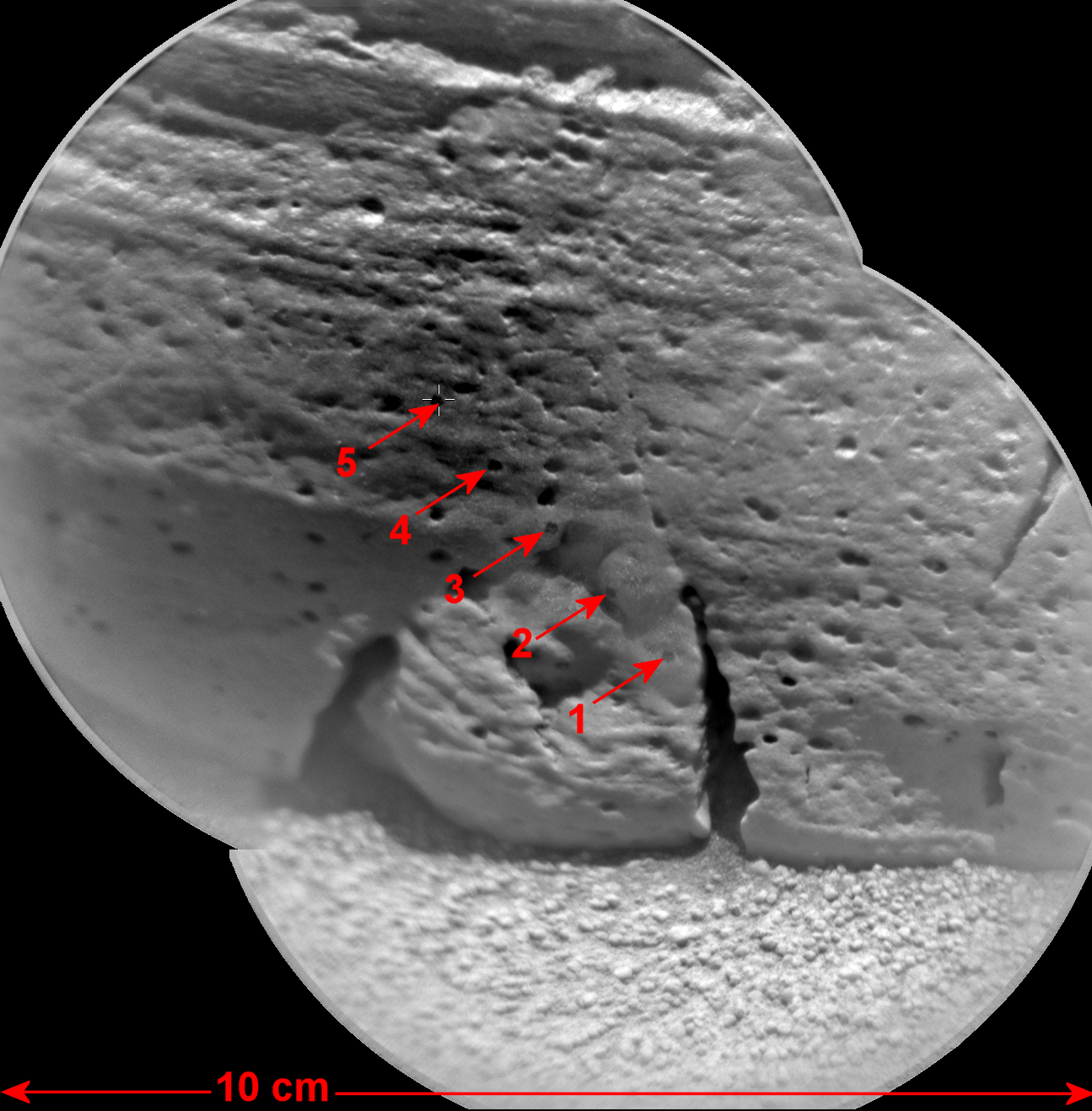
     This was taken on Sol 57 (4 October 2012) of target Rocknest3 using the ChemCam Remote Micro-Imager (RMI) on the NASA Curiosity rover at a distance of 3.7 m. The image was downlinked to Earth by ESA's Mars Express orbiter via the 35m deep space ESTRACK station in New Norcia, Australia. This image was taken before a series of five ChemCam Laser-Induced Breakdown Spectrometer (LIBS) observations. Rocknest is the name of the area where Curiosity stopped for a month to perform its first mobile laboratory analyses on soil scooped from a small sand dune. Rocknest3 was a convenient nearby target of which ChemCam made more than thirty observations overall consisting of 1,500 laser shots; it was also interrogated by the arm-mounted Alpha Particle X-ray Spectrometer (APXS) instrument.
    Credits: NASA/JPL-Caltech/LANL/CNES/IRAP

    For the first time, ESA’s Mars orbiter has relayed scientific data from NASA’s Curiosity rover on the Red Planet’s surface. The data included detailed images of ‘Rocknest3’ and were received by ESA’s deep-space antenna in Australia.

    It was a small but significant step in interplanetary cooperation between space agencies.

    Early on the morning of 6 October, ESA’s Mars Express looked down as it orbited the planet, lining up its lander communication antenna to point at Curiosity far below on the surface.
    For 15 minutes, the NASA rover transmitted scientific data up to the ESA satellite. A few hours later, Mars Express slewed to point its high-gain antenna toward Earth and began downlinking the precious information to the European Space Operations Centre in Darmstadt, Germany, via the Agency’s 35 m-diameter antenna in New Norcia, Australia.  

    The data were immediately made available to NASA’s Jet Propulsion Laboratory in California for processing and analysis, proving again that NASA’s amazing new rover can talk with Europe’s veteran Mars orbiter.
     

    Curiosity’s ChemCam images Rocknest3

    The information included a pair of tremendously interesting images acquired on 4 October by Curiosity’s ChemCam Remote Micro-Imager camera.
     

    ChemCam comprises the camera together with a Laser-Induced Breakdown Spectrometer, which fires a laser at targets and analyses the chemical composition of the vaporised material.
    The laser zaps areas smaller than 1 mm across on the surface of martian rocks and soils, and then the spectrometer provides information on the minerals and microstructures in the rocks.  
     ESA's Mars Express relays Rocknest3 images from NASA Curiosity

    Download:
    This was taken on Sol 57 (4 October 2012) of target Rocknest3 using the ChemCam Remote Micro-Imager (RMI) on the NASA Curiosity rover at a distance of 3.7 m. The image was downlinked to Earth by ESA's Mars Express orbiter via the 35m deep space ESTRACK station in New Norcia, Australia. This image was taken after a series of five ChemCam Laser-Induced Breakdown Spectrometer (LIBS) observations. Rocknest is the name of the area where Curiosity stopped for a month to perform its first mobile laboratory analyses on soil scooped from a small sand dune. Rocknest3 was a convenient nearby target of which ChemCam made more than thirty observations overall consisting of 1,500 laser shots; it was also interrogated by the arm-mounted Alpha Particle X-ray Spectrometer (APXSI instrument. 
    Credits: NASA/JPL-Caltech/LANL/CNES/IRAP 
    For the first time, ESA’s Mars orbiter has relayed scientific data from NASA’s Curiosity rover on the Red Planet’s surface. The data included detailed images of ‘Rocknest3’ and were received by ESA’s deep-space antenna in Australia.


    Outstanding image quality

    The first image (at top of article) was taken before a series of five ChemCam laser blasts and the second image (at right) was taken after. The image is centred on the fifth observation point.
    “The quality of these images from ChemCam is outstanding, and the mosaic image of the spectrometer analyses has been essential for scientific interpretation of the data,” says Sylvestre Maurice, Deputy Principal Investigator for ChemCam at France’s Research Institute in Astrophysics and Planetology (IRAP).
    “This combination of imaging and analysis has demonstrated its potential for future missions.”
    ESA's Mars Express relays Rocknest3 images from NASA Curiosity
    Download:
     This mosaic combines the multiple RMI images and indicates the locations of the LIBS laser observations. Credits: NASA/JPL–Caltech/LANL/CNES/IRAP/LPGN/CNRS

    ChemCam laser targets

    A third image, relayed separately by NASA, indicates the locations of the laser target points on Rocknest3, as seen by the RMI camera. ‘Rocknest’ is the area where Curiosity stopped for a month to perform its first mobile laboratory analyses on soil scooped from a small sand dune. Rocknest3 was a convenient nearby target where ChemCam made more than 30 observations using 1500 laser shots.
     

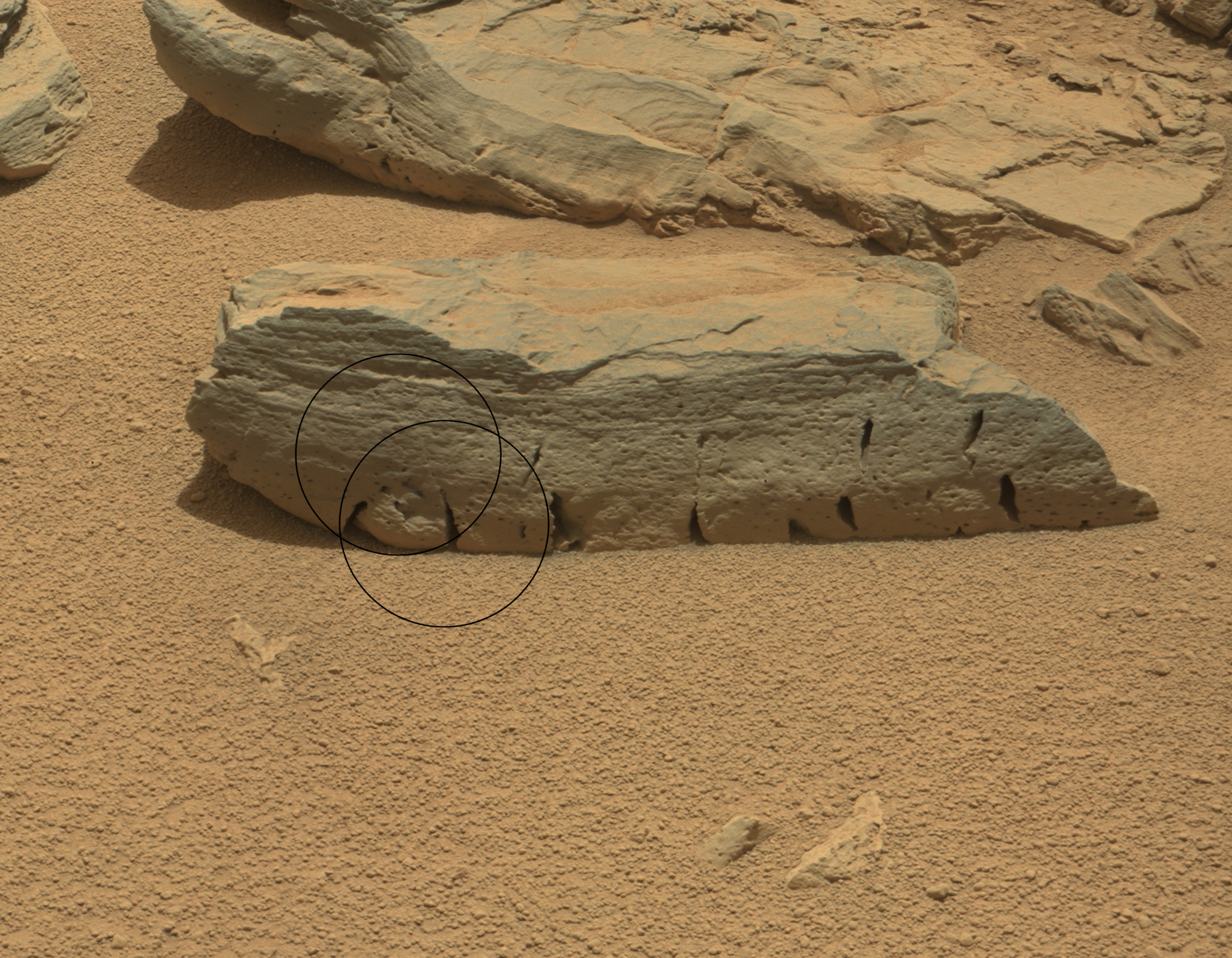
    A wide-angle context image was acquired by Curiosity’s MastCam and shows Rocknest3 as targeted by ChemCam. Rocknest3 is about 10 x 40 cm, or roughly the size of a shoe box.

     ESA's Mars Express relays Rocknest3 images from NASA Curiosity

    Download:
     Context image: The Mastcam 100 colour image shows Rocknest3 targeted by ChemCam and later by APXS; the fields of view of the RMI images are indicated. Rocknest3 is approximately 10 x 40 cm or roughly the size of a shoebox. 
    Credits: NASA/JPL–Caltech/Malin Space Science Systems


    ESA’s Mars orbiter has also relayed data for NASA’s other surface missions – Phoenix, Spirit and Opportunity – since 2004, and it relayed Curiosity’s radio signal during its arrival at Mars last August.

    During the Curiosity mission, Mars Express is set to provide additional relay slots, while maintaining its own scientific observation programme, under an ESA-NASA support agreement.
    It can also rapidly provide relay services in case of unavailability of NASA’s own relay orbiter or if there is a problem on the rover itself.
     

    Interplanetary cooperation

    “ESA–NASA cooperation at Mars is a continuing success, and comes after both sides have worked diligently for a number of years to set technical and engineering standards to enable sharing data between spacecraft, networks and ground stations,” says Mars Express Spacecraft Operations Manager Michel Denis.
    “Exploring Mars is a huge challenge, and space agencies are working to boost cooperation and mutual support for current and upcoming missions. It’s the way of the future.”
    ESA
    Guillermo Gonzalo Sánchez Achutegui
    ayabaca@gmail.com
    ayabaca@hotmail.com
    ayabaca@yahoo.com 

     Inscríbete en el Foro del blog y participa : A Vuelo De Un Quinde - El Foro!

    Mi lista de blogs