Mostrando entradas con la etiqueta NASA Curiosity rover. Mostrar todas las entradas

domingo, 11 de octubre de 2015

NASA : Curiosity Confirma la Existencia de Antiguos Lagos en Marte

Hola amigos: A VUELO DE UN QUINDE EL BLOG., el Robot Curiosity, que hace investigaciones en Marte, ha confirmado la existencia de agua en este planeta, claro está;  esto fue  hace miles de millones de años atrás, que fue capaz de almacenar agua en ciertos lugares durante un prolongado periodo de tiempo.
 
Lea con más amplitud la información abajo adjunta:
Concepto artístico del rover Curiosity en el Planeta Rojo. Image Credit: NASA/JPL-Caltech

09.10.15.- Un nuevo estudio llevado a cabo por científicos que están trabajando con datos del rover Curiosity de la NASA, han confirmado que Marte fue una vez, hace miles de millones de años, capaz de almacenar agua en ciertos lugares durante un prolongado periodo de tiempo.
Utilizando datos de rover Curiosity, el equipo ha determinado que, hace mucho tiempo el agua ayudó a llenar el cráter Gale, el lugar de aterrizaje del rover Curiosity hace tres años, con sedimentos depositados como las capas que formaron la base de la montaña que se encuentra en el centro del cráter hoy.
"Observaciones del rover sugieren que una serie corrientes de agua y lagos permanentes existieron en algún momento entre hace 3.800 millones y 3.300 millones de años, aportando sedimentos que se acumularon lentamente en las capas inferiores del monte Sharp," dijo Ashwin Vasavada, científico del MSL en el JPL.
Los hallazgos se basan en trabajos anteriores que sugerían que había antiguos lagos en Marte, además de la idea de un Marte húmedo, tanto en el pasado como en el presente.
"Todo lo que sabemos sobre el agua de Marte está siendo continuamente puesto a prueba", comentó Michael Meyer, científico jefe del Programa de Exploración de Marte de la NASA en la sede de la NASA en Washington. "Está claro que el Marte de hace miles de millones de años se asemejaba mucho más a la Tierra que el actual. Nuestro reto es encontrar por qué era Marte tan húmedo y qué paso con todo ese agua".
Antes de que Curiosity aterrizara en Marte en 2012, los científicos ya propusieron que el cráter Gale había sido llenado con capas de sedimentos. Algunas de las hipótesis sugerían que era que el propio viento el que podría haber depositado estos sedimentos "en seco". Otras teorías sugieren que estos depósitos fueron arrastrados por el agua.
 Una imagen de la formación "Kimberley" captada por el rover Curiosity de la NASA.
 Una imagen de la formación "Kimberley" captada por el rover Curiosity de la NASA. Image Credit: NASA/JPL-Caltech
 
Los últimos datos de Curiosity indican escenarios húmedos para las partes inferiores del Monte Sharp. Basándose en los nuevos análisis el llenado de al menos las capas inferiores de la montaña se produjo principalmente por ríos y lagos antiguos en un periodo de al menos 500 millones de años.
"Durante su travesía a través del cráter Gale, nos hemos fijado en patrones geológicos que evidencian antiguos flujos de movimiento rápido con grava gruesa, así como lugares en los que el agua parecía estar más estancada", dijo Vasavada. "Las predicciones indicaban que deberíamos empezar a ver rocas de grano fino depositadas cerca del Monte Sharp. Ahora que hemos llegado, estamos observando lutitas finamente laminadas en abundancia que se asemejan a depósitos lacustres".
"Paradojicamente, donde hoy hay una montaña, hubo una vez una cuenca que a veces se llenaba de agua", dijo John Grotzinger, ex científico del proyecto Mars Science Laboratory en el Instituto de Tecnología de California en Pasadena, y autor principal del nuevo estudio. "Vemos evidencias de sedimentos que han alcanzado los 75 metros de espesor, y en base a los datos de mapeo realizados por la sonda espacial MRO creemos que la deposición sedimentaria transportada por agua podría haber alcanzado al menos de 150 a 200 metros sobre el suelo del cráter".
Además, el espesor total de depósitos sedimentarios en el cráter Gale indican que la interacción con el agua podría extenderse aún más alto, tal vez hasta una media de 800 metros por encima del suelo del cráter.
Por encima de los 800 metros, el Monte Sharp no muestra evidencias de estratos hidratados. Grotzinger sugiere que tal vez este segmento posterior de la historia del cráter pudo haber sido dominado por los depósitos en seco impulsados por el viento.
Una pregunta persistente rodea la fuente original del agua que llevó los sedimentos al cráter. Para que el agua fluyendo haya existido en la superficie, Marte debería de haber tenido una atmósfera más densa y un clima más cálido, lo cual se ha teorizado que sucedió en el antiguo Marte, cuando el cráter Gale experimentó la intensa actividad geológica. Sin embargo, los modelos actuales de este paleoclima son, literalmente, secos.
Una parte de este agua podría deberse a las nevadas y lluvias que se producían en tierras más altas. Algunos han hecho el argumento de que había un océano en las llanuras al norte del cráter, pero eso no explica cómo el agua se las arregló para existir como líquida durante prolongados períodos de tiempo en la superficie del planeta.
"Hemos tendido a pensar que Marte era simple" dijo Grotzinger. "Nosotros una vez pensamos que la Tierra también era simple. Pero cuanto más le miramos, más preguntas nos surgen porque estamos empezando a comprender la complejidad real de lo que vemos en Marte. Este es un buen momento para volver a reevaluar todas nuestras suposiciones. Algo falta en algún lugar ".
Ver con más amplitud en:
http://www.lanasa.net/
NASA
Guillermo Gonzalo Sánchez Achutegui
ayabaca@gmail.com
ayabaca@Hotmail.com
ayabaca@yahoo.com
Inscríbete en el Foro del blog y participa : A Vuelo De Un Quinde - El Foro!

lunes, 26 de noviembre de 2012

ESA Portal - Fostering Curiosity: Mars Express relays rocky images


 ESA's Mars Express relays Rocknest3 images from NASA Curiosity
Download:
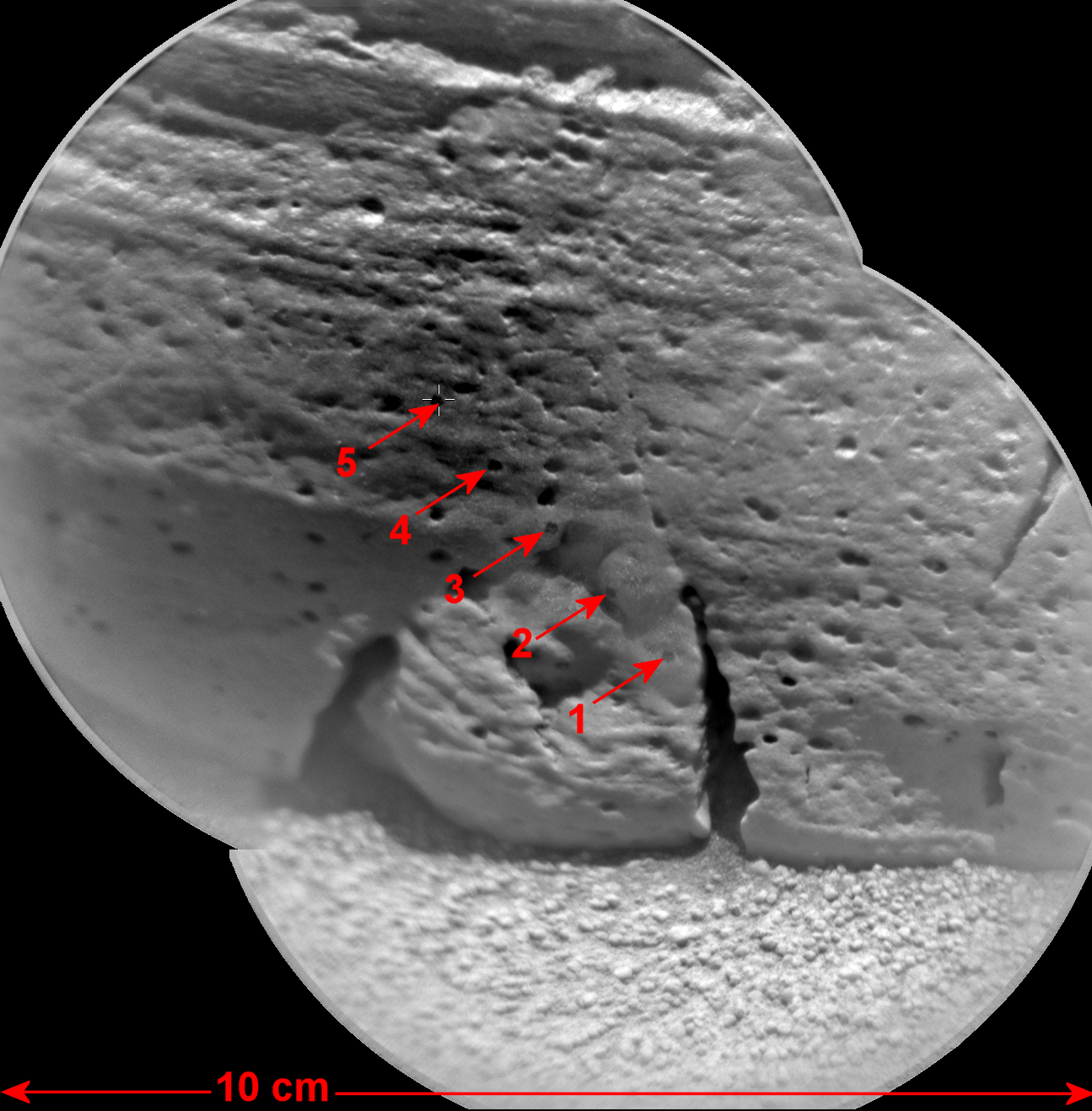
 This was taken on Sol 57 (4 October 2012) of target Rocknest3 using the ChemCam Remote Micro-Imager (RMI) on the NASA Curiosity rover at a distance of 3.7 m. The image was downlinked to Earth by ESA's Mars Express orbiter via the 35m deep space ESTRACK station in New Norcia, Australia. This image was taken before a series of five ChemCam Laser-Induced Breakdown Spectrometer (LIBS) observations. Rocknest is the name of the area where Curiosity stopped for a month to perform its first mobile laboratory analyses on soil scooped from a small sand dune. Rocknest3 was a convenient nearby target of which ChemCam made more than thirty observations overall consisting of 1,500 laser shots; it was also interrogated by the arm-mounted Alpha Particle X-ray Spectrometer (APXS) instrument.
Credits: NASA/JPL-Caltech/LANL/CNES/IRAP

For the first time, ESA’s Mars orbiter has relayed scientific data from NASA’s Curiosity rover on the Red Planet’s surface. The data included detailed images of ‘Rocknest3’ and were received by ESA’s deep-space antenna in Australia.

It was a small but significant step in interplanetary cooperation between space agencies.

Early on the morning of 6 October, ESA’s Mars Express looked down as it orbited the planet, lining up its lander communication antenna to point at Curiosity far below on the surface.
For 15 minutes, the NASA rover transmitted scientific data up to the ESA satellite. A few hours later, Mars Express slewed to point its high-gain antenna toward Earth and began downlinking the precious information to the European Space Operations Centre in Darmstadt, Germany, via the Agency’s 35 m-diameter antenna in New Norcia, Australia.  

The data were immediately made available to NASA’s Jet Propulsion Laboratory in California for processing and analysis, proving again that NASA’s amazing new rover can talk with Europe’s veteran Mars orbiter.
 

Curiosity’s ChemCam images Rocknest3

The information included a pair of tremendously interesting images acquired on 4 October by Curiosity’s ChemCam Remote Micro-Imager camera.
 

ChemCam comprises the camera together with a Laser-Induced Breakdown Spectrometer, which fires a laser at targets and analyses the chemical composition of the vaporised material.
The laser zaps areas smaller than 1 mm across on the surface of martian rocks and soils, and then the spectrometer provides information on the minerals and microstructures in the rocks.  
 ESA's Mars Express relays Rocknest3 images from NASA Curiosity

Download:
This was taken on Sol 57 (4 October 2012) of target Rocknest3 using the ChemCam Remote Micro-Imager (RMI) on the NASA Curiosity rover at a distance of 3.7 m. The image was downlinked to Earth by ESA's Mars Express orbiter via the 35m deep space ESTRACK station in New Norcia, Australia. This image was taken after a series of five ChemCam Laser-Induced Breakdown Spectrometer (LIBS) observations. Rocknest is the name of the area where Curiosity stopped for a month to perform its first mobile laboratory analyses on soil scooped from a small sand dune. Rocknest3 was a convenient nearby target of which ChemCam made more than thirty observations overall consisting of 1,500 laser shots; it was also interrogated by the arm-mounted Alpha Particle X-ray Spectrometer (APXSI instrument. 
Credits: NASA/JPL-Caltech/LANL/CNES/IRAP 
For the first time, ESA’s Mars orbiter has relayed scientific data from NASA’s Curiosity rover on the Red Planet’s surface. The data included detailed images of ‘Rocknest3’ and were received by ESA’s deep-space antenna in Australia.


Outstanding image quality

The first image (at top of article) was taken before a series of five ChemCam laser blasts and the second image (at right) was taken after. The image is centred on the fifth observation point.
“The quality of these images from ChemCam is outstanding, and the mosaic image of the spectrometer analyses has been essential for scientific interpretation of the data,” says Sylvestre Maurice, Deputy Principal Investigator for ChemCam at France’s Research Institute in Astrophysics and Planetology (IRAP).
“This combination of imaging and analysis has demonstrated its potential for future missions.”
ESA's Mars Express relays Rocknest3 images from NASA Curiosity
Download:
 This mosaic combines the multiple RMI images and indicates the locations of the LIBS laser observations. Credits: NASA/JPL–Caltech/LANL/CNES/IRAP/LPGN/CNRS

ChemCam laser targets

A third image, relayed separately by NASA, indicates the locations of the laser target points on Rocknest3, as seen by the RMI camera. ‘Rocknest’ is the area where Curiosity stopped for a month to perform its first mobile laboratory analyses on soil scooped from a small sand dune. Rocknest3 was a convenient nearby target where ChemCam made more than 30 observations using 1500 laser shots.
 

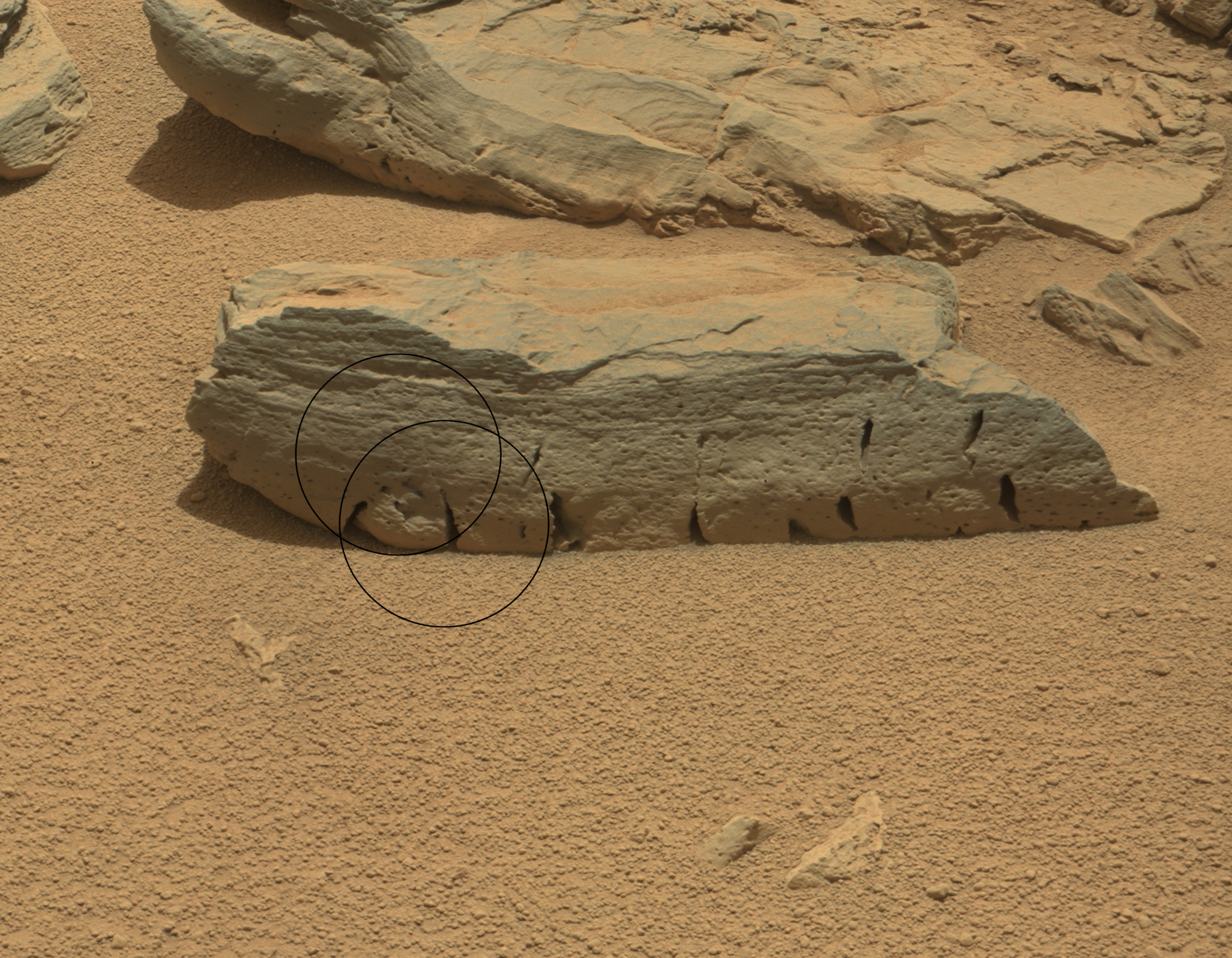
A wide-angle context image was acquired by Curiosity’s MastCam and shows Rocknest3 as targeted by ChemCam. Rocknest3 is about 10 x 40 cm, or roughly the size of a shoe box.

 ESA's Mars Express relays Rocknest3 images from NASA Curiosity

Download:
 Context image: The Mastcam 100 colour image shows Rocknest3 targeted by ChemCam and later by APXS; the fields of view of the RMI images are indicated. Rocknest3 is approximately 10 x 40 cm or roughly the size of a shoebox. 
Credits: NASA/JPL–Caltech/Malin Space Science Systems


ESA’s Mars orbiter has also relayed data for NASA’s other surface missions – Phoenix, Spirit and Opportunity – since 2004, and it relayed Curiosity’s radio signal during its arrival at Mars last August.

During the Curiosity mission, Mars Express is set to provide additional relay slots, while maintaining its own scientific observation programme, under an ESA-NASA support agreement.
It can also rapidly provide relay services in case of unavailability of NASA’s own relay orbiter or if there is a problem on the rover itself.
 

Interplanetary cooperation

“ESA–NASA cooperation at Mars is a continuing success, and comes after both sides have worked diligently for a number of years to set technical and engineering standards to enable sharing data between spacecraft, networks and ground stations,” says Mars Express Spacecraft Operations Manager Michel Denis.
“Exploring Mars is a huge challenge, and space agencies are working to boost cooperation and mutual support for current and upcoming missions. It’s the way of the future.”
ESA
Guillermo Gonzalo Sánchez Achutegui
ayabaca@gmail.com
ayabaca@hotmail.com
ayabaca@yahoo.com 

 Inscríbete en el Foro del blog y participa : A Vuelo De Un Quinde - El Foro!

Mi lista de blogs