Mostrando entradas con la etiqueta NASA's Mars rover Curiosity. Mostrar todas las entradas

domingo, 5 de julio de 2015

NASA : Curiosity's Stars and Stripes .- Barras y estrellas para el Curiosity

 Hola amigos: A VUELO DE UN QUINDE EL BLOG., hemos recibido información de la Agencia Espacial NASA, lo que ellos llaman: Barras y Estrellas para el Curiosity..
NASA nos dice....El medallón circular de la bandera está hecho de aluminio anodizado y mide 2,68 pulgadas (68 milímetros) de diámetro. El medallón fue fijada con pernos a los lugares en los balancines donde el hardware de vuelo una vez fue considerado, pero en última instancia consideró innecesario.


Curiosity's Stars and Stripes
This view of the American flag medallion on NASA's Mars rover Curiosity was taken by the rover's Mars Hand Lens Imager (MAHLI) during the 44th Martian day, or sol, of Curiosity's work on Mars (Sept. 19, 2012). The flag is one of four "mobility logos" placed on the rover's mobility rocker arms.

› View Presidential Plaque

The circular medallion of the flag is made of anodized aluminum and measures 2.68 inches (68 millimeters) in diameter. The medallion was affixed with bolts to locations on the rocker arms where flight hardware was once considered, but ultimately deemed unnecessary.

The other three medallions adorning the rover's rocker arms are the NASA logo, the JPL logo and the Curiosity mission logo.

The main purpose of Curiosity's MAHLI camera is to acquire close-up, high-resolution views of rocks and soil at the rover's Gale Crater field site. The camera is capable of focusing on any target at distances of about 0.8 inch (2.1 centimeters) to infinity, providing versatility for other uses, such as views of the rover itself from different angles.

Image Credit: NASA/JPL-Caltech/MSSS
Last Updated: July 5, 2015
Editor: NASA Administrator
Tags:  Image of the Day, Mars, Mars Science Laboratory (Curiosity), Solar System
 NASA
Guillermo Gonzalo Sánchez Achutegui
ayabaca@gmail.com
ayabaca@hotmail.com
ayabaca@yahoo.com 
Inscríbete en el Foro del blog y participa : A Vuelo De Un Quinde - El Foro!

martes, 5 de agosto de 2014

NASA : Two Years Ago, Curiosity Rover Lands on Mars, Captures Image of Mount Sharp


Two Years Ago, Curiosity Rover Lands on Mars, Captures Image of Mount Sharp
This image was captured by NASA's Mars rover Curiosity shortly after it landed on the Red Planet on the evening of Aug. 5, 2012 PDT (morning of Aug. 6 EDT), near the foot of a mountain three miles tall and 96 miles in diameter inside Gale Crater. The image shows the rover's main science target, Mount Sharp. The rover's shadow can be seen in the foreground, and the dark bands beyond are dunes. Rising up in the distance is Mount Sharp, whose peak is 3.4 miles (5.5 kilometers) high, taller than Mt. Whitney in California. The actual summit is not visible from this vantage point -- the highest elevation seen in this view is about 2.5 miles (4 kilometers) above the rover.
On June 24, 2014, Curiosity completed one Martian year -- 687 Earth days -- having accomplished the mission's main goal of determining whether Mars once offered environmental conditions favorable for microbial life. One of Curiosity's first major findings after landing in August 2012 was an ancient riverbed at its landing site. Nearby, at an area known as Yellowknife Bay, the mission met its main goal of determining whether the Martian Gale Crater ever was habitable for simple life forms. The answer, a historic "yes," came from two mudstone slabs that the rover sampled with its drill. Analysis of these samples revealed the site was once a lakebed with mild water, the essential elemental ingredients for life, and a type of chemical energy source used by some microbes on Earth. If Mars had living organisms, this would have been a good home for them.
Image Credit: NASA/JPL-CalTech
 
NASA
Guillermo Gonzalo Sánchez Achutegui
Inscríbete en el Foro del blog y participa : A Vuelo De Un Quinde - El Foro!

domingo, 14 de abril de 2013

NASA - NASA Associate Administrator Statements on the Asteroid Initiative in the FY 2014 Budget Request

Hola amigos: A VUELO DE UN QUINDE EL BLOG., como seguimos con tanta pasión la exploración espacial que realiza la Agencia Espacial NASA, nos alcanza la información de como será su presupuesto en lo concierte a lograr la tecnología necesaria para la intercepción y captura de un asteroide que pueda estrellarse contra La Tierra: Lo siguiente es declaraciones de los administradores asociados de la Exploración Humana de la NASA y la Dirección de Misión de Operaciones, la Dirección de Misión de Ciencia y la Dirección de Misión de Tecnología Espacial sobre el presupuesto de la administración la demanda del año fiscal 2014.
Veamos que nos dice : Sobre la captura robótica de intercepción de un asteroide tan peligrosos que puedan estrellarse contra La Tierra como acaba de suceder en los Montes Urales en Rusia......

El Administrador Asociado para Exploración Humana y Operaciones Guillermo Gerstenmaier:

"La misión de encontrar, para capturar y remitir un asteroide roboticamente, y luego lo visita con astronautas para estudiar esto y muestras de vuelta aprovechan la experiencia a través de toda la NASA en un acercamiento integrado a la exploración. Con la investigación científica y demostraciones de tecnología que pasan alrededor del reloj sobre la Estación Internacional Espacial que nos enseña como la gente puede vivir y trabajan en el espacio, esta misión nos dará la experiencia valiosa que tenemos que en operaciones profundas espaciales enviar a la gente a destinos más distantes en el sistema solar, incluyendo el Marte. Por el equilibrio de este año fiscal, trabajaremos para definir una arquitectura de y conceptos para interacciones de equipo con el En el Año fiscal 2014, NASA comenzará a desarrollar y probar mecanismos de captura de prototipo y conceptos para interacciones de equipo con el asteroide. "

El  Administrador Asociado para Ciencia John Grunsfeld:
Nos dice:
" El crucial primeroel primer paso que  debe realzar nuestros esfuerzos en curso para identificar y caracterizar objetos de cerca Tierra para la investigación científica y encontrar asteroides potencialmente peligrosos y objetivos apropiados por la captura. La misión de captura será una colaboración sumamente visible y significativa de exploración robótica y humana en el espacio translunar. "

 El  Administrador Asociado para Tecnología Espacial Michael Gazarik:
Nos dice:....
" Esta misión acelera nuestras actividades de desarrollo de tecnología en la propulsión solar eléctrica de alta potencia. La misión ambiciosa con la cita, capture y remitir un pequeño asteroide al espacio desde La Luna a La  Tierra no podía ser logrado sin la tecnología de propulsión solar eléctrica. Esta tecnología también apoyará las telecomunicaciones comerciales e industrias de satélite, y es un paso esencial hacia el futuro la NASA incursiones de exploración humanas y robóticas en el espacio profundo. "

Los invito a leer la versión original en inglés de la NASA .........
 
 
WASHINGTON -- The following are statements from the associate administrators of NASA's Human Exploration and Operations Mission Directorate, Science Mission Directorate and Space Technology Mission Directorate on the administration's budget request for the 2014 fiscal year.

From Associate Administrator for Human Exploration and Operations William Gerstenmaier:

"The mission to find, capture and redirect an asteroid robotically, and then visit it with astronauts to study it and return samples takes advantage of expertise across all of NASA in an integrated approach to exploration. Along with the scientific research and technology demonstrations happening around the clock on the International Space Station that are teaching us how humans can live and work in space, this mission will give us valuable experience we need in deep space operations to send humans to more distant destinations in the solar system, including Mars. Through the balance of this fiscal year, we will work to define an affordable mission architecture. In Fiscal Year 2014, NASA will begin developing and testing prototype capture mechanisms and concepts for crew interactions with the asteroid."

From Associate Administrator for Science John Grunsfeld:

"The crucial first step in this endeavor is to enhance our ongoing efforts to identify and characterize near-Earth objects for scientific investigation and to find potentially hazardous asteroids and targets appropriate for capture. The capture mission will be a highly visible and significant collaboration of robotic and human exploration in translunar space."

From Associate Administrator for Space Technology Michael Gazarik:

"This mission accelerates our technology development activities in high-powered solar electric propulsion. The ambitious mission to rendezvous, capture and redirect a small asteroid to Earth-moon space could not be accomplished without solar electric propulsion technology. This technology also will support the commercial telecommunications and satellite industries, and is an essential step toward future NASA human and robotic exploration forays into deep space."

The NASA budget and supporting information are available at:


NASA's FY 2014 Budget Proposal Gallery
 Budget Information
Wednesday, April 10 -- Fiscal Year 2014 NASA Budget Proposal:

FY 2014 Budget
› FY 2014 Complete Budget Estimates (12 MB PDF)
› FY 2014 Budget Presentation (2.8 MB PDF)
› FY 2014 Management and Performance (3.3 MB PDF)
› April 10, 2013, Media Teleconference Transcript (183 KB PDF)
› Administrator Bolden's Statement
› Deputy Administrator Lori Garver's Budget Presentation (3.2 MB PDF)
› Deputy Administrator Garver's Blog
› Associate Administrator Robert Lightfoot's Presentation on Asteroid Strategy (1.3 MB PDF)
› Associate Administrator Statements

NASA's New Asteroid Initiative
› NASA's Asteroid Initiative Benefits From Rich History
› Watch Video

The President's Fiscal Year 2014 Budget
› Full Fact Sheet
› Full Budget

International Space Station Documents
› Research in Space: 2013 and Beyond
› Education Opportunities and Accomplishments

Previous Years' Budgets
› FY 2013 | › FY 2012 | › FY 2011 | › FY 2010 | › FY 2009 | › FY 2008 | › FY 2007
› FY 2006 | › FY 2005 | › FY 2004 | › FY 2003 and Earlier

NASA
Guillermo Gonzalo Sánchez Achutegui
ayabaca@gmail.com
ayabaca@hotmail.com
ayabaca@yahoo.com
Inscríbete en el Foro del blog y participa : A Vuelo De Un Quinde - El Foro!

miércoles, 13 de febrero de 2013

NASA - Curiosity Rover's Self Portrait at 'John Klein' Drilling Site, Cropped


 Curiosity rover's self portrait

Download Image

› Full Size
 NASA
Guillermo Gonzalo Sánchez Achutegui
ayabaca@gmail.com
ayabaca@hotmail.com
ayabaca@yahoo.com
Inscríbete en el Foro del blog y participa : A Vuelo De Un Quinde - El Foro!

domingo, 10 de febrero de 2013

NASA - NASA Curiosity Rover Collects First Martian Bedrock Sample


Curiosity's first sample drilling
At the center of this image from NASA's Curiosity rover is the hole in a rock called "NASA Curiosity Rover Collects First Martian Bedrock Sample" where the rover conducted its first sample drilling on Mars. Image credit: NASA/JPL-Caltech/MSSS
› Full image and caption       › See drilling animation


Download Image

› Full Size
 An animated set of three images from NASA's Curiosity rover

Download Image

› Full Size 
Drill area, called

Download Image

› Full Size
 

 NASA Curiosity Rover Collects First Martian Bedrock Sample
 PASADENA, Calif. -- NASA's Curiosity rover has, for the first time, used a drill carried at the end of its robotic arm to bore into a flat, veiny rock on Mars and collect a sample from its interior. This is the first time any robot has drilled into a rock to collect a sample on Mars.

The fresh hole, about 0.63 inch (1.6 centimeters) wide and 2.5 inches (6.4 centimeters) deep in a patch of fine-grained sedimentary bedrock, can be seen in images and other data Curiosity beamed to Earth Saturday. The rock is believed to hold evidence about long-gone wet environments. In pursuit of that evidence, the rover will use its laboratory instruments to analyze rock powder collected by the drill.

"The most advanced planetary robot ever designed now is a fully operating analytical laboratory on Mars," said John Grunsfeld, NASA associate administrator for the agency's Science Mission Directorate. "This is the biggest milestone accomplishment for the Curiosity team since the sky-crane landing last August, another proud day for America."

For the next several days, ground controllers will command the rover's arm to carry out a series of steps to process the sample, ultimately delivering portions to the instruments inside.

"We commanded the first full-depth drilling, and we believe we have collected sufficient material from the rock to meet our objectives of hardware cleaning and sample drop-off," said Avi Okon, drill cognizant engineer at NASA's Jet Propulsion Laboratory (JPL), Pasadena.

Rock powder generated during drilling travels up flutes on the bit. The bit assembly has chambers to hold the powder until it can be transferred to the sample-handling mechanisms of the rover's Collection and Handling for In-Situ Martian Rock Analysis (CHIMRA) device.

Before the rock powder is analyzed, some will be used to scour traces of material that may have been deposited onto the hardware while the rover still was on Earth, despite thorough cleaning before launch.

"We'll take the powder we acquired and swish it around to scrub the internal surfaces of the drill bit assembly," said JPL's Scott McCloskey, drill systems engineer. "Then we'll use the arm to transfer the powder out of the drill into the scoop, which will be our first chance to see the acquired sample."

"Building a tool to interact forcefully with unpredictable rocks on Mars required an ambitious development and testing program," said JPL's Louise Jandura, chief engineer for Curiosity's sample system."To get to the point of making this hole in a rock on Mars, we made eight drills and bored more than 1,200 holes in 20 types of rock on Earth."

Inside the sample-handling device, the powder will be vibrated once or twice over a sieve that screens out any particles larger than six-thousandths of an inch (150 microns) across. Small portions of the sieved sample will fall through ports on the rover deck into the Chemistry and Mineralogy (CheMin) instrument and the Sample Analysis at Mars (SAM) instrument. These instruments then will begin the much-anticipated detailed analysis.

The rock Curiosity drilled is called "John Klein" in memory of a Mars Science Laboratory deputy project manager who died in 2011. Drilling for a sample is the last new activity for NASA's Mars Science Laboratory Project, which is using the car-size Curiosity rover to investigate whether an area within Mars' Gale Crater has ever offered an environment favorable for life.

JPL manages the project for NASA's Science Mission Directorate in Washington.

For more about the mission, visit:

You can follow the mission on Facebook and Twitter at:

and

NASA
Guillermo Gonzalo Sánchez Achutegui
ayabaca@gmail.com
ayabaca@hotmail.com
ayabaca@yahoo.com
Inscríbete en el Foro del blog y participa : A Vuelo De Un Quinde - El Foro!

martes, 4 de diciembre de 2012

NASA - NASA Mars Rover Fully Analyzes First Martian Soil Samples


Sampling of Martian soils

Download Image

› Full Size

 Rocknest Wind Drift

Download Image

› Full Size
 

Curiosity's 'Rocknest' Workplace

NASA's Curiosity Mars rover documented itself in the context of its work site, an area called "Rocknest Wind Drift," on the 84th Martian day, or sol, of its mission (Oct. 31, 2012). The rover worked at this location from Sol 56 (Oct. 2, 2012) to Sol 100 (Nov. 16, 2012).

The drift consists of sand trapped on the downwind side of a group of dark cobbles the team named Rocknest. This mosaic of 55 images from the Mars Hand Lens Imager (MAHLI) shows the first four of five places from which the rover’s scoop obtained sand to clean the sample handling and processing system. The scooped material was ultimately delivered to the Chemistry and Mineralogy Experiment (CheMin) and the Sample Analysis at Mars (SAM) laboratory instruments housed inside the rover’s body. The annotated version of this figure shows the location of a scoop taken at a later date -- the fifth and final scoop, and the only one that provided grains delivered to SAM.

Before scooping, the rover team put an approximately 20-inch-wide (about 50- centimeter-wide) wheel print on the Rocknest wind drift. This allowed MAHLI and the Alpha Particle X-Ray Spectrometer (APXS) to determine whether the drift really consisted of sand with small enough sizes to clean the Collection and Handling for In-Situ Martian Rock Analysis (CHIMRA) instrument and be delivered to CheMin and SAM. The drift material at the center of the wheel print, named "Portage" by the rover team, was examined by the APXS.

The rover’s robotic arm is not visible in the mosaic because the MAHLI that took this mosaic is on the turret at the end of the arm. Wrist motions and turret rotations on the arm allowed MAHLI to acquire the mosaic's 55 images. An earlier version of the Sol 84 self-portrait was released Nov. 1, 2012 (see PIA16239).

Image credit: NASA/JPL-Caltech/MSSS 
Scoop marks in the sand at 'Rocknest'
 This is a view of the third (left) and fourth (right) trenches made by the 1.6-inch-wide (4-centimeter-wide) scoop on NASA's Mars rover Curiosity in October 2012. Image credit: NASA/JPL-Caltech/MSSS
› Full image and caption       › Related video       › Latest images       › Curiosity gallery       › Curiosity videos

Download Image

› Full Size 


PASADENA, Calif. - NASA's Mars Curiosity rover has used its full array of instruments to analyze Martian soil for the first time, and found a complex chemistry within the Martian soil. Water and sulfur and chlorine-containing substances, among other ingredients, showed up in samples Curiosity's arm delivered to an analytical laboratory inside the rover.
Detection of the substances during this early phase of the mission demonstrates the laboratory's capability to analyze diverse soil and rock samples over the next two years. Scientists also have been verifying the capabilities of the rover's instruments.
Curiosity is the first Mars rover able to scoop soil into analytical instruments. The specific soil sample came from a drift of windblown dust and sand called "Rocknest." The site lies in a relatively flat part of Gale Crater still miles away from the rover's main destination on the slope of a mountain called Mount Sharp. The rover's laboratory includes the Sample Analysis at Mars (SAM) suite and the Chemistry and Mineralogy (CheMin) instrument. SAM used three methods to analyze gases given off from the dusty sand when it was heated in a tiny oven. One class of substances SAM checks for is organic compounds -- carbon-containing chemicals that can be ingredients for life.
"We have no definitive detection of Martian organics at this point, but we will keep looking in the diverse environments of Gale Crater," said SAM Principal Investigator Paul Mahaffy of NASA's Goddard Space Flight Center in Greenbelt, Md.
Curiosity's APXS instrument and the Mars Hand Lens Imager (MAHLI) camera on the rover's arm confirmed Rocknest has chemical-element composition and textural appearance similar to sites visited by earlier NASA Mars rovers Pathfinder, Spirit and Opportunity.
Curiosity's team selected Rocknest as the first scooping site because it has fine sand particles suited for scrubbing interior surfaces of the arm's sample-handling chambers. Sand was vibrated inside the chambers to remove residue from Earth. MAHLI close-up images of Rocknest show a dust-coated crust one or two sand grains thick, covering dark, finer sand.
"Active drifts on Mars look darker on the surface," said MAHLI Principal Investigator Ken Edgett, of Malin Space Science Systems in San Diego. "This is an older drift that has had time to be inactive, letting the crust form and dust accumulate on it."
CheMin's examination of Rocknest samples found the composition is about half common volcanic minerals and half non-crystalline materials such as glass. SAM added information about ingredients present in much lower concentrations and about ratios of isotopes. Isotopes are different forms of the same element and can provide clues about environmental changes. The water seen by SAM does not mean the drift was wet. Water molecules bound to grains of sand or dust are not unusual, but the quantity seen was higher than anticipated.
SAM tentatively identified the oxygen and chlorine compound perchlorate. This is a reactive chemical previously found in arctic Martian soil by NASA's Phoenix Lander. Reactions with other chemicals heated in SAM formed chlorinated methane compounds -- one-carbon organics that were detected by the instrument. The chlorine is of Martian origin, but it is possible the carbon may be of Earth origin, carried by Curiosity and detected by SAM's high sensitivity design.
"We used almost every part of our science payload examining this drift," said Curiosity Project Scientist John Grotzinger of the California Institute of Technology in Pasadena. "The synergies of the instruments and richness of the data sets give us great promise for using them at the mission's main science destination on Mount Sharp."
NASA's Mars Science Laboratory Project is using Curiosity to assess whether areas inside Gale Crater ever offered a habitable environment for microbes. NASA's Jet Propulsion Laboratory in Pasadena, a division of Caltech, manages the project for NASA's Science Mission Directorate in Washington, and built Curiosity.
For more information about Curiosity and other Mars missions, 
You can follow the mission on Facebook and Twitter 
 
 
Dwayne Brown Headquarters, Washington
NASA
Guillermo Gonzalo Sánchez Achutegui
ayabaca@gmail.com
ayabaca@hotmail.com
ayabaca@yahoo.com
 Inscríbete en el Foro del blog y participa : A Vuelo De Un Quinde - El Foro!

lunes, 26 de noviembre de 2012

ESA Portal - Fostering Curiosity: Mars Express relays rocky images


 ESA's Mars Express relays Rocknest3 images from NASA Curiosity
Download:
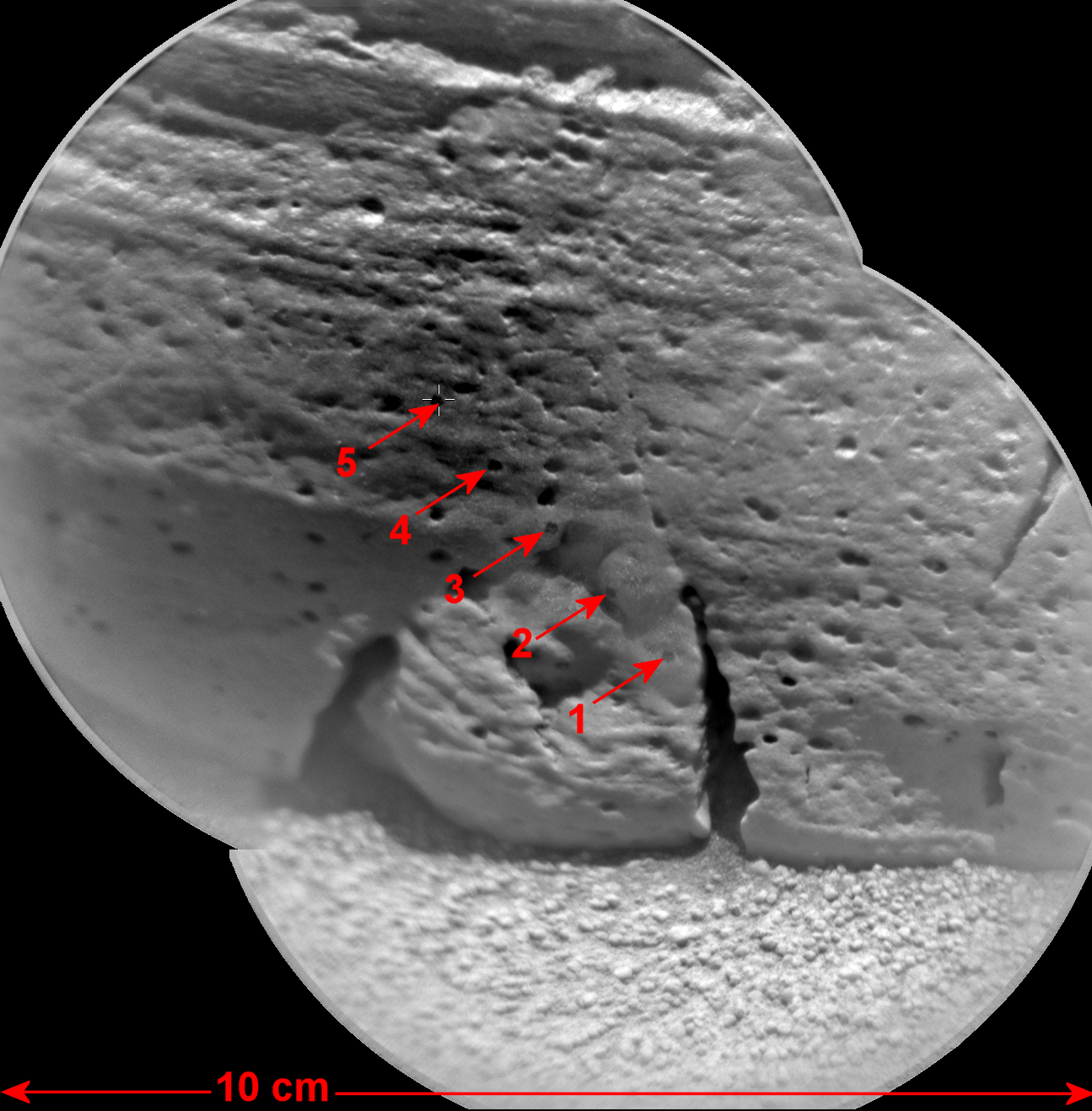
 This was taken on Sol 57 (4 October 2012) of target Rocknest3 using the ChemCam Remote Micro-Imager (RMI) on the NASA Curiosity rover at a distance of 3.7 m. The image was downlinked to Earth by ESA's Mars Express orbiter via the 35m deep space ESTRACK station in New Norcia, Australia. This image was taken before a series of five ChemCam Laser-Induced Breakdown Spectrometer (LIBS) observations. Rocknest is the name of the area where Curiosity stopped for a month to perform its first mobile laboratory analyses on soil scooped from a small sand dune. Rocknest3 was a convenient nearby target of which ChemCam made more than thirty observations overall consisting of 1,500 laser shots; it was also interrogated by the arm-mounted Alpha Particle X-ray Spectrometer (APXS) instrument.
Credits: NASA/JPL-Caltech/LANL/CNES/IRAP

For the first time, ESA’s Mars orbiter has relayed scientific data from NASA’s Curiosity rover on the Red Planet’s surface. The data included detailed images of ‘Rocknest3’ and were received by ESA’s deep-space antenna in Australia.

It was a small but significant step in interplanetary cooperation between space agencies.

Early on the morning of 6 October, ESA’s Mars Express looked down as it orbited the planet, lining up its lander communication antenna to point at Curiosity far below on the surface.
For 15 minutes, the NASA rover transmitted scientific data up to the ESA satellite. A few hours later, Mars Express slewed to point its high-gain antenna toward Earth and began downlinking the precious information to the European Space Operations Centre in Darmstadt, Germany, via the Agency’s 35 m-diameter antenna in New Norcia, Australia.  

The data were immediately made available to NASA’s Jet Propulsion Laboratory in California for processing and analysis, proving again that NASA’s amazing new rover can talk with Europe’s veteran Mars orbiter.
 

Curiosity’s ChemCam images Rocknest3

The information included a pair of tremendously interesting images acquired on 4 October by Curiosity’s ChemCam Remote Micro-Imager camera.
 

ChemCam comprises the camera together with a Laser-Induced Breakdown Spectrometer, which fires a laser at targets and analyses the chemical composition of the vaporised material.
The laser zaps areas smaller than 1 mm across on the surface of martian rocks and soils, and then the spectrometer provides information on the minerals and microstructures in the rocks.  
 ESA's Mars Express relays Rocknest3 images from NASA Curiosity

Download:
This was taken on Sol 57 (4 October 2012) of target Rocknest3 using the ChemCam Remote Micro-Imager (RMI) on the NASA Curiosity rover at a distance of 3.7 m. The image was downlinked to Earth by ESA's Mars Express orbiter via the 35m deep space ESTRACK station in New Norcia, Australia. This image was taken after a series of five ChemCam Laser-Induced Breakdown Spectrometer (LIBS) observations. Rocknest is the name of the area where Curiosity stopped for a month to perform its first mobile laboratory analyses on soil scooped from a small sand dune. Rocknest3 was a convenient nearby target of which ChemCam made more than thirty observations overall consisting of 1,500 laser shots; it was also interrogated by the arm-mounted Alpha Particle X-ray Spectrometer (APXSI instrument. 
Credits: NASA/JPL-Caltech/LANL/CNES/IRAP 
For the first time, ESA’s Mars orbiter has relayed scientific data from NASA’s Curiosity rover on the Red Planet’s surface. The data included detailed images of ‘Rocknest3’ and were received by ESA’s deep-space antenna in Australia.


Outstanding image quality

The first image (at top of article) was taken before a series of five ChemCam laser blasts and the second image (at right) was taken after. The image is centred on the fifth observation point.
“The quality of these images from ChemCam is outstanding, and the mosaic image of the spectrometer analyses has been essential for scientific interpretation of the data,” says Sylvestre Maurice, Deputy Principal Investigator for ChemCam at France’s Research Institute in Astrophysics and Planetology (IRAP).
“This combination of imaging and analysis has demonstrated its potential for future missions.”
ESA's Mars Express relays Rocknest3 images from NASA Curiosity
Download:
 This mosaic combines the multiple RMI images and indicates the locations of the LIBS laser observations. Credits: NASA/JPL–Caltech/LANL/CNES/IRAP/LPGN/CNRS

ChemCam laser targets

A third image, relayed separately by NASA, indicates the locations of the laser target points on Rocknest3, as seen by the RMI camera. ‘Rocknest’ is the area where Curiosity stopped for a month to perform its first mobile laboratory analyses on soil scooped from a small sand dune. Rocknest3 was a convenient nearby target where ChemCam made more than 30 observations using 1500 laser shots.
 

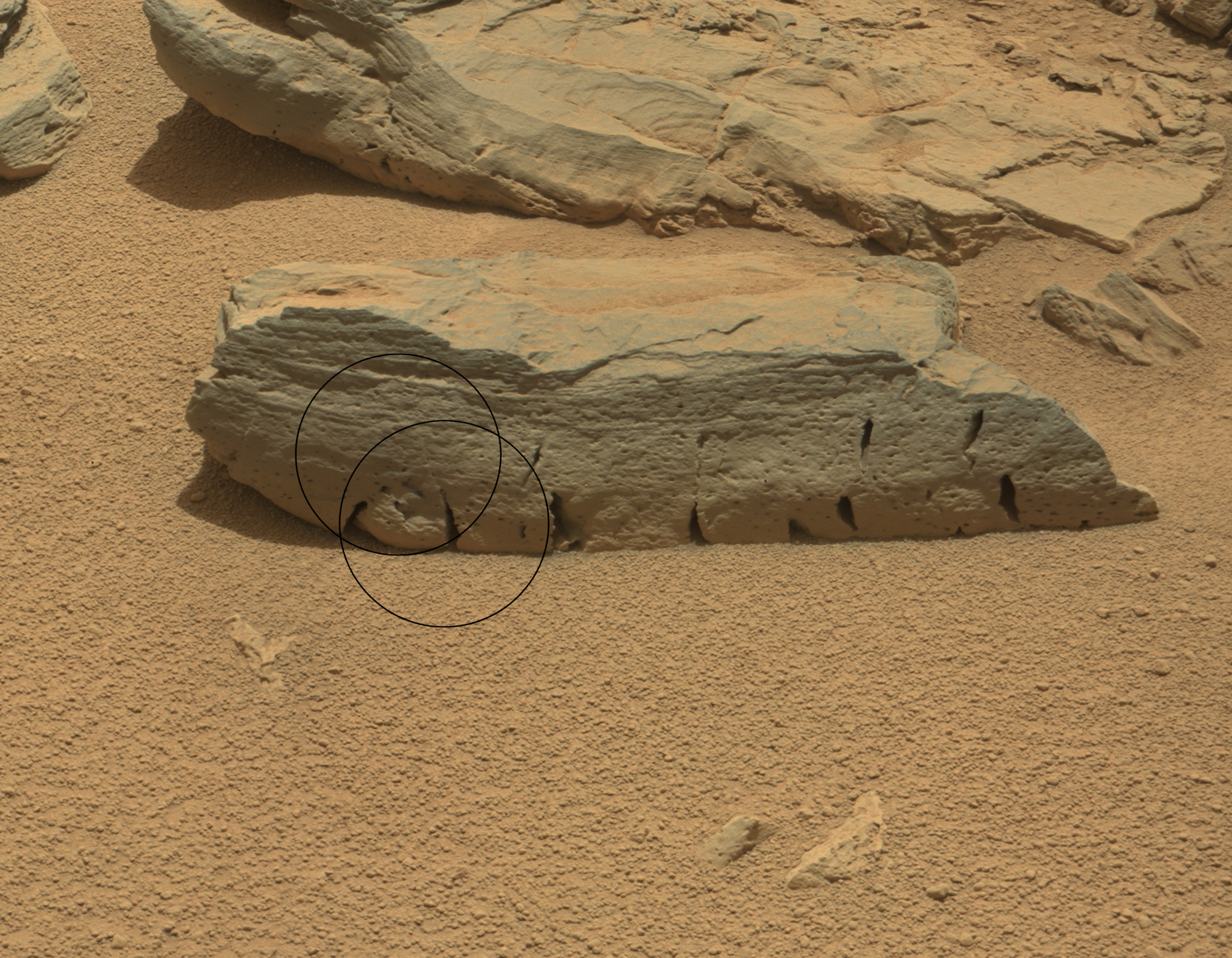
A wide-angle context image was acquired by Curiosity’s MastCam and shows Rocknest3 as targeted by ChemCam. Rocknest3 is about 10 x 40 cm, or roughly the size of a shoe box.

 ESA's Mars Express relays Rocknest3 images from NASA Curiosity

Download:
 Context image: The Mastcam 100 colour image shows Rocknest3 targeted by ChemCam and later by APXS; the fields of view of the RMI images are indicated. Rocknest3 is approximately 10 x 40 cm or roughly the size of a shoebox. 
Credits: NASA/JPL–Caltech/Malin Space Science Systems


ESA’s Mars orbiter has also relayed data for NASA’s other surface missions – Phoenix, Spirit and Opportunity – since 2004, and it relayed Curiosity’s radio signal during its arrival at Mars last August.

During the Curiosity mission, Mars Express is set to provide additional relay slots, while maintaining its own scientific observation programme, under an ESA-NASA support agreement.
It can also rapidly provide relay services in case of unavailability of NASA’s own relay orbiter or if there is a problem on the rover itself.
 

Interplanetary cooperation

“ESA–NASA cooperation at Mars is a continuing success, and comes after both sides have worked diligently for a number of years to set technical and engineering standards to enable sharing data between spacecraft, networks and ground stations,” says Mars Express Spacecraft Operations Manager Michel Denis.
“Exploring Mars is a huge challenge, and space agencies are working to boost cooperation and mutual support for current and upcoming missions. It’s the way of the future.”
ESA
Guillermo Gonzalo Sánchez Achutegui
ayabaca@gmail.com
ayabaca@hotmail.com
ayabaca@yahoo.com 

 Inscríbete en el Foro del blog y participa : A Vuelo De Un Quinde - El Foro!

miércoles, 3 de octubre de 2012

MARS: Bathurst Inlet' Rock on Curiosity's Sol 54, Context View


Download Image

› Full Size 

Inscríbete en el Foro del blog y participa : A Vuelo De Un Quinde - El Foro!

lunes, 10 de septiembre de 2012

Mars: Nasa - Wheels and a Destination


Download Image

› Full Size 
NASA
Guillermo Gonzalo Sánchez Achutegui
ayabaca@gmail.com
ayabaca@hotmail.com
ayabaca@yahoo.com
 Inscríbete en el Foro del blog y participa : A Vuelo De Un Quinde - El Foro!

Mi lista de blogs