Mostrando entradas con la etiqueta NASA's Hubble Space Telescope. Mostrar todas las entradas

domingo, 5 de marzo de 2017

ESA : Supernova aftermath .- Supernova después de las consecuencias .- The evolution of SN 1987A .- En el final de una supernova

http://www.esa.int/spaceinimages/Images/2017/02/The_evolution_of_SN_1987A
http://www.esa.int/esl/ESA_in_your_country/Spain/En_el_final_de_una_supernova

Details

Open/Close
  • Title The evolution of SN 1987A
  • Released 27/02/2017 9:00 am
  • Copyright NASA, ESA and R. Kirshner (Harvard-Smithsonian Center for Astrophysics and Gordon and Betty Moore Foundation) and P. Challis (Harvard-Smithsonian Center for Astrophysics)
  • Description
    Thirty years ago, on 23 February 1987, the light from a stellar explosion marking the death of a massive star arrived at Earth to shine in Southern Hemisphere skies.
    Located in the Large Magellanic Cloud, a satellite galaxy of the Milky Way, SN 1987A was the closest observed supernova to Earth since the invention of the telescope. Studying it for the last 30 years has revolutionised our understanding of the explosive death of massive stars.
    In operation since 1990, the NASA/ESA Hubble Space Telescope has observed the supernova remnant many times, as highlighted in this montage. The images show its evolution between 1994 and 2016, and highlight the main ring that blazes around the exploded star.
    A new wide-field image was also taken by Hubble in January 2017 to mark the 30 year anniversary.
    By observing the expanding remnant material over the years, Hubble has helped to show that the material within the ring was likely ejected 20 000 years before the actual explosion took place.
    The initial burst of light from the supernova initially illuminated the rings. They slowly faded over the first decade after the explosion, until a fast-moving shell of gas ejected during the supernova slammed into the central ring, sending a powerful shockwave through the gas, heating it to searing temperatures and generating strong X-ray emission.
    This caused clumps of denser gas within the ring to light up like a string of pearls, seen as the increasing number of bright spots, which are now fading again.
    As the shock wave continues to move through the shells ejected by the dying star in its final throes of life, who knows what new details will be revealed?
  • Id 373834

TAGS

Open/Close
 
 
     VERSIÓN EN ESPAÑOL :                           
The evolution of SN 1987A

En el final de una supernova

27 febrero 2017
El 23 de febrero de 1987, los cielos del hemisferio sur de la Tierra se iluminaron con la luz de una explosión estelar, que marcaba la muerte de una estrella masiva.
Situada en la Gran Nube de Magallanes, una galaxia satélite de la Vía Láctea, SN 1987A es la supernova más cercana a la Tierra observada desde la invención del telescopio. Su estudio a lo largo de estos últimos 30 años ha revolucionado nuestra comprensión de la muerte de estas estrellas masivas.
Como puede apreciarse en este montaje, el telescopio espacial Hubble de la NASA/ESA, en funcionamiento desde 1990, ha observado los restos de la supernova en numerosas ocasiones. Las imágenes muestran su evolución entre 1994 y 2016, destacando el anillo principal que brilla alrededor del remanente. a vuelo
Además, en enero de 2017, Hubble tomó una  nueva imagen de gran angular para celebrar su 30.º aniversario.
Al observar la expansión de los restos de esta supernova a lo largo de estos años, Hubble ha contribuido a mostrar que el material del interior del anillo probablemente se expulsara 20.000 años antes de que se produjera la explosión.
La emisión inicial de luz desde la supernova fue lo que en principio iluminó los anillos, atenuándose a lo largo de la primera década tras la explosión, hasta que una veloz nube de gas proyectada durante la supernova chocó con el anillo central, enviando una potente onda a través del gas que lo calentó a altísimas temperaturas y generó una fuerte emisión de rayos X.
Esto provocó que los cúmulos de gas más denso en el interior del anillo se fueran iluminando como una cadena de perlas, algo apreciable en el número creciente de puntos brillantes que, ahora, se están volviendo a apagar.
¿Quién sabe qué nuevos detalles descubriremos a medida que la onda de choque siga atravesando las capas eyectadas por esta estrella en las postrimerías de su vida?
ESA
Guillermo Gonzalo Sánchez Achutegui

domingo, 2 de octubre de 2016

ESO : Telescopio ALMA explora el Campo Ultra Profundo del Telescopio Espacial Hubble

Hola amigos: A VUELO DE UN QUINDE EL BLOG., hemos recibido información del Observatorio Austral Europeo ESO, en el sentido que un equipo de astrónomos y científicos espaciales, utilizando el Telescopio ALMA (Atacama Large Millimeter/submillimeter Array), para explorar el distante rincón del universo revelado por primera vez en las icónicas imágenes de Campo Ultra Profundo del Hubble (HUDF, Hubble Ultra Deep Field). Estas nuevas observaciones de ALMA son mucho más profundas y precisas que sondeos anteriores realizados en longitudes de onda milimétricas. Muestran claramente cómo la tasa de formación estelar en galaxias jóvenes está estrechamente relacionada con su masa total de estrellas. Los astrónomos seleccionaron específicamente el área de estudio en el HUDF, una región del espacio en la débil constelación meridional de Fornax (el horno), para que telescopios terrestres del hemisferio sur, como ALMA, pudieran sondear la región, ampliando nuestro conocimiento sobre el universo muy lejano.
Sondear las profundidades del universo no visibles en el óptico era uno de los primeros objetivos científicos para ALMA.
Más información, lea ampliación de la noticia abajo adjunta:

Se trata de las observaciones milimétricas más profundas del universo temprano

22 de Septiembre de 2016
Varios equipos internacionales de astrónomos han utilizado el Atacama Large Millimeter/submillimeter Array (ALMA) para explorar el distante rincón del universo revelado por primera vez en las icónicas imágenes de Campo Ultra Profundo del Hubble (HUDF, Hubble Ultra Deep Field). Estas nuevas observaciones de ALMA son mucho más profundas y precisas que sondeos anteriores realizados en longitudes de onda milimétricas. Muestran claramente cómo la tasa de formación estelar en galaxias jóvenes está estrechamente relacionada con su masa total de estrellas. También trazan la abundancia de gas implicado en la formación estelar en diferentes puntos en el tiempo, previamente desconocida, proporcionando una nueva visión de la "edad de oro" de la formación de galaxias hace aproximadamente 10.000 millones de años.
 
Los nuevos resultados de ALMA se darán a conocer en una serie de artículos  publicados en las revistas Astrophysical Journal y Monthly Notices of the Royal Astronomical Society. Estos resultados también se presentarán esta semana, junto con otros, en el congreso Half a Decade of ALMA (media década de ALMA) que se celebra en Palm Springs, California, EE.UU.
En 2004, se publicaron las imágenes de Campo Ultra Profundo de Hubble — observaciones pioneras de campo profundo llevadas a cabo con el Telescopio Espacial Hubble de NASA/ESA —. Estas espectaculares fotos hicieron la exploración más profunda hecha hasta el momento y revelaron una colección de galaxias que se extienden hasta menos de 1.000 millones de años después del Big Bang. El área fue observada varias veces por el Hubble y muchos otros telescopios, obteniendo como resultado la visión más profunda del universo hasta la fecha.
Los astrónomos que han utilizado ALMA han hecho un sondeo de esta ventana al universo distante, aparentemente ordinaria, pero muy estudiada. Y lo han hecho de forma profunda por primera vez y con mucha precisión en el rango milimétrico de la luz [1]. Esto les permite ver el débil resplandor de las nubes de gas y también las emisiones de polvo caliente en galaxias del universo temprano.
Hasta ahora, ALMA ha observado el HUDF durante un total de unas 50 horas. Hasta ahora, esta es la mayor cantidad de tiempo de observación de ALMA dedicada a un área del cielo.
Un equipo dirigido por Jim Dunlop (Universidad de Edimburgo, Reino Unido) utilizó ALMA para obtener la primera imagen profunda y homogénea de ALMA de una región tan grande como el HUDF. Esta información les permitió identificar claramente las galaxias que detectaron con objetos ya vistos con Hubble y otras instalaciones.
Este estudio demostró claramente, por primera vez, que la masa estelar de una galaxia es el mejor indicador de la tasa de formación estelar en el universo con alto desplazamiento al rojo. Esencialmente, detectaron todas las galaxias de alta masa [2] y prácticamente nada más.
Jim Dunlop, autor principal del artículo sobre la imagen de campo profundo, resume su importancia: "Este es un resultado importante. Por primera vez conectamos correctamente la visión de la luz ultravioleta y la luz visible del universo distante que nos proporciona el Hubble y la visión del infrarrojo lejano y el rango milimétrico que nos ofrece ALMA".
El segundo equipo, liderado por Manuel Aravena (Núcleo de Astronomía, Universidad Diego Portales, Santiago, Chile) y Fabian Walter (Instituto Max Planck de Astronomía, Heidelberg, Alemania), llevó a cabo una búsqueda más profunda con cerca de un sexto del total del HUDF [3].
"Hemos realizado la primera búsqueda tridimensional de gas frío en el universo temprano completamente a ciegas", afirma Chris Carilli, (astrónomo del NRAO -Observatorio Nacional de Radioastronomía-, Socorro, Nuevo México, EE.UU.) y miembro del equipo de investigación. "Gracias a esto, hemos descubierto una población de galaxias que no se ve con tanta evidencia en otros estudios profundos del cielo". [4]
Algunas de las nuevas observaciones de ALMA fueron específicamente diseñadas para detectar galaxias ricas en monóxido de carbono, ya que indica regiones óptimas de formación estelar. A pesar de que estos reservorios de gas molecular dan lugar a la actividad de formación estelar en galaxias, a menudo son muy difíciles de ver con el Hubble. Por lo tanto, ALMA puede revelar la "otra mitad" del proceso de formación y evolución de galaxias.
"Los nuevos resultados del ALMA implican un rápido aumento del gas contenido en las galaxias cuando miramos atrás en el tiempo", añade el autor principal de dos de los artículos, Manuel Aravena (Núcleo de Astronomía, Universidad Diego Portales, Santiago, Chile). "Este aumento del contenido de gas es probablemente el origen del notable incremento en las tasas de formación de estrellas durante la época en la que hallamos un pico en la formación de galaxias, hace unos 10.000 millones de años".
Los resultados presentados hoy son sólo el comienzo de una serie de futuras observaciones para sondear el universo distante con ALMA. Por ejemplo, una campaña de observación planificada de 150 horas del HUDF iluminará la historia potencial de la formación estelar del universo.
"Complementando nuestra comprensión sobre el material de formación estelar que falta, el próximo gran programa de ALMA completará nuestra visión de las galaxias en el icónico Campo Ultra Profundo del Hubble", concluye Fabian Walter.
 

Notas

 
[1] Los astrónomos seleccionaron específicamente el área de estudio en el HUDF, una región del espacio en la débil constelación meridional de Fornax (el horno), para que telescopios terrestres del hemisferio sur, como ALMA, pudieran sondear la región, ampliando nuestro conocimiento sobre el universo muy lejano.
Sondear las profundidades del universo no visibles en el óptico era uno de los primeros objetivos científicos para ALMA.
[2] En este contexto, "alta mayor" significa galaxias con masas estelares de más de 20.000 millones de veces la del Sol (2 x 10¹⁰ masas solares). En comparación, la Vía Láctea es una galaxia grande y tiene una masa de aproximadamente 100.000 millones de masas solares.
[3] Esta región del cielo es aproximadamente setecientas veces más pequeña que el área del disco de la Luna llena visto desde la Tierra. Uno de los aspectos más sorprendentes del HUDF fue la gran cantidad de galaxias que se encuentran en una pequeña fracción del cielo.
[4] La capacidad de ALMA de ver una parte del espectro electromagnético diferente a loa que capta el Hubble, permite a los astrónomos estudiar una clase diferente de objetos astronómicos, tales como nubes de formación estelar masivas, así como objetos que, de otra manera, son demasiado débiles para poder observarlos en luz visible, pero que son visibles en longitudes de onda milimétricas.
La búsqueda se conoce como "ciega" porque no se centró en ningún objeto en particular.
Las nuevas observaciones de ALMA del HUDF incluyen dos tipos distintos, pero complementarios, de datos: observaciones de continuo, que revelan la emisión de polvo y la formación de estrellas, y un sondeo de líneas de emisión espectrales, que enfocan la formación de estrellas alimentadas por gas molecular frío. El segundo sondeo es particularmente valioso porque incluye información sobre el grado en el que la luz de objetos distantes se ha desplazado al rojo debido a la expansión del universo. Un mayor desplazamiento al rojo significa que un objeto está más lejos y lo vemos más lejos en el tiempo. Esto permite a los astrónomos crear un mapa tridimensional del gas a partir del cual se forman las estrellas a medida que evoluciona con el tiempo cósmico.
 

Información adicional

 
Este trabajo de investigación se ha presentado en los siguientes artículos científicos:
  1. “A deep ALMA image of the Hubble Ultra Deep Field”, por J. Dunlop et al., en la revista Monthly Notices of the Royal Astronomical Society.
  2. “The ALMA Spectroscopic Survey in the Hubble Ultra Deep Field: Search for the [CII] Line and Dust Emission in 6 < z < 8 Galaxies”, por M. Aravena et al., en la revista Astrophysical Journal.
  3. “The ALMA Spectroscopic Survey in the Hubble Ultra Deep Field: Molecular Gas Reservoirs in High-Redshift Galaxies”, por R. Decarli et al., en la revista Astrophysical Journal.
  4. “The ALMA Spectroscopic Survey in the Hubble Ultra Deep Field: CO Luminosity Functions and the Evolution of the Cosmic Density of Molecular Gas”, por R. Decarli et al., en la revista Astrophysical Journal.
  5. “The ALMA Spectroscopic Survey in the Hubble Ultra Deep Field: Continuum Number Counts, Resolved 1.2-mm Extragalactic Background, and Properties of the Faintest Dusty Star Forming Galaxies”, por M. Aravena et al., en la revista Astrophysical Journal.
  6. “The ALMA Spectroscopic Survey in the Hubble Ultra Deep Field: Survey Description”, por F. Walter et al., en la revista Astrophysical Journal.
  7. “The ALMA Spectroscopic Survey in the Hubble Ultra Deep Field: the Infrared excess of UV-selected z= 2-10 Galaxies as a Function of UV-continuum Slope and Stellar Mass”, por R. Bouwens et al., en la revista Astrophysical Journal.
  8. “The ALMA Spectroscopic Survey in the Hubble Ultra Deep Field: Implication for spectral line intensity mapping at millimeter wavelengths and CMB spectral distortions”, por C. L. Carilli et al., en la revista Astrophysical Journal.
Los equipos están formados por:
M. Aravena (Núcleo de Astronomía, Universidad Diego Portales, Santiago, Chile); R. Decarli (Instituto Max Planck de Astronomía, Heidelberg, Alemania); F. Walter (Instituto Max Planck de Astronomía, Heidelberg, Alemania; Departamento de Astronomía, Instituto Tecnológico de California, EE.UU.; NRAO, Centro de Operaciones Científicas Pete V. Domenici, EE.UU.); R. Bouwens (Observatorio de Leiden, Leiden, Países Bajos; UCO/Observatorio Lick, Santa Cruz, EE.UU.); P.A. Oesch (Departamento de Astronomía, Universidad de Yale, New Haven, EE.UU.); C.L. Carilli (Observatorio de Leiden, Leiden, Países Bajos; Grupo de Astrofísica, Laboratorio Cavendish, Cambridge, Reino Unido); F.E. Bauer (Instituto de Astrofísica, Pontificia Universidad Católica de Chile, Santiago, Chile; Instituto Milenio de Astrofísica, Chile; Instituto de Ciencias Espaciales, Boulder, EE.UU.); E. Da Cunha (Escuela de Investigación de Astronomía y Astrofísica, Universidad Nacional de Australia, Canberra, Australia; Centro de Astrofísica y Supercomputación, Universidad Tecnológica de Swinburne, Hawthorn, Australia); E. Daddi (Laboratorio AIM, CEA/DSM-CNRS-Universidad París Diderot, Orme des Merisiers, Francia); J. Gónzalez-López (Instituto de Astrofísica, Pontificia Universidad Católica de Chile, Santiago, Chile); R.J. Ivison (Observatorio Europeo Austral, Garching - Múnich, Alemania; Instituto de Astronomía, Universidad de Edimburgo, Edimburgo, Reino Unido); D.A. Riechers (Universidad Cornell, 220 Edificio de Ciencias del Espacio, Ithaca, EE.UU.); I. Smail (Instituto de Cosmología Computacional, Universidad de Durham, Durham, Reino Unido); A.M. Swinbank (Instituto de Cosmología Computacional, Universidad de Durham, Durham, Reino Unido), A. Weiss (Instituto Max Planck de Radioastronomía, Bonn, Alemania); T. Anguita (Departamento de Ciencias Físicas, Universidad Andrés Bello, Santiago, Chile; Instituto Milenio de Astrofísica, Chile); R. Bacon (Universidad Lyon 1, Saint Genis Laval, Francia); E. Bell (Departamento de Astronomía, Universidad de Michigan, EE.UU.); F. Bertoldi (Instituto Argelander de Astronomía, Universidad de Bonn, Bonn, Alemania); P. Cortes (Observatorio Conjunto ALMA - ESO, Santiago, Chile; NRAO, Centro de Operaciones Científicas Pete V. Domenici, EE.UU.); P. Cox (Observatorio Conjunto ALMA - ESO, Santiago, Chile); J. Hodge (Observatorio de Leiden, Leiden, Países Bajos); E. Ibar (Instituto de Física y Astronomía, Universidad de Valparaíso, Valparaíso, Chile); H. Inami (Universidad Lyon 1, Saint Genis Laval, Francia); L. Infante (Instituto de Astrofísica, Pontificia Universidad Católica de Chile, Santiago, Chile); A. Karim (Instituto Argelander de Astronomía, Universidad de Bonn, Bonn, Alemania); B. Magnelli (Instituto Argelander de Astronomía, Universidad de Bonn, Bonn, Alemania); K. Ota (Instituto Kavli de Cosmología, Universidad de Cambridge, Cambridge, Reino Unido; Laboratorio Cavendish, Universidad de Cambridge, Reino Unido); G. Popping (Observatorio Europeo Austral, Garching - Múnich, Alemania); P. van der Werf (Observatorio de Leiden, Leiden, Países Bajos); J. Wagg (Organización SKA, Cheshire, Reino Unido); Y. Fudamoto (Observatorio Europeo Austral, Garching - Múnich, Alemania; Observatorio Universitario de Múnich, Múnich, Alemania); D. Elbaz (Laboratorio AIM, CEA/DSM-CNRS-Universidad París Diderot, Francia); S. Chapman (Universidad Dalhousie, Halifax, Nueva Escocia, Canadá); L.Colina (ASTRO-UAM, UAM, Unidad Asociada CSIC, España); H.W. Rix (Instituto Max Planck de Astronomía, Heidelberg, Alemania); Mark Sargent (Centro de Astronomía, Universidad de Sussex, Brighton, Reino Unido); Arjen van der Wel (Instituto Max Planck de Astronomía, Heidelberg, Alemania).
K. Sheth (Sede Central de la NASA, Washington DC, EE.UU.); Roberto Neri (IRAM, Saint-Martin d’Hères, Francia); O. Le Fèvre (Universidad Aix Marseille, Laboratorio de Astrofísica de Marsella, Marsella, Francia); M. Dickinson (Observatorio Steward, Universidad de Arizona, EE.UU.); R. Assef (Núcleo de Astronomía, Universidad Diego Portales, Santiago, Chile); I. Labbé (Observatorio de Leiden, Universidad de Leiden, Países Bajos); S. Wilkins (Centro de Astronomía, Universidad de Sussex, Brighton, Reino Unido); J.S. Dunlop (Universidad de Edimburgo, Real Observatorio, Edimburgo, Reino Unido); R.J. McLure (Universidad de Edimburgo, Real Observatorio, Edimburgo, Reino Unido); A.D. Biggs (ESO, Garching, Alemania); J.E. Geach (Universidad de Hertfordshire, Hatfield, Reino Unido); M.J. Michałowski (Universidad de Edimburgo, Real Observatorio, Edimburgo, Reino Unido); W. Rujopakarn (Universidad Chulalongkorn, Bangkok, Tailandia); E. van Kampen (ESO, Garching, Alemania); A. Kirkpatrick (Universidad de Massachusetts, Amherst, Massachusetts, EE.UU.); A. Pope (Universidad de Massachusetts, Amherst, Massachusetts, EE.UU.); D. Scott (Universidad de British Columbia, Vancouver, British Columbia, Canadá); T.A. Targett (Universidad del Estado de Sonoma, Rohnert Park, California, EE.UU.); I. Aretxaga (Instituto Nacional de Astrofísica, Óptica y Electrónica, México); J.E. Austermann (Grupo de Dispositivos Cuánticos NIST, Boulder, Colorado, EE.UU.); P.N. Best (Universidad de Edimburgo, Real Observatorio, Edimburgo, Reino Unido); V.A. Bruce (Universidad de Edimburgo, Real Observatorio, Edimburgo, Reino Unido); E.L. Chapin (Astronomía y Astrofísica Herzberg, Consejo Nacional de Investigación de Canadá, Victoria, Canadá); S. Charlot (Universidades de la Sorbona, UPMC-CNRS, UMR7095, Instituto de Astrofísica de París, París, Francia); M. Cirasuolo (ESO, Garching, Alemania); K.E.K. Coppin (Universidad de Hertfordshire, College Lane, Hatfield, Reino Unido); R.S. Ellis (ESO, Garching, Alemania); S.L. Finkelstein (Universidad de Texas en Austin, Austin, Texas, EE.UU.); C.C. Hayward (Instituto Tecnológico de California, Pasadena, California, EE.UU.); D.H. Hughes (Instituto Nacional de Astrofísica, Óptica y Electrónica, México); S. Khochfar (Universidad de Edimburgo, Real Observatorio, Edimburgo, Reino Unido); M.P. Koprowski (Universidad de Hertfordshire, College Lane, Hatfield, Reino Unido); D. Narayanan (Colegio Haverford, Haverford, Pensilvania, EE.UU.); C. Papovich (Universidad Texas A & M, College Station, Texas, EE.UU.); J.A. Peacock (Universidad de Edimburgo, Real Observatorio, Edimburgo, Reino Unido); B. Robertson (Universidad de California, Santa Cruz, Santa Cruz, California, EE.UU.); T. Vernstrom (Instituto Dunlap de Astronomía y Astrofísica, Universidad de Toronto, Toronto, Ontario, Canadá); G.W. Wilson (Universidad de Massachusetts, Amherst, Massachusetts, EE.UU.) y M. Yun (Universidad de Massachusetts, Amherst, Massachusetts, EE.UU.).
El conjunto ALMA, (Atacama Large Millimeter/submillimeter Array) es una instalación astronómica internacional fruto de la colaboración entre ESO, la Fundación Nacional para la Ciencia de EE.UU. (NSF, National Science Foundation) y los Institutos Nacionales de Ciencias Naturales de Japón (NINS, National Institutes of Natural Sciences) en cooperación con la República de Chile. ALMA está financiado por ESO en nombre de sus países miembros; por la NSF en cooperación con el Consejo Nacional de Investigación de Canadá (NRC, National Research Council) y el Consejo Nacional de Ciencias de Taiwán (NSC, National Science Council), y por el NINS en cooperación con la Academia Sinica (AS) de Taiwán y el Instituto de Astronomía y Ciencias Espaciales de Corea (KASI, Korea Astronomy and Space Science Institute).
La construcción y operaciones de ALMA están lideradas por ESO en nombre de sus países miembros; por el Observatorio Nacional de Radioastronomía (NRAO, National Radio Astronomy Observatory), gestionado por Associated Universities, Inc. (AUI), en América del Norte; y por el Observatorio Astronómico Nacional de Japón (NAOJ, Observatorio Astronómico Nacional de Japón) en Asia Oriental. El Observatorio Conjunto ALMA (Observatorio Conjunto ALMA, JAO) proporciona al proyecto la unificación tanto del liderazgo como de la gestión de la construcción, puesta a punto y operaciones de ALMA.
ESO es la principal organización astronómica intergubernamental de Europa y el observatorio astronómico más productivo del mundo. Cuenta con el respaldo de dieciséis países: Alemania, Austria, Bélgica, Brasil, Dinamarca, España, Finlandia, Francia, Italia, Países Bajos, Polonia, Portugal, el Reino Unido, República Checa, Suecia y Suiza, junto con el país anfitrión, Chile. ESO desarrolla un ambicioso programa centrado en el diseño, construcción y operación de poderosas instalaciones de observación terrestres que permiten a los astrónomos hacer importantes descubrimientos científicos. ESO también desarrolla un importante papel al promover y organizar la cooperación en investigación astronómica. ESO opera en Chile tres instalaciones de observación únicas en el mundo: La Silla, Paranal y Chajnantor. En Paranal, ESO opera el Very Large Telescope, el observatorio óptico más avanzado del mundo, y dos telescopios de rastreo. VISTA (siglas en inglés de Telescopio de Rastreo Óptico e Infrarrojo para Astronomía) trabaja en el infrarrojo y es el telescopio de rastreo más grande del mundo, y el VST (VLT Survey Telescope, Telescopio de Rastreo del VLT) es el telescopio más grande diseñado exclusivamente para rastrear el cielo en luz visible. ESO es el socio europeo de un revolucionario telescopio, ALMA, actualmente el mayor proyecto astronómico en funcionamiento del mundo. Además, cerca de Paranal, en Cerro Armazones, ESO está construyendo el E-ELT (European Extremely Large Telescope), el telescopio óptico y de infrarrojo cercano de 39 metros que llegará a ser “el ojo más grande del mundo para mirar el cielo”.
Las traducciones de las notas de prensa de ESO las llevan a cabo miembros de la Red de Divulgación de la Ciencia de ESO (ESON por sus siglas en inglés), que incluye a expertos en divulgación y comunicadores científicos de todos los países miembros de ESO y de otras naciones.

El
nodo español de la red ESON está representado por J. Miguel Mas Hesse y Natalia Ruiz Zelmanovitch.

Enlaces

Contactos

José Miguel Mas Hesse
Centro de Astrobiología (INTA-CSIC)
Madrid, España
Tlf.: (+34) 91 813 11 96
Correo electrónico: mm@cab.inta-csic.es
James Dunlop
University of Edinburgh
Edinburgh, United Kingdom
Correo electrónico: jsd@roe.ac.uk
Fabian Walter
Max-Planck Institut für Astronomie
Heidelberg, Germany
Correo electrónico: walter@mpia.de
Manuel Aravena
Núcleo de Astronomía, Facultad de Ingeniería, Universidad Diego Portales
Santiago, Chile
Correo electrónico: manuel.aravenaa@mail.udp.cl
Richard Hook
ESO Public Information Officer
Garching bei München, Germany
Tlf.: +49 89 3200 6655
Móvil: +49 151 1537 3591
Correo electrónico: rhook@eso.org

Imágenes

ALMA explora el Campo Ultra Profundo del Hubble
El Campo Profundo Extremo del Hubble
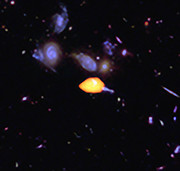
Profunda imagen de ALMA de parte del Campo Ultra Profundo del Hubble

Videos
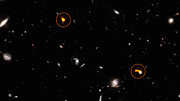
ALMA explora el Campo Ultra Profundo del Hubble

Ver también

Esta es una traducción de la nota de prensa de ESO eso1633.
ESO
Guillermo Gonzalo Sánchez Achutegui
ayabaca@gmail.com
ayabaca@hotmail.com
ayabaca@yahoo.com

domingo, 13 de marzo de 2016

NASA : Hubble Sees a Legion of Galaxies .- Telescopio Espacial Hubble ve una legión de Galaxias

Hola amigos: A VUELO DE UN QUINDE EL BLOG., hemos recibido información de la Agencia Espacial NASA,  de que el telescopio espacial Hubble observa una legión de galaxias encabezadas por la Galaxia Gigante : Galaxy cluster Abell 2744,
More information..............

Thousands of colorful galaxies swimming in the inky blackness of space
Peering deep into the early universe, this picturesque parallel field observation from the NASA/ESA Hubble Space Telescope reveals thousands of colorful galaxies swimming in the inky blackness of space. A few foreground stars from our own galaxy, the Milky Way, are also visible.

In October 2013 Hubble’s Wide Field Camera 3 (WFC3) and Advanced Camera for Surveys (ACS) began observing this portion of sky as part of the Frontier Fields program. This spectacular skyscape was captured during the study of the giant galaxy cluster Abell 2744, otherwise known as Pandora’s Box. While one of Hubble’s cameras concentrated on Abell 2744, the other camera viewed this adjacent patch of sky near to the cluster.

Containing countless galaxies of various ages, shapes and sizes, this parallel field observation is nearly as deep as the Hubble Ultra-Deep Field. In addition to showcasing the stunning beauty of the deep universe in incredible detail, this parallel field — when compared to other deep fields — will help astronomers understand how similar the universe looks in different directions.

Image credit: NASA, ESA and the HST Frontier Fields team (STScI), Acknowledgement: Judy Schmidt
Text credit: European Space Agency
Last Updated: March 11, 2016
Editor: Ashley Morrow
NASA
Guillermo Gonzalo Sánchez Achutegui
Inscríbete en el Foro del blog y participa : A Vuelo De Un Quinde - El Foro!

domingo, 7 de febrero de 2016

NASA : Hubble Views Merging Galaxies in Eridanus .- Telescopio Espacila Hubble observa la fusión de galaxias en Eridanus

Hola amigos: A VUELO DE UN QUINDE EL BLOG., Esta imagen, tomada por el telescopio espacial Hubble de la NASA / ESA, muestra una galaxia peculiar conocida como NGC 1487, situada a unos 30 millones de años luz de distancia en la constelación austral de Eridanus. En lugar de verla como un objeto celeste, en realidad es mejor pensar en esto como un evento. En este caso, estamos en presencia de dos o más galaxias en el acto de la fusión entre sí para formar una sola nueva galaxia. Cada galaxia ha perdido casi todos los rastros de su aspecto original, como estrellas y el gas han sido arrojados por la gravedad en un remolino cósmico elaborado.
More information....

Two or more galaxies in the act of merging together
This image, taken by the NASA/ESA Hubble Space Telescope, shows a peculiar galaxy known as NGC 1487, lying about 30 million light-years away in the southern constellation of Eridanus.

Rather than viewing it as a celestial object, it is actually better to think of this as an event. Here, we are witnessing two or more galaxies in the act of merging together to form a single new galaxy. Each galaxy has lost almost all traces of its original appearance, as stars and gas have been thrown by gravity in an elaborate cosmic whirl.

Unless one is very much bigger than the other, galaxies are always disrupted by the violence of the merging process. As a result, it is very difficult to determine precisely what the original galaxies looked like and, indeed, how many of them there were. In this case, it is possible that we are seeing the merger of several dwarf galaxies that were previously clumped together in a small group.

Although older yellow and red stars can be seen in the outer regions of the new galaxy, its appearance is dominated by large areas of bright blue stars, illuminating the patches of gas that gave them life. This burst of star formation may well have been triggered by the merger.
Image credit: ESA/Hubble & NASA, Acknowledgement: Judy Schmidt
Text credit: European Space Agency
Last Updated: Feb. 5, 2016
Editor: Ashley Morrow
 
NASA
Guillermo Gonzalo Sánchez Achutegui
Inscríbete en el Foro del blog y participa : A Vuelo De Un Quinde - El Foro!

jueves, 14 de enero de 2016

NASA : Hubble Sees a Supermassive and Super-hungry Galaxy .- Telescopio Espacial Hubble ve una galaxia Supermassive y Super-hambre

Hola amigos: A VUELO DE UN QUINDE EL BLOG., Esta imagen del telescopio espacial de la NASA / ESA Hubble muestra la galaxia espiral NGC 4845, que se encuentra más de 65 millones de años-luz de distancia en la constelación de Virgo (La Virgen). La orientación de la galaxia revela claramente sorprendente estructura espiral de la galaxia: un disco plano y sin polvo que rodea a una abigarrada bulbo galáctico brillante.
Centro brillante de NGC 4845 alberga una versión gigantesca de un agujero negro, conocido como un agujero negro supermasivo. La presencia de un agujero negro en una galaxia lejana como NGC 4845 se puede deducir de su efecto en las estrellas más internas de la galaxia; estas estrellas experimentan una fuerte atracción gravitatoria del agujero negro y el genio de alrededor del centro de la galaxia mucho más rápido que lo contrario.
More information.....
 

Image of spiral galaxy NGC 4845, a flat and dust-mottled disk surrounding a bright galactic bulge.
This NASA/ESA Hubble Space Telescope image shows the spiral galaxy NGC 4845, located over 65 million light-years away in the constellation of Virgo (The Virgin). The galaxy’s orientation clearly reveals the galaxy’s striking spiral structure: a flat and dust-mottled disk surrounding a bright galactic bulge.

NGC 4845’s glowing center hosts a gigantic version of a black hole, known as a supermassive black hole. The presence of a black hole in a distant galaxy like NGC 4845 can be inferred from its effect on the galaxy’s innermost stars; these stars experience a strong gravitational pull from the black hole and whizz around the galaxy’s center much faster than otherwise.

From investigating the motion of these central stars, astronomers can estimate the mass of the central black hole — for NGC 4845 this is estimated to be hundreds of thousands times heavier than the sun. This same technique was also used to discover the supermassive black hole at the center of our own Milky Way — Sagittarius A* — which hits some four million times the mass of the sun.

The galactic core of NGC 4845 is not just supermassive, but also super-hungry. In 2013 researchers were observing another galaxy when they noticed a violent flare at the center of NGC 4845. The flare came from the central black hole tearing up and feeding off an object many times more massive than Jupiter. A brown dwarf or a large planet simply strayed too close and was devoured by the hungry core of NGC 4845.

Image credit: ESA/Hubble & NASA and S. Smartt (Queen's University Belfast)
Text credit: European Space Agency

Last Updated: Jan. 8, 2016
Editor: Ashley Morrow
NASA
Guillermo Gonzalo Sánchez Achutegui
ayabaca@gmail.com
ayabaca@hotmail.com
ayabaca@yahoo.com
Inscríbete en el Foro del blog y participa : A Vuelo De Un Quinde - El Foro!

domingo, 10 de mayo de 2015

NASA : Engineers Clean Mirror with Carbon Dioxide Snow.- Ingenieros limpian espejo con nieve de dióxido de carbono....

Hola amigos: A VUELO DE UN QUINDE EL BLOG., hemos recibido información de la Agencia Espacial NASA, sobre una actividad que ingenieros especialistas limpian una capa de nieve de dióxido de Carbono del espejo del:  the James Webb Space Telescope.
NASA, dice :  "Los cristales como de nieve (nieve de dióxido de carbono) golpean con  partículas y moléculas que  contaminan  al espejo", dijo Lee Feinberg, la NASA gestor de elementos telescopio óptico. Esta técnica sólo se utilizará si el espejo Espacial James Webb Telescope se contamina durante la integración y pruebas.

Two men in white lab suits shoot snow at a round, copper-colored mirror
Just like drivers sometimes use snow to clean their car mirrors in winter, two Exelis Inc. engineers are practicing "snow cleaning'" on a test telescope mirror for the James Webb Space Telescope at NASA's Goddard Space Flight Center in Greenbelt, Maryland. By shooting carbon dioxide snow at the surface, engineers are able to clean large telescope mirrors without scratching them. 
"The snow-like crystals (carbon dioxide snow) knock contaminate particulates and molecules off the mirror," said Lee Feinberg, NASA optical telescope element manager. This technique will only be used if the James Webb Space Telescope's mirror is contaminated during integration and testing.
The Webb telescope is the scientific successor to NASA's Hubble Space Telescope. It will be the most powerful space telescope ever built. With a mirror seven times as large as Hubble's and infrared capability, Webb will be capturing light from 13.5 billion light years away. To do this, its mirror must be kept super clean.
"Small dust particles or molecules can impact the science that can be done with the Webb," said Feinberg. "So cleanliness especially on the mirrors is critical."
Webb is an international project led by NASA with its partners, the European Space Agency and the Canadian Space Agency.
Image credit: NASA/Chris Gunn
Text credit: Laura Betz, NASA's Goddard Space Flight Center, Greenbelt, Maryland
Last Updated: May 10, 2015
Editor: Ashley Morrow
NASA
Guillermo Gonzalo Sánchez Achutegui
Inscríbete en el Foro del blog y participa : A Vuelo De Un Quinde - El Foro!

jueves, 1 de enero de 2015

NASA: Ceres, Target of NASA's Dawn Mission

Hola amigos: A VUELO DE UN QUINDE EL BLOG., Hemos recibido de la Agencia Espacial NASA, la información sobre el objetivo de la Misión: NASA's Dawn misión, en enfocar al asteroide Ceres, que está ubicado en el llamado Cinturón de Asteroides, una franja del Sistema Solar entre Marte y Júpiter.
Ceres, Target of NASA's Dawn Mission
 
Discovered on Jan. 1, 1801 by Giuseppe Piazzi of Italy, Ceres is the largest object in the asteroid belt - the strip of solar system real estate between Mars and Jupiter. On March 6, 2015, NASA's Dawn spacecraft will arrive at Ceres, marking the first time that a spacecraft has ever orbited two solar system targets. Dawn previously explored the protoplanet Vesta for 14 months, from 2011 to 2012, capturing detailed images and data about that body. Dawn has entered its approach phase toward Ceres, and the next couple of months promise continually improving views prior to arrival. By the end of January, the spacecraft's images and other data will be the best ever taken of the dwarf planet.
This image of Ceres was taken by the Advanced Camera for Surveys on NASA's Hubble Space Telescope between December 2003 and January 2004. Hubble images of Vesta and Ceres helped astronomers plan for the Dawn spacecraft’s tour. Astronomers enhanced the sharpness in the image to bring out features on Ceres' surface, including brighter and darker regions that could be asteroid impact features. The observations were made in visible and ultraviolet light.
The colors represent the differences between relatively red and blue regions. These differences may simply be due to variation on the surface among different types of material. Ceres' round shape suggests that its interior is layered like those of terrestrial planets such as Earth. Ceres may have a rocky inner core, an icy mantle, and a thin, dusty outer crust inferred from its density and rotation rate of 9 hours. Ceres is approximately 590 miles (950 kilometers) across.
Image Credit: NASA/ESA/J. Parker (SWRI), P. Thomas (Cornell U.), L. McFadden (U-Md., College Park), and M. Mutchler and Z. Levay (STScI)
NASA
Guillermo Gonzalo Sánchez Achutegui
Inscríbete en el Foro del blog y participa : A Vuelo De Un Quinde - El Foro!

domingo, 2 de noviembre de 2014

NASA : Here’s Looking at You: Spooky Shadow Gives Jupiter a Giant Eye .- Aquí le está mirando: Spooky Sombra de un ojo gigante de Júpiter .....

Hola amigos: A VUELO DE UN QUINDE EL BLOG., la Agencia Espacial NASA, nos informa sobre la captación de un Ojo Gigante en el plante Júpiter, captada por el Telescopio Espacial Hubble y nos dicen...."Este truco de que el planeta está mirando detrás usted es en realidad un regalo de Hubble: Un, vista espeluznante de cerca de Júpiter, el planeta más grande de nuestro sistema solar. Hubble estaba monitoreando los cambios en la inmensa Gran Mancha Roja (GRS) la tormenta de Júpiter el 21 de abril de 2014, cuando la sombra de la luna  Ganimedes de Júpiter, se extendió por todo el centro de la tormenta. Esto le dio al planeta gigante la aparición misteriosa de tener un alumno en el centro de un 10,000 millas de diámetro "ojo". Por un momento, Júpiter "mirado" hacia atrás en el Hubble como un solo ojo cíclope gigante. Haga clic en la imagen para ver Júpiter desde la distancia................."

 
Here’s Looking at You: Spooky Shadow Gives Jupiter a Giant Eye
This trick that the planet is looking back at you is actually a Hubble treat: An eerie, close-up view of Jupiter, the biggest planet in our solar system. Hubble was monitoring changes in Jupiter’s immense Great Red Spot (GRS) storm on April 21, 2014, when the shadow of the Jovian moon, Ganymede, swept across the center of the storm. This gave the giant planet the uncanny appearance of having a pupil in the center of a 10,000 mile-diameter “eye.” For a moment, Jupiter “stared” back at Hubble like a one-eyed giant Cyclops. Click on the image to view Jupiter from a distance.
Image Credit: NASA/ESA/A. Simon (Goddard Space Flight Center)
Caption: Ray Villard, Space Science Telescope Institute
Acknowledgment: C. Go and the Hubble Heritage Team (STScI/AURA)
NASA
Guillermo Gonzalo Sánchez Achutegui
ayabaca@gmail.com
ayabaca@hotmail.com
ayabaca@yahoo.com
Inscríbete en el Foro del blog y participa : A Vuelo De Un Quinde - El Foro!

sábado, 12 de julio de 2014

NASA : Hubble Sees a Galaxy With a Glowing Heart


Hubble Sees a Galaxy With a Glowing Heart
This view, captured by the NASA/ESA Hubble Space Telescope, shows a nearby spiral galaxy known as NGC 1433. At about 32 million light-years from Earth, it is a type of very active galaxy known as a Seyfert galaxy — a classification that accounts for 10% of all galaxies. They have very bright, luminous centers that are comparable in brightness to that of our entire galaxy, the Milky Way.
Galaxy cores are of great interest to astronomers. The centers of most, if not all, galaxies are thought to contain a supermassive black hole, surrounded by a disk of in-falling material.
NGC 1433 is being studied as part of a survey of 50 nearby galaxies known as the Legacy ExtraGalactic UV Survey (LEGUS). Ultraviolet radiation is observed from galaxies, mainly tracing the most recently formed stars. In Seyfert galaxies, ultraviolet light is also thought to emanate from the accretion discs around their central black holes. Studying these galaxies in the ultraviolet part of the spectrum is incredibly useful to study how the gas is behaving near the black hole. This image was obtained using a mix of ultraviolet, visible, and infrared light.
LEGUS will study a full range of properties from a sample of galaxies, including their internal structure. This Hubble survey will provide a unique foundation for future observations with the James Webb Space Telescope (JWST) and the Atacama Large Millimeter/submillimeter Array (ALMA). ALMA has already caught unexpected results relating to the center of NGC 1433, finding a surprising spiral structure in the molecular gas close to the center of NGC 1433. The astronomers also found a jet of material flowing away from the black hole, extending for only 150 light-years — the smallest such molecular outflow ever observed in a galaxy beyond our own.
European Space Agency
Credit: ESA/Hubble & NASA, Acknowledgements: D. Calzetti (UMass) and the LEGUS Team
NASA
Guillermo Gonzalo Sánchez Achutegui
ayabaca@gmail.com
ayabaca@hotmail.com
ayabaca@yahoo.com
Inscríbete en el Foro del blog y participa : A Vuelo De Un Quinde - El Foro!

jueves, 5 de junio de 2014

NASA : Hubble Team Unveils Most Colorful View of Universe Captured by Space Telescope


Composite image showing the visible and near infrared light spectrum
This is a composite image showing the visible and near infrared light spectrum collected from Hubble's ACS and WFC3 instruments over a nine-year period.
Image Credit: 
NASA/ESA
 
Astronomers using NASA's Hubble Space Telescope have assembled a comprehensive picture of the evolving universe – among the most colorful deep space images ever captured by the 24-year-old telescope.
Researchers say the image, in new study called the Ultraviolet Coverage of the Hubble Ultra Deep Field, provides the missing link in star formation. The Hubble Ultra Deep Field 2014 image is a composite of separate exposures taken in 2003 to 2012 with Hubble's Advanced Camera for Surveys and Wide Field Camera 3.
Astronomers previously studied the Hubble Ultra Deep Field (HUDF) in visible and near-infrared light in a series of images captured from 2003 to 2009. The HUDF shows a small section of space in the southern-hemisphere constellation Fornax. Now, using ultraviolet light, astronomers have combined the full range of colors available to Hubble, stretching all the way from ultraviolet to near-infrared light. The resulting image -- made from 841 orbits of telescope viewing time -- contains approximately 10,000 galaxies, extending back in time to within a few hundred million years of the big bang.
Prior to the Ultraviolet Coverage of the Hubble Ultra Deep Field study of the universe, astronomers were in a curious position. Missions such as NASA's Galaxy Evolution Explorer (GALEX) observatory, which operated from 2003 to 2013, provided significant knowledge of star formation in nearby galaxies. Using Hubble's near-infrared capability, researchers also studied star birth in the most distant galaxies, which appear to us in their most primitive stages due to the significant amount of time required for the light of distant stars to travel into a visible range. But for the period in between, when most of the stars in the universe were born -- a distance extending from about 5 to 10 billion light-years -- they did not have enough data.
"The lack of information from ultraviolet light made studying galaxies in the HUDF like trying to understand the history of families without knowing about the grade-school children," said principal investigator Harry Teplitz of Caltech in Pasadena, California. "The addition of the ultraviolet fills in this missing range."
Ultraviolet light comes from the hottest, largest and youngest stars. By observing at these wavelengths, researchers get a direct look at which galaxies are forming stars and where the stars are forming within those galaxies.
Studying the ultraviolet images of galaxies in this intermediate time period enables astronomers to understand how galaxies grew in size by forming small collections of very hot stars. Because Earth's atmosphere filters most ultraviolet light, this work can only be accomplished with a space-based telescope.
"Ultraviolet surveys like this one using the unique capability of Hubble are incredibly important in planning for NASA's James Webb Space Telescope," said team member Dr. Rogier Windhorst of Arizona State University in Tempe. "Hubble provides an invaluable ultraviolet light dataset that researchers will need to combine with infrared data from Webb. This is the first really deep ultraviolet image to show the power of that combination."
The Hubble Space Telescope is a project of international cooperation between NASA and the European Space Agency. NASA's Goddard Space Flight Center in Greenbelt, Maryland, manages the telescope. The Space Telescope Science Institute (STScI) in Baltimore conducts Hubble science operations. STScI is operated for NASA by the Association of Universities for Research in Astronomy, Inc., in Washington.
For Hubble Ultra Deep Field 2014 images and more information about Hubble, visit:
and
NASA
Guillermo Gonzalo Sánchez Achutegui

viernes, 16 de mayo de 2014

NASA : Hubble Sees Starbursts in the Wake of a Fleeting Romance


Hubble Sees Starbursts in the Wake of a Fleeting Romance
This image from NASA/ESA's Hubble Space Telescope shows galaxy NGC 4485 in the constellation of Canes Venatici (The Hunting Dogs). The galaxy is irregular in shape, but it hasn’t always been so. Part of NGC 4485 has been dragged towards a second galaxy, named NGC 4490 — which lies out of frame to the bottom right of this image.
Between them, these two galaxies make up a galaxy pair called Arp 269. Their interactions have warped them both, turning them from spiral galaxies into irregular ones. NGC 4485 is the smaller galaxy in this pair, which provides a fantastic real-world example for astronomers to compare to their computer models of galactic collisions. The most intense interaction between these two galaxies is all but over; they have made their closest approach and are now separating. The trail of bright stars and knotty orange clumps that we see here extending out from NGC 4485 is all that connects them — a trail that spans some 24 000 light-years.
Many of the stars in this connecting trail could never have existed without the galaxies’ fleeting romance. When galaxies interact hydrogen gas is shared between them, triggering intense bursts of star formation. The orange knots of light in this image are examples of such regions, clouded with gas and dust.
European Space Agency
Credit: ESA/Hubble & NASA, Acknowledgement: Kathy van Pelt
NASA
Guillermo Gonzalo Sánchez Achutegui
ayabaca@gmail.com
ayabaca@Hotmail.com
ayabaca@yahoo.com
Inscríbete en el Foro del blog y participa : A Vuelo De Un Quinde - El Foro!

NASA : NASA's Hubble Shows Jupiter's Great Red Spot is Smaller than Ever Measured


Jupiter's Great Red Spot is Smaller than Ever
Images of Jupiter's Great Red Spot, taken by the Hubble Space Telescope over a span of 20 years, shows how the planet's trademark spot has decreased in size over the years
Image Credit: 
NASA/ESA
 
Jupiter's trademark Great Red Spot -- a swirling anti-cyclonic storm larger than Earth -- has shrunk to its smallest size ever measured.
According to Amy Simon of NASA's Goddard Space Flight Center in Greenbelt, Maryland, recent NASA Hubble Space Telescope observations confirm the Great Red Spot now is approximately 10,250 miles across. Astronomers have followed this downsizing since the 1930s. 
Historic observations as far back as the late 1800s gauged the storm to be as large as 25,500 miles on its long axis.  NASA Voyager 1 and Voyager 2 flybys of Jupiter in 1979 measured it to be 14,500 miles across. In 1995, a Hubble photo showed the long axis of the spot at an estimated 13,020 miles across. And in a 2009 photo, it was measured at 11,130 miles across.
Beginning in 2012, amateur observations revealed a noticeable increase in the rate at which the spot is shrinking -- by 580 miles per year -- changing its shape from an oval to a circle.
"In our new observations it is apparent very small eddies are feeding into the storm," said Simon. "We hypothesized these may be responsible for the accelerated change by altering the internal dynamics and energy of the Great Red Spot."
Simon's team plans to study the motions of the small eddies and the internal dynamics of the storm to determine whether these eddies can feed or sap momentum entering the upwelling vortex, resulting in this yet unexplained shrinkage.
The Hubble Space Telescope is a project of international cooperation between NASA and the European Space Agency.  Goddard Space Flight Center manages the telescope. The Space Telescope Science Institute (STScI) in Baltimore conducts Hubble science operations. STScI is operated for NASA by the Association of Universities for Research in Astronomy, Inc., in Washington.
For images and more information about Hubble, visit:
NASA
Guillermo Gonzalo Sánchez Achutegui
Inscríbete en el Foro del blog y participa : A Vuelo De Un Quinde - El Foro!

Mi lista de blogs