Mostrando entradas con la etiqueta NASA's Jet Propulsion Laboratory. Mostrar todas las entradas

sábado, 27 de mayo de 2017

NASA : BBC Mundo Noticias .- Las espectaculares imágenes de Júpiter que ponen en duda todo lo que sabemos del planeta más grande del Sistema Solar...

https://www.nasa.gov/press-release/a-whole-new-jupiter-first-science-results-from-nasa-s-juno-misión

http://www.bbc.com/mundo/noticias-40059986

http://www.lanasa.net/                                
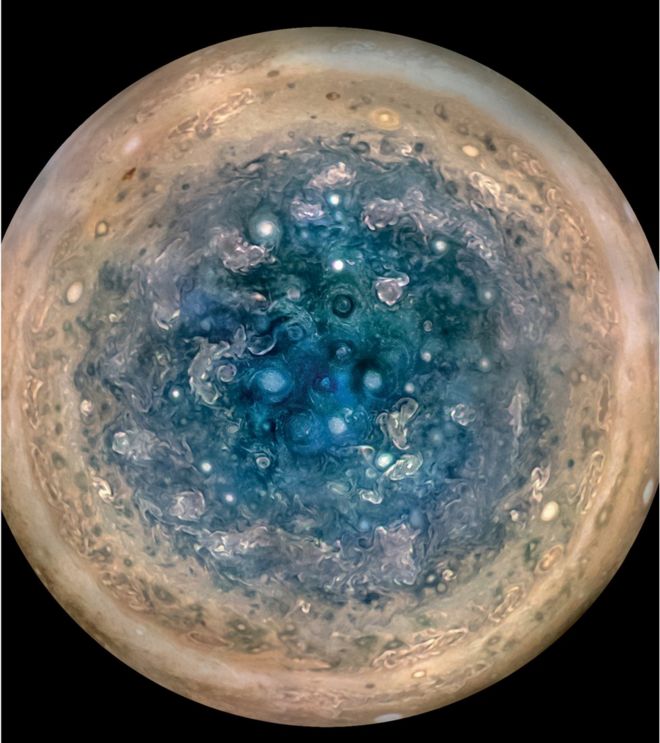
JúpiterDerechos de autor de la imagen NASA/JPL-Caltech/SwRI/MSSS/BA.Hall/G.Robles
Image caption
                                    Polo Sur: la estructura de la nube polar en Júpiter es muy diferente a la de Saturno.
Nubes gigantescas, poderosos ciclones, y violentas tormentas.
Estos fueron algunos de los rasgos revelados por las primeras observaciones de Júpiter, que dejaron sin aliento a los investigadores de la NASA a cargo de la misión Juno.
"Imagínate varias tormentas, cada una del tamaño de la Tierra, tan juntas que se tocan las unas a las otras", dijo el investigador de la agencia espacial estadounidense Mike Janssen.
"Incluso en una habitación repleta de investigadores expertos, estas imágenes de remolinos de nubes despertaron suspiros".
La sonda llegó al quinto planeta del Sistema Solar el 4 de julio del año pasado. Desde entonces, hace un vuelo para acercarse al planeta gaseoso cada 53 días.

Todo lo que sabemos, en entredicho

Los datos recabados hasta ahora -y que fueron publicados por primera vez esta semana en Science y otras revistas especializadas- cuestionan todas las teorías existentes sobre el planeta, dicen los investigadores.
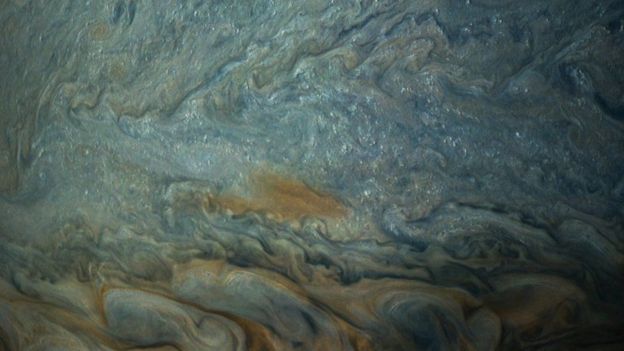
JúpiterDerechos de autor de la imagen NASA/SWRI/MSSS/G.EICHSTÄDT/S.DORAN
Image caption
                                    Los puntos blancos en esta imagen son nubes de hielo de una extensión de más de 50 Km.
"Es la primera vez que nos acercamos tanto a Júpiter y estamos viendo que muchas de nuestras ideas son incorrectas y puede que hasta ingenuas", aseguró Scott Bolton, investigador principal del Instituto de Investigación del Suroeste en San Antonio, Texas, Estados Unidos.
Los ciclones gigantescos que cubren las latitudes más altas del planeta pudieron ser ahora observados en detalle, ya que las misiones anteriores nunca pudieron ver al planeta desde arriba y desde abajo tal y como lo logró Juno, y tampoco habían tomado imágenes en un resolución tan alta.

Línea
  • Júpiter es 11 veces más ancho que la Tierra
  • Demora 12 años terrestres en completar una órbita alrededor del Sol
  • Su composición es similar a la de una estrella: está hecho mayormente de hidrógeno y helio
  • Bajo presión, el hidrógeno entra en estado similar al de un metal

Línea
Las estructuras -algunas de cerca de 50 Km- son muy diferentes de las que se observan en los polos de Saturno, por ejemplo, y el equipo ahora tendrá que descubrir por qué.
Tampoco se sabe por cuánto tiempo se mantienen y si se disipan más rápidamente que las tormentas en latitudes más bajas.
Otra de las sorpresas que se llevaron los científicos fue la detección de una ancha banda de amoníaco en el ecuador, que va desde la parte superior de la atmósfera hasta la zona más profunda que pudo observarse, a una profundidad de al menos 350 Km.
Esta banda, dicen, podría ser parte de un sistema de circulación.

Auroras misteriosas

Varias mediciones mostraron además que el campo magnético de Júpiter es más fuerte de lo esperado (10 veces más fuerte que el campo magnético más fuerte encontrado en la Tierra) y su señal es irregular.
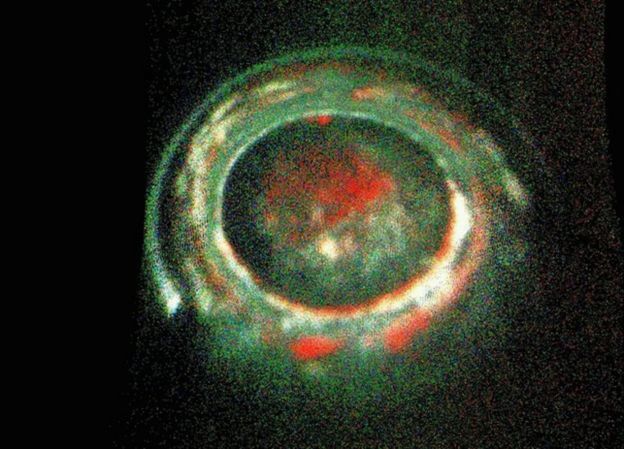
JúpiterDerechos de autor de la imagen NASA/JPL-CALTECH/SWR
Image caption
                                    Las luces son las auroras que tiene lugar en el polo sur.
La irregularidad podría indicar que el sistema dinámico -la región conductora de electricidad que genera el campo- está, probablemente, en una zona no tan profunda del planeta.
Entender el campo magnético permitiría explicar las auroras brillantes de Júpiter.
Estas auroras deberían ser el resultado del choque de los electrones que se mueven por el campo magnético con la atmósfera. Pero la corrientes transportada por los electrones debería tener su propia firma magnética y Juno, al menos por ahora, no logró detectarla.
"Debo admitir que esto nos desconcertó", explicó Jonathan Nichols, de la Universidad de Leicester, en Reino Unido.
"Vemos las auroras, tenemos una idea de cómo se generan, pero cuando llega el momento de corroborarlo, no vemos la corriente que deberíamos ver".

¿Tiene o no tiene núcleo?

Otra de las fotos tomadas por Juno muestra el anillo de polvo que rodea al planeta.
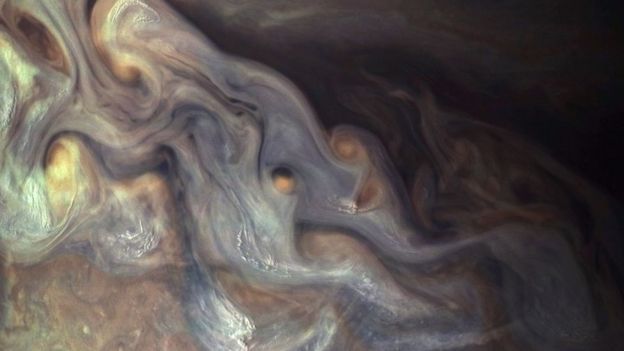
JúpiterDerechos de autor de la imagen NASA/SWRI/MSSS/GERALD EICHSTÄDT/SEÁN DORAN
Image caption
                                    El próximo sobrevuelo está previsto para el 11 de julio.
"Esta es la primera imagen del anillo de Júpiter que se ha tomado desde dentro, mirando hacia afuera", señaló Heidi Becker, investigadora de la misión.
En cuanto a la gravedad de Júpiter, las teorías existentes sostienen que el planeta tiene un núcleo rocoso pequeño o directamente no tiene un núcleo.
Las mediciones de Juno hacen pensar ahora que puede ser algo intermedio: un núcleo difuso.
"Puede que haya un núcleo, pero es muy grande y quizás esté parcialmente disuelto", explicó Bolton.
Éste y otros misterios de Júpiter serán investigados a lo largo de la misión que concluye en febrero de 2018.
El próximo sobrevuelo está previsto para el 11 de julio, cuando la sonda se concentrará en la descomunal tormenta conocida como la "Gran Mancha Roja", que tiene el doble del tamaño de la Tierra y es el mayor remolino tormentoso del Sistema Solar, activo desde hace 400 años.
.

Temas relacionados

Contenido relacionado

BBC Mundo Noticias

NASA Presenta los Primeros Resultados Científicos de la Misión Juno

 
27.05.17.- Los resultados científicos iniciales de la misión Juno de la NASA a Júpiter retratan al mayor de los planetas de nuestro Sistema Solar como un mundo complejo, gigantesco, turbulento… con ciclones del tamaño de la Tierra en los polos, sistemas de tormentas que descienden hacia el corazón del gigante de gas, y un enrome campo magnético e irregular que podría generarse más cerca de la superficie del planeta de lo que se pensaba.
La sonda espacial Juno fue lanzada el 5 de Agosto de 2011, entrando en la órbita de Júpiter el 4 de Julio de 2016. Los hallazgos ahora presentados corresponden al primer sobrevuelo de recolección de datos, que voló a 4.200 kilómetros de los remolinos de nubes de Júpiter el pasado 27 de Agosto.
“Estamos muy contentos de compartir estos primeros descubrimientos, que nos ayudan a comprender mejor lo que hace que Júpiter sea tan fascinante”, dijo Diane Brown, encargada del programa de Juno de la NASA en Washington. "Fue un largo viaje llegar a Júpiter, pero estos primeros resultados ya demuestran que ha valido la pena el viaje.”
"Hay tantas cosas aquí que no esperábamos que hubiéramos tenido que dar un paso atrás y empezar a repensar esto como un Júpiter completamente nuevo", dijo Scott Bolton, investigador principal de Juno en el Instituto de Investigación del Suroeste en San Antonio.
Entre los hallazgos que desafían lo supuesto hasta ahora figuran los proporcionados por la cámara de Juno, JunoCam. Las imágenes muestran que ambos polos de Júpiter están cubiertos por tormentas del tamaño de la Tierra que están densamente agrupadas y rozándose entre sí.
"Estamos perplejos en cuanto a cómo podrían formarse, lo estable que es su configuración y por qué el polo norte de Júpiter no se parece al polo sur", dijo Bolton. "Estamos cuestionando si se trata de un sistema dinámico, y estamos viendo sólo una etapa. Durante el próximo año, vamos a ver si desaparece, o es una configuración estable y estas tormentas están circulando unas alrededor de otras."
Otra sorpresa viene del radiómetro de microondas de Juno (MWR), que muestra la radiación térmica de microondas de la atmósfera de Júpiter, desde la parte superior de las nubes de amoníaco hasta el fondo de su atmósfera. Los datos del MWR indican que las cinturones y otras zonas icónicas de Júpiter son misteriosos, con el cinturón cerca del ecuador penetrando hasta el fondo, mientras que en otras latitudes parecen evolucionar a otras estructuras. Los datos sugieren que el amoníaco es bastante variable y continúa aumentando tan lejos como se puede ver con MWR, que es de unos cientos de kilómetros.  
Antes de la misión Juno, se sabía que Júpiter tenía el campo magnético más intenso en el sistema solar. Las mediciones de la magnetosfera del planeta masivo con el magnetómetro de Juno (MAG), indican que el campo magnético de Júpiter es incluso más fuerte que los modelos esperados, y su forma más irregular. Los datos del MAG indican que el campo magnético excedió en gran medida las expectativas en 7.766 Gauss, aproximadamente 10 veces más fuerte que el campo magnético más fuerte encontrado en la Tierra.
"Juno nos está dando una visión del campo magnético cercano a Júpiter que nunca hemos tenido antes", dijo Jack Connerney, investigador principal adjunto de Juno y el líder de la misión de investigación de campo magnético en el Centro espacial Goddard de la NASA en Greenbelt, Maryland. "Ya vemos que el campo magnético parece voluminoso: es más fuerte en algunos lugares y más débil en otros. Esta distribución desigual sugiere que el campo puede ser generado por la acción de una dinamo más cerca de la superficie, por encima de la capa de hidrógeno metálico. Cada sobrevuelo nos acerca a más a poder determinar dónde y cómo funciona la dinamo de Júpiter".
Juno también está diseñada para estudiar la magnetosfera polar y el origen de las poderosas auroras de Júpiter. Estas emisiones de auroras son causadas por partículas que recogen la energía y golpean las moléculas atmosféricas. Las observaciones iniciales de Juno indican que el proceso parece funcionar de manera diferente en Júpiter que en la Tierra.
Juno está en una órbita polar alrededor de Júpiter, y la mayoría de cada órbita tiene lugar lejos del gigante del gas. Pero, una vez cada 53 días, su trayectoria se aproxima a Júpiter desde arriba de su polo norte, donde comienza un tránsito de dos horas (de polo a polo) volando de norte a sur con sus ocho instrumentos científicos recolectando datos e imágenes con su cámara JunoCam. La descarga de seis megabytes de datos recogidos durante el tránsito puede llevar día y medio.
 
El polo sur de Júpiter, observado por la nave espacial Juno desde una distancia de 52000 kilómetros. Las estructuras ovales son ciclones de hasta 1000 km de diámetro. Image Credit: NASA/JPL-Caltech/SwRI/MSSS/Betsy Asher Hall/Gervasio Robles

A Whole New Jupiter: First Science Results from NASA’s Juno Mission


This image shows Jupiter’s south pole, as seen by NASA’s Juno spacecraft from an altitude of 32,000 miles
This image shows Jupiter’s south pole, as seen by NASA’s Juno spacecraft from an altitude of 32,000 miles (52,000 kilometers). The oval features are cyclones, up to 600 miles (1,000 kilometers) in diameter. Multiple images taken with the JunoCam instrument on three separate orbits were combined to show all areas in daylight, enhanced color, and stereographic projection.
Credits: NASA/JPL-Caltech/SwRI/MSSS/Betsy Asher Hall/Gervasio Robles

Early science results from NASA’s Juno mission to Jupiter portray the largest planet in our solar system as a complex, gigantic, turbulent world, with Earth-sized polar cyclones, plunging storm systems that travel deep into the heart of the gas giant, and a mammoth, lumpy magnetic field that may indicate it was generated closer to the planet’s surface than previously thought. a vuelo

“We are excited to share these early discoveries, which help us better understand what makes Jupiter so fascinating,” said Diane Brown, Juno program executive at NASA Headquarters in Washington. "It was a long trip to get to Jupiter, but these first results already demonstrate it was well worth the journey.”

Juno launched on Aug. 5, 2011, entering Jupiter’s orbit on July 4, 2016. The findings from the first data-collection pass, which flew within about 2,600 miles (4,200 kilometers) of Jupiter's swirling cloud tops on Aug. 27, are being published this week in two papers in the journal Science, as well as 44 papers in Geophysical Research Letters.

“We knew, going in, that Jupiter would throw us some curves,” said Scott Bolton, Juno principal investigator from the Southwest Research Institute in San Antonio. “But now that we are here we are finding that Jupiter can throw the heat, as well as knuckleballs and sliders. There is so much going on here that we didn’t expect that we have had to take a step back and begin to rethink of this as a whole new Jupiter.”

Among the findings that challenge assumptions are those provided by Juno’s imager, JunoCam. The images show both of Jupiter's poles are covered in Earth-sized swirling storms that are densely clustered and rubbing together.

“We're puzzled as to how they could be formed, how stable the configuration is, and why Jupiter’s north pole doesn't look like the south pole,” said Bolton. “We're questioning whether this is a dynamic system, and are we seeing just one stage, and over the next year, we're going to watch it disappear, or is this a stable configuration and these storms are circulating around one another?”
Another surprise comes from Juno’s Microwave Radiometer (MWR), which samples the thermal microwave radiation from Jupiter’s atmosphere, from the top of the ammonia clouds to deep within its atmosphere. The MWR data indicates that Jupiter’s iconic belts and zones are mysterious, with the belt near the equator penetrating all the way down, while the belts and zones at other latitudes seem to evolve to other structures. The data suggest the ammonia is quite variable and continues to increase as far down as we can see with MWR, which is a few hundred miles or kilometers. 
Prior to the Juno mission, it was known that Jupiter had the most intense magnetic field in the solar system. Measurements of the massive planet’s magnetosphere, from Juno’s magnetometer investigation (MAG), indicate that Jupiter’s magnetic field is even stronger than models expected, and more irregular in shape. MAG data indicates the magnetic field greatly exceeded expectations at 7.766 Gauss, about 10 times stronger than the strongest magnetic field found on Earth.

“Juno is giving us a view of the magnetic field close to Jupiter that we’ve never had before,” said Jack Connerney, Juno deputy principal investigator and the lead for the mission’s magnetic field investigation at NASA's Goddard Space Flight Center in Greenbelt, Maryland. “Already we see that the magnetic field looks lumpy: it is stronger in some places and weaker in others. This uneven distribution suggests that the field might be generated by dynamo action closer to the surface, above the layer of metallic hydrogen. Every flyby we execute gets us closer to determining where and how Jupiter’s dynamo works.”
Juno also is designed to study the polar magnetosphere and the origin of Jupiter's powerful auroras—its northern and southern lights. These auroral emissions are caused by particles that pick up energy, slamming into atmospheric molecules. Juno’s initial observations indicate that the process seems to work differently at Jupiter than at Earth.
Juno is in a polar orbit around Jupiter, and the majority of each orbit is spent well away from the gas giant. But, once every 53 days, its trajectory approaches Jupiter from above its north pole, where it begins a two-hour transit (from pole to pole) flying north to south with its eight science instruments collecting data and its JunoCam public outreach camera snapping pictures. The download of six megabytes of data collected during the transit can take 1.5 days.

“Every 53 days, we go screaming by Jupiter, get doused by a fire hose of Jovian science, and there is always something new,” said Bolton. “On our next flyby on July 11, we will fly directly over one of the most iconic features in the entire solar system -- one that every school kid knows -- Jupiter’s Great Red Spot. If anybody is going to get to the bottom of what is going on below those mammoth swirling crimson cloud tops, it’s Juno and her cloud-piercing science instruments.”

NASA's Jet Propulsion Laboratory in Pasadena, California, manages the Juno mission for NASA. The principal investigator is Scott Bolton of the Southwest Research Institute in San Antonio. The Juno mission is part of the New Frontiers Program managed by NASA's Marshall Space Flight Center in Huntsville, Alabama, for the agency’s Science Mission Directorate. Lockheed Martin Space Systems, in Denver, built the spacecraft.

More information on the Juno mission is available at:


Follow the mission on Facebook and Twitter at:


-end-

Dwayne Brown / Laurie Cantillo
Headquarters, Washington
202-358-1726 / 202-358-1077
dwayne.c.brown@nasa.gov / laura.l.cantillo@nasa.gov

DC Agle
Jet Propulsion Laboratory, Pasadena, Calif.
818-393-9011
agle@jpl.nasa.gov

Nancy Neal Jones
Goddard Space Flight Center, Greenbelt, Md.
301-286-0039
nancy.n.jones@nasa.gov

Deb Schmid
Southwest Research Institute, San Antonio
210-522-2254
dschmid@swri.org
Last Updated: May 25, 2017
Editor: Karen Northon
Tags:  Juno, Jupiter,
NASA
Guillermo Gonzalo Sánchez Achutegui
ayabaca@gmail.com
ayabaca@hotmail.com
ayabaca@yahoo.com
Inscríbete en el Foro del blog y participa : A Vuelo De Un Quinde - El Foro!

jueves, 1 de septiembre de 2016

NASA : Speeding Towards Jupiter's Pole .- Juno: Apresura hacia polo norte de Júpiter

http://www.nasa.gov/image-feature/speeding-towards-jupiters-pole

Jupiter
Jupiter's north polar region is coming into view as NASA's Juno spacecraft approaches the giant planet. This view of Jupiter was taken on August 27, when Juno was 437,000 miles (703,000 kilometers) away.
 
The Juno mission successfully executed its first of 36 orbital flybys of Jupiter. The time of the Aug. 27 closest approach with the gas-giant world was 6:44 a.m. PDT (9:44 a.m. EDT, 13:44 UTC) when Juno passed about 2,600 miles (4,200 kilometers) above Jupiter's swirling clouds.
 
NASA's Jet Propulsion Laboratory, Pasadena, Calif., manages the Juno mission for the principal investigator, Scott Bolton, of Southwest Research Institute in San Antonio. The Juno mission is part of the New Frontiers Program managed at NASA's Marshall Space Flight Center in Huntsville, Ala. Lockheed Martin Space Systems, Denver, built the spacecraft. JPL is a division of the California Institute of Technology in Pasadena.
Image Credit: NASA/JPL-Caltech/SwRI/MSSS
Last Updated: Aug. 27, 2016
Editor: Sarah Loff
NASA
Guillermo Gonzalo Sánchez Achutegui
ayabaca@gmail.com
ayabaca@hotmail.com
ayabaca@yahoo.com
Inscríbete en el Foro del blog y participa : A Vuelo De Un Quinde - El Foro!

domingo, 21 de febrero de 2016

NASA: Jarosite in the Noctis Labyrinthus Region of Mars.- Jarosita en el Labyrinthus Región Noctis de Marte

Hola amigos: A VUELO DE UN QUINDE EL BLOG., Esta imagen, adquirida el 24 de noviembre 2015 mediante la cámara Experimento Científico de Imágenes de Alta Resolución (HiRISE) a bordo del Orbitador de Reconocimiento de Marte de la NASA, muestra el lado occidental de una depresión alargada en boxes en la región oriental Noctis Labyrinthus de Marte. A lo largo de la pared superior de la fosa es un depósito de capas de color claro. Noctis Labyrinthus es una enorme región de valles tectónicamente controlados ubicados en el extremo occidental del sistema de cañones de los Valles Marineris en Marte.
More information...............

Light toned layered pit depression on surface of Mars
This image, acquired on Nov. 24, 2015 by the High Resolution Imaging Science Experiment (HiRISE) camera aboard NASA's Mars Reconnaissance Orbiter, shows the western side of an elongated pit depression in the eastern Noctis Labyrinthus region of Mars. Along the pit's upper wall is a light-toned layered deposit. Noctis Labyrinthus is a huge region of tectonically controlled valleys located at the western end of the Valles Marineris canyon system.

Spectra extracted from the light-toned deposit by the spacecraft's Compact Reconnaissance Imaging Spectrometer for Mars (CRISM) instrument are consistent with the mineral jarosite, which is a potassium and iron hydrous sulfate. On Earth, jarosite can form in ore deposits or from alteration near volcanic vents, and indicates an oxidizing and acidic environment. The Opportunity rover discovered jarosite at the Meridiani Planum landing site, and jarosite has been found at several other locations on Mars, indicating that it is a common mineral on the Red Planet.

The jarosite-bearing deposit observed here could indicate acidic aqueous conditions within a volcanic system in Noctis Labyrinthus. Above the light-toned jarosite deposit is a mantle of finely layered darker-toned material. CRISM spectra do not indicate this upper darker-toned mantle is hydrated. The deposit appears to drape over the pre-existing topography, suggesting it represents an airfall deposit from either atmospheric dust or volcanic ash.

The University of Arizona, Tucson, operates HiRISE, which was built by Ball Aerospace & Technologies Corp., Boulder, Colo. NASA's Jet Propulsion Laboratory, a division of the California Institute of Technology in Pasadena, manages the Mars Reconnaissance Orbiter Project for NASA's Science Mission Directorate, Washington.
Image Credit: NASA/JPL-Caltech/Univ. of Arizona
Caption: Cathy Weitz
Last Updated: Feb. 19, 2016
Editor: Sarah Loff
NASA
Guillermo Gonzalo Sánchez Achutegui
Inscríbete en el Foro del blog y participa : A Vuelo De Un Quinde - El Foro!

jueves, 20 de agosto de 2015

NASA : Curiosity Low-Angle Self-Portrait at 'Buckskin' Drilling Site on Mount Sharp .- Robot Curiosity, bajo un águlo Buckskin con una imagen de autoretrato,muestra una perforación en el Monte Sharp de Marte

Hola amigos: A VUELO DE UN QUINDE EL BLOG., hemos recibido información de la Agencia Espacial NASA, sobre una perforación efectuada por el Robot Curiosity en una foto de autoretrato efecutada sobre el Monte Sharp.
More inforamtion...
http://www.nasa.gov/jpl/msl/pia19807/curiosity-low-angle-self-portrait-at-buckskin-drilling-site-on-mount-sharp

Low-angle self-portrait of NASA's Curiosity Mars rover
This low-angle self-portrait of NASA's Curiosity Mars rover shows the vehicle above the "Buckskin" rock target, where the mission collected its seventh drilled sample. The site is in the "Marias Pass" area of lower Mount Sharp.
The scene combines dozens of images taken by Curiosity's Mars Hand Lens Imager (MAHLI) on Aug. 5, 2015, during the 1,065th Martian day, or sol, of the rover's work on Mars. The 92 component images are among MAHLI Sol 1065 
For scale, the rover's wheels are 20 inches (50 centimeters) in diameter and about 16 inches (40 centimeters) wide. 
Curiosity drilled the hole at Buckskin during Sol 1060 (July 30, 2015). Two patches of pale, powdered rock material pulled from Buckskin are visible in this scene, in front of the rover. The patch closer to the rover is where the sample-handling mechanism on Curiosity's robotic arm dumped collected material that did not pass through a sieve in the mechanism. Sieved sample material was delivered to laboratory instruments inside the rover. The patch farther in front of the rover, roughly triangular in shape, shows where fresh tailings spread downhill from the drilling process. The drilled hole, 0.63 inch (1.6 centimeters) in diameter, is at the upper point of the tailings.
The rover is facing northeast, looking out over the plains from the crest of a 20-foot (6-meter) hill that it climbed to reach the Marias Pass area.  The upper levels of Mount Sharp are visible behind the rover, while Gale Crater’s northern rim dominates the horizon on the left and right of the mosaic.
A portion of this selfie cropped tighter around the rover is at  
  http://photojournal.jpl.nasa.gov/catalog/PIA19808.  Another version of the wide view, presented in a projection that shows the horizon as a circle, is at
MAHLI is mounted at the end of the rover's robotic arm. For this self-portrait, the rover team positioned the camera lower in relation to the rover body than for any previous full self-portrait of Curiosity. This yielded a view that includes the rover's "belly," as in a partial self-portrait
 (http://photojournal.jpl.nasa.gov/catalog/PIA16137) taken about five weeks after Curiosity's August 2012 landing inside Mars' Gale Crater. Before sending Curiosity the arm-positioning commands for this Buckskin belly panorama, the team previewed the low-angle sequence of camera pointings on a test rover in California. A mosaic from that test is 
This selfie at Buckskin does not include the rover's robotic arm beyond a portion of the upper arm held nearly vertical from the shoulder joint. Shadows from the rest of the arm and the turret of tools at the end of the arm are visible on the ground. With the wrist motions and turret rotations used in pointing the camera for the component images, the arm was positioned out of the shot in the frames or portions of frames used in this mosaic. This process was used previously in acquiring and assembling Curiosity self-portraits taken at sample-collection sites "Rocknest" 
"John Klein" 
MAHLI was built by Malin Space Science Systems, San Diego. NASA's Jet Propulsion Laboratory, a division of the California Institute of Technology in Pasadena, manages the Mars Science Laboratory Project for the NASA Science Mission Directorate, Washington. JPL designed and built the project's Curiosity rover.
More information about Curiosity is online at
Credit: NASA/JPL-Caltech/MSSS
Last Updated: Aug. 20, 2015
Editor: Tony Greicius
Tags:  Image of the Day, Jet Propulsion Laboratory, Journey to Mars, Mars, Mars Science Laboratory (Curiosity), Solar System
NASA
Guillermo Gonzalo Sánchez Achutegui
ayabaca@gmail.com
ayabaca@hotmail.com
ayabaca@yahoo.com
Inscríbete en el Foro del blog y participa : A Vuelo De Un Quinde - El Foro!

martes, 16 de septiembre de 2014

NASA : Media telecon

NASA is hosting a news telecon at 10 a.m. PDT (1 p.m. EDT) on Thursday, Sept. 11, to discuss mission status and the future science campaign for the Mars rover Curiosity mission.
Audio and visuals of the event will be streamed live online at:
 http://www.nasa.gov/newsaudio
 and
http://www.ustream.tv/nasajpl


Participants
  • Jim Green, director, Planetary Science Division, NASA Headquarters, Washington
  • John Grotzinger, Curiosity project scientist, California Institute of Technology, Pasadena
  • Kathryn Stack, Curiosity Rover mission scientist, NASA's Jet Propulsion Laboratory, Pasadena, California
     

Grotzinger - 1

Mars telecon image


Grotzinger - 2

Mars telecon image


Grotzinger - 3

Mars telecon image


Grotzinger - 4

Mars telecon image


Grotzinger - 5

Mars telecon image


Grotzinger - 6

Mars telecon image


Grotzinger - 7

Mars telecon image


Stack - 1

Mars telecon image


Stack - 2

Mars telecon image


Stack - 3

Mars telecon image


Stack - 4

Mars telecon image


Stack - 5

Mars telecon image


Stack - 6

Mars telecon image


Grotzinger - 8

Mars telecon image


Ustream
› Archived events
Archived telecon visuals
› Sept. 11, 2014
› May 30, 2013
› Feb. 20, 2013
› Jan. 15, 2013
› Nov. 15, 2012
› Nov. 2, 2012
› Oct. 30, 2012
› Oct. 18, 2012
› Oct. 11, 2012
› Oct. 4, 2012
› Sept. 19, 2012
› Sept. 12, 2012
› Sept. 6, 2012
› Aug. 21, 2012
› Aug. 17, 2012
› Aug. 14, 2012

NASA
Guillermo GOnzalo Sánchez Achutegui
ayabaca@gmail.com
ayabaca@hotmail.com
ayabaca@yahoo.com
Inscríbete en el Foro del blog y participa : A Vuelo De Un Quinde - El Foro!

domingo, 14 de septiembre de 2014

NASA : NASA Holds Teleconference to Discuss Science Campaign of Curiosity Mars Rover


NASA's Mars Science Laboratory Curiosity rover
Artist concept features NASA's Mars Science Laboratory Curiosity rover, a mobile robot for investigating Mars' past or present ability to sustain microbial life.
Image Credit: 
NASA/JPL-Caltech
NASA will host a teleconference at 1 p.m. EDT Thursday, Sept. 11, to discuss mission status and the future science campaign for the Mars rover Curiosity mission.
Participants in the teleconference will be:
-- Jim Green, director, Planetary Science Division, NASA Headquarters, Washington
-- John Grotzinger, Curiosity project scientist, California Institute of Technology, Pasadena, California
-- Kathryn Stack, Curiosity Rover Mission Scientist, NASA's Jet Propulsion Laboratory, Pasadena
To participate, reporters must contact Gina Fontes at 818-354-5011 or georgina.d.fontes@jpl.nasa.gov
and provide their media affiliation not later than noon Thursday.
Audio of the teleconference will be streamed live at:
Visuals for this teleconference will be available at the start of the event at:
The teleconference, with visuals, will also be streamed live at:
For information about NASA's Curiosity mission, visit:

NASA
Guillermo Gonzalo Sánchez Achutegui
ayabaca@gmail.com
ayabaca@hotmail.com
ayabaca@yahoo.com
Inscríbete en el Foro del blog y participa : A Vuelo De Un Quinde - El Foro!

viernes, 27 de junio de 2014

NASA : Curiosity Self-Portrait at 'Windjana' Drilling Site


Curiosity Self-Portrait at 'Windjana' Drilling Site
NASA's Curiosity Mars rover used the camera at the end of its arm in April and May 2014 to take dozens of component images combined into this self-portrait where the rover drilled into a sandstone target called "Windjana." The camera is the Mars Hand Lens Imager (MAHLI), which previously recorded portraits of Curiosity at two other important sites during the mission:  "Rock Nest"
Winjana is within a science waypoint site called "The Kimberley," where sandstone layers with different degrees of resistance to wind erosion are exposed close together.
The view does not include the rover's arm.  It does include the hole in Windjana produced by the hammering drill on Curiosity's arm collecting a sample of rock powder from the interior of the rock.  The hole is surrounded by grayish cuttings on top of the rock ledge to the left of the rover.  The Mast Camera (Mastcam) atop the rover's remote sensing mast is pointed at the drill hole.  A Mastcam image of the drill hole from that perspective is at
 The hole is 0.63 inch (1.6 centimeters) in diameter.  The rover's wheels are 20 inches (0.5 meter) in diameter.
Most of the component frames of this mosaic view were taken during the 613th Martian day, or sol, of Curiosity's work on Mars (April 27, 2014).  Frames showing Windjana after completion of the drilling were taken on Sol 627 (May 12, 2014).  The hole was drilled on Sol 621 (May 5, 2014).
MAHLI was built by Malin Space Science Systems, San Diego.  NASA's Jet Propulsion Laboratory, a division of the California Institute of Technology in Pasadena, manages the Mars Science Laboratory Project for the NASA Science Mission Directorate, Washington. JPL designed and built the project's Curiosity rover.
Image Credit: NASA/JPL-Caltech/MSSS
NASA
Guillermo Gonzalo Sánchez Achutegui
Inscríbete en el Foro del blog y participa : A Vuelo De Un Quinde - El Foro!

martes, 20 de mayo de 2014

NASA : NASA June 2 Kauai Media Day for First Supersonic Saucer-Shaped Vehicle Test

NASA's Saucer-Shaped Craft Preps for Flight Test

 
A saucer-shaped test vehicle
A saucer-shaped test vehicle holding equipment for landing large payloads on Mars is shown in the Missile Assembly Building at the US Navy's Pacific Missile Range Facility in Kaua‘i, Hawaii.
Image Credit: 
NASA/JPL-Caltech
 
NASA’s saucer-shaped experimental flight vehicle
In this picture, NASA’s saucer-shaped experimental flight vehicle is prepared for a Range Compatibility Test at the US Navy’s Pacific Missile Range Facility in Kaua‘i, Hawaii.
Image Credit: 
NASA/JPL-Caltech
 
An engineer works on the Parachute Deployment Device of the Low Density Supersonic Decelerator test vehicle
An engineer works on the Parachute Deployment Device of the Low Density Supersonic Decelerator test vehicle in this image taken at the Missile Assembly Building at the US Navy's Pacific Missile Range Facility in Kaua‘i, Hawaii.
Image Credit: 
NASA/JPL-Caltech
 

NASA's Low-Density Supersonic Decelerator (LDSD) project, a rocket-powered, saucer-shaped test vehicle, has completed final assembly at the U.S. Navy's Pacific Missile Range Facility in Kauai, Hawaii.
This experimental flight test is designed to investigate breakthrough technologies that will benefit future Mars missions, including those involving human exploration. Three weeks of testing, simulations and rehearsals are planned before the first launch opportunity on the morning of June 3. LDSD was built at NASA's Jet Propulsion Laboratory, Pasadena, California, and shipped to Kauai for final assembly and preparations.
"Our Supersonic Flight Dynamics Test Vehicle number 1 arrived at the Navy's Pacific Missile Range Facility on April 17," said Mark Adler, project manager of the Low Density Supersonic Decelerator project from JPL. "Since then, we have been preparing it for flight. One of the last big assemblies occurred on April 30, when we mated the vehicle with its Star-48 booster rocket."
During the June experimental flight test, a balloon will carry the test vehicle from the Hawaii Navy facility to an altitude of about 120,000 feet. There, it will be dropped and its booster rocket will quickly kick in and carry it to 180,000 feet, accelerating to Mach 4. Once in the very rarified air high above the Pacific, the saucer will begin a series of automated tests of two breakthrough technologies.
In order to get larger payloads to Mars, and to pave the way for future human explorers, cutting-edge technologies like LDSD are critical. Among other applications, this new space technology will enable delivery of the supplies and materials needed for long-duration missions to the Red Planet.
The upper layers of Earth’s stratosphere are the most similar environment available to match the properties of the thin atmosphere of Mars. The Low Density Supersonic Decelerator mission developed this test method to ensure the best prospects for effective testing of the new and improved technologies here on Earth.
Anyone with Internet access will be able to watch live as video from the June test is relayed from the vehicle to the ground. The low-resolution images from the saucer are expected to show the vehicle dropping away from its high-altitude balloon mothership and then rocketing up to the very edge of the stratosphere. The test vehicle will then deploy an inflatable Kevlar tube around itself, called the Supersonic Inflatable Aerodynamic Decelerator (SIAD). After the SIAD inflates, the test vehicle will deploy a mammoth parachute called the Supersonic Disk Sail Parachute.
While people watching at home may be fascinated by how these two new technologies operate, the NASA flight team will actually be concentrating on a more fundamental question – "Will the test vehicle work as planned?"
"This first test is a true experimental flight test," said Ian Clark, the LDSD principal investigator from JPL. "Our goal is to get this first-of-its-kind test vehicle to operate correctly at very high speeds and very high altitudes. "
Although there is no guarantee that this first test will be successful, regardless of the outcome, the LDSD team expects to learn a great deal from the test. NASA has two more saucer-shaped test vehicles in the pipeline, with plans to test them from Hawaii in summer of 2015.
"We are pushing the envelope on what we know," said Clark. "We are accepting higher risk with these test flights than we would with a space mission, such as the Mars Science Laboratory. We will learn a great deal even if these tests, conducted here in Earth's atmosphere at relatively low cost, fail to meet some of the mission objectives."
As NASA plans increasingly ambitious robotic missions to Mars, laying the groundwork for even more complex human science expeditions to come, the spacecraft needed to land safely on the Red Planet's surface will become larger and heavier. This new technology will enable those important missions.
More information about LDSD is at:
NASA's Space Technology Mission Directorate in Washington funds the LDSD mission, a cooperative effort led by NASA's Jet Propulsion Laboratory in Pasadena, California. JPL is home to the LDSD project manager, Mark Adler, and its principal investigator, Ian Clark. NASA's Marshall Space Flight Center, in Huntsville, Alabama, manages LDSD within the Technology Demonstration Mission Program Office. NASA’s Wallops Flight Facility in Virginia is coordinating support with the Pacific Missile Range Facility and providing the balloon systems for the LDSD test.
 
NASA June 2 Kauai Media Day for First Supersonic Saucer-Shaped Vehicle Test
Reporters are invited to a media day Monday, June 2 at the U.S. Navy's Pacific Missile Range Facility (PMRF) on Kauai, Hawaii, to learn about NASA's upcoming flight test of the Low-Density Supersonic Decelerator (LDSD) experiment.
NASA's LDSD test is designed to investigate breakthrough technologies that will benefit landing future human and robotic Mars missions, as well as aid in safely returning large payloads to Earth. The NASA LDSD test over the Pacific Ocean will simulate the entry, descent and landing speeds a spacecraft would be exposed to when flying through the Martian atmosphere. During the test a large saucer-shaped disk carrying an inflatable inner tube-shaped decelerator and parachute system will be carried to an altitude of 120,000 feet by a giant balloon. After release from the balloon, rockets will lift the disk to 180,000 feet while reaching supersonic speeds. Traveling at 3.5 times the speed of sound, the saucer's decelerator will inflate, slowing the vehicle down, and then a parachute will deploy to carry it to the ocean's surface.
The media day will start with a mission overview briefing at 8 a.m. HST. Briefing participants will include:
-- Capt. Bruce Hay USN, commanding officer, Pacific Missile Range Facility, Kauai, Hawaii
-- Michael Gazarik, associate administrator of the Space Technology Mission Directorate, NASA Headquarters, Washington
-- Mark Adler, LDSD project manager, NASA's Jet Propulsion Laboratory (JPL), Pasadena, California
-- Ian Clark, LDSD principal investigator, JPL
The briefing will be streamed live on the agency's website at:
Journalists unable to attend the briefing in person will be able to participate by teleconference. After the briefing, reporters at PMRF will have the opportunity for a tour of the launch area, the Range Operations Center, and a driving tour of the facility.
NASA has six potential dates for launch of the high altitude balloon carrying the LDSD experiment: June 3, 5, 7, 9, 11 and 13. The launch window for each date extends from 7 a.m. to 8:30 a.m.
Journalists are invited to PMRF to watch the launch of the balloon carrying the LDSD on launch attempt days. After the balloon launch, reporters will be able to watch events as they unfold from monitors in the LDSD media center at PMRF. Reporters must arrive each balloon launch attempt day by no later than by 5:45 a.m. for escort onto the base.
NASA's LDSD carries several onboard cameras. It is expected that video of selected portions of the test, including the rocket-powered ascent, will be downlinked and streamed live to several NASA websites, including:
and
Decisions to attempt launch of the LDSD test will be made the day before each launch opportunity date. NASA will issue launch advisories via social media -- @NASA_Technology and @NASA -- the mission website and news media advisories.
Journalists who would like to cover LDSD-related events and tour of the facility at PMRF must register in advance by contacting Elena Mejia at JPL Media Relations at 818-354-5011 or Elena.Mejia@jpl.nasa.gov. Foreign journalists/news organizations must register by Thursday, May 22. U.S. media representatives must register by Wednesday, May 28. Reporters who are unsure whether they will attend are encouraged to register by the deadlines, even if they must later cancel. NASA will provide detailed instructions to journalists who register.For more information about NASA's LDSD, visit the mission page at:
NASA's LDSD program is part of the agency's Space Technology Mission Directorate, which is innovating, developing, testing and flying hardware for use in NASA's future missions. For more information about NASA's investment in space technology, visit:
 
NASA
Guillermo Gonzalo Sánchez Achutegui

Mi lista de blogs