Mostrando entradas con la etiqueta NASA's Mars Science Laboratory Curiosity rover. Mostrar todas las entradas

domingo, 9 de agosto de 2015

NASA: New Online Exploring Tools Bring NASA's Journey to Mars to New Generation .- Nuevas herramientas de exploración de línea Bring para el viaje de la NASA a Marte a Nueva Generación

Hola amigos: A VUELO DE UN QUINDE EL BLOG.,  hemos recibido de la Agencia Espacial NASA, la información que ya existen las nuevas herramientas necesarias para el viaje que tiene programado NASA hacia Marte.

More information...
http://www.nasa.gov/mission_pages/msl/index.html

Experience Curiosity Screen Capture
A screen capture from NASA's new Experience Curiosity website shows the rover in the process of taking its own self-portrait. Users can view Mars through the eyes of the rover, using the window in the lower, right corner. The control panel at left helps users navigate the rover itself, and relive some of its actual expeditions on Mars. Visit the website online at: http://eyes.nasa.gov/curiosity/ .
Credits: NASA/JPL-Caltech
 
On the three-year anniversary of the Mars landing of NASA’s Curiosity rover, NASA is unveiling two new online tools that open the mysterious terrain of the Red Planet to a new generation of explorers, inviting the public to help with its journey to Mars.
Mars Trek is a free, web-based application that provides high-quality, detailed visualizations of the planet using real data from 50 years of NASA exploration and allowing astronomers, citizen scientists and students to study the Red Planet’s features.

Curiosity Rover's View of Alluring Martian Geology Ahead
A panorama combining images from both cameras of the Mastcam on NASA's Curiosity Mars Rover shows diverse geological textures on Mount Sharp. Three years after landing on Mars, the mission is investigating this layered mountain for evidence about changes in Martian environmental conditions.
Credits: NASA/JPL-Caltech/MSSS
 
Experience Curiosity allows viewers to journey along with the one-ton rover on its Martian expeditions. The program simulates Mars in 3-D based on actual data from Curiosity and NASA's Mars Reconnaissance Orbiter (MRO), giving users first-hand experience in a day in the life of a Mars rover.
A NASA team already is using Mars Trek to aid in the selection of possible landing sites for the agency’s Mars 2020 rover, and the application will be used as part of NASA’s newly-announced process to examine and select candidate sites for the first human exploration mission to Mars in the 2030s.
“This tool has opened my eyes as to how we should first approach roaming on another world, and now the public can join in on the fun,” said Jim Green, director of NASA’s Planetary Science Division in Washington. “Our robotic scientific explorers are paving the way, making great progress on the journey to Mars. Together, humans and robots will pioneer Mars and the solar system."
Mars Trek has interactive maps, which include the ability to overlay a range of data sets generated from instruments aboard spacecraft orbiting Mars, and analysis tools for measuring surface features. Standard keyboard gaming controls are used to maneuver the users across Mars’ surface and 3-D printer-exportable topography allows users to print physical models of surface features.
Mars Trek was developed by NASA's Lunar Mapping and Modeling Project, which provides mission planners, lunar scientists and the public with analysis and data visualization tools for our moon. LMMP is managed by NASA's Solar System Exploration Research Virtual Institute at NASA's Ames Research Center in Moffett Field, California.
Experience Curiosity also uses real science data to create a realistic and game-ready rover model based entirely on real mechanisms and executed commands. Users can manipulate the rover’s tools and view Mars through each of its cameras.

Hole at 'Buckskin' Drilled Days Before Landing Anniversary
NASA's Curiosity Mars Rover drilled this hole to collect sample material from a rock target called "Buckskin" on July 30, 2015, about a week prior to the third anniversary of the rover's landing on Mars. The diameter is slightly smaller than a U.S. dime.
Credits: NASA/JPL-Caltech/MSSS
 
"We've done a lot of heavy 3-D processing to make Experience Curiosity work in a browser. Anybody with access to the web can take a journey to Mars," said Kevin Hussey, manager of the Visualization Applications and Development group at NASA’s Jet Propulsion Laboratory (JPL) in Pasadena, California, which manages and operates the Curiosity rover.
Curiosity's adventures on the Red Planet began in the early morning hours of Aug. 6, 2012, Eastern time (evening of Aug. 5, Pacific time), when a landing technique called the sky-crane maneuver deposited the rover in the 96-mile-wide Gale Crater. From there, the rover began investigating its new home, discovering it had landed near an ancient lakebed sprinkled with organic material. Billions of years ago, fresh water would have flowed into this lake, offering conditions favorable for microbial life.
"At three years old, Curiosity already has had a rich and fascinating life. This new program lets the public experience some of the rover's adventures first-hand," said Jim Erickson, the project manager for the mission at JPL.
NASA has been on Mars for five decades with robotic explorers, and August traditionally has been a busy month for exploration of the planet. Viking 2 was put into orbit around Mars 39 years ago on Aug. 7, 1976, making NASA’s second successful landing on the Martian surface weeks later. MRO was launched on Aug. 12, 2005 and still is in operation orbiting Mars. And, Tuesday, Aug. 4 marked the eight-year anniversary of the launch of the Phoenix mission to the north polar region of the Red Planet.
NASA’s orbiters and rovers have changed the way we look at Mars and enable continued scientific discoveries that one day will pave the way for astronauts to explore the Red Planet.
More information about NASA's journey to Mars is available online at:
https://www.nasa.gov/topics/journeytomars
For more information about Curiosity, visit:
http://www.nasa.gov/msl
To download and print a 3-D model of Curiosity, go to:
http://nasa3d.arc.nasa.gov/detail/mars-rover-curiosity
-end-
Dwayne Brown / Laurie Cantillo
Headquarters, Washington                                                                    
202-358-1726 / 202-358-1077
dwayne.c.brown@nasa.gov / laura.l.cantillo@nasa.gov
Guy Webster / Whitney Clavin
Jet Propulsion Laboratory, Pasadena, Calif.
818-354-6278 / 818-354-4673
guy.w.webster@jpl.nasa.gov / whitney.clavin@jpl.nasa.gov
Darryl Waller
Ames Research Center, Moffett Field, Calif.
650-604-4789
darryl.e.waller@nasa.gov
Last Updated: Aug. 5, 2015
Editor: Gina Anderson
Tags:  Ames Research Center, Journey to Mars, Mars Science Laboratory (Curiosity)

Curiosity Celebra su Tercer Aniversario en Marte


05.08.15.- Es un verano de hitos para la exploración de Marte. Hace cincuenta años, la Mariner 4 se convirtió en la primera nave espacial en tomar fotografías cercanas de Marte. Hace treinta y nueve años, el lander Viking 1 se convirtió en la primera nave espacial en aterrizar exitosamente en el Planeta Rojo. Y ahora, Curiosity celebra 3 años en Marte - trabajando en perfecto estado durante más de mil días marcianos.
Desde su llegada en agosto de 2012, Curiosity ha recorrido casi once kilómetros desde su lugar de aterrizaje a los pies del Monte de Sharp en el cráter Gale. El primer año lo pasó recorriendo a través de cauces antiguos y exploró Yellowknife Bay, el lugar donde se albergaba un antiguo lago. Ahí es donde Curiosity perforó y tomó muestras del fondo del lago para revelar la evidencia de agua dulce. También encontró moléculas orgánicas que contienen carbono en una forma utilizable para la vida. Así que si la vida alguna vez estuvo presente en Marte, un sitio como Yellowknife Bay podría albergarla.
Después Curiosity puso rumbo a otro de sus objetivos, el Monte Sharp. Fue entonces cuando los ingenieros notaron un desgaste excesivo en las ruedas del rover. Entonces los ingenieros tuvieron que trabajar para lograr entender las causas y la forma de evitarlo. Pero ahora estamos seguros de que las ruedas pueden llevarnos a donde tenemos que ir.

 Curiosity_news050815.jpg
 Concepto artístico del rover Curiosity en el Planeta Rojo. Image Credit: NASA/JPL-Caltech

Ha sido todo un viaje por carretera. Curiosity ha perforado en la región de Kimberley, conducido a través de valles largos y captado fotos de la geología en carretera antes de llegar a la roca madre en la base del Monte Sharp.
Pasamos varios meses estudiando estas rocas en Pahrump Hills. El equipo científico ha estado fascinado por todos los signos de agua antigua en el Monte Sharp. Es probable que el cráter Gale acogió una vez muchos ríos y lagos, llevando el sedimento al fondo del cráter, que ahora forma la capa inferior del Monte Sharp.
Ahora que estamos subiendo por las faldas de la montaña, la conducción es un reto. El equipo se basa en imágenes de la sonda espacial Mars Reconnaissance Orbiter, MRO, para encontrar caminos seguros para alcanzar objetivos geológicos interesantes.
Llegar a la ubicación actual del rover en Marias Pass requirió una fuerte subida hasta una colina de 6 metros. A medida que subimos la colina, el espectrómetro láser ChemCam de Curiosity notó inusualmente altas cantidades de sílice en las rocas cercanas. ¿Qué podría significar eso? ¿Fueron las condiciones ambientales buenas o peligrosas para la vida? ¿Podría la sílice haber conservado moléculas orgánicas en las rocas para poder estudiarlas hoy? Tenemos la esperanza de averiguarlo.
Nada de esto sería posible sin el equipo especializado de ingenieros del rover en el JPL. Cada día que operan con Curiosuty, un equipo de enlace descendente estudia la información enviada por el rover y se asegura de que está sano y listo para proceder con las siguientes actividades.
A continuación, un equipo de enlace ascendente convierte los deseos del equipo científico en secuencias de comandos que se pueden ejecutar de forma segura por el rover. Es un proceso intenso que lleva cerca de nueve horas cada día.
Así que felicitaciones a todo el equipo y feliz aniversario para Curiosity. ¡Sigue adelante!
NASA
Guillermo Gonzalo Sánchez Achutegui
ayabaca@gmail.com
ayabaca@hotmail.com
ayabaca@yahoo.com  
Inscríbete en el Foro del blog y participa : A Vuelo De Un Quinde - El Foro!

domingo, 14 de septiembre de 2014

NASA : NASA Holds Teleconference to Discuss Science Campaign of Curiosity Mars Rover


NASA's Mars Science Laboratory Curiosity rover
Artist concept features NASA's Mars Science Laboratory Curiosity rover, a mobile robot for investigating Mars' past or present ability to sustain microbial life.
Image Credit: 
NASA/JPL-Caltech
NASA will host a teleconference at 1 p.m. EDT Thursday, Sept. 11, to discuss mission status and the future science campaign for the Mars rover Curiosity mission.
Participants in the teleconference will be:
-- Jim Green, director, Planetary Science Division, NASA Headquarters, Washington
-- John Grotzinger, Curiosity project scientist, California Institute of Technology, Pasadena, California
-- Kathryn Stack, Curiosity Rover Mission Scientist, NASA's Jet Propulsion Laboratory, Pasadena
To participate, reporters must contact Gina Fontes at 818-354-5011 or georgina.d.fontes@jpl.nasa.gov
and provide their media affiliation not later than noon Thursday.
Audio of the teleconference will be streamed live at:
Visuals for this teleconference will be available at the start of the event at:
The teleconference, with visuals, will also be streamed live at:
For information about NASA's Curiosity mission, visit:

NASA
Guillermo Gonzalo Sánchez Achutegui
ayabaca@gmail.com
ayabaca@hotmail.com
ayabaca@yahoo.com
Inscríbete en el Foro del blog y participa : A Vuelo De Un Quinde - El Foro!

martes, 10 de diciembre de 2013

NASA : Yellowknife Bay Formation on Mars


Yellowknife Bay Formation on Mars
This mosaic of images from Curiosity's Mast Camera (Mastcam) shows geological members of the Yellowknife Bay formation. The scene has the Sheepbed mudstone in the foreground and rises up through Gillespie Lake member to the Point Lake outcrop. These rocks record superimposed ancient lake and stream deposits that offered past environmental conditions favorable for microbial life. Rocks here were exposed about 70 million years ago by removal of overlying layers due to erosion by the wind.
The scene is a portion of a 111-image mosaic acquired during the 137th Martian day, or sol, of Curiosity's work on Mars (Dec. 24, 2012). The foothills of Mount Sharp are visible in the distance, upper left, southwest of camera position.
Image Credit: NASA/JPL-Caltech/MSSS
NASA
Guillermo Gonzalo Sánchez Achutegui
ayabaca@hotmail.com
ayabaca@gmail.com
ayabaca@yahoo.com
Inscríbete en el Foro del blog y participa : A Vuelo De Un Quinde - El Foro!

sábado, 7 de diciembre de 2013

NASA : NASA Discusses Curiosity Radiation Findings


NASA Discusses Curiosity Radiation Findings
NASA will host a media teleconference at 1 p.m. EST Monday, Dec. 9, to discuss new findings from the Mars Science Laboratory (MSL) Radiation Assessment Detector (RAD) aboard the rover Curiosity.
Just prior to the teleconference, the findings will be presented at the American Geophysical Union Fall Meeting in San Francisco. The journal Science has embargoed details until noon Dec. 9.
The briefing participants are:
-- Jason Crusan, Advanced Exploration Systems Division director, NASA Headquarters, Washington
-- Dan Dumbacher, deputy associate administrator for exploration systems development, NASA Headquarters, Washington
-- Donald M. Hassler, RAD principal investigator and program director, Southwest Research Institute (SwRI), San Antonio
-- Rich Williams, chief health and medical officer, NASA Headquarters, Washington
For dial-in information, media representatives should e-mail their name, affiliation and telephone number to Rachel Kraft at rachel.h.kraft@nasa.gov by 11 a.m. Dec. 9.
SwRI and Christian Albrechts University in Kiel, Germany, built RAD with funding from NASA's Human Exploration and Operations Mission Directorate and Germany's national aerospace research center, Deutsches Zentrum für Luft- und Raumfahrt. NASA's Jet Propulsion Laboratory, a division of the California Institute of Technology in Pasadena, Calif., manages the MSL Project. NASA's Science Mission Directorate in Washington manages the Mars Exploration Program.
Audio of the teleconference will be streamed live on NASA's website at:
For more information about MSL, visit:
NASA
Guillermo Gonzalo Sánchez Achutegui
ayabaca@gmail.com
ayabaca@hotmail.com
ayabaca@yahoo.com
Inscríbete en el Foro del blog y participa : A Vuelo De Un Quinde - El Foro!

viernes, 26 de julio de 2013

NASA - View From Mars Orbiter Showing Curiosity Rover at 'Shaler'


View From Mars Orbiter Showing Curiosity Rover at 'Shaler'
NASA's Mars Science Laboratory rover Curiosity appears as a bluish dot near the lower right corner of this enhanced-color view from the High Resolution Imaging Science Experiment (HiRISE) camera on NASA's Mars Reconnaissance Orbiter. The rover's tracks are visible extending from the landing site, "Bradbury Landing," in the left half of the scene. Two bright, relatively blue spots surrounded by darker patches are where the Mars Science Laboratory spacecraft's landing jets cleared away reddish surface dust at the landing site. North is toward the top. For scale, the two parallel lines of the wheel tracks are about 10 feet (3 meters) apart.
HiRISE shot this image on June 27, 2013, when Curiosity was at an outcrop called "Shaler" in the "Glenelg" area of Gale Crater. Subsequently the rover drove away from Glenelg toward the southwest.
When HiRISE captured this view, the Mars Reconnaissance Orbiter was rolled for an eastward-looking angle rather than straight downward. The afternoon sun illuminated the scene from the western sky, so the lighting was nearly behind the camera. Specifically, the angle from sun to orbiter to rover was just 5.47 degrees. This geometry hides shadows and reveals subtle color variations.
The image is one product from HiRISE observation ESP_032436_1755. Other image products from this observation are available at
HiRISE is one of six instruments on NASA's Mars Reconnaissance Orbiter. The University of Arizona, Tucson, operates HiRISE, which was built by Ball Aerospace & Technologies Corp., Boulder, Colo. NASA's Jet Propulsion Laboratory, a division of the California Institute of Technology in Pasadena, manages the Mars Reconnaissance Orbiter and Mars Science Laboratory projects for NASA's Science Mission Directorate, Washington.
Image credit: NASA/JPL-Caltech/Univ. of Arizona
NASA
Guillermo Gonzalo Sánchez Achutegui

sábado, 8 de junio de 2013

NASA . NASA to Host June 5 Teleconference on Curiosity Mars Rover

NASA's Curiosity Mars Rover Nears Turning Point
06.05.13
 
Drilled hole and ChemCam marks at 'Cumberland' 
The Chemistry and Camera (ChemCam) instrument on NASA's Mars rover Curiosity was used to check the composition of gray tailings from the hole in rock target "Cumberland" that the rover drilled on May 19, 2013. Image credit: NASA/JPL-Caltech/MSSS
 › Full image and caption
› See telecon images      

 › Curiosity gallery     
  › Related video      
 › Curiosity videos

Mission status report
PASADENA, Calif. - NASA's Mars Science Laboratory mission is approaching its biggest turning point since landing its rover, Curiosity, inside Mars' Gale Crater last summer.
Curiosity is finishing investigations in an area smaller than a football field where it has been working for six months, and it will soon shift to a distance-driving mode headed for an area about 5 miles (8 kilometers) away, at the base Mount Sharp.
In May, the mission drilled a second rock target for sample material and delivered portions of that rock powder into laboratory instruments in one week, about one-fourth as much time as needed at the first drilled rock.
"We're hitting full stride," said Mars Science Laboratory Project Manager Jim Erickson of NASA's Jet Propulsion Laboratory, Pasadena, Calif. "We needed a more deliberate pace for all the first-time activities by Curiosity since landing, but we won't have many more of those."
No additional rock drilling or soil scooping is planned in the "Glenelg" area that Curiosity entered last fall as the mission's first destination after landing. To reach Glenelg, the rover drove east about a third of a mile (500 meters) from the landing site. To reach the next destination, Mount Sharp, Curiosity will drive toward the southwest for many months.
"We don't know when we'll get to Mount Sharp," Erickson said. "This truly is a mission of exploration, so just because our end goal is Mount Sharp doesn't mean we're not going to investigate interesting features along the way."
Images of Mount Sharp taken from orbit and images Curiosity has taken from a distance reveal many layers where scientists anticipate finding evidence about how the ancient Martian environment changed and evolved.
While completing major first-time activities since landing, the mission has also already accomplished its main science objective. Analysis of rock powder from the first drilled rock target, "John Klein," provided evidence that an ancient environment in Gale Crater had favorable conditions for microbial life: the essential elemental ingredients, energy and ponded water that was neither too acidic nor too briny.
The rover team chose a similar rock, "Cumberland," as the second drilling target to provide a check for the findings at John Klein. Scientists are analyzing laboratory-instrument results from portions of the Cumberland sample. One new capability being used is to drive away while still holding rock powder in Curiosity's sample-handling device to supply additional material to instruments later if desired by the science team.
For the drill campaign at Cumberland, steps that each took a day or more at John Klein could be combined into a single day's sequence of commands. "We used the experience and lessons from our first drilling campaign, as well as new cached sample capabilities, to do the second drill campaign far more efficiently," said sampling activity lead Joe Melko of JPL. "In addition, we increased use of the rover's autonomous self-protection. This allowed more activities to be strung together before the ground team had to check in on the rover."
The science team has chosen three targets for brief observations before Curiosity leaves the Glenelg area: the boundary between bedrock areas of mudstone and sandstone, a layered outcrop called "Shaler" and a pitted outcrop called "Point Lake."
JPL's Joy Crisp, deputy project scientist for Curiosity, said "Shaler might be a river deposit. Point Lake might be volcanic or sedimentary. A closer look at them could give us better understanding of how the rocks we sampled with the drill fit into the history of how the environment changed."
JPL, a division of the California Institute of Technology, Pasadena, manages the Mars Science Laboratory Project for NASA's Science Mission Directorate in Washington. For more about the mission, 
You can follow the mission on Facebook and Twitter
 
 
Guy Webster 818-354-6278
Jet Propulsion Laboratory, Pasadena, Calif.
guy.webster@jpl.nasa.gov
 
 
'Point Lake' Outcrop in Gale Crater, Raw Color 
One priority target for a closer look by NASA's Mars rover Curiosity before the rover departs the "Glenelg" area east of its landing site is the pitted outcrop called "Point Lake," in the upper half of this image. Image credit: NASA/JPL-Caltech/MSSS
› Full image and caption

Image of the  

This image demonstrates how engineers place the drill carried by NASA's Mars rover Curiosity onto rock targets. Image credit: NASA/JPL-Caltech/MSSS
› Full image and caption

NASA
Guillermo Gonzalo Sánchez Achutegui
ayabaca@gmail.com
ayabaca@hotmail.com
ayabaca@yahoo.com

Inscríbete en el Foro del blog y participa : A Vuelo De Un Quinde - El Foro!

domingo, 19 de mayo de 2013

NASA - Curiosity at 'Cumberland'


Download Image

› Full Size 
 
NASA
Guillermo Gonzalo Sánchez Achutegui
ayabaca@gmail.com
ayabaca@hotmail.com
ayabaca@yahoo.com
Inscríbete en el Foro del blog y participa : A Vuelo De Un Quinde - El Foro!

domingo, 12 de mayo de 2013

NASA - NASA Wins Prestigious Aerospace Industry Awards

WASHINGTON -- Two prominent aerospace industry organizations are recognizing the contributions of NASA, especially the achievements of the team that landed NASA's Curiosity rover on Mars in August, with coveted awards.

The National Aeronautic Association (NAA) will present its Robert J. Collier Trophy to the Mars Science Laboratory (MSL) Team of NASA's Jet Propulsion Laboratory (JPL) in Pasadena, Calif., at an event in Arlington, Va., Thursday night. At an event in Washington on Wednesday, the team received the American Institute of Aeronautics and Astronautics (AIAA) Foundation Award.

AIAA also conferred its highest recognition, the title of honorary fellow, on William Gerstenmaier, NASA's associate administrator for human exploration and operations and presented NASA's Associate Administrator for Science, astronaut John Grunsfeld, with its AIAA National Capitol Section Barry Goldwater Educator Award. AIAA recognized two other NASA employees as fellows: Ray G. Clinton of NASA's Marshall Space Flight Center in Huntsville, Ala., and Laurence D. Leavitt of NASA's Langley Research Center in Hampton, Va.

"It's wonderful to see NASA's people and their accomplishments recognized by the aerospace community," NASA Administrator Charles Bolden said. "In particular, the Curiosity landing was the hardest NASA mission ever attempted in the history of robotic planetary exploration. These prestigious awards are a testament to the dedication and hard work of the entire worldwide team."

The NAA established the Collier Trophy in 1911 and presents it yearly to recognize the greatest achievement in aeronautics or astronautics in America. The AIAA awards recognize the most influential and inspiring individuals in aerospace, whose outstanding contributions merit the highest accolades. Past honorees have included Orville Wright, Neil Armstrong, the team that designed the space shuttle and the astronauts who carried out the first Hubble Space Telescope repair mission in 1993.

The NAA's Collier citation notes the MSL team's "extraordinary achievements of successfully landing Curiosity on Mars, advancing the nation's technological and engineering capabilities, and significantly improving humanity's understanding of ancient Martian habitable environments."

More than 7,000 people in at least 33 U.S. states and 11 other countries have worked on the Mars Science Laboratory mission. Curiosity, the laboratory's centerpiece, carries 10 science instruments to investigate the environmental history inside Gale Crater on Mars. In March, rover scientists announced an analysis of a rock sample collected there shows Mars could have supported living microbes in an ancient freshwater environment. Curiosity's mission is expected to last at least two years.

"The prestigious Collier Trophy is a wonderful recognition for Curiosity, a phenomenal engineering and science achievement that has captured the hearts and minds of children and adults across America and around the globe," said Charles Elachi, director of JPL. "It's an honor to do missions like this one on behalf of NASA and the nation."

Two other teams from JPL that manage NASA spacecraft, the Dawn mission to the asteroid belt and the Voyager mission to interstellar space, were finalists for the 2012 Collier Trophy.

JPL designed, developed and assembled the rover and manages its mission for NASA's Science Mission Directorate in Washington.

For more information about the Collier Trophy, visit:


For more information about the AIAA awards, visit:

For more about the Mars Science Laboratory mission, visit:

For information on other NASA missions and programs, visit:

Download Image

› Full Size
 
NASA Curiosity Rover Team Selects Second Drilling Target on Mars
05.09.13
 
Map shows the location of 'Cumberland' This map shows the location of "Cumberland," the second rock-drilling target for NASA's Mars rover Curiosity, in relation to the rover's first drilling target, "John Klein," within the southwestern lobe of a shallow depression called "Yellowknife Bay." Image credit: NASA/JPL-Caltech/Univ. of Arizona
› Full image and caption      
  › Curiosity videos

'Cumberland' target for drilling This patch of bedrock, called "Cumberland," has been selected as the second target for drilling by NASA's Mars rover Curiosity. Image credit: NASA/JPL-Caltech/MSSS
› Full image and caption

PASADENA, Calif. -- The team operating NASA's Curiosity Mars rover has selected a second target rock for drilling and sampling. The rover will set course to the drilling location in coming days.
This second drilling target, called "Cumberland," lies about nine feet (2.75 meters) west of the rock where Curiosity's drill first touched Martian stone in February. Curiosity took the first rock sample ever collected on Mars from that rock, called "John Klein." The rover found evidence of an ancient environment favorable for microbial life. Both rocks are flat, with pale veins and a bumpy surface. They are embedded in a layer of rock on the floor of a shallow depression called "Yellowknife Bay."
This second drilling is intended to confirm results from the first drilling, which indicated the chemistry of the first powdered sample from John Klein was much less oxidizing than that of a soil sample the rover scooped up before it began drilling.
"We know there is some cross-contamination from the previous sample each time," said Dawn Sumner, a long-term planner for Curiosity's science team at the University of California at Davis. "For the Cumberland sample, we expect to have most of that cross-contamination come from a similar rock, rather than from very different soil."
Although Cumberland and John Klein are very similar, Cumberland appears to have more of the erosion-resistant granules that cause the surface bumps. The bumps are concretions, or clumps of minerals, which formed when water soaked the rock long ago. Analysis of a sample containing more material from these concretions could provide information about the variability within the rock layer that includes both John Klein and Cumberland.
Mission engineers at NASA's Jet Propulsion Laboratory in Pasadena, Calif., recently finished upgrading Curiosity's operating software following a four-week break. The rover continued monitoring the Martian atmosphere during the break, but the team did not send any new commands because Mars and the sun were positioned in such a way the sun could have blocked or corrupted commands sent from Earth.
Curiosity is about nine months into a two-year prime mission since landing inside Gale Crater on Mars in August 2012. After the second rock drilling in Yellowknife Bay and a few other investigations nearby, the rover will drive toward the base of Mount Sharp, a 3-mile-tall (5-kilometers) layered mountain inside the crater.
JPL, a division of the California Institute of Technology, Pasadena, manages the Mars Science Laboratory Project, of which Curiosity is the centerpiece, for NASA's Science Mission Directorate in Washington.
For more information about the mission, 
 To follow the mission on Facebook and Twitter 
 
 
Guy Webster 818-354-6278
Jet Propulsion Laboratory, Pasadena, Calif.
guy.webster@jpl.nasa.gov

Dwayne Brown 202-358-1726
NASA Headquarters, Washington
dwayne.c.brown@nasa.gov

NASA
Guillermo Gonzalo Sánchez Achutegui
ayabaca@gmail.com
ayabaca@hotmail.com
ayabaca@yahoo.com

martes, 12 de marzo de 2013

NASA - NASA Rover Finds Conditions Once Suited for Ancient Life on Mars


This set of images compares rocks seen by NASA's Opportunity rover and Curiosity rover at two different parts of Mars.This set of images compares rocks seen by NASA's Opportunity rover and Curiosity rover at two different parts of Mars. On the left is " Wopmay" rock, in Endurance Crater, Meridiani Planum, as studied by the Opportunity rover. On the right are the rocks of the "Sheepbed" unit in Yellowknife Bay, in Gale Crater, as seen by Curiosity. 
 Image credit: NASA/JPL-Caltech/Cornell/MSSS
› Full image and caption       › Latest images       › Curiosity gallery       › Curiosity videos

Download Image

› Full Size 

Two Different Aqueous Environments

This set of images compares rocks seen by NASA's Opportunity rover and Curiosity rover at two different parts of Mars. On the left is " Wopmay" rock, in Endurance Crater, Meridiani Planum, as studied by the Opportunity rover. On the right are the rocks of the "Sheepbed" unit in Yellowknife Bay, in Gale Crater, as seen by Curiosity.

The rock on the left is formed from sulfate-rich sandstone. Scientists think the particles were in part formed and cemented in the presence of water. They also think the concretions (spherical bumps distributed across rock face) were formed in the presence of water. The Meridiani rocks record an ancient aqueous environment that likely was not habitable due the extremely high acidity of the water, the very limited chemical gradients that would have restricted energy available, and the extreme salinity that would have impeded microbial metabolism -- if microrganisms had ever been present.

In the Sheepbed image on the right, these very fine-grained sediments represent the record of an ancient habitable environment. The Sheepbed sediments were likely deposited under water. Scientists think the water cemented the sediments, and also formed the concretions. The rock was then fractured and filled with sulfate minerals when water flowed through subsurface fracture networks (white lines running through rock). Data from several instruments on Curiosity -- the Alpha Particle X-ray Spectrometer, the Chemistry and Camera instrument, the Chemistry and Mineralogy instrument, the Mars Hand Lens Imager, the Mast Camera, and the Sample Analysis at Mars instrument -- all support these interpretations. They indicate a habitable environment characterized by neutral pH, chemical gradients that would have created energy for microbes, and a distinctly low salinity, which would have helped metabolism if microorganisms had ever been present.

Both color images have been white–balanced using the same technique to show roughly what they would look like if they were on Earth.

The "true color" image from Opportunity's panoramic camera (Pancam) was acquired on Sol 250 (the 250th Martian day of Opportunity's operations, which was Oct. 6, 2004, on Earth).

The image from Sheepbed was from Curiosity's Mast Camera on Sol 192 (the 192d Martian day of Curiosity's operations, which was Feb. 18, 2013, on Earth).

Location of John Klein drill site This false-color map shows the area within Gale Crater on Mars, where NASA's Curiosity rover landed on Aug. 5, 2012 PDT (Aug. 6, 2012 EDT) and the location where Curiosity collected its first drilled sample at the "John Klein" rock. Image credit: NASA/JPL-Caltech/MSSS
› Full image and caption

Minerals at 'Rocknest' and 'John Klein' This side-by-side comparison shows the X-ray diffraction patterns of two different samples collected from the Martian surface by NASA's Curiosity rover. Image credit: NASA/JPL-Caltech/Ames
› Full image and caption 

NASA Rover Finds Conditions Once Suited for Ancient Life on Mars
 
 
WASHINGTON -- An analysis of a rock sample collected by NASA's Curiosity rover shows ancient Mars could have supported living microbes.

Scientists identified sulfur, nitrogen, hydrogen, oxygen, phosphorus and carbon -- some of the key chemical ingredients for life -- in the powder Curiosity drilled out of a sedimentary rock near an ancient stream bed in Gale Crater on the Red Planet last month.

"A fundamental question for this mission is whether Mars could have supported a habitable environment," said Michael Meyer, lead scientist for NASA's Mars Exploration Program at the agency's headquarters in Washington. "From what we know now, the answer is yes."

Clues to this habitable environment come from data returned by the rover's Sample Analysis at Mars (SAM) and Chemistry and Mineralogy (CheMin) instruments. The data indicate the Yellowknife Bay area the rover is exploring was the end of an ancient river system or an intermittently wet lake bed that could have provided chemical energy and other favorable conditions for microbes. The rock is made up of a fine grain mudstone containing clay minerals, sulfate minerals and other chemicals. This ancient wet environment, unlike some others on Mars, was not harshly oxidizing, acidic, or extremely salty.

The patch of bedrock where Curiosity drilled for its first sample lies in an ancient network of stream channels descending from the rim of Gale Crater. The bedrock also is fine-grained mudstone and shows evidence of multiple periods of wet conditions, including nodules and veins.

Curiosity's drill collected the sample at a site just a few hundred yards away from where the rover earlier found an ancient streambed in September 2012.

"Clay minerals make up at least 20 percent of the composition of this sample," said David Blake, principal investigator for the CheMin instrument at NASA's Ames Research Center in Moffett Field, Calif.

These clay minerals are a product of the reaction of relatively fresh water with igneous minerals, such as olivine, also present in the sediment. The reaction could have taken place within the sedimentary deposit, during transport of the sediment, or in the source region of the sediment. The presence of calcium sulfate along with the clay suggests the soil is neutral or mildly alkaline.

Scientists were surprised to find a mixture of oxidized, less-oxidized, and even non-oxidized chemicals providing an energy gradient of the sort many microbes on Earth exploit to live. This partial oxidation was first hinted at when the drill cuttings were revealed to be gray rather than red.

"The range of chemical ingredients we have identified in the sample is impressive, and it suggests pairings such as sulfates and sulfides that indicate a possible chemical energy source for micro-organisms," said Paul Mahaffy, principal investigator of the SAM suite of instruments at NASA's Goddard Space Flight Center in Greenbelt, Md.

An additional drilled sample will be used to help confirm these results for several of the trace gases analyzed by the SAM instrument.

"We have characterized a very ancient, but strangely new 'gray Mars' where conditions once were favorable for life," said John Grotzinger, Mars Science Laboratory project scientist at the California Institute of Technology in Pasadena, Calif. "Curiosity is on a mission of discovery and exploration, and as a team we feel there are many more exciting discoveries ahead of us in the months and years to come."

Scientists plan to work with Curiosity in the Yellowknife Bay area for many more weeks before beginning a long drive to Gale Crater's central mound, Mount Sharp. Investigating the stack of layers exposed on Mount Sharp, where clay minerals and sulfate minerals have been identified from orbit, may add information about the duration and diversity of habitable conditions.

NASA's Mars Science Laboratory Project has been using Curiosity to investigate whether an area within Mars' Gale Crater ever has offered an environment favorable for microbial life. Curiosity, carrying 10 science instruments, landed seven months ago to begin its two-year prime mission. NASA's Jet Propulsion Laboratory in Pasadena, Calif., manages the project for NASA's Science Mission Directorate in Washington.

For more about the mission, visit:  

You can follow the mission on Facebook and Twitter at:  
and
 NASA
Guillermo Gonzalo Sánchez Achutegui
ayabaca@gmail.com
ayabaca@hotmail.com
ayabaca@yahoo.com
 Inscríbete en el Foro del blog y participa : A Vuelo De Un Quinde - El Foro!

domingo, 10 de marzo de 2013

NASA - NASA Briefing on Curiosity's Analysis of Mars Rock

NASA TV Briefing Discusses Curiosity Rover Analysis of Mars Rock
 
 Artist's concept of NASA's Mars Science Laboratory Curiosity rover
 This artist's concept features NASA's Mars Science Laboratory Curiosity rover, a mobile robot for investigating Mars' past or present ability to sustain microbial life. Image credit: NASA/JPL-Caltech
› Full image and caption

Download Image

› Full Size
 
 NASA
Guillerm Gonzalo Sánchez Achutegui
ayabaca@gmail.com
ayabaca@hotmail.com
ayabaca@yahoo.com
Inscríbete en el Foro del blog y participa : A Vuelo De Un Quinde - El Foro!

domingo, 24 de febrero de 2013

NASA - NASA Mars Rover Confirms First Drilled Martian Rock Sample

 
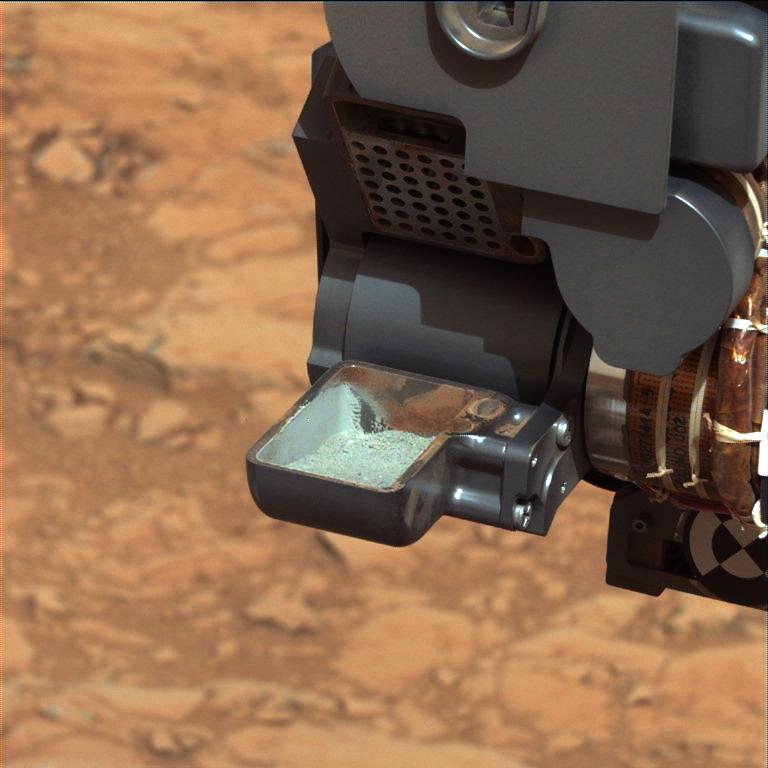
 http://photojournal.jpl.nasa.gov/jpegMod/PIA16729_modest.jpgPIA16729: First Curiosity Drilling Sample in the Scoop.

Target Name: Mars
Is a satellite of: Sol (our sun)
Mission: Mars Science Laboratory (MSL)
Spacecraft: Curiosity
Instrument: CHIMRA
Mastcam
Product Size: 768 x 768 pixels (width x height)
Produced By: Malin Space Science Systems
Full-Res TIFF: PIA16729.tif (1.77 MB)
Full-Res JPEG: PIA16729.jpg (59.15 kB)


Original Caption Released with Image:

Click here for larger version of PIA16729
Raw version
Click on the image for larger versionThis image from NASA's Curiosity rover shows the first sample of powdered rock extracted by the rover's drill. The image was taken after the sample was transferred from the drill to the rover's scoop. In planned subsequent steps, the sample will be sieved, and portions of it delivered to the Chemistry and Mineralogy instrument and the Sample Analysis at Mars instrument.
The scoop is 1.8 inches (4.5 centimeters) wide.
The image was obtained by Curiosity's Mast Camera on Feb. 20, or Sol 193, Curiosity's 193rd Martian day of operations.
The image has been white-balanced to show what the sample would look like if it were on Earth. A raw-color version is available (see inset above).
Malin Space Science Systems, San Diego, developed, built and operates MAHLI. NASA's Jet Propulsion Laboratory, Pasadena, Calif., manages the Mars Science Laboratory Project and the mission's Curiosity rover for NASA's Science Mission Directorate in Washington. The rover was designed and assembled at JPL, a division of the California Institute of Technology in Pasadena.
More information about Curiosity is online at http://www.nasa.gov/msl and http://mars.jpl.nasa.gov/msl/.
Image Credit:
NASA/JPL-Caltech/MSSS

Image Addition Date:
2013-02-20
NASA Mars Rover Confirms First Drilled Martian Rock Sample
 
 
PASADENA, Calif. -- NASA's Mars rover Curiosity has relayed new images that confirm it has successfully obtained the first sample ever collected from the interior of a rock on another planet. No rover has ever drilled into a rock beyond Earth and collected a sample from its interior.

Transfer of the powdered-rock sample into an open scoop was visible for the first time in images received Wednesday at NASA's Jet Propulsion Laboratory (JPL) in Pasadena, Calif.

"Seeing the powder from the drill in the scoop allows us to verify for the first time the drill collected a sample as it bore into the rock," said JPL's Scott McCloskey, drill systems engineer for Curiosity. "Many of us have been working toward this day for years. Getting final confirmation of successful drilling is incredibly gratifying. For the sampling team, this is the equivalent of the landing team going crazy after the successful touchdown."

The drill on Curiosity's robotic arm took in the powder as it bored a 2.5-inch (6.4-centimeter) hole into a target on flat Martian bedrock on Feb. 8. The rover team plans to have Curiosity sieve the sample and deliver portions of it to analytical instruments inside the rover.
The scoop now holding the precious sample is part of Curiosity's Collection and Handling for In-Situ Martian Rock Analysis (CHIMRA) device. During the next steps of processing, the powder will be enclosed inside CHIMRA and shaken once or twice over a sieve that screens out particles larger than 0.006 inch (150 microns) across.

Small portions of the sieved sample later will be delivered through inlet ports on top of the rover deck into the Chemistry and Mineralogy (CheMin) instrument and Sample Analysis at Mars (SAM) instrument.

In response to information gained during testing at JPL, the processing and delivery plan has been adjusted to reduce use of mechanical vibration. The 150-micron screen in one of the two test versions of CHIMRA became partially detached after extensive use, although it remained usable. The team has added precautions for use of Curiosity's sampling system while continuing to study the cause and ramifications of the separation.

The sample comes from a fine-grained, veiny sedimentary rock called "John Klein," named in memory of a Mars Science Laboratory deputy project manager who died in 2011. The rock was selected for the first sample drilling because it may hold evidence of wet environmental conditions long ago. The rover's laboratory analysis of the powder may provide information about those conditions.

NASA's Mars Science Laboratory Project is using the Curiosity rover with its 10 science instruments to investigate whether an area within Mars' Gale Crater ever has offered an environment favorable for microbial life. JPL manages the project for NASA's Science Mission Directorate in Washington.

An image of the drill's rock powder held in the scoop is online at:

For more about the mission, visit:

You can follow the mission on Facebook and Twitter at:

and

NASA
Guillermo Gonzalo Sánchez Achutegui
ayabaca@gmail.com
ayabaca@hotmail.com
ayabaca@yahoo.com
Inscríbete en el Foro del blog y participa : A Vuelo De Un Quinde - El Foro!

domingo, 20 de enero de 2013

NASA - Curiosity Replica Preps for Parade


 On Saturday morning, Jan. 19, 2013, at Joint Base Anacostia Bolling (JBAB) in Washington, Steve LaDrew, with Capitol Exhibit Services, adjusts the Mastcam on a replica of the Mars Curiosity Rover.
 Download Image
 NASA
Guillermo Gonzalo Sánchez Achutegui
ayabaca@gmail.com
ayabaca@hotmail.com
ayabaca@yahoo.com
Inscríbete en el Foro del blog y participa : A Vuelo De Un Quinde - El Foro!

miércoles, 9 de enero de 2013

NASA - First Use of Mars Rover Curiosity's Dust Removal Tool


 Image from the Mars Hand Lens Imager (MAHLI) on NASA's Mars rover Curiosity

Download Image

› Full Size 
 NASA
Guillermo Gonzalo Sánchez Achutegui
ayabaca@gmail.com
ayabaca@hotmail.com
ayabaca@yahoo.com
Inscríbete en el Foro del blog y participa : A Vuelo De Un Quinde - El Foro!

sábado, 29 de diciembre de 2012

NASA - NASA Encourages Public to Explore Its Curiosity With New Rover-Themed Badge on Foursquare


A shallow depression called 'Yellowknife Bay' on Mars

Download Image

› Full Size 
 

 NASA Encourages Public to Explore Its Curiosity With New Rover-Themed Badge on Foursquare.-
 
WASHINGTON -- NASA and the mobile application Foursquare have teamed up to help the public unlock its scientific curiosity with a new rover-themed Curiosity Explorer badge.

Users of the Foursquare social media platform can earn the badge by following NASA and checking in at a NASA visitor center or venue categorized as a science museum or planetarium. Upon earning the badge, users will see a special message on Foursquare:

"Get out your rock-vaporizing laser! You've explored your scientific curiosities just like NASA's Curiosity rover on Mars. Stay curious and keep exploring. You never know what you'll find."

The launch of the badge follows the October check-in on Mars by NASA's Curiosity rover, which marked the first check-in on another planet. Foursquare users can keep up with Curiosity as the rover checks in at key locations and posts photos and tips, all while exploring the Red Planet.

After landing in Gale Crater in August, Curiosity began a 23-month mission that includes some of Mars' most intriguing science destinations. The mission's main science destination will be on Mount Sharp, a mountain about 3 miles (5 kilometers) tall. First, Curiosity is investigating targets on flatter ground near the mountain, seeking clues in the rocks and soil that would indicate whether Mars ever was capable of supporting microbial life. It also is taking pictures of the trip, beaming them back to Earth for all to share.

NASA has been on Foursquare since 2010 through a strategic partnership with the platform. This partnership, launched with astronaut Doug Wheelock's first-ever check-in from the International Space Station, has allowed users to connect with NASA, and enabled them to explore the universe and rediscover Earth.

The partnership launched the now-expired NASA Explorer badge for Foursquare users, which encouraged them to explore NASA-related locations across the country. It also included the launch of a NASA Foursquare page, where the agency continues to provide official tips and information about the nation's space program.

NASA's Jet Propulsion Laboratory (JPL) manages the Mars Science Laboratory mission and its Curiosity rover for the agency's Science Mission Directorate in Washington. The rover was designed, developed and assembled at JPL, a division of the California Institute of Technology in Pasadena, Calif.

To follow the Mars Curiosity rover and NASA on Foursquare, visit:


and


For information about NASA's partnership with Foursquare, visit:


For more information about NASA's Curiosity mission, visit:


and

Guillermo Gonzalo Sánchez Achutegui
ayabaca@gmail.com
ayabaca@hotmail.com
ayabaca@yahoo.com
 Inscríbete en el Foro del blog y participa : A Vuelo De Un Quinde - El Foro!

Mi lista de blogs