Mostrando entradas con la etiqueta Radiation. Mostrar todas las entradas

sábado, 17 de noviembre de 2012

NASA - NASA Rover Providing New Weather and Radiation Data About Mars


Download Image 

› Full Size 

 › 800 x 600


Download Image

› Full Size 


PASADENA, Calif. -- Observations of wind patterns and natural radiation patterns on Mars by NASA's Curiosity rover are helping scientists better understand the environment on the Red Planet's surface.
Researchers using the car-sized mobile laboratory have identified transient whirlwinds, mapped winds in relation to slopes, tracked daily and seasonal changes in air pressure, and linked rhythmic changes in radiation to daily atmospheric changes. The knowledge being gained about these processes helps scientists interpret evidence about environmental changes on Mars that might have led to conditions favorable for life.
During the first 12 weeks after Curiosity landed in an area named Gale Crater, an international team of researchers analyzed data from more than 20 atmospheric events with at least one characteristic of a whirlwind recorded by the Rover Environmental Monitoring Station (REMS) instrument. Those characteristics can include a brief dip in air pressure, a change in wind direction, a change in wind speed, a rise in air temperature or a dip in ultraviolet light reaching the rover. Two of the events included all five characteristics.
In many regions of Mars, dust-devil tracks and shadows have been seen from orbit, but those visual clues have not been seen in Gale Crater. One possibility is that vortex whirlwinds arise at Gale without lifting as much dust as they do elsewhere.
"Dust in the atmosphere has a major role in shaping the climate on Mars," said Manuel de la Torre Juarez of NASA's Jet Propulsion Laboratory in Pasadena, Calif. He is the investigation scientist for REMS, which Spain provided for the mission. "The dust lifted by dust devils and dust storms warms the atmosphere."
Dominant wind direction identified by REMS has surprised some researchers who expected slope effects to produce north-south winds. The rover is just north of a mountain called Mount Sharp. If air movement up and down the mountain's slope governed wind direction, dominant winds generally would be north-south. However, east-west winds appear to predominate. The rim of Gale Crater may be a factor.
"With the crater rim slope to the north and Mount Sharp to the south, we may be seeing more of the wind blowing along the depression in between the two slopes, rather than up and down the slope of Mount Sharp," said Claire Newman, a REMS investigator at Ashima Research in Pasadena. "If we don't see a change in wind patterns as Curiosity heads up the slope of Mount Sharp -- that would be a surprise."
REMS monitoring of air pressure has tracked both a seasonal increase and a daily rhythm. Neither was unexpected, but the details improve understanding of atmospheric cycles on present-day Mars, which helps with estimating how the cycles may have operated in the past.
The seasonal increase results from tons of carbon dioxide, which had been frozen into a southern winter ice cap, returning into the atmosphere as southern spring turns to summer. The daily cycle of higher pressure in the morning and lower pressure in the evening results from daytime heating of the atmosphere by the sun. As morning works its way westward around the planet, so does a wave of heat-expanded atmosphere, known as a thermal tide.
Effects of that atmospheric tide show up in data from Curiosity's Radiation Assessment Detector (RAD). This instrument monitors high-energy radiation considered to be a health risk to astronauts and a factor in whether microbes could survive on Mars' surface.
"We see a definite pattern related to the daily thermal tides of the atmosphere," said RAD Principal Investigator Don Hassler of the Southwest Research Institute's Boulder, Colo., branch. "The atmosphere provides a level of shielding, and so charged-particle radiation is less when the atmosphere is thicker. Overall, Mars' atmosphere reduces the radiation dose compared to what we saw during the flight to Mars."
The overall goal of NASA's Mars Science Laboratory mission is to use 10 instruments on Curiosity to assess whether areas inside Gale Crater ever offered a habitable environment for microbes.
JPL, a division of the California Institute of Technology in Pasadena, manages the project for NASA's Science Mission Directorate, Washington, and built Curiosity.
For more information about Curiosity and its mission, 
You can follow the mission on Facebook and Twitter at: http://www.facebook.com/marscuriosity 
 
 
Guy Webster 818-354-6278
Jet Propulsion Laboratory, Pasadena, Calif.
guy.webster@jpl.nasa.gov

Dwayne Brown 202-358-1726
NASA Headquarters, Washington
dwayne.c.brown@nasa.gov
NASA
Guillermo Gonzalo Sánchez Achuteguui
ayabaca@hotmail.com
ayabaca@gmail.com
ayabaca@yahoo.com
 Inscríbete en el Foro del blog y participa : A Vuelo De Un Quinde - El Foro!

miércoles, 10 de octubre de 2012

Mars: Testing Mars and Moon soil for sheltering astronauts from radiation

 
http://www.esa.int/images/cis_lunar-Lagrange-580.png
NASA proposal for a future deep space station, 'parked' at lunar Lagrange point 2 past the far side of the Moon. Residing beyond Earth's magnetic field, its occupants would need enhanced radiation protection. 
Credits: NASA 
Humans venturing beyond Earth orbit deeper into space face increased exposure to cosmic radiation, so ESA has teamed with Germany’s GSI particle accelerator to test potential shielding for astronauts, including Moon and Mars soil.

ESA’s two-year project is assessing the most promising materials for shielding future astronauts going to the Moon, the asteroids or Mars.
“We are working with the only facility in Europe capable of simulating the high-energy heavy atomic nuclei found in galactic cosmic radiation – the GSI Helmholtz Centre for Heavy Ion Research in Darmstadt, Germany,” explained Alessandra Menicucci, overseeing the project.
“We assessed materials including aluminium, water, polyethylene plastic, multilayer structures and simulated Moon and Mars material – the latter on the basis these will be accessible to planetary expeditions
 http://www.esa.int/images/simulant.jpg
Lunar regolith simulant JSC-1A 
Credits: NASA 

“We have also confirmed a new type of hydrogen storage material holds particular promise.”
Space is awash with charged particles, meaning that astronauts are officially classed as radiation workers.
The International Space Station orbits within Earth’s magnetic field, safeguarding its occupants from the bulk of space radiation. To venture further out, dedicated shielding will be required.
Space radiation comes from the Sun – in the form of intense but short-lived ‘solar particle events’ – as well as galactic cosmic radiation originating beyond our Solar System: atomic nuclei produced by dying stars, their passage sped by magnetic fields as they cross the galaxy.
 http://www.esa.int/images/7_GSI_UNILAC_Superlinse_01.jpg
Download:
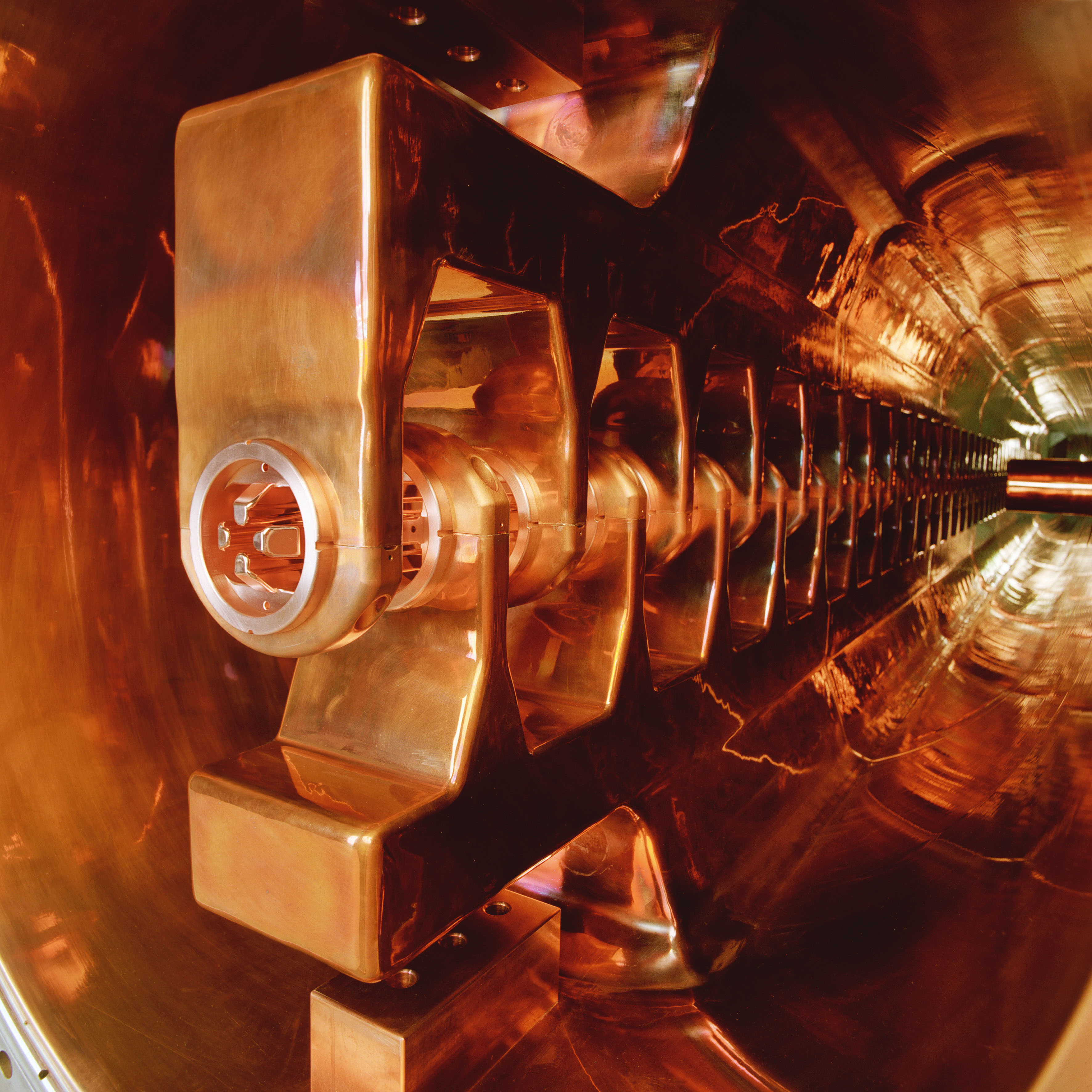
 GSI's linear accelerator UNILAC (UNIversal Linear ACcelerator) has a length of 120 meters. Ions, e.g. charged atoms of all chemical elements can be accelerated up to 20 percent of the speed of light (60,000 km/s) with this unit. 
Credits: GSI

"Solar particle events are made up of protons that can be shielded quite simply,” added Alessandra.
“The real challenge for deep-space missions is galactic cosmic radiation, which cannot be shielded completely because of its very high energy, although the exposure level decreases with increased solar activity.
Most are small protons or helium nuclei, but about 1% are larger, the size of an iron atom or more – known as ‘high-ionising high energy particles’ or HZE for short.
Radiation shielding can be counter-intuitive because denser and thicker does not always mean better.
 http://www.esa.int/images/5486558838_f2d05b4d95_o.jpg
Discovery's spacewalkers Stephen Bowen and Al Drew working outside the ISS. ESA's Paolo Nespoli took this photo on 28 February 2011. 
Credits: ESA/NASA

 HZEs striking metal shields can produce showers of secondary particles that might be even more harmful.
And as shield thickness increases, overall the energy loss of ionising radiation rises to a peak then declines rapidly.
“In general, the lighter a material’s atomic nuclei the better the protection,” notes Alessandra.
Water and polyethylene performed better than aluminium for instance, and new hydrogen-rich materials developed by UK company Cella Energy tested better still.
Cella Energy originally developed its patent-pending materials for storing hydrogen fuel but is currently investigating their radiation resistance.
 

Read more
ESA.
Guillermo Gonzalo Sánchez Achutegui
ayabaca@gmail.com
ayabaca@hotmail.com
ayabaca@yahoo.com
Inscríbete en el Foro del blog y participa : A Vuelo De Un Quinde - El Foro!

sábado, 11 de agosto de 2012

Astronomy: New NASA Mission Ready to Brave Earth's Radiation Belts‏

Hi My Friends: A VUELO DE UN QUINDE EL BLOG., NASA's Radiation Belt Storm Probes (RBSP) mission will send two spacecraft into the harsh environment of our planet's radiation belts. Final preparations have begun for launch on Thursday, Aug. 23, from Florida's Space Coast.
 › View larger
Two giant donuts of charged particles called the Van Allen Belts surround Earth. Credit: NASA/T. Benesch, J. Carns 
Our day-to-day lives exist in what physicists would call an electrically neutral environment. Desks, books, chairs and bodies don't generally carry electricity and they don't stick to magnets. But life on Earth is substantially different from, well, almost everywhere else. Beyond Earth's protective atmosphere and extending all the way through interplanetary space, electrified particles dominate the scene. Indeed, 99% of the universe is made of this electrified gas, known as plasma.

Two giant donuts of this plasma surround Earth, trapped within a region known as the Van Allen Radiation Belts. The belts lie close to Earth, sandwiched between satellites in geostationary orbit above and satellites in low Earth orbit (LEO) are generally below the belts. A new NASA mission called the Radiation Belt Storm Probes (RBSP), due to launch in August 2012, will improve our understanding of what makes plasma move in and out of these electrified belts wrapped around our planet.

"We discovered the radiation belts in observations from the very first spacecraft, Explorer 1, in 1958" says David Sibeck, a space scientist at NASA's Goddard Space Flight Center in Greenbelt, Md., and the mission scientist for RBSP. "Characterizing these belts filled with dangerous particles was a great success of the early space age, but those observations led to as many questions as answers. These are fascinating science questions, but also practical questions, since we need to protect satellites from the radiation in the belts."

The inner radiation belt stays largely stable, but the number of particles in the outer one can swell 100 times or more, easily encompassing a horde of communications satellites and research instruments orbiting Earth. Figuring out what drives these changes in the belts, requires understanding what drives the plasma. 


 An artist's rendition of what the two Radiation Belt Storm Probe spacecraft will look like in space. 
Credit: NASA/Goddard Space Flight Center 

 New NASA Mission Ready to Brave Earth's Radiation Belts.-
 WASHINGTON -- NASA's Radiation Belt Storm Probes (RBSP) mission will send two spacecraft into the harsh environment of our planet's radiation belts. Final preparations have begun for launch on Thursday, Aug. 23, from Florida's Space Coast.

The RBSP spacecraft are designed to fly and operate in the heart of the most hazardous regions of near-Earth space to collect crucial data. The data will help researchers develop an understanding of the Van Allen radiation belts, two rings of very high energy electrons and protons that can pose hazards to human and robotic explorers.

"At the end of this month we will turn our attention from planet Mars to planet Earth, both immersed in the atmosphere of our sun," said Barbara Giles, director of NASA's Heliophysics Division. "RBSP will further explore the connection of solar variability and its impacts on Earth's radiation belts."

RBSP will help scientists understand how the invisible radiation belts -- named for James Van Allen, who discovered them -- behave and react to changes in the sun, thereby contributing to Earth's space weather. Space weather is caused in great part by the sun's influence on Earth and near-Earth space, including solar events such as giant eruptions of solar material called coronal mass ejections.

"The dramatic dynamics of Earth's radiation belts caused by space weather are highly unpredictable," said Barry Mauk, RBSP project scientist at the Johns Hopkins University Applied Physics Laboratory (APL) in Laurel, Md. "One of the fundamental objectives of the RBSP mission is to use Earth's magnetosphere as a natural laboratory to understand generally how radiation is created and evolves throughout the universe. There are many mysteries that need to be resolved."

Space weather fluctuations can increase radiation exposure for pilots and passengers during polar aircraft flights. They also can disable satellites, cause power grid failures, and disrupt the Global Positioning System, television and telecommunications signals. Understanding the science of space weather will lead to better space weather predictions, which in turn will allow us to better manage and protect our technological infrastructure in space and on the ground.

The spacecraft are atop a United Launch Alliance Atlas V rocket currently being prepared to lift off from Cape Canaveral Air Force Station, Fla.

"Everything is ready and prepared for RBSP to launch as scheduled," said Richard Fitzgerald, RBSP project manager at APL. "Both the twin spacecraft and the entire RBSP team are eager to begin their exploration of one of the most dangerous parts of space near our planet."

The mission will last two years. The spacecraft, carrying the best and most comprehensive instrumentation ever sent into the radiation belts, will fly through surging and swelling belts of energized particles that would damage ordinary spacecraft. By using a pair of probes flying in highly elliptical orbits, scientists will be able to study the radiation belts over space and time, learn how particles within the belts are produced and behave during space weather events, and what mechanisms drive the acceleration of the particles.

RBSP is part of NASA's Living With a Star Program to explore aspects of the connected sun-Earth system that directly affect life and society. LWS is managed by the agency's Goddard Space Flight Center in Greenbelt, Md. APL built the RBSP spacecraft and will manage the mission for NASA.

For more information about NASA's RBSP mission, visit:


NASA
Guillermo Gonzalo Sánchez Achutegui
ayabaca@hotmail.com
ayabaca@gmail.com
ayabaca@yahoo.com
 Inscríbete en el Foro del blog y participa : A Vuelo De Un Quinde - El Foro!

Mi lista de blogs