Mostrando entradas con la etiqueta South America. Mostrar todas las entradas

viernes, 4 de marzo de 2016

NASA : NASA's IMERG Measures Flooding Rainfall in Peru .- NASA IMERG Medidas de lluvia Las inundaciones en Perú

http://www.nasa.gov/press-release/nasa-deputy-administrator-visits-home-state-for-aviation-stem-talks-available-for

Heavy rainfall recently caused flooding, landslides and power outages in some areas of Peru. NASA's Integrated Multi-satellitE Retrievals for GPM (IMERG) measured that rainfall by using a merged precipitation product from a constellation of satellites.
Las fuertes lluvias recientemente causó inundaciones, deslizamientos de tierra y cortes de energía en algunas zonas del Perú. Multi-Satélite Retrievals Integrados de la NASA para GPM (IMERG) midieron que la lluvia mediante el uso de un producto de precipitación resultante de la fusión de una constelación de satélites.

map of bolivia and peru with red/green rainfall data
NASA's IMERG data collected from February 23-29, 2016 were used to estimate rainfall totals over this area of South America. The highest rainfall total estimates for this period were over 700 mm (27.6 inches). These extreme rainfall total estimates were shown east of the Andes in southeastern Peru and Bolivia.
Credits: ASA/JAXA/SSAI, Hal Pierce
 
GPM is the Global Precipitation Measurement mission, which is a satellite co-managed by NASA and the Japan Aerospace Exploration Agency and is used in NASA's IMERG data. GPM provides next-generation observations of rain and snow worldwide every three hours.

Extremely heavy rainfall was reported in northern Peru on February 26 and February 27, 2016. Thousands were made homeless and at least two people were reportedly killed from the severe weather. The strong El Niño was partially blamed for the abnormally high rainfall in that area.

NASA's IMERG data collected from February 23-29, 2016 were used to estimate rainfall totals over this area of South America. The highest rainfall total estimates for this period were over 700 mm (27.6 inches). These extreme rainfall total estimates were shown east of the Andes in southeastern Peru and Bolivia.

The satellites used in IMERG include DMSPs from the U.S. Department of Defense, GCOM-W from the Japan Aerospace Exploration Agency (JAXA), Megha-Tropiques from the Centre National D’etudies Spatiales (CNES) and Indian Space Research Organization (ISRO), NOAA series from the National Oceanic and Atmospheric Administration (NOAA), Suomi-NPP from NOAA-NASA, and MetOps from the European Organisation for the Exploitation of Meteorological Satellites (EUMETSAT).  All of the instruments (radiometers) onboard the constellation partners are intercalibrated with information from the GPM Core Observatory’s GPM Microwave Imager (GMI) and Dual-frequency Precipitation Radar (DPR). 

On March 3, Peru's National Meteorological and Hydrological Service said that rain was forecast to continue along the North Coast. The service said that in 10 hours, the Lancones (Piura) station recorded a total of 4.3 inches (110 mm), while in the city of Tumbes recorded 2.4 inches (60 mm). For forecasts, visit:

For more information about GPM, visit:

Harold F. Pierce
NASA's Goddard Space Flight Center in Greenbelt, Maryland
Last Updated: March 3, 2016
Editor: Karl Hille
NASA
Guillermo Gonzalo Sánchez Achutegui
Inscríbete en el Foro del blog y participa : A Vuelo De Un Quinde - El Foro!

jueves, 24 de abril de 2014

NASA : Earth Science Radar Imaging Mission Travels to Central and South America


Earth Science Radar Imaging Mission Travels to Central and South America
This photo of volcanoes in Guatemala was taken from NASA's C-20A aircraft during a four-week Earth science radar imaging mission deployment over Central and South America. The conical volcano in the center is "Volcan de Agua." The two volcanoes behind it are, right to left, "Volcan de Fuego" and "Acatenango." "Volcan de Pacaya" is in the foreground.
The radar imaging mission got underway in early April when the C-20A departed its base in Palmdale, Calif., to collect data over targets in the Gulf Coast area of the southeastern United States. The aircraft, a modified Gulfstream III, is carrying NASA's Uninhabited Aerial Vehicle Synthetic Aperture Radar (UAVSAR) instrument in a specialized pod. Developed by NASA's Jet Propulsion Laboratory in Pasadena, Calif., UAVSAR measures ground deformation over large areas to a precision of 0.04 to 0.2 inches (0.1 to 0.5 centimeters).
The mission schedule calls for the aircraft to make stops in 10 international and U.S. locations, including the Gulf Coast. Research during the deployment is covering a variety of topics, including volcanoes, glaciers, forest structure, levees, and subsidence. It is also providing vegetation data sets for satellite algorithm development. The volcanoes of Central and South America are of interest because of the hazard they pose to nearby population centers. A majority of the research will focus on gathering volcano deformation measurements, with many flight lines being repeats from previous deployments. Surface deformation often precedes other signs of renewed volcanic activity.
Image Credit: NASA/Stu Broce
NASA
Guillermo Gonzalo Sánchez Achutegui

domingo, 8 de diciembre de 2013

nsf.gov - National Science Foundation - Staple of recipe favorites--the tomato--reveals processes that maintain biodiversity


No hothouse plants: Study examines supermarket tomatoes' wild relatives, which live in Earth's most extreme environments
a tomato and the text  photogallery
Wild tomatoes are small plants with big messages.
Credit and Larger Version
December 5, 2013
The following is part twelve in a series on the National Science Foundation's Science, Engineering and Education for Sustainability (SEES) investment. Visit parts one, two, three, four, five, six, seven, eight, nine, ten and eleven in this series.
Tomatoes are in almost everything we eat, from salad and soup to chili and pizza. For some, tomato-based dishes are featured during the holiday season.
Most people don't realize, however, that there are more than a dozen wild tomato species, or that wild tomatoes grow in the deserts, rainforests and highlands of South America and on the Galapagos Islands.
These wild species don't have the big, bold fruits we're used to seeing in the supermarket, though. Wild tomato fruits are smaller, from the size of a pea to that of a large marble and are sometimes green and bitter when they're ripe.
But compared with their domesticated relatives, wild tomatoes are more diverse in many hidden and not-so-hidden ways.
Now scientists are using the genomes of wild tomatoes to study the processes that drive Earth's biodiversity.
Their goal is to learn how species cope with differences in climate and natural enemies, and what might happen in this time of environmental change.
 
Wild tomato genomes as a framework for understanding biodiversity
To study natural trait and genome diversity in wild tomatoes, scientists Leonie Moyle, David Haak and Matthew Hahn of Indiana University Bloomington received a grant from the National Science Foundation's (NSF) Dimensions of Biodiversity program.
Dimensions of Biodiversity is part of NSF's Science, Engineering and Education for Sustainability investment and is supported by NSF's Directorates for Biological Sciences and Geosciences.
Scientists funded through Dimensions of Biodiversity integrate genetic, taxonomic and functional approaches in their research.
"The resulting discoveries go beyond expanding our knowledge of the depth and breadth of life on Earth," says John Wingfield, NSF assistant director for Biological Sciences.
"They have the potential to revolutionize the way we manage agriculture, practice medicine, address global climate change and develop new technologies."
The award to Moyle's team funds sequencing of the complete set of all expressed genes (the transcriptome) in populations of wild tomato species.
"Variations within and between these wild tomato genomes can be compared by using the genome sequence of the domesticated tomato as a 'backbone,'"says Moyle.
By linking this genome-wide sequence data with information on wild tomato trait variation, the biologists hope to identify the genes responsible for adaptation to environmental change.
The research focuses on the role of drought and of defense against herbivores, or plant-eaters, in the diversity of wild tomatoes.
"These factors," says Haak, "capture two of the most important aspects of any plant's environment: climate and natural enemies."
 
Wild tomatoes: From hothouse to deep freeze
While domesticated tomatoes thrive only in agricultural irrigation, wild tomatoes live in some of the planet's most extreme environments.
They're among the few plants found in the driest place on Earth--the Atacama Desert in Chile. Other wild tomatoes blossom along the rocky, salty shores of the Galapagos Islands, and in the daily rains of Ecuador's rainforests.
But it's not just the climate in which they grow that varies among wild tomatoes.
The plants bristle with an array of natural defenses, from dense coverings of plant hairs to toxins deadly against insect attackers.
 
Measuring biodiversity in plant defenses
In a forthcoming paper in the journal Ecology, Haak, Moyle and colleagues document large differences in defenses among wild tomatoes.
They used bioassays--experiments in which living organisms are used to reveal the potency or concentration of a substance.
In this case, they fed leaf samples of different wild tomato species to tobacco hornworms.
The tobacco hornworm--also known as the tomato hornworm--is an enemy of both domesticated and wild tomatoes. It rapidly eats its way through the plants' leaves.
Each hornworm caterpillar was weighed before and after feeding to determine how much it had gained on a diet of wild tomato leaves.
Those tomatoes on which caterpillars gained little or no weight, says Haak, have more natural defenses than those on which the caterpillars gained weight.
In one wild tomato species, caterpillars lost significant weight; they refused to consume the plant's toxic leaves.
The researchers showed that the level of natural defense varies widely among wild tomato species.
"Although all wild tomatoes are closely related, these patterns of defense variation don't simply follow historical, evolutionary relationships," says Moyle. "The defense level of each wild tomato population is likely shaped by responses to local herbivores."
 
Linking biodiversity to genomics to understand environmental responses
Moyle and Haak are using DNA sequencing to look at the genes that are expressed differently in wild tomatoes with varying levels of natural defenses, and with differences in responses to drought.
Genes that are consistently up- or down-regulated in these conditions, says Moyle, can reveal the changes important for responding to and coping with environmental stresses.
"By linking data on DNA sequence variation, and on variation in gene expression, with wild tomatoes' responses to drought and natural enemies," she says, "we may find a powerful model for understanding the genetics of responses to environmental change."
The study could also uncover genetic variations helpful in improving domesticated tomatoes and their cultivated relatives, including potatoes and peppers.
"This research on tomatoes' wild relatives offers insights into the huge reservoir of genetic information available to ensure our future food security," says Simon Malcomber, lead NSF program director for Dimensions of Biodiversity.
"Tomatoes are one of the most widely consumed foods around the world," he says. "Studies such as this provide important information that could be used to improve herbivore resistance in crop cultivars."
Next time you're in the supermarket, tomatoes are worth a closer look. These common plants may offer a glimpse of our global food security, and of Earth's environmental future.
-- Cheryl Dybas, NSF (703) 292-7734
  cdybas@nsf.gov
Investigators David Haak
Leonie Moyle
Matthew Hahn
Related Institutions/Organizations Indiana University
Related Programs Dimensions of Biodiversity
Total Grants $1,182,938
Related WebsitesIn race against time, NSF grants fund research on Earth's threatened biodiversity:
 http://www.nsf.gov/news/news_summ.jsp?cntn_id=129242
Stemming the Tide of Biodiversity Loss on Earth:
 http://www.nsf.gov/news/news_summ.jsp?cntn_id=125495&org=NSF&from=news
Diversity of Life on Earth: NSF Awards Grants for Study of Dimensions of Biodiversity:
 http://www.nsf.gov/news/news_summ.jsp?cntn_id=122098
NSF Awards Grants to Study Dimensions of Earth's Biodiversity:
 http://www.nsf.gov/news/news_summ.jsp?cntn_id=117811&org=NSF&from=news
Earth Week: A Stream Is a Stream Is a Stream: Or Is It?:
 http://www.nsf.gov/discoveries/disc_summ.jsp?cntn_id=123855&org=NSF
NSF Publication: "Discoveries in Sustainability":
 http://www.nsf.gov/pubs/2012/disco12001/disco12001.pdf
Biodiversity of Earth's Richest Plant Kingdom Under Fire:
 http://www.nsf.gov/discoveries/disc_summ.jsp?cntn_id=122938&org=NSF
Wild tomatoes and domesticated tomatoes shown in different sizes
Wild tomatoes (right) differ in size, taste, color from domesticated tomatoes (left).
Credit and Larger Version
Sheena Shah, a researcher at Indiana University Bloomington, labels wild tomatoes in a greenhouse.
Credit and Larger Version
a wild tomato species with red fruits.
Solanum pimpinellifolium, a wild tomato species, has red, sweet fruits.
Credit and Larger Version

green-striped, wild tomato Solanum peruvianum.
First the sweet, then the bitter: The green-striped, wild tomato Solanum peruvianum.
Credit and Larger Version
Researcher Amanda Garbers of Indiana University Bloomington in a lab
Researcher Amanda Garbers of Indiana University Bloomington studies the DNA of wild tomato plants.
Credit and Larger Version
 
The National Science Foundation
Guillermo Gonzalo Sánchez Achutegui

martes, 3 de septiembre de 2013

nsf.gov - Electric fish may hold answers to better understanding of sensory abilities and movement

Research could lead to robots that can move and "sense" in highly cluttered and dark underwater environments
electric ghost knifefish from South America
This image is of the electric ghost knifefish, Apteronotus albifrons, from South America.
Credit and Larger Version
September 3, 2013
The weakly electric fish, so named because it generates a weak electric field, can do some very cool things. Using sensors located all over its body, for example, it can detect prey or predators that interrupt its surrounding electric field. This enables it to hunt in the dark, as well as to avoid being hunted by piranhas and other visually-guided fish that share its home.
It also has a unique propulsion system that allows it to swim backwards; in fact, the fish can switch from full speed ahead to full speed in reverse in a fifth of a second.
Like many things in nature, the weakly electric fish, found in South America and Africa, is inspiring scientists trying to answer fundamental questions, in this case about sensory abilities and movement, with the goal of better understanding brain science and, ultimately, developing new technologies drawn from biology.
"The general question we are trying to understand is how the ability to sense the world is combined with the ability to move," says Malcolm MacIver, an associate professor of mechanical and biomedical engineering at Northwestern University. "What is the relationship between the space you are able to sense, and your mechanical abilities?"
Using the fish as a model system, he is deciphering the relationship between the sensory volume, that is, the space in which the fish perceives things in its field, and the motor volume, the space in which it moves. He calls the field of study "infomechanics."
To explain the relationship, he suggests comparing two starkly different scenarios one might encounter while driving a car. On a clear sunny day, most people drive in "deliberative" mode, meaning the driving conditions do not prompt any urgent responses to the circumstances or the driving environment. When encountering a dense fog, however, people typically switch to "reactive" mode--they slow down, for example, and become more alert to potential dangers on the road.
"When you're driving on a flat roadway on a sunny day, you can see a far distance ahead, and think about things, such as whether you're hungry or need to stop to use a restroom and want to get off an exit," he says. "In a fog, you don't have that luxury. The relationship between your sensory volume and where you are moving in your immediate future determines the kind of behavioral strategies you use."
How does this connect to the fish? "What the fish have allowed us to see is that most animals are in reactive mode, especially aquatic animals, because light doesn't travel very far in water, " he says. "Remember that our evolutionary ancestry started with animals in the water. My hypothesis is that something very important happened when we came up on land, as light can travel much farther in air than in water."
The weakly electric fish, a freshwater fish found in South America and Africa, has sensory receptors everywhere on its body, "which would be like us having eyeballs scattered across our body surface," he says. "The fish emits an electric field, and its sensors detect the field. So if something is out there, there is an interruption of the signal and the receptors pick up the distortion. It can do it in all directions."
The information researchers gain by studying the fish ultimately could have important applications, particularly in designing machines equipped with this so-called "electrosense," that is, the ability to maneuver and "sense" the world underwater with weak electric fields.
MacIver and his collaborators already have developed prototype robots that can move and "sense" in highly cluttered and dark underwater environments, and expect to see them in commercial use, including possibly by the US Navy, within the next few years.
"The underwater robots used during the Deepwater Horizon problem were held back by lack of maneuverability and sensor technology that could have helped them function well in turbid environments," he says, referring to the BP oil spill in 2010 in the Gulf of Mexico. "They were trying to operate in those huge plumes of oil mixed with water. You can't see in that. This technology has the potential to change all that."
MacIver also is working on a mechanical version of the fish's unique propulsion system.
"Most fish flap their fin, they wave the back portion of their body through the water, which propels them forward," he says. "Our fish doesn't swim that way. It keeps its body straight, and has a fin that goes almost of the full length of its body, down and along the belly. It ripples that fin, almost like a curtain in the wind. Using that, they are able to move in a highly acrobatic fashion."
Not only can it swim backwards, but "this fish can also move in all directions, including sideways and at an angle," he says. "It's like the helicopter of the water. If we had a device that could do this, we would have an aquatic helicopter."
They are working on it. "We have a bit further to go with the high maneuverability propulsion system," he says. "But we're getting there."
MacIver is conducting his research under a National Science Foundation (NSF) Faculty Early Career Development (CAREER) award, which he received in 2009 as part of NSF's American Recovery and Reinvestment Act. The award supports junior faculty who exemplify the role of teacher-scholars through outstanding research, excellent education, and the integration of education and research within the context of the mission of their organization. NSF is funding his work with about $1.25 million over four years.
In 2009, he also received the Presidential Early Career Award for Scientists and Engineers (PECASE), which recognized his interdisciplinary work on the biomechanical and neural basis of intelligence, spanning robotics, biomechanics, neurobiology, philosophy and computation, as well as for his innovative science outreach efforts that include Hollywood science-fiction advisory efforts, interactive art installations and blogging for Discover magazine.
MacIver uses three approaches in his work: mechanics and robotics for understanding the ways in which the body contributes to adaptive behavior; neurobiology for understanding the how sensory signals are processed for movement control; and computational modeling, for constructing supercomputer simulations of the body, nervous system, sensory signals and mechanical interactions with the world.
His collaborators include Kevin Lynch, a professor of mechanical engineering, Michael Peshkin, a professor of mechanical engineering, Neelesh Patankar, a professor of mechanical engineering, and David McLean, a professor of neurobiology, from Northwestern University; Julio Santos and James Solberg, of HDT Robotics, in Evanston, Ill.; George Lauder, a professor of zoology at the Museum of Comparative Zoology, Harvard University; Noah Cowan, a professor of mechanical engineering, and Eric Fortune, a professor of psychological and brain sciences at Johns Hopkins University.
MacIver also helped develop "Scale," a "singing electric fish" art installation that has appeared on exhibition in The Netherlands and in China. The multidisciplinary artwork was created by MacIver, visual artist Marlena Novak and composer and sound designer Jay Alan Yim, the latter two also from Northwestern. Twelve different species of electric fish from the Amazon River Basin comprise a "choir" whose sonified electrical fields provide the source tones for an immersive audiovisual experience.
"Every electric fish emits an electric field, and if you put it into a speaker, it's something you can hear," MacIver explains. "The fish aren't generating a sound, but if you dip the speaker leads into the water and amplify it, you can hear the audio equivalent of their electric field--an electric fish choir."
-- Marlene Cimons, National Science Foundation
Investigators Malcolm MacIver
Related Institutions/Organizations Northwestern University
 
Malcolm MacIver
Malcolm MacIver teaches mechanical and biomedical engineering at Northwestern University.
Credit and Larger Version
 
Guillermo Gonzalo Sánchez Achutegui

lunes, 8 de julio de 2013

ESA - Cordillera de los Andes


El cambio climático incrementa las emisiones de amoniaco a la atmósfera

El aumento de la temperatura como consecuencia del calentamiento global incrementa las emisiones de amoníaco a la atmósfera y con ello los efectos adversos sobre los ecosistemas y la salud humana, por lo que los científicos piden más esfuerzos para controlar las emisiones de ese gas.
- See more at: http://www.efeverde.com/blog/noticias/el-cambio-climatico-incrementa-las-emisiones-de-amoniaco-a-la-atmosfera-2/#sthash.q017K7io.dpu

El cambio climático incrementa las emisiones de amoniaco a la atmósfera

El aumento de la temperatura como consecuencia del calentamiento global incrementa las emisiones de amoníaco a la atmósfera y con ello los efectos adversos sobre los ecosistemas y la salud humana, por lo que los científicos piden más esfuerzos para controlar las emisiones de ese gas.
Esta es una de las conclusiones del artículo firmado por investigadores de diversos países que ha publicado la revista “Philosophical transactions of the Royal Society B.”, ha explicado a Efe Celia Milford, del Centro de Investigación Atmosférica de Izaña (Aemet), en Tenerife.
El amoníaco (NH3) es un gas que se encuentre de forma natural en la atmósfera y que también es emitido por las actividades agrícolas, sobre todo la ganadería y los fertilizantes, así como por la quema de biomasa.
El aumento de amoniaco preocupa porque contribuye a la acidificación y al exceso de fertilización de los ecosistemas, tantos terrestres como marinos, y desempeña una función importante en la formación de partículas finas (PM2.5).
Las partículas finas son objeto de preocupación para los científicos debido a que afectan a la salud, sobre todo en aspectos cardiovasculares.

Emisiones de amoniaco

A diferencia de lo que sucede con otros contaminantes, hay pocas reducciones previstas para las emisiones de amoniaco, e incluso se prevé un aumento de las emisiones.
Por ejemplo, en Europa se prevé un descenso de un dos por ciento para las emisiones de amoniaco entre 2010 y 2020, comparado con un descenso del treinta por ciento para el dióxido de azufre (SO2) y del veintinueve por ciento para los óxidos de nitrógeno (NOx).
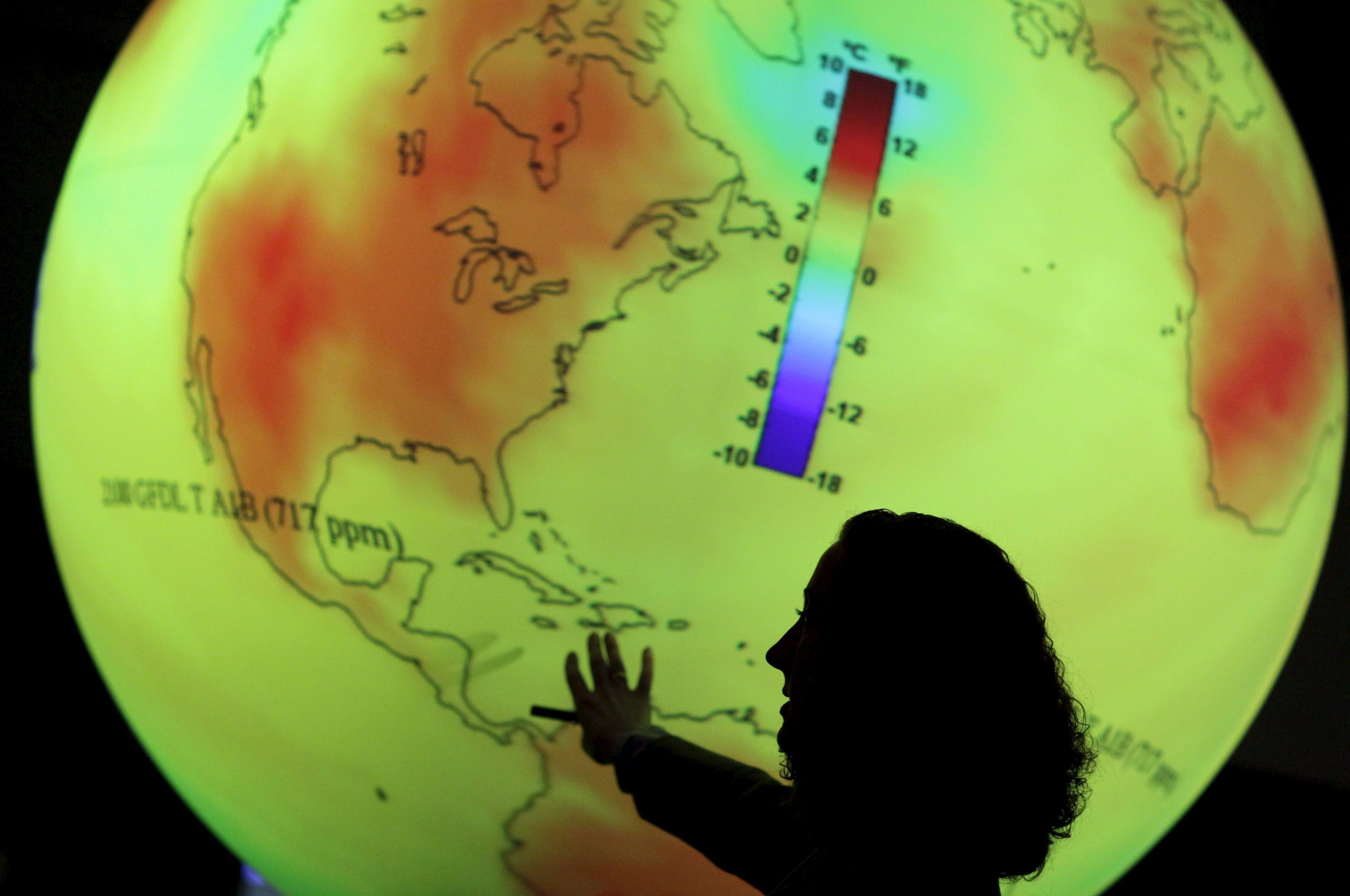
Una investigadora señala los efectos del cambio climático sobre una bola del mundo.
Una investigadora señala los efectos del cambio climático sobre una bola del mundo. EFE/Kay Nietfeld
En otros partes del mundo, por ejemplo en Estados Unidos, se prevé un incremento de las emisiones del amoniaco, mientras que las emisiones de los óxidos de nitrógeno está previsto que disminuyan, debido a la implementación de nuevas tecnologías para reducir las emisiones de los vehículos.

Calor y amoniaco

Celia Milford explicó que la mayoría de estas emisiones de amoníaco son muy sensibles a la temperatura y a la disponibilidad de agua, por lo que el incremento de la temperatura, como consecuencia del calentamiento global, provoca un aumento de las emisiones de amoníaco.
En la actualidad se dispone de herramientas para medir el amoníaco tanto en determinadas estaciones terrestres como en observaciones desde satélites.
El artículo también presenta nuevos desarrollos para la modelización de amoníaco que permite evaluar las consecuencias del cambio climático, indicó la investigadora.
Las estimaciones iniciales indican que un calentamiento de cinco grados centígrados produciría un incremento en las emisiones de amoníaco en torno al 42 por ciento.
Por tanto, según comentó Celia Milford, la reducción de las emisiones de amoníaco a la atmósfera requerirá un esfuerzo adicional, ya que se prevé un incremento de las emisiones por un lado debido a las actividades antropogénicas (actividad humana) y por otro al incremento de la temperatura. EFEverde
- See more at: http://www.efeverde.com/blog/noticias/el-cambio-climatico-incrementa-las-emisiones-de-amoniaco-a-la-atmosfera-2/#sthash.q017K7io.dpuf

El cambio climático incrementa las emisiones de amoniaco a la atmósfera

El aumento de la temperatura como consecuencia del calentamiento global incrementa las emisiones de amoníaco a la atmósfera y con ello los efectos adversos sobre los ecosistemas y la salud humana, por lo que los científicos piden más esfuerzos para controlar las emisiones de ese gas.
- See more at: http://www.efeverde.com/blog/noticias/el-cambio-climatico-incrementa-las-emisiones-de-amoniaco-a-la-atmosfera-2/#sthash.9fcXK84R.dpuf
DOWNLOAD HI-RES(1.68 MB)

El cambio climático incrementa las emisiones de amoniaco a la atmósfera

El aumento de la temperatura como consecuencia del calentamiento global incrementa las emisiones de amoníaco a la atmósfera y con ello los efectos adversos sobre los ecosistemas y la salud humana, por lo que los científicos piden más esfuerzos para controlar las emisiones de ese gas.
Esta es una de las conclusiones del artículo firmado por investigadores de diversos países que ha publicado la revista “Philosophical transactions of the Royal Society B.”, ha explicado a Efe Celia Milford, del Centro de Investigación Atmosférica de Izaña (Aemet), en Tenerife.
El amoníaco (NH3) es un gas que se encuentre de forma natural en la atmósfera y que también es emitido por las actividades agrícolas, sobre todo la ganadería y los fertilizantes, así como por la quema de biomasa.
El aumento de amoniaco preocupa porque contribuye a la acidificación y al exceso de fertilización de los ecosistemas, tantos terrestres como marinos, y desempeña una función importante en la formación de partículas finas (PM2.5).
Las partículas finas son objeto de preocupación para los científicos debido a que afectan a la salud, sobre todo en aspectos cardiovasculares.

Emisiones de amoniaco

A diferencia de lo que sucede con otros contaminantes, hay pocas reducciones previstas para las emisiones de amoniaco, e incluso se prevé un aumento de las emisiones.
Por ejemplo, en Europa se prevé un descenso de un dos por ciento para las emisiones de amoniaco entre 2010 y 2020, comparado con un descenso del treinta por ciento para el dióxido de azufre (SO2) y del veintinueve por ciento para los óxidos de nitrógeno (NOx).
Una investigadora señala los efectos del cambio climático sobre una bola del mundo.
Una investigadora señala los efectos del cambio climático sobre una bola del mundo. EFE/Kay Nietfeld
En otros partes del mundo, por ejemplo en Estados Unidos, se prevé un incremento de las emisiones del amoniaco, mientras que las emisiones de los óxidos de nitrógeno está previsto que disminuyan, debido a la implementación de nuevas tecnologías para reducir las emisiones de los vehículos.

Calor y amoniaco

Celia Milford explicó que la mayoría de estas emisiones de amoníaco son muy sensibles a la temperatura y a la disponibilidad de agua, por lo que el incremento de la temperatura, como consecuencia del calentamiento global, provoca un aumento de las emisiones de amoníaco.
En la actualidad se dispone de herramientas para medir el amoníaco tanto en determinadas estaciones terrestres como en observaciones desde satélites.
El artículo también presenta nuevos desarrollos para la modelización de amoníaco que permite evaluar las consecuencias del cambio climático, indicó la investigadora.
Las estimaciones iniciales indican que un calentamiento de cinco grados centígrados produciría un incremento en las emisiones de amoníaco en torno al 42 por ciento.
Por tanto, según comentó Celia Milford, la reducción de las emisiones de amoníaco a la atmósfera requerirá un esfuerzo adicional, ya que se prevé un incremento de las emisiones por un lado debido a las actividades antropogénicas (actividad humana) y por otro al incremento de la temperatura. EFEverde
- See more at: http://www.efeverde.com/blog/noticias/el-cambio-climatico-incrementa-las-emisiones-de-amoniaco-a-la-atmosfera-2/#sthash.q017K7io.dpuf
El cambio climático incrementa las emisiones de amoniaco a la atmósfera
El aumento de la temperatura como consecuencia del calentamiento global incrementa las emisiones de amoníaco a la atmósfera y con ello los efectos adversos sobre los ecosistemas y la salud humana, por lo que los científicos piden más esfuerzos para controlar las emisiones de ese gas.
- See more at: http://www.efeverde.com/blog/noticias/el-cambio-climatico-incrementa-las-emisiones-de-amoniaco-a-la-atmosfera-2/#sthash.9fcXK84R.dpufPeruvian landscapeDOWNLOAD HI-RES(1.68 MB)

The foothills of the Andes mountains near the southern coast of Peru were captured by the Kompsat-2 satellite on 4 May 2011. The Andes stretch about 7000 km from Venezuela down South America’s west coast to the top of Argentina. The mountain rage is the result of the Nazca and Antarctic tectonic plates moving under the South American plate – a geological process called ‘subduction’. This process is also responsible for the Andes range’s volcanic activity.

El cambio climático incrementa las emisiones de amoniaco a la atmósfera

El aumento de la temperatura como consecuencia del calentamiento global incrementa las emisiones de amoníaco a la atmósfera y con ello los efectos adversos sobre los ecosistemas y la salud humana, por lo que los científicos piden más esfuerzos para controlar las emisiones de ese gas.
Esta es una de las conclusiones del artículo firmado por investigadores de diversos países que ha publicado la revista “Philosophical transactions of the Royal Society B.”, ha explicado a Efe Celia Milford, del Centro de Investigación Atmosférica de Izaña (Aemet), en Tenerife.
El amoníaco (NH3) es un gas que se encuentre de forma natural en la atmósfera y que también es emitido por las actividades agrícolas, sobre todo la ganadería y los fertilizantes, así como por la quema de biomasa.
El aumento de amoniaco preocupa porque contribuye a la acidificación y al exceso de fertilización de los ecosistemas, tantos terrestres como marinos, y desempeña una función importante en la formación de partículas finas (PM2.5).
Las partículas finas son objeto de preocupación para los científicos debido a que afectan a la salud, sobre todo en aspectos cardiovasculares.

Emisiones de amoniaco

A diferencia de lo que sucede con otros contaminantes, hay pocas reducciones previstas para las emisiones de amoniaco, e incluso se prevé un aumento de las emisiones.
Por ejemplo, en Europa se prevé un descenso de un dos por ciento para las emisiones de amoniaco entre 2010 y 2020, comparado con un descenso del treinta por ciento para el dióxido de azufre (SO2) y del veintinueve por ciento para los óxidos de nitrógeno (NOx).
Una investigadora señala los efectos del cambio climático sobre una bola del mundo.
Una investigadora señala los efectos del cambio climático sobre una bola del mundo. EFE/Kay Nietfeld
En otros partes del mundo, por ejemplo en Estados Unidos, se prevé un incremento de las emisiones del amoniaco, mientras que las emisiones de los óxidos de nitrógeno está previsto que disminuyan, debido a la implementación de nuevas tecnologías para reducir las emisiones de los vehículos.

Calor y amoniaco

Celia Milford explicó que la mayoría de estas emisiones de amoníaco son muy sensibles a la temperatura y a la disponibilidad de agua, por lo que el incremento de la temperatura, como consecuencia del calentamiento global, provoca un aumento de las emisiones de amoníaco.
En la actualidad se dispone de herramientas para medir el amoníaco tanto en determinadas estaciones terrestres como en observaciones desde satélites.
El artículo también presenta nuevos desarrollos para la modelización de amoníaco que permite evaluar las consecuencias del cambio climático, indicó la investigadora.
Las estimaciones iniciales indican que un calentamiento de cinco grados centígrados produciría un incremento en las emisiones de amoníaco en torno al 42 por ciento.
Por tanto, según comentó Celia Milford, la reducción de las emisiones de amoníaco a la atmósfera requerirá un esfuerzo adicional, ya que se prevé un incremento de las emisiones por un lado debido a las actividades antropogénicas (actividad humana) y por otro al incremento de la temperatura. EFEverde
- See more at: http://www.efeverde.com/blog/noticias/el-cambio-climatico-incrementa-las-emisiones-de-amoniaco-a-la-atmosfera-2/#sthash.q017K7io.dpuf
The foothills of the Andes mountains near the southern coast of Peru are captured by the Kompsat-2 satellite.

The Andes stretch about 7000 km from Venezuela down South America’s west coast to the top of Argentina. The mountain rage is the result of the Nazca and Antarctic tectonic plates moving under the South American plate – a geological process called ‘subduction’. This process is also responsible for the Andes range’s volcanic activity.
Running across the centre of the image we can see a patchwork of agricultural plots along what appears to be a source of water runoff from the mountains – although there looks to be little to no water present when this image was captured. This area is extremely dry, as evident in the sparse vegetation.
Nearby to the southwest of the area pictured is the site of the famous Nazca lines (not visible) – a group of geoglyphs depicting a monkey, spider, hummingbird and other designs. Scratched on the surface of the arid plain, the figures spread over 280 m in length, while some geometrical shapes stretch for kilometres.
The Korea Aerospace Research Institute’s Kompsat-2 satellite acquired this image on 4 May 2011. ESA supports Kompsat as a Third Party Mission, meaning it uses its ground infrastructure and expertise to acquire, process and distribute data to users.
 ESA
Guillermo Gonzalo Sánchez Achutegui
ayabaca@hotmail.com
ayabca@gmail.com
ayabaca@yahoo.com
 Inscríbete en el Foro del blog y participa : A Vuelo De Un Quinde - El Foro!

domingo, 3 de marzo de 2013

nsf.gov - Discovery - "Defective" Virus Leads to Epidemic of Dengue Fever

Virus may have led to widespread disease in Myanmar in 2001.-

 close up of a mosquito on skin

Mosquitoes transmit the virus that causes the often-deadly disease dengue fever.
Credit: Wikimedia Commons
Download the high-resolution JPG version of the image. (1.2 MB)
 Pagoda in Myanmar surrounded by buildings

Pagoda in Myanmar, site of a 2001-2002 epidemic of dengue fever.
Credit: Ruian Ke
Download the high-resolution JPG version of the image. (168 KB)
 Map showing where dengue has occurred in the Eastern Hemisphere.

Map showing where dengue has occurred in the Eastern Hemisphere.
Credit: CDC
Download the high-resolution JPG version of the image. (81 KB)
 Bare back of a man showing rash seen in people with dengue fever.
The typical rash seen in people with dengue fever.
Credit: Wikimedia Commons
Download the high-resolution JPG version of the image. (9 KB)
 map of western hemisphere showing countries with dengue fever cases

Dengue is also on-the-march across the Western Hemisphere.
Credit: CDC
Download the high-resolution JPG version of the image. (67 KB)
 Worker men in the southern U.S. in the 1920s dig a drainage ditch to control mosquitoes.

Workers in the southern U.S. in the 1920s dig a drainage ditch to control mosquitoes.
Credit: Wikimedia Commons
Download the high-resolution JPG version of the image. (82 KB)

The following is part four in a series on the NSF-NIH Ecology and Evolution of Infectious Diseases (EEID) Program. For part one, please see: Cool Cat in a Hot Zone. For part two: Snails in the Waters, Disease in the Villages. For part three: Underwater Whodunit: What's Killing Florida's Elkhorn Coral?.
It's 2001 in Myanmar (formerly known as Burma), a country in Southeast Asia. Almost 200 people have died, and more than 15,000 are ill--all having contracted dengue fever.
Dengue is a disease transmitted by mosquitoes and caused by four types of dengue virus. Infection may not result in symptoms, or may cause mild, flu-like illness--or hemorrhagic fever.
Dengue virus infects some 50-100 million people annually in Southeast Asia, South America and parts of the United States.
In 1998, a pandemic of dengue resulted in 1.2 million cases of dengue hemorrhagic fever in 56 countries.
In Myanmar, dengue is endemic. The disease has occurred there in three- to five-year cycles since the first recorded outbreak in 1970. Each one has been more deadly.
What caused the widespread infection in Myanmar in 2001, a disease that resulted from one type of dengue virus, DENV-1? For more than a decade, researchers have been working to solve the puzzle.
All viruses not created equal
Could the DENV-1 in Myanmar have been different in some way, perhaps "defective"?
Defective viruses result from genetic mutations or deletions that eliminate essential functions. They're generated in viruses with high mutation rates, but were believed to be unimportant.
But it now appears that defective viruses may be able to play a critical role in the spread of disease.
In a paper published this week in the journal PLoS Pathogens, scientists funded by the National Science Foundation (NSF) report a significant link between one such defective virus and the high rate of transmission of DENV-1 in Myanmar in 2001.
"The idea has always been that defective viruses are either meaningless or detrimental," says James Lloyd-Smith, an ecologist and evolutionary biologist at University of California, Los Angeles.
"We've found the opposite--that the defective virus is actually helping the normal, functional virus. It's bizarre and hard to believe, but the data are the data."
"We've shown that the defective virus not only goes with the normal virus, but increases the transmission of that virus," says scientist Ruian Ke, also of UCLA.
While defective viruses can't complete their life cycle on their own, if they're able to get into the same cell with a non-defective virus, they can "hitch-hike" with the non-defective one and propagate.
Deadly outbreak of DENV-1
The research team--James Lloyd-Smith; Ruian Ke; John Aaskov, a virologist at Queensland University of Technology in Brisbane, Australia; and Edward Holmes, a biologist at the University of Sydney--found that the presence of a defective DENV-1 virus may have led to a spike in dengue fever cases in Myanmar during 2001-2002.
"The causes of epidemics are much more complicated than we thought," says Sam Scheiner, NSF program director for the joint NSF-National Institutes of Health Ecology and Evolution of Infectious Diseases (EEID) Program. At NSF, EEID is funded by the Directorates for Biological Sciences and Geosciences.
In addition to EEID, the research was supported by NSF's Advancing Theory in Biology Program.
"Pathogens can depend on the presence of other microbial species or, as in this case, other varieties of the same species," says Scheiner. "Understanding these interactions is critical for predicting when the next epidemic might occur--and how to prevent it."
In the study, Ke designed a mathematical model to learn how the defective DENV-1 virus interacted with the normal virus.
Aaskov and Holmes collected genetic sequences from the defective viruses from 15 people sampled over an 18-month period in Myanmar. All were infected with DENV-1 virus; nine were also infected with the defective version.
Ke discovered that the lineage of defective viruses emerged between June 1998 and February 2001; it spread through the population until at least 2002.
The following year, the lineage appeared in the South Pacific island of New Caledonia, carried there by a mosquito or a person.
The scientists analyzed the genetic sequences of the defective and normal viruses to estimate how long the defective virus had been transmitting in the human population.
"We can see from the gene sequence of the defective version that it's the same lineage, and is a continued propagation of the virus," says Lloyd-Smith.
"From 2001 to 2002, it went from being quite rare to being in all nine people we sampled that year," says Lloyd-Smith. "Everyone sampled who was getting dengue fever was getting the defective version along with the functional virus.
"It rose from being rare to being very common in just one year."
Most surprisingly, say the scientists, the combination of the defective virus with the normal virus was "more fit" than the normal dengue virus alone.
"What we've shown is that this defective virus, which everyone had thought was useless or even detrimental to the fitness of the functional virus, actually appears to have made it better able to spread," Lloyd-Smith says.
Ke calculated that the defective virus makes it at least 10 percent more transmissible. "It was spreading better with its defective cousin tagging along than on its own," says Lloyd-Smith.
It takes two (viruses) to tango
The functional virus and defective virus travel in unison. The two transmit together in an unbroken chain.
"That's not just a matter of getting into the same human or the same mosquito--they need to get into the same cell inside that human or mosquito in order to share their genes, and for the defective version to continue hitchhiking," says Lloyd-Smith.
"We're gaining insights into the cellular biology of how dengue is infecting hosts. It must be the case that frequently there are multiple infections of single cells."
The defective virus appeared one to three years before the major epidemics in 2001 and 2002.
"One could imagine that if you build an understanding of this mechanism, you could measure it, see it coming and potentially get ahead of it," says Lloyd-Smith.
Defective viruses: disease transmitters beyond dengue?
Might defective viruses play a role in the transmission of the flu, measles and other diseases?
"There are a few signs that this phenomenon may be happening in other viruses," Lloyd-Smith says.
"We may be cracking open the book on the possible interactions between normal, functional viruses and the defective ones that people thought were just dead-ends.
"These supposedly meaningless viruses may be having a positive effect--positive for the virus, not for us.
"There's great variation from year to year in dengue epidemics in various locations, but we don't understand why. This is a possible mechanism."
Why would a defective virus increase transmission of a disease?
Lloyd-Smith offers two hypotheses.
One is that the presence of the defective virus with the functional virus in the same cell makes the functional virus replicate better within the cell by an unknown mechanism.
"It might give the virus flexibility in how it expresses its genes, and may make it more fit and better able to reproduce under some circumstances," Lloyd-Smith says.
A second idea is that the defective virus may be interfering with the disease-causing virus, making the disease less intense.
People then have a milder infection, and because they don't feel as sick, they're more likely to go out of their homes and spread the disease.
In conducting the research, Lloyd-Smith and Ke combined genetic sequence analyses with sophisticated mathematical models and bioinformatics.
"We were able to show that this defective virus transmitted in an unbroken chain across this population in Myanmar for a year-and-a-half," Lloyd-Smith says.
"Without gene sequencing, we wouldn't have been able to establish that."
The biologists hope their work will help turn the tide of the next deadly outbreak of dengue in Myanmar--and in other tropical countries around the globe.
--  Cheryl Dybas, NSF (703) 292-7734 cdybas@nsf.gov
Related Websites
NSF Special Report: Ecology and Evolution of Infectious Diseases: 
http://newsroom.ucla.edu/portal/ucla/defective-virus-surprisingly-243742.aspx
U.S. Centers for Disease Control and Prevention: Dengue:
The National Science Foundation (NSF) 
 Guillermo Gonzalo Sánchez Achutegui
ayabaca@gmail.com
ayabaca@hotmail.com
ayabaca@yahoo.com
 Inscríbete en el Foro del blog y participa : A Vuelo De Un Quinde - El Foro!

miércoles, 21 de noviembre de 2012

nsf.gov - Discovery - Snails in the Waters, Disease in the Villages

Treatment for snail-borne schistosomiasis works best over the long haul.-
http://www.nsf.gov/news/mmg/media/images/4.%20Monitoring%20snails%20for%20transmission3.jpg
 Monitoring for infectious snails in bodies of water near villages in coastal Kenya.
Credit: J. Clennon, Emory University
Download the high-resolution version of the image. (104 KB)http://www.nsf.gov/news/mmg/media/images/8.%20CDC%20world%20schistosomiasis%20map%20Aug%2020073.jpg
Countries worldwide where people are at risk for the snail-borne disease schistosomiasis.
Credit: CDC
Download the high-resolution version of the image. (112 KB)
http://www.nsf.gov/news/mmg/media/images/3.%20Exposure%20to%20schistosomiasis3.JPG
People who work in rice fields are exposed for many hours to snail-infested waters.
Credit: U. Kitron, Emory University
Download the high-resolution version of the image. (963 KB)

 http://www.nsf.gov/news/mmg/media/images/6.%20GIS%20Field%20map%20for%20Schistosoma%20transmission%20studies3.jpg
GIS map showing four communities in Kenya that are at high risk for schistosomiasis.
Credit: Charles King, Case Western Reserve University et al.
Download the high-resolution version of the image. (142 KB)  http://www.nsf.gov/news/mmg/media/images/2.%20Diagnosis%20of%20schistosomiasis3.jpg
 Diagnosis of schistosomiasis is made by detection of parasite eggs in urine samples.
Credit: C. King, Case Western Reserve University
Download the high-resolution version of the image. (178 KB) http://www.nsf.gov/news/mmg/media/images/5.%20Multi-dose%20cans%20of%20anti-schistosomal%20drug,%20praziquantel3.jpg
 Bulk containers of cans of pills of the anti-schistosomiasis drug praziquantel.
Credit: F. Richards, Carter Center
Download the high-resolution version of the image. (62 KB)
Watch where you jump in for a swim or where your bath water comes from, especially if you live in Africa, Asia or South America. Snails that live in tropical freshwater in these locations are intermediaries between disease-causing parasitic worms and humans.
People in developing countries who don't have access to clean water and good sanitation facilities are often exposed to the infected snails. Then they're left open to the parasitic worms.
The worms' infectious larvae emerge from the snails, cruise in shallow water, easily penetrate human skin and mature in internal organs.
The result is schistosomiasis, the second most socioeconomically devastating disease after malaria. As of 2009, 74 developing nations had identified significant rates of schistosomiasis in human populations.
There has been much debate about how best to prevent the disease, says Charles King, a physician and researcher at Case Western Reserve University in Cleveland, Ohio. "Beyond that," he asks, "how long should treatment last once someone has schistosomiasis?"
"Current guidelines focus on suppressing the disease's effects by limiting the infection during childhood," says King. "But that may not be enough to cure it or to prevent re-infection, leaving children still at risk for stunted growth and anemia."
King and colleagues recently published results of a study of long-term treatment of schistosomiasis in the journal PLOS Neglected Tropical Diseases.
The team's work is funded by the National Science Foundation (NSF)-National Institutes of Health (NIH) Evolution and Ecology of Infectious Diseases (EEID) program.
At NSF, the EEID program is supported by the Directorate for Biological Sciences and Directorate for Geosciences. At NIH, it's supported through the Fogarty International Center.
Schistosomiasis is usually treated with a single dose of the oral drug praziquantel.
World Health Organization (WHO) guidelines set forth in 2006 recommend that when a village reports that more than 50 percent of its children have parasite eggs in their urine or stool--a clear sign of schistosomiasis--everyone in the village should receive treatment.
When 10 to 50 percent of children are affected, say the guidelines, only school-age children should be treated--every two years. With less than 10 percent, mass treatment is not suggested.
But because of the long-term health effects of schistosomiasis, says King, "we now think it's better to provide regular yearly treatment."
He and scientists Xiaoxia Wang, David Gurarie and Peter Mungai of Case Western Reserve University; Eric Muchiri of the Ministry of Public Health and Sanitation in Nairobi, Kenya; and Uriel Kitron of Emory University in Atlanta, Georgia, used data collected in 10 villages in southeastern Kenya to run advanced models of village-level schistosomiasis transmission.
They scored the number of years each of the 10 villages would be projected to remain below a 10 percent infection level during a simulated 10-to-20-year treatment program.
All strategies that included an initial four annual treatments reduced community prevalence of the disease to less than 10 percent. Programs with gaps in treatment, however, didn't reach this objective in half the villages.
At typical levels of treatment, the researchers found, current WHO recommendations likely could not achieve full suppression of schistosomiasis.
"With more aggressive annual intervention that lasts at least four years," says King, "some communities might be able to continue without further treatment for 8 to 10 years.
"But in higher-risk villages, repeated annual treatment may be necessary for an indefinite period--until the eco-social factors that foster the disease [such as poor wastewater treatment] are removed."
In high-risk places, ongoing surveillance for the disease and annual drug treatment, the scientists say, need to become the mainstays of control.
In short, these villages require what they call "re-worming after de-worming."
But what happens if townspeople move to a more arid location, one with less freshwater and fewer snails?
In drier landscapes, schistosomiasis is a rare event that happens only during floods. Response to treatment therefore may be much better. Unless or until another flood occurs.
Although drier locales carry less risk for the disease, they're by no means free and clear. Even in arid locations, people would likely need to be treated more than once to get rid of the parasites.
"This research demonstrates the value of understanding where disease-causing organisms are in the environment," says Sam Scheiner, NSF program officer for EEID.
"Such knowledge can reduce human diseases much more effectively and at a lower cost than simply focusing on treatment."
The best goal, says King, is complete eradication of schistosomiasis.
To achieve that, scientists need to determine what makes a "wormy village," how often therapy is needed to prevent disease in such locations--and what can be done to change the environment such that a high-risk village becomes a low-risk one.
Related Websites
NSF Special Report: Ecology and Evolution of Infectious Diseases: 
http://www.nsf.gov/news/special_reports/ecoinf/index.jsp
NSF News Release: Controlling the Spread of Diseases Among Humans, Other Animals and the Environment:
 The National Science Foundation (NSF).
Guillermo Gonzalo Sánchez Achutegui
ayabaca@gmail.com
ayabaca@hotmail.com
ayabaca@yahoo.com
 Inscríbete en el Foro del blog y participa : A Vuelo De Un Quinde - El Foro!

Mi lista de blogs