Mostrando entradas con la etiqueta M31. Mostrar todas las entradas

sábado, 15 de junio de 2013

NASA - Andromeda Galaxy


  • Twenty-six black hole candidates have been identified in Andromeda, aka M31, adding to 9 previously found.

  • This is the largest number of possible black holes to date ever found in a galaxy outside of our own Milky Way.

  • These are stellar-mass black holes, which are formed by the collapse of a giant star and have masses between five and 10 times the Sun's.

  • Researchers used over 150 separate Chandra observations spread over 13 years to obtain these results.

Data from NASA's Chandra X-ray Observatory have been used to discover 26 black hole candidates in the Milky Way's galactic neighbor, Andromeda, as described in our latest press release. This is the largest number of possible black holes found in a galaxy outside of our own.
A team of researchers, led by Robin Barnard of the Harvard-Smithsonian Center for Astrophysics, used 152 observations of Chandra spanning over 13 years to find the 26 new black hole candidates. Nine were known from earlier work. These black holes belong to the stellar-mass black hole category, which means they were created when a massive star collapsed and are about 5 to 10 times the mass of the Sun.
This wide-field view of Andromeda contains optical data from the Burrell Schmidt telescope of the Warner and Swansey Observatory on Kitt Peak in Arizona. Additional detail of the core and dust in the spiral arms comes from an image taken by astrophotographer Vicent Peris using data from two of his personal telescopes. In this combined optical image, red, green, and blue show different bands from the visible light portion of the electromagnetic spectrum.
The inset contains X-ray data from multiple Chandra observations of the central region of Andromeda. This Chandra image shows 28 of the 35 black hole candidates in this view, visible by mousing over the image. The other seven candidates can be seen in this Chandra image with a larger field of view.
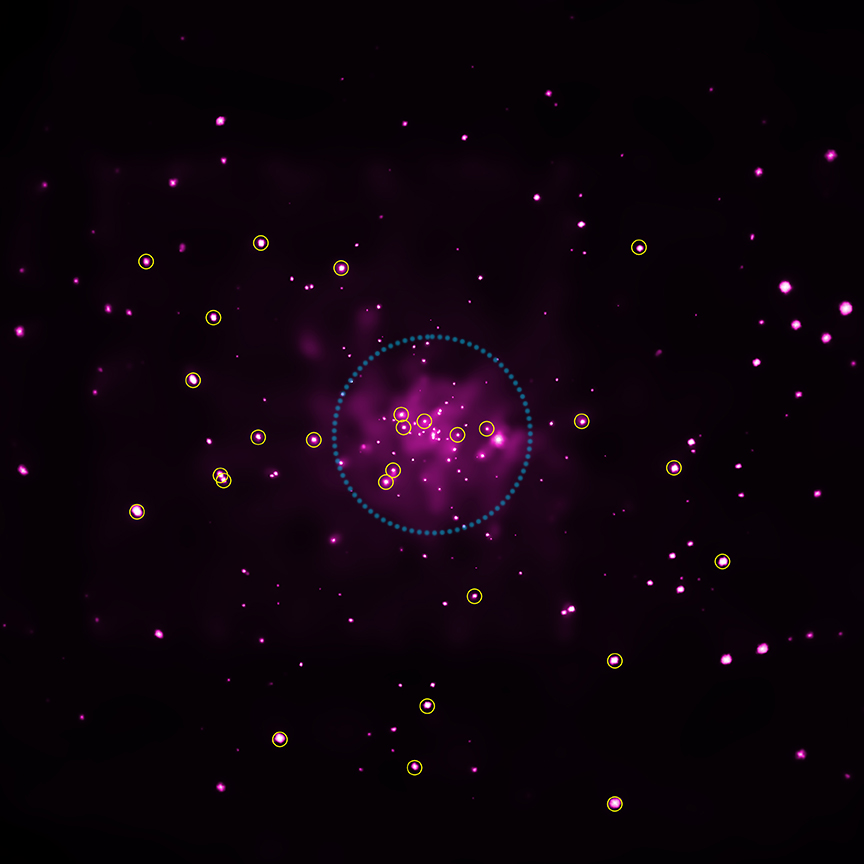
X-ray close-up
Chandra X-ray close-up of M31's core, with sources circled.
Seven of the 35 black hole candidates are within only 1,000 light years of the Andromeda Galaxy's center (mouse over the image for the dotted circle enclosing these sources). This is more than the number of black hole candidates with similar properties located near the center of our own Galaxy. This, however, does not take astronomers by surprise, since the bulge of stars in the middle of Andromeda is bigger, allowing more black holes to form.
Eight of the nine black hole candidates that were previously identified are associated with globular clusters, the ancient concentrations of stars distributed in a spherical pattern about the center of the galaxy. This also differentiates Andromeda from the Milky Way as astronomers have yet to find a similar black hole in one of the Milky Way's globular clusters.
Andromeda, also known as Messier 31 (M31), is a spiral galaxy located about 2.5 million light years away. It is thought that the Milky Way and Andromeda will collide several billion years from now. The black holes located in both galaxies will then reside in the large, elliptical galaxy that results from this merger.
These results are available online and will be published in the June 20th issue of The Astrophysical Journal. Many of the Andromeda observations were made within Chandra's Guaranteed Time Observer program.

Fast Facts for M31:
Credit  X-ray (NASA/CXC/SAO/R.Barnard, Z.Lee et al.), Optical (NOAO/AURA/NSF/REU Prog./B.Schoening, V.Harvey; Descubre Fndn./CAHA/OAUV/DSA/V.Peris)
Release Date  June 12, 2013
Scale  Optical image is 2 degrees across (about 100,000 light years); inset image is 14 arcmin across (about 12,000 light years)
Category  Normal Galaxies & Starburst Galaxies, Black Holes
Coordinates (J2000)  RA 00h 40m 27s | Dec +40° 40' 12
Constellation  Andromeda
Observation Date  152 pointings between 1999 and 2012
Observation Time  55 hours 30 min (2 days 7 hours 30 min)
Instrument  ACIS
Also Known As Andromeda
References Barnard, R. et al, 2013, ApJ 770, 148; arXiv:1304.7780
Color Code  X-ray (Purple); Optical (Red, Green, Blue)
Optical
X-ray
Distance Estimate  About 2.5 million light years
Visitor Comments (3)

Want to see more.
Posted by gray kolya on Thursday, 06.13.13 @ 09:00am

It appears to me, that, eventually all the black holes will join up
in every galaxy, with gravity being so powerful, all the galaxies
will be attracted to each other, and all the black holes will eventually
join together to form one black hole, and then BANG a new Universe.


Posted by RON on Thursday, 06.13.13 @ 08:58am

Very important information &great photos
Posted by Rajika RUwini on Thursday, 06.13.13 @ 02:49am


Andromeda Galaxy

 
Data from the NASA Chandra Xray Observatory has been used to discover 26 black hole candidates in Andromeda, the galactic neighbor to the Milky Way.

Data from NASA's Chandra X-ray Observatory have been used to discover 26 black hole candidates in the Milky Way's galactic neighbor, Andromeda, as described in our latest press release. This is the largest number of possible black holes found in a galaxy outside of our own.

A team of researchers, led by Robin Barnard of the Harvard-Smithsonian Center for Astrophysics, used 152 observations of Chandra spanning over 13 years to find the 26 new black hole candidates. Nine were known from earlier work. These black holes belong to the stellar-mass black hole category, which means they were created when a massive star collapsed and are about 5 to 10 times the mass of the Sun.

This wide-field view of Andromeda contains optical data from the Burrell Schmidt telescope of the Warner and Swansey Observatory on Kitt Peak in Arizona. Additional detail of the core and dust in the spiral arms comes from an image taken by astrophotographer Vicent Peris using data from two of his personal telescopes. In this combined optical image, red, green, and blue show different bands from the visible light portion of the electromagnetic spectrum.

The inset contains X-ray data from multiple Chandra observations of the central region of Andromeda. A larger view can be seen in the Chandra image at this link.

Seven of the 35 black hole candidates are within only 1,000 light years of the Andromeda Galaxy's center. This is more than the number of black hole candidates with similar properties located near the center of our own Galaxy. This, however, does not take astronomers by surprise, since the bulge of stars in the middle of Andromeda is bigger, allowing more black holes to form.

Eight of the nine black hole candidates that were previously identified are associated with globular clusters, the ancient concentrations of stars distributed in a spherical pattern about the center of the galaxy. This also differentiates Andromeda from the Milky Way as astronomers have yet to find a similar black hole in one of the Milky Way's globular clusters.

Andromeda, also known as Messier 31 (M31), is a spiral galaxy located about 2.5 million light years away. It is thought that the Milky Way and Andromeda will collide several billion years from now. The black holes located in both galaxies will then reside in the large, elliptical galaxy that results from this merger.

These results are available online and will be published in the June 20th issue of The Astrophysical Journal. Many of the Andromeda observations were made within Chandra's Guaranteed Time Observer program.

Credits: X-ray: NASA/CXC/SAO/R. Barnard, Z. Lee et al.; Optical: NOAO/AURA/NSF/REU Program/B. Schoening, V. Harvey and Descubre Foundation/CAHA/OAUV/DSA/V. Peris

› Read more/access all images
› Chandra's Flickr photoset
 NASA
Guillermo Gonzalo Sánchez Achutegui
ayabaca@gmail.com
ayabaca@hotmail.com
ayabaca@yahoo.com
Inscríbete en el Foro del blog y participa : A Vuelo De Un Quinde - El Foro!

NASA - NASA's Chandra Turns Up Black Hole Bonanza in Galaxy Next Door


Data from the NASA Chandra Xray Observatory has been used to discover 26 black hole candidates in Andromeda, the galactic neighbor to the Milky Way. 
Data from NASA's Chandra X-ray Observatory has been used to discover 26 black hole candidates in the Milky Way's galactic neighbor, Andromeda. (X-ray: NASA/CXC/SAO/R. Barnard, Z. Lee et al.; Optical: NOAO/AURA/NSF/REU Program/B. Schoening, V. Harvey and Descubre Foundation/CAHA/OAUV/DSA/V. Peris)
View large image 

  Using data from NASA's Chandra X-ray Observatory, astronomers have discovered an unprecedented bonanza of black holes in the Andromeda Galaxy, one of the nearest galaxies to the Milky Way.

Using more than 150 Chandra observations, spread over 13 years, researchers identified 26 black hole candidates, the largest number to date, in a galaxy outside our own. Many consider Andromeda to be a sister galaxy to the Milky Way. The two ultimately will collide, several billion years from now.

"While we are excited to find so many black holes in Andromeda, we think it's just the tip of the iceberg," said Robin Barnard of Harvard-Smithsonian Center for Astrophysics (CfA) in Cambridge, Mass., and lead author of a new paper describing these results. "Most black holes won't have close companions and will be invisible to us."

The black hole candidates belong to the stellar mass category, meaning they formed in the death throes of very massive stars and typically have masses five to 10 times that of our sun. Astronomers can detect these otherwise invisible objects as material is pulled from a companion star and heated up to produce radiation before it disappears into the black hole.

The first step in identifying these black holes was to make sure they were stellar mass systems in the Andromeda Galaxy itself, rather than supermassive black holes at the hearts of more distant galaxies. To do this, the researchers used a new technique that draws on information about the brightness and variability of the X-ray sources in the Chandra data. In short, the stellar mass systems change much more quickly than the supermassive black holes.

To classify those Andromeda systems as black holes, astronomers observed that these X-ray sources had special characteristics: that is, they were brighter than a certain high level of X-rays and also had a particular X-ray color. Sources containing neutron stars, the dense cores of dead stars that would be the alternate explanation for these observations, do not show both of these features simultaneously. But sources containing black holes do.

The European Space Agency's XMM-Newton X-ray observatory added crucial support for this work by providing X-ray spectra, the distribution of X-rays with energy, for some of the black hole candidates. The spectra are important information that helps determine the nature of these objects.

"By observing in snapshots covering more than a dozen years, we are able to build up a uniquely useful view of M31," said co-author Michael Garcia, also of CfA. "The resulting very long exposure allows us to test if individual sources are black holes or neutron stars."

The research group previously identified nine black hole candidates within the region covered by the Chandra data, and the present results increase the total to 35. Eight of these are associated with globular clusters, the ancient concentrations of stars distributed in a spherical pattern about the center of the galaxy. This also differentiates Andromeda from the Milky Way as astronomers have yet to find a similar black hole in one of the Milky Way's globular clusters.

Seven of these black hole candidates are within 1,000 light-years of the Andromeda Galaxy's center. That is more than the number of black hole candidates with similar properties located near the center of our own galaxy. This is not a surprise to astronomers because the bulge of stars in the middle of Andromeda is bigger, allowing more black holes to form.

"When it comes to finding black holes in the central region of a galaxy, it is indeed the case where bigger is better," said co-author Stephen Murray of Johns Hopkins University and CfA. "In the case of Andromeda we have a bigger bulge and a bigger supermassive black hole than in the Milky Way, so we expect more smaller black holes are made there as well."

This new work confirms predictions made earlier in the Chandra mission about the properties of X-ray sources near the center of M31. Earlier research by Rasmus Voss and Marat Gilfanov of the Max Planck Institute for Astrophysics in Garching, Germany, used Chandra to show there was an unusually large number of X-ray sources near the center of M31. They predicted most of these extra X-ray sources would contain black holes that had encountered and captured low mass stars. This new detection of seven black hole candidates close to the center of M31 gives strong support to these claims.

"We are particularly excited to see so many black hole candidates this close to the center, because we expected to see them and have been searching for years," said Barnard.

These results will be published in the June 20 issue of The Astrophysical Journal. Many of the Andromeda observations were made within Chandra's Guaranteed Time Observer program.

NASA's Marshall Space Flight Center in Huntsville, Ala., manages the Chandra Program for NASA's Science Mission Directorate in Washington. The Smithsonian Astrophysical Observatory controls Chandra's science and flight operations from Cambridge, Mass.

For Chandra images, multimedia and related materials, visit:

http://www.nasa.gov/chandra

For an additional interactive image, podcast, and video on the finding, visit:

http://chandra.si.edu


J.D. Harrington, 202-358-0321
Headquarters, Washington
j.d.harrington@nasa.gov

Janet Anderson, 256-544-0034
Marshall Space Flight Center, Huntsville, Ala.
janet.l.anderson@nasa.gov

Megan Watzke 617-496-7998
Chandra X-ray Center, Cambridge, Mass.
mwatzke@cfa.harvard.edu
NASA
Guillermo Gonzalo Sánchez Achutegui
ayabaca@gmail.com
ayabaca@hotmail.com
ayabaca@yahoo.com
Inscríbete en el Foro del blog y participa : A Vuelo De Un Quinde - El Foro!

domingo, 5 de mayo de 2013

NASA - Herschel Completes Its 'Cool' Journey in Space

Hi My Friends:  A VUELO DE UN QUINDE EL BLOG., We have received of  NASA..... on the formation of planets, stars and galaxies in conditions of a lot of cold. Realized by the telescope...The Herschel observatory.
We invite the reader to read the original version...of  NASA
 
Andromeda galaxy
Andromeda, also known as M31, is the nearest major galaxy to our own Milky Way. Sensitive to infrared light from cool dust mixed in with the gas, Herschel seeks out clouds of gas where stars are born. Andromeda is host to several hundred billion stars, and this Herschel image clearly shows that many more will soon spark into existence. Image credit: ESA/Herschel/PACS & SPIRE Consortium, O. Krause, HSC, H. Linz › Full image and caption › Image gallery
Large Magellanic Cloud galaxy in infrared light 
The Large Magellanic Cloud galaxy is captured in this stunning infrared view from Herschel and NASA's Spitzer Space Telescope. This nearby "dwarf" galaxy looks like a fiery circular explosion. The ribbons are actually giant ripples of dust, spanning tens or hundreds of light-years. Image credit: ESA/NASA/JPL-Caltech/STScI
› Full image and caption

Orion's rainbow of infrared light 
This view of the Orion nebula, taken by the Herschel and Spitzer space telescopes, highlights fledgling stars hidden in the gas and dust clouds. In several hundred thousand years, some of these dense clumps of dust and gas will gather enough material to trigger nuclear fusion at their cores and blaze into stardom. Image credit: NASA/ESA/JPL-Caltech/IRAM
› Full image and caption

Centaurus A in Infrared and X-Rays 
This composite image of the peculiar galaxy Centaurus A shows longer-infrared wavelengths captured by Herschel and X-rays from the European Space Agency's XMM-Newton. The inner structural and jet features are helping scientists understand the mechanisms and interactions within the galaxy. Image credit: Far-infrared: ESA/Herschel/PACS/SPIRE/C.D. Wilson, MacMaster University, Canada; X-ray: ESA/XMM-Newton/EPIC
› Full image and caption

Dense filaments of gas in the IC5146 interstellar cloud 
Dense filaments of gas in this space cloud, called IC5146, are seen clearly in Herschel's infrared view. Herschel has revealed that clouds between stars contain networks of these tangled gaseous filaments, stretching for tens of light-years through space, and that the filaments may result from interstellar sonic booms throughout our Milky Way galaxy. Image credit: ESA/Herschel/SPIRE/PACS/D. Arzoumanian (CEA Saclay)
› Full image and caption
PASADENA, Calif. -- The Herschel observatory, a European space telescope for which NASA helped build instruments and process data, has stopped making observations after running out of liquid coolant as expected.

The European Space Agency mission, launched almost four years ago, revealed the universe's "coolest" secrets by observing the frigid side of planet, star and galaxy formation.

"Herschel gave us the opportunity to peer into the dark and cold regions of the universe that are invisible to other telescopes," said John Grunsfeld, associate administrator for NASA's Science Mission Directorate at NASA headquarters in Washington. "This successful mission demonstrates how NASA and ESA can work together to tackle unsolved mysteries in astronomy."

Confirmation the helium is exhausted came today, at the beginning of the spacecraft's daily communication session with its ground station in Western Australia. A clear rise in temperatures was measured in all of Herschel's instruments.

Herschel launched aboard an Ariane 5 rocket from French Guiana in May 2009. NASA's Jet Propulsion Laboratory in Pasadena, Calif., built components for two of Herschel's three science instruments. NASA also supports the U.S. astronomical community through the agency's Herschel Science Center, located at the California Institute of Technology's Infrared Processing and Analysis Center in Pasadena.

Herschel's detectors were designed to pick up the glow from celestial objects with infrared wavelengths as long as 625 micrometers, which is 1,000 times longer than what we can see with our eyes. Because heat interferes with these devices, they were chilled to temperatures as low as 2 kelvins (minus 271 degrees Celsius, or 456 Fahrenheit) using liquid helium. The detectors also were kept cold by the spacecraft's orbit, which is around a stable point called the second Lagrange point about 930,000 miles (1.5 million kilometers) from Earth. This location gave Herschel a better view of the universe.

"Herschel has improved our understanding of how new stars and planets form, but has also raised many new questions," said Paul Goldsmith, NASA Herschel project scientist at JPL. "Astronomers will be following up on Herschel's discoveries with ground-based and future space-based observatories for years to come."

The mission will not be making any more observations, but discoveries will continue. Astronomers still are looking over the data, much of which already is public and available through NASA's Herschel Science Center. The final batch of data will be public in about six months.

"Our goal is to help the U.S. community exploit the nuggets of gold that lie in that data archive," said Phil Appleton, project scientist at the science center.

Highlights of the mission include:

-- Discovering long, filamentary structures in space, dotted with dense star-making knots of material.

-- Detecting definitively, for the first time, oxygen molecules in space, in addition to other never-before-seen molecules. By mapping the molecules in different regions, researchers are learning more about the life cycles of stars and planets and the origins of life.

-- Discovering high-speed outflows around central black holes in active galaxies, which may be clearing out surrounding regions and suppressing future star formation.

-- Opening new views on extremely distant galaxies that could be seen only with Herschel, and providing new information about their high rates of star formation.

-- Following the trail of water molecules from distant galaxies to the clouds of gas between stars to planet-forming solar systems.

-- Examining a comet in our own solar system and finding evidence comets could have brought a substantial fraction of water to Earth.

-- Together with NASA's Spitzer Space Telescope, discovering a large asteroid belt around the bright star Vega.

Other findings from the mission include the discovery of some of the youngest stars ever seen in the nearby Orion "cradle," and a peculiar planet-forming disk of material surrounding the star TW Hydra, indicating planet formation may happen over longer periods of time than expected. Herschel also has shown stars interact with their environment in many surprising ways, including leaving trails as they move through clouds of gas and dust.

More information is online at
 and
NASA
Guillermo Gonzalo Sánchez Achutegui

jueves, 31 de mayo de 2012

Astronomy: NASA'S Hubble Shows Milky Way is Destined for Head-on Collision

Hi My Friends: A VUELO DE UN QUINDE EL BLOG., NASA astronomers announced Thursday they can now predict with certainty the next major cosmic event to affect our galaxy, sun, and solar system: the titanic collision of our Milky Way galaxy with the neighboring Andromeda galaxy.

The Milky Way is destined to get a major makeover during the encounter, which is predicted to happen four billion years from now. It is likely the sun will be flung into a new region of our galaxy, but our Earth and solar system are in no danger of being destroyed.
 This illustration shows a stage in the predicted merger between our Milky Way galaxy and the neighboring Andromeda galaxy, as it will unfold over the next several billion years. In this image, representing Earth's night sky in 3.75 billion years, Andromeda (left) fills the field of view and begins to distort the Milky Way with tidal pull. (Credit: NASA; ESA; Z. Levay and R. van der Marel, STScI; T. Hallas; and A. Mellinger)
› Larger image


"Our findings are statistically consistent with a head-on collision between the Andromeda galaxy and our Milky Way galaxy," said Roeland van der Marel of the Space Telescope Science Institute (STScI) in Baltimore.

The solution came through painstaking NASA Hubble Space Telescope measurements of the motion of Andromeda, which also is known as M31. The galaxy is now 2.5 million light-years away, but it is inexorably falling toward the Milky Way under the mutual pull of gravity between the two galaxies and the invisible dark matter that surrounds them both.
This illustration shows the collision paths of our Milky Way galaxy and the Andromeda galaxy. The galaxies are moving toward each other under the inexorable pull of gravity between them. Also shown is a smaller galaxy, Triangulum, which may be part of the smashup. (Credit: NASA; ESA; A. Feild and R. van der Marel, STScI)
› Larger image


The universe is expanding and accelerating, and collisions between galaxies in close proximity to each other still happen because they are bound by the gravity of the dark matter surrounding them. The Hubble Space Telescope's deep views of the universe show such encounters between galaxies were more common in the past when the universe was smaller.

A century ago astronomers did not realize that M31 was a separate galaxy far beyond the stars of the Milky Way. Edwin Hubble measured its vast distance by uncovering a variable star that served as a "milepost marker."

Hubble went on to discover the expanding universe where galaxies are rushing away from us, but it has long been known that M31 is moving toward the Milky Way at about 250,000 miles per hour. That is fast enough to travel from here to the moon in one hour. The measurement was made using the Doppler effect, which is a change in frequency and wavelength of waves produced by a moving source relative to an observer, to measure how starlight in the galaxy has been compressed by Andromeda's motion toward us.

Previously, it was unknown whether the far-future encounter will be a miss, glancing blow, or head-on smashup. This depends on M31’s tangential motion. Until now, astronomers had not been able to measure M31's sideways motion in the sky, despite attempts dating back more than a century. The Hubble Space Telescope team, led by van der Marel, conducted extraordinarily precise observations of the sideways motion of M31 that remove any doubt that it is destined to collide and merge with the Milky Way.

"This was accomplished by repeatedly observing select regions of the galaxy over a five- to seven-year period," said Jay Anderson of STScI.

"In the worst-case-scenario simulation, M31 slams into the Milky Way head-on and the stars are all scattered into different orbits," said Gurtina Besla of Columbia University in New York, N.Y. "The stellar populations of both galaxies are jostled, and the Milky Way loses its flattened pancake shape with most of the stars on nearly circular orbits. The galaxies' cores merge, and the stars settle into randomized orbits to create an elliptical-shaped galaxy."
 This series of photo illustrations shows the predicted merger between our Milky Way galaxy and the neighboring Andromeda galaxy.
  • First Row, Left: Present day.
  • First Row, Right: In 2 billion years the disk of the approaching Andromeda galaxy is noticeably larger.
  • Second Row, Left: In 3.75 billion years Andromeda fills the field of view.
  • Second Row, Right: In 3.85 billion years the sky is ablaze with new star formation.
  • Third Row, Left: In 3.9 billion years, star formation continues.
  • Third Row, Right: In 4 billion years Andromeda is tidally stretched and the Milky Way becomes warped.
  • Fourth Row, Left: In 5.1 billion years the cores of the Milky Way and Andromeda appear as a pair of bright lobes.
  • Fourth Row, Right: In 7 billion years the merged galaxies form a huge elliptical galaxy, its bright core dominating the nighttime sky.
(Credit: NASA; ESA; Z. Levay and R. van der Marel, STScI; T. Hallas, and A. Mellinger)
› Larger image


The space shuttle servicing missions to Hubble upgraded it with ever more-powerful cameras, which have given astronomers a long-enough time baseline to make the critical measurements needed to nail down M31's motion. The Hubble observations and the consequences of the merger are reported in three papers that will appear in an upcoming issue of the Astrophysical Journal.

For more images, video and information about M31's collision with the Milky Way, visit: http://hubblesite.org/news/2012/20

 NASA'S Hubble Shows Milky Way is Destined for Head-on Collision
 
 
WASHINGTON -- NASA astronomers announced Thursday they can now predict with certainty the next major cosmic event to affect our galaxy, sun, and solar system: the titanic collision of our Milky Way galaxy with the neighboring Andromeda galaxy.

The Milky Way is destined to get a major makeover during the encounter, which is predicted to happen four billion years from now. It is likely the sun will be flung into a new region of our galaxy, but our Earth and solar system are in no danger of being destroyed.

"Our findings are statistically consistent with a head-on collision between the Andromeda galaxy and our Milky Way galaxy," said Roeland van der Marel of the Space Telescope Science Institute (STScI) in Baltimore.

The solution came through painstaking NASA Hubble Space Telescope measurements of the motion of Andromeda, which also is known as M31. The galaxy is now 2.5 million light-years away, but it is inexorably falling toward the Milky Way under the mutual pull of gravity between the two galaxies and the invisible dark matter that surrounds them both.

"After nearly a century of speculation about the future destiny of Andromeda and our Milky Way, we at last have a clear picture of how events will unfold over the coming billions of years," said Sangmo Tony Sohn of STScI.

The scenario is like a baseball batter watching an oncoming fastball. Although Andromeda is approaching us more than two thousand times faster, it will take 4 billion years before the strike.

Computer simulations derived from Hubble's data show that it will take an additional two billion years after the encounter for the interacting galaxies to completely merge under the tug of gravity and reshape into a single elliptical galaxy similar to the kind commonly seen in the local universe.

Although the galaxies will plow into each other, stars inside each galaxy are so far apart that they will not collide with other stars during the encounter. However, the stars will be thrown into different orbits around the new galactic center. Simulations show that our solar system will probably be tossed much farther from the galactic core than it is today.

To make matters more complicated, M31's small companion, the Triangulum galaxy, M33, will join in the collision and perhaps later merge with the M31/Milky Way pair. There is a small chance that M33 will hit the Milky Way first.

The universe is expanding and accelerating, and collisions between galaxies in close proximity to each other still happen because they are bound by the gravity of the dark matter surrounding them. The Hubble Space Telescope's deep views of the universe show such encounters between galaxies were more common in the past when the universe was smaller.

A century ago astronomers did not realize that M31 was a separate galaxy far beyond the stars of the Milky Way. Edwin Hubble measured its vast distance by uncovering a variable star that served as a "milepost marker."

Hubble went on to discover the expanding universe where galaxies are rushing away from us, but it has long been known that M31 is moving toward the Milky Way at about 250,000 miles per hour. That is fast enough to travel from here to the moon in one hour. The measurement was made using the Doppler effect, which is a change in frequency and wavelength of waves produced by a moving source relative to an observer, to measure how starlight in the galaxy has been compressed by Andromeda's motion toward us.

Previously, it was unknown whether the far-future encounter will be a miss, glancing blow, or head-on smashup. This depends on M31’s tangential motion. Until now, astronomers had not been able to measure M31's sideways motion in the sky, despite attempts dating back more than a century. The Hubble Space Telescope team, led by van der Marel, conducted extraordinarily precise observations of the sideways motion of M31 that remove any doubt that it is destined to collide and merge with the Milky Way.

"This was accomplished by repeatedly observing select regions of the galaxy over a five- to seven-year period," said Jay Anderson of STScI.

"In the worst-case-scenario simulation, M31 slams into the Milky Way head-on and the stars are all scattered into different orbits," said Gurtina Besla of Columbia University in New York. "The stellar populations of both galaxies are jostled, and the Milky Way loses its flattened pancake shape with most of the stars on nearly circular orbits. The galaxies' cores merge, and the stars settle into randomized orbits to create an elliptical-shaped galaxy."

The space shuttle servicing missions to Hubble upgraded it with ever more-powerful cameras, which have given astronomers a long-enough time baseline to make the critical measurements needed to nail down M31's motion. The Hubble observations and the consequences of the merger are reported in three papers that will appear in an upcoming issue of the Astrophysical Journal.

For images, video, and more information about M31's collision with the Milky Way, visit:


For more information about NASA's Hubble Space Telescope, visit:
NASA
Guillermo Gonzalo Sánchez Achutegui
 ayabaca@gmail.com
 ayabaca@hotmail.com
 ayabaca@yahoo.com
Inscríbete en el Foro del blog y participa : A Vuelo De Un Quinde - El Foro!

Mi lista de blogs