Mostrando entradas con la etiqueta The black hole. Mostrar todas las entradas

domingo, 4 de octubre de 2015

NASA : A Fresh Perspective on an Extraordinary Cluster of Galaxies .- Una perspectiva fresca en un Extraordinaria Cúmulo de Galaxias

Hola amigos: A VUELO DE UN QUINDE EL BLOG., hemos recibido información de la Agencia Espacial NASA, sobre la captación de una extraordinaria vista de un Cúmulo de Galaxias SPT-CLJ2344-4243, por el NASA's Chandra X-ray Observatory.-  Los cúmulos de galaxias son a menudo descrito por los superlativos. Después de todo, son enormes conglomerados de galaxias, gas caliente y la materia oscura y representan las estructuras más grandes del Universo mantienen unidas por la gravedad.
Los cúmulos de galaxias tienden a ser pobres en la producción de nuevas estrellas en sus centros. En general, tienen una galaxia gigante en su medio que forma estrellas a un ritmo significativamente más lento que la mayoría de las galaxias - incluyendo nuestra Vía Láctea. La galaxia central contiene un agujero negro supermasivo aproximadamente mil veces más masivo que el que está en el centro de nuestra galaxia. Sin calefacción por arrebatos de este agujero negro, las grandes cantidades de gas caliente que se encuentran en la galaxia central deben enfriar, permitiendo estrellas para formar a un alto clip. Se cree que el agujero negro central actúa como un termostato, la prevención de enfriamiento rápido de gas caliente que rodea y obstaculizar la formación de estrellas.
Moe information.............
http://www.nasa.gov/mission_pages/chandra/a-fresh-perspective-on-an-extraordinary-cluster-of-galaxies.HTML

The Phoenix Galaxy Cluster
Galaxy clusters are often described by superlatives. After all, they are huge conglomerations of galaxies, hot gas, and dark matter and represent the largest structures in the Universe held together by gravity.
Galaxy clusters tend to be poor at producing new stars in their centers. They generally have one giant galaxy in their middle that forms stars at a rate significantly slower than most galaxies – including our Milky Way. The central galaxy contains a supermassive black hole roughly a thousand times more massive than the one at the center of our galaxy. Without heating by outbursts from this black hole, the copious amounts of hot gas found in the central galaxy should cool, allowing stars to form at a high clip. It is thought that the central black hole acts as a thermostat, preventing rapid cooling of surrounding hot gas and impeding star formation.
New data provide more details on how the galaxy cluster SPT-CLJ2344-4243, nicknamed the Phoenix Cluster for the constellation in which it is found, challenges this trend. The cluster has shattered multiple records in the past: In 2012, scientists announced that the Phoenix cluster featured the highest rate of cooling hot gas and star formation ever seen in the center of a galaxy cluster, and is the most powerful producer of X-rays of all known clusters. The rate at which hot gas is cooling in the center of the cluster is also the largest ever observed.
New observations of this galaxy cluster at X-ray, ultraviolet, and optical wavelengths by NASA’s Chandra X-ray Observatory, the Hubble Space Telescope, and the Clay-Magellan telescope located in Chile, are helping astronomers better understand this remarkable object. Clay-Magellan’s optical data reveal narrow filaments from the center of the cluster where stars are forming. These massive cosmic threads of gas and dust, most of which had never been detected before, extend for 160,000 to 330,000 lights years. This is longer than the entire breadth of the Milky Way galaxy, making them the most extensive filaments ever seen in a galaxy cluster.
These filaments surround large cavities – regions with greatly reduced X-ray emission – in the hot gas. The X-ray cavities can be seen in this composite image that shows the Chandra X-ray data in blue and optical data from the Hubble Space Telescope (red, green, and blue). For the location of these “inner cavities”, mouse over the image. Astronomers think that the X-ray cavities were carved out of the surrounding gas by powerful jets of high-energy particles emanating from near a supermassive black hole in the central galaxy of the cluster. As matter swirls toward a black hole, an enormous amount of gravitational energy is released. Combined radio and X-ray observations of supermassive black holes in other galaxy clusters have shown that a significant fraction of this energy is released as jets of outbursts that can last millions of years. The observed size of the X-ray cavities indicates that the outburst that produced the cavities in SPT-CLJ2344-4243  SPT- CLJ2344-4243 was one of the most energetic such events ever recorded.
However, the central black hole in the Phoenix cluster is suffering from somewhat of an identity crisis, sharing properties with both “quasars”, very bright objects powered by material falling onto a supermassive black hole, and “radio galaxies” containing jets of energetic particles that glow in radio waves, and are also powered by giant black holes. Half of the energy output from this black hole comes via jets mechanically pushing on the surrounding gas (radio-mode), and the other half from optical, UV and X-radiation originating in an accretion disk (quasar-mode). Astronomers suggest that the black hole may be in the process of flipping between these two states.  
X-ray cavities located farther away from the center of the cluster, labeled as “outer cavities”, provide evidence for strong outbursts from the central black hole about a hundred million years ago (neglecting the light travel time to the cluster). This implies that the black hole may have been in a radio mode, with outbursts, about a hundred million years ago, then changed into a quasar mode, and then changed back into a radio mode.
It is thought that rapid cooling may have occurred in between these outbursts, triggering star formation in clumps and filaments throughout the central galaxy at a rate of about 610 solar masses per year. By comparison, only a couple of new stars form every year in our Milky Way galaxy. The extreme properties of the Phoenix cluster system are providing new insights into various astrophysical problems, including the formation of stars, the growth of galaxies and black holes, and the co-evolution of black holes and their environment.
A paper describing these results, led by Michael McDonald (Massachusetts Institute of Technology), has been accepted for publication in The Astrophysical Journal and is available online. NASA's Marshall Space Flight Center in Huntsville, Alabama, manages the Chandra program for NASA's Science Mission Directorate in Washington. The Smithsonian Astrophysical Observatory in Cambridge, Massachusetts, controls Chandra's science and flight operations. 
Image credit: X-ray: NASA/CXC/MIT/M. McDonald et al.; Optical: NASA/STScI
 
 
For more Chandra images, multimedia and related materials, visit:

Last Updated: Sept. 30, 2015
Editor: Lee Mohon
Tags:  Chandra X-Ray Observatory, Galaxies, Image of the Day,
NASA
Guillermo Gonzalo Sánchez Achutegui
Inscríbete en el Foro del blog y participa : A Vuelo De Un Quinde - El Foro!

domingo, 23 de noviembre de 2014

NASA : Swift Gamma-Ray Burst Mission Marks Ten Years of Discovery.- La Misión Swift Gamma-Ray Burst marca 10 años de descubrimientos

Hola amigos: A VUELO DE UN QUINDE  EL BLOG., hemos recibido de la Agencia Espacial NASA, la información del satélite llamado : "NASA's Swift spacecraft " que viajó a bordo del cohete Boing Delta II, que fue lanzado desde la Base Espacial Cabo Cañaveral el 20 de noviembre del 2004, cuya misión fue identificar el origen y estallido de los Rayos Gamma, que se observan como explosiones luminosas en el Cosmos; su origen se cree que se produce cuando una estrella se queda sin su combustible nuclear y colapsa bajo su propio peso; y forma lo que conocemos como los Agujeros Negros, que impulsa chorros de partículas de la estrella en colapso y estallan en el espacio casi a la velocidad de la luz.
NASA... nos dice .."El 20 de noviembre de 2004, la nave espacial Swift de la NASA despegó a bordo de un cohete Boeing Delta II desde Cabo Cañaveral, Florida., Comenzando su misión de estudiar los estallidos de rayos gamma e identificar su origen. Estallidos de rayos gamma son las explosiones más luminosas en el cosmos. La mayoría se cree que se activará cuando el núcleo de una estrella masiva se queda sin combustible nuclear, se colapsa bajo su propio peso, y forma un agujero negro. El agujero negro luego impulsa chorros de partículas que perforan todo el camino a través de la estrella en colapso y estallan al espacio a casi la velocidad de la luz..............."

Swift Gamma-Ray Burst Mission Marks Ten Years of Discovery
On Nov. 20, 2004, NASA's Swift spacecraft lifted off aboard a Boeing Delta II rocket from Cape Canaveral Air Force Station, Fla., beginning its mission to study gamma-ray bursts and identify their origins. Gamma-ray bursts are the most luminous explosions in the cosmos. Most are thought to be triggered when the core of a massive star runs out of nuclear fuel, collapses under its own weight, and forms a black hole. The black hole then drives jets of particles that drill all the way through the collapsing star and erupt into space at nearly the speed of light.
Astronomers at NASA and Pennsylvania State University used Swift to create the most detailed ultraviolet light surveys ever of the Large and Small Magellanic Clouds, the two closest major galaxies. Nearly a million ultraviolet sources appear in this mosaic of the Large Magellanic Cloud, which was assembled from 2,200 images taken by Swift's Ultraviolet/Optical Telescope (UVOT) and released on June 3, 2013. The 160-megapixel image required a cumulative exposure of 5.4 days. The image includes light from 1,600 to 3,300 angstroms -- UV wavelengths largely blocked by Earth's atmosphere -- and has an angular resolution of 2.5 arcseconds at full size. The Large Magellanic Cloud is about 14,000 light-years across.
Viewing in the ultraviolet allows astronomers to suppress the light of normal stars like the sun, which are not very bright at such higher energies, and provides a clearer picture of the hottest stars and star-formation regions. No telescope other than UVOT can produce such high-resolution wide-field multicolor surveys in the ultraviolet.
Pennsylvania State University manages the Swift Mission Operations Center, which controls Swift's science and flight operations. Goddard manages Swift, which was launched in November 2004. The satellite is operated in collaboration with Penn State, the Los Alamos National Laboratory in New Mexico and Orbital Sciences Corp. in Dulles, Va. International collaborators are in the United Kingdom and Italy, and the mission includes contributions from Germany and Japan.
Image Credit: NASA/Swift/S. Immler (Goddard) and M. Siegel (Penn State)
NASA
Guillermo Gonzalo Sánchez Achutegui
Inscríbete en el Foro del blog y participa : A Vuelo De Un Quinde - El Foro!

domingo, 21 de septiembre de 2014

NASA : Hubble Helps Find Smallest Known Galaxy Containing a Supermassive Black Hole


Artist's View of M60-UCD1 Black Hole
Image Credit: 
NASA, ESA, STScI-PRC14-41a
 
Astronomers using data from NASA’s Hubble Space Telescope and ground observation have found an unlikely object in an improbable place -- a monster black hole lurking inside one of the tiniest galaxies ever known.

The black hole is five times the mass of the one at the center of our Milky Way galaxy. It is inside one of the densest galaxies known to date -- the M60-UCD1 dwarf galaxy that crams 140 million stars within a diameter of about 300 light-years, which is only 1/500th of our galaxy’s diameter.
If you lived inside this dwarf galaxy, the night sky would dazzle with at least 1 million stars visible to the naked eye. Our nighttime sky as seen from Earth’s surface shows 4,000 stars.
The finding implies there are many other compact galaxies in the universe that contain supermassive black holes. The observation also suggests dwarf galaxies may actually be the stripped remnants of larger galaxies that were torn apart during collisions with other galaxies rather than small islands of stars born in isolation.
“We don’t know of any other way you could make a black hole so big in an object this small,” said University of Utah astronomer Anil Seth, lead author of an international study of the dwarf galaxy published in Thursday’s issue of the journal Nature.
Seth’s team of astronomers used the Hubble Space Telescope and the Gemini North 8-meter optical and infrared telescope on Hawaii’s Mauna Kea to observe M60-UCD1 and measure the black hole’s mass. The sharp Hubble images provide information about the galaxy’s diameter and stellar density. Gemini measures the stellar motions as affected by the black hole’s pull. These data are used to calculate the mass of the black hole.
Black holes are gravitationally collapsed, ultra-compact objects that have a gravitational pull so strong that even light cannot escape. Supermassive black holes -- those with the mass of at least one million stars like our sun -- are thought to be at the centers of many galaxies.
The black hole at the center of our Milky Way galaxy has the mass of four million suns. As heavy as that is, it is less than 0.01 percent of the Milky Way’s total mass. By comparison, the supermassive black hole at the center of M60-UCD1, which has the mass of 21 million suns, is a stunning 15 percent of the small galaxy’s total mass.
“That is pretty amazing, given that the Milky Way is 500 times larger and more than 1,000 times heavier than the dwarf galaxy M60-UCD1,” Seth said.
One explanation is that M60-UCD1 was once a large galaxy containing 10 billion stars, but then it passed very close to the center of an even larger galaxy, M60, and in that process all the stars and dark matter in the outer part of the galaxy were torn away and became part of M60.
The team believes that M60-UCD1 may eventually be pulled to fully merge with M60, which has its own monster black hole that weighs a whopping 4.5 billion solar masses, or more than 1,000 times bigger than the black hole in our galaxy. When that happens, the black holes in both galaxies also likely will merge. Both galaxies are 50 million light-years away.
The Hubble Space Telescope is a project of international cooperation between NASA and the European Space Agency. NASA's Goddard Space Flight Center in Greenbelt, Maryland, manages the telescope. The Space Telescope Science Institute (STScI) in Baltimore conducts Hubble science operations. STScI is operated for NASA by the Association of Universities for Research in Astronomy, Inc., in Washington.
For images and more information about Hubble, visit:
NASA
Guillermo Gonzalo Sánchez Achutegui
Inscríbete en el Foro del blog y participa : A Vuelo De Un Quinde - El Foro!

sábado, 21 de junio de 2014

NASA : Swiftly Moving Gas Streamer Eclipses Supermassive Black Hole


galaxy NGC 5548
In this illustration, the position of a dark, absorbing cloud of material is located high above the supermassive black hole and accretion disk in the center of the active galaxy NGC 5548. Numerous other filaments twist around the black hole as they are swept away by a torrent of radiation "winds."
Image Credit: NASA, ESA, and A. Feild (STScI)
 
An international team of astronomers, using data from several NASA and European Space Agency (ESA) space observatories, has discovered unexpected behavior from the supermassive black hole at the heart of the galaxy NGC 5548, located 244.6 million light-years from Earth. This behavior may provide new insights into how supermassive black holes interact with their host galaxies.
Immediately after NASA's Hubble Space Telescope observed NGC 5548 in June 2013, this international research team discovered unexpected features in the data. They detected a stream of gas flowing rapidly outward from the galaxy's supermassive black hole, blocking 90 percent of its emitted X-rays.
"The data represented dramatic changes since the last observation with Hubble in 2011," said Gerard Kriss of the Space Telescope Science Institute (STScI) in Baltimore, Maryland. "I saw signatures of much colder gas than was present before, indicating that the wind had cooled down due to a significant decrease in X-ray radiation from the galaxy's nucleus."
The discovery was made during an intensive observing campaign that also included data from NASA's Swift spacecraft, Nuclear Spectroscopic Telescope Array (NuSTAR) and Chandra X-ray Observatory, as well as ESA's X-ray Multi-Mirror Mission (XMM-Newton) and Integral gamma-ray observatory (INTEGRAL).
After combining and analyzing data from all six sources, the team was able to put together the pieces of the puzzle. Supermassive black holes in the nuclei of active galaxies, such as NGC 5548, expel large amounts of matter through powerful winds of ionized gas. For instance, the persistent wind of NGC 5548 reaches velocities exceeding 621 miles (approximately 1,000 kilometers) a second. But now a new wind has arisen, much stronger and faster than the persistent wind.
"These new winds reach speeds of up to 3,107 miles (5,000 kilometers) per second, but is much closer to the nucleus than the persistent wind," said lead scientist Jelle Kaastra of the SRON Netherlands Institute for Space Research. "The new gas outflow blocks 90 percent of the low-energy X-rays that come from very close to the black hole, and it obscures up to a third of the region that emits the ultraviolet radiation at a few light-days distance from the black hole."
The newly discovered gas stream in NGC 5548 -- one of the best-studied of the type of galaxy know as Type I Seyfert -- provides the first direct evidence of a shielding process that accelerates the powerful gas streams, or winds, to high speeds. These winds only occur if their starting point is shielded from X-rays.
It appears the shielding in NGC 5548 has been going on for at least three years, but just recently began crossing their line of sight.
"There are other galaxies with similar streams of gas flowing outward from the direction of its central black hole, but we've never before found evidence that the stream of gas changed its position as dramatically as this one has," said Kriss. "This is the first time we've seen a stream like this move into our line of sight. We got lucky."
Researchers also deduced that in more luminous quasars, the winds may be strong enough to blow off gas that otherwise would have become "food" for the black hole, thereby regulating both the growth of the black hole and that of its host galaxy.
These results are being published online in the Thursday issue of Science Express.
The Hubble Space Telescope is a project of international cooperation between NASA and the European Space Agency. NASA's Goddard Space Flight Center in Greenbelt, Maryland, manages the telescope. STScI conducts Hubble science operations and is operated for NASA by the Association of Universities for Research in Astronomy, Inc., in Washington.
For images and more information about Hubble, visit:
NASA
Guillermo Gonzalo Sánchez Achutegui

sábado, 8 de marzo de 2014

NASA : Chandra and XMM-Newton Provide Direct Measurement of Distant Black Hole's Spin


Multiple images of a distant quasar known as RX J1131-1231 are visible in this combined view from Chandra (pink) and Hubble (red, green, and blue)
Multiple images of a distant quasar known as RX J1131-1231 are visible in this combined view from Chandra (pink) and Hubble (red, green, and blue).
Image Credit: NASA/CXC/Univ of Michigan/R.C.Reis et al; Optical: NASA/STSc
Astronomers have used NASA's Chandra X-ray Observatory and the European Space Agency's (ESA's) XMM-Newton to show a supermassive black hole six billion light years from Earth is spinning extremely rapidly. This first direct measurement of the spin of such a distant black hole is an important advance for understanding how black holes grow over time.

Black holes are defined by just two simple characteristics: mass and spin. While astronomers have long been able to measure black hole masses very effectively, determining their spins has been much more difficult.
In the past decade, astronomers have devised ways of estimating spins for black holes at distances greater than several billion light-years away, meaning we see the region around black holes as they were billions of years ago. However, determining the spins of these remote black holes involves several steps that rely on one another.
"We want to be able to cut out the middle man, so to speak, of determining the spins of black holes across the universe," said Rubens Reis of the University of Michigan in Ann Arbor, who led a paper describing this result that was published online Wednesday in the journal Nature.
Reis and his colleagues determined the spin of the supermassive black hole that is pulling in surrounding gas, producing an extremely luminous quasar known as RX J1131-1231 (RX J1131 for short). Because of fortuitous alignment, the distortion of space-time by the gravitational field of a giant elliptical galaxy along the line of sight to the quasar acts as a gravitational lens that magnifies the light from the quasar. Gravitational lensing, first predicted by Einstein, offers a rare opportunity to study the innermost region in distant quasars by acting as a natural telescope and magnifying the light from these sources.
"Because of this gravitational lens, we were able to get very detailed information on the X-ray spectrum – that is, the amount of X-rays seen at different energies – from RX J1131," said co-author Mark Reynolds also of Michigan. "This in turn allowed us to get a very accurate value for how fast the black hole is spinning."
The X-rays are produced when a swirling accretion disk of gas and dust that surrounds the black hole creates a multimillion-degree cloud, or corona near the black hole. X-rays from this corona reflect off the inner edge of the accretion disk. The strong gravitational forces near the black hole alter the reflected X-ray spectrum. The larger the change in the spectrum, the closer the inner edge of the disk must be to the black hole.
"We estimate that the X-rays are coming from a region in the disk located only about three times the radius of the event horizon, the point of no return for infalling matter," said Jon M. Miller of Michigan, another author on the paper. "The black hole must be spinning extremely rapidly to allow a disk to survive at such a small radius."
For example, a spinning black hole drags space around with it and allows matter to orbit closer to the black hole than is possible for a non-spinning black hole.
By measuring the spin of distant black holes researchers discover important clues about how these objects grow over time. If black holes grow mainly from collisions and mergers between galaxies, they should accumulate material in a stable disk, and the steady supply of new material from the disk should lead to rapidly spinning black holes. In contrast, if black holes grow through many small accretion episodes, they will accumulate material from random directions. Like a merry go round that is pushed both backwards and forwards, this would make the black hole spin more slowly.
The discovery that the black hole in RX J1131 is spinning at over half the speed of light suggests this black hole, observed at a distance of six billion light years, corresponding to an age about 7.7 billion years after the Big Bang, has grown via mergers, rather than pulling material in from different directions.
The ability to measure black hole spin over a large range of cosmic time should make it possible to directly study whether the black hole evolves at about the same rate as its host galaxy. The measurement of the spin of the RX J1131-1231 black hole is a major step along that path and demonstrates a technique for assembling a sample of distant supermassive black holes with current X-ray observatories.
Prior to the announcement of this work, the most distant black holes with direct spin estimates were located 2.5 billion and 4.7 billion light-years away.
NASA's Marshall Space Flight Center in Huntsville, Ala., manages the Chandra program for NASA's Science Mission Directorate in Washington. The Smithsonian Astrophysical Observatory in Cambridge, Mass., controls Chandra's science and flight operations.
For an additional interactive image, podcast, and video on the finding, visit:
For Chandra images, multimedia and related materials, visit:
NASA
Guillermo Gonzalo Sánchez Achutegui

viernes, 24 de enero de 2014

NASA: Extreme Power of Black Hole Revealed


Extreme Power of Black Hole Revealed
Astronomers have used NASA's Chandra X-ray Observatory and a suite of other telescopes to reveal one of the most powerful black holes known. The black hole has created enormous structures in the hot gas surrounding it and prevented trillions of stars from forming.
The black hole is in a galaxy cluster named RX J1532.9+3021 (RX J1532 for short), located about 3.9 billion light years from Earth. The image here is a composite of X-ray data from Chandra revealing hot gas in the cluster in purple and optical data from the Hubble Space Telescope showing galaxies in yellow. The cluster is very bright in X-rays implying that it is extremely massive, with a mass about a quadrillion - a thousand trillion - times that of the sun. At the center of the cluster is a large elliptical galaxy containing the supermassive black hole.
The large amount of hot gas near the center of the cluster presents a puzzle. Hot gas glowing with X-rays should cool, and the dense gas in the center of the cluster should cool the fastest. The pressure in this cool central gas is then expected to drop, causing gas further out to sink in towards the galaxy, forming trillions of stars along the way. However, astronomers have found no such evidence for this burst of stars forming at the center of this cluster.
This problem has been noted in many galaxy clusters but RX J1532 is an extreme case, where the cooling of gas should be especially dramatic because of the high density of gas near the center. Out of the thousands of clusters known to date, less than a dozen are as extreme as RX J1532. The Phoenix Cluster is the most extreme, where, conversely, large numbers of stars have been observed to be forming.
What is stopping large numbers of stars from forming in RX J1532? Images from the Chandra X-ray Observatory and the NSF's Karl G. Jansky Very Large Array (VLA) have provided an answer to this question. The X-ray image shows two large cavities in the hot gas on either side of the central galaxy. The Chandra image has been specially processed to emphasize the cavities. Both cavities are aligned with jets seen in radio images from the VLA. The location of the supermassive black hole between the cavities is strong evidence that the supersonic jets generated by the black hole have drilled into the hot gas and pushed it aside, forming the cavities.
Shock fronts - akin to sonic booms - caused by the expanding cavities and the release of energy by sound waves reverberating through the hot gas provide a source of heat that prevents most of the gas from cooling and forming new stars.
The cavities are each about 100,000 light years across, roughly equal to the width of the Milky Way galaxy. The power needed to generate them is among the largest known in galaxy clusters. For example, the power is almost 10 times greater than required to create the well-known cavities in Perseus.
Although the energy to power the jets must have been generated by matter falling toward the black hole, no X-ray emission has been detected from infalling material. This result can be explained if the black hole is "ultramassive" rather than supermassive, with a mass more than 10 billion times that of the sun. Such a black hole should be able to produce powerful jets without consuming large amounts of mass, resulting in very little radiation from material falling inwards.
Another possible explanation is that the black hole has a mass only about a billion times that of the sun but is spinning extremely rapidly. Such a black hole can produce more powerful jets than a slowly spinning black hole when consuming the same amount of matter. In both explanations the black hole is extremely massive.
A more distant cavity is also seen at a different angle with respect to the jets, along a north-south direction. This cavity is likely to have been produced by a jet from a much older outburst from the black hole. This raises the question of why this cavity is no longer aligned with the jets. There are two possible explanations. Either large-scale motion of the gas in the cluster has pushed it to the side or the black hole is precessing, that is, wobbling like a spinning top.
A paper describing this work was published in the November 10th, 2013 issue of The Astrophysical Journal and is available online. The first author is Julie Hlavacek-Larrondo from Stanford University. The Hubble data used in this analysis were from the Cluster Lensing and Supernova survey, led by Marc Postman from Space Telescope Science Institute.
NASA's Marshall Space Flight Center in Huntsville, Ala., manages the Chandra program for NASA's Science Mission Directorate in Washington. The Smithsonian Astrophysical Observatory in Cambridge, Mass., controls Chandra's science and flight operations.
Image credit: X-ray: NASA/CXC/Stanford/J.Hlavacek-Larrondo et al, Optical:                                  NASA/ESA/STScI/M.Postman & CLASH team
NASA
Guillermo Gonzalo Sánchez Achutegui

sábado, 11 de enero de 2014

NASA : Dwarf Galaxy, Galaxy Cluster Abell 1795


Dwarf Galaxy, Galaxy Cluster Abell 1795
A bright, long duration flare may be the first recorded event of a black hole destroying a star in a dwarf galaxy, as reported in our latest press release. The dwarf galaxy is located in the galaxy cluster Abell 1795, about 800 million light years from Earth. A composite image of the cluster shows Chandra X-ray Observatory data in blue and optical data from the Canada-France-Hawaii Telescope in red, green and blue. An inset centered on the dwarf galaxy shows Chandra data taken between 1999 and 2005 on the left and Chandra data taken after 2005 on the right.
The X-ray flare in the inset provides the key evidence for stellar destruction. A star that wanders too close to a supermassive black hole should be ripped apart by extreme tidal forces. As the stellar debris falls toward the black hole, it should produce intense X-rays as it is heated to millions of degrees. The X-rays should fade as the hot gas spirals inward.
This discovery was part of an ongoing search of Chandra's archival data for such events. In the past few years, Chandra and other astronomical satellites have identified several suspected cases of a supermassive black hole ripping apart a nearby star. This newly discovered episode of cosmic, black-hole-induced violence is different because it has been associated with a much smaller galaxy than these other cases.
The black hole in this dwarf galaxy may be only a few hundred thousand times as massive as the Sun, making it ten times less massive than the Galaxy's supermassive black hole. This places it in what astronomers call an “intermediate mass black hole” category.
Astronomers believe that intermediate mass black holes may be the “seeds” that ultimately formed the supermassive black holes in the centers of galaxies like the Milky Way. Finding additional nearby examples should teach us about how these primordial galaxies from the early universe grew and evolved over cosmic time.
Two independent studies reported observations of this event. The paper led by Peter Maksym is available online and was published in the November 1st, 2013 issue of the Monthly Notices of the Royal Astronomical Society. A paper led by Davide Donato and colleagues is available online and has been accepted for publication in The Astrophysical Journal.
Image credit: X-ray: NASA/CXC/Univ. of Alabama/W.P. Maksym et al & NASA/CXC/GSFC/UMD/D. Donato, et al; Optical: CFHT

NASA
Guillermo Gonzalo Sánchez Achutegui

miércoles, 4 de diciembre de 2013

NASA : Massive Black Hole Duo: Possible Sighting by NASA's WISE


Artist's concept of two black holes
Two black holes are entwined in a gravitational tango in this artist's conception. Supermassive black holes at the hearts of galaxies are thought to form through the merging of smaller, yet still massive black holes, such as the ones depicted here.
Image Credit: NASA
Image Token:
Feature Link:
Astronomers have spotted what appear to be two supermassive black holes at the heart of a remote galaxy, circling each other like dance partners. The incredibly rare sighting was made with the help of NASA's Wide-field Infrared Survey Explorer, or WISE.

Follow-up observations with the Australian Telescope Compact Array near Narrabri, Australia, and the Gemini South telescope in Chile, revealed unusual features in the galaxy, including a lumpy jet thought to be the result of one black hole causing the jet of the other to sway.
"We think the jet of one black hole is being wiggled by the other, like a dance with ribbons," said Chao-Wei Tsai of NASA's Jet Propulsion Laboratory, Pasadena, Calif., who is lead author of a paper on the findings appearing in the Dec. 10 issue of Astrophysical Journal. "If so, it is likely the two black holes are fairly close and gravitationally entwined."
The findings could teach astronomers more about how supermassive black holes grow by merging with each other.
The WISE satellite scanned the entire sky twice in infrared wavelengths before being put into hibernation in 2011. NASA recently gave the spacecraft a second lease on life, waking it up to search for asteroids, in a project called NEOWISE.
The new study took advantage of previously released all-sky WISE data. Astronomers sifted through images of millions of actively feeding supermassive black holes spread throughout our sky before an oddball, also known as WISE J233237.05-505643.5, jumped out.
"At first we thought this galaxy's unusual properties seen by WISE might mean it was forming new stars at a furious rate," said Peter Eisenhardt, WISE project manager at NASA's Jet Propulsion Laboratory, Pasadena, Calif., and a co-author of the study. "But on closer inspection, it looks more like the death spiral of merging giant black holes."
Almost every large galaxy is thought to harbor a supermassive black hole filled with the equivalent in mass of up to billions of suns. How did the black holes grow so large? One way is by swallowing ambient materials. Another way is through galactic cannibalism. When galaxies collide, their massive black holes sink to the center of the new structure, becoming locked in a gravitational tango. Eventually, they merge into one even-more-massive black hole.
The dance of these black hole duos starts out slowly, with the objects circling each other at a distance of about a few thousand light-years. So far, only a few handfuls of supermassive black holes have been conclusively identified in this early phase of merging. As the black holes continue to spiral in toward each other, they get closer, separated by just a few light-years.
It is these close-knit black holes, also called black hole binaries, that have been the hardest to find. The objects are usually too small to be resolved even by powerful telescopes. Only a few strong candidates have been identified to date, all relatively nearby. The new WISE J233237.05-505643.5 is a new candidate, and located much farther away, at 3.8 billion light-years from Earth.
Radio images with the Australian Telescope Compact Array were key to identifying the dual nature of WISE J233237.05-505643.5. Supermassive black holes at the cores of galaxies typically shoot out pencil-straight jets, but, in this case, the jet showed a zigzag pattern. According to the scientists, a second massive black hole could, in essence, be pushing its weight around to change the shape of the other black hole's jet.
Visible-light spectral data from the Gemini South telescope in Chile showed similar signs of abnormalities, thought to be the result of one black hole causing disk material surrounding the other black hole to clump. Together, these and other signs point to what is probably a fairly close-knit set of circling black holes, though the scientists can't say for sure how much distance separates them.
"We note some caution in interpreting this mysterious system," said Daniel Stern of JPL, a co-author of the study. "There are several extremely unusual properties to this system, from the multiple radio jets to the Gemini data, which indicate a highly perturbed disk of accreting material around the black hole, or holes. Two merging black holes, which should be a common event in the universe, would appear to be simplest explanation to explain all the current observations."
The final stage of merging black holes is predicted to send gravitational waves rippling through space and time. Researchers are actively searching for these waves using arrays of dead stars called pulsars in hopes of learning more about the veiled black hole dancers (see
 
The technical paper is online at
NASA's Jet Propulsion Laboratory, Pasadena, Calif., manages and operates the WISE mission for NASA's Science Mission Directorate. The WISE mission was selected competitively under NASA's Explorers Program managed by the agency's Goddard Space Flight Center in Greenbelt, Md. The science instrument was built by the Space Dynamics Laboratory in Logan, Utah. The spacecraft was built by Ball Aerospace & Technologies Corp. in Boulder, Colo. Science operations and data processing take place at the Infrared Processing and Analysis Center at the California Institute of Technology in Pasadena. Caltech manages JPL for NASA. More information is online at http://www.nasa.gov/wise
Whitney Clavin 818-354-4673
Jet Propulsion Laboratory, Pasadena, Calif.
whitney.clavin@jpl.nasa.gov
NASA
Guillermo Gonzalo Sánchez Achutegui

viernes, 29 de noviembre de 2013

NASA : Black Holes Have Simple Feeding Habits


Black Holes Have Simple Feeding Habits
At the center of spiral galaxy M81 is a supermassive black hole about 70 million times more massive than our sun.
A study using data from Chandra and ground-based telescopes, combined with detailed theoretical models, shows that the supermassive black hole in M81 feeds just like stellar mass black holes, with masses of only about ten times that of the sun. This discovery supports Einstein's relativity theory that states black holes of all sizes have similar properties.
Image Credit: X-ray: NASA/CXC/Wisconsin/D.Pooley & CfA/A.Zezas; Optical: NASA/ESA/CfA/A.Zezas; UV: NASA/JPL-Caltech/CfA/J.Huchra et al.; IR: NASA/JPL-Caltech/CfA
NASA
Guillermo Gonzalo Sánchez Achutegui
ayabaca@gmail.com
ayabaca@hotmail.com
ayabaca@yahoo.com
Inscríbete en el Foro del blog y participa : A Vuelo De Un Quinde - El Foro!

viernes, 22 de noviembre de 2013

NASA : High-Energy Particles in Milky Way Black Hole


High-Energy Particles in Milky Way Black Hole
New evidence has been uncovered for the presence of a jet of high-energy particles blasting out of the Milky Way’s supermassive black hole. As outlined in the press release, astronomers have made the best case yet that such a jet exists by combining X-ray data from NASA’s Chandra X-ray Observatory with radio emission from the NSF’s Very Large Array (VLA). This composite image features both X-rays from Chandra (purple) and radio data from the VLA (blue).
In addition, the location of a shock front is also marked. As the jet fires away from Sgr A*, it continues to travels through in space until it hits gas several light years away. (The region around the Milky Way’s black hole has many clumps of gas and dust.) Once the jet hits, it triggers the formation of a shock front. This interaction also further accelerates electrons, that are already moving fast. This generates X-rays as the electrons stream down the path of the jet, past the shock front.
The shock front is also of interest because it is unusually wide in the radio emission compared to its more narrow profile of the jet in X-rays. This suggests that there may be a secondary, weaker outflow, which might be like a sheath or cocoon surrounding the jet with an opening angle of around 25 degrees.
Sgr A* is about 4 million times the mass of the sun and lies about 26,000 light years from Earth in the center of the galaxy. Astronomers have been looking for a jet from Sgr A* for years since it is now common to find jets tied to a range of cosmic objects on both big and small scales. Prior to this latest study, there have been reports of possible evidence of a jet associated with Sgr A*. However, these have contradicted one another and have thus not been considered definitive.
A paper describing these results is available online and will appear in an upcoming issue of The Astrophysical Journal.
Image credit: X-ray: NASA/CXC/UCLA/Z. Li et al; Radio: NRAO/VLA
NASA
Guillermo Gonzalo Sánchez Achutegui

lunes, 29 de julio de 2013

NASA - Black Hole Outburst


Black Hole Outburst
NASA's Chandra X-ray Observatory has discovered an extraordinary outburst by a black hole in the spiral galaxy M83, located about 15 million light years from Earth. Using Chandra, astronomers found a new ultraluminous X-ray source, or ULX. These objects give off more X-rays than most normal binary systems in which a companion star is in orbit around a neutron star or black hole.

Image Credit: NASA/CXC/Curtin University/R.Soria et al.
NASA
Guillermo Gonzalo Sánchez Achutegui
ayabaca@gmail.com
ayabaca@hotmail.com
ayabaca@yahoo.com
Inscríbete en el Foro del blog y participa : A Vuelo De Un Quinde - El Foro!

sábado, 15 de junio de 2013

NASA - Andromeda Galaxy


  • Twenty-six black hole candidates have been identified in Andromeda, aka M31, adding to 9 previously found.

  • This is the largest number of possible black holes to date ever found in a galaxy outside of our own Milky Way.

  • These are stellar-mass black holes, which are formed by the collapse of a giant star and have masses between five and 10 times the Sun's.

  • Researchers used over 150 separate Chandra observations spread over 13 years to obtain these results.

Data from NASA's Chandra X-ray Observatory have been used to discover 26 black hole candidates in the Milky Way's galactic neighbor, Andromeda, as described in our latest press release. This is the largest number of possible black holes found in a galaxy outside of our own.
A team of researchers, led by Robin Barnard of the Harvard-Smithsonian Center for Astrophysics, used 152 observations of Chandra spanning over 13 years to find the 26 new black hole candidates. Nine were known from earlier work. These black holes belong to the stellar-mass black hole category, which means they were created when a massive star collapsed and are about 5 to 10 times the mass of the Sun.
This wide-field view of Andromeda contains optical data from the Burrell Schmidt telescope of the Warner and Swansey Observatory on Kitt Peak in Arizona. Additional detail of the core and dust in the spiral arms comes from an image taken by astrophotographer Vicent Peris using data from two of his personal telescopes. In this combined optical image, red, green, and blue show different bands from the visible light portion of the electromagnetic spectrum.
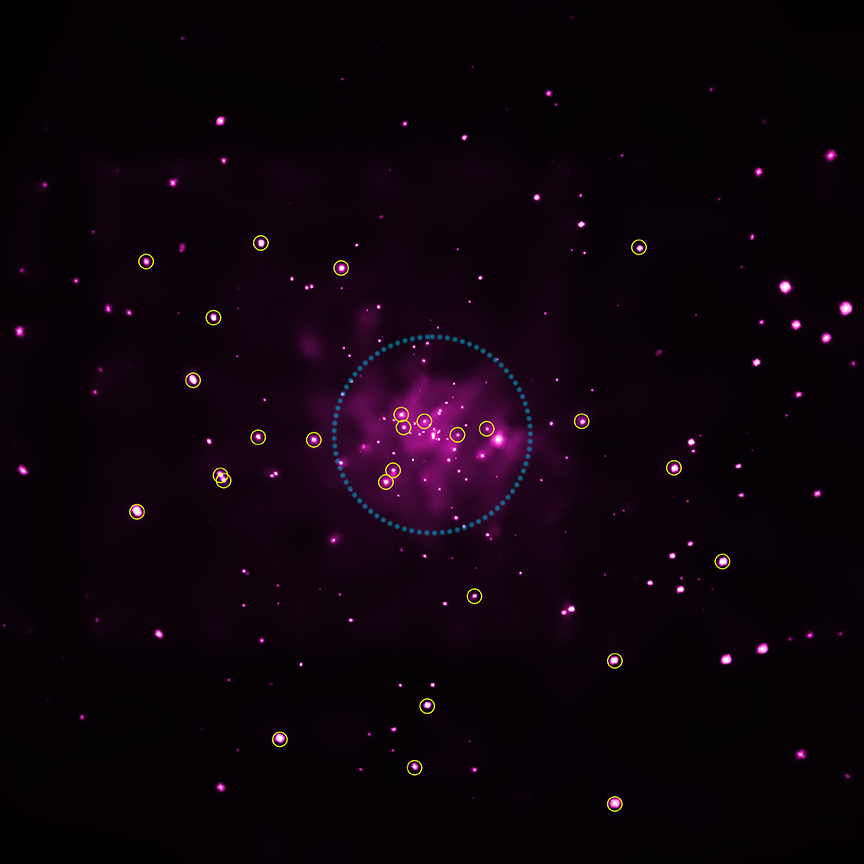
The inset contains X-ray data from multiple Chandra observations of the central region of Andromeda. This Chandra image shows 28 of the 35 black hole candidates in this view, visible by mousing over the image. The other seven candidates can be seen in this Chandra image with a larger field of view.
X-ray close-up
Chandra X-ray close-up of M31's core, with sources circled.
Seven of the 35 black hole candidates are within only 1,000 light years of the Andromeda Galaxy's center (mouse over the image for the dotted circle enclosing these sources). This is more than the number of black hole candidates with similar properties located near the center of our own Galaxy. This, however, does not take astronomers by surprise, since the bulge of stars in the middle of Andromeda is bigger, allowing more black holes to form.
Eight of the nine black hole candidates that were previously identified are associated with globular clusters, the ancient concentrations of stars distributed in a spherical pattern about the center of the galaxy. This also differentiates Andromeda from the Milky Way as astronomers have yet to find a similar black hole in one of the Milky Way's globular clusters.
Andromeda, also known as Messier 31 (M31), is a spiral galaxy located about 2.5 million light years away. It is thought that the Milky Way and Andromeda will collide several billion years from now. The black holes located in both galaxies will then reside in the large, elliptical galaxy that results from this merger.
These results are available online and will be published in the June 20th issue of The Astrophysical Journal. Many of the Andromeda observations were made within Chandra's Guaranteed Time Observer program.

Fast Facts for M31:
Credit  X-ray (NASA/CXC/SAO/R.Barnard, Z.Lee et al.), Optical (NOAO/AURA/NSF/REU Prog./B.Schoening, V.Harvey; Descubre Fndn./CAHA/OAUV/DSA/V.Peris)
Release Date  June 12, 2013
Scale  Optical image is 2 degrees across (about 100,000 light years); inset image is 14 arcmin across (about 12,000 light years)
Category  Normal Galaxies & Starburst Galaxies, Black Holes
Coordinates (J2000)  RA 00h 40m 27s | Dec +40° 40' 12
Constellation  Andromeda
Observation Date  152 pointings between 1999 and 2012
Observation Time  55 hours 30 min (2 days 7 hours 30 min)
Instrument  ACIS
Also Known As Andromeda
References Barnard, R. et al, 2013, ApJ 770, 148; arXiv:1304.7780
Color Code  X-ray (Purple); Optical (Red, Green, Blue)
Optical
X-ray
Distance Estimate  About 2.5 million light years
Visitor Comments (3)

Want to see more.
Posted by gray kolya on Thursday, 06.13.13 @ 09:00am

It appears to me, that, eventually all the black holes will join up
in every galaxy, with gravity being so powerful, all the galaxies
will be attracted to each other, and all the black holes will eventually
join together to form one black hole, and then BANG a new Universe.


Posted by RON on Thursday, 06.13.13 @ 08:58am

Very important information &great photos
Posted by Rajika RUwini on Thursday, 06.13.13 @ 02:49am


Andromeda Galaxy

 
Data from the NASA Chandra Xray Observatory has been used to discover 26 black hole candidates in Andromeda, the galactic neighbor to the Milky Way.

Data from NASA's Chandra X-ray Observatory have been used to discover 26 black hole candidates in the Milky Way's galactic neighbor, Andromeda, as described in our latest press release. This is the largest number of possible black holes found in a galaxy outside of our own.

A team of researchers, led by Robin Barnard of the Harvard-Smithsonian Center for Astrophysics, used 152 observations of Chandra spanning over 13 years to find the 26 new black hole candidates. Nine were known from earlier work. These black holes belong to the stellar-mass black hole category, which means they were created when a massive star collapsed and are about 5 to 10 times the mass of the Sun.

This wide-field view of Andromeda contains optical data from the Burrell Schmidt telescope of the Warner and Swansey Observatory on Kitt Peak in Arizona. Additional detail of the core and dust in the spiral arms comes from an image taken by astrophotographer Vicent Peris using data from two of his personal telescopes. In this combined optical image, red, green, and blue show different bands from the visible light portion of the electromagnetic spectrum.

The inset contains X-ray data from multiple Chandra observations of the central region of Andromeda. A larger view can be seen in the Chandra image at this link.

Seven of the 35 black hole candidates are within only 1,000 light years of the Andromeda Galaxy's center. This is more than the number of black hole candidates with similar properties located near the center of our own Galaxy. This, however, does not take astronomers by surprise, since the bulge of stars in the middle of Andromeda is bigger, allowing more black holes to form.

Eight of the nine black hole candidates that were previously identified are associated with globular clusters, the ancient concentrations of stars distributed in a spherical pattern about the center of the galaxy. This also differentiates Andromeda from the Milky Way as astronomers have yet to find a similar black hole in one of the Milky Way's globular clusters.

Andromeda, also known as Messier 31 (M31), is a spiral galaxy located about 2.5 million light years away. It is thought that the Milky Way and Andromeda will collide several billion years from now. The black holes located in both galaxies will then reside in the large, elliptical galaxy that results from this merger.

These results are available online and will be published in the June 20th issue of The Astrophysical Journal. Many of the Andromeda observations were made within Chandra's Guaranteed Time Observer program.

Credits: X-ray: NASA/CXC/SAO/R. Barnard, Z. Lee et al.; Optical: NOAO/AURA/NSF/REU Program/B. Schoening, V. Harvey and Descubre Foundation/CAHA/OAUV/DSA/V. Peris

› Read more/access all images
› Chandra's Flickr photoset
 NASA
Guillermo Gonzalo Sánchez Achutegui
ayabaca@gmail.com
ayabaca@hotmail.com
ayabaca@yahoo.com
Inscríbete en el Foro del blog y participa : A Vuelo De Un Quinde - El Foro!

Mi lista de blogs