Mostrando entradas con la etiqueta Nitrogen. Mostrar todas las entradas

domingo, 13 de agosto de 2017

the National Science Foundation(NSF) : Projected precipitation increases are bad news for water quality .- Los aumentos proyectados de la precipitación son malas noticias para la calidad del agua..

https://www.nsf.gov/news/news_summ.jsp?cntn_id=242494&WT.mc_id=USNSF_51&WT.mc_ev=click

More rainfall would lead to more algae blooms, dead zones
An extensive algae bloom in Lake Erie in August, 2011 resulted from record-breaking nutrient loads.

An extensive algae bloom in Lake Erie in August, 2011 resulted from record-breaking nutrient loads.
Credit and Larger Version

July 27, 2017

Increased precipitation from a changing climate could pollute U.S. waterways with excess nitrogen, increasing the likelihood of severe water quality impairment from coast to coast, according to a new study by scientists Eva Sinha and Anna Michalak of the Carnegie Institution for Science and Venkatramani Balaji of Princeton University.
The results are published in this week's issue of the journal Science.
The effects will be especially strong in the Midwest and Northeast, the researchers found.
Rainfall and other precipitation washes nutrients from human activities like agriculture and fossil fuel combustion into rivers and lakes. When these nutrients overload waterways, a process called eutrophication, the results can be dangerous.
Harmful, toxin-producing algae blooms can develop, as well as dangerous low-oxygen dead zones. Over the past several years, dead zones and algae blooms in coastal regions across the United States -- including the Gulf of Mexico, the Chesapeake Bay and Florida -- have received extensive news coverage.
Sinha and Michalak used models to predict how climate change might affect eutrophication.
"In the 1970s, we discovered human-caused eutrophication and took steps to reverse its course," said Tom Torgersen, director of the National Science Foundation's Water, Sustainability and Climate program, which funded the research. "As this paper shows, however, even seemingly minor climate variations can result in a return to the eutrophication of the past. It will take more research to create better management strategies just to stay even."
In an earlier study, Sinha and Michalak found that, while land use and land management control the supply of nitrogen, precipitation controls how much of that nitrogen flows from the land into waterways.
They noted that the amount of precipitation plays a large role in determining how much nitrogen runoff happens during a given year.
In the current study, they used these insights to predict how future changes to precipitation caused by climate change will, in and of themselves, affect nitrogen runoff and thereby increase the risk of water quality impairment in the U.S.
The scientists leveraged projections from 21 different models and looked at three possible future scenarios.
They found that if trends in greenhouse gas emissions follow a "business-as-usual" scenario, the resulting changes in climate will alter precipitation patterns in the U.S. and increase nutrient pollution by one-fifth by the end of the century. The effects will be particularly strong in the Corn Belt and in the Northeast.
Offsetting the increased amount of nitrogen being washed into waterways would be an enormous task, requiring a whopping one-third reduction in overall nitrogen inputs, such as fertilizer use.
"Our findings demonstrate that it is imperative that water quality management strategies account for the effect of future precipitation changes on nitrogen loading," Michalak said.
Sinha's and Michalak's results are specific to the U.S., but the researchers have identified India, China and Southeast Asia as areas at high risk for large increases in nitrogen pollution due to increased precipitation.
"These are regions that more than half the world's population calls home, so severe water quality impairments could have serious effects," Sinha said.
-NSF-
Media Contacts
Cheryl Dybas, NSF, (703) 292-7734, cdybas@nsf.gov
Natasha Metzler, Carnegie Institution for Science, (202) 939-1142, nmetzler@CarnegieScience.edu

The National Science Foundation (NSF) is an independent federal agency that supports fundamental research and education across all fields of science and engineering. In fiscal year (FY) 2017, its budget is $7.5 billion. NSF funds reach all 50 states through grants to nearly 2,000 colleges, universities and other institutions. Each year, NSF receives more than 48,000 competitive proposals for funding and makes about 12,000 new funding awards.
Useful NSF Web Sites:
NSF Home Page: https://www.nsf.gov
NSF News: https://www.nsf.gov/news/
For the News Media: https://www.nsf.gov/news/newsroom.jsp
Science and Engineering Statistics: https://www.nsf.gov/statistics/
Awards Searches: https://www.nsf.gov/awardsearch/

A cup of fouled water, scooped from Lake Erie during the 2011 algae bloom.
Credit and Larger Version
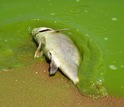
Fish suffocated in the Lake Erie algae bloom of August,2011.
Fish suffocated in the Lake Erie algae bloom of August, 2011.
Credit and Larger Version
A Lake Okeechobee algae bloom in the summer of 2016. Water discharge led to more downstream blooms.
Credit and Larger Version
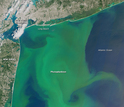
A huge algae bloom happened off the Atlantic coast in August, 2015.
Credit and Larger Version
A large algae bloom off the Pacific Northwest coast occurred in July, 2014.
Credit and Larger Version
The National Science Foundation (NSF)
Guillermo Gonzalo Sánchez Achutegui
ayabaca@gmail.com
ayabaca@hotmail.com
ayabaca@yahoo.com
Inscríbete en el Foro del blog y participa : A Vuelo De Un Quinde - El Foro!

miércoles, 18 de julio de 2012

Agriculture: Scientists Develop New Carbon Accounting Method to Reduce Farmers' Use of Nitrogen Fertilizer

Hi My Friends: A VUELO DE UN QUINDE EL BLOG., t's summer. For many of us, summer is a time synonymous with fresh corn, one of the major field crops produced in the United States.

Agricultural crops are studied in experiments at NSF's Kellogg Biological Station LTER site.

Credit: Julie Doll, NSF KBS LTER Site


Download the high-resolution JPG version of the image. (4.3 MB)

Dawn breaks over fields, some fertilized, some not, at the KBS site.

Credit: Julie Doll, NSF KBS LTER Site


Download the high-resolution JPG version of the image. (7.2 MB)
Where does nitrogen fertilizer go? Studies of crops hold answers.

Credit: Julie Doll, NSF KBS LTER Site


Download the high-resolution JPG version of the image. (2.8 MB)

 Scientists Develop New Carbon Accounting Method to Reduce Farmers' Use of Nitrogen Fertilizer

Large amounts of nitrogen fertilizer lead to nitrous oxide, a greenhouse gas, in the atmosphere
It's summer. For many of us, summer is a time synonymous with fresh corn, one of the major field crops produced in the United States.
In 2011, corn was planted on more than 92 million acres in the U.S., helping the nation continue its trend as the world's largest exporter of the crop.
Corn is a nitrogen-loving plant. To achieve desired production levels, most U.S. farmers apply synthetic nitrogen fertilizer to their fields every year.
Once nitrogen fertilizer hits the ground, however, it's hard to contain and is easily lost to groundwater, rivers, oceans and the atmosphere.
"That's not good for the crops, the farmers or the environment," says Phil Robertson, a scientist at Michigan State University and principal investigator at the National Science Foundation's (NSF) Kellogg Biological Station (KBS) Long-Term Ecological Research (LTER) site.
KBS is one of 26 such NSF LTER sites across the United States and around the globe in ecosystems from forests to coral reefs.
Nitrogen lost to the environment from agricultural fields is nitrogen not used by crops, Robertson says. "This costs farmers money and degrades water and air quality, with significant health, biodiversity and downstream economic effects."
Farmers already manage fertilizer to avoid large losses. But, to reduce losses further, it currently costs more money than the fertilizer saves.
Robertson and colleagues are working on a way to help make the time and expense of efforts to mitigate fertilizer loss worthwhile. They're putting the finishing touches on a program that would pay farmers to apply less nitrogen fertilizer in a way that doesn't jeopardize yields. The program, called the nitrous oxide greenhouse gas reduction methodology, is being conducted in partnership with the Electric Power Research Institute.
"This project is a great example of how long-term, fundamental research can contribute practical solutions to important environmental problems of concern in the U.S.--and ultimately around the world," says Matt Kane, an NSF program director for LTER.
In the United States, agriculture accounts for almost 70 percent of all nitrous oxide emissions linked with human activity. Nitrous oxide is one of the major gases contributing to human-induced climate change; it has a lifetime in the atmosphere of more than 100 years. In addition, a molecule of nitrous oxide has more than 300 times the heat-trapping effect in the atmosphere as a molecule of carbon dioxide.
In soils, the production of nitrous oxide through microbial activity is a natural process. By applying large amounts of fertilizer, however, humans have greatly increased the amount of nitrous oxide in soils. This is particularly true when nitrogen fertilizer is added in larger amounts than the crop needs, and when it is applied at times or in ways that make it difficult for the crop to get the full benefit.
"Improving the efficiency of nitrogen use for field crop agriculture holds great promise for helping mitigate climate change," Robertson says.
The nitrous oxide greenhouse gas reduction methodology, which is a way for farmers to participate in existing and emerging carbon markets, recently was approved by the American Carbon Registry and is in its final stages of validation by the Verified Carbon Standard--two carbon market standards that operate worldwide.
When farmers reduce their nitrogen fertilizer use, they can use the methodology as a means of generating carbon credits. These credits can be traded in carbon markets for financial payments.
The scientific underpinning for the methodology rests on decades of research Robertson and colleagues have conducted at the KBS LTER site.
"By closely following nitrous oxide, crop yields and other ecosystem responses to fertilizers," Robertson says, "we discovered that nitrous oxide emissions increase exponentially and consistently with increasing nitrogen fertilizer use."
The idea of the methodology is to offer ways of using less fertilizer to produce crops. But if farmers apply less fertilizer, will their crop production take a hit?
"Carbon credits provide an incentive to apply fertilizer more precisely, not to reduce yields," says Robertson. "If yields were reduced significantly, the climate effect would be nil because a farmer somewhere else would have to use more nitrogen to make up the yield loss, thereby generating more nitrous oxide."
The new methodology developed at NSF's KBS LTER site was successfully used by a Michigan farmer in Tuscola County as part of a proof-of-concept project.
"A major value of the approach is that it is straightforward to understand and implement," says KBS LTER scientist Neville Millar, who co-led development of the methodology.
In addition to providing an economic incentive, the methodology is a tool farmers can apply to enhance their land stewardship.
"The same strategies that farmers can use to minimize nitrous oxide loss will act to reduce the loss of nitrate to groundwater and loss of other forms of nitrogen to the atmosphere," says Millar.
Adam Diamant, technical executive at the Electric Power Research Institute and a co-developer of the methodology, says the new approach resulted in a "quadruple win: for farmers, for industrial organizations that may be required to reduce their greenhouse gas emissions, for the atmosphere and for water quality from the upper Midwest all the way to the Gulf of Mexico."
Adds Robertson: "We're in uncharted territory with a growing global human population and unprecedented environmental change.
"Performing the research that links environmental benefits to environmental markets, without compromising crop yields, is crucial for feeding more people while sustaining Earth's ecosystems."
-NSF-
Media Contacts Cheryl Dybas, NSF (703) 292-7734 cdybas@nsf.gov
Related WebsitesNSF LTER Network: http://www.lternet.edu
NSF Kellogg Biological Station LTER Site: http://lter.kbs.msu.edu/
The National Science Foundation (NSF) is an independent federal agency that supports fundamental research and education across all fields of science and engineering. In fiscal year (FY) 2012, its budget is $7.0 billion. NSF funds reach all 50 states through grants to nearly 2,000 colleges, universities and other institutions. Each year, NSF receives over 50,000 competitive requests for funding, and makes about 11,000 new funding awards. NSF also awards nearly $420 million in professional and service contracts yearly.
 Get News Updates by Email 
Useful NSF Web Sites:
NSF Home Page: http://www.nsf.gov
NSF News: http://www.nsf.gov/news/
For the News Media: http://www.nsf.gov/news/newsroom.jsp
Science and Engineering Statistics: http://www.nsf.gov/statistics/
Awards Searches: http://www.nsf.gov/awardsearch/
Guillermo Gonzalo Sánchez Achutegui
ayabaca@gmail.com 
ayabaca@hotmail.com 
ayabaca@yahoo.com
 Inscríbete en el Foro del blog y participa : A Vuelo De Un Quinde - El Foro!

Mi lista de blogs