Over time, nutrients such as nitrogen affect important marsh bacteria
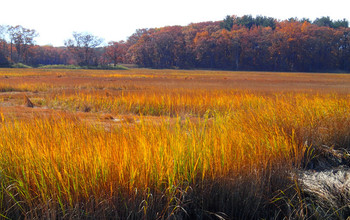 Sunset over a salt marsh at Plum Island, Massachusetts, as autumn arrives. Credit and Larger Version |
September 26, 2016
The following is part 22 in a series on the National Science Foundation's Long-Term Ecological Research (LTER) Network. Visit parts one, two, three, four, five, six, seven, eight, nine, 10, 11, 12, 13, 14, 15, 16,17, 18, 19, 20 and 21.
Could the future of a salt marsh be hidden in the health of its microbes? Scientists say yes.
Salt marshes play key roles in reducing the effects of urbanization and climate change. Marshes absorb carbon dioxide from the atmosphere, and their microbes break down carbon.
That's why researchers are working to find out how these vital ecosystems tick.
Jennifer Bowen of Northeastern University and colleagues have studied microbes in the sediments of salt marshes in the National Science Foundation (NSF) Plum Island Ecosystems Long-Term Ecological Research (LTER) site in northeastern Massachusetts.
They're working to discover how the marsh -- and the microbes in it -- change over time when outside influences, such as nitrogen, are introduced to the ecosystem.
"A lot of the ecological services salt marshes provide are facilitated by microbes," Bowen said. "They're involved in the carbon cycle and the nitrogen cycle, and they remove nutrient pollution through their metabolic processes."
Dormant microbes
In a new paper published in the journal Nature Communications, Bowen and her Northeastern colleague Patrick Kearns, who is first author of the paper, along with researchers at the Marine Biological Laboratory and Woods Hole Oceanographic Institution, set out to discover what would happen to microbes in salt marshes if specific nutrients were added to the environment -- through urbanization and climate change, for example.
Adding nutrients like nitrogen produced no change in the types of bacteria present in the salt marsh -- at least, temporarily. But over time, a large number of the microbes became dormant.
"It's kind of like a bear going into hibernation," Bowen said. "These dormant bacteria are in a low metabolic state. They just bide their time until environmental conditions return that are suitable for them."
When the microbes go dormant, they don't contribute to the critical ecosystem services that make salt marshes important.
Human-salt marsh interactions
"This study shows that human activities are affecting bacteria essential to salt marshes in ways we never suspected," said Matt Kane, program director in the NSF Division of Environmental Biology, which co-funded the research with NSF's Division of Ocean Sciences. "Coastal salt marshes provide many benefits -- supporting diverse wildlife, helping to reduce pollution, and protecting us from flooding."
What happens to salt marshes and their bacteria, Kane explained, ripples into human lives.
The study's results help explain why salt marshes contain so much microbial diversity. One group of microbes is specialized for a specific set of conditions, while another is linked with others. As the environment changes, different bacteria take advantage of the conditions that are most suitable to them.
"These investigators have made an important discovery about the resilience of microbial communities in salt marsh ecosystems," said David Garrison, program officer in NSF's Ocean Sciences Division.
A salt marsh, the researchers say, is a constant balancing act.
"If we see an increase in the abundance of bacteria that are able to decompose the marsh, we also see an increase in bacteria that can help fix carbon," Bowen said. "If a marsh is failing, there is no way to restore the microbes. But what can be created is an environment that will help these microbes thrive."
To save the marshes, she said, save their microbes.
| -- | Cheryl Dybas, NSF (703) 292-7734 cdybas@nsf.gov |
| -- | Lori Lennon, Northeastern University (617) 373-7686 l.lennon@northeastern.edu |
Investigators Jennifer Bowen
Related Institutions/Organizations University of Massachusetts Boston
Related Awards #1353140 Collaborative Research: Ecosystem Evolution and Sustainability of Nutrient Enriched Coastal Saltmarshes
Total Grants $220,177
Related WebsitesNSF Plum Island Ecosystems LTER Site:
https://lternet.edu/sites/pie
NSF Long-Term Ecological Research discovery articles series: https://www.nsf.gov/discoveries/disc_summ.jsp?cntn_id=138170

The Plum Island marsh expanse in summer at low tide.
Credit and Larger Version

Researcher Patrick Kearns fills tubes of mud to look at microbes' responses to nutrients.
Credit and Larger Version

Low tide in the marsh, with "Frank the Tank," a nutrient delivery system, in the background.
Credit and Larger Version

Patrick Kearns samples salt marsh sediments from West Creek on Plum Island.
Credit and Larger Version

Researchers take a break from field sampling in Plum Island's salt marshes.
Credit and Larger Versión
the National Science Foundation (NSF)
Guillermo Gonzalo Sánchez Achutegui
ayabaca@gmail.com
ayabaca@hotmail.com
ayabaca@yahoo.com
Inscríbete en el Foro del blog y participa : A Vuelo De Un Quinde - El Foro!


